Showing posts with label Covent Garden. Show all posts

Sunday, May 08, 2022

THREE ASHTON BALLETS: SCÉNES DE BALLET / A MONTH IN THE COUNTRY / SYMPHONY: Ashton's Enduring Legacy

Sir Frederick Ashton had a life as packed with incident as one of his ballets.  Born in Ecuador to British parents, he did not move to England until he was 15 to a public school to learn a trade.  He was miserable there as he had already seen what he wanted to be his future: he had seen Anna Pavlova dance and was desperate to be a dancer but his family refused to contemplate it.  His father commited suicide when Fred was 20 and, despite his mother and sister joining him in London, he followed his dream and was accepted as a pupil by two former Ballets Russes stars Leonide Massine and later by Marie Rambert.  As well as all these influences, he had also seen the iconic Isadora Duncan dance.

By 1930 Ashton had been encouraged by Rambert to concentrate on choreography and he worked for her company Ballet Club which morphed into Ballet Rambert.  In 1935, after working with her on several production, Ashton joined another former Ballet Russes star Ninette de Valois as her company choreographer.  So Ashton was well placed when, after WWII, de Valois' company was invited to form the new ballet company at Covent Garden Opera House, the company that ten years later were granted the title The Royal Ballet.  Two years after moving to Covent Garden Ashton created SCÉNES DE BALLET (1948) to music by Igor Stravinsky.

Against a surreal background, the short piece still holds the attention with Ashton's pioneering geometric choreography, the dancers' sharp staccato movements and the arresting although slightly dated costume colours of yellow, black, purple and blue.  The lead performances by Yasmine Naghadi and Reece Clarke were fine.

De Valois stood down as director in 1963 and Ashton took over.  Although no fan of administration his tenure continued to build The Royal Ballet's fame but when the CEO David Webster stood down in 1970 he wanted a whole new creative team to take over so Ashton was forced to stand down too which was an upset to him.  Sir Fred still created the occasional ballet including his narrative masterpiece A MONTH IN THE COUNTRY (1976)

We had seen A MONTH IN THE COUNTRY in 2019 and it remains a remarkable adaptation of Turgenev's play.  Natalia Petrovna rules her country home with a charming grace, adored by her husband Ysiaev, son Kolia, her ward Vera and close friend Rakitin.  Her life is changed however when her son's new tutor arrives, handsome student Baliaev.  He returns Natalia's affections but when Vera discovers them together, she jealously alerts the whole family to their romance; Baliaev leaves and Natalia is left with her lovelorn feelings.

Peggy Ashcroft told Ashton that his version was better than the original play and at only 40 minutes it whips along. Ashton's clean, classic tone and economic story-telling shine and his choreography allows moments for the cast to stand out such as Liam Boswell's solo as Kolya.  It is a haunting cameo of a ballet, perfectly matched to a selected score by Chopin.  William Bracewell was a passionate Baliaev and Isabella Gasparini was fine as Vera.  But the heart of the ballet was the remarkable Natalia Osipova - her poise and elegance changed by sudden love ending up crushed, slowly walking towards an uncertain future.  

In 1980, Sir Fred aged 76 was invited to devise a short piece to celebrate The Queen Mother's 80th birthday and he produced RHAPSODY to music by Rachmaninoff.  As Mikhail Baryshnikov was a guest artist with The Royal Ballet, the male lead role is certanly more showier than the female partner, originally danced by Lesley Collier.  Ashton had used the music before in Vincente Minnelli's film STORY OF THREE LOVES but devised new choreography for this commission.  

Baryshnikov missed the start of rehearsals so Ashton perfected the female lead's solos and the ensemble of 6 male and 6 female dancers.  When he arrived Baryshnikov was disappointed that his movements were in the brash "Russian style" and not the more nuanced English style that Ashton had created but he threw himself into it.  Here it was a perfect fit for Steven McRae's bravura style although it was still an edge-of-seat performance as it is only 7 months since his return to the stage where he tore his tendon during a performance in MANON which took two years to heal.  Anna Rose O'Sullivan was a delightful partner but Steven's astonishing leaps and sheer panache made him the focus of attention throughout; it ended with a lovely "That's all" pose which won him cheers to the Faberge egg-style roof.

Sir Fred died eight years after RHAPSODY's creation, his place in the history of dance assured and his legacy of work lives on vibrantly in the company he helped form.


Thursday, November 04, 2021

L'HEURE EXQUISE at The Linbury & ROMEO AND JULIET at Covent Garden

As you know Constant Reader, my final pre-lockdown theatre trip was to see the late Liam Scarlett's SWAN LAKE at Covent Garden so how odd it was to visit it again twice in as many days; a bit wary but we did it.  The main reason was to see two favourite dancers who illuminate The Royal Ballet company.

The first was a ballet amuse-bouche, only 70 minutes, but what a remarkable 70 minutes!  It was Maurice Béjart's L'HEURE EXQUISE from 1998, a dance adaptation of Samuel Beckett's HAPPY DAYS.  Becket without the words?  It sounds a stretch but the ballerina playing 'She' does speak occasionally, enough at least to put the piece into some context.

Actually I like HAPPY DAYS so I found it enjoyable but missed the profound quality that the play has: Winnie finds her life shrinking: buried up to her waist in earth but still able to apply her make-up, play with her parasol, sort through her capacious handbag - sure in the knowledge that the gun she has could be used in the last resort = and all the time chatting away to her husband Willie, just out of sight to her.  But all changes in the second half as she is now buried up to her neck, all she can access are her memories, but Willie is still there and she remembers the words to their love song "The Merry Widow waltz".

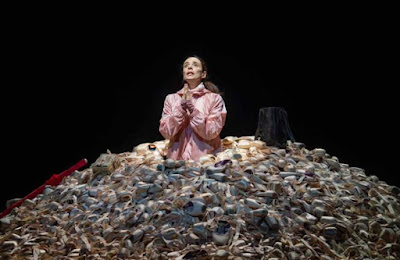
In L'HEURE EXQUISE, Winnie is now named She, an aging ballerina buried up to her waist in her old ballet shoes and as she chatters away to her partner He, she remembers her career.  Luckily for the audience, the mound of shoes parts and we watch She as she recalls dancing as a child to reaching success, dancing many roles and seemingly ending up in a vaudeville routine - all the time helped and hindered by He as her father / dance partner / manager.  Only three dancers have danced the role professionally: the late Carla Fracci who originated it, Maina Gielgud and now Ferri (under Gielgud's staging).

Ferri chose this to celebrate her 40th anniversary with The Royal Ballet which is no small achievement in the life of a ballet dancer - even one who is a prima ballerina assoluta.  In the 120+ years since the first assoluta was named there have only been thirteen dancers granted that title: there are three still living but only Ferri remains dancing.  She is simply glorious; when she dances you believe every gesture, every movement - she is an actress without needing words but here she handled both with ease.  She was partnered by Carsten Jung, ex-principal with the Hamburg Ballet.

Our second visit was to see the return to the Covent Garden stage of our favourite male dancer Steven McRae, it was a performance that we needed to see...  On 16th October 2019, we were overjoyed to see him on stage at Covent Garden again, after nearly two years injured.  We were nearly at the end of the 2nd Act of Kenneth MacMillan's MANON and McRae was dancing alone on the stage: two leaps, two pirouhettes - then he froze for a few seconds, and hopped into the wings as the curtains closed but not before hearing chilling, unforgettable howls of pain.  Kevin O'Hare, Director of the Royal Ballet, appeared onstage to confirm Steven was injured and would be replaced for the rest of the performance.

It later transpired that he had endured a full rupture of his Achilles tendon and we followed his slow, determined rehabilitation back to full dancing strength and here we were, two years after that ghastly night, to see him dance again.  Could he?  Would he?  

A massive cheer greeted his first appearance and as wonderful as it was to see him again, we were on the edge of our seats right up to the last chords of Prokofiev's score, but he absolutely triumphed.  Giving us a Romeo of passion and verve, Steven was greeted with an enormous ovation at the end. 

It must have been very special for him to share his return with his frequent stage partner Sarah Lamb who emotionally pushed him forward to take a solo bow and joined in the rapturous applause for him. Sarah Lamb was an exquisite Juliet, her grace and elegance turned by her secret love into determination and ultimately devastation.  What a marvellous partnership they have on stage!

MacMillan premiered ROMEO AND JULIET in 1965 with the iconic pairing of Margot Fonteyn and Rudolph Nureyev but it wasn't meant to be them.  He had created the roles for the younger Christopher Gable and Lynn Seymour but they were demoted to the second cast when demands for box-office names for the subsequent US tour won out - Gable and Seymour even had to help teach the more famous pair their roles due to time constraints in rehearsals.

The unhappy situation resulted in MacMillan leaving The Royal Ballet the following year but returned to be it's artistic director from 1970 to 1977 when he became it's principal choreographer until his death backstage during a revival of his MAYERLING in 1992.  Along with his other great works, ROMEO AND JULIET has remained in the repertoire and is still a glorious creation, it grips from the start with a thrilling choreographed sword fight in the city square which results in five bodies piled up centre-stage; in McMillan's Verona, danger is only a hair's breath away.

John B Read's lighting and the original evocative set design by the late Nicholas Georgiadis are still wonderful while McMillan's truly thrilling choreography is staged this time by Christopher Saunders and Laura Morera. Sergei Prokofiev's score sounded excellent played by the Opera House orchestra under the baton of Koen Kessels.

There was good support from James Hay and Bennet Gartside as Mercutio and Tybalt, Christopher Saunders was also a controlling Lord Capulet partnered by Elizabeth McGorin as Lady Capulet and Kristen McNally's bustling Nurse.  The night we saw it marked the 514th performance of MacMillan's masterpiece: here's to many more - and welcome back Steven!


Saturday, April 18, 2020

DVD/150: TOSCA (Jonathan Kent / Jonathan Haswell, 2011)

A wonderful opportunity to see again Jonathan Kent's thrilling production of TOSCA at The Royal Opera House, Covent Garden.


I first saw Puccini's opera at the English National Opera but it's Jonathan Kent's ROH production that I have now seen twice.


TOSCA made it's London debut in 1900 at Covent Garden and Puccini's tragic, headstrong heroine has appeared practically every year since then, apart from during the World Wars.


We follow one day in the lives of diva Floria Tosca, her Republican lover Caravadossi and their nemesis Chief of Police Scarpia in the dangerous atmosphere of Rome, 1800 as Napoleon's army advances.


Kent's production plays like a runaway train with the late Paul Brown's sumptious sets and costumes, and Mark Henderson's atmospheric lighting adding wonders.


In Jonathan Haswell's film, Tosca is vibrantly sung by Angela Gheorghiu, Jonas Kaufmann is an impassioned Caravadossi and Bryn Terfel is a deliously evil Scarpia.


Shelf or charity shop?  A definite keeper to relive the passion and the pure emotion of Puccini's score in Jonathan Kent's thrilling production.  A special mention must go to the glorious playing of the Royal Opera House orchestra under the baton of Antonio Pappino.

Tuesday, March 17, 2020

SWAN LAKE at the Opera House Covent Garden - Swansong...

The Royal Ballet's big Spring presntation was scheduled to be the first revival of Liam Scarlett's SWAN LAKE; we saw it in 2018 and wanted to see it again as our favourite dancer Steven McRae was finally due to dance the lead role of Prince Siegfried.  Back in 2018 he was recovering from an injury so we saw William Bracewell instead.  But last October, we were in the audience when, while dancing des Grieux in MANON, Steven snapped his tendon onstage and he is still recovering, so again we saw a replacement, this time Federico Bonelli.

Devil Works: 1


This revival, while being well-reviewed and successful at the box office - hey it's SWAN LAKE!! - has yet appeared under a cloud as Liam Scarlett, instead of reaping the benefits of this revival of the Tchaikovsky classic, was suspended in January by the Royal Ballet for allegations of sexual misconduct which are still ongoing.

Devil Works: 2

This is all a shame as Scarlett's production - here staged by the Royal Ballet's Director Kevin O'Hare - is a wonderful, sweeping version of the 1895 Imperial Ballet, his choreography building on the legendary work of Marius Petipa and Lev Ivanov as well as the Neopolitan dance by Sir Frederick Ashton.  Unlike the museum piece that the Bolshoi Ballet presented a few years back, Scarlett's version seems vivid and new.  There are even overtones of Matthew Bourne's version when at the end Siegfried carries Odette's body towards us while behind him she appears floating illuminated behind the backdrop.


With the romantic design by John Macfarlane and moody lighting by David Finn still proving a triumph, we again had Akane Takada dancing Odette / Odile and, while I still feel her to be a bit antiseptic, she still dances with a fluidity of movement, like the ripples on her swan's lake.  It would be good to see one of the other female soloists do it such as Sarah Lamb or Natalia Osipova.

There was exquisite support from the ever-whirling James Hay as Benno, Kristen McNally as the Queen who realises too late the error of her ways, and the always hissable Thomas Whitehead as the nasty Von Rothbart.


Of course one must also praise the wonderful corps de ballet for the always dazzling work they do as Odette's swans - shaping and re-shaping themselves into dazzling groups, they are always an arresting sight.  We were lucky to have in the cast Itziar Mendizabal as one of the pairing of lead swans and a special shout-out to Gina Storm-Jensen for her dazzling Spanish dancer.

The Royal Opera House Orchestra as usual got the biggest ovation under the baton of Koen Kessels.  The night we saw it danced marked the 1,032nd performance of SWAN LAKE at Covent Garden and I am so glad we saw it again - I even had an icy tear trickle down my cheek at the end which has never happened before, unlike the Bourne version which has me full of sobs. 


But now what?  I cannot recommend you see it as thanks to the Coronavirus pandemic, Covent Garden as well as all other theatres has closed for an indefinite period.  Who knows how many months I will be robbed of that unique experience of alchemy between performer and audience.

Devil Works: 3

Somehow The Bard - as usual - sums up the moment best:


The rest is silence...


Friday, December 13, 2019

COPPÉLIA at Covent Garden - like clockwork...

In the last four years, since being swept away by The Royal Ballet's WOOLF WORKS, we have seen most of the famous ballets in the canon but one has only just been revived so I can finally tick COPPÉLIA off the list.


Léo Delibes' ballet premiered in 1870, with a libretto by Charles-Louis-Étienne Nuitter based on two stories by ETA Hoffmann, at the Paris Opera and was a big success but it's success was halted by the Franco-Prussian war and the concomitant siege of Paris by Prussian troops.  The severe food shortages that followed cost many Parisians their lives, one of which was 17 year-old Giuseppina Bozzacchi who had danced the female lead.

in 1884 Marius Petipa staged a production for the Russian Imperial Ballet which was hugely successful; in 1894 it was revived by Petipa's assistants Lev Ivanov and Mario Cecchetti and it was this production which has formed the basis for most Western productions down the years.  The original Imperial Ballet production 'bible's were smuggled out of Bolshevik Russia by Nicholas Sergeyev who staged a production with Ninette de Valois' Vic-Wells Theatre Company at Sadler's Wells in 1933.


In 1947 de Valois' ballet company became the permanent dance company at Covent Garden - eventually being named the Royal Ballet - and in 1954 she choreographed her own version based on these Imperial Ballet originals, and here we are, some 65 years later, and it is back in the Royal Ballet's repertoire after a decade away.  I am glad I saw it finally but while entertaining enough, it really doesn't hold up to too intense scrutiny.

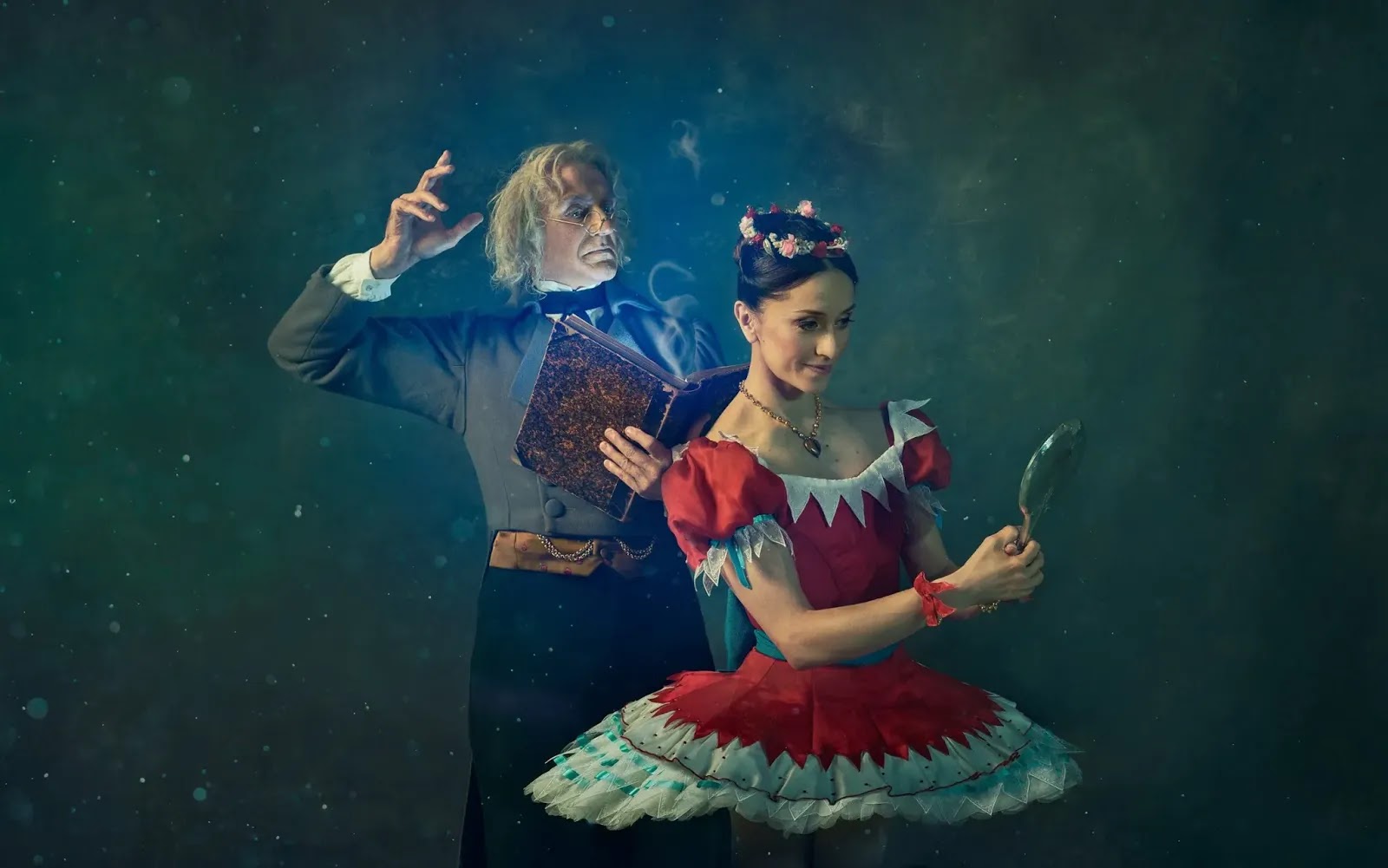
In a small German town Swanhilda and Franz are to be married at an upcoming festival but Franz has been noticeably distracted by Coppélia, an impossibly beautiful woman who sits reading in the window of the mysterious Dr Coppelius' house and workshop.  Coppelius loses his house keys and, on finding them, Swanhilda sneaks into the house with her friends to investigate - closely followed by Franz climbing up a ladder!


Once inside they discover Coppelius has made life size clockwork dolls to keep himself company - and Coppélia is one of these.  Coppelius returns; Swanhilda hides behind a curtain with her mechanical rival just as Franz climbs through the window.  Coppelius wishes his dream doll to become alive and drugs Franz in an attempt to steal his soul for her, but Swanhilda breaks the spell by emerging in Coppélia's clothes.  The old man is delighted his creation has come to life but is left in despair when he realizes it's a trick when Swanhilda and Franz escape.  Cue a happy ending in the town square...

There are dark areas in the plot which could be explored - Franz' speed at falling in love with another girl, the eerie workshop of mechanical people who come to life when Swanhilda investigates, Coppelius' wish to kill Franz for his soul, and his sadness when he discovers Coppélia did not come to life - but none of it is really explored and all one is left with is the folksy aspects of the fairy tale.


To be honest I found de Valois' choreography to be fairly uneventful - pretty but hardly memorable - but Delibes's music was lovely and this production is blessed with Francesca Hayward's spirited and fun Swanhilda, Alexander Campbell's bouncy Franz and Gary Avis excelling as Coppelius, not too far from his memorable performance as Drosselmeyer in THE NUTCRACKER only this time he does not have a cloak to swirl around.

I am sure the Royal Ballet have found in COPPÉLIA a good substitute for their Christmas perennial THE NUTCRACKER and I am glad I have finally seen it but I suspect I will not be wanting to see it again.


Saturday, November 23, 2019

THE SLEEPING BEAUTY at Covent Garden - Wakey Wakey!

I think we were very brave returning to Covent Garden as our last visit to The Royal Ballet saw us witness the heartbreak of Steven McRae injured mid-performance during MANON.  Happily  I can report that we counted all the dancers onto the stage and we counted them all off safely.  More importantly, it was a real pleasure to see THE SLEEPING BEAUTY again, still a jewel in the RB's crown.


It has been around for such a long time that quite a few names can claim some ownership of it.  Originally created in 1890 by legendary Russian choreographer Marius Petipa, his original Imperial Ballet production 'bible's were smuggled out of Bolshevik Russia by Nicholas Sergeyev who staged his own production at Sadler's Wells in 1939.

In 1947 Ninette De Valois' Sadler's Wells Ballet company were given the honour of becoming the permanent dance company at Covent Garden - which had been a dance hall during WWII! - and she decided that, to match the building coming back to life, her first production would be Petipa's THE SLEEPING BEAUTY with picture-book designs by Oliver Messel.


De Valois' production stayed in the repertoire for over 20 years then several new productions replaced it until the Dame's was brought back, redirected by then-Royal Ballet Director Monica Mason with Christopher Newton, in 2006 to celebrate the Royal Ballet's 75th Anniversary and it has stayed ever since; however it has since interpolated certain choreographed contributions from Sir Frederick Ashton, Sir Anthony Dowell and Christopher Wheeldon.

As I said it is still going strong - we saw it's 910th performance - but again I find it strange to be seeing a production that is relatively the same as has been done for years; no matter how acclaimed a theatre production, they are rarely revived after more than a year.  It would be nice if someone could look at the tired 'pantomime' actions between the dances; it does rather turn into dance for the deaf with the gesticulations for beauty, sleep etc.


As I said Steven McCrea was injured during the run of MANON so Prince Florimund was danced by Reece Clarke and Akane Takada was off too so Aurora was danced by Fumi Kaneko who really rose to her challenge of the famous Rose Adagio, a dazzling display of movement, balance and stillness as Aurora dances with four visiting princes.

There was fine support from the marvellous Itziar Mendizabal dancing the role of The Lilac Fairy exquisitely, Christine Arestis was very boo-able as the Wicked Fairy Carabosse, and a special mention for James Hay as the always leaping and spinning Bluebird in the finale.  Tchaikovsky's remarkable music sounded lustrous under the baton of Simon Hewitt.


I had been in two minds about seeing THE SLEEPING BEAUTY when it was obvious that Steven McRae would not be dancing but I am glad I did - the many artists who worked down the years to make it created a legendary classic.


Saturday, October 26, 2019

MANON at Covent Garden - High drama, emotion and tears - and a ballet too

It had been an evening I was looking forward to for several reasons: first to see again Kenneth MacMillan's dark and dangerous MANON which we first saw last year, and secondly we were finally to see the wonderful Steven McRae dancing the male lead of des Grieux as he was returning from injury.


Abbé Prévost published his novel of Manon Lescault in 1731 only to have the print run banned because of it's sexual subject but pirated copies made it hugely popular.  In the 20th Century it inspired seven silent and sound films, four operas, a Japanese musical and two ballets!  Kenneth MacMillan choreographed his for the Royal Ballet in 1974, the critics disliked it but the audiences loved it and here we are 45 years later and it is still in the repertoire.

MacMillan wanted his new creation to show off not only the Royal Ballet principals but to also showcase the ensemble, and MANON certainly does that.  It also gave him another chance to explore the presentation of dangerous, corrupted love through dance.  The score was commissioned by MacMillan from composer / conductor Leighton Lucas, compiled from works by Jules Massenet and it is a remarkable achievement as it does sound like a unified piece.


Young Manon, on her way to a convent, arrives at a Parisian tavern to meet her brother Lescault.  He notices a passenger watching her so Lescault escorts him inside to arrange a meeting.  Outside, Manon meets student des Grieux and it's love at first sight.  They flee but another rich man, Monsieur GM, approaches Lescault and offers him a reward for Manon.  They track the lovers to their lodgings and Manon chooses Monsieur's diamonds over des Grieux's love.  The four meet again at a debauched party and Manon lets des Grieux know she still loves him. Monsieur discovers des Grieux cheating him at cards and again the lovers flee but Monsieur appears with police to arrest Manon as a prostitute and he shoots Lescault in anger.  Deported to New Orleans as a prostitute, a lecherous gaoler attempts to rape Manon, but des Grieux, who has followed her to America, kills him and again they flee... but in the swamps of Louisiana their love reaches it's tragic climax.

Partnered with Akane Takada's well-danced but colourless Manon, Steven McRae provided his brand of vivid, charismatic dancing as des Grieux and it was a joy to see him back onstage after an injury-strewn year and a half.  He partially tore his Achilles tendon at the start of 2018 which nearly ended his dance career and at the start of this year he injured his knee on the set of the upcoming film of CATS.  All in all, we missed four productions he was due to appear in so seeing him back on the Covent Garden stage for the first time in nearly a year was a joy.


The lights came up for the last scene of the Second Act; Des Grieux has rescued the wayward Manon from the corrupt clutches of Monsieur but is unaware that his rival is closing in.  Alone on stage, McRae executed two small gazelle leaps and two relatively small pirouettes then stretched up... froze for a second or two... then limped into the wings with his right leg raised.  After a moment or two a stage manager came on and asked us for a moment while they sorted out a problem.  The curtains were quickly brought in but not before we, his shocked audience, could hear Steven's heartbreaking wails from backstage.

Kevin O'Hare, the Director of The Royal Ballet, appeared to tell us what we all suspected, that Steven had sustained an injury and would not be able to complete the performance.  Reece Clarke who had just appeared as a guest in the party scene was able to play des Grieux for the final scene of Act II and all of Act III.


The show continued and Clarke has to be applauded for stepping in at such short notice and be able to focus on his own performance knowing that everyone's minds were obviously elsewhere. Congratulations too for Akane Takada who had only 30 minutes to recalibrate her performance to partner the taller Clarke who has a different style of McRae - needless to say both received a big ovation at the curtain.

Any difficulty in emotionally engaging with MANON's relentlessly shallow characters is enveloped in the glorious sweep of MacMillan's vision, recreated here by Julie Lincoln.  Manon's world is still wonderfully realized by the late Nicholas Georgiades' designs; the design suggests that behind the opulent world that Manon aspires to is desperate poverty and danger where people can be discarded if they overstep their class or usefulness.


The supporting characters were all performed by the same dancers from last year and were still excellent: James Hay as Lescault was well-partnered in his drunken pas de deux by Yuhui Choe as his mistress, Thomas Whitehead was very hissable as Monsieur and Kristen McNally gave the procuress a suitably decadent panache.  I am really glad I saw MacMillan's masterpiece again but I wish it had been under happier conditions.

Steven McRae's injury was diagnosed as a full Achilles tendon rupture and he will have surgery in the week starting 28th October.  He is the king of positivity but at 33 he must have worries about his future.  Hopefully the operation and recovery will be successful and we can see this magical dancer for a few years more.  Steven posted the pictures of him and Akane Takada rehearsing the famous pas-de-deux from Act III which he did not get to perform on the night which is a shame as it looks amazing.

All best wishes Steven!