Showing posts with label Lev Ivanov. Show all posts

Tuesday, March 17, 2020

SWAN LAKE at the Opera House Covent Garden - Swansong...

The Royal Ballet's big Spring presntation was scheduled to be the first revival of Liam Scarlett's SWAN LAKE; we saw it in 2018 and wanted to see it again as our favourite dancer Steven McRae was finally due to dance the lead role of Prince Siegfried.  Back in 2018 he was recovering from an injury so we saw William Bracewell instead.  But last October, we were in the audience when, while dancing des Grieux in MANON, Steven snapped his tendon onstage and he is still recovering, so again we saw a replacement, this time Federico Bonelli.

Devil Works: 1


This revival, while being well-reviewed and successful at the box office - hey it's SWAN LAKE!! - has yet appeared under a cloud as Liam Scarlett, instead of reaping the benefits of this revival of the Tchaikovsky classic, was suspended in January by the Royal Ballet for allegations of sexual misconduct which are still ongoing.

Devil Works: 2

This is all a shame as Scarlett's production - here staged by the Royal Ballet's Director Kevin O'Hare - is a wonderful, sweeping version of the 1895 Imperial Ballet, his choreography building on the legendary work of Marius Petipa and Lev Ivanov as well as the Neopolitan dance by Sir Frederick Ashton.  Unlike the museum piece that the Bolshoi Ballet presented a few years back, Scarlett's version seems vivid and new.  There are even overtones of Matthew Bourne's version when at the end Siegfried carries Odette's body towards us while behind him she appears floating illuminated behind the backdrop.


With the romantic design by John Macfarlane and moody lighting by David Finn still proving a triumph, we again had Akane Takada dancing Odette / Odile and, while I still feel her to be a bit antiseptic, she still dances with a fluidity of movement, like the ripples on her swan's lake.  It would be good to see one of the other female soloists do it such as Sarah Lamb or Natalia Osipova.

There was exquisite support from the ever-whirling James Hay as Benno, Kristen McNally as the Queen who realises too late the error of her ways, and the always hissable Thomas Whitehead as the nasty Von Rothbart.


Of course one must also praise the wonderful corps de ballet for the always dazzling work they do as Odette's swans - shaping and re-shaping themselves into dazzling groups, they are always an arresting sight.  We were lucky to have in the cast Itziar Mendizabal as one of the pairing of lead swans and a special shout-out to Gina Storm-Jensen for her dazzling Spanish dancer.

The Royal Opera House Orchestra as usual got the biggest ovation under the baton of Koen Kessels.  The night we saw it danced marked the 1,032nd performance of SWAN LAKE at Covent Garden and I am so glad we saw it again - I even had an icy tear trickle down my cheek at the end which has never happened before, unlike the Bourne version which has me full of sobs. 


But now what?  I cannot recommend you see it as thanks to the Coronavirus pandemic, Covent Garden as well as all other theatres has closed for an indefinite period.  Who knows how many months I will be robbed of that unique experience of alchemy between performer and audience.

Devil Works: 3

Somehow The Bard - as usual - sums up the moment best:


The rest is silence...


Friday, December 13, 2019

COPPÉLIA at Covent Garden - like clockwork...

In the last four years, since being swept away by The Royal Ballet's WOOLF WORKS, we have seen most of the famous ballets in the canon but one has only just been revived so I can finally tick COPPÉLIA off the list.


Léo Delibes' ballet premiered in 1870, with a libretto by Charles-Louis-Étienne Nuitter based on two stories by ETA Hoffmann, at the Paris Opera and was a big success but it's success was halted by the Franco-Prussian war and the concomitant siege of Paris by Prussian troops.  The severe food shortages that followed cost many Parisians their lives, one of which was 17 year-old Giuseppina Bozzacchi who had danced the female lead.

in 1884 Marius Petipa staged a production for the Russian Imperial Ballet which was hugely successful; in 1894 it was revived by Petipa's assistants Lev Ivanov and Mario Cecchetti and it was this production which has formed the basis for most Western productions down the years.  The original Imperial Ballet production 'bible's were smuggled out of Bolshevik Russia by Nicholas Sergeyev who staged a production with Ninette de Valois' Vic-Wells Theatre Company at Sadler's Wells in 1933.


In 1947 de Valois' ballet company became the permanent dance company at Covent Garden - eventually being named the Royal Ballet - and in 1954 she choreographed her own version based on these Imperial Ballet originals, and here we are, some 65 years later, and it is back in the Royal Ballet's repertoire after a decade away.  I am glad I saw it finally but while entertaining enough, it really doesn't hold up to too intense scrutiny.

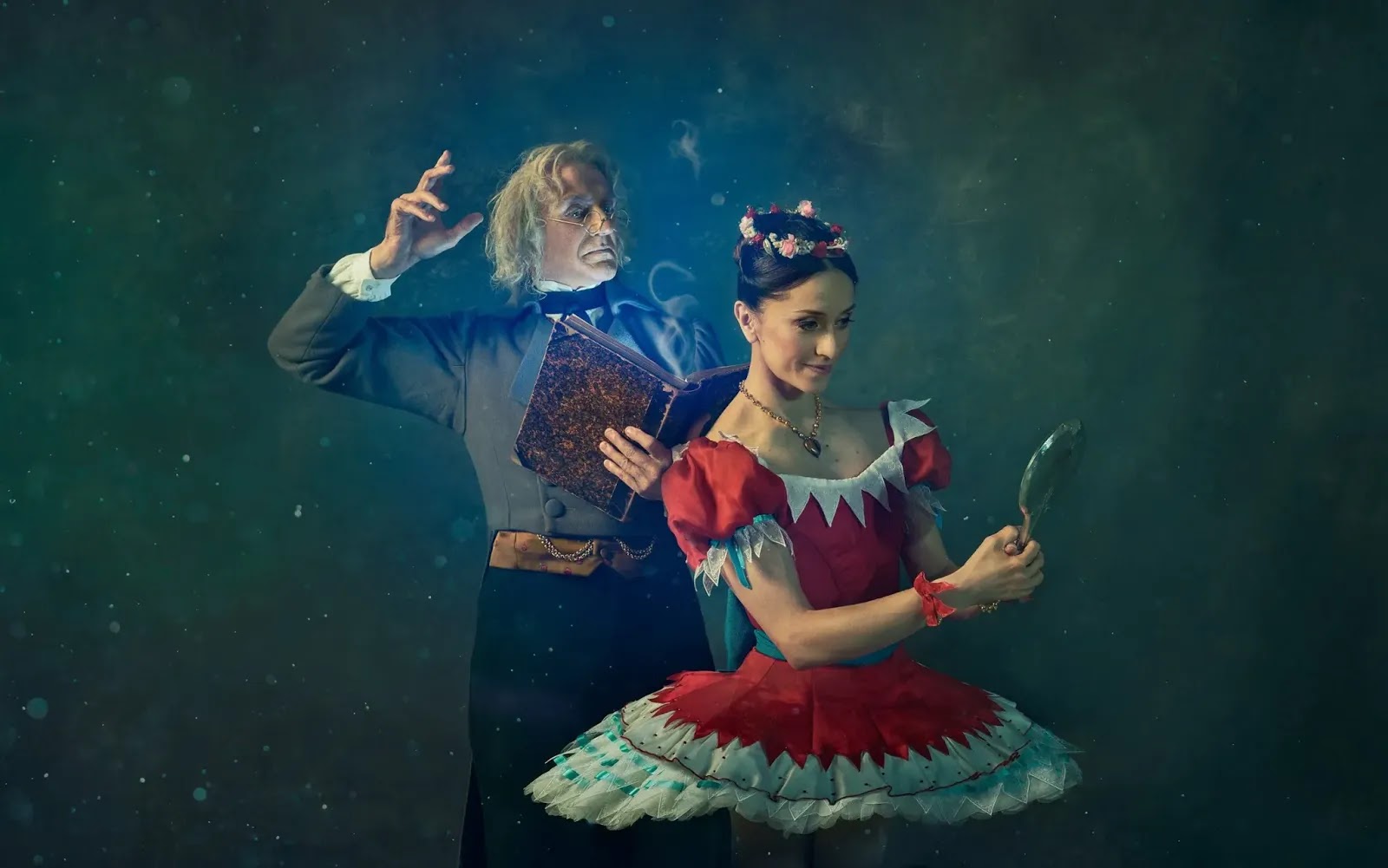
In a small German town Swanhilda and Franz are to be married at an upcoming festival but Franz has been noticeably distracted by Coppélia, an impossibly beautiful woman who sits reading in the window of the mysterious Dr Coppelius' house and workshop.  Coppelius loses his house keys and, on finding them, Swanhilda sneaks into the house with her friends to investigate - closely followed by Franz climbing up a ladder!


Once inside they discover Coppelius has made life size clockwork dolls to keep himself company - and Coppélia is one of these.  Coppelius returns; Swanhilda hides behind a curtain with her mechanical rival just as Franz climbs through the window.  Coppelius wishes his dream doll to become alive and drugs Franz in an attempt to steal his soul for her, but Swanhilda breaks the spell by emerging in Coppélia's clothes.  The old man is delighted his creation has come to life but is left in despair when he realizes it's a trick when Swanhilda and Franz escape.  Cue a happy ending in the town square...

There are dark areas in the plot which could be explored - Franz' speed at falling in love with another girl, the eerie workshop of mechanical people who come to life when Swanhilda investigates, Coppelius' wish to kill Franz for his soul, and his sadness when he discovers Coppélia did not come to life - but none of it is really explored and all one is left with is the folksy aspects of the fairy tale.


To be honest I found de Valois' choreography to be fairly uneventful - pretty but hardly memorable - but Delibes's music was lovely and this production is blessed with Francesca Hayward's spirited and fun Swanhilda, Alexander Campbell's bouncy Franz and Gary Avis excelling as Coppelius, not too far from his memorable performance as Drosselmeyer in THE NUTCRACKER only this time he does not have a cloak to swirl around.

I am sure the Royal Ballet have found in COPPÉLIA a good substitute for their Christmas perennial THE NUTCRACKER and I am glad I have finally seen it but I suspect I will not be wanting to see it again.


Wednesday, June 27, 2018

SWAN LAKE at Covent Garden - Scarlett's swans take off...

This December I will see my fifth production of Matthew Bourne's SWAN LAKE at Sadler's Wells and I am sure I will blub again at the last scene, it gets me every time.  But three years ago, after we had our Paulean conversion to the Royal Ballet, we decided it was time to see a 'classic' production of Tchaikovsky's masterpiece.

In 2016 we saw the visiting Bolshoi production, and what a disappointment that was!  Technically proficient yes, but danced with no sense of emotion or connection to the audience - it felt like they turned up for work and did their job, no more no less.  So the news that the Royal Ballet were going to stage a new production by Liam Scarlett set us off... finally a chance to see it done properly.


The night we went marked the 1,026th performance of SWAN LAKE at Covent Garden and Scarlett's version has replaced Anthony Dowell's production which had lasted in the repertoire for thirty years!  As I have frequently mentioned, it is jaw-dropping how long productions run in the ballet and opera houses of London - can you imagine the idea of the National Theatre only ever staging revivals of productions from the 1980s and 1990s?

But SWAN LAKE goes even further back, because - as is the case with practically all productions - it is based on the version staged by Marius Petipa and Lev Ivanov for the Imperial Ballet in 1895.  The main body of the ballet is theirs: Petipa's choreography is used for the palace scenes, the famous lake side scene is Ivanov's while Scarlett has devised a new final scene as well as the featured dances for the visiting princesses - apart from the Neapolitan princesses dance which is by Sir Frederick Ashton!  With all these choreographic strands to be woven together, Scarlett has said that his biggest challenge is to make it flow together as if from a single vision - and he succeeded; it was a thrilling production.


With the romantic design by John Macfarlane and moody lighting by David Finn, Scarlett's production swept you up in the swirling drama of Tchaikovsky's monumental score and the oft-told tale of Prince Siegfried who, when ordered to marry by his imperious mother The Queen, falls in love with the beautiful Odette who is under the spell of the wicked magician Von Rothbart who has disguised himself as The Queen's chief courtier.

Odette is transformed from a swan into a woman only at night but Siegfried is tricked at a sumptuous palace ball by the sorcerer into proposing to the mysterious Odile who resembles Odette.  As soon as he does, Odette is doomed to remain a swan forever but can Siegfried save Odette in time?  Of course it ends unhappily but this only makes Tchaikovsky's score all the more powerful and all-encompassing.


The biggest ovation of the evening was for the orchestra, under the baton of Valery Ovsyanikov, which filled the auditorium with the full grandeur of Tchaikovsky's score

Originally we had booked on this particular night to see Steven McRae dance the role of Siegfried but a recent leg injury put paid to that so instead we saw William Bracewell who performed the role well enough but it did not stop me thinking how much more thrilling McRae would have danced the love-lorn prince.  Akane Takada danced the dual role of Odette / Odile, but while her Odette was a graceful, captivating presence I felt she missed out on the seductive danger of Odile.  I will long remember though her slowly rippling arms showing the exact moment that Odette transforms back into the Swan.


Thomas Whitehead added yet another villain to his collection as the hissable Von Rothbart, Kristen McNally was an imposing presence as The Queen while Marcelino Sambé hit all the right notes as Benno, Siegfried's friend, in particular with his dazzling leaps.  SWAN LAKE of course allows the ballerinas of the company to shine and they were glorious as the elegant, ever-watchful swans.

A special mention to the tripping cygnets danced by Isabella Gasparini, Elizabeth Harrod, Meaghan Grace Hinkis and Romany Pajdak, while Itziar Mendizabal was on eye-catching form as the Spanish princess and a special mention to the whirling excitement of Olivia Cowley as the Spanish dancer attended by Reece Clarke, Téo Dubreuil, Fernando Montano and Giacomo Rovero.


I suspect this production will be visited again in years to come; I now look forward to seeing the Matthew Bourne version with new eyes in December at Sadler's Wells.


Tuesday, December 29, 2015

The NUTCRACKER at Covent Garden - Christmas can start officially now!

How better to end the year of New Cultural Events (namely opera and ballet) than with a visit to Covent Garden to see a classic Royal Ballet production of Tchaikovsky's perennial favourite THE NUTCRACKER.


Warning to any diabetics - this production could endanger your health as the Sugar Plums rule!  My only previous experience of the piece is through Matthew Bourne's own take on it NUTCRACKER! which i have always enjoyed but now I am more au fait with dance it was time to be able to put that production in context next to the original.  Step forward the Royal Ballet with their 1999 production choreographed by Peter Wright after Lev Ivanov's original 1892 choreography.

As I have said before, it's remarkable that ballet companies can have productions that hark back to the original production of the piece.  How many theatre directors would like to direct UNCLE VANYA that was modelled on Stanislavski's original?  However there is certainly something in having a lineage to draw on and this production, here staged by Christopher Carr, is already in it's eleventh revival.


The production is simply enchanting, radiating warmth and goodwill like a particularly large glass of mulled wine.  Helped immeasurably by the late Julia Trevelyan Oman's designs, Wright's take on the story has the magician Drosselmeyer mourning that his nephew has been transformed by an enemy into a nutcracker, as you do!  His chance to undo the spell comes with a Christmas invitation to a family where he gives the nutcracker to the young daughter Clara.

Her love for the nutcracker releases the spell but not before Clara and the nephew defeat the nasty mouse king and his army after being shrunk by the magician.  He could have made it easier surely by keeping them human-sized!  Their reward is to be spirited away to the Kingdom of Sweets to meet the Sugar Plum Fairy and her Prince and be entertained by divertissements organised by Drosselmeyer.  On their return to the real world, Clara runs out of her house and bumps into a young man who looks strangely familiar, he in turn, hurries to Drosselmeyer's house where he is happily reunited with his uncle.


Peter Wright's spin on the story makes for a delightful fairy tale and Christopher Carr's staging made it as light as spun sugar on whipped cream.  It whizzed along like a top and this was in no small measure due to the excellent cast.  It was a particular delight to see a proper corps in the impossibly lovely Dance of the Snowflakes.

Gary Avis was very good as the magician Drosselmeyer, he has played it for a few years now and he twirled his vivid blue cape with panache.  Francesca Hayward was delightful as Clara, dancing with a sweet elegance and she was well partnered by Alexander Campbell as her energetic beloved nutcracker-made-real.  A special mention too for Olivia Cowley as the sinuous lead dancer in the Arabic speciality number.


The biggest treat of all was to see the show on the night that the Sugar Plum royalty were being danced by Iana Salenko and Steven McRae who we have seen previously as the lovers in THE TWO PIGEONS and as ROMEO AND JULIET.  In their solos and in their pas de deux both were excellent, elegant, graceful and with innate musicality but also dazzling in their speed around the stage and their controlled strength.

As I said, in a year of discovering the Royal Ballet in particular, what a delight to end on the magical high with this production of the NUTCRACKER and as I said, finally having a mental companion piece to Matthew Bourne's version.