Showing posts with label Giacomo Puccini. Show all posts

Saturday, April 18, 2020

DVD/150: TOSCA (Jonathan Kent / Jonathan Haswell, 2011)

A wonderful opportunity to see again Jonathan Kent's thrilling production of TOSCA at The Royal Opera House, Covent Garden.


I first saw Puccini's opera at the English National Opera but it's Jonathan Kent's ROH production that I have now seen twice.


TOSCA made it's London debut in 1900 at Covent Garden and Puccini's tragic, headstrong heroine has appeared practically every year since then, apart from during the World Wars.


We follow one day in the lives of diva Floria Tosca, her Republican lover Caravadossi and their nemesis Chief of Police Scarpia in the dangerous atmosphere of Rome, 1800 as Napoleon's army advances.


Kent's production plays like a runaway train with the late Paul Brown's sumptious sets and costumes, and Mark Henderson's atmospheric lighting adding wonders.


In Jonathan Haswell's film, Tosca is vibrantly sung by Angela Gheorghiu, Jonas Kaufmann is an impassioned Caravadossi and Bryn Terfel is a deliously evil Scarpia.


Shelf or charity shop?  A definite keeper to relive the passion and the pure emotion of Puccini's score in Jonathan Kent's thrilling production.  A special mention must go to the glorious playing of the Royal Opera House orchestra under the baton of Antonio Pappino.

Tuesday, June 11, 2019

TOSCA at Covent Garden - Up On The Roof...

The current score?  English National Opera 1 - Royal Opera 2


So after first seeing TOSCA onstage in 2016 performed by the ENO, we have now seen it at Covent Garden twice in Jonathan Kent's wonderfully fluid and thrilling production.  Yes I know what happens in the end but that's really not the point.  It's being there and experiencing Puccini's huge score played live by the Royal Opera House Orchestra, seeing singers belting out their passions while having your emotions wrung out to dry.

TOSCA had premiered in Rome only six months before it was first performed in London at the Opera House in 1900 and our tragic, headstrong heroine has swept across it's stage practically every year since then, only taking a break when the theatres closed at the outbreak of the World Wars.


Giacomo Puccini insisted that the original Sardou play be stripped by his librettist to the bare minimum, nothing was to distract from the main characters' triangular relationship of fate, namely the diva Floria Tosca and her Republican lover Caravadossi who fall foul to the machinations of chief of police Scarpia in the tinderbox atmosphere of Rome in summer, 1800 as Napoleon's army advances.

Jonathan Kent's 2006 production has been restaged by Andrew Sinclair but the production now stands as a tribute to the designer Paul Brown who died in 2017.  His wonderful designs for TOSCA have an epic quality to them - his Act 1 Sant'Andrea della Valle chapel is wonderfully realized especially in the Te Deum scene, with the front-stage occupied by Scarpia in the gloomy chapel while above and behind it, the main church is ablaze with light as a mass is sung to celebrate the alleged defeat of Napoleon.


The Act 2 palazzo apartment for Scarpia is dominated by a huge statue of a conquering figure with drawn sword which, of course, mirrors the later action where Tosca kills Scarpia - although when she sings her magnificent aria "Vissi d'arte", it's huge size dwarfs her to mirror the supplicating song she is singing.  Brown's Act 3 battlements for the Castel Sant'Angelo are stark and dramatic; after the cluttered and claustrophobic sets, here Tosca and Caravadossi can, for a few minutes at least, sing their love to the heavens with the wind in their hair.

Mark Henderson's lighting was as wonderfully evocative as ever: the Act 1 Te Deum performed in a blaze of light in the main church while Scarpia plots in the shadows of the chapel, the end of Act 2 with the pinpoints of candle-light in Scarpia's palazzo room and then the barely noticeable change from night to grey dawn in Act 3.  Something I had never noticed before is Puccini's use of the bells of Rome which seem to toll all over the city to proclaim the dawn; this is achieved by having sets of bells set up all along the backstage area to get the suitable sound of church-bells near and far and with different tones.  It is wonderfully effective and of course added to the magnificent soundscape provided by the orchestra under the baton of Alexander Joel.


There was a mighty intake of breath before the start when the curtains opened to reveal a woman with a hand-mike; she said that Kristine Opolais (Tosca) and Vittorio Grigolo (Carravadossi) were suffering from colds - "GROAN" said the audience - however they both were still going to perform and asked forgiveness for any shortcomings - "HURRAY" said the audience.

You would never know they were suffering as they both gave full-throated performances as our troubled lovers with both hitting their peak at the right time - Opolais with a heart wrenching "Vissi d'arte" and Grigolo with a spellbinding "And The Stars Shone" both of which were rewarded with huge ovations and lusty cries of 'Brava' (no, it wasn't me doing that!)  Bryn Terfel was a deliciously nasty Scarpia, commanding the stage with great presence and lampshade-rattling vocal power.


TOSCA will be back at Covent Garden next summer; I can get my fix by watching the Royal Opera House's 2012 DVD of Jonathan Kent's production... but... you never know...


Friday, February 16, 2018

TOSCA at Covent Garden - Love and Death in Rome...

In 2016, after seeing a marvellous English National Opera production, we had left the Coliseum wondering "Wow, what would TOSCA be like if done by the Royal Opera?"  Well I know now...  Wow!


TOSCA made it's London debut at Covent Garden in 1900 and Puccini's tragic, headstrong heroine has swept across it's stage practically every year since then, interestingly the only two noticeable breaks were in the periods during the two World Wars.

Giacomo Puccini and his librettist clashed during it's writing as the composer wanted to strip back Sardou's original play, cutting his five-act drama to three acts; Puccini succeeded and the opera is remarkable in it's through-line - cutting through the usual operatic padding to tell the tragic tale of the diva Floria Tosca and her Republican lover Caravadossi who fall foul to the machinations of chief of police Scarpia in the tinderbox atmosphere of Rome in summer, 1800 as Napoleon's army advances..


Jonathan Kent's production was first seen in 2006 and again I find it remarkable that his theatre productions from that era are lost in time but his opera production is still seen 12 years on.  Be that as it may, Kent rose to the challenge excellently; he said at the time "What I admire about it, quite apart from the thrilling music, is its theatre craft ... It's a taut, sinewy melodrama, exquisitely put together. There isn't an ounce of flesh on it ... That's what interested me: to find a way within that hurtling narrative to examine the relationships and its themes of sex, power and death".

Sadly the production now stands as a tribute to the designer Paul Brown who died last November.  His wonderful designs for TOSCA have an epic quality to them - his Act 1 Sant'Andrea della Valle chapel is wonderfully realized especially in the Te Deum scene, with the front-stage occupied by Scarpia in the gloomy chapel while above and behind it, the main church is ablaze with light as a mass is sung to celebrate the alleged defeat of Napoleon.


His Act 2 palazzo apartment for Scarpia is dominated by a huge statue of a conquering figure with drawn sword which, of course, mirrors the later action where Tosca kills Scarpia, and his Act 3 battlements for the Castel Sant'Angelo were stark and dramatic - oddly enough I missed the huge sweeping wing across the top of the set which references the enormous statue of the avenging angel atop the building (I've been there you know!).

Mark Henderson's lighting was wonderfully evocative as well, particularly towards the end of Act 2 in the pinpoints of candle-light in Scarpia's palazzo room while the Covent Garden orchestra made Puccini's score come to resounding life under the baton of Dan Ettinger.


Canadian Adrianne Pieczonka played Tosca with a willful passion although I think the English National Opera's Keri Alkema edged her for performance.  However her singing of Tosca's great aria "Vissi d'arte" was quite lovely.  Maltese singer Joseph Calleja gave a robust performance as Caravadossi with an equally marvellous rendition of "And The Stars Shone" in the last act.  Gerald Finley from Canada was a very hissable Scarpia and fully deserved the panto boos he got at his curtain call!

I think I still have a way to go to fully appreciating opera but TOSCA is now a firm favourite.


Wednesday, July 19, 2017

TURANDOT at the Royal Opera House, Covent Garden - I didn't sleep!

Back to the Opera House, Covent Garden... but not for ballet!  Only three months after seeing Puccini's MADAMA BUTTERFLY on that marvellous stage, we were back to see the maestro's final opera TURANDOT,  yes... the one with *that* aria.


As soon as Giacomo Puccini committed to writing the opera in early 1920, he raced ahead of his librettists Giuseppe Adami and Renato Simoni and by December, when they delivered their first draft, the composer was drumming his fingers, eager to fit the music he had written into the plot line.  But the opera's birth was a protracted affair, with characters being re-written and the plot streamlined but in 1924 the opera looked completed.

However the ending of the story proved problematic and Puccini remained unhappy with the plot and his contribution to it, but his own final act was fast approaching; he was diagnosed in October with throat cancer and, unaware of the full extent of his illness, he died in pain one month later.  With TURANDOT still not completed, the task was given to composer Franco Alfano but the first attempt was rejected as too wide of what Puccini would have wanted and a shorter version was finally accepted.


However at the very first production at La Scala in 1926, the composer Toscanini stopped after the onstage death of the character Liu and addressed the audience that this was the last music composed by Puccini as the curtain fell.  However the subsequent performances included the Alfano ending and that is how the opera is performed.

TURANDOT made it's London debut the following year at Covent Garden and has played regularly ever since; the current production was first seen in Los Angeles in 1984 when the Royal Opera appeared at the Cultural Olympiad and we saw the 277th production of it!  Again I think it's remarkable - and somewhat alarming - how long productions stay in both the opera and ballet repertoires at Covent Garden.  I guess it shows how much new productions cost to stage...


That said, Andrei Serban's production (revived here by Andrew Sinclair) is wonderfully vivid and moves like a train through the simple plot: Calaf, the disguised Prince of Tartary is reunited with his deposed father King Timur who has only his slave girl Liu to look after him, needless to say Liu has always loved the Prince from afar.  They are reunited in Peking which is ruled by the beautiful Princess Turandot who has set a heavy price on any man who would marry her.

Like the Sphynx, the icy Turandot asks the men three impenetrable riddles and are summarily executed in public should they get the questions wrong; the Princess has sworn she will revenge the rape and murder of an earlier Princess in her dynasty on all men who would dare ask her to marry.  Needless to say Calaf falls immediately in love with Turandot and accepts the riddle challenge.  Amazingly he answers the riddles correctly and amid the crowd's jubilation, notices that Turandot remains unmoved.  He offers her a deal: if she can discover his real identity by dawn he will allow himself to be executed...


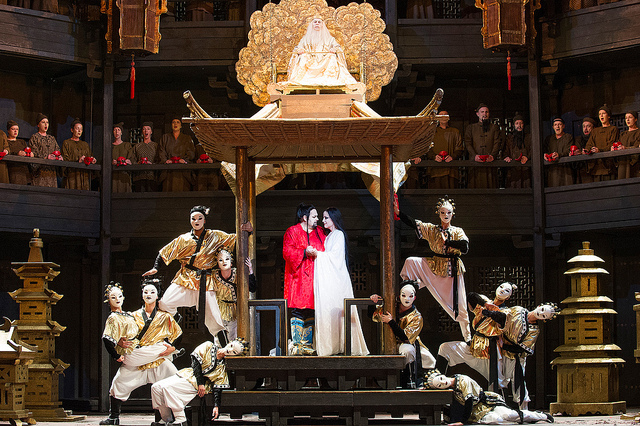
The story's bloodthirsty theme is playfully evoked by the set being littered and over-hung with large wooden heads showing all the men executed for failing the challenge, the bloody gore represented by long, trailing red ribbons.  The design by Sally Jacobs was a marvellous mix of the simple and the extravagant: the set was a curved two-storey wall which allowed the chorus to stand and watch the plot unravel, with occasional huge set-pieces like a dragon-festooned knife-grinder for the Executioner to ride around on, a pagoda for Calaf to rest during the long night before his possible-execution and a golden throne for the Emperor of Peking to descend from the heavens.

The Opera House orchestra sounded wonderful, making Puccini's ravishing music sweep you along in it's wake, the climax being - as it should be - the third act opener 'Nessun Dorma'.  It was marvellous to hear it in it's proper setting, presaged by a darkened stage being illuminated from behind the wall by light from the palace and large lanterns bobbing around Calaf's pagoda.  I didn't think I would be moved by the aria but I was, understanding it's place in the story-telling made it all the more special and it was excellently sung by Roberto Alagna as Calaf.  The odd thing being that it is so much a part of the story-telling that Calaf is interrupted as soon as he finishes belting out his final 'VincerĂ³'by three other characters... the urge to clap had to wait until the finale when the Nessun Dorma theme is reprised.


Lise Lindstrom was in imperious form as the icy Turandot but the biggest cheers were reserved for Aleksandra Kurzak as the tragic Liu, her two arias were beautifully sung and she gave her character a real personality which cannot be said for the others thanks to the basic shallowness of the libretto.  I also liked the trio of ministers Ping Pang and Pong who were well sung by Leon Kosavic, Samuel Sakker and David Junghoon Kim.

it's an odd opera, the rushed happy ending (for everyone but Liu and Timur) is not quite believable but Puccini's majestic and thrilling Chinese-influenced score is marvellous and the story, while thin, powers along.  Added to this, a production that is witty and spectacular and you have a real treat.  Now... let's find another Puccini...


Monday, April 10, 2017

MADAMA BUTTERFLY at Covent Garden: the long wait is over...

...for Butterfly and me!  Yes I have finally seen her opera.

Constant Reader, you are probably bored with my reiterating that in 2015 we decided to explore a more diverse cultural map which including those imposing monoliths opera and dance.  Dance was an immediate winner but opera has been a harder sell - a truly unmagical PETER PAN from Welsh National Opera put paid to that.  However we seem to have had a new plan of attack which is to see the Big Diva operas and so far they are paying off.  First was Verdi's LA TRAVIATA at the Opera House, then TOSCA at the English National Opera and now it's back to the welcoming plush of Covent Garden to see Puccini's MADAMA BUTTERFLY.


I've just noticed that these operas are all based on plays - maybe that should be the criteria for choosing ones to see?  It was only a stone's throw from the Opera House - at the more humble Duke of Yorks Theatre - that Puccini saw the original stage production in 1900.  He didn't understand what was being said but what connected with him was the intimate drama that was so powerfully staged by David Belasco who also wrote it.

A particular moment that struck Puccini was how Belasco had his lead actress sit still for over 10 minutes while lighting effects suggested the shift from night to day as Butterfly waits all through the night for her husband who does not appear - Puccini would later score this moment in his opera with an offstage choir providing the haunting "Humming Chorus".


Oddly enough, along with TOSCA and TRAVIATA, BUTTERFLY was not well received but the great composers were not precious about these things and after some judicious editing - changing it from a 3-act opera to a 2 act one - BUTTERFLY has fluttered down the years to be not just one of the most popular operas of all time but to also become an icon in other areas of performance: Mary Pickford and Anna May Wong played her in silent films while Helen Hayes played her in the sound era, Malcolm McLaren reinvented the aria 'Un Bel Di Vedremo' into his hip-hop classic "Madame Butterfly" and, of course, it was transposed to Vietnam for the bore-fest MISS SAIGON.

1900, Nagasaki: American sailor Lt Pinkerton marries a 15 year-old girl called Cio-Cio-San whose family have fallen on hard times after her father committed an honour suicide.  The US Consul Sharpless tries to stop Pinkerton from going through with the contract - arranged with the oily marriage broker Goro - but the Lieutenant has no qualms about saying he will get married 'properly' when he returns to America. After the ceremony, Cio-Cio-San's uncle appears to announce to her family that she has betrayed them by secretly becoming a Christian which causes them all to desert her, leaving her alone with her-seemingly loving husband.


Three years later, Cio-Cio-San waits unfailingly for Pinkerton to return as he left Japan soon after the marriage.  Cared for by faithful servant Suzuki, she fends off Goro who is trying to marry her off again and is visited by Sharpless who tells her that Pinkerton's ship is returning.  He also has a letter from Pinkerton telling Cio-Cio-San that he has brought with him his new American wife Kate but the Consul cannot break the news as she is so happy to hear of her husband's return and she surprises him with her 2 year-old son who Pinkerton knows nothing about; Cio-Cio-San stays up through the night just in case Pinkerton arrives home.

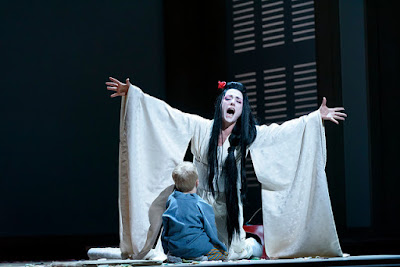
Suzuki entreats her to sleep in the morning so she misses the arrival of Sharpless with Pinkerton and Kate who are now aware of the existence of the son.  Pinkerton, overcome with shame, cannot face his first wife and it is left to Suzuki, Sharpless and Kate to persuade her that the marriage is over and to relinquish her son to be raised in America.  Cio-Cio-San realizes that her dream of love is over and agrees to hand over her son, but only to Pinkerton...  She leaves her son outside blindfolded and holding an American flag then retrieves one of her few possessions - her father's suicide dagger....


Now in it's 14th year, Moshe Leiser and Patrice Caurier's production was sleek and cool, maybe a bit too much to truly ignite the emotions in the piece, that was left to the unbridled passion of Puccini's score which sounded wonderful under the conducting of Antonio Pappano.

Albanian-born Ermonela Jaho was a tempest-tossed Cio-Cio-San and certainly sang her testing arias well, I just didn't feel particularly connected to her as a character.  Scott Hendricks as the put-upon Sharpless and Elizabeth Deshong as the faithful Suzuki were both excellent in their roles and Marcelo Puente played and sang the difficult role of the awful Pinkerton well.  The supporting performances of Carlo Bosi, Yuriy Yurchuk and Emily Edmonds as Goro, Prince Yamadori and Kate Pinkerton also stayed in the mind.


The performance was being shown live in cinemas on the night we went and I was only mildly disappointed that the filming in no way impinged on the actual show.  I was *hugely* disappointed instead by the shambolic scenes in the bar in the interval when 55 minutes was evidently not long enough for the bar staff to get the pre-paid interval drinks out properly.  Cue mulish attitude from the one bar staff assigned to fulfill the orders and me losing my rag at the petulant sod and the overbearing cow who was attempting to push in ahead of me.  Constant Reader, Mr Puccini's music calmed me down in the second half you will be pleased to hear...

I am really pleased to have finally seen MADAMA BUTTERFLY onstage in such a good production and hope the journey into appreciating the form will continue - next up is TURANDOT in July again at the Opera House... I can only hope that they keep the drama to the stage and not in the bar again!

Sunday, October 23, 2016

TOSCA at London Coliseum - lived for love, lived for art...

Our experiment in seeing new art forms in 2015 resulted in the success of ballet as a new favourite - 14 visits to see the Royal Ballet and the Bolshoi at Covent Garden testify to this.

But opera did not fare as well - the awful Welsh National Opera production PETER PAN seemingly put paid to that.  But this year we saw Richard Eyre's production of LA TRAVIATA at Covent Garden and that whetted our appetite for the classic Big Opera.  Last week we saw English National Opera's TOSCA at the London Coliseum... and I think the operatic penny might have dropped!


This is a revival of the 2010 production by Catherine Malfitano, herself an acclaimed Tosca during her singing career, and Donna Stirrup has directed it with a steady hand, at all times keeping the action focused on the three main characters.  In this she is aided by the clever sets of Frank Philipp Schlossman, Gideon Davey's costume design and David Martin Jacques' lighting, here re-created by Kevin Sleep.

I had a vague idea of the plot, knew that it contained the magnificent aria 'Vissi d'arte' and that it had a spectacular end so the journey to that famous climax was totally new for me - and what a wonderful dramatic story Puccini and his librettists Giuseppe Giacosa and Luigi Illica fashioned from the original play by Victorien Sardou.


1800:  With Rome in turmoil after the collapse of the French-backed republic, the jealous opera diva Floria Tosca is duped by the nasty chief of police Scarpia into thinking that her lover, the painter Mario Cavaradossi, has vanished with another woman when in reality he knows Mario is hiding an escaped republican prisoner.  The police follow her to Cavaradossi's hiding place and arrest him.  Cavaradossi is tortured in the room next to where Scarpia has had Tosca brought and to stop her lover's ordeal she reveals to Scarpia where the escaped prisoner is hiding.  Mario is due to be shot at dawn but Scarpia tells Tosca - who he is obsessed with - that he will arrange a 'fake' shooting if she sleeps with him. 

They hear that the escaped prisoner has killed himself, Tosca knows Scarpia will want revenge so agrees to his bargain but on the proviso that he sign a safe-conduct pass for her and Cavaradossi.  After Scarpia has signed the document, she stabs him to death singing "This is the kiss of Tosca".  On the roof of the Castel Sant'Angelo, Cavaradossi reflects that despite her actions, his love for Tosca was the greatest thing in his life.  She appears and tells him she has killed Scarpia, that the execution squad will fire blanks and coaches him on how to 'play dead' then they can escape. The soldiers appear and Tosca exults in their triumph of Scarpia.  However his is the final triumph as Mario is shot dead. She hears the clamour at the discovery of Scarpia's corpse and rather than be arrested, she throws herself from the parapet shouting "Scarpia... in the eyes of God".


The dramatic momentum of the plot in this production drives towards the famous climax with a powerful relentlessness, it's only on reflection that you realize that the action takes place within less than 24 hours.  What I also loved about the production was that, unlike most revivals, Malfitano did not set decide to impose a jarring 'concept' on the production - setting it in the Swinging 60s or in Dublin in 1916 (yes Globe Theatre I am looking at you...) but vaguely in period and allowing nothing to distract from the music and the performances.

Tosca was brought to magnificent life by American soprano Keri Alkema who was in splendid voice and certainly convinced as the imperious diva whose life would never be compromised.  Cavaradossi was well sung by Gwyn Hughes Jones especially his third act aria "And the stars shone" while Craig Colclough's Scarpia (or 'Shitface' as Owen re-christened him) was rewarded with ultimate accolade at his curtain call, yes he was loudly booed like a panto villain.


TOSCA has stayed with me since seeing it, in particular the sheer magnificence of Puccini's score, and I listened to a full recording while writing this to get into the mood.

She lived for art, she lived for love and she is one of the great tragic heroines of the stage.