Showing posts with label Francesca Hayward. Show all posts

Friday, December 13, 2019

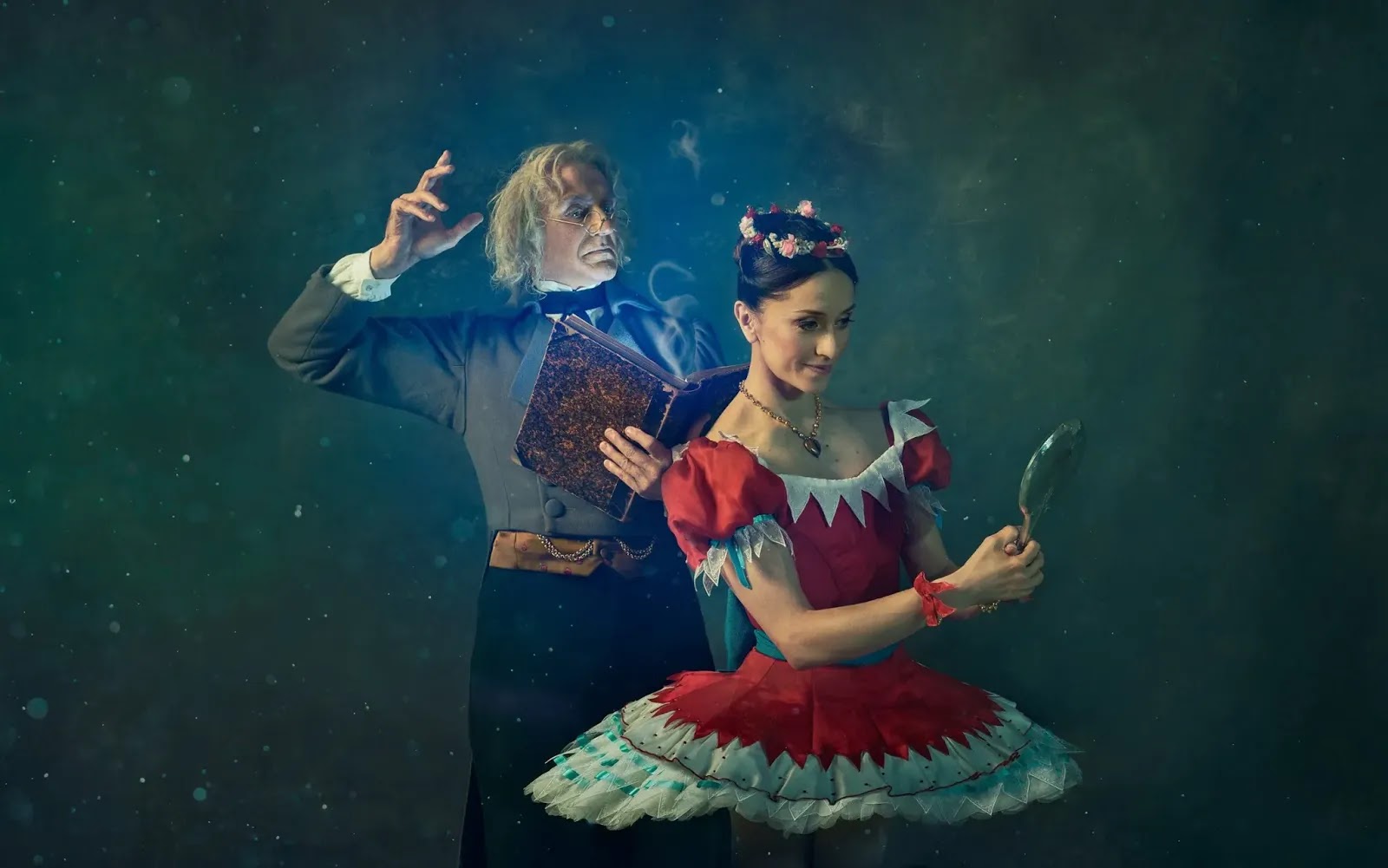
COPPÉLIA at Covent Garden - like clockwork...

In the last four years, since being swept away by The Royal Ballet's WOOLF WORKS, we have seen most of the famous ballets in the canon but one has only just been revived so I can finally tick COPPÉLIA off the list.


Léo Delibes' ballet premiered in 1870, with a libretto by Charles-Louis-Étienne Nuitter based on two stories by ETA Hoffmann, at the Paris Opera and was a big success but it's success was halted by the Franco-Prussian war and the concomitant siege of Paris by Prussian troops.  The severe food shortages that followed cost many Parisians their lives, one of which was 17 year-old Giuseppina Bozzacchi who had danced the female lead.

in 1884 Marius Petipa staged a production for the Russian Imperial Ballet which was hugely successful; in 1894 it was revived by Petipa's assistants Lev Ivanov and Mario Cecchetti and it was this production which has formed the basis for most Western productions down the years.  The original Imperial Ballet production 'bible's were smuggled out of Bolshevik Russia by Nicholas Sergeyev who staged a production with Ninette de Valois' Vic-Wells Theatre Company at Sadler's Wells in 1933.


In 1947 de Valois' ballet company became the permanent dance company at Covent Garden - eventually being named the Royal Ballet - and in 1954 she choreographed her own version based on these Imperial Ballet originals, and here we are, some 65 years later, and it is back in the Royal Ballet's repertoire after a decade away.  I am glad I saw it finally but while entertaining enough, it really doesn't hold up to too intense scrutiny.

In a small German town Swanhilda and Franz are to be married at an upcoming festival but Franz has been noticeably distracted by Coppélia, an impossibly beautiful woman who sits reading in the window of the mysterious Dr Coppelius' house and workshop.  Coppelius loses his house keys and, on finding them, Swanhilda sneaks into the house with her friends to investigate - closely followed by Franz climbing up a ladder!


Once inside they discover Coppelius has made life size clockwork dolls to keep himself company - and Coppélia is one of these.  Coppelius returns; Swanhilda hides behind a curtain with her mechanical rival just as Franz climbs through the window.  Coppelius wishes his dream doll to become alive and drugs Franz in an attempt to steal his soul for her, but Swanhilda breaks the spell by emerging in Coppélia's clothes.  The old man is delighted his creation has come to life but is left in despair when he realizes it's a trick when Swanhilda and Franz escape.  Cue a happy ending in the town square...

There are dark areas in the plot which could be explored - Franz' speed at falling in love with another girl, the eerie workshop of mechanical people who come to life when Swanhilda investigates, Coppelius' wish to kill Franz for his soul, and his sadness when he discovers Coppélia did not come to life - but none of it is really explored and all one is left with is the folksy aspects of the fairy tale.


To be honest I found de Valois' choreography to be fairly uneventful - pretty but hardly memorable - but Delibes's music was lovely and this production is blessed with Francesca Hayward's spirited and fun Swanhilda, Alexander Campbell's bouncy Franz and Gary Avis excelling as Coppelius, not too far from his memorable performance as Drosselmeyer in THE NUTCRACKER only this time he does not have a cloak to swirl around.

I am sure the Royal Ballet have found in COPPÉLIA a good substitute for their Christmas perennial THE NUTCRACKER and I am glad I have finally seen it but I suspect I will not be wanting to see it again.


Saturday, February 18, 2017

WOOLF WORKS Works On Stage, Screen And CD... Living the past again

Nearly two years ago, we took the plunge - in the year of trying new things artistically - and went to Covent Garden to see WOOLF WORKS, a new Royal Ballet production choreographed by Wayne McGregor.  I remember feeling some trepidation... Virginia Woolf is one of my favourite authors for whom language is the key so how can you silence that but still make it relevant?  Two words... Wayne McGregor.

As you can see from my blog it had a profound effect on us both and it did indeed start a continuing exploration of ballet which has been very rewarding.  But how would the first revival of WOOLF WORKS compare - and would it have the same impact?


I am happy to be able to say that it led to a deeper, richer understanding of the work but also there was the added bonus this year of seeing it on the big screen at the Curzon Mayfair and also being able to appreciate the depth of Max Richter's music with it's release on cd.

Onstage we were blessed with practically the same cast as in 2015, the only major replacement being Calvin Richardson and his breathtaking pirouettes dancing the role of 'Evans' for the unwell Tristan Dyer in the MRS. DALLOWAY-inspired 'I Now, I Then'.  The impact of seeing the company onstage was made even more exciting by seeing the same dancers a few days later on the live cinema screening, giving an opportunity to experience their talent closer than possible at the Opera House although there was some loss too, in particular the glorious digital stage image of the garden of Clarissa's imagined youth flooding the set.


McGregor has choreographed three ballets in distinct styles: 'I Now, I Then' is the most narrative; based on MRS DALLOWAY - and introduced with the only known recording of Virginia Woolf musing on the difficulty of using old English words in new ways - we see Clarissa Dalloway (sublime Alessandra Ferri) meeting old flame Peter Walsh (Gary Aves) and relives the glorious summer she spent as a teenager with Peter and her best friend, the free spirited Sally Seton, and how life seemed full of possibility and choice.  The younger selves were danced wonderfully by Francesca Hayward, Federico Bonelli and Beatriz Stix-Brunell.

As Clarissa is lost in memories of what could have been we also see Septimus Smith (the astonishing Edward Watson) who is tortured with the lasting trauma of shell-shock from his experience in the WWI trenches.  His wife Rezia (Akana Takada) tries to keep him engaged in life but he is lost in memories of his friend Evans (Richardson) who was killed before him.  It is a perfect fusion of performance, choreography, design by Cigué, lighting by Lucy Carter - the moment the stage was suffused with glowing red when Septimus danced with Evans was glorious - and, almost a character of it's own, Max Richter's heartbreaking, longing music.


The second act 'Becomings' takes ORLANDO as it's inspiration and is the most abstract of the pieces although during one of the intervals for the screened event Wayne McGregor was interviewed by hosts Darcey Bussell and Clemency Burton-Hill and said he believed that no dance can be truly abstract as the human element will always lend a dance a narrative sense.  Again Lucy Carter's lighting is thrilling: an overhead beam roams the dark stage picking out 12 dancers in varying degrees of glittering gold Elizabethan costumes before a cold laser beam illuminates two of them and we launch into McGregor's take on Woolf's exploration of gender fluidity.

As Richter's music roams from bone-crunching electro beats to minimal keyboard runs so McGregor's choreography changes from solos to duets to triple routines for his remarkable dancers - pushing their limbs into even more challenging shapes and attitudes; the exhilaration is in seeing male and female dancers fusing into just pure dance.  With each segment, they slowly lose their Elizabethan costumes until they are in shades of grey, all dancing in and out of four overhead spotlights, all individual but all unified, until the lights cut out and the auditorium is criss-crossed with shafts of laserlight.  Again the live screening was wonderful to showcase in detail the astonishing work of, among others, Sarah Lamb, Natalia Osipova, Steven McRae and Watson.


The final act is TUESDAY and takes it inspiration from THE WAVES but also references Woolf's suicide note written on Tuesday 25th March 1941, three days before she actually drowned in the River Ouse.  McGregor has the inspired choice of Gillian Anderson reading the wrenching suicide note while a slow-motion film of crashing waves shows on a stage-wide screen all but dwarfing the stationary figure of Ferri beneath.  Anderson's measured, hypnotic delivery leads you in to McGregor's slow meditation on love and loss, beautifully danced by Ferri and Federico Bonelli who are later joined by Sarah Lamb and an ensemble which also includes young students from the Royal Ballet School.

Ferri is astonishing in her poetry and control as she becomes the embodiment of Richter's dreamlike, ethereal music, solitary notes slowly coming together with Anush Hovhannisyan's soprano to wash over you with waves of strings and brass.  There was one moment that haunts me: Alessandra Ferri starts a solo movement against the ensemble's choreography who slowly, three or four at a time, echo her until they are all bending and stretching as one, it's breathtakingly beautiful.  Slowly the ensemble ebb away into the darkness at the back of the stage, as Bonelli lowers a prone Ferri onto the stage as the music slowly vanishes note by note...


As I have said, the live screening was a wonderful opportunity to see the dancers closer than possible in the theatre and there were the added extras of interviews with Wayne McGregor and Max Richter as well as Maggie Smith reading passages from THE WAVES as well as Virginia's memoir MOMENTS OF BEING.

As I have written this I have been able to relive the experience by playing the cd THREE WORLDS of Richter's score; I wondered if it would work separately from the experience of seeing it with the dancers but it works beautifully.  It has been great to be able to explore this work in depth for the past two weeks - I would love the opportunity to see it again.


Sunday, May 22, 2016

FRANKENSTEIN at Covent Garden - Frankenstein's at it again... this time on point!

Surely ice-skating is the only area of story-telling that has not been utilized to re-tell Mary Shelley's classic horror novel FRANKENSTEIN.  Since it's publication in 1818 it has been revisited, re-imagined, re-written, re-filmed... all a testament to Shelley's original idea of how man can be brought down through hubris and by his refusal to face the consequences of his actions.

However there is so much going on in her novel that any part of it can be picked on as a way to view the material.  And now it's latest incarnation is in a full-length production by the Royal Ballet at Covent Garden and I saw it's 5th performance last week - always nice to be able to say that, with Royal Ballet productions it's usually the 305th!


Liam Scarlett is the Royal Ballet's artist-in-residence and this is his first full-length production for the company and it was marvellous to watch due to Scarlett's firm grasp on the narrative allied to a genuinely thrilling score by American composer Lowell Liebermann.

Scarlett stays mostly true to Shelley's story, dropping the framing device of Victor Frankenstein recounting his tale to the captain of a ship that rescues him and also the abortive creation of a mate for the creature but adds his own new spin as a finale which works within the spirit of the text.


The genesis of the story is almost as famous as the novel itself.  In 1816, aged only 19, Mary Godwin, her lover Percy Shelley and Mary's half-sister Claire Claremont travelled across Europe to visit Claire's lover Lord Byron and his physician John Polidori in the rented Villa Diodati near Lake Geneva.  Bad weather kept them indoors and Byron suggested they all try writing scary stories.  Mary struggled with hers but a later talk about experiments in galvanization gave her the idea of a man attempting to revive a corpse - the fact that she was still grieving for her baby who had died only two months before must have influenced this idea.

The story both reflected and foreshadowed Mary's life which was shrouded with death: her mother Mary Woolstonecraft died a month after giving birth to her, three of her children with Shelley died young, her step-sister Fanny killed herself as did Shelley's abandoned wife Harriet, Shelley drowned at sea in 1822 and Mary herself died aged only 53 in 1851 from a suspected brain tumor.


Liam Scarlett's production also utilizes a moody set design from John Macfarlane and David Finn's exceptional lighting design, along with a mood-setting front cloth of a skull seen in profile which at the start of the second act turned to face the audience - wooo!  As I said it was all marvellous to watch but, on reflection, the most negligible thing about the show was Scarlett's choreography.

I am no balletomane but time and again I found myself wondering how many scenes of prancing maids and servants does the story of FRANKENSTEIN need?  There was also a puzzling tavern routine which sat in between the anatomy lecture-room scenes which did nothing to forward the story and seemed to be there only to give the female members of the corps a chance to whore it up. 


I can appreciate that Liam Scarlett wanted to make the character of Elizabeth more than just a typical horror story heroine but again, when you realize that you are watching yet another interminable pas-de-deux for her and Victor, then you know something is off-kilter.  I must say however that Sarah Lamb as Elizabeth danced the role well, full of grace and humanity.

What made me brew on this so strongly was that the final confrontation between Victor and his Creature must surely be the emotional climax of the show but here it just did not spark - was it because we had the Male Team B of Tristan Dyer as Victor and Ryoichi Hirano as the Creature?  The only thing I could compare it to was the end of Matthew Bourne's SWAN LAKE which, no matter the dancers, always delivers an emotional punch.


There were fine performances from Ethan Bailey as William, Victor's young brother who plays a fatal game of blind-man's-bluff with the Creature in one of the more suspenseful scenes, James Hay was good as Frankenstein's friend Clerval, the always good Itziar Mendizabel did what she could with the minimal opportunities she had as the housekeeper Madame Moritz while her tragic daughter Justine was danced well by Francesca Hayward.

Despite my issues with the choreography I am glad we saw the show and more than enjoyed living through the story - which is more than 8 of the main 10 characters do!  It's few remaining shows are sold out but hopefully it will rejoin the repertoire - maybe in 2018 to mark the novel's 200th anniversary?


In the same week, by some odd stroke of luck, we found we had booked a Horror Triple Bill at the theatre: FRANKENSTEIN, DOCTOR FAUSTUS at the Duke of Yorks and JEKYLL & HYDE at the Old Vic - who came out the winner?  Constant Reader, read on...

Tuesday, December 29, 2015

The NUTCRACKER at Covent Garden - Christmas can start officially now!

How better to end the year of New Cultural Events (namely opera and ballet) than with a visit to Covent Garden to see a classic Royal Ballet production of Tchaikovsky's perennial favourite THE NUTCRACKER.


Warning to any diabetics - this production could endanger your health as the Sugar Plums rule!  My only previous experience of the piece is through Matthew Bourne's own take on it NUTCRACKER! which i have always enjoyed but now I am more au fait with dance it was time to be able to put that production in context next to the original.  Step forward the Royal Ballet with their 1999 production choreographed by Peter Wright after Lev Ivanov's original 1892 choreography.

As I have said before, it's remarkable that ballet companies can have productions that hark back to the original production of the piece.  How many theatre directors would like to direct UNCLE VANYA that was modelled on Stanislavski's original?  However there is certainly something in having a lineage to draw on and this production, here staged by Christopher Carr, is already in it's eleventh revival.


The production is simply enchanting, radiating warmth and goodwill like a particularly large glass of mulled wine.  Helped immeasurably by the late Julia Trevelyan Oman's designs, Wright's take on the story has the magician Drosselmeyer mourning that his nephew has been transformed by an enemy into a nutcracker, as you do!  His chance to undo the spell comes with a Christmas invitation to a family where he gives the nutcracker to the young daughter Clara.

Her love for the nutcracker releases the spell but not before Clara and the nephew defeat the nasty mouse king and his army after being shrunk by the magician.  He could have made it easier surely by keeping them human-sized!  Their reward is to be spirited away to the Kingdom of Sweets to meet the Sugar Plum Fairy and her Prince and be entertained by divertissements organised by Drosselmeyer.  On their return to the real world, Clara runs out of her house and bumps into a young man who looks strangely familiar, he in turn, hurries to Drosselmeyer's house where he is happily reunited with his uncle.


Peter Wright's spin on the story makes for a delightful fairy tale and Christopher Carr's staging made it as light as spun sugar on whipped cream.  It whizzed along like a top and this was in no small measure due to the excellent cast.  It was a particular delight to see a proper corps in the impossibly lovely Dance of the Snowflakes.

Gary Avis was very good as the magician Drosselmeyer, he has played it for a few years now and he twirled his vivid blue cape with panache.  Francesca Hayward was delightful as Clara, dancing with a sweet elegance and she was well partnered by Alexander Campbell as her energetic beloved nutcracker-made-real.  A special mention too for Olivia Cowley as the sinuous lead dancer in the Arabic speciality number.


The biggest treat of all was to see the show on the night that the Sugar Plum royalty were being danced by Iana Salenko and Steven McRae who we have seen previously as the lovers in THE TWO PIGEONS and as ROMEO AND JULIET.  In their solos and in their pas de deux both were excellent, elegant, graceful and with innate musicality but also dazzling in their speed around the stage and their controlled strength.

As I said, in a year of discovering the Royal Ballet in particular, what a delight to end on the magical high with this production of the NUTCRACKER and as I said, finally having a mental companion piece to Matthew Bourne's version.