Showing posts with label Sergei Prokofiev. Show all posts

Thursday, November 04, 2021

L'HEURE EXQUISE at The Linbury & ROMEO AND JULIET at Covent Garden

As you know Constant Reader, my final pre-lockdown theatre trip was to see the late Liam Scarlett's SWAN LAKE at Covent Garden so how odd it was to visit it again twice in as many days; a bit wary but we did it.  The main reason was to see two favourite dancers who illuminate The Royal Ballet company.

The first was a ballet amuse-bouche, only 70 minutes, but what a remarkable 70 minutes!  It was Maurice Béjart's L'HEURE EXQUISE from 1998, a dance adaptation of Samuel Beckett's HAPPY DAYS.  Becket without the words?  It sounds a stretch but the ballerina playing 'She' does speak occasionally, enough at least to put the piece into some context.

Actually I like HAPPY DAYS so I found it enjoyable but missed the profound quality that the play has: Winnie finds her life shrinking: buried up to her waist in earth but still able to apply her make-up, play with her parasol, sort through her capacious handbag - sure in the knowledge that the gun she has could be used in the last resort = and all the time chatting away to her husband Willie, just out of sight to her.  But all changes in the second half as she is now buried up to her neck, all she can access are her memories, but Willie is still there and she remembers the words to their love song "The Merry Widow waltz".
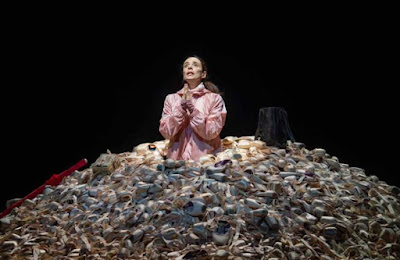
In L'HEURE EXQUISE, Winnie is now named She, an aging ballerina buried up to her waist in her old ballet shoes and as she chatters away to her partner He, she remembers her career.  Luckily for the audience, the mound of shoes parts and we watch She as she recalls dancing as a child to reaching success, dancing many roles and seemingly ending up in a vaudeville routine - all the time helped and hindered by He as her father / dance partner / manager.  Only three dancers have danced the role professionally: the late Carla Fracci who originated it, Maina Gielgud and now Ferri (under Gielgud's staging).

Ferri chose this to celebrate her 40th anniversary with The Royal Ballet which is no small achievement in the life of a ballet dancer - even one who is a prima ballerina assoluta.  In the 120+ years since the first assoluta was named there have only been thirteen dancers granted that title: there are three still living but only Ferri remains dancing.  She is simply glorious; when she dances you believe every gesture, every movement - she is an actress without needing words but here she handled both with ease.  She was partnered by Carsten Jung, ex-principal with the Hamburg Ballet.

Our second visit was to see the return to the Covent Garden stage of our favourite male dancer Steven McRae, it was a performance that we needed to see...  On 16th October 2019, we were overjoyed to see him on stage at Covent Garden again, after nearly two years injured.  We were nearly at the end of the 2nd Act of Kenneth MacMillan's MANON and McRae was dancing alone on the stage: two leaps, two pirouhettes - then he froze for a few seconds, and hopped into the wings as the curtains closed but not before hearing chilling, unforgettable howls of pain.  Kevin O'Hare, Director of the Royal Ballet, appeared onstage to confirm Steven was injured and would be replaced for the rest of the performance.

It later transpired that he had endured a full rupture of his Achilles tendon and we followed his slow, determined rehabilitation back to full dancing strength and here we were, two years after that ghastly night, to see him dance again.  Could he?  Would he?  

A massive cheer greeted his first appearance and as wonderful as it was to see him again, we were on the edge of our seats right up to the last chords of Prokofiev's score, but he absolutely triumphed.  Giving us a Romeo of passion and verve, Steven was greeted with an enormous ovation at the end. 

It must have been very special for him to share his return with his frequent stage partner Sarah Lamb who emotionally pushed him forward to take a solo bow and joined in the rapturous applause for him. Sarah Lamb was an exquisite Juliet, her grace and elegance turned by her secret love into determination and ultimately devastation.  What a marvellous partnership they have on stage!

MacMillan premiered ROMEO AND JULIET in 1965 with the iconic pairing of Margot Fonteyn and Rudolph Nureyev but it wasn't meant to be them.  He had created the roles for the younger Christopher Gable and Lynn Seymour but they were demoted to the second cast when demands for box-office names for the subsequent US tour won out - Gable and Seymour even had to help teach the more famous pair their roles due to time constraints in rehearsals.

The unhappy situation resulted in MacMillan leaving The Royal Ballet the following year but returned to be it's artistic director from 1970 to 1977 when he became it's principal choreographer until his death backstage during a revival of his MAYERLING in 1992.  Along with his other great works, ROMEO AND JULIET has remained in the repertoire and is still a glorious creation, it grips from the start with a thrilling choreographed sword fight in the city square which results in five bodies piled up centre-stage; in McMillan's Verona, danger is only a hair's breath away.

John B Read's lighting and the original evocative set design by the late Nicholas Georgiadis are still wonderful while McMillan's truly thrilling choreography is staged this time by Christopher Saunders and Laura Morera. Sergei Prokofiev's score sounded excellent played by the Opera House orchestra under the baton of Koen Kessels.

There was good support from James Hay and Bennet Gartside as Mercutio and Tybalt, Christopher Saunders was also a controlling Lord Capulet partnered by Elizabeth McGorin as Lady Capulet and Kristen McNally's bustling Nurse.  The night we saw it marked the 514th performance of MacMillan's masterpiece: here's to many more - and welcome back Steven!


Thursday, August 29, 2019

ROMEO + JULIET at Sadler's Wells - Mad Love

On the way into Sadler's Wells I wondered to Owen whether this new Matthew Bourne was going to be another RED SHOES or another DORIAN GRAY - was it going to be one I loved or not affected by at all?  Sigh...


I fear it was one of those occasions when I simply didn't get what other people were reacting to.  My heart vaguely sank when I saw that it was set in the Verona Institute with a standing set of white bricks and metal mesh side walls.  However the first loud sigh started when the show did!

Prokofiev's score has been cut to suit Bourne's cloth and it launched straight into the score's greatest hit 'Montagues and Capulets' aka 'Dance Of The Knights' aka 'The Apprentice UK's Theme Music', the first of quite a few appearances during the ballet - it's like doing a version of THE NUTCRACKER with 'The Dance of The Sugar Plum Fairy' every 15 minutes.


My main gripe was Bourne's clunking premise which, for me, simply refused to fly.  Romeo is admitted to the Bourne Home For The Perpetually Leaping Confused by his careerist politician parents and left to mingle with the usual Bourne misfit inmates including the flashy Mercutio and his gay lover Balthasar and the sadistic guard Tybalt who terrorizes the inmates.

At a scene - shall we say borrowed? - straight out of WEST SIDE STORY, during a party for the inmates - cue lots of gauche acting and stiff-legged two and fro dancing - the mirror ball starts and Romeo and Juliet spy each other across the room - cue the ensemble start to dance in slow motion while our couple instantly fall in love.


Juliet is a twitchy inmate that we find already prowling the walls and always on guard from the nasty advances of Tybalt.  After the party, Tybalt murders Mercutio and the inmates turn on him, all having a hand in his death... and that's only the first half!  And that's the problem...  Surely the pivot for any adaptation of Shakespeare's Romeo and Juliet is that the two lovers are separated by blood and circumstance, both interior and exterior obstacles, that result in the fatal outcome... but here, where do the obstacles lie? 

Tybalt is dispatched in the first act so no hindrance there... the Asylum staff hardly seem to care about them; Romeo's parents could care less about them - they are just happy to have their son off their hands... which leaves... what, their madness?  If there is nothing keeping them apart then what do you have left?  You are left with Bourne's scenario which culminates in an out-of-nowhere accident.  Hardly the stuff to inspire 423 years of fascination.


Bourne's choreography was remarkable but not consistently - there seemed to be certain moments which seemed to be retreads from other shows - most noticeably in the party scene where the ensemble did his usual 'embarrased dancer shtick' and in the second-act opener for grieving Balthasar which was an all-too familiar copy of Angelo's jail solo in THE CAR MAN.  The wimpy, whey-faced Romeo of Paris Fitzpatrick struck me again as being based on Bourne's character of EDWARD SCISSORHANDS but thank the lord for the magnetism of Cordelia Braithwaite as Juliet.

As she demonstrated most notably in THE RED SHOES, she is a dancer of exquisite emotion and like in that ballet, here she demonstrated deep wells of maniacal energy that made her incredibly watchable.  To be honest no one else came close although Jackson Fisch went all out for pathos in his Balthasar solo.  The ensemble were all exceptional and gave committed performances.


Lez Brotherston's set was little more than functional but Paule Constable's lighting gave the show the light and shade not always found in the scenario or choreography. 

The ultimate problem for me is that Kenneth McMillan's Royal Ballet version is so unforgettably powerful that even Bourne's anti-romantic take on the score here for me failed because you simply don't care about anyone on stage - and if you don't care what happens to your pair of star-crossed lovers in whatever adaptation you are seeing then what's the point?


Being a Bourne show there will be a tour, a cinema screening at some point and a probable dvd release so I am guessing I will have an opportunity so give it another look.

I suppose...


Sunday, April 21, 2019

ROMEO AND JULIET at Covent Garden - Grief so Brief

“O, swear not by the moon, th’ inconstant moon..." or your favourite dancers.

It is now four years since we discovered the Royal Ballet's wonderful repertoire and one of the first productions we saw was Kenneth MacMillan's classic Shakespeare adaptation ROMEO AND JULIET with Steven McRae dancing Romeo.  Steven soon became our favourite male dancer, a performer with real star quality, and when it was announced he was dancing the role again this year, tickets were snapped up.  However on his last day of filming CATS, McRae had a knee injury which required a surgical procedure.  "Romeo, Romeo... wherefore art thou Romeo?"  He's resting his knee that's where he is.  This is sad as we also missed him last year in SWAN LAKE and MANON through being out injured.  Anyway where were we?  Oh yes, "Two households both alike in dignity..."


McMillan's production originated in 1965, his first full-length work for the Royal Ballet.  He had expanded a pas-de-deux filmed for Canadian TV with the young pairing of Lynn Seymour and Christopher Gable and was determined they would be his original star-crossed lovers.  But the production was due to tour the USA after it's premiere and the American promoter wanted the star wattage of Margot Fonteyn and Rudolf Nureyev and the Royal Ballet management gave in, so Gable and Seymour were demoted to the second cast and even had to teach the two more famous dancers some of the moves which must have been particularly galling.  McMillan felt betrayed by the decision and left the Royal Ballet the next year to run the ballet company at the Deutsche Ballet in Berlin.  He would return to Covent Garden as the Artistic Director in 1970 but resigned seven years later to be the company's principal choreographer.

I still find it remarkable that a production can remain for 54 years in a repertoire - no matter how hard you look you will not find Franco Zeffirelli's MUCH ADO ABOUT NOTHING or Peter Wood's LOVE FOR LOVE at the National Theatre or Peter Hall's THE HOMECOMING at the Royal Shakespeare Company.  But it's a minor quibble as ROMEO AND JULIET is still a glorious creation, involving from the start with a thrilling choreographed sword fight in the city square which ends with five dead bodies piled up centre-stage, McMillan's Verona is always a hair's breath away from danger.


John B Read's lighting and the original evocative set design by the late Nicholas Georgiadis combine to give you an immediate understanding of place while McMillan's truly thrilling choreography is realized by Julie Lincoln and Christopher Saunders.  Sergei Prokofiev's score sounded excellent played by the Opera House orchestra under the baton of Paul Murphy.

Steven McRae's replacement was Ryoichi Hirano and Juliet was danced by Akane Takada - who always seems to be on when we visit.  Hirano was technically fine but was dramatically colourless; Takada embodied the full arc of Juliet, delicate and joyful at the start, troubled and passionate in love and death at the end.


As usual, there was fine support from James Hay and Bennet Gartside as the deadly rivals Mercutio and Tybalt, Kristen McNally and Thomas Whitehead were fine as Juliet's controlling parents, and there was great scene-stealing from the vivacious strumpets led by Itziar Mendizabal.

Despite Steven McRae's absence, ROMEO AND JULIET was wonderful to see again and to relive Kenneth McMillan's creative genius.


Friday, December 29, 2017

CINDERELLA at Sadler's Wells: Cinders Bourne again...

If it's Christmas then there will be a Matthew Bourne production at Sadler's Wells and this year it's a return for his version of Prokofiev's CINDERELLA which we last saw there in 2010.


It was a delight to see it again but I also feel a bit more able to critique it now after having had more exposure to dance through seeing the work of the Royal Ballet.

Bourne sets his CINDERELLA in wartime London 1941 which is a good framework for the story as the chances of happiness were fleeting and could be snatched away quickly.  Cinderella is the put-upon child of a withdrawn father, isolated in his wheelchair, and her stepmother, a glamorous Joan Crawfordesque drunken maneater.  She shares the house with her 5 step-siblings: two vain sisters and 3 brothers: one a gay clothes designer, a shoe fetishist and a hyper-active lad.


Into their life stumbles an RAF pilot, disorientated and dishevelled, who Cinderella instantly falls for.  He runs out of the house with Cinders in hot pursuit and her life changes forever.  Cinderella is watched over by a ghostly angel who guides her through the London blitz and who even recreates the just-bombed nightclub the Cafe de Paris so Cinderella can have her moment in a pretty dress dancing with her RAF prince.

A night of love between them ends with the angel summoning Cinderella to flee at midnight but, caught again in the dangerous streets, Cinderella and her pilot both end up in the hospital - what chance for a happy ending now?


What dazzled most was the excellent set and costume design by Lez Brotherston who conjures haunting imagery - none more so than in the Cafe de Paris scene, based on the real event in March 1941 when the assumed-safe underground club was struck by two bombs that fell through a ventilation shaft and exploded on the dancefloor, killing 34 people and injuring 80.  Neil Austin's excellent lighting adds to the thrilling visual power.

Bourne excels in strong narratives but in CINDERELLA he loses clarity towards the end especially in the lengthy hospital scene which also includes a confusing flashback of her stepmother shooting her father then appearing in the hospital to smother Cinderella - why?  Up until then, the stepmother is portrayed as a comic vamp; the sudden lurch into melodrama just feels forced.


The central relationship between Cinderella and the pilot also feels ultimately negligible, they seem to be do a lot of rushing around chasing each other through the blackouts but they never really seem to connect as a couple, their best duet being in his bedroom while air-raids threaten overhead.  The idea of having five siblings for Cinderella dissipates the tension within their relationships; her two sisters are oddly anonymous as the brothers are given more attention-getting characters.

Bourne's choreography has it's signature moves but it would be good if you were not able to second guess some of them: the straight arms crossing at the elbows as couples dance being one.  As I said, some natural, clean lines would be nice occasionally.


However Ashley Shaw was delightful as Cinderella, creating a real sympathetic character - none more so than in her lovely solo with her brother's tailoring dummy which then turns into a duet with her hero - and Bourne regulars Michela Meazza and Liam Mower were excellent as nasty Sybil the stepmother and Cinderella's other-worldly Angel.

CINDERELLA is still a wonderful theatrical experience with our charming heroine, tormented hero, heavenly guide, nocturnal trouser-jiggling rentboys, brassy tarts, gas-mask dogs, glamorous nightclub patrons and lonely love-lorn Londoners all mixing together as the bombs fall and Prokofiev's dramatic, moody score soars. 


Next Christmas at Sadler's Wells?  Let's just say I'll be there...


Tuesday, July 21, 2015

CINDERELLA - Dutch National Ballet at the Coliseum

Over a week ago we continued our investigation into seeing new things with another visit to the matchless Matcham-designed London Coliseum.

Last time it was to see operetta with Mike Leigh's PIRATES OF PENZANCE but now it was to see Prokofiev's CINDERELLA performed by the Dutch National Ballet choreographed by Christopher Wheeldon.  The production was first performed in Holland in 2012 and this was it's UK premiere.


It was odd to think I was listening to the same score that inspired Matthew Bourne's re-imagined version a few years ago that updated it to WWII London which was bold, imaginative and visually striking.  This was... pretty, and occasionally visually striking.

It was certainly sweepingly romantic but as usual with this style of ballet,  I found it's form to be a barrier stopping any enjoyment on my part.  Call it the Isadora Duncan in me.  I can appreciate the technique but not the emotion, I can appreciate the production but see no passion. 


I certainly could appreciate Julian Crouch's set and costume design, in particular the ball scene where the corps' costumes were various shades of blue, lilac and violet - Cinderella singularly flouting the dress code by wearing a little gold number. The settings were suitably palatial and pastoral for the scenes around the massive tree that grows by the grave of Cinderella's mother.  I also liked Natasha Katz' atmospheric lighting.

Basil Twist should also be mentioned for his clever - if slightly too long - transformation scene which closed the first act, Cinderella vanishing into the truck of the tree as a collection of nymphs, bird people and tree gnomes cavorted before she reappeared with a billowing white silk train which became the coach.


I can't say any of the dancers stood out as exceptional but they were all good at what they did.  Christopher Wheeldon's choreography was fluid and suitably traditional for this to stay in repertoires for a long time and I have to admit the big romantic pas de deux was very good.  He has just won a Tony award for his choreography for the Broadway production of AN AMERICAN IN PARIS and I can certainly see how his romantic style would fit that production.

One moment which sticks out - more as an image than for any specific choreography - was the start of the third act when a row of palace chairs were placed along the front of the stage for various characters - including a wood gnome and the Prince's equerry - to sit out their turn at trying on the glass slipper.  When they all fled at the Prince's exasperation the chairs were all whisked upwards to hang in a surreal fashion over the rest of the scene.  It didn't add much to the story but was certainly visually arresting.


The Prince was featured a lot in this production, showing him growing up unhappy in the rigidity of court life, but it struck me that this seemed to borrow from Bourne's SWAN LAKE scenario and also that, in truth, the least interesting character in CINDERELLA is actually the Prince!

I'm glad I saw it as an experiment in dance but ultimately found that I had more of an emotional connection to Bourne's version of the ballet.


Sad to report yet another twat audience member in the row in front of us forgot he was sitting in a theatre when about 10 minutes into the production he turned on his mobile phone and proceeded to turn it on and off intemittently.  That is until a woman a few seats down from us gave him a swift jab in the shoulder.  He did turn it off but then was so enthralled in the action that, by the second interval, he and his two children were fast asleep as his wife sat and glowered at the stage.

And again, where were the bloody ushers to do the job they are paid to do?  Probably bitching about the Wicked Stepmother's port de bras on the stairs outside and picking their teeth with the used ticket stubs.