The Royal Ballet's big Spring presntation was scheduled to be the first revival of Liam Scarlett's SWAN LAKE; we saw it in 2018 and wanted to see it again as our favourite dancer Steven McRae was finally due to dance the lead role of Prince Siegfried. Back in 2018 he was recovering from an injury so we saw William Bracewell instead. But last October, we were in the audience when, while dancing des Grieux in MANON, Steven snapped his tendon onstage and he is still recovering, so again we saw a replacement, this time Federico Bonelli.
Devil Works: 1
This revival, while being well-reviewed and successful at the box office - hey it's SWAN LAKE!! - has yet appeared under a cloud as Liam Scarlett, instead of reaping the benefits of this revival of the Tchaikovsky classic, was suspended in January by the Royal Ballet for allegations of sexual misconduct which are still ongoing.
Devil Works: 2
This is all a shame as Scarlett's production - here staged by the Royal Ballet's Director Kevin O'Hare - is a wonderful, sweeping version of the 1895 Imperial Ballet, his choreography building on the legendary work of Marius Petipa and Lev Ivanov as well as the Neopolitan dance by Sir Frederick Ashton. Unlike the museum piece that the Bolshoi Ballet presented a few years back, Scarlett's version seems vivid and new. There are even overtones of Matthew Bourne's version when at the end Siegfried carries Odette's body towards us while behind him she appears floating illuminated behind the backdrop.
With the romantic design by John Macfarlane and moody lighting by David
Finn still proving a triumph, we again had Akane Takada dancing Odette / Odile and, while I still feel her to be a bit antiseptic, she still dances with a fluidity of movement, like the ripples on her swan's lake. It would be good to see one of the other female soloists do it such as Sarah Lamb or Natalia Osipova.
There was exquisite support from the ever-whirling James Hay as Benno, Kristen McNally as the Queen who realises too late the error of her ways, and the always hissable Thomas Whitehead as the nasty Von Rothbart.
Of course one must also praise the wonderful corps de ballet for the always dazzling work they do as Odette's swans - shaping and re-shaping themselves into dazzling groups, they are always an arresting sight. We were lucky to have in the cast Itziar Mendizabal as one of the pairing of lead swans and a special shout-out to Gina Storm-Jensen for her dazzling Spanish dancer.
The Royal Opera House Orchestra as usual got the biggest ovation under the baton of Koen Kessels. The night we saw it danced marked the 1,032nd performance of SWAN LAKE at Covent Garden and I am so glad we saw it again - I even had an icy tear trickle down my cheek at the end which has never happened before, unlike the Bourne version which has me full of sobs.
But now what? I cannot recommend you see it as thanks to the Coronavirus pandemic, Covent Garden as well as all other theatres has closed for an indefinite period. Who knows how many months I will be robbed of that unique experience of alchemy between performer and audience.
Devil Works: 3
Somehow The Bard - as usual - sums up the moment best:
Nearly two years ago, we took the plunge - in the year of trying new things artistically - and went to Covent Garden to see WOOLF WORKS, a new Royal Ballet production choreographed by Wayne McGregor. I remember feeling some trepidation... Virginia Woolf is one of my favourite authors for whom language is the key so how can you silence that but still make it relevant? Two words... Wayne McGregor.
As you can see from my blog it had a profound effect on us both and it did indeed start a continuing exploration of ballet which has been very rewarding. But how would the first revival of WOOLF WORKS compare - and would it have the same impact?
I am happy to be able to say that it led to a deeper, richer understanding of the work but also there was the added bonus this year of seeing it on the big screen at the Curzon Mayfair and also being able to appreciate the depth of Max Richter's music with it's release on cd.
Onstage we were blessed with practically the same cast as in 2015, the only major replacement being Calvin Richardson and his breathtaking pirouettes dancing the role of 'Evans' for the unwell Tristan Dyer in the MRS. DALLOWAY-inspired 'I Now, I Then'. The impact of seeing the company onstage was made even more exciting by seeing the same dancers a few days later on the live cinema screening, giving an opportunity to experience their talent closer than possible at the Opera House although there was some loss too, in particular the glorious digital stage image of the garden of Clarissa's imagined youth flooding the set.
McGregor has choreographed three ballets in distinct styles: 'I Now, I Then' is the most narrative; based on MRS DALLOWAY - and introduced with the only known recording of Virginia Woolf musing on the difficulty of using old English words in new ways - we see Clarissa Dalloway (sublime Alessandra Ferri) meeting old flame Peter Walsh (Gary Aves) and relives the glorious summer she spent as a teenager with Peter and her best friend, the free spirited Sally Seton, and how life seemed full of possibility and choice. The younger selves were danced wonderfully by Francesca Hayward, Federico Bonelli and Beatriz Stix-Brunell.
As Clarissa is lost in memories of what could have been we also see Septimus Smith (the astonishing Edward Watson) who is tortured with the lasting trauma of shell-shock from his experience in the WWI trenches. His wife Rezia (Akana Takada) tries to keep him engaged in life but he is lost in memories of his friend Evans (Richardson) who was killed before him. It is a perfect fusion of performance, choreography, design by Cigué, lighting by Lucy Carter - the moment the stage was suffused with glowing red when Septimus danced with Evans was glorious - and, almost a character of it's own, Max Richter's heartbreaking, longing music.
The second act 'Becomings' takes ORLANDO as it's inspiration and is the most abstract of the pieces although during one of the intervals for the screened event Wayne McGregor was interviewed by hosts Darcey Bussell and Clemency Burton-Hill and said he believed that no dance can be truly abstract as the human element will always lend a dance a narrative sense. Again Lucy Carter's lighting is thrilling: an overhead beam roams the dark stage picking out 12 dancers in varying degrees of glittering gold Elizabethan costumes before a cold laser beam illuminates two of them and we launch into McGregor's take on Woolf's exploration of gender fluidity.
As Richter's music roams from bone-crunching electro beats to minimal keyboard runs so McGregor's choreography changes from solos to duets to triple routines for his remarkable dancers - pushing their limbs into even more challenging shapes and attitudes; the exhilaration is in seeing male and female dancers fusing into just pure dance. With each segment, they slowly lose their Elizabethan costumes until they are in shades of grey, all dancing in and out of four overhead spotlights, all individual but all unified, until the lights cut out and the auditorium is criss-crossed with shafts of laserlight. Again the live screening was wonderful to showcase in detail the astonishing work of, among others, Sarah Lamb, Natalia Osipova, Steven McRae and Watson.
The final act is TUESDAY and takes it inspiration from THE WAVES but also references Woolf's suicide note written on Tuesday 25th March 1941, three days before she actually drowned in the River Ouse. McGregor has the inspired choice of Gillian Anderson reading the wrenching suicide note while a slow-motion film of crashing waves shows on a stage-wide screen all but dwarfing the stationary figure of Ferri beneath. Anderson's measured, hypnotic delivery leads you in to McGregor's slow meditation on love and loss, beautifully danced by Ferri and Federico Bonelli who are later joined by Sarah Lamb and an ensemble which also includes young students from the Royal Ballet School.
Ferri is astonishing in her poetry and control as she becomes the embodiment of Richter's dreamlike, ethereal music, solitary notes slowly coming together with Anush Hovhannisyan's soprano to wash over you with waves of strings and brass. There was one moment that haunts me: Alessandra Ferri starts a solo movement against the ensemble's choreography who slowly, three or four at a time, echo her until they are all bending and stretching as one, it's breathtakingly beautiful. Slowly the ensemble ebb away into the darkness at the back of the stage, as Bonelli lowers a prone Ferri onto the stage as the music slowly vanishes note by note...
As I have said, the live screening was a wonderful opportunity to see the dancers closer than possible in the theatre and there were the added extras of interviews with Wayne McGregor and Max Richter as well as Maggie Smith reading passages from THE WAVES as well as Virginia's memoir MOMENTS OF BEING.
As I have written this I have been able to relive the experience by playing the cd THREE WORLDS of Richter's score; I wondered if it would work separately from the experience of seeing it with the dancers but it works beautifully. It has been great to be able to explore this work in depth for the past two weeks - I would love the opportunity to see it again.
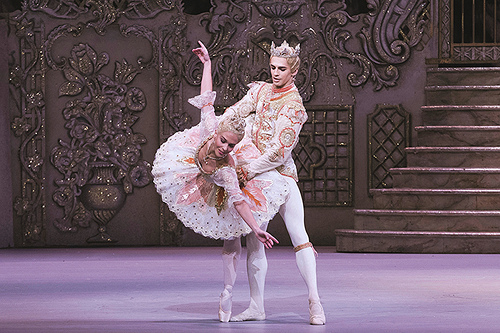
On the Monday before Xmas it was time to revisit the Royal Ballet's evergreen production of THE NUTCRACKER. Yes, once again it was time to revisit the workshop of Herr Drosselmeyer, battle the Mouse King and journey to the Land of Sweets via the magical growing Christmas tree on the stage of Covent Garden. Well I suppose three out of four isn't bad.
The Royal Ballet production of choreographer Peter Wright's THE NUTCRACKER is a Christmas staple at Covent Garden and after having fallen totally under it's spell last year, we pirouetted back for another helping, in fact we saw it's 436th performance! This year is an extra-special revival as it mark's Sir Peter's 90th birthday.
It was a joy to see again and to hear the Royal Opera House orchestra under the baton of Boris Gruzin bring Tchaikovsky's thrilling score to life again - the second act could almost be called Ballet's Greatest Hits with the Chinese and Russian Divertissements followed by the Prince and Sugar Plum Fairy's glorious pas de deux and her solo.
We were about a third into the opening scene and gearing up to the big reveal - Drosselmeyer's shrinking Clara to the size of the Nutcracker by the scenic ploy of having the Christmas Tree at the back of the stage seeming to grow bigger and bigger and bigger.
Christopher Saunders as Drosselmeyer whipped his cloak around and about - it must be said not a patch on Gary Avis' capework from last year - and Meaghan Grace Hinkis' Clara fluttered about expectantly... but the tree stayed the same size. With a whoosh the curtains flew in and a stage manager appeared to tell us that due to technical difficulties they were going to have stop for a few minutes... but, but, it's - like - Covent Garden!!! It's the Christmas Tree!!!!
After what seemed an eternity - but probably not that long really - the orchestra struck up the transformation music, the curtains parted - and there was Clara and Drosselmeyer whirling away in front of the fully-grown tree. I guess it was ok in the long run but darn, Constant Reader... I wanted to see the damn thing grow!
But the great thing about Peter Wright's NUTCRACKER is that it doesn't hang around over anything for too long, it's forever moving forward. So after Clara defeats the Mouse King and frees Drosselmeyer's handsome nephew Hans-Peter from his Nutcracker spell, they are off into the world to experience the joy of dancing snowflakes and their trip to become guests of the Sugar Plum Fairy and her Prince.
Although I liked Hinkis and Valentino Zucchetti as Clara and Hans-Peter, I felt that Federico Bonelli and Laura Morera as the Prince and the Sugar Plum Fairy, while fine together, lacked something in their solos - the pairing last year of Steven McRae and Iana Salenko were excellent together and apart.
But the total work was still glorious: Wright's always thrilling choreography, the late Julia Trevelyan Oman's exquisite design and Mark Henderson's lighting all combine to make The Royal Ballet's THE NUTCRACKER a perennial must-see at Christmas time.
Just sort out that Christmas Tree for next time, eh?
As you know Constant Reader, last year was the year of doing New
Cultural Things and the winner was ballet - I honestly didn't see that
one coming. So here we are again, back at Covent Garden and ready to
launch on this year's terpsichorean adventures!
One
of last year's non-Covent Garden ballet events was seeing Christopher
Wheeldon's CINDERELLA at the Coliseum which was a good introduction to
his choreographic style but here we were, back in the impossibly
glamorous Royal Opera House, to see a triple bill of his more
challenging pieces.
The programme included a world
premiere bracketed by two works Wheeldon choreographed for American
companies which have now been added to the Royal Ballet's repertoire.
AFTER THE RAIN from 2005 was an abstract sliver of elegant loveliness
danced to an achingly spare score by Arvo Part. It started with two
male and female dancers in grey/black costumes suggesting the swirling
relentlessness of a rain storm but were wiped out of mind by the simple
delicacy of Marianella Nunez and Thiago Soares in a glorious pas de deux seemingly welcoming the sun after the deluge, it, and they, were spellbinding.
I
was excited to see the world premiere as it dealt with a favourite
subject: John Singer Sargent's MADAME X, his infamous 1884 portrait of
society beauty Amélie Gautreau. American-born, Amélie married well in
Paris and hired Sargent, the artist-of-the-moment, to immortalise her
imperious beauty. Sargent had her model in a black evening dress and
painted her with one of the golden straps slipped off her shoulder.
The
result was an instant scandal when the painting was displayed at that
year's Salon - her imperious air and the suggestion of abandonment in
her pose was deemed too shocking for the Parisians and their opprobrium
was turned on both Sargent and Amélie. Sargent heard that the Gautreau
family wanted to buy the painting at the end of the Salon to destroy it
so Sargent removed it and kept it in his studio, eventually repainting
the offending shoulder strap to look more normal. Sargent was too great
an artist to be ostracised for long but Amélie's reputation was
permanently ruined and she became a recluse in a house with no mirrors.
The reaction always struck me as bizarre when one assumes that the
Salon also had it's usual number of artistic nudes which were deemed
okay - but a misplaced shoulder strap....!
Ultimately
I think STRAPLESS slightly missed it's target as the narrative had to
put over too much through pure dance but the I enjoyed the fluidity of
Wheeldon's choreography and in particular Bob Crowley's beautiful set
and costume design which suggested the Belle Époque very well. I
particularly loved Crowley's version of the infamous black dress which
swirled and whirled behind the ever-moving Amélie, restlessly pursuing
Sargent until she was immortalised.
The
main three performances were also excellent: Natalia Osipova was an
imperious Amélie, spoilt and capricious until she is shunned by her
peers, and she managed the final moments well, stripped and standing in
front of her portrait, now surrounded by a 21st Century audience, but
the woman herself is invisible to them. Edward Watson gave us a
suitably grave and haughty John Singer Sargent fascinated by the glamour
of Amélie but drawn to a younger man, and Federico Bonelli was very
seductive as Dr Pozzi, first seen in the pose that Sargent painted him,
who is the conduit for Amélie to her painter. I hope they stage it
again in the future...
The
last act was Wheeldon's 2008 ballet WITHIN THE GOLDEN HOUR which was an
excellent showcase for his abstract choreography, his fourteen dancers
seemingly floating, sliding, rising and falling again and again, and as
the curtain slowly fell, they were circling and weaving, circling and
weaving, movement flowing for ever... It was a particular joy to see
the male dancer we seemed to always see last year, Steven McRae, having
the most extended pas de deux with Sarah Lamb.
It
was another great evening at the Royal Opera House and I am looking
forward to seeing Wheeldon's version of THE WINTER'S TALE there soon.
This triple bill - more than his CINDERELLA - has made me see what a
fine choreographer he is.
Oh and by the way, what was my reaction to MADAME X? Click here for my blog about the 2006 AMERICANS IN PARIS exhibition at the National Gallery to find out!