Showing posts with label Alexander Campbell. Show all posts

Friday, December 13, 2019

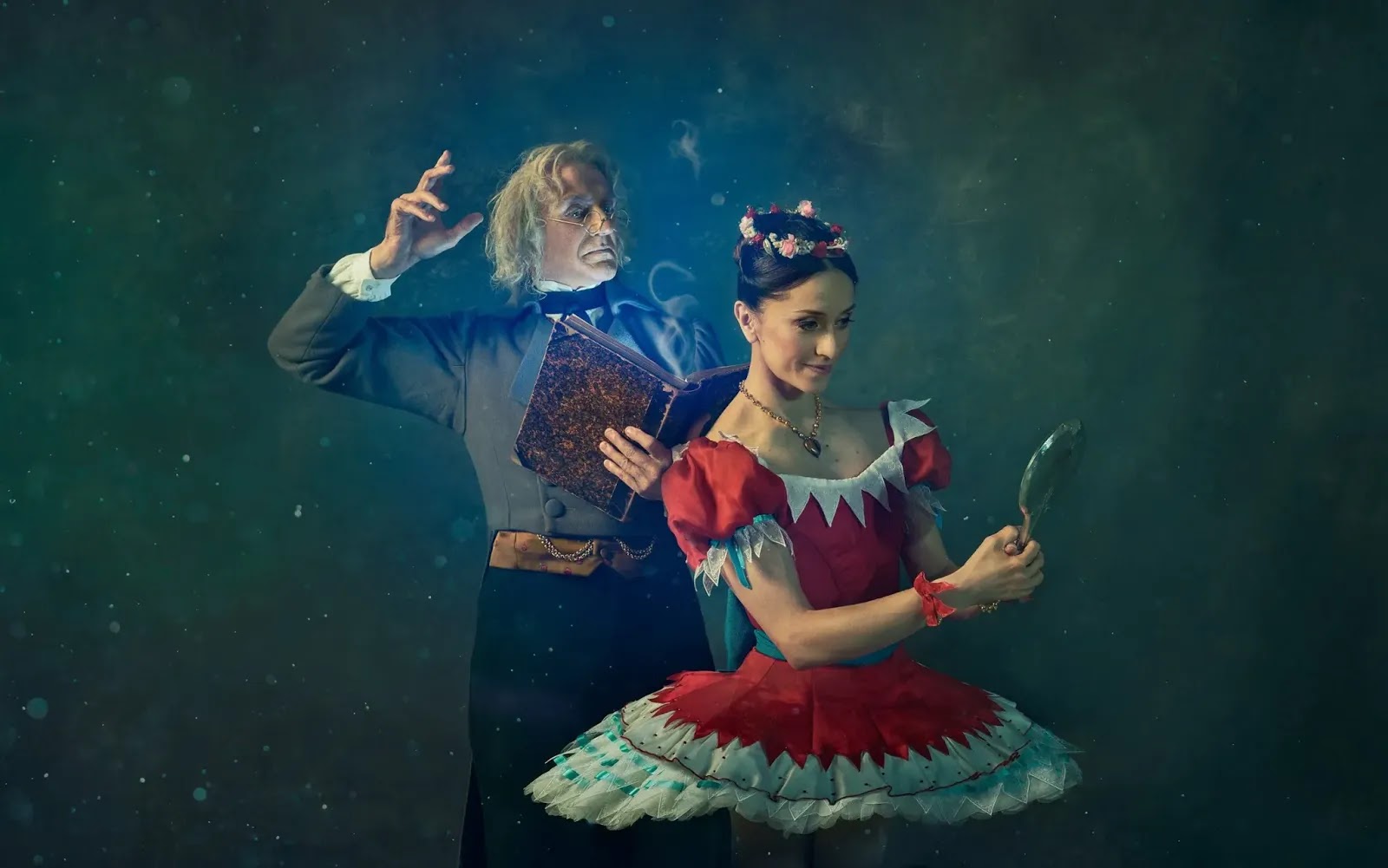
COPPÉLIA at Covent Garden - like clockwork...

In the last four years, since being swept away by The Royal Ballet's WOOLF WORKS, we have seen most of the famous ballets in the canon but one has only just been revived so I can finally tick COPPÉLIA off the list.


Léo Delibes' ballet premiered in 1870, with a libretto by Charles-Louis-Étienne Nuitter based on two stories by ETA Hoffmann, at the Paris Opera and was a big success but it's success was halted by the Franco-Prussian war and the concomitant siege of Paris by Prussian troops.  The severe food shortages that followed cost many Parisians their lives, one of which was 17 year-old Giuseppina Bozzacchi who had danced the female lead.

in 1884 Marius Petipa staged a production for the Russian Imperial Ballet which was hugely successful; in 1894 it was revived by Petipa's assistants Lev Ivanov and Mario Cecchetti and it was this production which has formed the basis for most Western productions down the years.  The original Imperial Ballet production 'bible's were smuggled out of Bolshevik Russia by Nicholas Sergeyev who staged a production with Ninette de Valois' Vic-Wells Theatre Company at Sadler's Wells in 1933.


In 1947 de Valois' ballet company became the permanent dance company at Covent Garden - eventually being named the Royal Ballet - and in 1954 she choreographed her own version based on these Imperial Ballet originals, and here we are, some 65 years later, and it is back in the Royal Ballet's repertoire after a decade away.  I am glad I saw it finally but while entertaining enough, it really doesn't hold up to too intense scrutiny.

In a small German town Swanhilda and Franz are to be married at an upcoming festival but Franz has been noticeably distracted by Coppélia, an impossibly beautiful woman who sits reading in the window of the mysterious Dr Coppelius' house and workshop.  Coppelius loses his house keys and, on finding them, Swanhilda sneaks into the house with her friends to investigate - closely followed by Franz climbing up a ladder!


Once inside they discover Coppelius has made life size clockwork dolls to keep himself company - and Coppélia is one of these.  Coppelius returns; Swanhilda hides behind a curtain with her mechanical rival just as Franz climbs through the window.  Coppelius wishes his dream doll to become alive and drugs Franz in an attempt to steal his soul for her, but Swanhilda breaks the spell by emerging in Coppélia's clothes.  The old man is delighted his creation has come to life but is left in despair when he realizes it's a trick when Swanhilda and Franz escape.  Cue a happy ending in the town square...

There are dark areas in the plot which could be explored - Franz' speed at falling in love with another girl, the eerie workshop of mechanical people who come to life when Swanhilda investigates, Coppelius' wish to kill Franz for his soul, and his sadness when he discovers Coppélia did not come to life - but none of it is really explored and all one is left with is the folksy aspects of the fairy tale.


To be honest I found de Valois' choreography to be fairly uneventful - pretty but hardly memorable - but Delibes's music was lovely and this production is blessed with Francesca Hayward's spirited and fun Swanhilda, Alexander Campbell's bouncy Franz and Gary Avis excelling as Coppelius, not too far from his memorable performance as Drosselmeyer in THE NUTCRACKER only this time he does not have a cloak to swirl around.

I am sure the Royal Ballet have found in COPPÉLIA a good substitute for their Christmas perennial THE NUTCRACKER and I am glad I have finally seen it but I suspect I will not be wanting to see it again.


Saturday, May 12, 2018

MANON at Covent Garden: Love, Death and MacMillan

In 1731 Abbé Prévost published "L'Histoire du Chevalier des Grieux et de Manon Lescault" to instant notoriety and it's print run banned in France.  Pirated copies filtered out to an eager public and Prévost's tale of the tragic love affair of Manon and des Grieux went on to inspire writers and to be referenced in novels such as "The Lady of The Camillias", "The Red and The Black", "Venus In Furs" and "The Portrait of Dorian Gray".

The tale is also the basis of seven silent and sound films, four operas, a Japanese musical and two ballets!  The last of these dance versions was choreographed by the great Kenneth MacMillan for the Royal Ballet in 1974 and although it was greeted with unfavourable reviews, it became an instant hit with audiences and last week I saw it's 274th performance at Covent Garden.


MacMillan had been looking for a new, sweeping ballet which would show off not only the Royal Ballet stars but also give the ensemble a chance to shine, and the teaming locations of Manon and des Grieux's love proved ideal.  It was to be the first original work after his controversial ANASTASIA and it can be seen as a further exploration of where the physical boundaries were for the female and male dancers of his time (and after).

"Manon Lescault" had been suggested to MacMillan as a subject by the designer Nicholas Georgiades although it had been on the choreographer's mind since it had been mooted to the previous Royal Ballet supremo Sir Frederick Ashton but he had rejected it as he felt it was too close to his "Camille" ballet MARGUERITE AND ARMAND.  There's only so many demi-mondaines to go around...


MacMillan asked composer and conductor Leighton Lucas to compile a score from the work of Jules Massenet whose opera version of the tale was in the Royal Opera repertoire and it is a remarkable achievement as it does seem like a whole unified score.

I will agree with the criticism levelled at the piece that it's hard to feel totally engaged with the characters but maybe it is down to the performers dancing on any given night, I am sure if Steven McRae had been dancing des Grieux I would have been more involved in his character but he was unable to dance due to an injury.  Instead we had fellow-Australian Alexander Campbell as des Grieux and Akane Takada as the eponymous anti-heroine.


Young Manon is on her way to a convent when her coach stops at a bustling inn outside Paris; there she meets her brother Lescault who promptly notices a fellow-passenger is lusting after her, Lescault, an enterprising heel, takes the passenger into the inn to sell his sister to him.  In the courtyard Manon meets young student des Grieux and the pair - of course - fall in love at first sight.  They decide to flee to Paris immediately, leaving Lescault high and dry - and the old man penniless as Manon has stolen his money!  Another rich man, Monsieur GM, approaches Lescault and offers a reward if he too can have Manon.  Lescault takes up the challenge...

In Paris, Manon and des Grieux are living in his lodgings and, despite their obvious love for each other, as soon as Lescault and Monsieur GM track her down and entice her with Monsieur's riches Manon chooses diamonds over love.  Some time later, at a debauched party at a brothel, the four meet again and Manon intimates to des Grieux that she still loves him.  Attempting to deprive the rich man of his cash, des Grieux is discovered cheating at cards and they flee to his lodgings, where Monsieur appears with police to arrest Manon as a prostitute; in the melée Lescault is killed.


Deported to New Orleans as a common prostitute, Manon is singled out by a lecherous gaoler, but des Grieux, who has followed her to America, murders the gaoler and, again, the couple are on the run but in the shadowy swamps of Louisiana their love reaches it's tragic climax.

Any difficulty in emotionally engaging with the relentlessly shallow characters is offset by the glorious sweep of action that MacMillan conjures - his production is recreated here by Christopher Saunders and Julie Lincoln.  MacMillan's wish that his MANON would showcase the ensemble is fulfilled as they give colour and life to Manon's world.  Georgiades' designs also help MacMillan's subtext that the opulent world that Manon aspires to sits like a bubble on top of a society of desperate poverty and danger, his sets are always juxtaposed against backdrops of decaying clothes hanging as silent witnesses to the corrupt world of Monsieur GM, where people can be discarded if they overstep their class or usefulness.


As I said, while technically excellent, Takana and Campbell were low on star wattage but the pas de deux that define their relationship were thrilling to watch: full of the passion and desire of new love, then more hesitant and incomplete as Manon wavers between the worlds of love and wealth, then the desperation of love in the face of death.

The supporting performances shone brighter: James Hay was excellent as the opportunistic Lescault and was well partnered by Yuhui Choe as his mistress, Thomas Whitehead brought his own air of menace to the lethal Monsieur GM and Kristen McNally also gave the Madame a suitably decadent panache.


MANON, an enduring testament to the genius of Sir Kenneth MacMillan.

Monday, April 16, 2018

Bernstein Triple Bill: YUGEN, THE AGE OF ANXIETY, CORYBANTIC GAMES at Covent Garden

Sometimes the Royal Ballet triple-bills can be a curate's egg but, every so often, all the pieces fall together and, while the individual one-acts dazzle, together they form a cohesive whole.  The Royal Ballet's recent celebration of Leonard Bernstein's centenary did just that.


Bernstein was such a giant of American music that it has taken three RB-favourite choreographers to stage this tribute: in tandem with Liam Scarlett's existing THE AGE OF ANXIETY, Wayne McGregor devised YUGEN and Christopher Wheeldon was given the final ballet CORYBANTIC GAMES.  All in their own way were exciting and Bernstein's soaring music sounded wonderful thanks to the Royal Opera House Orchestra.

Moving effortlessly between the classical and Broadway stages, Leonard Bernstein never forgot either as essential outlets for his creativity - indeed when a musical adaptation of THE SKIN OF OUR TEETH was abandoned because of creative differences, Bernstein reworked parts of the score to become a 1965 symphonic work which had been requested by the Dean of Chichester Cathedral two years earlier, waste not want not...  THE CHICHESTER PSALMS have been used by McGregor for his ballet YUGEN.


Utilizing his signature moves, McGregor had his dancers moving with vigour and astonishing physicality but also complementing the singing of the psalms in Hebrew.  The stark but intriguing design by Edmund De Waal of tall moving white light-boxes concentrated you on the remarkable dancers, as fluid as the red and purple costumes they wore.

I am sure it was just because it is the Bernstein score I know the most but I occasionally picked up the odd phrase that sounded straight out of WEST SIDE STORY in all three pieces.  I also saw a possible Matthew Bourne moment when a dancer did very noticeable swan-like swooping movements over three other crouching dancers.  McGregor can sometimes be all cerebral movement and little emotional involvement but here the lush musicality of Bernstein brought out the best in him, very much like Max Richter's music for WOOLF WORKS.


The second was a revival of Liam Scarlett's 2014 ballet THE AGE OF ANXIETY, written by Bernstein in 1949 and based on WH Auden's epic poem.  Bernstein's symphony throbs with the post-war feeling in New York of possible new beginnings under an air of lonely city living, Scarlett vividly moves his four lonely drinkers from a corner bar - an excellent design by John MacFarlane - to an apartment where they continue their drinking in the hope of making a connection.

They pal around, they flirt, they come together then break up leaving one of them, Malin, staring at the New York skyline at sunrise, eventually rushing towards it, ready to take up the challenge of another day, another possibility...  Sadly injury meant the wonderful Steven McRae had to pull out of the production and was replaced by fellow Aussie Alexander Campbell, but the lead quartet of Campbell, Sarah Lamb, Edward Gartside and Tristan Dyer were excellent, and Kevin Emerton was equally fine as the bartender.


After that blast of narrative, it was back to abstract for the last piece which was choreographed by Christopher Wheeldon.  He has set his ballet to Bernstein's Serenade after Plato's 'Symposium' - excuse me people - and the theme was carried through in Erdem Moralioglu's Hellenic-style costumes.  Through the five movements the constant theme seemed to be harking back to athletic running and leaping movement. 

I would love to see this again; Wheeldon's choreography was wonderfully alive, especially the 4th movement where a man and a woman, two men and two women danced variations to the same movements, perfectly embodying Bernstein's flowing music, before the whole ensemble at the end came together in kinetic, perfect fluidity.


As I said, the Royal Ballet triple bills may sometimes be unbalanced but in their tribute to Bernstein they triumphed.

Tuesday, December 29, 2015

The NUTCRACKER at Covent Garden - Christmas can start officially now!

How better to end the year of New Cultural Events (namely opera and ballet) than with a visit to Covent Garden to see a classic Royal Ballet production of Tchaikovsky's perennial favourite THE NUTCRACKER.


Warning to any diabetics - this production could endanger your health as the Sugar Plums rule!  My only previous experience of the piece is through Matthew Bourne's own take on it NUTCRACKER! which i have always enjoyed but now I am more au fait with dance it was time to be able to put that production in context next to the original.  Step forward the Royal Ballet with their 1999 production choreographed by Peter Wright after Lev Ivanov's original 1892 choreography.

As I have said before, it's remarkable that ballet companies can have productions that hark back to the original production of the piece.  How many theatre directors would like to direct UNCLE VANYA that was modelled on Stanislavski's original?  However there is certainly something in having a lineage to draw on and this production, here staged by Christopher Carr, is already in it's eleventh revival.


The production is simply enchanting, radiating warmth and goodwill like a particularly large glass of mulled wine.  Helped immeasurably by the late Julia Trevelyan Oman's designs, Wright's take on the story has the magician Drosselmeyer mourning that his nephew has been transformed by an enemy into a nutcracker, as you do!  His chance to undo the spell comes with a Christmas invitation to a family where he gives the nutcracker to the young daughter Clara.

Her love for the nutcracker releases the spell but not before Clara and the nephew defeat the nasty mouse king and his army after being shrunk by the magician.  He could have made it easier surely by keeping them human-sized!  Their reward is to be spirited away to the Kingdom of Sweets to meet the Sugar Plum Fairy and her Prince and be entertained by divertissements organised by Drosselmeyer.  On their return to the real world, Clara runs out of her house and bumps into a young man who looks strangely familiar, he in turn, hurries to Drosselmeyer's house where he is happily reunited with his uncle.


Peter Wright's spin on the story makes for a delightful fairy tale and Christopher Carr's staging made it as light as spun sugar on whipped cream.  It whizzed along like a top and this was in no small measure due to the excellent cast.  It was a particular delight to see a proper corps in the impossibly lovely Dance of the Snowflakes.

Gary Avis was very good as the magician Drosselmeyer, he has played it for a few years now and he twirled his vivid blue cape with panache.  Francesca Hayward was delightful as Clara, dancing with a sweet elegance and she was well partnered by Alexander Campbell as her energetic beloved nutcracker-made-real.  A special mention too for Olivia Cowley as the sinuous lead dancer in the Arabic speciality number.


The biggest treat of all was to see the show on the night that the Sugar Plum royalty were being danced by Iana Salenko and Steven McRae who we have seen previously as the lovers in THE TWO PIGEONS and as ROMEO AND JULIET.  In their solos and in their pas de deux both were excellent, elegant, graceful and with innate musicality but also dazzling in their speed around the stage and their controlled strength.

As I said, in a year of discovering the Royal Ballet in particular, what a delight to end on the magical high with this production of the NUTCRACKER and as I said, finally having a mental companion piece to Matthew Bourne's version.


Monday, November 09, 2015

ROMEO AND JULIET at Covent Garden: a 50 year old love affair...

On February 9th 1965 the choreographer Kenneth MacMillan premiered his ballet of ROMEO AND JULIET with the iconic pairing of Margot Fonteyn and Rudolph Nureyev playing Shakespeare's star-crossed lovers but it wasn't meant to be them.

MacMillan had originally planned - and indeed collaborated - with the younger dancers Christopher Gable and Lynn Seymour in the roles but they were relegated to the second cast, they even had to help teach the more famous pair their roles due to time constraints in rehearsals. 


It was all due to the promoter of the American tour that was scheduled after the London opening who wanted guaranteed box-office names to sell tickets.  The production was filmed for cinema release the following year and since then the production has been staged countless times in the Royal Ballet's repertoire and here it is back again in it's 50th anniversary year.

Just in time to fit into our year of New Cultural Things (aka ballet and opera).  It's interesting how ballet and opera companies will keep a production going year after year; where are the National Theatre productions from the 1960s directed by John Dexter or Laurence Olivier or the RSC productions by Peter Hall or Peter Brook in the company's repertoires?  Not to be seen.


But what did I think of this year's production which has been recreated by Julie Lincoln and Christopher Saunders?  Well Constant Reader, I thought it was excellent, thanks for asking.

Prokofiev's almost filmic score sounded big and bold under the baton of Koen Kessels and MacMillan's choreography was still thrilling in it's sweep, lyricism and sheer story-telling bravura.


The cast we saw were all very good: Steven McRae was a vital, virile Romeo (despite his lute-playing) and Iana Salenko was excellent in Juliet's short journey from innocent rapture at her first love to her desperate anguish in the tomb.

Alexander Campbell was a quicksilver Mercutio and was well-partnered with Thomas Whitehead (an ex-Matthew Bourne Swan King) as Tybalt.  The co-stager Christopher Saunders was an imperious Lord Capulet and Genesia Rosato made the most of Lady Capulet's anguish over the death of Tybalt.  A special mention too for Itziar Mendizabal, Olivia Cowley and Helen Crawford who were feisty and spirited as the three tarts of Verona!


Nicholas Georgiadis' evocative set is a timeless design which allows for both grandeur and intimacy and I am sure the production will last for many years to come in the repertoire.

I think our adventures into the more rarefied arts this year have been interesting but for me the dance productions are out in front so far.