Showing posts with label Sarah Lamb. Show all posts

Sunday, May 01, 2022

DVD/150: MANON (Ross McGibbon, 2018, tv)

Kenneth MacMillan's 1974 ballet of the notorious novel of lost innocence was greeted with critical disapproval but remains an audience favourite and was filmed during it's 2018 revival.

MacMillan wanted a new production to showcase both his stars and the Royal Ballet ensemble and the tragedy of Manon proved ideal.

Convent girl Manon meets student des Grieux at an inn and - obviously - fall in love immediately.  They flee to Paris as a rich man, Monsieur GM, approaches Manon's brother Lescaut offering money for her...

Despite her affection, Manon is enticed by Monsieur's riches.  This sets in motion a chain of events that lead to the high life but also transportation and death.

Any difficulty in emotionally engaging with the relentlessly shallow characters is offset by MacMillan's breathtaking choreograpy.

Sarah Lamb is sparkling but remote as Manon and Vadim Muntagirov matches her intensity in the couple's wonderful three pas de deux.

Shelf or charity shop?  Def shelf. Although the characters are never sympathetic, MANON is a wonderful tribute to the genius of MacMillan.  The supporting cast include classy performances from Itziar Mendizabel as Lescaut's salty mistress, Gary Avis exudes menace as Monsieur, and James Hay shines as the lead beggar in the opening scene.  Sadly Ryoichi Hirano is fairly one-note as the conniving Lescaut, his 'drunk' dancing in the brothel scene has been done better.  What is remarkable is that although Jules Massinet wrote an opera based on MANON, MacMillan chose to use a whole new score based around other music by the composer; it was done so skilfully by Leighton Lucas that you would never guess it was not a proper score.


Thursday, November 04, 2021

L'HEURE EXQUISE at The Linbury & ROMEO AND JULIET at Covent Garden

As you know Constant Reader, my final pre-lockdown theatre trip was to see the late Liam Scarlett's SWAN LAKE at Covent Garden so how odd it was to visit it again twice in as many days; a bit wary but we did it.  The main reason was to see two favourite dancers who illuminate The Royal Ballet company.

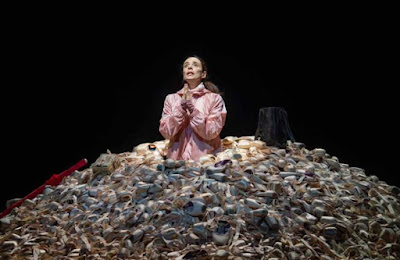
The first was a ballet amuse-bouche, only 70 minutes, but what a remarkable 70 minutes!  It was Maurice Béjart's L'HEURE EXQUISE from 1998, a dance adaptation of Samuel Beckett's HAPPY DAYS.  Becket without the words?  It sounds a stretch but the ballerina playing 'She' does speak occasionally, enough at least to put the piece into some context.

Actually I like HAPPY DAYS so I found it enjoyable but missed the profound quality that the play has: Winnie finds her life shrinking: buried up to her waist in earth but still able to apply her make-up, play with her parasol, sort through her capacious handbag - sure in the knowledge that the gun she has could be used in the last resort = and all the time chatting away to her husband Willie, just out of sight to her.  But all changes in the second half as she is now buried up to her neck, all she can access are her memories, but Willie is still there and she remembers the words to their love song "The Merry Widow waltz".

In L'HEURE EXQUISE, Winnie is now named She, an aging ballerina buried up to her waist in her old ballet shoes and as she chatters away to her partner He, she remembers her career.  Luckily for the audience, the mound of shoes parts and we watch She as she recalls dancing as a child to reaching success, dancing many roles and seemingly ending up in a vaudeville routine - all the time helped and hindered by He as her father / dance partner / manager.  Only three dancers have danced the role professionally: the late Carla Fracci who originated it, Maina Gielgud and now Ferri (under Gielgud's staging).

Ferri chose this to celebrate her 40th anniversary with The Royal Ballet which is no small achievement in the life of a ballet dancer - even one who is a prima ballerina assoluta.  In the 120+ years since the first assoluta was named there have only been thirteen dancers granted that title: there are three still living but only Ferri remains dancing.  She is simply glorious; when she dances you believe every gesture, every movement - she is an actress without needing words but here she handled both with ease.  She was partnered by Carsten Jung, ex-principal with the Hamburg Ballet.

Our second visit was to see the return to the Covent Garden stage of our favourite male dancer Steven McRae, it was a performance that we needed to see...  On 16th October 2019, we were overjoyed to see him on stage at Covent Garden again, after nearly two years injured.  We were nearly at the end of the 2nd Act of Kenneth MacMillan's MANON and McRae was dancing alone on the stage: two leaps, two pirouhettes - then he froze for a few seconds, and hopped into the wings as the curtains closed but not before hearing chilling, unforgettable howls of pain.  Kevin O'Hare, Director of the Royal Ballet, appeared onstage to confirm Steven was injured and would be replaced for the rest of the performance.

It later transpired that he had endured a full rupture of his Achilles tendon and we followed his slow, determined rehabilitation back to full dancing strength and here we were, two years after that ghastly night, to see him dance again.  Could he?  Would he?  

A massive cheer greeted his first appearance and as wonderful as it was to see him again, we were on the edge of our seats right up to the last chords of Prokofiev's score, but he absolutely triumphed.  Giving us a Romeo of passion and verve, Steven was greeted with an enormous ovation at the end. 

It must have been very special for him to share his return with his frequent stage partner Sarah Lamb who emotionally pushed him forward to take a solo bow and joined in the rapturous applause for him. Sarah Lamb was an exquisite Juliet, her grace and elegance turned by her secret love into determination and ultimately devastation.  What a marvellous partnership they have on stage!

MacMillan premiered ROMEO AND JULIET in 1965 with the iconic pairing of Margot Fonteyn and Rudolph Nureyev but it wasn't meant to be them.  He had created the roles for the younger Christopher Gable and Lynn Seymour but they were demoted to the second cast when demands for box-office names for the subsequent US tour won out - Gable and Seymour even had to help teach the more famous pair their roles due to time constraints in rehearsals.

The unhappy situation resulted in MacMillan leaving The Royal Ballet the following year but returned to be it's artistic director from 1970 to 1977 when he became it's principal choreographer until his death backstage during a revival of his MAYERLING in 1992.  Along with his other great works, ROMEO AND JULIET has remained in the repertoire and is still a glorious creation, it grips from the start with a thrilling choreographed sword fight in the city square which results in five bodies piled up centre-stage; in McMillan's Verona, danger is only a hair's breath away.

John B Read's lighting and the original evocative set design by the late Nicholas Georgiadis are still wonderful while McMillan's truly thrilling choreography is staged this time by Christopher Saunders and Laura Morera. Sergei Prokofiev's score sounded excellent played by the Opera House orchestra under the baton of Koen Kessels.

There was good support from James Hay and Bennet Gartside as Mercutio and Tybalt, Christopher Saunders was also a controlling Lord Capulet partnered by Elizabeth McGorin as Lady Capulet and Kristen McNally's bustling Nurse.  The night we saw it marked the 514th performance of MacMillan's masterpiece: here's to many more - and welcome back Steven!


Sunday, December 23, 2018

LES PATINEURS / WINTER DREAMS / THE CONCERT at Covent Garden - light and shade...

My last visit to the Royal Ballet this year was to see another of their mixed programmes, curated to celebrate three great choreographers: Frederick Ashton, Kenneth MacMillan and Jerome Robbins.  As usual it was also a perfect opportunity to show the breadth of talent across the Royal Ballet company.


First was Ashton's LES PATINEURS which debuted in 1937 and is set to music by the composer Giacomo Meyerbeer, a composer whose operas have fallen out the repertoire but his themes were wonderfully arranged by Constant Lambert into a fizzing, whirling delight.  At only 35 minutes it's an almost perfect cameo of ballet pleasure.  The Royal Ballet are still using the original designs by William Chappell and it almost took your breath away when first seen - a glorious Victorian Christmas illustration come to life, each colour popping off the stage.

A group of 15 dancers dance/skate across the stage in various combinations: a group of eight dancers in red and blue give way to three couples in reddish-brown, blue and white and a solo male dancer in blue, whose effortless spins and leaps supposedly were inspired by Ashton's admiration of another Fred, Mr. Astaire.  It was utterly captivating and is going to be revisited hopefully again sometime.  The ballet was a tribute to Ashton's dazzling vision and style - effortlessly elegant but with a grounding in pattern and technique.  The company were excellent but special mention to Luca Acri as the effervescent boy in blue.


The mood changed dramatically with MacMillan's WINTER DREAMS which uses Chekhov's THREE SISTERS for inspiration.  The ballet had it's first performance in 1991 and MacMillan said he did not want to do a literal ballet adaptation of the play but to use it as a template to explore the emotions of loneliness and longing.  MacMillan originally staged it as a pas-de-deux for Masha and Vershenin as part of a gala for the Queen Mother's 90th birthday and expanded it to make a full 55 minute one-act ballet.

It's been quite a while since I saw THREE SISTERS so I was a bit shaky as to who was who but the central theme of the isolation of the three sisters was palpable and they were danced beautifully by Itziar Mendizabal as Olga, Sarah Lamb as Masha and Yasmin Naghdi as Irina with fine support from Gary Avis as Kulygin and Vadim Muntagirov as Vershenin; he and Lamb danced the central pas-de-deux wonderfully.  As with all MacMillan's finest work, WINTER DREAMS had an ominous air of sadness about it and it's duel scene towards the end reminded me of MAYERLING with it's guns and figures under umbrellas.  I think however I would have liked to have seen it grouped with other ballets as the wrench from the gaiety of the Ashton piece to the MacMillan was a bit too jarring.  The ballet is set to music by Tchaikovsky and it sounded wonderful shared between Russian stringed instruments and Robert Clark's piano.


The last ballet was Jerome Robbins' THE CONCERT first performed by NY City Ballet in 1956.  Set to music by Chopin, a fussy concert pianist - Robert Clark proving to be a right trooper - plays to a small audience who spend more time fidgeting and daydreaming than they do just listening.  Their various personal thoughts are interrupted by the arrival of six ballerinas who attempt a pas de six but end up facing the wrong way or with the wrong arm raised etc.

It's a slight piece but made up a pleasing sandwich with LES PATINEURS for the more weighty WINTER DREAMS, and it was well performed by the company who communicated a sense of delight in being able to do comedy. 


The art of curating a mixed programme is a tricky one but I was delighted to have seen these three ballets in one sitting and see some favourite dancers in new roles.

Onto the 2019 season...!

Tuesday, December 04, 2018

Theatre of War: WAR HORSE at the Lyttelton Theatre; THE UNKNOWN SOLDIER Mixed Programme at Covent Garden

As was expected, the theatre also marked the Centenary of the end of Word War I in November and I saw two of the productions that marked the event.

First off was the more obvious one, the National Theatre's game-changing production of WAR HORSE which had been on manoeuvres around the country before reaching the Lyttelton Theatre stable for an extended stay until the start of January.


As Mr and Mrs World know by now, WAR HORSE is based on the novel by Michael Morpurgo about Albert Narracott who, although under-age, joins up to find his beloved horse Joey who has been sold to the army and is somewhere on the Western Front; while there boy and horse both experience the carnage of war at first hand.  I was lucky to see both the original 2007 production and the 2008 revival, both at the Olivier Theatre and both were very moving, involving productions - just ask Stephen Sondheim who was a blubbing wreck in 2007 on the night we went!

It then moved to the New London Theatre where it had an amazing run from 2009 to 2016.  Joey has since become a mainstay of many Remembrance celebrations, a genuine iconic presence.  I had such vivid memories of the show that it was a surprise that it was nearly ten years since I had seen it last so another visit was definitely on the cards.


The good news is that Marianne Elliott and Tom Morris' production - here re-directed by Katie Henry - still delivers the emotional crescendo which had the Lyttelton audience sobbing and sniffing and there are certain images that are indelible once you have seen them, however...  it is a given that no one really goes to see WAR HORSE for the cast's performances - Nick Dear's adaptation is more weighted towards Joey, his equine rival Topthorn and the Narracott's family goose - but even by these standards the anonymity of the performances was quite astonishing.

Thomas Dennis as Albert hardly registered and, as his irascible father Ted, Gwilym Lloyd huffed and puffed to very little effect.  There is also a very odd performance from Ben Ingles as the supposedly-sympathetic officer Lt. Nicholls who promises to care for Joey - it was nothing I could really pinpoint but I wouldn't trust him with a My Little Pony toy, let alone our plucky Joey.  Even the usual laugh-generator role of the f-ing Sgt Thunder went for nothing in Jason Furnival's hands.


However I would like to praise Peter Becker as the caring German officer Friedrich Muller who helps Joey and Topthorn when they are captured on the wrong side of No Man's Land, he at least convinced that Muller was a three-dimensional character.  Jo Castelton as Rose Narracott also found some depth as Albert's careworn but worried mother and the John Tams' songs were well sung by Bob Fox.

The best performances were unsurprisingly by the Handspring life-size puppets of Joey, both foal and horse, Topthorn and - yes - the goose.  The puppeteers invested them all with character and emotions which made it very easy to forget the actors and concentrate on them.  In particular, the scenes where  Joey and Topthorn were commandeered by the German army as pack-horses were full of unspoken pathos, none more so than Joey's gentle nuzzling of Topthorn as he dies, exhausted and broken.  The excellent touch of Topthorn's demise being made real by having his puppeteers slowly emerge from the puppet and slowly walking offstage is incredibly effective.


I did feel something was lost in the transfer to the proscenium stage but Rae Smith's spare design, Basil Jones and Adrian Kohler's remarkable puppet design and Paule Constable's lighting still delivered, as did Adrian Sutton's score.  I am glad I experienced WAR HORSE again, but just wish that most of the human cast had invested their roles with the passion that the puppeteers did.

A few days later we saw a more intriguing response to the Centenary, the Royal Ballet's premiere of THE UNKNOWN SOLDIER, which was part of a mixed programme with Wayne McGregor's INFRA and the late George Balanchine's SYMPHONY IN C.


The ballet took as it's inspiration the recorded memories of WWI veteran Wally Patch and a contemporary of his, Florence Billington, who in voice-over remember the quiet and lonely devastation they felt at the deaths of friends and a boyfriend respectively.  These spoken memories are interwoven with the lush, sombre score by film composer Dario Marianelli to create an absorbing soundscape to Alastair Marriott's choreography which illustrates the story of Florence and her beau Ted Feltham; from their meeting at a social dance before the war to his enlisting and subsequent death on the battlefield, cradled by Patch as he dies, to Florence receiving the news by telegram to Ted viewing it all from another place.

The ballet was visually stunning with a fractured, broken video playing on the scrim of contemporary footage of the call to arms in 1914 to the solemn procession of the coffin of the Unknown Soldier in 1920, which eventually raised to reveal Es Devlin's minimalist design of rotating flat panels which were played upon by Bruno Poet's stark lighting to create sweeping changes of tone across the stage while the reminiscences of Patch and Billington were heard.
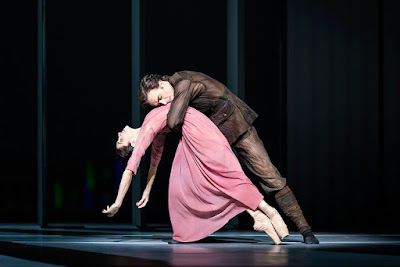

There were good performances from William Bracewell as Ted and Anna Rose O'Sullivan as Florence but in the cold light of day the ballet failed to move; Marriott's choreography was nice to watch but detracted from the pathos of the spoken testimony of individual loss.  There was no profundity in the thoughts behind the movements but more importantly the very real disconnect between the spoken remembrances of the Western Front's living Hell and the precision and athleticism of the male dancers was too strong to ignore.  The piece ultimately felt like there was no real artistic need for being there, it was a commission to fill a brief in the programming.  I also read somewhere the jibe that he can't be THE UNKNOWN SOLDIER if we know his name was Ted Feltham!

The three ballets in the mixed programme seemed to have been selected to counter-point each other, there was no linear connection between them other than to show off the versatility of the Royal ballet company.  McGregor's INFRA from 2008 had twelve dancers hyper-extending in solos and groups to McGregor's signature taxing choreography while above them Julien Opie's illuminated silhouettes walked in solipsistic silence left and right.  It's an obvious leap to get what McGregor is illustrating - the tortured souls underneath those anonymous walkers - but after a while you long for a resolution.  But always good to hear Max Richter's music...


But then the mood was turned on it's head again with George Balanchine's glorious SYMPHONY IN C, danced to the music of Georges Bizet.  Premiered in 1947 in Paris but extensively re-thought for New York City Ballet the following year, Balanchine drew on his extensive knowledge of the Russian classical tradition from his teenage years with the Imperial Ballet and from his years with the Ballet Russes in the 1920s.

Broken down into four movements with new performers for each, SYMPHONY IN C is a whirlwind extravaganza of pure classical technique: it's like every classical ballet finale with the narrative and named characters removed so you can just concentrate on solos, pas de deux and ensemble routines.  With over 50 dancers onstage as it reaches it's conclusion, it felt so impossibly sumptuous and showy that I almost expected a camera crane to swoop in and a director to yell "cut", such is it's feel of a Hollywood musical idea of a big ballet number.


The four couples were excellently danced by Natalia Osipova, Sarah Lamb, Reece Clarke, Marcelino Sambé, William Bracewell, Anna Rose O'Sullivan, Yuhue Choe and Luca Acri.  It was by far the most memorable piece of the evening and rather put the others in their place.

I would definitely see SYMPHONY IN C again, I am happy to have seen THE UNKNOWN SOLDIER and INFRA but think I would pass on seeing them again.  However as I said earlier, the mixed programme was a wonderful showcase for the talents of the whole Royal Ballet company.


Monday, April 16, 2018

Bernstein Triple Bill: YUGEN, THE AGE OF ANXIETY, CORYBANTIC GAMES at Covent Garden

Sometimes the Royal Ballet triple-bills can be a curate's egg but, every so often, all the pieces fall together and, while the individual one-acts dazzle, together they form a cohesive whole.  The Royal Ballet's recent celebration of Leonard Bernstein's centenary did just that.


Bernstein was such a giant of American music that it has taken three RB-favourite choreographers to stage this tribute: in tandem with Liam Scarlett's existing THE AGE OF ANXIETY, Wayne McGregor devised YUGEN and Christopher Wheeldon was given the final ballet CORYBANTIC GAMES.  All in their own way were exciting and Bernstein's soaring music sounded wonderful thanks to the Royal Opera House Orchestra.

Moving effortlessly between the classical and Broadway stages, Leonard Bernstein never forgot either as essential outlets for his creativity - indeed when a musical adaptation of THE SKIN OF OUR TEETH was abandoned because of creative differences, Bernstein reworked parts of the score to become a 1965 symphonic work which had been requested by the Dean of Chichester Cathedral two years earlier, waste not want not...  THE CHICHESTER PSALMS have been used by McGregor for his ballet YUGEN.


Utilizing his signature moves, McGregor had his dancers moving with vigour and astonishing physicality but also complementing the singing of the psalms in Hebrew.  The stark but intriguing design by Edmund De Waal of tall moving white light-boxes concentrated you on the remarkable dancers, as fluid as the red and purple costumes they wore.

I am sure it was just because it is the Bernstein score I know the most but I occasionally picked up the odd phrase that sounded straight out of WEST SIDE STORY in all three pieces.  I also saw a possible Matthew Bourne moment when a dancer did very noticeable swan-like swooping movements over three other crouching dancers.  McGregor can sometimes be all cerebral movement and little emotional involvement but here the lush musicality of Bernstein brought out the best in him, very much like Max Richter's music for WOOLF WORKS.


The second was a revival of Liam Scarlett's 2014 ballet THE AGE OF ANXIETY, written by Bernstein in 1949 and based on WH Auden's epic poem.  Bernstein's symphony throbs with the post-war feeling in New York of possible new beginnings under an air of lonely city living, Scarlett vividly moves his four lonely drinkers from a corner bar - an excellent design by John MacFarlane - to an apartment where they continue their drinking in the hope of making a connection.

They pal around, they flirt, they come together then break up leaving one of them, Malin, staring at the New York skyline at sunrise, eventually rushing towards it, ready to take up the challenge of another day, another possibility...  Sadly injury meant the wonderful Steven McRae had to pull out of the production and was replaced by fellow Aussie Alexander Campbell, but the lead quartet of Campbell, Sarah Lamb, Edward Gartside and Tristan Dyer were excellent, and Kevin Emerton was equally fine as the bartender.


After that blast of narrative, it was back to abstract for the last piece which was choreographed by Christopher Wheeldon.  He has set his ballet to Bernstein's Serenade after Plato's 'Symposium' - excuse me people - and the theme was carried through in Erdem Moralioglu's Hellenic-style costumes.  Through the five movements the constant theme seemed to be harking back to athletic running and leaping movement. 

I would love to see this again; Wheeldon's choreography was wonderfully alive, especially the 4th movement where a man and a woman, two men and two women danced variations to the same movements, perfectly embodying Bernstein's flowing music, before the whole ensemble at the end came together in kinetic, perfect fluidity.


As I said, the Royal Ballet triple bills may sometimes be unbalanced but in their tribute to Bernstein they triumphed.

Monday, November 27, 2017

THE ILLUSTRATED "FAREWELL" / THE WIND / UNTOUCHABLE at Covent Garden

Time for another triple bill from the Royal Ballet, they do come round with some regularity and I know there is another due in April.  Although these all had individual moments, they did not hang together as a whole.


On reflection the one I enjoyed most was Twyla Tharp's THE ILLUSTRATED "FAREWELL" which builds on an earlier ballet she choreographed in 1973 set to Haydn's 'Farewell' symphony.  That work was called AS TIME GOES BY but only used the final movements of the symphony; when invited to work for the Royal Ballet for the first time since 1995, Tharp leaped at the opportunity to choreograph the first two movements of 'Farewell' to flow into the older ballet.

The ballet was, for me, the most thrilling as the opening was danced by the marvellous partnership of Steven McRae and Sarah Lamb whose dancing flows and complements each other beautifully.  Gravity-defying leaps, standing pivots and intricate 'pop' movements that showed their effortless synchronicity well.  As well as being excellent dancers, they also convey real personalities and connect perfectly with the audience.


The older work is introduced soundlessly by the whirling, swirling Mayara Magri who is partnered by Joseph Sissons (who we saw as the tapping Mad Hatter in ALICE'S ADVENTURES IN WONDERLAND), and later groupings of five then ten dancers - with occasional appearances by Steven McRae and Sarah Lamb high above the stage, almost ghostly visions of the earlier music.  As I said, for the quality of pure dance, this was my favourite of the three.

Arthur Pita has only choreographed for the Royal Ballet's studio space so for his main stage debut he has gone for an "intimate epic" THE WIND.  Based in part on the original novel by Dorothy Scarborough and the Victor Sjostrom classic silent film which starred Lillian Gish, it certainly grabbed the attention but was over far too soon.  There was no character development and the plot climax was too garbled.  However I enjoyed it while I was watching it for Pita's stagecraft.


The ballet opened with the arresting image of billowing plastic sheeting blowing across the stage from massive jukebox-like fans which kept up the gale all through the act.  A ghostly-pale native American dances with and against the wind before ushering in the plot: young Letty arrives in a dust bowl western town - where the men are men and the sheep are frightened - and marries the taciturn and unemotional Lige. Letty was danced by the always extraordinary Natalya Osipova and she captured the uncertainty of a woman unable to fit into her environment.

Left alone by Lige, Letty is terrorized and later raped by the boo-worthy Wirt (the always-dependable Thomas Whitehead) and as she exacts her revenge on him, the constant howling wind finally snaps her grasp on reality and, watched by the mysterious figures of the native American and a bone-bleached frontier woman, walks into the howling night unafraid.


As I said, Osipova was enthralling as was Edward Watson as the ominous native American, but the piece was just far too short to get much involvement going and the large wind machines were just too modern and clunky for the period setting.  However special shout-out have to go to to the costumes by Yann Seabra which fluttered and whipped around in the constant gale and the lighting by Adam Silverman.

I certainly think I could take another chance to see THE WIND at some later date but hopefully they can find maybe 15 more minutes to allow for some engagement with the main role - maybe they could have trimmed some off Hofesh Shechter's interminable UNTOUCHABLE.  I am amazed it only ran 30 minutes, it seemed so much longer.  One cannot deny the talented 20 dancers onstage who moved in strict rhythm either en mass, as smaller groups or alone but, if truth be told, if I want to see a fascistic, militarist troupe go through their motions, I will watch Janet Jackson's video for RHYTHM NATION.


So there we are - one winner, one curiosity and one dud.  I don't suppose that's a bad batting average but I have seen more cohesive triple bills on the same stage, these three pieces simply didn't coalesce.  Maybe they need to roll the dice again and match them with other ballets?


Wednesday, April 12, 2017

JEWELS at Covent Garden - Balanchine's sparklers...

What?  Another night at the Royal Opera House?  Hey don't blame me, I have to go to make sure Owen doesn't climb onstage and jig about.


This time it was to celebrate the 50th birthday of George Balanchine's three part ballet based on the jewels he once saw on a visit to Van Cleef & Arpels.  Balanchine is credited with being the father of American Ballet but is also the template for the modern choreographer who can move between the worlds of ballet, dance, musical theatre and even film.

Born in St. Petersburg, Russia, Balanchine was the last choreographer hired by Sergei Diaghilev for his landmark company the Ballets Russes and after the impresario's death he struggled on with failing companies in Monte Carlo before making the move to the US where he flourished and found fertile ground for his exploration into abstract dance.


Indeed JEWELS is a necklace of short abstract ballets which had as a connecting thread three moments of dance development - EMERALDS is based on classical French ballet with languid movement to music by Fauré, RUBIES is pure 20th Century jazz ballet danced to music by Stravinsky and DIAMONDS is in the Russian Imperial style to music by Tchaikovsky.  It was certainly charming and showed the expertise of the Royal Ballet company but I found it an oddly disjointed affair.

EMERALDS as I said was all very languid but - and this might be a hangover from the contemporary dance seen recently - none of it seemed terribly exciting and the choreography seemed very - um - ok I'll say it - American.  It all seemed very ersatz and toothless, admittedly it did end interestingly with the four women leaving the stage slowly as the men knelt alone - as Owen opined "they have lost their emeralds" but it was all very dreary.  It was only the drama of a woman having a seizure in the row in front of me that stopped me dropping off.  She was ok after a while - but it did make me wonder how they get someone out of the precipitous amphitheatre seats if they conk out...


DIAMONDS was better only in so far as it contained a wonderful performance from Marianela Nunez as the lead ballerina in an extended pas-de-doux with Thiago Soares which must be exhausting to perform as to be honest it did outstay it's welcome for me.  Again one could not fault the performances of the company but it did ultimately - again - feel like a copy of a copy; a Las Vegas recreation of watching Pavlova.

The reason that these two nostalgic ballets felt so thin was because the middle section RUBIES was practically fizzing with inventiveness and wit!  Like a Van Cleef and Arpels necklace, tiny diamonds and emeralds surrounded a huzzing big glorious ruby slap-bang in the middle of the setting.


Vibrant and colourful, Balanchine's tribute to the American idiom of jazz ballet was the only one of the three pieces that felt original and with it's own inner dynamic which lit up the stage.  Stravinsky's 'Capriccio for Piano and Orchestra' jabs and pokes at you, keeping you - as well as the dancers - on your toes.  The delicious ruby-red costumes turn the stage incarnadine - there you go Virginia Woolf, I used one of your favourite words.  There is a very good reason why the poster art for this revival features the central couple from RUBIES - because they are sensational! 

The established partnership of Steven McRae and Sarah Lamb lit up the stage and not just because of their bejewelled costumes.  They gave the piece a real sense of personality and their style made it seem as if it was all coming naturally to them, belying the intensive training needed to achieve it.  Steven McRae's cheeky persona shone out but his dancing prowess was also in evidence as his dizzying pirouette into the wings at top speed attested to.  Sarah Lamb's extraordinary suppleness and grace thrilled with her gravity-defying extensions and spins.  They were complemented by Melissa Hamilton whose angular jazz movements suggested the influence that Balanchine had on Jerome Robbins and Bob Fosse.


Lamb and McRae's larger-than-life performances are what I will remember about JEWELS, two dancers at the top of their talent given the perfect showcase to dazzle.