Showing posts with label Kenneth MacMillan. Show all posts

Sunday, May 01, 2022

DVD/150: MANON (Ross McGibbon, 2018, tv)

Kenneth MacMillan's 1974 ballet of the notorious novel of lost innocence was greeted with critical disapproval but remains an audience favourite and was filmed during it's 2018 revival.

MacMillan wanted a new production to showcase both his stars and the Royal Ballet ensemble and the tragedy of Manon proved ideal.

Convent girl Manon meets student des Grieux at an inn and - obviously - fall in love immediately.  They flee to Paris as a rich man, Monsieur GM, approaches Manon's brother Lescaut offering money for her...

Despite her affection, Manon is enticed by Monsieur's riches.  This sets in motion a chain of events that lead to the high life but also transportation and death.

Any difficulty in emotionally engaging with the relentlessly shallow characters is offset by MacMillan's breathtaking choreograpy.

Sarah Lamb is sparkling but remote as Manon and Vadim Muntagirov matches her intensity in the couple's wonderful three pas de deux.

Shelf or charity shop?  Def shelf. Although the characters are never sympathetic, MANON is a wonderful tribute to the genius of MacMillan.  The supporting cast include classy performances from Itziar Mendizabel as Lescaut's salty mistress, Gary Avis exudes menace as Monsieur, and James Hay shines as the lead beggar in the opening scene.  Sadly Ryoichi Hirano is fairly one-note as the conniving Lescaut, his 'drunk' dancing in the brothel scene has been done better.  What is remarkable is that although Jules Massinet wrote an opera based on MANON, MacMillan chose to use a whole new score based around other music by the composer; it was done so skilfully by Leighton Lucas that you would never guess it was not a proper score.


Thursday, November 04, 2021

L'HEURE EXQUISE at The Linbury & ROMEO AND JULIET at Covent Garden

As you know Constant Reader, my final pre-lockdown theatre trip was to see the late Liam Scarlett's SWAN LAKE at Covent Garden so how odd it was to visit it again twice in as many days; a bit wary but we did it.  The main reason was to see two favourite dancers who illuminate The Royal Ballet company.

The first was a ballet amuse-bouche, only 70 minutes, but what a remarkable 70 minutes!  It was Maurice Béjart's L'HEURE EXQUISE from 1998, a dance adaptation of Samuel Beckett's HAPPY DAYS.  Becket without the words?  It sounds a stretch but the ballerina playing 'She' does speak occasionally, enough at least to put the piece into some context.

Actually I like HAPPY DAYS so I found it enjoyable but missed the profound quality that the play has: Winnie finds her life shrinking: buried up to her waist in earth but still able to apply her make-up, play with her parasol, sort through her capacious handbag - sure in the knowledge that the gun she has could be used in the last resort = and all the time chatting away to her husband Willie, just out of sight to her.  But all changes in the second half as she is now buried up to her neck, all she can access are her memories, but Willie is still there and she remembers the words to their love song "The Merry Widow waltz".
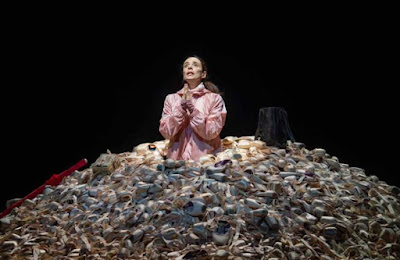
In L'HEURE EXQUISE, Winnie is now named She, an aging ballerina buried up to her waist in her old ballet shoes and as she chatters away to her partner He, she remembers her career.  Luckily for the audience, the mound of shoes parts and we watch She as she recalls dancing as a child to reaching success, dancing many roles and seemingly ending up in a vaudeville routine - all the time helped and hindered by He as her father / dance partner / manager.  Only three dancers have danced the role professionally: the late Carla Fracci who originated it, Maina Gielgud and now Ferri (under Gielgud's staging).

Ferri chose this to celebrate her 40th anniversary with The Royal Ballet which is no small achievement in the life of a ballet dancer - even one who is a prima ballerina assoluta.  In the 120+ years since the first assoluta was named there have only been thirteen dancers granted that title: there are three still living but only Ferri remains dancing.  She is simply glorious; when she dances you believe every gesture, every movement - she is an actress without needing words but here she handled both with ease.  She was partnered by Carsten Jung, ex-principal with the Hamburg Ballet.

Our second visit was to see the return to the Covent Garden stage of our favourite male dancer Steven McRae, it was a performance that we needed to see...  On 16th October 2019, we were overjoyed to see him on stage at Covent Garden again, after nearly two years injured.  We were nearly at the end of the 2nd Act of Kenneth MacMillan's MANON and McRae was dancing alone on the stage: two leaps, two pirouhettes - then he froze for a few seconds, and hopped into the wings as the curtains closed but not before hearing chilling, unforgettable howls of pain.  Kevin O'Hare, Director of the Royal Ballet, appeared onstage to confirm Steven was injured and would be replaced for the rest of the performance.

It later transpired that he had endured a full rupture of his Achilles tendon and we followed his slow, determined rehabilitation back to full dancing strength and here we were, two years after that ghastly night, to see him dance again.  Could he?  Would he?  

A massive cheer greeted his first appearance and as wonderful as it was to see him again, we were on the edge of our seats right up to the last chords of Prokofiev's score, but he absolutely triumphed.  Giving us a Romeo of passion and verve, Steven was greeted with an enormous ovation at the end. 

It must have been very special for him to share his return with his frequent stage partner Sarah Lamb who emotionally pushed him forward to take a solo bow and joined in the rapturous applause for him. Sarah Lamb was an exquisite Juliet, her grace and elegance turned by her secret love into determination and ultimately devastation.  What a marvellous partnership they have on stage!

MacMillan premiered ROMEO AND JULIET in 1965 with the iconic pairing of Margot Fonteyn and Rudolph Nureyev but it wasn't meant to be them.  He had created the roles for the younger Christopher Gable and Lynn Seymour but they were demoted to the second cast when demands for box-office names for the subsequent US tour won out - Gable and Seymour even had to help teach the more famous pair their roles due to time constraints in rehearsals.

The unhappy situation resulted in MacMillan leaving The Royal Ballet the following year but returned to be it's artistic director from 1970 to 1977 when he became it's principal choreographer until his death backstage during a revival of his MAYERLING in 1992.  Along with his other great works, ROMEO AND JULIET has remained in the repertoire and is still a glorious creation, it grips from the start with a thrilling choreographed sword fight in the city square which results in five bodies piled up centre-stage; in McMillan's Verona, danger is only a hair's breath away.

John B Read's lighting and the original evocative set design by the late Nicholas Georgiadis are still wonderful while McMillan's truly thrilling choreography is staged this time by Christopher Saunders and Laura Morera. Sergei Prokofiev's score sounded excellent played by the Opera House orchestra under the baton of Koen Kessels.

There was good support from James Hay and Bennet Gartside as Mercutio and Tybalt, Christopher Saunders was also a controlling Lord Capulet partnered by Elizabeth McGorin as Lady Capulet and Kristen McNally's bustling Nurse.  The night we saw it marked the 514th performance of MacMillan's masterpiece: here's to many more - and welcome back Steven!


Saturday, October 26, 2019

MANON at Covent Garden - High drama, emotion and tears - and a ballet too

It had been an evening I was looking forward to for several reasons: first to see again Kenneth MacMillan's dark and dangerous MANON which we first saw last year, and secondly we were finally to see the wonderful Steven McRae dancing the male lead of des Grieux as he was returning from injury.


Abbé Prévost published his novel of Manon Lescault in 1731 only to have the print run banned because of it's sexual subject but pirated copies made it hugely popular.  In the 20th Century it inspired seven silent and sound films, four operas, a Japanese musical and two ballets!  Kenneth MacMillan choreographed his for the Royal Ballet in 1974, the critics disliked it but the audiences loved it and here we are 45 years later and it is still in the repertoire.

MacMillan wanted his new creation to show off not only the Royal Ballet principals but to also showcase the ensemble, and MANON certainly does that.  It also gave him another chance to explore the presentation of dangerous, corrupted love through dance.  The score was commissioned by MacMillan from composer / conductor Leighton Lucas, compiled from works by Jules Massenet and it is a remarkable achievement as it does sound like a unified piece.


Young Manon, on her way to a convent, arrives at a Parisian tavern to meet her brother Lescault.  He notices a passenger watching her so Lescault escorts him inside to arrange a meeting.  Outside, Manon meets student des Grieux and it's love at first sight.  They flee but another rich man, Monsieur GM, approaches Lescault and offers him a reward for Manon.  They track the lovers to their lodgings and Manon chooses Monsieur's diamonds over des Grieux's love.  The four meet again at a debauched party and Manon lets des Grieux know she still loves him. Monsieur discovers des Grieux cheating him at cards and again the lovers flee but Monsieur appears with police to arrest Manon as a prostitute and he shoots Lescault in anger.  Deported to New Orleans as a prostitute, a lecherous gaoler attempts to rape Manon, but des Grieux, who has followed her to America, kills him and again they flee... but in the swamps of Louisiana their love reaches it's tragic climax.

Partnered with Akane Takada's well-danced but colourless Manon, Steven McRae provided his brand of vivid, charismatic dancing as des Grieux and it was a joy to see him back onstage after an injury-strewn year and a half.  He partially tore his Achilles tendon at the start of 2018 which nearly ended his dance career and at the start of this year he injured his knee on the set of the upcoming film of CATS.  All in all, we missed four productions he was due to appear in so seeing him back on the Covent Garden stage for the first time in nearly a year was a joy.


The lights came up for the last scene of the Second Act; Des Grieux has rescued the wayward Manon from the corrupt clutches of Monsieur but is unaware that his rival is closing in.  Alone on stage, McRae executed two small gazelle leaps and two relatively small pirouettes then stretched up... froze for a second or two... then limped into the wings with his right leg raised.  After a moment or two a stage manager came on and asked us for a moment while they sorted out a problem.  The curtains were quickly brought in but not before we, his shocked audience, could hear Steven's heartbreaking wails from backstage.

Kevin O'Hare, the Director of The Royal Ballet, appeared to tell us what we all suspected, that Steven had sustained an injury and would not be able to complete the performance.  Reece Clarke who had just appeared as a guest in the party scene was able to play des Grieux for the final scene of Act II and all of Act III.


The show continued and Clarke has to be applauded for stepping in at such short notice and be able to focus on his own performance knowing that everyone's minds were obviously elsewhere. Congratulations too for Akane Takada who had only 30 minutes to recalibrate her performance to partner the taller Clarke who has a different style of McRae - needless to say both received a big ovation at the curtain.

Any difficulty in emotionally engaging with MANON's relentlessly shallow characters is enveloped in the glorious sweep of MacMillan's vision, recreated here by Julie Lincoln.  Manon's world is still wonderfully realized by the late Nicholas Georgiades' designs; the design suggests that behind the opulent world that Manon aspires to is desperate poverty and danger where people can be discarded if they overstep their class or usefulness.


The supporting characters were all performed by the same dancers from last year and were still excellent: James Hay as Lescault was well-partnered in his drunken pas de deux by Yuhui Choe as his mistress, Thomas Whitehead was very hissable as Monsieur and Kristen McNally gave the procuress a suitably decadent panache.  I am really glad I saw MacMillan's masterpiece again but I wish it had been under happier conditions.

Steven McRae's injury was diagnosed as a full Achilles tendon rupture and he will have surgery in the week starting 28th October.  He is the king of positivity but at 33 he must have worries about his future.  Hopefully the operation and recovery will be successful and we can see this magical dancer for a few years more.  Steven posted the pictures of him and Akane Takada rehearsing the famous pas-de-deux from Act III which he did not get to perform on the night which is a shame as it looks amazing.

All best wishes Steven!


Sunday, April 21, 2019

ROMEO AND JULIET at Covent Garden - Grief so Brief

“O, swear not by the moon, th’ inconstant moon..." or your favourite dancers.

It is now four years since we discovered the Royal Ballet's wonderful repertoire and one of the first productions we saw was Kenneth MacMillan's classic Shakespeare adaptation ROMEO AND JULIET with Steven McRae dancing Romeo.  Steven soon became our favourite male dancer, a performer with real star quality, and when it was announced he was dancing the role again this year, tickets were snapped up.  However on his last day of filming CATS, McRae had a knee injury which required a surgical procedure.  "Romeo, Romeo... wherefore art thou Romeo?"  He's resting his knee that's where he is.  This is sad as we also missed him last year in SWAN LAKE and MANON through being out injured.  Anyway where were we?  Oh yes, "Two households both alike in dignity..."


McMillan's production originated in 1965, his first full-length work for the Royal Ballet.  He had expanded a pas-de-deux filmed for Canadian TV with the young pairing of Lynn Seymour and Christopher Gable and was determined they would be his original star-crossed lovers.  But the production was due to tour the USA after it's premiere and the American promoter wanted the star wattage of Margot Fonteyn and Rudolf Nureyev and the Royal Ballet management gave in, so Gable and Seymour were demoted to the second cast and even had to teach the two more famous dancers some of the moves which must have been particularly galling.  McMillan felt betrayed by the decision and left the Royal Ballet the next year to run the ballet company at the Deutsche Ballet in Berlin.  He would return to Covent Garden as the Artistic Director in 1970 but resigned seven years later to be the company's principal choreographer.

I still find it remarkable that a production can remain for 54 years in a repertoire - no matter how hard you look you will not find Franco Zeffirelli's MUCH ADO ABOUT NOTHING or Peter Wood's LOVE FOR LOVE at the National Theatre or Peter Hall's THE HOMECOMING at the Royal Shakespeare Company.  But it's a minor quibble as ROMEO AND JULIET is still a glorious creation, involving from the start with a thrilling choreographed sword fight in the city square which ends with five dead bodies piled up centre-stage, McMillan's Verona is always a hair's breath away from danger.


John B Read's lighting and the original evocative set design by the late Nicholas Georgiadis combine to give you an immediate understanding of place while McMillan's truly thrilling choreography is realized by Julie Lincoln and Christopher Saunders.  Sergei Prokofiev's score sounded excellent played by the Opera House orchestra under the baton of Paul Murphy.

Steven McRae's replacement was Ryoichi Hirano and Juliet was danced by Akane Takada - who always seems to be on when we visit.  Hirano was technically fine but was dramatically colourless; Takada embodied the full arc of Juliet, delicate and joyful at the start, troubled and passionate in love and death at the end.


As usual, there was fine support from James Hay and Bennet Gartside as the deadly rivals Mercutio and Tybalt, Kristen McNally and Thomas Whitehead were fine as Juliet's controlling parents, and there was great scene-stealing from the vivacious strumpets led by Itziar Mendizabal.

Despite Steven McRae's absence, ROMEO AND JULIET was wonderful to see again and to relive Kenneth McMillan's creative genius.


Sunday, December 23, 2018

LES PATINEURS / WINTER DREAMS / THE CONCERT at Covent Garden - light and shade...

My last visit to the Royal Ballet this year was to see another of their mixed programmes, curated to celebrate three great choreographers: Frederick Ashton, Kenneth MacMillan and Jerome Robbins.  As usual it was also a perfect opportunity to show the breadth of talent across the Royal Ballet company.


First was Ashton's LES PATINEURS which debuted in 1937 and is set to music by the composer Giacomo Meyerbeer, a composer whose operas have fallen out the repertoire but his themes were wonderfully arranged by Constant Lambert into a fizzing, whirling delight.  At only 35 minutes it's an almost perfect cameo of ballet pleasure.  The Royal Ballet are still using the original designs by William Chappell and it almost took your breath away when first seen - a glorious Victorian Christmas illustration come to life, each colour popping off the stage.

A group of 15 dancers dance/skate across the stage in various combinations: a group of eight dancers in red and blue give way to three couples in reddish-brown, blue and white and a solo male dancer in blue, whose effortless spins and leaps supposedly were inspired by Ashton's admiration of another Fred, Mr. Astaire.  It was utterly captivating and is going to be revisited hopefully again sometime.  The ballet was a tribute to Ashton's dazzling vision and style - effortlessly elegant but with a grounding in pattern and technique.  The company were excellent but special mention to Luca Acri as the effervescent boy in blue.


The mood changed dramatically with MacMillan's WINTER DREAMS which uses Chekhov's THREE SISTERS for inspiration.  The ballet had it's first performance in 1991 and MacMillan said he did not want to do a literal ballet adaptation of the play but to use it as a template to explore the emotions of loneliness and longing.  MacMillan originally staged it as a pas-de-deux for Masha and Vershenin as part of a gala for the Queen Mother's 90th birthday and expanded it to make a full 55 minute one-act ballet.

It's been quite a while since I saw THREE SISTERS so I was a bit shaky as to who was who but the central theme of the isolation of the three sisters was palpable and they were danced beautifully by Itziar Mendizabal as Olga, Sarah Lamb as Masha and Yasmin Naghdi as Irina with fine support from Gary Avis as Kulygin and Vadim Muntagirov as Vershenin; he and Lamb danced the central pas-de-deux wonderfully.  As with all MacMillan's finest work, WINTER DREAMS had an ominous air of sadness about it and it's duel scene towards the end reminded me of MAYERLING with it's guns and figures under umbrellas.  I think however I would have liked to have seen it grouped with other ballets as the wrench from the gaiety of the Ashton piece to the MacMillan was a bit too jarring.  The ballet is set to music by Tchaikovsky and it sounded wonderful shared between Russian stringed instruments and Robert Clark's piano.


The last ballet was Jerome Robbins' THE CONCERT first performed by NY City Ballet in 1956.  Set to music by Chopin, a fussy concert pianist - Robert Clark proving to be a right trooper - plays to a small audience who spend more time fidgeting and daydreaming than they do just listening.  Their various personal thoughts are interrupted by the arrival of six ballerinas who attempt a pas de six but end up facing the wrong way or with the wrong arm raised etc.

It's a slight piece but made up a pleasing sandwich with LES PATINEURS for the more weighty WINTER DREAMS, and it was well performed by the company who communicated a sense of delight in being able to do comedy. 


The art of curating a mixed programme is a tricky one but I was delighted to have seen these three ballets in one sitting and see some favourite dancers in new roles.

Onto the 2019 season...!

Saturday, November 03, 2018

MAYERLING at Covent Garden: McRae's back... and firing on all cylanders

He's back,, and the Royal Ballet's still got him!   After ten months away from the stage recovering from an injury, Steven McRae,the most charismatic of Royal Ballet male stars, is back and dancing up a storm!  However as one returns so another is up on bricks: Edward Watson who was due to dance the role of the tortured Crown Prince Rudolf for some performances in this revival has had to limp away injured.  I hope he recovers quickly.


Kenneth MacMillan's brooding masterpiece is now 40 years old but has lost none of it's power to unsettle - luckily there are two intervals for you to exhale after the pressure-cooker atmosphere his choreography engenders.  The bleakness of the tale of Crown Prince Rudolf and his teenage mistress Mary Vetsera casts a strange, disturbing atmosphere.

Rudolf was a death-obsessed womanizer addicted to morphine and addled with syphilis. His politically expedient marriage to Princess Stephanie of Belgium left both miserable but his wish to separate was refused by his parents Emperor Franz Josef and Empress Elizabeth which was jaw-dropping hypocrisy as they both had lovers and lived separate lives.


Countess Marie Larisch, a former mistress and one of his mother's ladies-in-waiting, knew Mary Vetsera's mother and, as they both wanted advancement at court, they affected an introduction between the 30 year-old Prince and 17 year-old Mary, who was obsessed with him.  After a secret three month affair, he invited her to the royal hunting lodge of Mayerling.  Mary probably knew why - she left a letter saying they were going together into an uncertain beyond - but the result was two dead bodies and a revolver.

MacMillan's ballet begins and ends with Vetsera's secret, moonlit burial in a monastery cemetery - in real-life a ghoulish affair where her corpse was driven in a carriage to the site, wedged between her two uncles with a broomstick pushed down the back of her coat and a hat covering the bullet wound in the back of her head.  Her uncertain beyond was to be written out of history initially while Rudolf was mourned supposedly dying of a heart rupture.  But eventually their dangerous liaison was revealed...


Thankfully Kenneth MacMillan wasn't in the mood to make Rudolf and Mary tragic victims of a devastating love or a cruel world who refused them happiness as in the film versions of the story; all the characters in his ballet are presented with a clear-eyed realism which makes it hard to sympathize with them but you remain riveted as the lovers pirouette closer to their abyss.

Steven McRae was remarkable as the narcissistic Rudolf, seeming to dance at times to crazed music playing in his own head, emanating an icy disdain for all around him seemingly not connecting with anyone, you suspect that for McRae's Rudolf even Vetsera was simply a means to an end.


Akane Takada danced the role of Mary and did so with a technical precision but I never felt any particular heat from her, the last time I saw it Lauren Cuthbertson danced the role and had been violently passionate.  Meaghan Grace Hinkis was a suitably scared Princess Stephanie and there was the usual very good work from Kristen McNally as the Empress Elizabeth and Laura Morera as the scheming Countess Marie Larisch. 

It's a ballet where the best roles are the women's but Luca Acri was very good as Bratfisch, Rudolf's coach-driver, who has a great solo in the tavern scene which he repeats for the doomed couple in the final scene but falters and stops when he realizes nothing can distract them from their deadly solipsism.


The revival is again staged by Christopher Saunders, Grant Coyle and Karl Burnett and the late Nicholas Georgiades set designs are still wonderfully evocative. However it's the presence of MacMillan that pervades the whole production, for both his artistic and choreographic brilliance and the sadder thought that it was during a 1992 revival of MAYERLING that he collapsed and died alone backstage at Covent Garden from a heart attack.

Saturday, May 12, 2018

MANON at Covent Garden: Love, Death and MacMillan

In 1731 Abbé Prévost published "L'Histoire du Chevalier des Grieux et de Manon Lescault" to instant notoriety and it's print run banned in France.  Pirated copies filtered out to an eager public and Prévost's tale of the tragic love affair of Manon and des Grieux went on to inspire writers and to be referenced in novels such as "The Lady of The Camillias", "The Red and The Black", "Venus In Furs" and "The Portrait of Dorian Gray".

The tale is also the basis of seven silent and sound films, four operas, a Japanese musical and two ballets!  The last of these dance versions was choreographed by the great Kenneth MacMillan for the Royal Ballet in 1974 and although it was greeted with unfavourable reviews, it became an instant hit with audiences and last week I saw it's 274th performance at Covent Garden.


MacMillan had been looking for a new, sweeping ballet which would show off not only the Royal Ballet stars but also give the ensemble a chance to shine, and the teaming locations of Manon and des Grieux's love proved ideal.  It was to be the first original work after his controversial ANASTASIA and it can be seen as a further exploration of where the physical boundaries were for the female and male dancers of his time (and after).

"Manon Lescault" had been suggested to MacMillan as a subject by the designer Nicholas Georgiades although it had been on the choreographer's mind since it had been mooted to the previous Royal Ballet supremo Sir Frederick Ashton but he had rejected it as he felt it was too close to his "Camille" ballet MARGUERITE AND ARMAND.  There's only so many demi-mondaines to go around...


MacMillan asked composer and conductor Leighton Lucas to compile a score from the work of Jules Massenet whose opera version of the tale was in the Royal Opera repertoire and it is a remarkable achievement as it does seem like a whole unified score.

I will agree with the criticism levelled at the piece that it's hard to feel totally engaged with the characters but maybe it is down to the performers dancing on any given night, I am sure if Steven McRae had been dancing des Grieux I would have been more involved in his character but he was unable to dance due to an injury.  Instead we had fellow-Australian Alexander Campbell as des Grieux and Akane Takada as the eponymous anti-heroine.


Young Manon is on her way to a convent when her coach stops at a bustling inn outside Paris; there she meets her brother Lescault who promptly notices a fellow-passenger is lusting after her, Lescault, an enterprising heel, takes the passenger into the inn to sell his sister to him.  In the courtyard Manon meets young student des Grieux and the pair - of course - fall in love at first sight.  They decide to flee to Paris immediately, leaving Lescault high and dry - and the old man penniless as Manon has stolen his money!  Another rich man, Monsieur GM, approaches Lescault and offers a reward if he too can have Manon.  Lescault takes up the challenge...

In Paris, Manon and des Grieux are living in his lodgings and, despite their obvious love for each other, as soon as Lescault and Monsieur GM track her down and entice her with Monsieur's riches Manon chooses diamonds over love.  Some time later, at a debauched party at a brothel, the four meet again and Manon intimates to des Grieux that she still loves him.  Attempting to deprive the rich man of his cash, des Grieux is discovered cheating at cards and they flee to his lodgings, where Monsieur appears with police to arrest Manon as a prostitute; in the melée Lescault is killed.


Deported to New Orleans as a common prostitute, Manon is singled out by a lecherous gaoler, but des Grieux, who has followed her to America, murders the gaoler and, again, the couple are on the run but in the shadowy swamps of Louisiana their love reaches it's tragic climax.

Any difficulty in emotionally engaging with the relentlessly shallow characters is offset by the glorious sweep of action that MacMillan conjures - his production is recreated here by Christopher Saunders and Julie Lincoln.  MacMillan's wish that his MANON would showcase the ensemble is fulfilled as they give colour and life to Manon's world.  Georgiades' designs also help MacMillan's subtext that the opulent world that Manon aspires to sits like a bubble on top of a society of desperate poverty and danger, his sets are always juxtaposed against backdrops of decaying clothes hanging as silent witnesses to the corrupt world of Monsieur GM, where people can be discarded if they overstep their class or usefulness.


As I said, while technically excellent, Takana and Campbell were low on star wattage but the pas de deux that define their relationship were thrilling to watch: full of the passion and desire of new love, then more hesitant and incomplete as Manon wavers between the worlds of love and wealth, then the desperation of love in the face of death.

The supporting performances shone brighter: James Hay was excellent as the opportunistic Lescault and was well partnered by Yuhui Choe as his mistress, Thomas Whitehead brought his own air of menace to the lethal Monsieur GM and Kristen McNally also gave the Madame a suitably decadent panache.


MANON, an enduring testament to the genius of Sir Kenneth MacMillan.

Friday, January 26, 2018

SONG OF THE EARTH / LA SYLPHIDE at the London Coliseum

Much to my surprise, my first ballet of 2018 was not at the Royal Ballet or a Matthew Bourne at Sadler's Wells, no it was at the infrequently-visited English National Ballet at the London Coliseum who were presenting an intriguing double-bill of Kenneth MacMillan's SONG OF THE EARTH and the classic romantic ballet LA SYLPHIDE.


It all made for a pleasant and enjoyable evening but both ballets seemed to lack *that* spark or *that* bass note that is found in practically all Royal Ballet productions.  It was all very well-danced but the connection of deep emotion and movement just seemed to be lacking.

In 1965 Kenneth MacMillan choreographed his dance version of Gustav Mahler's song cycle "Das Lied von der Erde" for the Stuttgart Ballet at the invitation of the company's director John Cranko who was an admirer of MacMillan's work.  His vision is based around a man, a woman and a figure representing death who slowly perform solos and pas de deux within a larger ensemble until the figure of death claims the man, but as MacMillan said they "find that in death there is the promise of renewal".


His production was a huge success and eventually opened at the Royal Ballet six months later to equal acclaim, a particular triumph for MacMillan who had wanted to stage it at Covent Garden six years previously but was told the music was wrong for a ballet!  SONG OF THE EARTH famously provided the swansong for Darcey Bussell when she left the Royal Ballet in 2007, the event even being broadcast live on BBC2.

Tamara Rojo was captivating as The Woman while Joseph Caley as The Man and Fernando Carratalá Coloma as The Messenger of Death gave good performances too.  I loved the austere beauty of the production and any occasional lapses I had during it I think can be attributed to that indefinable something that separates the good from the very good.  I would definitely see another production of it again.


After the lyrical and austere symbolism of SONG OF THE EARTH, it was time for the over-the-top narrative romanticism of LA SYLPHEDE - it was quite a wrench!

I have two memories of LA SYLPHIDE - seeing HIGHLAND FLING, Matthew Bourne's modernised take on it in 1994 as well as, and I remembered this just as the curtain went up, having a Walt Disney album when I was growing up of famous pieces of ballet music which had music from LA SYLPHIDE included on it... the memory eh?


LA SYLPHIDE first appeared as a ballet in 1832 in Paris by the choreographer Filippo Taglioni whose equally famous daughter Marie danced the lead role.  Four years later the Danish choreographer August Bournonville wanted to stage it at the Royal Danish Ballet but, when faced with an inflated price by the French for the original score, he simply choreographed his own version to a new score by the Norwegian composer Herman Severin Lovenskiold.  Bournonville's version has been the production that has lived on - indeed this production was from the Royal Danish Theatre - while Taglioni's choreography has vanished from public memory. 

Both were based on an 1822 gothic romantic novel by the French writer Charles Nodier which set the template for Romantic ballets with doomed love, winsome heroines, strapping heroes and flurries of ghostly spirits.


James, a young Scottish man, is asleep on the eve of his wedding day but watched over by a Sylph that adores him.  He awakes but she vanishes before his eyes, he questions his friend who saw nothing but readies himself for the arrival of his bride Effie and her family and their friends.  He thinks he sees the Sylph again but it is an old witch who prophesies that Effie will marry James' best friend.  Finally the Sylph appears again and realizing he loves the ghostly creature, James follows her into the woods, leaving the wedding party in disarray.

Once in the woods the old witch conjures up a cursed diaphanous shawl just as James and The Sylph appear.  The Sylph summons her ghostly ensemble of sisters who dance for the couple but they are eventually interrupted by the wedding guests.  They all leave when James' friend proposes to Effie who accepts.  The witch gives James the shawl to wind around the Sylph but when he does he inadvertently destroys her.  After watching her being lifted to the heavens, James dies.


Unlike the more sombre GISELLE which premiered five years after Bournonville's production, LA SYLPHIDE cannot help but look a bit overwrought and unintentionally lame with it's reliance on over-the-top mimed gestures between the lead characters but it has a charm and what's not to love with a stage crowded with a female ensemble, moving as one in long tutus and wings?

Although the performances of Erina Takahashi as the Sylph and Ciro Tamayo as James were full of light and airiness, again I felt I would have gained more if the Royal Ballet had been dancing it; yes it should be lightweight but there should also be some gravitas in the peril James and the Sylph find themselves in which was lacking here.


However, as an introduction to the two ballets, it more than served it's purpose and I enjoyed the double-bill as such... and it was nice to recall the Disney l.p. too!