Showing posts with label Samuel Beckett. Show all posts

Thursday, November 04, 2021

L'HEURE EXQUISE at The Linbury & ROMEO AND JULIET at Covent Garden

As you know Constant Reader, my final pre-lockdown theatre trip was to see the late Liam Scarlett's SWAN LAKE at Covent Garden so how odd it was to visit it again twice in as many days; a bit wary but we did it.  The main reason was to see two favourite dancers who illuminate The Royal Ballet company.

The first was a ballet amuse-bouche, only 70 minutes, but what a remarkable 70 minutes!  It was Maurice Béjart's L'HEURE EXQUISE from 1998, a dance adaptation of Samuel Beckett's HAPPY DAYS.  Becket without the words?  It sounds a stretch but the ballerina playing 'She' does speak occasionally, enough at least to put the piece into some context.

Actually I like HAPPY DAYS so I found it enjoyable but missed the profound quality that the play has: Winnie finds her life shrinking: buried up to her waist in earth but still able to apply her make-up, play with her parasol, sort through her capacious handbag - sure in the knowledge that the gun she has could be used in the last resort = and all the time chatting away to her husband Willie, just out of sight to her.  But all changes in the second half as she is now buried up to her neck, all she can access are her memories, but Willie is still there and she remembers the words to their love song "The Merry Widow waltz".
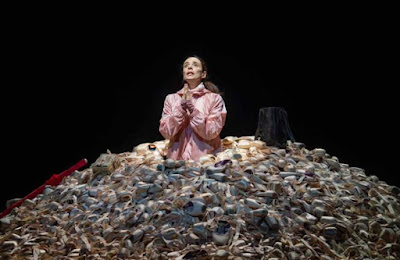
In L'HEURE EXQUISE, Winnie is now named She, an aging ballerina buried up to her waist in her old ballet shoes and as she chatters away to her partner He, she remembers her career.  Luckily for the audience, the mound of shoes parts and we watch She as she recalls dancing as a child to reaching success, dancing many roles and seemingly ending up in a vaudeville routine - all the time helped and hindered by He as her father / dance partner / manager.  Only three dancers have danced the role professionally: the late Carla Fracci who originated it, Maina Gielgud and now Ferri (under Gielgud's staging).

Ferri chose this to celebrate her 40th anniversary with The Royal Ballet which is no small achievement in the life of a ballet dancer - even one who is a prima ballerina assoluta.  In the 120+ years since the first assoluta was named there have only been thirteen dancers granted that title: there are three still living but only Ferri remains dancing.  She is simply glorious; when she dances you believe every gesture, every movement - she is an actress without needing words but here she handled both with ease.  She was partnered by Carsten Jung, ex-principal with the Hamburg Ballet.

Our second visit was to see the return to the Covent Garden stage of our favourite male dancer Steven McRae, it was a performance that we needed to see...  On 16th October 2019, we were overjoyed to see him on stage at Covent Garden again, after nearly two years injured.  We were nearly at the end of the 2nd Act of Kenneth MacMillan's MANON and McRae was dancing alone on the stage: two leaps, two pirouhettes - then he froze for a few seconds, and hopped into the wings as the curtains closed but not before hearing chilling, unforgettable howls of pain.  Kevin O'Hare, Director of the Royal Ballet, appeared onstage to confirm Steven was injured and would be replaced for the rest of the performance.

It later transpired that he had endured a full rupture of his Achilles tendon and we followed his slow, determined rehabilitation back to full dancing strength and here we were, two years after that ghastly night, to see him dance again.  Could he?  Would he?  

A massive cheer greeted his first appearance and as wonderful as it was to see him again, we were on the edge of our seats right up to the last chords of Prokofiev's score, but he absolutely triumphed.  Giving us a Romeo of passion and verve, Steven was greeted with an enormous ovation at the end. 

It must have been very special for him to share his return with his frequent stage partner Sarah Lamb who emotionally pushed him forward to take a solo bow and joined in the rapturous applause for him. Sarah Lamb was an exquisite Juliet, her grace and elegance turned by her secret love into determination and ultimately devastation.  What a marvellous partnership they have on stage!

MacMillan premiered ROMEO AND JULIET in 1965 with the iconic pairing of Margot Fonteyn and Rudolph Nureyev but it wasn't meant to be them.  He had created the roles for the younger Christopher Gable and Lynn Seymour but they were demoted to the second cast when demands for box-office names for the subsequent US tour won out - Gable and Seymour even had to help teach the more famous pair their roles due to time constraints in rehearsals.

The unhappy situation resulted in MacMillan leaving The Royal Ballet the following year but returned to be it's artistic director from 1970 to 1977 when he became it's principal choreographer until his death backstage during a revival of his MAYERLING in 1992.  Along with his other great works, ROMEO AND JULIET has remained in the repertoire and is still a glorious creation, it grips from the start with a thrilling choreographed sword fight in the city square which results in five bodies piled up centre-stage; in McMillan's Verona, danger is only a hair's breath away.

John B Read's lighting and the original evocative set design by the late Nicholas Georgiadis are still wonderful while McMillan's truly thrilling choreography is staged this time by Christopher Saunders and Laura Morera. Sergei Prokofiev's score sounded excellent played by the Opera House orchestra under the baton of Koen Kessels.

There was good support from James Hay and Bennet Gartside as Mercutio and Tybalt, Christopher Saunders was also a controlling Lord Capulet partnered by Elizabeth McGorin as Lady Capulet and Kristen McNally's bustling Nurse.  The night we saw it marked the 514th performance of MacMillan's masterpiece: here's to many more - and welcome back Steven!


Saturday, October 15, 2016

NO'S KNIFE at the Old Vic - Bleak Beckett

One of the most thrilling theatrical events last year was seeing Lisa Dwan performing the three Beckett monologues NOT I, FOOTFALLS and ROCKABY, so when it was announced that she was going to appear this month at the Old Vic in Beckett's NO'S KNIFE I was very keen to see it.


After a particularly awful week - including walking out of the dreadful TWO GENTLEMEN OF VERONA at the Globe - boy, did I want to drown in Beckett's particular brand of existential nihilism.  NO'S KNIFE didn't disappoint in that respect, but maybe it did in other ways.

Lisa Dwan doesn't make things easy for either herself or us - NO'S KNIFE is a 70 minute monologue which is based on a collection of Beckett's writings published in 1967 under the title TEXTS FOR NOTHING.


In five 'movements', a voice calls out from another place, of the earth but not of the earth; possibly beneath the earth, buried in a peat bog, by turns wheedling, aggressive, plaintive, argumentative, lonely, lost.  That voice is personified by Dwan, who is first seen squeezed into a crack in a rocky landscape, then appearing, Lear-like, on a blasted heath.  She then appears floating above the stage and finally walks down from the stage to address us close-up.

She is a mesmerizing actress who knows how to hold an audience, but dear God, most of the Old Vic audience felt they should make it an interactive event; every time the lights dimmed to signal the end of a particular 'act' off they went: COUGH HACK SPLUTTER COUGH COUGH... it was utterly absurd and totally disrespectful to Dwan.


Co-directed by Dwan and Joe Murphy, the production had a haunting other-worldly look from both set designer Christopher Oram and lighting designer Hugh Vanstone, and their vision was also helped by a mood-setting video piece from Andrzej Goulding...

...but, but, but... why did it leave me cold whereas NOT I, FOOTFALLS and ROCKABY totally gripped me?  I think the answer is somewhere in the fact that these texts were never really meant to be performed in the theatre.  Beckett wrote them as literary pieces although he did allow them to be read on radio in 1974 by Beckett stalwart Patrick Magee, in a hushed non-theatrical style.


Beckett was an individual playwright, everything distilled down to the absolute essence but more importantly, he wrote them to be presented in the theatre for a reason.  I am sure if Beckett had wanted these writings to be theatrical he would have made them so; this had the vague feeling of "let's do these to give Lisa Dwan another chance to do Beckett monologues on stage".  We were there to listen but not to see.

Dwan is such a remarkable performer however that she made the enterprise worthwhile - I wonder when she will get around to HAPPY DAYS?


Tuesday, June 16, 2015

NOT I ~ FOOTFALLS ~ ROCKABY: BECKETT AT THE BARBICAN

Some theatre visits you look forward to more than others and ever since I booked to see the three Samuel Beckett monologues NOT I, FOOTFALLS and ROCKABY I had been getting more and more excited as the day got nearer.


Cut to the day of the show and I was excited - even sitting in the Pit Theatre at the Barbican waiting for it to start in the blacked-out auditorium which is the setting for NOT I, I was genuinely, butterflies-in-stomach excited... and I have not felt that for a production in quite a while.  I was not disappointed.

So what had made me get in such a tremulous state?  It was the fact that this was the first time I have ever experienced these monologues live.  I had seen Billie Whitelaw's filmed versions from the 1980s but to see them live is the best way to experience them although, with the sad news of Billie's death in December still fresh in my mind, it was always going to be emotional, especially as the actress Lisa Dwan had been coached by Billie when she first started the trilogy - Billie almost conducting her in rehearsals just as Beckett had done with her.


With the exit signs covered up and with all the house lights off we were plunged into pitch blackness and the tension that had been building up as the house manager read us 'the rules' for watching the plays suddenly ratcheted up.  Straining to hear something, anything, soon we heard the black curtains swish apart and slowly a single spotlight revealed a pair of vivid red lips hovering high above the stage.

The mouth started the monologue with it's lightning-fast delivery -  Beckett wanted to suggest the speed of thought aloud - and it was one of the most thrilling, dazzling things I have ever experienced.  I am aware that I am saying 'experienced' a lot but that is exactly what it felt like, not simply observing a performance passively but watching in awe and some slight feeling of terror.


The mouth - surely the inspiration for the opening of THE ROCKY HORROR PICTURE SHOW! - jabbers away for nearly ten minutes, moving forever onwards deeper into oblique memories but repeating, words, phrases again and again only to be admonish itself with the shouted statement "What.... who.... no..... SHE!"  Remarkably for what it is, there was every opportunity for the odd laugh as Lisa Dwan found the humour in Mouth's rattling prattling.

Slowly the music and the poetry take you over and you begin to formulate an idea - a woman is unloved from her premature birth and at a certain point while in a field she found herself lying on the ground with a relentless buzzing in her ears.  An illusion to a courtroom is there too but your mind races to make sense of what you are hearing and just as soon as you feel submerged by it all, the light fades and the voice is stilled.


It was quite, quite breathtaking, a theatre experience like none other.  The power of theatre to make an indelible visual image,  the playwright's words as sonic overload while also you are aware of the humanity of the performer who is having to deliver it.  Billie Whitelaw in her autobiography writes of the physical endurance of performing NOT I, the first time she was left an emotional wreck during the dress rehearsal, so much so that Beckett left the Royal Court and didn't return for several days to relieve some of the pressure that his presence had added to and she admits that although she did it two years later, again at the Court, that the experience changed her forever.

The physical endurance for Whitelaw included being strapped into a chair to perform it with clamps on either side of her head to hold it steady for the spotlight.  Lisa Dwan goes through a similar ordeal, standing with her head held in place by straps and with her arms pressed behind a bar to keep the tension going through her.


Back to the blackness for a short pause - broken by low, ominous rumblings - and the curtains swished aside again for the lights to dimly reveal Dwan in a long white dress, her arms held in a locked embrace in front of her, walking to and fro, nine steps back and forth, with the dull clumping of her heels on the wooden platform announcing the arrival of FOOTFALLS.  Dwan, shimmered pearl-grey in the dim light.

A woman, May, walks back and forwards outside the room of her mother who we assume is dying but May walks and walks as the mother's voice tells us that her daughter has walked back and forwards like that since a child.  A single hollow bell announces a break in the monologue and each time it starts May gets slower and more deliberate in her pacing. The mother addresses us, then May telling the story of a woman called Amy.  Is the mother dead?  Is May dead?  Does her ghost walk the house where they both died?  In the last 'stanza' the dim light comes up to reveal that May has vanished.


After the explosive NOT I, the deliberate pacing (no pun intended) of FOOTFALLS did mean that it felt excessively long and I found myself drifting once or twice.

Billie Whitelaw says in her book that while in rehearsals for FOOTFALLS in 1976, again at the Royal Court, she asked Beckett the only question she ever asked him about his plays, "Am I dead?"  He slowly replied "Well, let's just say you are not quite there".


After being consumed by the darkness again the curtains swished apart for the last time to reveal Dwan, this time as the old woman who inhabits ROCKABY, slowly rocking away in her rocking chair, dressed in her ornately embroidered Edwardian-style black dress.  It is similar in tone to FOOTFALLS as we watch a faded figure of a woman slowly edging towards death, perfectly still apart from the rocking of the chair and the circling thoughts in her head "close of a long day" and "time she stopped, time she stopped".

Every so often, at the beginning of a new 'stanza', the woman will open her eyes and implore for "More...", for what?  More time? More memories?  Slowly the rocking chair comes to a halt and the woman slowly stops too.  Again, Beckett gives us an arresting visual image but unlike the longer FOOTFALLS, ROCKABY feels just right, the perfect length for the profound poetry.


I wondered whether Lisa Dwan would actually take a curtain call, would that break the spell that had been woven through the three plays?  But she did and as she bowed and smiled it was like we were all congratulating having come through the pure existance of Beckett's women into the light - literally so as it was very disconcerting to leave the Barbican and walk out into warm sunny weather.

Thank you Sam, thank you Billie, thank you Lisa.

"And the end came.  Close of a long day...".


Sunday, February 22, 2015

HAPPY DAYS at the Young Vic

A woman is buried up to her waist in a mound of earth exposed to the strength of the sun, a loud harsh bell wakes her up and announces when she should sleep, her meager, nearly depleted possessions are in a nearby bag while her uncommunicative husband remains on the other side of the mound just out of her eyesight but still she can tell herself:

"Oh this is a happy day, this will have been another happy day.  After all.  So far."


Samuel Beckett's HAPPY DAYS is truly one of the great roles for any actress: actors may have the Shakespearean kings to look forward to as they get older, women have Winnie in HAPPY DAYS.

I had never seen the play before but I read it two years ago so was disappointed that Natalie Abrahami's Young Vic production last year sold out quickly.  However it has now been revived so jumped at the chance to finally experience the play's power in person - which is how HAPPY DAYS should be experienced.


Beckett wrote the English version of HAPPY DAYS in 1961 (he would also write a French version as was his custom) and the part was first played on the London stage by Brenda Bruce.  In 1976, Peggy Ashcroft played it at the National Theatre and she reflected that Winnie "was a part that actresses will want to play in the way that actors aim at HAMLET - a summit part".  Beckett told Brenda Bruce that who could cope with all that Winnie has to and still go down singing but a woman?

1n 1979 Beckett directed a revival at the Royal Court with his favourite interpreter. Billie Whitelaw.  She later wrote that when she read it for the first time she wondered "how this man could have written the story of my life so long before he knew me?"  For Winnie, does in her extreme state, what we all do - we get through the day as best we can.  We chatter about what is around us and recollect memories to keep the darkness at bay.  


Beckett actually left the rehearsals for two weeks as their intense one-to-one method was, for the first time, beginning to stress Billie out.  She contacted Brenda Bruce and asked did she feel that after doing HAPPY DAYS she could learn anything?  No, said Bruce, after HAPPY DAYS she felt like she could never learn anything again.

Luckily, Whitelaw's performance was filmed by the BBC and can be seen on YouTube in an uncomfortable tape-to-digital transfer - come on BBC, get this remastered and available on dvd.  However even during filming Whitelaw was put through the mill as she was recovering from the flu and had to have cortisone injections on the day of filming to get through it.  Seeing this revival only two months after Billie Whitelaw's death made it all the more moving.


In Natalie Abrahami's production which wonderfully balances the humour and the tragedy, Juliet Stevenson was simply astonishing as Winnie, her bright, optimistic chatter as she goes through the pattern of her day only clouding over when her fears overtake her: that she is an object of ridicule to a couple who pass by, that Willie will one day not be there to answer her with his monosyllabic answers.

Her parasol catches fire in the heat of the sun, her medicinal tonic runs out, her toothpaste is nearly squeezed out but still Winnie chatters away, playing with both the revolver and the music box in her bag.  And she has her half-remembered quotations and memories: a ball she attended with Willie, a kiss in a garden shed when young, a little girl frightened by a mouse while undressing her doll under a table at night.  


In the second act, she is in even more dire straits as she is now buried up to her neck, kept awake by the insistent loud bell and blanched by the heat of the sun.  Although her regimented emptying of her bag's contents is lost to her, she can still see it and there is Willie.  After all.  So far.

Dwarfed by Vicki Mortimer's rockface set with it's path of trickling pebbles and deprived of bodily expression, Stevenson mesmerised with her croaking voice and facial reactions and at the play's climax, when David Beames' decrepit Willie crawls across the ground in his (wedding?) suit to collapse in front of her, she broke my heart with her whispered singing of her music box tune 'The Merry Widow Waltz':

"Every touch of fingers
Tells me what I know,
Says for you,
It's true, it's true,
You love me so"


Wednesday, October 27, 2010

The persistence of Memory is at the heart of Samuel Beckett's KRAPP'S LAST TAPE which we saw at the Duchess Theatre last week. Memory is a tricky thing. What is remembered and how much should it be revisited?
The decrepit Krapp, who we later learn is an author, every year on his birthday stirs himself from his torpor and records a message of what is happening to him. Consulting a dusty ledger (they must get through a lot of talc with two shows a night) he chooses a diary recording from when he was 39 and we listen along with him as his middle-aged self expounds on how his magnum opus will seal his status as a great writer and also his loss of a lover.

We were primed by the production manager - in person, mind, no recording ironically - to ensure that all phones and pagers had to be silenced before the play started. As the play's stony silence played out I have to admit that I was on the edge of my seat STRAINING for the silence to be shattered by a tinny version of "Single Ladies" or some such. Only when Gambon actually started speaking could I on some way relax... it was mental torture!I was intrigued by the production as I have never seen KRAPP'S LAST TAPE and it was a pleasure to let the richness of Beckett's poetry seep in and the clues to the mystery of Krapp's past being dropped along the way.

You need an actor at the top of his game to pull off the sheer concentration needed to keep the tension throughout and Gambon is certainly that. It was a fine performance but at no time did it surprise me - I got the performance I was expecting. Gambon's physicality was there as always - I did wonder however how many of those hand gestures were the same as press night as he loves to embellish - but I felt that director Michael Colgan had drawn the 'business' out to the nth degree so that, although, this was my first KRAPP - as 'twere - I could second guess each of the moves.

The Irish actor Patrick Magee was the inspiration for the piece and I would love to see an actor with his brillo-pad abrasiveness play the role, Gambon's mellifluous speaking voice was more Baileys than Sarsons.

Still, for all it's vague predictability, Gambon gave us a memorable miniature of lost chances and sorrowful regret.