Saturday, December 21, 2019

THE OCEAN AT THE END OF THE LANE at the Dorfman, National Theatre - into the woods...

Hot on the lion's tail of THE LION, THE WITCH AND THE WARDROBE, it was time to see another theatrical adaptation of a fantasy novel - one in which, ironically, CS Lewis' Narnia novel is heavily featured.  Welcome to the at-once familiar, but very strange world of writer Neil Gaiman's THE OCEAN AT THE END OF THE LANE.


I have only read one of Neil Gaiman's novels, the topsy-turvy London adventure NEVERWHERE, but have seen him onstage playing wingman to his missus Amanda Palmer, and even met him once ten years ago when we bumped into the two of them taking photographs in the Vaudeville Theatre foyer.  Luckily Owen had one of Amanda's badges on so we got a hug and told her we were seeing her soon at the Union Chapel.  While queueing that night for a signed cd, Neil Gaiman nudged Amanda and said "Oh look Amanda, it's the two gentlemen from the theatre".  Fame, eh?

Gaiman dedicated THE OCEAN AT THE END OF THE LANE to Amanda;  it started out as a short story in response to her questions about his childhood, but as he got more involved into the plot it changed to novel-length.  Wildly successful, it later won Book of The Year from the British National Book Awards.  Gaiman has had no involvement in Joel Horwood's adaptation but there is a connection to Amanda Palmer as a frequent musical collaborator Jhereck Bischoff has composed the score.  Not having read the book I had no idea what to expect but it did not take long for me to get involved in the story as well as the way it was told. 


A man attends a family funeral and, strolling back to his old house, he strays towards a nearby farmhouse where he encounters an older woman.  Prompted by her, he vaguely remembers a girl called Lettie Hempstock, who he was inseparable from when 12 years old, and just about remembers that she moved away.  We then flashback to far-flung 1988: he is living with his father and younger sister, and the whole family is silently trying to cope with the death of the children's mother a year ago, his escape being his love of books.

Their lives are further disrupted when the family's former lodger commits suicide after stealing the family car.  The boy meets Lettie on the border of her land soon after and when he tells her about the suicide she brings him home to her mother and grandmother to tell them about it too.  The women of the farmhouse are strange mystics who believe that the man's suicide - caused by guilt of stealing money - has allowed an evil entity - a 'flea' - to attempt to 'cross over' into the real world. Lettie and the boy set out to destroy the 'flea' by magic but the boy is warned not to let go of Lettie's hand - but during the tumult he accidentally does.


Later that night in his bathroom, the boy extracts a worm from a wound in his hand without realizing he has left a piece inside... which means the 'flea' has escaped into the real world!  Shortly after, the boy's dad informs his children that a new lodger is moving in, a woman called Ursula Monckton who bonds with his sister but who the boy takes an instant dislike to.  Slowly he realizes Ursula is the 'flea' in human form and soon his father is her pawn too..

With Ursula able to read his mind, he escapes from the house by reciting from memory THE LION, THE WITCH AND THE WARDROBE to block his thoughts.  Once safe at the Hempstock farm, the boy and Lettie must again fight evil in the shape of Ursula - but what if there is a greater danger than her?


Director Katy Rudd has a firm hold on the narrative for most of the play - oddly it only lapses at the end where the climactic battle between good and evil seems to plateau out - but she not only gives us a good eerie tale but also a sad portrait of a family struggling with the loss of a wife and mother. 

Concentration on the tricksy plot is well-served by Fly Davis' simple set - a thicket of trees serves as a backdrop with all other locations suggested by a few pieces of furniture, this comes into it's own as Ursula spreads her malign influence in the boy's house with her appearing behind every door he opens and, in a particularly scary moment, when the boy casually drops the worm from under his skin into the bath, a bloodied hand reaches out of it.  It was one of a few moments when I wondered how the few scattered pre-teens in the audience were handling it!


Paule Constable's lighting is exemplary in illuminating unsettling moments, Steven Hoggett's movement suggests a whirling world of dark undertows and a particular mention to Samuel Wyer's puppet and costume designs - Ursula's pink peg-leg trousers pinpoint the late 80s very well.

In a hard-working cast, three stood out: Pippa Nixon was very good as the smiling intruder Ursula who left the action too soon; her insidious poisoning of the household was an excellent, unexpected plot twist.  Justin Salinger was very good as the boy's father, trying hard to keep his two children occupied after their mother's death but not seeing the enemy within; he also played the grown-up boy at the beginning and end but he could do little with the over-emphatic lines of half-finished sentences which meant to show his hesitant forgetfulness but, as Owen said, just made you think no one speaks like that in real life.


But the performance of the night was Samuel Blenkin as boy at the centre of the action.  Gawky and uncomfortable, unhappy and sad, he was a very believable anti-hero and delivered a touching and true performance.  I think the play could possibly stand another look-at to iron out some pacing issues in the second act but THE OCEAN AT THE END OF THE LANE was an unexpected delight and deserves going on to bigger stages: for a fantasy tale, it has a lot of truth in it about memory and loss.

On the night we went, the actress playing the boy's sister was unwell and could not perform and while the Dorfman as is has the same rule as the Cottesloe as was, eg. no understudies, still they managed to find an actress to go on reading the script.  Well done whoever she was - there was no slip in the programme and the stage manager mumbled her name.  Needless to say she got a nice round at the end...


Thursday, December 19, 2019

GIRL FROM THE NORTH COUNTRY at the Gielgud Theatre - no direction home

When GIRL FROM THE NORTH COUNTRY premiered at the Old Vic in 2017, the idea of sitting through a musical consisting of Bob Dylan songs left me cold so I avoided it but of course it gathered rave reviews and two Olivier Awards - if it had not been for the HAMILTON juggernaut I am sure it would have been more.  After three months at the Old Vic, it played a further three months at the Noel Coward Theatre, but I still couldn't work up the courage to see it.  So when a revival was announced at the Gielgud Theatre I made sure seats were booked - and I'm glad I did.


We saw it the night after the General Election and as I was in a deep depression I figured nothing would shift my humour but it was actually the perfect show for my state, it lifted me up with excellent ensemble work, fine individual performances, and the chance to have a quiet weep in the dark.  Four years ago, Irish playwright Conor McPherson was approached by Bob Dylan's record company with the suggestion of turning some of his back catalogue into a stage musical but McPherson - known for his powerful dramas which are haunted by unseen malign influences such as THE WEIR - politely refused.  He had never attempted a musical before and couldn't see how Dylan's work would fit into one.

But it preyed on his mind and the idea came to him of setting it in the Minnesota of 1934 (where Dylan would be born seven years later) - a mix of John Steinbeck and Southern Gothic.  He contacted the record company and soon received an e-mail saying Dylan gave the idea a green light and promptly sent him 40 Dylan albums with permission to use any of them in whatever style he wanted, which is wonderfully trusting for such a musical figure.  McPherson knew he wanted the music to be played on instruments used in 1934 and working closely with orchestrator and arranger Simon Hale, he has certainly achieved a very individual sound.  Some purists have argued that songs sound unlike the Dylan originals but it shows how protean the material is which spans from the 1960s onwards and includes a healthy dollop of 1970s and 1980s album tracks... no jukebox musical here.


All the action centres on a ramshackle Duluth boarding house run by husband and wife Nick and Elizabeth Laine, but the bank is threatening to foreclose on it and Elizabeth is slowly submerging into early dementia.  Their son Gene aspires to be a writer but drinks more than he types, and their adopted black daughter Marianne - abandoned as a baby by a non-paying guest - stoically nurses Elizabeth and acts as general housemaid to the guests.

One of their guests is Mrs Neilson, a widow who is waiting for her husband's will to be finalized; she and Nick are clandestine lovers who dream of running away to set up their own hotel with her inheritance.  The only other guests are Mr and Mrs Burke - living in reduced circumstances thanks to the Depression - and their retarded son Elias.  Marianne is five months pregnant but refuses to divulge the father's identity; her adopted father Nick is attempting a 'deal' with the local - and aged - shoe-peddler Mr Perry to marry Marianne for the companionship she will offer, but Marianne resists this arrangement.


One stormy night, two new guests - Reverend Marlowe and Joe Scott - arrive at the rooming house: the former says he is an itinerant holier-than-thou bible-seller and the other a black one-time-contender boxer but are they?  Life over the coming months gets no easier for the occupants of the boarding house until it culminates in Nick and Elizabeth alone at their dining table with the audience on the edge of their seats...

It sounds grim and, in places, it was - McPherson again shadows characters with the unforgettable trauma of dead children - and the action builds to an unbearably tense peak as Nick sees a way out, but the characters are all written in such a humane, non-judgmental way that you are drawn into their sad little stories, hoping for a resolution for them that will make life better.  The whole story is narrated occasionally by the town doctor who knows most of the occupants' secrets and a few of his own, in a style reminiscent of The Stage Director in Thornton Wilder's OUR TOWN: he tells the story but is also one step ahead of the action to describe their later lives.


In a nod to the radio days of the 1930s, the solos are sung into old radio microphones which gives the impression that these numbers are more to do with what is happening in the character's minds than simply singing a song to someone.  As I said, the idea of an evening of Bob Dylan songs once had me running a mile from the show but McPherson has chosen songs that were all fairly new to me - at best I knew five of the twenty listed songs - but they are woven so well into the fabric of the story and in the unified sound of Hale's 1930s instruments, that three in particular had me hooked: TIGHT CONNECTION TO MY HEART, SWEETHEART LIKE YOU and TRUE LOVE TENDS TO FORGET.

Conor McPherson directs the show beautifully, always keeping an air of fragile unease while eliciting a wonderful ensemble performance from his 19 cast members but I particularly want to mention the marvellous work of Katie Brayben as the mentally lost Elizabeth, a difficult role to place as most of it she spends glowering at the world from her chair but rising to deliver scorching versions of LIKE A ROLLING STONE - growling through the song of her now untethered life - and a heartbreaking FOREVER YOUNG; Anna-Jane Casey as the secretly doped-up Mrs Burke (and occasional drummer); Rachel John who is wonderfully sympathetic as Mrs Neilsen and in excellent voice; Finbar Lynch's weaselly Reverend Marlowe; Donald Sage Mackay's quietly despairing Nick; Gloria Obiyanyo's secretive and wary Marianne with a voice that sounds like a mix of Tracy Chapman and Joan Armatrading, and Shaq Taylor's proud boxer Joe Scott.  All this and Gemma Sutton too in an all-too-brief role as Gene's departing girlfriend.


Rae Smith's designs are as spare and lean as the Minnesota dust bowl while Mark Henderson delivers another masterclass in story-telling through lighting.  A special mention too for the four-man onstage band who weave such a great musical backdrop throughout the show.

GIRL FROM THE NORTH COUNTRY is on at the Gielgud until 1st February - run to see this truly remarkable show of people's power to love and endure...


Sunday, December 15, 2019

THE LION, THE WITCH AND THE WARDROBE at The Bridge Theatre - A roaring success?

When I was in primary school, one of my favourite books was CS Lewis' 1950 fantasy novel THE LION THE WITCH AND THE WARDROBE; a gripping narrative, likeable characters, and the titanic struggle between Aslan the lion and the nasty White Witch leading to a final battle for Narnia's throne.  Then someone told me "You DO know it's all about religion don't you?" and my heart broke.  CS Lewis you utter sod.  That then put me off any fantasy-type novel or film... I just sit there waiting for the God analogy to clump like a second boot.

It was with a heavy heart that I went to see the 2005 film but found that I still could really enjoy it's story - and Aslan's mane was WELL strokeable - and to be honest I thought of that film most of the time I was watching Sally Cookson's stage production, currently playing at The Bridge Theatre.  It's definitely time for another viewing.


Did I hate it?  No.  Did I like it then?  Let's just say I got the production I expected when I heard that Sally Cookson had directed it.  Her production of PETER PAN at the National - was it REALLY three years ago? - was one of the most annoying experiences I have sat through.  But happy to say, after a first half that fairly lumped along, the second half picked up the pace and delivered some fairly neat stage images thanks to Rae Smith's designs.  Sometimes though, it might just be pleasant to see an effect onstage that is truly magical without knowing that it is just a tea-chest with a drapery thrown over it courtesy of 'poor theatre' techniques.

The show is billed as being 'conceived by the company' - how '70s - but there is a 'writer in the room' credit for Adam Peck and he certainly did well in distilling such an epic down onto the Bridge stage.  Among the standard over-stated performance with over-emphatic regional dialects, there were a few good performances - Stuart Neal was a graceful Mr Tumnus whose disappearance halfway through is keenly felt, Shalisha James-Davis and Keziah Joseph were good as Susan and Lucy Pevensie - the actors who played Peter and Edmund were fairly nondescript - and I liked Wil Johnson's commanding Aslan, although Laura Elphinstone as The White Witch was rather underwhelming.


I also thought Dean Nolan and Beverly Rudd had a good partnership as the Beavers who help the Pevensie children, and while Benji Bower's music was anodyne folky stuff, Bruno Poet worked some magic of his own with his lighting designs; a word too for the choreographed moves by Dan Canham who kept the stage traffic moving.

So there we go, an amiable 2 and a half hours that might not have done it for me - maybe my head was too full of that night's election results - but hopefully a few of the kids and teens in the audience might have seen something on the stage that made them realize the joy of live theatre and set them off on their own journey.

I must add the poster image is a wonderful design - now, where is that film version... 


DVD/150: GO WEST (Edward Buzzell, 1940)

The Marx Brothers joined MGM in 1935 under the patronage of influential producer Irving Thalberg and had a hit immediately with A NIGHT AT THE OPERA.  But the following year Thalberg died aged 37 and the brothers found themselves without a champion.  After a loan-out to RKO, they returned to MGM to films with smaller budgets and lower production values, like GO WEST.


Groucho plays confidence man S. Quentin Quail who goes west to fleece new chumps but is himself swindled by wily brothers Joseph and Rusty (Chico and Harpo).


Despite this, they join together to foil villainous railway executives from stealing land away from an old prospector, his daughter and her boyfriend.


Cue brassy saloon girls, threatening Indians, moustache-twirling villains, and other b-western tropes found on the backlot.


A climactic train chase - done while chopping up the train for fuel - ends the film on a high.


Shelf or charity shop?  There is still enough fun to be had from Groucho - and a delightful song RIDIN' THE RANGE by Roger Edens and Gus Kahn - to keep this in my dvd limbo of a plastic storage box.  It should be noted that Buster Keaton was an uncredited contributor to the script which might explain why the train chase occasionally echoes his own classic THE GENERAL.

Friday, December 13, 2019

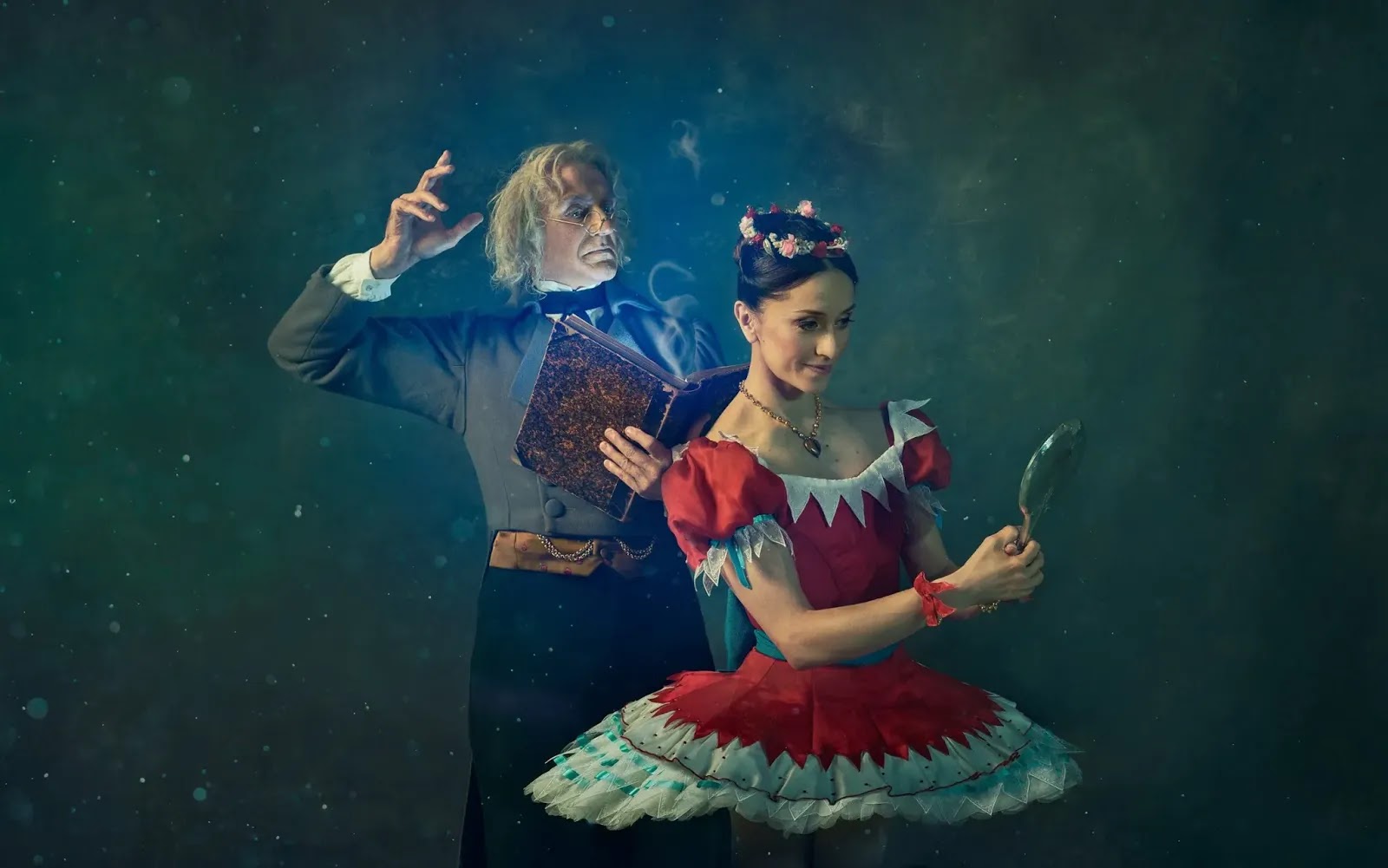
COPPÉLIA at Covent Garden - like clockwork...

In the last four years, since being swept away by The Royal Ballet's WOOLF WORKS, we have seen most of the famous ballets in the canon but one has only just been revived so I can finally tick COPPÉLIA off the list.


Léo Delibes' ballet premiered in 1870, with a libretto by Charles-Louis-Étienne Nuitter based on two stories by ETA Hoffmann, at the Paris Opera and was a big success but it's success was halted by the Franco-Prussian war and the concomitant siege of Paris by Prussian troops.  The severe food shortages that followed cost many Parisians their lives, one of which was 17 year-old Giuseppina Bozzacchi who had danced the female lead.

in 1884 Marius Petipa staged a production for the Russian Imperial Ballet which was hugely successful; in 1894 it was revived by Petipa's assistants Lev Ivanov and Mario Cecchetti and it was this production which has formed the basis for most Western productions down the years.  The original Imperial Ballet production 'bible's were smuggled out of Bolshevik Russia by Nicholas Sergeyev who staged a production with Ninette de Valois' Vic-Wells Theatre Company at Sadler's Wells in 1933.


In 1947 de Valois' ballet company became the permanent dance company at Covent Garden - eventually being named the Royal Ballet - and in 1954 she choreographed her own version based on these Imperial Ballet originals, and here we are, some 65 years later, and it is back in the Royal Ballet's repertoire after a decade away.  I am glad I saw it finally but while entertaining enough, it really doesn't hold up to too intense scrutiny.

In a small German town Swanhilda and Franz are to be married at an upcoming festival but Franz has been noticeably distracted by Coppélia, an impossibly beautiful woman who sits reading in the window of the mysterious Dr Coppelius' house and workshop.  Coppelius loses his house keys and, on finding them, Swanhilda sneaks into the house with her friends to investigate - closely followed by Franz climbing up a ladder!


Once inside they discover Coppelius has made life size clockwork dolls to keep himself company - and Coppélia is one of these.  Coppelius returns; Swanhilda hides behind a curtain with her mechanical rival just as Franz climbs through the window.  Coppelius wishes his dream doll to become alive and drugs Franz in an attempt to steal his soul for her, but Swanhilda breaks the spell by emerging in Coppélia's clothes.  The old man is delighted his creation has come to life but is left in despair when he realizes it's a trick when Swanhilda and Franz escape.  Cue a happy ending in the town square...

There are dark areas in the plot which could be explored - Franz' speed at falling in love with another girl, the eerie workshop of mechanical people who come to life when Swanhilda investigates, Coppelius' wish to kill Franz for his soul, and his sadness when he discovers Coppélia did not come to life - but none of it is really explored and all one is left with is the folksy aspects of the fairy tale.


To be honest I found de Valois' choreography to be fairly uneventful - pretty but hardly memorable - but Delibes's music was lovely and this production is blessed with Francesca Hayward's spirited and fun Swanhilda, Alexander Campbell's bouncy Franz and Gary Avis excelling as Coppelius, not too far from his memorable performance as Drosselmeyer in THE NUTCRACKER only this time he does not have a cloak to swirl around.

I am sure the Royal Ballet have found in COPPÉLIA a good substitute for their Christmas perennial THE NUTCRACKER and I am glad I have finally seen it but I suspect I will not be wanting to see it again.


Wednesday, December 11, 2019

DVD/150: A NIGHT IN CASABLANCA (Archie Mayo, 1946)

The Marx Brothers quit films in 1941 but by 1946, Chico was in debt due to his gambling addiction so they returned to the screen with A NIGHT IN CASABLANCA.  Having lost their MGM contract, CASABLANCA was released through United Artists.


Their last few films had reduced budgets and their unique anarchic spark had been watered down by playing almost second fiddle to insipid romantic couples and the obligatory instrumental solos for Harpo and Chico.


A NIGHT IN CASABLANCA follows this pattern with them shoe-horned into a lacklustre espionage plot where ex-Nazis are killing recurring hotel managers who get in the way of them finding hidden Nazi loot within the Casablanca hotel. 


Enter Groucho as Ronald Kornblow, the new hotel manager, who joins forces with the ex-Nazi's bullied valet Rusty (Harpo) and camel taxi-owner Corbaccio (Chico) to get into various scrapes and unwittingly foil the baddies.


Shelf or charity shop?  I am still undecided... Groucho is always worth watching but the film has them revisiting earlier situations but with a tired air which probably reflects that Groucho, Harpo and Chico were respectively 56, 58 and 59 at the time of filming.  I suspect it will stay in my dvd limbo of a plastic storage box.


Sunday, December 08, 2019

A ROOM OF ONE'S OWN / THREE GUINEAS at the Sam Wanamaker Playhouse - Woolf Works

This year marks the centenary of Nancy Astor being the first woman to take a seat in the House of Commons, but she was not the first female MP; that was the Sein Fein member and feminist Countess Constance Markievich who refused to take her seat in the UK Parliament.  A woman who deserves greater acclaim in my eyes than Astor who later was an appeaser and virulent anti-Semite. 

However to celebrate Astor taking her seat and the passing of the first law that banned discrimination based on gender or marriage, the Globe hosted a reading of Virginia Woolf's two most famous essays: A ROOM OF ONE'S OWN on the subject of women and fiction and her more controversial THREE GUINEAS in which she explored the connection between patriarchy and militarism.  It was definitely a game of two halves.


First up was Hattie Morahan with A ROOM OF ONE'S OWN which she interpreted wonderfully.  Both essays were abridged by Globe artistic director Michelle Terry and directed by Blanche McIntyre and it felt like Morahan got the better attention. In A ROOM OF ONE'S OWN, Woolf brilliantly explores the many interpretations of the phrase "Women and fiction": she had been asked to give a talk on the subject in the autumn of 1928 at Newnham and Girton, the two foremost colleges for women in Cambridge, and after these events she enlarged them into a book.

Virginia explores, in a wonderfully 'meta' style, her process of understanding what they wanted to hear: the role of women in fiction or women who have written fiction?  While exploring this quandary, she enlarges it to show us the world around her - being told to stay off the grass by a Cambridge beadle, being refused entry to see a book in the college library by an attendant, musing on the actual financing and building of the college by rich men for their sons' education, the delicious food served at lunch in the men's college compared to the plain and dull dinner served at the women's college.  Back in London and starting her research at the British Library, she discovers many books on the subject of women and their place in society, both here and overseas... all written by men who seem to be very angry about the subject.


It is these unseen influences that leads to Virginia stating that her conclusion is that in the future for a woman to be a successful writer she needs to have an independent income and a room of one's own.  Being allowed to write, unfettered from the distraction of a job or family or visitors, will lead to generations of female writers writing not just fiction but books on many subjects "for books have a way of influencing each other".  On her way to her conclusion she cites such originators as Aphra Behn, the playwright who proved that women could earn a living by writing, the poet Anne Finch, Jane Austen - who Woolf compares to Shakespeare as a writer whose writing shows a clarity of vision with no petty hatreds cluttering that vision - George Elliot, Charlotte Bronte and Emily Bronte. 

She also famously imagines Shakespeare having a sister whom she names Judith, a woman with the same wish to write as her brother and with the same need to express herself but, diametrically opposed to her brother, had no chance of education, no chance of becoming a performer to gain access to the theatre, but meets an actor-manager who promises to help her but instead gets her pregnant and in a fit of despair, Judith killed herself and "lies buried at some cross-roads where the omnibuses now stop outside the Elephant and Castle".  One of my favourite things to do is to read Virginia Woolf's writing out loud and twice Hattie Morahan paused to simply take a breath, obviously affected by what she was reading.


After the interval Joan Iyiola read THREE GUINEAS, Woolf's controversial reaction to the encroaching shadow of Fascism.  In 1932 Virginia Woolf started writing a new book which would intersperse the fictional story of the well-to-do Pargiter family and their changing fortunes from 1880 to the 1930s with essays relating to aspects within the fictional chapters.  She found it ultimately not to be working so she concentrated on the fictional chapters which later turned into her novel THE YEARS. published in 1937 to huge success.  But the rise of Hitler and Mussolini in Europe led her back to her 1932 essays and she expanded on them, concentrating on the links between the patriarchal society and the rise of militarism and the rush to war.

Like in A ROOM OF OWN'S OWN, Virginia uses repetition to enforce her central thesis, forever circling back to certain thoughts or phrases, but while Morahan made these distinct from each other, Iyiola offered no variation to her tone and sure enough, people started leaving while she was only mid-way through.  I mentally wandered quite a few times and started to feel the agony of the Sam Wanamaker Playhouses's purgatorial seats.  It felt like the first half had been worked on more and poor Joan was left to just read out the text without being able to illuminate it. But any excuse to hear my favourite writer celebrated and spoken aloud is to be grasped at.


Sunday, December 01, 2019

50 Favourite Musicals: 8: WEST SIDE STORY (1957) (Leonard Bernstein, Stephen Sondheim)

The 50 shows that have stood out down the years and, as we get up among the paint cards, the shows that have become the cast recording of my life.


First performed: 1957, Winter Garden, NY
First seen by me: 1984, Her Majesty's Theatre, London
Productions seen: two
  
Score: Leonard Bernstein / Stephen Sondheim
Book: Arthur Laurents
Plot: in 1957 New York, two young gangs - the American Jets and Puerto-Rican Sharks - fight for control of the streets.  Despite this, American Tony meets Puerto-Rican Maria and they fall in love.  But when the fighting results in two deaths, Tony and Maria are trapped in a dangerous momentum...

Five memorable numbers: TONIGHT, AMERICA, MARIA, SOMEWHERE, SOMETHING'S COMING

It's just always been there.  An early memory is going to see the film version at the Gaumont in Notting Hill Gate with my mum and a neighbour - no, not in 1961 - and enjoying the colour and music but my biggest memory is the two of them bawling at the end so I joined in, not terribly sure why.  I have always been suggestible, Constant Reader.  It's stunning songs were frequently sung on television variety shows and then the film was a constant staple of Bank Holiday films on television.  It truly was and is a global phenomenon. But it nearly didn't happen at all...


In 1947, choreographer Jerome Robbins, composer Leonard Bernstein and writer Arthur Laurents attempted an updating of Shakespeare's ROMEO AND JULIET, set in New York's Lower East Side focusing on the conflicts between Irish-Americans and Jews but it foundered on Bernstein's wish for it to be operatic and the realization that it was rehashing old themes.  This most quintessential of NY musicals was re-born in Los Angeles eight years later where the three men were working on separate projects; they decided to switch to the Upper West Side where a gang culture was growing between American teens and Puerto-Rican immigrants.  It must also be borne in mind that in the intervening years Robbins had been a 'friendly witness' in the McCarthy Communist witch hunt hearings; although they were not named by Robbins, Bernstein and Laurents had suffered from the resultant blacklisting of suspected persons.  Bernstein only wanted to write the music so when Arthur Laurents met his friend Stephen Sondheim at a party, 27 year-old Sondheim - recovering from his debut Broadway musical SATURDAY NIGHT being cancelled - was offered the lyricist role.  Sondheim was wary as he wanted to write his own material but his father-figure and mentor Oscar Hammerstein II advised he take it as working with such talents would be invaluable experience.  But two weeks before the start of rehearsals, producer Cheryl Crawford backed out; Sondheim sent the script to his producer friend Hal Prince who, after hearing Sondheim and Bernstein perform the score for him, jumped aboard.  During rehearsals, Robbins demanded a "Conceived by.." credit due to the extensive contribution his choreography had to the show; he received the credit but used it to his advantage, causing serious dissent from his collaborators.  The show opened to wild acclaim in 1957, Sondheim's lyrics almost always overlooked in reviews in the rush to praise Bernstein's music and Robbins' choreography.  For all it's shaking up of musical theatre, it only won two of it's six Tony nominations: Best Choreography and Best Scenic Design.  Carol Lawrence as Maria was the only acting nomination - bizarrely as Best Supporting Actress - but lost to Barbara Cook in THE MUSIC MAN as did the show for Best Musical!  The London production opened at Her Majesty's in 1958 and ran for two and a half years, some seven months longer than on Broadway, and won the Evening Standard Award for Best Musical.  In 1961, the film version co-directed by Robert Wise and Jerome Robbins - although in fact Robbins was fired during filming - exploded onscreen and went on to win ten Academy Awards, losing only one nomination for Best Adapted Screenplay.  Apart from it's two Broadway and three West End revivals, WEST SIDE STORY had also had countless regional productions


I first saw WEST SIDE STORY onstage in 1984 when the production from Leicester Haymarket moved to Her Majesty's and ran for over a year.  It was the last major production to play there until THE PHANTOM OF THE OPERA took up what looks like an eternal residency.  Robbins' partner Tommy Abbott - one of the original Jets on Broadway - reproduced Robbins' choreography to glorious effect and despite being note-perfect on the film version I was captivated with it when seen in it's original theatrical context.  I was also swept away by Jan Hartley's glorious Maria - it's a difficult role as Maria is the essence of purity which can be hard with more flashy characters around her but she was quite wonderful.  There was good work too from Steven Pacey as Tony, Richard Pettyfer as Riff and Lee Robinson as Anita.  In 2008 a touring 50th Anniversary production had a sold-out run at Sadlers' Wells and again, although the cast were picked for their dancing skills over their singing, it still was wonderfully powerful on stage.  In 2020 WEST SIDE STORY will be rising again: Ivo van Hove is directing a new Broadway revival and next December will see the release of Steven Spielberg's film remake.  The Variety newspaper theatre critic Hobe Morrison died in 2000 but I suspect he remembered his 1957 review of WEST SIDE STORY's Broadway opening for many years after:  
"The show seems a doubtful prospect for record album popularity and would need considerable revision as film material... at a guess it might be a sensation in London"
The obvious choice would be to include something from the film version but as this blog is about my favourite stage musicals I have chosen this dynamic version of the "Dance At The Gym" from the 2009 Tony Awards to show that while Jerome Robbins might have been difficult but his choreography is timeless.