When GIRL FROM THE NORTH COUNTRY premiered at the Old Vic in 2017, the idea of sitting through a musical consisting of Bob Dylan songs left me cold so I avoided it but of course it gathered rave reviews and two Olivier Awards - if it had not been for the HAMILTON juggernaut I am sure it would have been more. After three months at the Old Vic, it played a further three months at the Noel Coward Theatre, but I still couldn't work up the courage to see it. So when a revival was announced at the Gielgud Theatre I made sure seats were booked - and I'm glad I did.
We saw it the night after the General Election and as I was in a deep depression I figured nothing would shift my humour but it was actually the perfect show for my state, it lifted me up with excellent ensemble work, fine individual performances, and the chance to have a quiet weep in the dark. Four years ago, Irish playwright Conor McPherson was approached by Bob Dylan's record company with the suggestion of turning some of his back catalogue into a stage musical but McPherson - known for his powerful dramas which are haunted by unseen malign influences such as THE WEIR - politely refused. He had never attempted a musical before and couldn't see how Dylan's work would fit into one.
But it preyed on his mind and the idea came to him of setting it in the Minnesota of 1934 (where Dylan would be born seven years later) - a mix of John Steinbeck and Southern Gothic. He contacted the record company and soon received an e-mail saying Dylan gave the idea a green light and promptly sent him 40 Dylan albums with permission to use any of them in whatever style he wanted, which is wonderfully trusting for such a musical figure. McPherson knew he wanted the music to be played on instruments used in 1934 and working closely with orchestrator and arranger Simon Hale, he has certainly achieved a very individual sound. Some purists have argued that songs sound unlike the Dylan originals but it shows how protean the material is which spans from the 1960s onwards and includes a healthy dollop of 1970s and 1980s album tracks... no jukebox musical here.
All the action centres on a ramshackle Duluth boarding house run by husband and wife Nick and Elizabeth Laine, but the bank is threatening to foreclose on it and Elizabeth is slowly submerging into early dementia. Their son Gene aspires to be a writer but drinks more than he types, and their adopted black daughter Marianne - abandoned as a baby by a non-paying guest - stoically nurses Elizabeth and acts as general housemaid to the guests.
One of their guests is Mrs Neilson, a widow who is waiting for her husband's will to be finalized; she and Nick are clandestine lovers who dream of running away to set up their own hotel with her inheritance. The only other guests are Mr and Mrs Burke - living in reduced circumstances thanks to the Depression - and their retarded son Elias. Marianne is five months pregnant but refuses to divulge the father's identity; her adopted father Nick is attempting a 'deal' with the local - and aged - shoe-peddler Mr Perry to marry Marianne for the companionship she will offer, but Marianne resists this arrangement.
One stormy night, two new guests - Reverend Marlowe and Joe Scott - arrive at the rooming house: the former says he is an itinerant holier-than-thou bible-seller and the other a black one-time-contender boxer but are they? Life over the coming months gets no easier for the occupants of the boarding house until it culminates in Nick and Elizabeth alone at their dining table with the audience on the edge of their seats...
It sounds grim and, in places, it was - McPherson again shadows characters with the unforgettable trauma of dead children - and the action builds to an unbearably tense peak as Nick sees a way out, but the characters are all written in such a humane, non-judgmental way that you are drawn into their sad little stories, hoping for a resolution for them that will make life better. The whole story is narrated occasionally by the town doctor who knows most of the occupants' secrets and a few of his own, in a style reminiscent of The Stage Director in Thornton Wilder's OUR TOWN: he tells the story but is also one step ahead of the action to describe their later lives.
In a nod to the radio days of the 1930s, the solos are sung into old radio microphones which gives the impression that these numbers are more to do with what is happening in the character's minds than simply singing a song to someone. As I said, the idea of an evening of Bob Dylan songs once had me running a mile from the show but McPherson has chosen songs that were all fairly new to me - at best I knew five of the twenty listed songs - but they are woven so well into the fabric of the story and in the unified sound of Hale's 1930s instruments, that three in particular had me hooked: TIGHT CONNECTION TO MY HEART, SWEETHEART LIKE YOU and TRUE LOVE TENDS TO FORGET.
Conor McPherson directs the show beautifully, always keeping an air of fragile unease while eliciting a wonderful ensemble performance from his 19 cast members but I particularly want to mention the marvellous work of Katie Brayben as the mentally lost Elizabeth, a difficult role to place as most of it she spends glowering at the world from her chair but rising to deliver scorching versions of LIKE A ROLLING STONE - growling through the song of her now untethered life - and a heartbreaking FOREVER YOUNG; Anna-Jane Casey as the secretly doped-up Mrs Burke (and occasional drummer); Rachel John who is wonderfully sympathetic as Mrs Neilsen and in excellent voice; Finbar Lynch's weaselly Reverend Marlowe; Donald Sage Mackay's quietly despairing Nick; Gloria Obiyanyo's secretive and wary Marianne with a voice that sounds like a mix of Tracy Chapman and Joan Armatrading, and Shaq Taylor's proud boxer Joe Scott. All this and Gemma Sutton too in an all-too-brief role as Gene's departing girlfriend.
Rae Smith's designs are as spare and lean as the Minnesota dust bowl while Mark Henderson delivers another masterclass in story-telling through lighting. A special mention too for the four-man onstage band who weave such a great musical backdrop throughout the show.
GIRL FROM THE NORTH COUNTRY is on at the Gielgud until 1st February - run to see this truly remarkable show of people's power to love and endure...
Showing posts with label Gielgud Theatre. Show all posts
Thursday, December 19, 2019
Saturday, June 15, 2019
SWEAT at the Gielgud - Hard Times...
With a Pultzer Prize for Drama tucked in it's overalls pocket, Lynn Nottage's grim tale SWEAT swaggers into the chintzy surroundings of the Gielgud Theatre from it's opening run at the Donmar; it's a juxtaposition it just about manages to transcend.
Nottage wrote her play after two years of extensive research in and around the city of Reading in Pennsylvania; this city was reported to be one of the poorest in the USA with a poverty level of 40%. Reading saw a dizzying decline after 2007 with it's industrial jobs being decimated through factory closures and companies relocating. Her findings which were later made into this play hold no great surprises - demoralized workers feeling used and abandoned by business but with no redress - through political or social channels - other than blame the wrong factors for the job losses.
I cannot help but feel that the play - although involving in an Arthur Miller-esque way - is quite basic and has possibly been over-praised for being what it is. Fault lines are alluded to but are left hanging, certain characters are given more grace and favour treatment than others while issues slowly slink back to make room for the plot where we know from flash-forwarding That Something Bad Happened.
Two young recently-released prisoners are interviewed by the same probation officer and in these interviews they both mention that they have seen each other around town and are worried how that will be for their rehabilitation. We learn that they are African-American Chris and Caucasian Jason both of whom Have Done Something Bad eight years before. They were friends having grown up together as their mothers had been best friends and co-workers in the same pipe factory.
Their mothers Cynthia and Tracey - along with their ex-hippy friend Jessie -have a strong bond from working side by side for years and enjoying the after-work camaraderie in the nearby saloon run by Stan, an ex-Vietnam veteran - yes that old staple - who also worked with them until a factory injury made him a bar-keep instead. Hovering in the background is also Brucie, Cynthia's ex-husband and Chris' father, once a powerful union man who after one too many brushes with the Man is now a junkie floating through life.
The plot turns on a supervisor job at the factory that both Cynthia and Tracey apply for; Cynthia gets the promotion and that, almost imperceptibly, starts the rot in their friendship as Tracey harbours a very quiet resentment at having been passed over. Suddenly, Cynthia finds her new job is in fact Nessus' shirt - no sooner has she started the job then the management start pushing for the workers having to re-apply for their jobs, cuts in pay and longer working hours - all under the guise of streamlining productivity, and claiming their hands are tied.
Cynthia tries to keep her friends updated on all that she knows but soon realizes that the promotion probably only happened so the managers would have a patsy to filter bad news down to the shop-floor. Tracey's anger at Cynthia catches fire and she turns against her, especially when word gets out that the management is targeting Hispanics to fill the jobs of the by-now striking workforce. It's a situation where the only winners are the unseen managers; the former workers are left jobless, the factory vanishes to Mexico, bitter resentment is in the air when out of nowhere, a Bad Thing Happens.
There was much to admire in Nottage's play and she certainly addresses the febrile nature of workers who in the past few years, through snake-oil selling, media mis-information and their own intolerance, find themselves all too ready to lash out at anything and everything. But I also found her plot to be fairly routine and also fairly predictable - I could sense who was going to be the victim of The Bad Thing Happening but to Nottage's credit, she changed the victim at the last second. It did however lead to a fairly obvious and clunky final image of the victim of these stupid times being the good person or people damaged forever,
Lynette Linton has certainly delivered a production that echoes the solid metal pipes and girders that tower over Frankie Bradshaw's bar-room set but it is also a monotone world where no humour is allowed to penetrate and ultimately the grim atmosphere became too one-note; as I said earlier, I was reminded of Arthur Miller's A VIEW FROM THE BRIDGE while watching it - but unlike Miller, Nottage can offer no illumination of her character's lives - they are hard-working and noble or hard-working and venal with no contrast or shade. I wonder how she would have portrayed her unseen bosses? In this, I was also reminded of Matthew Lopez' THE INHERITANCE which was unafraid to plant a Trump-supporting Republican right at the centre of the play but also had the awareness to not make him an out-and-out villain as most playwrights would do.
SWEAT does boast some remarkable performances: Clare Perkins delivers a strong Cynthia, who watches lifelong friendships evaporate while trying to do right by them, Martha Plimpton is a coruscating Tracey whose harbouring a lifetime of resentments boils over scarring everyone including herself and Stuart McQuarrie as Stan, a man who tries to keep his bar a safe haven for all but who cannot stop the rising anger and violence from it's doors.
There were also good performances from Patrick Gibson and Osy Ikhile as the two sons who in a moment of madness assign themselves the roles that society was just waiting to throw on them, and Leanne Best as Tracey and Cynthia's friend Jessie, who allows herself occasionally to remember the idealism of her teenage years before booze overwhelms the pain.
It certainly isn't the first US play to be shown up as somewhat over-lauded in transferring to London but it is one that I suspect will niggle away at me. What I did wonder was, would a similar play about the miner's strike or any number of factories that have closed down in the north of England or in Wales find a home on Shaftesbury Avenue or is SWEAT 'allowable' as it's Rust Belt Americana can be viewed as separate from our own angry, vindictive under-class?
I also cannot help but wonder how a production about the corrosive effects of capitalism can charge £107.25 for Premium Seating?
Nottage wrote her play after two years of extensive research in and around the city of Reading in Pennsylvania; this city was reported to be one of the poorest in the USA with a poverty level of 40%. Reading saw a dizzying decline after 2007 with it's industrial jobs being decimated through factory closures and companies relocating. Her findings which were later made into this play hold no great surprises - demoralized workers feeling used and abandoned by business but with no redress - through political or social channels - other than blame the wrong factors for the job losses.
I cannot help but feel that the play - although involving in an Arthur Miller-esque way - is quite basic and has possibly been over-praised for being what it is. Fault lines are alluded to but are left hanging, certain characters are given more grace and favour treatment than others while issues slowly slink back to make room for the plot where we know from flash-forwarding That Something Bad Happened.
Two young recently-released prisoners are interviewed by the same probation officer and in these interviews they both mention that they have seen each other around town and are worried how that will be for their rehabilitation. We learn that they are African-American Chris and Caucasian Jason both of whom Have Done Something Bad eight years before. They were friends having grown up together as their mothers had been best friends and co-workers in the same pipe factory.
Their mothers Cynthia and Tracey - along with their ex-hippy friend Jessie -have a strong bond from working side by side for years and enjoying the after-work camaraderie in the nearby saloon run by Stan, an ex-Vietnam veteran - yes that old staple - who also worked with them until a factory injury made him a bar-keep instead. Hovering in the background is also Brucie, Cynthia's ex-husband and Chris' father, once a powerful union man who after one too many brushes with the Man is now a junkie floating through life.
The plot turns on a supervisor job at the factory that both Cynthia and Tracey apply for; Cynthia gets the promotion and that, almost imperceptibly, starts the rot in their friendship as Tracey harbours a very quiet resentment at having been passed over. Suddenly, Cynthia finds her new job is in fact Nessus' shirt - no sooner has she started the job then the management start pushing for the workers having to re-apply for their jobs, cuts in pay and longer working hours - all under the guise of streamlining productivity, and claiming their hands are tied.
Cynthia tries to keep her friends updated on all that she knows but soon realizes that the promotion probably only happened so the managers would have a patsy to filter bad news down to the shop-floor. Tracey's anger at Cynthia catches fire and she turns against her, especially when word gets out that the management is targeting Hispanics to fill the jobs of the by-now striking workforce. It's a situation where the only winners are the unseen managers; the former workers are left jobless, the factory vanishes to Mexico, bitter resentment is in the air when out of nowhere, a Bad Thing Happens.
There was much to admire in Nottage's play and she certainly addresses the febrile nature of workers who in the past few years, through snake-oil selling, media mis-information and their own intolerance, find themselves all too ready to lash out at anything and everything. But I also found her plot to be fairly routine and also fairly predictable - I could sense who was going to be the victim of The Bad Thing Happening but to Nottage's credit, she changed the victim at the last second. It did however lead to a fairly obvious and clunky final image of the victim of these stupid times being the good person or people damaged forever,
Lynette Linton has certainly delivered a production that echoes the solid metal pipes and girders that tower over Frankie Bradshaw's bar-room set but it is also a monotone world where no humour is allowed to penetrate and ultimately the grim atmosphere became too one-note; as I said earlier, I was reminded of Arthur Miller's A VIEW FROM THE BRIDGE while watching it - but unlike Miller, Nottage can offer no illumination of her character's lives - they are hard-working and noble or hard-working and venal with no contrast or shade. I wonder how she would have portrayed her unseen bosses? In this, I was also reminded of Matthew Lopez' THE INHERITANCE which was unafraid to plant a Trump-supporting Republican right at the centre of the play but also had the awareness to not make him an out-and-out villain as most playwrights would do.
SWEAT does boast some remarkable performances: Clare Perkins delivers a strong Cynthia, who watches lifelong friendships evaporate while trying to do right by them, Martha Plimpton is a coruscating Tracey whose harbouring a lifetime of resentments boils over scarring everyone including herself and Stuart McQuarrie as Stan, a man who tries to keep his bar a safe haven for all but who cannot stop the rising anger and violence from it's doors.
There were also good performances from Patrick Gibson and Osy Ikhile as the two sons who in a moment of madness assign themselves the roles that society was just waiting to throw on them, and Leanne Best as Tracey and Cynthia's friend Jessie, who allows herself occasionally to remember the idealism of her teenage years before booze overwhelms the pain.
It certainly isn't the first US play to be shown up as somewhat over-lauded in transferring to London but it is one that I suspect will niggle away at me. What I did wonder was, would a similar play about the miner's strike or any number of factories that have closed down in the north of England or in Wales find a home on Shaftesbury Avenue or is SWEAT 'allowable' as it's Rust Belt Americana can be viewed as separate from our own angry, vindictive under-class?
I also cannot help but wonder how a production about the corrosive effects of capitalism can charge £107.25 for Premium Seating?
Thursday, October 18, 2018
COMPANY at the Gielgud Theatre: Side By Side.. By Side
Constant Reader, as you will recall, I am wandering through my 50 favourite musicals elsewhere on this blog and Stephen Sondheim's groundbreaking COMPANY from 1970 landed at #46. It's not my favourite musical of his as you can see; don't get me wrong I love the score but I have found George Furth's book to be dated. So how will Marianne Elliott's re-appraised and gender-flipped version work?
Um.. about the same really! For all it's promised looking from a new angle at the show, it still left me loving the score and slightly enervated by the linking scenes. Playwright George Furth had written a collection of one-act plays for mercurial actress Kim Stanley which were to be directed by Anthony Perkins... who showed them to his friend Stephen Sondheim... who showed them to Hal Prince who agreed that the short plays could be the basis of a new kind of musical where they could be solo scenes linked by a single character observing the action. There is no word on how pissed Stanley or Perkins must have been to see their project side-lined.
So COMPANY was born: Robert is surprised on his 35th birthday by his close-knit group of friends, five sets of partnered couples. As he attempts - and fails - to blow out his candles, he remembers occasions when he has been alone with the five couples when their happy facade showed cracks. Ultimately Robert has to face that, for all his fear of commitment, "alone is not alive". COMPANY was one of the first non-linear musicals and after mixed reviews out-of-town - Variety infamously said "As it stands now it's for ladies' matinees, homos and misogynists", it struck a zeitgeist-y moment on Broadway and won six Tony Awards, and has seen popular revivals since.
Director Marianne Elliott approached Sondheim with the idea of reworking the show so Robert is now Bobbi, a 35 year-old woman who, after concentrating on the goals of education and a career, finds herself in an emotional limbo. Sondheim wasn't particularly excited by it but with his old adage "a revival can tinker but the original will always be there" he agreed for her to give it a go; it helped that he was a big fan of her work - indeed, when we first saw WAR HORSE at the National Theatre my attention was drawn to an elderly man a few row down from us on the aisle BLUBBING at the play's climax... it was Sondheim.
Elliott's vision certainly fits the musical's frame - with the implied idea that the biological clock is running too - and of course, in updating the material to include mobile phones and texting, there is also the opportunity to replace one of the couples for a gay couple and, to a less noticeable extent, swap another couple's roles: she is the provider, he is the house-husband. Elliott's redrawn COMPANY succeeds more because of the production and ensemble rather than the actual material. I have said how I think the linking scenes are the show's weakness and, again, I just found most of them - for all their modernizing - neither insightful or particularly humorous. Furth's friends are a collectively unsympathetic lot to be honest and the book's flaws are all the more evident when they co-exist next to Sondheim's effortless wit and insight.
However, as I said, Marianne Elliott has attacked the show with such passion and focus that it is a pleasure to watch. Helped by Neil Austin's bright neon framing for Bunny Christie's adjoining boxed sets, the show is an unexpected visual treat while at the same time, Sondheim's score sounds fantastic under musical director Joel Fram although having him and the orchestra perched above the set on a bridge is distracting and makes it look like they are sitting on Evita's balcony. Liam Steel's choreography doesn't really move beyond quirky.
That I liked the production is established and it is the most cohesive vision of the musical I have seen but, for the life of me, I do not understand Marianne Elliott's obsession with Rosalie Craig, who as Bobbi, is the production's dead centre.
Rosalie Craig is a go-to actress for directors such as Elliott, Josie Rourke and Rufus Norris - I presume she takes direction well and doesn't get in the way of their concept-heavy approaches but from THE LIGHT PRINCESS to CITY OF ANGELS, from AS YOU LIKE IT to here in COMPANY she has turned in anonymous after anonymous leading performances. She is certainly capable, with a pleasant singing voice - although it strains itself in the upper register - but she has zero charisma with no variance in tone - at no time did she surprise me onstage - which here is alarming as Robert / Bobbi is the glue that holds her the show together: at best Craig provides the Pritstick.
In scene after scene, my attention strayed to whoever else was on stage, no matter how good they were. People might be saying "Let's see COMPANY, Marianne Elliott is directing it" not "Let's see COMPANY, Rosalie Craig is in it". At one point I thought if only they had asked Cynthia Errivo... imagine what she could do with "Being Alive"?
As I said, it was easy to look through Craig to see some good performances: Mel Giedroyc was a delight as Sarah, forever in contest with husband Harry; it is a bit of stunt casting as her pulling power out-weighs her small role but she was great fun and well matched with Gavin Stokes as Harry who also sang the lovely "Sorry / Grateful" wonderfully. The classic Sondheim tongue-twisting number "Getting Married Today" is sung by Jonathan Bailey - as Jamie, not Amy - and although he pitched it a little too hysterical to catch all the lyrics it played well to the peanut gallery. Far better was the scene that follows when Jamie's paranoia leads him to break-up with his partner Paul, only to change his mind when Bobbi suggests they marry each other instead; Bailey and Alex Gaumond made a very good partnership.
There was also good work from Bobbi's three lingering boyfriends: Richard Fleeshman was a revelation as the air-head air pilot Andy who wrestles to leave Bobbi to fly to "Barcelona" while Matthew Seadon-Young was very good as Theo, the lover that somehow got away; sadly George Blagden couldn't do much with his big number "Another Hundred People" but that was probably due to the distracting choreography behind him, but the three combined well to deliver a great "You Could Drive A Person Crazy".
Um.. about the same really! For all it's promised looking from a new angle at the show, it still left me loving the score and slightly enervated by the linking scenes. Playwright George Furth had written a collection of one-act plays for mercurial actress Kim Stanley which were to be directed by Anthony Perkins... who showed them to his friend Stephen Sondheim... who showed them to Hal Prince who agreed that the short plays could be the basis of a new kind of musical where they could be solo scenes linked by a single character observing the action. There is no word on how pissed Stanley or Perkins must have been to see their project side-lined.
So COMPANY was born: Robert is surprised on his 35th birthday by his close-knit group of friends, five sets of partnered couples. As he attempts - and fails - to blow out his candles, he remembers occasions when he has been alone with the five couples when their happy facade showed cracks. Ultimately Robert has to face that, for all his fear of commitment, "alone is not alive". COMPANY was one of the first non-linear musicals and after mixed reviews out-of-town - Variety infamously said "As it stands now it's for ladies' matinees, homos and misogynists", it struck a zeitgeist-y moment on Broadway and won six Tony Awards, and has seen popular revivals since.
Director Marianne Elliott approached Sondheim with the idea of reworking the show so Robert is now Bobbi, a 35 year-old woman who, after concentrating on the goals of education and a career, finds herself in an emotional limbo. Sondheim wasn't particularly excited by it but with his old adage "a revival can tinker but the original will always be there" he agreed for her to give it a go; it helped that he was a big fan of her work - indeed, when we first saw WAR HORSE at the National Theatre my attention was drawn to an elderly man a few row down from us on the aisle BLUBBING at the play's climax... it was Sondheim.
Elliott's vision certainly fits the musical's frame - with the implied idea that the biological clock is running too - and of course, in updating the material to include mobile phones and texting, there is also the opportunity to replace one of the couples for a gay couple and, to a less noticeable extent, swap another couple's roles: she is the provider, he is the house-husband. Elliott's redrawn COMPANY succeeds more because of the production and ensemble rather than the actual material. I have said how I think the linking scenes are the show's weakness and, again, I just found most of them - for all their modernizing - neither insightful or particularly humorous. Furth's friends are a collectively unsympathetic lot to be honest and the book's flaws are all the more evident when they co-exist next to Sondheim's effortless wit and insight.
However, as I said, Marianne Elliott has attacked the show with such passion and focus that it is a pleasure to watch. Helped by Neil Austin's bright neon framing for Bunny Christie's adjoining boxed sets, the show is an unexpected visual treat while at the same time, Sondheim's score sounds fantastic under musical director Joel Fram although having him and the orchestra perched above the set on a bridge is distracting and makes it look like they are sitting on Evita's balcony. Liam Steel's choreography doesn't really move beyond quirky.
That I liked the production is established and it is the most cohesive vision of the musical I have seen but, for the life of me, I do not understand Marianne Elliott's obsession with Rosalie Craig, who as Bobbi, is the production's dead centre.
Rosalie Craig is a go-to actress for directors such as Elliott, Josie Rourke and Rufus Norris - I presume she takes direction well and doesn't get in the way of their concept-heavy approaches but from THE LIGHT PRINCESS to CITY OF ANGELS, from AS YOU LIKE IT to here in COMPANY she has turned in anonymous after anonymous leading performances. She is certainly capable, with a pleasant singing voice - although it strains itself in the upper register - but she has zero charisma with no variance in tone - at no time did she surprise me onstage - which here is alarming as Robert / Bobbi is the glue that holds her the show together: at best Craig provides the Pritstick.
In scene after scene, my attention strayed to whoever else was on stage, no matter how good they were. People might be saying "Let's see COMPANY, Marianne Elliott is directing it" not "Let's see COMPANY, Rosalie Craig is in it". At one point I thought if only they had asked Cynthia Errivo... imagine what she could do with "Being Alive"?
As I said, it was easy to look through Craig to see some good performances: Mel Giedroyc was a delight as Sarah, forever in contest with husband Harry; it is a bit of stunt casting as her pulling power out-weighs her small role but she was great fun and well matched with Gavin Stokes as Harry who also sang the lovely "Sorry / Grateful" wonderfully. The classic Sondheim tongue-twisting number "Getting Married Today" is sung by Jonathan Bailey - as Jamie, not Amy - and although he pitched it a little too hysterical to catch all the lyrics it played well to the peanut gallery. Far better was the scene that follows when Jamie's paranoia leads him to break-up with his partner Paul, only to change his mind when Bobbi suggests they marry each other instead; Bailey and Alex Gaumond made a very good partnership.
There was also good work from Bobbi's three lingering boyfriends: Richard Fleeshman was a revelation as the air-head air pilot Andy who wrestles to leave Bobbi to fly to "Barcelona" while Matthew Seadon-Young was very good as Theo, the lover that somehow got away; sadly George Blagden couldn't do much with his big number "Another Hundred People" but that was probably due to the distracting choreography behind him, but the three combined well to deliver a great "You Could Drive A Person Crazy".
And the bitter cherry on the cake is Patti LuPone as Joanne, Bobbi's older and cynical friend, now on her third - possibly fourth - husband, who finally manages to break through Bobbi's defences after delivering her coruscating study of upper-class Manhattan wives, "The Ladies Who Lunch". This classic was wonderfully paced and sung, and of course, LuPone was a sensation. Luckily we were sitting halfway back in the stalls so there was no repeat of when we last saw her sing that song at the Leicester Square Theatre when she hurled her martini / water into the audience and I ended up soaked!
Elliott was lucky to get Patti: after suffering such pain from a needed hip operation that her last Broadway show had to close early, LuPone announced that she was finished with musicals - shortly before Marianne Elliott asked her to play Joanne! LuPone was also a fan of Elliott's previous work so agreed - "if I had turned her down she may never have asked me again" LuPone has said. Thank goodness she changed her mind. As great as she was at socking over "The Ladies Who Lunch", her playing of the whole scene was a masterclass in nailing a character and holding her moment.
So, despite Craig, everybody rise... COMPANY is back in town.
Monday, April 21, 2014
The British Birthday Play
After the hard-edged GOOD PEOPLE, it was time to relax into the chiffon-edged comedy of Noël Coward's BLITHE SPIRIT currently revived at the Gielgud Theatre with a long-overdue return to the London stage by Angela Lansbury. All very appropriate as John Gielgud had starred in and directed an ENSA touring production of the comedy during World War 2.
Michael Blakemore had previously directed Angela Lansbury in 2009 on Broadway in the play which won her a fifth Tony Award and here they are reunited with a new cast and production team. Unsurprisingly she has rooted herself into the character, making Madame Arcati her own.
Written by Coward in 1941, it was an instant hit - although Graham Greene found it "a wearisome exhibition of bad taste"! It went on to hold the record for the longest running play in the West End until "The Mousetrap" overtook it in 1957. David Lean filmed a screen adaptation in 1945 which featured the original players of Arcarti and Elvira, Margaret Rutherford and the delicious Kay Hammond, although this version had an alternate ending. The play has been revived frequently and I first saw it in 1986 at the Vaudeville Theatre with the perfect cast of Simon Cadell, Jane Asher (Ruth), Joanna Lumley (Elvira) and Marcia Warren as Arcarti.
Author Charles Condomine and his wife Ruth hold a soirée with the village doctor and his wife as well as the local eccentric Madame Arcarti with the ulterior motive of getting her to hold a seance so Charles can get material for a novel he is planning. During the seance however Arcarti "brings across" the ghost of Charles's glamorous first wife Elvira who has been dead for seven years and only Charles can see her. Elvira, as capricious in death as in life, causes mischief around the house much to Ruth's anger and Charles' bemusement.
He soon tires of her behaviour however when he realizes she has her own agenda when she fixes the brakes on his car hoping he will join her forever - but it's Ruth who uses the car first. Now with two ghostly wives making his life a misery he calls in Madame Arcarti to try and get them back to the other side. If only she knew how...
Michael Blakemore directs the comic business and Coward's devilishly witty dialogue to expert effect but also suggests the darker tones that lurk in the corners of the Condomine living room. Written two years into World War II where death was in everyone's consciousness, it's musings on the lingering effects of those departed must have made for a very heightened experience when first presented.
Simon Higlett's set has just the right feel of a home counties living room and also is entertaining in it's own right when the other world encroaches in on it which is also well-evoked by Mark Jonathan's lighting design.
Blakemore's cast also rise to the occasion with one clanging exception. The ever-reliable Charles Edwards is a delight as Charles, effortlessly spinning his lines with the lightest touch like the deftest of tennis players. But he also plays a man quietly delighted to be given a change from his second, rather conformist, marriage. Luckily Edwards is complemented perfectly by Janie Dee as Ruth. She showed her excellent comic timing time and again particularly in the classic exchange:
I found the casting of Jemima Rooper to be a miscalculation however. Her childishly petulant pouts and squeaky voice seemed to belong to a totally different production and more than once I felt she was totally out of her depth with the quality of performance onstage. Simon Jones and Serena Evans made full use of their considerable experience to fill out the roles of Doctor and Mrs Bradman and Patsy Ferran made the most of the West End debut as Edith, the Condomine's gormless maid.
Needless to say Madame Arcarti's belated entrance on stage provoked a round of applause for Angela Lansbury, you don't get too many of those anymore but somehow within the context of Coward and BLITHE SPIRIT it didn't seem strange at all! There was the odd stumbled line but that is more than allowed when you're 88 and in the process of giving a performance of pure star quality. She played Arcarti as an intelligent and engaging authoress but one who didn't suffer fools gladly - I will treasure the exasperated daggers she shot at Mrs. Bradman's clueless questioning.
Yes, she stole scenes with her bizarre little dance in her pre-seance trance or in her delighted responses to Elvira's presence but that's what she's there to do! Although the role didn't give her the opportunity to touch us in the way her Madame Armfelt did in A LITTLE NIGHT MUSIC on Broadway in 2010, it was an utter joy to see her on a West End stage and proving that this wasn't a case of stunt star casting - just like Arcarti, she brought sheer magic to us.
All this and being made Dame Angela last week too - it's about time!
Michael Blakemore had previously directed Angela Lansbury in 2009 on Broadway in the play which won her a fifth Tony Award and here they are reunited with a new cast and production team. Unsurprisingly she has rooted herself into the character, making Madame Arcati her own.
Written by Coward in 1941, it was an instant hit - although Graham Greene found it "a wearisome exhibition of bad taste"! It went on to hold the record for the longest running play in the West End until "The Mousetrap" overtook it in 1957. David Lean filmed a screen adaptation in 1945 which featured the original players of Arcarti and Elvira, Margaret Rutherford and the delicious Kay Hammond, although this version had an alternate ending. The play has been revived frequently and I first saw it in 1986 at the Vaudeville Theatre with the perfect cast of Simon Cadell, Jane Asher (Ruth), Joanna Lumley (Elvira) and Marcia Warren as Arcarti.
Author Charles Condomine and his wife Ruth hold a soirée with the village doctor and his wife as well as the local eccentric Madame Arcarti with the ulterior motive of getting her to hold a seance so Charles can get material for a novel he is planning. During the seance however Arcarti "brings across" the ghost of Charles's glamorous first wife Elvira who has been dead for seven years and only Charles can see her. Elvira, as capricious in death as in life, causes mischief around the house much to Ruth's anger and Charles' bemusement.
He soon tires of her behaviour however when he realizes she has her own agenda when she fixes the brakes on his car hoping he will join her forever - but it's Ruth who uses the car first. Now with two ghostly wives making his life a misery he calls in Madame Arcarti to try and get them back to the other side. If only she knew how...
Michael Blakemore directs the comic business and Coward's devilishly witty dialogue to expert effect but also suggests the darker tones that lurk in the corners of the Condomine living room. Written two years into World War II where death was in everyone's consciousness, it's musings on the lingering effects of those departed must have made for a very heightened experience when first presented.
Simon Higlett's set has just the right feel of a home counties living room and also is entertaining in it's own right when the other world encroaches in on it which is also well-evoked by Mark Jonathan's lighting design.
Blakemore's cast also rise to the occasion with one clanging exception. The ever-reliable Charles Edwards is a delight as Charles, effortlessly spinning his lines with the lightest touch like the deftest of tennis players. But he also plays a man quietly delighted to be given a change from his second, rather conformist, marriage. Luckily Edwards is complemented perfectly by Janie Dee as Ruth. She showed her excellent comic timing time and again particularly in the classic exchange:
- Charles: Anything interesting in The Times?
- Ruth: Don't be silly, Charles.
I found the casting of Jemima Rooper to be a miscalculation however. Her childishly petulant pouts and squeaky voice seemed to belong to a totally different production and more than once I felt she was totally out of her depth with the quality of performance onstage. Simon Jones and Serena Evans made full use of their considerable experience to fill out the roles of Doctor and Mrs Bradman and Patsy Ferran made the most of the West End debut as Edith, the Condomine's gormless maid.
Needless to say Madame Arcarti's belated entrance on stage provoked a round of applause for Angela Lansbury, you don't get too many of those anymore but somehow within the context of Coward and BLITHE SPIRIT it didn't seem strange at all! There was the odd stumbled line but that is more than allowed when you're 88 and in the process of giving a performance of pure star quality. She played Arcarti as an intelligent and engaging authoress but one who didn't suffer fools gladly - I will treasure the exasperated daggers she shot at Mrs. Bradman's clueless questioning.
Yes, she stole scenes with her bizarre little dance in her pre-seance trance or in her delighted responses to Elvira's presence but that's what she's there to do! Although the role didn't give her the opportunity to touch us in the way her Madame Armfelt did in A LITTLE NIGHT MUSIC on Broadway in 2010, it was an utter joy to see her on a West End stage and proving that this wasn't a case of stunt star casting - just like Arcarti, she brought sheer magic to us.
All this and being made Dame Angela last week too - it's about time!
Saturday, December 31, 2011
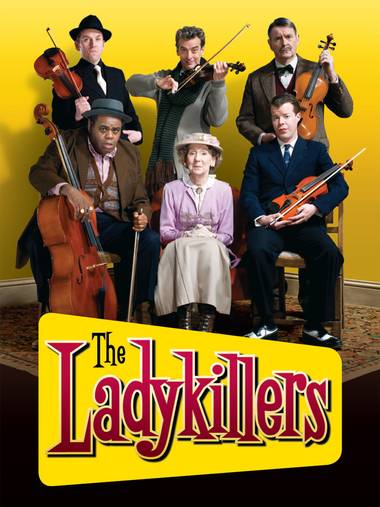
And still they come...The West End listings are fast resembling IMDB as there are so many film-to-stage versions playing and Owen and I went to see one of the more individual, Graham Linehan's take on the classic Ealing comedy THE LADYKILLERS at the Gielgud.
Constant Reader, it's admissions time - I have not seen the original Alexander Mackendrick film from 1955 which is the play's source. Wiliiam Rose's oddball idea of a little old lady foiling the plans of a gang of criminals who are using her home as cover for a robbery adapts well to a stage treatment with all it's action taking place within Mrs. Wilberforce's Kings Cross house.
The original cast of Alec Guinness, Cecil Parker, Peter Sellers, Danny Green, Herbert Lom and Katie
Johnson would make anyone think long and hard about recreating them on stage as they were all such memorable performers but here the production is well-served by the casting of Peter Capaldi, James Fleet, Stephen Wight, Clive Rowe, Ben Miller and Marcia Warren.Capaldi is a sheer delight as Professor Marcus, the criminal mastermind who runs his criminal network under the guise of being a music professor from Mrs. Wilberforce's spare room. With his loping gait, trailing scarf and wheedling voice he has the right mix of inspired lunacy with the undertow of genuine menace. He galvanises the production and keeps up the energy which has a tendency to flag occasionally.
Director Sean Foley also elicits nice performances from James Fleet as a secret cross-dressing ex-major, Stephen Wight as the young wired Harry and Clive Rowe as the punch-drunk ex-boxer One Round. Sadly I was less impressed with Ben Miller as Louis, the lethal crook from Romania. He seemed very muted on stage which I can only suspect is down to his inexperience as a stage actor apart from his Edinburgh stand-up shows. It was a pity as I had been looking forward to seeing him.

The production's secret weapon is the ever-glorious Marcia Warren as Mrs. Wilberforce who more than matches the flashier performances of the criminals. The role could almost have been written for her as it plays to all her onstage strengths - the sweet, daffy and smiling persona that hides a moral core of steel.
Marcia's sneaky stage craft stole the show from her thieves co-stars. It doesn't seem 27 years since I first saw her onstage in her Olivier-award winning role as the impossibly nouveau rich Vera in the original production of Ayckbourn's STEPPING OUT.
Michael Taylor's set is also a potential scene stealer - all crooked and wonky angles and playing surfaces which must be a difficult space to act on so well done again to the cast. In a fun little segue, the set rotates to reveal the building's front where the robbery is enacted on the wall with little cars racing all over it.
So despite all this why were there times when I was less than gripped and found my attention easily wandered? There seemed at times to be an overly cosy atmosphere which seemed to make the action simply coast along, the scene changes seemed to last forever and despite the play's second half being primarily about the gang's internecine killing spree, there was little genuine menace apart from the final scene between Marcus and Louis played in the gloomy darkness of James Farncombe's inventive lighting design.The production was rapturously received by my fellow audience members so go figure, maybe it was me.
Saturday, October 23, 2010
In the past week we have been to two music events - one of which was mostly all talk, go figure Oh Constant Reader.

Last Saturday we saw Stephen Sondheim interviewed on the stage of the Festival Hall by Jude Kelly. I have never seen an event like this at the Festival Hall and I'm not sure the space served the event well but Sondheim at 80 has quite a few stories to tell and he was as entertaining, analytical and candid as ever.
He also proved adept at gently deflating Kelly's over-articulated analysis of some of his themes, he's been to the interview rodeo so many times he must be used to having to parry such thesis'.
There were occasional snatches from his scores and Sondheim also was wryly amused at the mismatching slide show that was shown while the song played. The slides were from his shows in chronological order - but the songs were not. It would have been better had the visuals gone with what we were hearing (the best disconnect was "Being Alive" played over pictures from SWEENEY TODD!) but Sondheim laughingly said after one such interlude that it was a brilliant idea for a musical, one where the songs had nothing to do with what was happening on stage - actually Steve I think I have seen some dog shows like that!
The show was to coincide with the publication of his first collection of lyrics with added analysis of his process and I bought a pre-signed copy, it's already proving to be a great "dipping-in" book.
On Wednesday we chomped our way through the usual uninspired Jazz Cafe food just in time for the start of Gavin Creel's solo show. There was a connection too as Gavin appeared in the first production of Sondheim's troubled last show BOUNCE (which will play the Menier next year in the re-written guise of ROAD SHOW).
Gavin was returning to London after his recent run in the wondrous revival of HAIR at the Gielgud Theatre but now he was not hiding behind his beads and Claude wig but out there on his own performing his own songs. Gavin proved to be as captivating a presence as himself then when he is playing a character.
Gavin has one album and one e.p. under his belt and a selection of recently-written songs that will be the basis for an album hopefully next year. I was hearing all the songs for the first time and they impressed me with their from-the-heart lyrics and great melodies. I liked "For Nancy" a no-doubt autobiographical song of a son coming out to his mother, "Radio Lover" which is his hymn to pop music, "Might Still Happen", "Love Fell Down" and "Hot Ohio" which he dedicated to a former schoolfriend who moved to London and was a few tables down from us. He also has a delightful presence on stage - chatty and irreverent.

He attempted a cover version of George Michael's "Faith" which was charming, mainly because he dried on the chorus lyrics twice! He fared better with his own take on the dreaded "I KIssed A Girl".
We hung around long enough to tell him how much we enjoyed the show and to tell him belatedly how much we loved HAIR and we had seen him in New York on the eve of Snowmageddon. Bearing in mind he had just come off after a 90 minute show he couldn't have been more charming and gracious. He is hoping to be back next year with the new album and it will be a delight to see him again.

Last Saturday we saw Stephen Sondheim interviewed on the stage of the Festival Hall by Jude Kelly. I have never seen an event like this at the Festival Hall and I'm not sure the space served the event well but Sondheim at 80 has quite a few stories to tell and he was as entertaining, analytical and candid as ever.
He also proved adept at gently deflating Kelly's over-articulated analysis of some of his themes, he's been to the interview rodeo so many times he must be used to having to parry such thesis'.
There were occasional snatches from his scores and Sondheim also was wryly amused at the mismatching slide show that was shown while the song played. The slides were from his shows in chronological order - but the songs were not. It would have been better had the visuals gone with what we were hearing (the best disconnect was "Being Alive" played over pictures from SWEENEY TODD!) but Sondheim laughingly said after one such interlude that it was a brilliant idea for a musical, one where the songs had nothing to do with what was happening on stage - actually Steve I think I have seen some dog shows like that!
The show was to coincide with the publication of his first collection of lyrics with added analysis of his process and I bought a pre-signed copy, it's already proving to be a great "dipping-in" book.
On Wednesday we chomped our way through the usual uninspired Jazz Cafe food just in time for the start of Gavin Creel's solo show. There was a connection too as Gavin appeared in the first production of Sondheim's troubled last show BOUNCE (which will play the Menier next year in the re-written guise of ROAD SHOW).Gavin was returning to London after his recent run in the wondrous revival of HAIR at the Gielgud Theatre but now he was not hiding behind his beads and Claude wig but out there on his own performing his own songs. Gavin proved to be as captivating a presence as himself then when he is playing a character.
Gavin has one album and one e.p. under his belt and a selection of recently-written songs that will be the basis for an album hopefully next year. I was hearing all the songs for the first time and they impressed me with their from-the-heart lyrics and great melodies. I liked "For Nancy" a no-doubt autobiographical song of a son coming out to his mother, "Radio Lover" which is his hymn to pop music, "Might Still Happen", "Love Fell Down" and "Hot Ohio" which he dedicated to a former schoolfriend who moved to London and was a few tables down from us. He also has a delightful presence on stage - chatty and irreverent.
He attempted a cover version of George Michael's "Faith" which was charming, mainly because he dried on the chorus lyrics twice! He fared better with his own take on the dreaded "I KIssed A Girl".
We hung around long enough to tell him how much we enjoyed the show and to tell him belatedly how much we loved HAIR and we had seen him in New York on the eve of Snowmageddon. Bearing in mind he had just come off after a 90 minute show he couldn't have been more charming and gracious. He is hoping to be back next year with the new album and it will be a delight to see him again.
Wednesday, September 08, 2010
They came, they danced, they spread joy.
But all good things must come to an end and with an echo of cheering in our ears, they were gone.
On Saturday evening, the phenomenal American cast of Diane Paulus' revival of HAIR said their goodbye to London, The Gielgud Theatre and Owen and I.
We had already seen Gavin Creel's last night as Claude on Wednesday so it was time to put ourselves through the turmoil of watching the show knowing this was the last time - and also knowing the performers were thinking the same thing. As some of them have been with the show since 2008 when it first opened at the Delacorte in Central Park this had all the aspects of one emotional show.
To be honest, I felt a bit sorry for anyone who was seeing the show for the first time as the show kind of lost it's shape a little as the audience response was so huge. But for us HAIRites it was a great opportunity to finally let rip and show The Tribe in what affection they are held.
Needless to say the Gielgud roof got it's first seismic shock when Sasha Allen finished singing AQUARIUS - a huge roar and a standing ovation marked the end of the number - Tribe member Hannah Shankman (brunette at the front in the picture above) was in the stalls aisle nearest us and with the ovation, her face crumpled into a teary smile. And we were off...
Standing ovations abounded - at the end of the title number we again were on our feet applauding - and we had Darius Nichols as 'Hud' standing on the seat in front of us! It was a bit of a shame that Gavin Creel had to leave those few days before as it would have been great to see him in these circumstances.
It was a particular delight to be able to stand and applaud some performers - Kacie Sheik as 'Jeannie' with "Air", Andrew Kober as 'Margaret Mead' with "My Conviction", Caissie Levy as 'Sheila' with "Easy To Be Hard" and - best of all - Allison Case as 'Crissy" with "Frank Mills". Every time I have seen it she has broken my heart with this most gentle and touching song in the score and as I said in an earlier blog, she carefully guided us through it - pointing out the funny lines at the start but never failing to touch the heart at the end of it. She was quite adorable.
After a much-needed drink and ice cream in the interval it was time to welcome in the second act. It seemed to whizz by and soon we were at the cold dawn of "Let The Sun Shine In" which again was greeted with a standing ovation midway through and as the Tribe left the stage for the last time revealing the snow falling on the fallen Claude, quite a few of them were already giving way to emotion too.
They raced back on stage to a thunderous ovation and there was one hell of a lot of love in the air. As soon as we saw the rails appear to be put on the stairs leading up to the stage we were off but hadn't reckoned on the cheeky buggers at the back who had followed the cast down the aisle when they returned. It was at absolute scrum and despite initial fears, we both managed to get on stage and join in the last dance.
I think that's me about 3:05 getting on stage looking about quickly then clapping with my hands over my head!
After it was all over we threaded our way through the throng and Owen managed to nab Allison Case just as she was heading into the wings. She graciously signed the picture Owen had taken of the two of us together on an earlier trip and we told her we would love to see her in future shows which she was most touched by.
And with that, they were gone... gone to star in the theatre that lives in memory.
But all good things must come to an end and with an echo of cheering in our ears, they were gone.
On Saturday evening, the phenomenal American cast of Diane Paulus' revival of HAIR said their goodbye to London, The Gielgud Theatre and Owen and I.We had already seen Gavin Creel's last night as Claude on Wednesday so it was time to put ourselves through the turmoil of watching the show knowing this was the last time - and also knowing the performers were thinking the same thing. As some of them have been with the show since 2008 when it first opened at the Delacorte in Central Park this had all the aspects of one emotional show.
To be honest, I felt a bit sorry for anyone who was seeing the show for the first time as the show kind of lost it's shape a little as the audience response was so huge. But for us HAIRites it was a great opportunity to finally let rip and show The Tribe in what affection they are held.Needless to say the Gielgud roof got it's first seismic shock when Sasha Allen finished singing AQUARIUS - a huge roar and a standing ovation marked the end of the number - Tribe member Hannah Shankman (brunette at the front in the picture above) was in the stalls aisle nearest us and with the ovation, her face crumpled into a teary smile. And we were off...
Standing ovations abounded - at the end of the title number we again were on our feet applauding - and we had Darius Nichols as 'Hud' standing on the seat in front of us! It was a bit of a shame that Gavin Creel had to leave those few days before as it would have been great to see him in these circumstances.It was a particular delight to be able to stand and applaud some performers - Kacie Sheik as 'Jeannie' with "Air", Andrew Kober as 'Margaret Mead' with "My Conviction", Caissie Levy as 'Sheila' with "Easy To Be Hard" and - best of all - Allison Case as 'Crissy" with "Frank Mills". Every time I have seen it she has broken my heart with this most gentle and touching song in the score and as I said in an earlier blog, she carefully guided us through it - pointing out the funny lines at the start but never failing to touch the heart at the end of it. She was quite adorable.
After a much-needed drink and ice cream in the interval it was time to welcome in the second act. It seemed to whizz by and soon we were at the cold dawn of "Let The Sun Shine In" which again was greeted with a standing ovation midway through and as the Tribe left the stage for the last time revealing the snow falling on the fallen Claude, quite a few of them were already giving way to emotion too.They raced back on stage to a thunderous ovation and there was one hell of a lot of love in the air. As soon as we saw the rails appear to be put on the stairs leading up to the stage we were off but hadn't reckoned on the cheeky buggers at the back who had followed the cast down the aisle when they returned. It was at absolute scrum and despite initial fears, we both managed to get on stage and join in the last dance.
I think that's me about 3:05 getting on stage looking about quickly then clapping with my hands over my head!
After it was all over we threaded our way through the throng and Owen managed to nab Allison Case just as she was heading into the wings. She graciously signed the picture Owen had taken of the two of us together on an earlier trip and we told her we would love to see her in future shows which she was most touched by.
And with that, they were gone... gone to star in the theatre that lives in memory.
Wednesday, August 04, 2010
Like Miss Mansfield, Constant Reader, I am all behind! So a quick catch-up...We went to see how the HAIR company are faring these days now that Will Swenson who had played 'Berger' has left the show. Well I can report that the understudy and former Tribe member Steel Burkhardt has slipped into the role with ease and in fact the show seems to flow a little easier without Swenson's overly-manic performance.
There was no Caissie Levy as 'Sheila' so we had Megan Reinking who although she has a similar voice didn't really have Levy's control so she sounded a bit loosey-goosey when belting.However the show was still a fantastic experience and as we were in the fifth row, a bit scary being so close to the marauding hippies! It was great to be close enough to see all the interaction between the actors - especially when Gavin Creel had to start the title song again after he ran his fingers through a co-star's hair that was just a bit too manky for Gavin!
Of course we were also close enough to be among the first ones up on the stage at the end... well after I had buffaloed over the rest of our row. It was nice to linger on the stage after - Owen had a chat with Woof (aka Luther Creek) who had come over to complement O on his beard and I had a wee chat with the ever-chatty, ever-approachable, Chrissie (aka Allison Case). Her rendition of the glorious FRANK MILLS never fails to get me blubby so it was nice to tell her so!
Last week Owen booked to see GUTTED: A REVENGER'S MUSICAL which played a couple of days at the Riverside Studios before making it's way to Edinburgh.
Now I had no idea what it was all about... and I suspect Owen didn't either, however what he did know was that one of his cultural heroes was playing a featured role - none other than Jim Bob from Carter USM!What, no programme - not even a photocopied sheet?? I was less than impressed and even less so with the Soho media-type audience who all seemed to know each other. Loudly. Director Chris George popped up to tell us that as it was just a preview it would be nice to laugh as loud as we could - oh and that one of the cast had not been able to make it so someone was standing in! Needless to say my heart was sinking by the time the lights went down.
But damn it all.... it was HUGE fun. Martin White and Danielle Ward's show is a sort of delirious mix of KIND HEARTS AND CORONETS and THE ROCKY HORROR SHOW.
It's the wedding day of Sorrow (the delightful Helen George) to her
super-posh boyfriend (the unstoppable Colin Hoult) so everyone should be happy, right? Wrong. Sorrow has tracked the posh bloke for years after finding out he murdered her parents when she was young and now she has him, not only in her wedding photographs but in her sights.However there is also his awful family to deal with... literally, as they keep turning up at the wrong time. An obnoxious cousin to be smothered, an aunt harpy to be dispatched with a rake, etc. However there is the chance of future happiness with the friendly gardener (Doc Brown). But Sorrow is haunted by Fate (well... a trio of them to be precise) so no one is guaranteed a happy ending.
The cast is full of rich comedy talent - The Penny Dreadfuls aka David Reed, Thom Tuck and Humphrey Ker played the ghoulish figures of Fate as well as the three policemen after the murderer while Michael Legge was a prissy, hysterical vicar spouting truisms like "When you sin it's like God sticking his finger up your bum and you have to smell it for the rest of your life"!Margaret Cabourn-Smith was an acerbic housekeeper, Doc Brown had an appealing presence as the young gardener with a love of M&Ms (but not the peanut ones) and Jim Bob felt his way through his roles of a washed-up pop star and Sorrow's ghostly Dad but did them both with an undeniable charm.
As mentioned, Helen George was a delight, a good voice as well as sharp comic timing but the undeniable star of the show was Colin Hoult who did an Alec Guinness and played all the members of the ghastly rich and nasty family - disappearing and re-appearing in quick-change after quick-change and coping disdainfully with recalcitrant props. He was huge fun.
The score was amiable rather than memorable but it is the sort of show that carefully nurtured in a small theatre could become a big cult hit. I wish them well!Follow the show's fortunes on it's Facebook page
Subscribe to:
Posts (Atom)


.jpg)