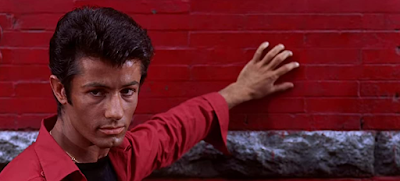
In 2019 I blogged my 50 favourite musicals and WEST SIDE STORY was #8, largely due to the unshakeable memories of this film which won 10 Academy Awards - the only nomination it lost was for Ernest Lehman's screenplay, unsurprising as it's the weakest element.
Tony and Maria's love across sectarian divides in Manhattan actually only lasts two days but thanks to director Robert Wise and choreographer Jerome Robbins they give Shakespeare a run for his money.
Robbins was hired to direct and choreograph his first film but Wise was signed to co-direct to give him support with the dramatic scenes; but perfectionist Robbins pushed the filming into delays so he was removed but not before filming the iconic PROLOGUE, AMERICA, I FEEL PRETTY and COOL.
Natalie Wood and Richard Beymer don't have the best screen chemistry but Rita Moreno, George Chakiris and Russ Tamblyn's performances still defy the years.
Shelf or charity shop? Leaping and twirling along the shelf. It's pure musical cinema but filming wasn't easy: Richard Beymer soon discovered that Natalie Wood disliked him for some unknown reason and this reflects in their on-screen partnership; Wood's contract included that she would record her vocals - and she mimed to them while filming - but ultimately it was decided her voice was too thin and they were replaced by ghost-singer Marni Nixon. Beymer was dubbed by singer Jimmy Bryant throughout, Russ Tamblyn's vocal for the THE JET SONG was dubbed by Tucker Smith who ironically plays his deputy Ice and who sings COOL, while Rita Moreno was dubbed by singer Betty Wand in A BOY LIKE THAT as she could not not manage the range. In an even more bizarre twist, Betty Wand was meant to sing Moreno's last note in the QUINTET but she and Moreno both had a cold that day so Marni Nixon was brought back in after dubbing Wood's vocals - in essence harmonizing with herself! Composer Leonard Bernstein criticized the orchestrations for the large studio orchestra as "overbearing" but did help Marni Nixon when she realised that her contract did not include getting paid for her vocals on the soundtrack album; Bernstein signed over a percentage of his profits to her - not bad as it became the best-selling album of the 1960s in America. The sense of sharing extended to Robert Wise insisting on Jerome Robbins being billed as co-director despite him beng fired from the project. The only person happy it seems was lyricist Stephen Sondheim who finally got his wish in having the comic song GEE OFFICER KRUPKE moved to before the Rumble; in the stage version it had come after the murderous fight where he argued it made no dramatic sense - he still hated his lyrics for I FEEL PRETTY however! But despite all this... the glory endures.
The 50 shows that have stood out down the years and,
as we get up among the paint cards, the shows that have become the cast
recording of my life. So here we are... a year and 10 months in the
making and we have reached the stage musical that is my favourite ever -
and I cannot name one out of the four shows that I have left to
consider.
I have tried every criteria, every angle and there is simply no way I
can say that one of the four is better than the other. So let's
go... my Top Four Number One's (in alphabetical order)
First performed: 1959, Broadway Theatre, NY
First seen by me: 1989, St. James Theatre, NY
Productions seen: four
Score: Jule Styne / Stephen Sondheim
Book: Arthur Laurents
Plot: Based on Gypsy Rose Lee's memoir and set against the decline of vaudeville, the unstoppable Rose travels around the country with the song-and-dance act featuring her daughters June and Louise. Rose is obsessed with making June a star - whether she wants it or not - while Louise is overlooked emotionally. However when June suddenly marries and quits the act, Rose switches her ambition... now Louise will be a star. But as she can't sing or dance, how can she become a star?
Five memorable numbers: ROSE'S TURN, YOU GOTTA GET A GIMMICK, EVERYTHING'S COMING UP ROSES, IF MOMMA WAS MARRIED, "GYPSY" OVERTURE
Despite being one of the greatest musicals ever written, there is one imbalance that every production confronts: the title character is not the one the show is built around, nor cast with a star. Arthur Laurents was faced with adapting Gypsy's memoir while she was still alive which might explain why the character of Louise seems slightly blank. However Louise comes into her own midway
through the second act and become a match for her mother towards the
end. This is a difficult ask as Rose is always cast with powerhouse
performers in a role that is proven to be one of the biggest in musical
theatre so whoever is cast as Louise has to be able to step up to this.
David Merrick produced the original Broadway show as a vehicle for Ethel Merman that was to be directed and choreographed by Jerome Robbins, his first musical since WEST SIDE STORY. But choosing a composer was more problematic: former Merman composers Irving Berlin and Cole Porter both declined saying they couldn't see how to approach it, so Robbins and Laurents asked their WEST SIDE STORY lyricist Stephen Sondheim as they knew he wanted to be the sole composer of a show. But Merman refused to trust an untried composer as her last Broadway show had been written by unknown writers and she disliked the experience intently. While happy for Sondheim to be lyricist, she asked for the music to be trusted to Jule Styne, composer of GENTLEMEN PREFER BLONDES and BELLS ARE RINGING. Sondheim wanted to quit as he did not want to just write lyrics but his mentor Oscar Hammerstein II advised he accept as it would be an ideal chance to write for a specific - and unique - star. As it turned out, Styne was ego-free and they collaborated well together. Like GUYS AND DOLLS, GYPSY is a seamless show where the score and book work in a perfect relationship, the songs springing naturally out of the action and always moving the plot forward. What GYPSY also has is one of the greatest overtures for any Broadway show, running at just over 5 minutes, it bounces you around the show's wonderfully varied moods, I particularly love the section where the gentle ballad "Small World" skips along only to be elbowed out of the way by the sleazy, strutting burlesque strip music.
The original production received 8 Tony Award nominations but lost them all to either THE SOUND OF MUSIC or FIORELLO! Of the five actresses who have played Rose on Broadway, all have been
Tony Award-nominated with Angela Lansbury, Tyne Daly and Patti LuPone
winning. Lansbury also won the London
Critic's Circle Award for Best Actress, the first time it had been given
to a musical actress. For the last revival of GYPSY in London, Imelda Staunton rightly won both the Olivier and Evening Standard Awards. It is incredible to think that between Angela Lansbury in the London premiere and Imelda Staunton in it's first London revival it was a wait of 40 years... did no one think Julia McKenzie would have been a perfect Rose in the 1980s or 1990s? I first saw GYPSY onstage in New York when Tyne Daly made the show a personal triumph in her first theatre role after finding television fame in CAGNEY AND LACEY. I then saw Lynda Baron deliver an excellent performance in a production at Cheltenham in 1993 but then had to endure a long wait until 2008 when we saw Patti LuPone - oddly enough at the same theatre as Tyne Daly and with the same director, the book-writer Arthur Laurents. We saw her the Saturday after her opening night - it was a surreal experience to be seeing it so soon after the critics had ordained it as The show to see - the audience screaming and clapping at everything that moved, even the dog playing Chowsie. Patti LuPone is always an experience best seen onstage and she certainly took no prisoners, making no attempt to sugar-coat the monster in Rose, but ultimately she didn't surprise me... I got the performance I was expecting from her. Imelda on the other hand...
Under Jonathan Kent's direction, Imelda Staunton inhabited Rose from the inside out: her tenacious, terrier-like,
attack on the world to make one of her daughters a star, the
tough-as-nails exterior covering up a damaged child's vulnerability, it was all
there; at various points Rose is described as "always being in the middle of a sentence" and "a pioneer woman without a frontier" and that's what Imelda delivered. But truly hair-raising was how she took on the two act-closing
solos where any actress playing Rose has to go from 0-to-100 in as many
minutes. Discovering June has rejected
both her and the act, Rose switches her dreams
to unprepared Louise by declaring "Everything's Coming Up
Roses". Staunton's Rose was so
caught up in her vision that she hugged Louise to her only to cast her aside as she went for her scorching final note, button-holed
with her twirling her coat around, off to start her burning
new mission. Laurents' book really comes into it's own in the final section of the musical: Louise is now Gypsy Rose Lee, the top-billed star at Minsky's Burlesque Theatre, and Rose sneaks backstage where she is not permitted. They finally confront each other and when Rose angrily demands an answer to why she did all the fighting and pushing to get Louise her stardom, Gypsy coldly retorts "I thought you did it for me Mama". Alone on the empty stage, Rose finally releases her long-bottled-up
rage at all those who have walked out on her with the scorching "Rose's
Turn". This legendary number - a mental breakdown performed to a
bump-and-grind beat - is what the whole show has been building to and
any actress playing the role has to be up to it's tricky challenges. Imelda totally nailed it: the sarcasm, the anger, the despair and the
mania that she had hinted at earlier all came together in an
all-too-human performance. Resisting the temptation to chew the
scenery, Staunton kept it in check which made it all the more thrilling.
The remarkable thing about Laurents' book is how each of the major characters are nursing a dream: Rose wants her daughters to have the fame and stardom denied to her, Herbie wants Rose to marry him and give up struggling to achieve her dream, Louise wants stability and the attention she is missing, June wants to break away from her mother's tyrannical grip and live her own life - even Tulsa, the dancer Louise secretly has a crush on, has his dream of being a successful dancer onstage with a female dance partner. The only ones who don't are the three strippers Mazeppa, Tessie and Electra: they have done it all and they are past dreaming. But what they can do is educate Louise to the secret of being a successful stripper in the magnificent "You Gotta Get A Gimmick" I have yet to see a production where this number doesn't raise the roof. GYPSY is a musical that, like GUYS AND DOLLS, is a tribute to the Broadway musical's Golden Age and how a collaboration between genuine artists all working to a common goal can make a timeless classic.
Merman, Russell, Lansbury, Daly, Midler, Peters, LuPone, Staunton... I mean, I know someone is going to be disappointed. So I am going to go for the clearest video I can find which happens to be Imelda Staunton with Lara Pulver and Peter Davison in the whole last scene of Act I which leads up to "Everything's Coming Up Roses". Until I saw it within the context of the show I never realised that what sounds otherwise like a gung-ho song of optimism is actually a song of pure delusion on Rose's part - just watch the subtle shifts in Imelda's performance as she works through the song and her physical manhandling of Louise; Louise is just a prop for Rose to get her revenge on June who has abandoned her, It's a perfect example of Laurents' excellent book and Styne and Sondheim's perfect score serving each other to give us an unforgettable experience.
The 50 shows that have stood out down the years and,
as we get up among the paint cards, the shows that have become the cast
recording of my life.
First performed: 1957, Winter Garden, NY
First seen by me: 1984, Her Majesty's Theatre, London
Productions seen: two Score: Leonard Bernstein / Stephen Sondheim
Book: Arthur Laurents
Plot: in 1957 New York, two young gangs - the American Jets and Puerto-Rican Sharks - fight for control of the streets. Despite this, American Tony meets Puerto-Rican Maria and they fall in love. But when the fighting results in two deaths, Tony and Maria are trapped in a dangerous momentum...
Five memorable numbers: TONIGHT, AMERICA, MARIA, SOMEWHERE, SOMETHING'S COMING
It's just always been there. An early memory is going to see the film version at the Gaumont in Notting Hill Gate with my mum and a neighbour - no, not in 1961 - and enjoying the colour and music but my biggest memory is the two of them bawling at the end so I joined in, not terribly sure why. I have always been suggestible, Constant Reader. It's stunning songs were frequently sung on television variety shows and then the film was a constant staple of Bank Holiday films on television. It truly was and is a global phenomenon. But it nearly didn't happen at all...
In 1947, choreographer Jerome Robbins, composer Leonard Bernstein and writer Arthur Laurents attempted an updating of Shakespeare's ROMEO AND JULIET, set in New York's Lower East Side focusing on the conflicts between Irish-Americans and Jews but it foundered on Bernstein's wish for it to be operatic and the realization that it was rehashing old themes. This most quintessential of NY musicals was re-born in Los Angeles eight years later where the three men were working on separate projects; they decided to switch to the Upper West Side where a gang culture was growing between American teens and Puerto-Rican immigrants. It must also be borne in mind that in the intervening years Robbins had been a 'friendly witness' in the McCarthy Communist witch hunt hearings; although they were not named by Robbins, Bernstein and Laurents had suffered from the resultant blacklisting of suspected persons. Bernstein only wanted to write the music so when Arthur Laurents met his friend Stephen Sondheim at a party, 27 year-old Sondheim - recovering from his debut Broadway musical SATURDAY NIGHT being cancelled - was offered the lyricist role. Sondheim was wary as he wanted to write his own material but his father-figure and mentor Oscar Hammerstein II advised he take it as working with such talents would be invaluable experience. But two weeks before the start of rehearsals, producer Cheryl Crawford backed out; Sondheim sent the script to his producer friend Hal Prince who, after hearing Sondheim and Bernstein perform the score for him, jumped aboard. During rehearsals, Robbins demanded a "Conceived by.." credit due to the extensive contribution his choreography had to the show; he received the credit but used it to his advantage, causing serious dissent from his collaborators. The show opened to wild acclaim in 1957, Sondheim's lyrics almost always overlooked in reviews in the rush to praise Bernstein's music and Robbins' choreography. For all it's shaking up of musical theatre, it only won two of it's six Tony nominations: Best Choreography and Best Scenic Design. Carol Lawrence as Maria was the only acting nomination - bizarrely as Best Supporting Actress - but lost to Barbara Cook in THE MUSIC MAN as did the show for Best Musical! The London production opened at Her Majesty's in 1958 and ran for two and a half years, some seven months longer than on Broadway, and won the Evening Standard Award for Best Musical. In 1961, the film version co-directed by Robert Wise and Jerome Robbins - although in fact Robbins was fired during filming - exploded onscreen and went on to win ten Academy Awards, losing only one nomination for Best Adapted Screenplay. Apart from it's two Broadway and three West End revivals, WEST SIDE STORY had also had countless regional productions
I first saw WEST SIDE STORY onstage in 1984 when the production from Leicester Haymarket moved to Her Majesty's and ran for over a year. It was the last major production to play there until THE PHANTOM OF THE OPERA took up what looks like an eternal residency. Robbins' partner Tommy Abbott - one of the original Jets on Broadway - reproduced Robbins' choreography to glorious effect and despite being note-perfect on the film version I was captivated with it when seen in it's original theatrical context. I was also swept away by Jan Hartley's glorious Maria - it's a difficult role as Maria is the essence of purity which can be hard with more flashy characters around her but she was quite wonderful. There was good work too from Steven Pacey as Tony, Richard Pettyfer as Riff and Lee Robinson as Anita. In 2008 a touring 50th Anniversary production had a sold-out run at Sadlers' Wells and again, although the cast were picked for their dancing skills over their singing, it still was wonderfully powerful on stage. In 2020 WEST SIDE STORY will be rising again: Ivo van Hove is directing a new Broadway revival and next December will see the release of Steven Spielberg's film remake. The Variety newspaper theatre critic Hobe Morrison died in 2000 but I suspect he remembered his 1957 review of WEST SIDE STORY's Broadway opening for many years after:
"The show seems a doubtful prospect for record album popularity and would need considerable revision as film material... at a guess it might be a sensation in London"
The obvious choice would be to include something from the film version but as this blog is about my favourite stage musicals I have chosen this dynamic version of the "Dance At The Gym" from the 2009 Tony Awards to show that while Jerome Robbins might have been difficult but his choreography is timeless.
I couldn't get terribly worked up over seeing Trevor Nunn's revival of FIDDLER ON THE ROOF when it originated at the Menier Chocolate Factory as, while I admire the stagecraft that went into it's creation, it's not really one of my favourite musicals. But it's glowing reviews, it's transfer to the Playhouse Theatre - and the fact that I had seen every other show in the West End that interested me - meant that my birthday theatre event found me journeying back to the Russian shtetl of Anatevka in the early 1900s.
In it's transfer to the Playhouse, director Trevor Nunn has reconfigured the stalls to echo his Menier staging so a raised meandering path runs through the stalls to bring you into the middle of the small Jewish town, it's a bit cumbersome in finding your seat but very effective and for once, I felt engaged with the show. Of course being a Trevor Nunn production, it's very lengthy which for me only highlighted the repetitions in Joseph Stein's book, but as I said, I was engaged.
I have only seen the show once before onstage - a jaw-dropping 14 years ago in New York in a Chekhovian production directed by David Leveaux starring Harvey Fierstein and Rosie O'Donnell - and, of course, the Norman Jewison film version starring Topol. As I said, it's not a particular favourite of mine, mostly because I find the plot device of a Jewish village milkman finding the traditions he lives by erode through his three daughters marrying against his wishes too repetitive. I will agree that this is done by degrees: the first falls in love with a nebbish Jewish tailor, the second to a Bolshevik, the third to a gentile - but, particularly in this production, the three daughters are played exactly the same, sound exactly the same - typical west end soprano - and are so resolutely two-dimensional, that it's like you are seeing one actress on a revolve. The three boyfriends are all given different shadings but the daughters get no personalities at all.
I also am not the biggest fan of Jerry Bock and Sheldon Harnick's score which has it's standards - "Tradition", "If I Were A Rich Man", "Sunrise Sunset", "Do You Love Me" - but otherwise I find it fairly anonymous and repetitive. But as I said, I found Nunn's production to be involving with very good musical direction from Paul Bogaev which serves the score well, apart from the endless "Tevye's Nightmare" which proves that time is not always a continuum.
Nunn has chosen Andy Nyman for his Tevye and he is excellent, making him a very human-sized character, unlike the usual Star turn from actors taking their lead from the originator of the role, the larger-than-life Zero Mostel. Without the character being figuratively spot-lit downstage while the other actors huddle upstage, it makes for more integrated story-telling with the town of Anatevka coming fully to life.
Like the daughters, the role of Tevye's wife Golde is a fairly thankless one; for ever careworn and kvetching at her husband's foolish dreams, but Broadway actress Judy Kuhn suggested more depth to the character than is on the page. In particular the duet "Do You Love Me?" where Tevye finally plucks up the courage to ask Golde whether their 25-year marriage is based on love or just circumstance is a touching, almost embarrassed moment between Nyman and Kuhn rather than being played for comedy.
The other stand-out in the cast is Louise Gold as Yente, the gossipy matchmaker of the village; another two-dimensional female character but imbued by the ever-reliable Gold with a vibrant personality who again had colour and depth that was not suggested by the script. I also liked Stewart Clarke as Perchik the stern Bolshevik student who is smitten by the middle daughter Hodel.
Of course the spirit of Jerome Robbins, the show's original director/choreographer, is ever-present in the big dance routines for "To Life" and "The Wedding / Bottle Dance"; for a man who has been dead 21 years, it's not bad that he gets named three times on the poster. Matt Cole is responsible for the rest of the enjoyable choreography.
Robert Jones' set design brings the crowded Anatevka to vibrant life both onstage and off, while Tim Lutkin's subtle, shifting lighting gives the town the warmth of summer and the dark of winter. None more so than in the final scenes when the mood turns sombre with the forced eviction of the Jews from the town. Despite my problems with the show, it is impossible not to be moved by the final scene where lifelong friends and families say their goodbyes knowing they will probably never see each other again as they scatter over Europe and America.
As the snow falls on Tevye's shattered community slowly trudging out of their hometown, clutching their few possessions on a long journey to who knows what fate, Nunn shows his production is sadly very relevant to today's world of displaced people and the search for home in a world of prejudice and fear.
I am not always a fan of Trevor Nunn's work but here he gives us a memorable production of FIDDLER ON THE ROOF, maybe one to see again...
My last visit to the Royal Ballet this year was to see another of their mixed programmes, curated to celebrate three great choreographers: Frederick Ashton, Kenneth MacMillan and Jerome Robbins. As usual it was also a perfect opportunity to show the breadth of talent across the Royal Ballet company.
First was Ashton's LES PATINEURS which debuted in 1937 and is set to music by the composer Giacomo Meyerbeer, a composer whose operas have fallen out the repertoire but his themes were wonderfully arranged by Constant Lambert into a fizzing, whirling delight. At only 35 minutes it's an almost perfect cameo of ballet pleasure. The Royal Ballet are still using the original designs by William Chappell and it almost took your breath away when first seen - a glorious Victorian Christmas illustration come to life, each colour popping off the stage.
A group of 15 dancers dance/skate across the stage in various combinations: a group of eight dancers in red and blue give way to three couples in reddish-brown, blue and white and a solo male dancer in blue, whose effortless spins and leaps supposedly were inspired by Ashton's admiration of another Fred, Mr. Astaire. It was utterly captivating and is going to be revisited hopefully again sometime. The ballet was a tribute to Ashton's dazzling vision and style - effortlessly elegant but with a grounding in pattern and technique. The company were excellent but special mention to Luca Acri as the effervescent boy in blue.
The mood changed dramatically with MacMillan's WINTER DREAMS which uses Chekhov's THREE SISTERS for inspiration. The ballet had it's first performance in 1991 and MacMillan said he did not want to do a literal ballet adaptation of the play but to use it as a template to explore the emotions of loneliness and longing. MacMillan originally staged it as a pas-de-deux for Masha and Vershenin as part of a gala for the Queen Mother's 90th birthday and expanded it to make a full 55 minute one-act ballet.
It's been quite a while since I saw THREE SISTERS so I was a bit shaky as to who was who but the central theme of the isolation of the three sisters was palpable and they were danced beautifully by Itziar Mendizabal as Olga, Sarah Lamb as Masha and Yasmin Naghdi as Irina with fine support from Gary Avis as Kulygin and Vadim Muntagirov as Vershenin; he and Lamb danced the central pas-de-deux wonderfully. As with all MacMillan's finest work, WINTER DREAMS had an ominous air of sadness about it and it's duel scene towards the end reminded me of MAYERLING with it's guns and figures under umbrellas. I think however I would have liked to have seen it grouped with other ballets as the wrench from the gaiety of the Ashton piece to the MacMillan was a bit too jarring. The ballet is set to music by Tchaikovsky and it sounded wonderful shared between Russian stringed instruments and Robert Clark's piano.
The last ballet was Jerome Robbins' THE CONCERT first performed by NY City Ballet in 1956. Set to music by Chopin, a fussy concert pianist - Robert Clark proving to be a right trooper - plays to a small audience who spend more time fidgeting and daydreaming than they do just listening. Their various personal thoughts are interrupted by the arrival of six ballerinas who attempt a pas de six but end up facing the wrong way or with the wrong arm raised etc.
It's a slight piece but made up a pleasing sandwich with LES PATINEURS for the more weighty WINTER DREAMS, and it was well performed by the company who communicated a sense of delight in being able to do comedy.
The art of curating a mixed programme is a tricky one but I was delighted to have seen these three ballets in one sitting and see some favourite dancers in new roles.
An unashamedly starry-eyed celebration of that most American of art forms, the Broadway musical.
Produced for PBS, the six episodes are narrated in syrupy style by Julie Andrews and charts the milestone shows of the musical from 1893 to the 2000s: the Ziegfeld Follies, SHOWBOAT, SHUFFLE ALONG, OF THEE I SING, PORGY AND BESS, PAL JOEY, OKLAHOMA!, ON THE TOWN, CAROUSEL, KISS ME KATE, SOUTH PACIFIC, GUYS AND DOLLS, MY FAIR LADY, THE SOUND OF MUSIC, WEST SIDE STORY, FIDDLER ON THE ROOF, CABARET, HAIR, COMPANY, A CHORUS LINE, CHICAGO, SWEENEY TODD, THE PRODUCERS, 42ND STREET, CATS, SUNDAY IN THE PARK WITH GEORGE, LA CAGE AUX FOLLES, THE LION KING, RENT and WICKED.
Packed with interviews from the performers, composers, directors, writers, choreographers and critics who created and witnessed this evolving story, what makes the series really special is the dazzling historical footage of almost every great Broadway star.
Shelf or charity shop? Singing out (Louise) from the shelf!