When I was in primary school, one of my favourite books was CS Lewis' 1950 fantasy novel THE LION THE WITCH AND THE WARDROBE; a gripping narrative, likeable characters, and the titanic struggle between Aslan the lion and the nasty White Witch leading to a final battle for Narnia's throne. Then someone told me "You DO know it's all about religion don't you?" and my heart broke. CS Lewis you utter sod. That then put me off any fantasy-type novel or film... I just sit there waiting for the God analogy to clump like a second boot.
It was with a heavy heart that I went to see the 2005 film but found that I still could really enjoy it's story - and Aslan's mane was WELL strokeable - and to be honest I thought of that film most of the time I was watching Sally Cookson's stage production, currently playing at The Bridge Theatre. It's definitely time for another viewing.
Did I hate it? No. Did I like it then? Let's just say I got the production I expected when I heard that Sally Cookson had directed it. Her production of PETER PAN at the National - was it REALLY three years ago? - was one of the most annoying experiences I have sat through. But happy to say, after a first half that fairly lumped along, the second half picked up the pace and delivered some fairly neat stage images thanks to Rae Smith's designs. Sometimes though, it might just be pleasant to see an effect onstage that is truly magical without knowing that it is just a tea-chest with a drapery thrown over it courtesy of 'poor theatre' techniques.
The show is billed as being 'conceived by the company' - how '70s - but there is a 'writer in the room' credit for Adam Peck and he certainly did well in distilling such an epic down onto the Bridge stage. Among the standard over-stated performance with over-emphatic regional dialects, there were a few good performances - Stuart Neal was a graceful Mr Tumnus whose disappearance halfway through is keenly felt, Shalisha James-Davis and Keziah Joseph were good as Susan and Lucy Pevensie - the actors who played Peter and Edmund were fairly nondescript - and I liked Wil Johnson's commanding Aslan, although Laura Elphinstone as The White Witch was rather underwhelming.
I also thought Dean Nolan and Beverly Rudd had a good partnership as the Beavers who help the Pevensie children, and while Benji Bower's music was anodyne folky stuff, Bruno Poet worked some magic of his own with his lighting designs; a word too for the choreographed moves by Dan Canham who kept the stage traffic moving.
So there we go, an amiable 2 and a half hours that might not have done it for me - maybe my head was too full of that night's election results - but hopefully a few of the kids and teens in the audience might have seen something on the stage that made them realize the joy of live theatre and set them off on their own journey.
I must add the poster image is a wonderful design - now, where is that film version...
Showing posts with label Bruno Poet. Show all posts
Sunday, December 15, 2019
Wednesday, October 19, 2016
THE TEMPEST at Sadlers Wells - David Bintley's damp squib
Almost a year ago we went to Sadler's Wells to see a triple bill from Birmingham Royal Ballet, the works choreographed by the company's artistic director David Bintley. There were all enjoyable in their own way with one, THE KING DANCES, being truly memorable, so when it was announced that Bintley's dance adaptation of Shakespeare's THE TEMPEST was to appear at Sadler's Wells, we were keen to see it.
Sadly, although commendable in various areas of the production, it left you feeling that this TEMPEST had blown itself out somewhere between Birmingham and London.
I would have thought that you would want to stage a ballet of THE TEMPEST if you had an extra dimension to bring to the play but I sat there as one scene followed another from the play feeling more and more becalmed...yes there were nice moments but they were fleeting.
Ultimately it all felt a little too polite; as Virginia Woolf said of another female writer "It aimed to soar but agreed to perch". There was no particular larger-than-life feel to it, no feeling that between them Prospero and Ariel could conjure up wonders. Sally Beamish's score was interesting in spells (no pun intended) but ultimately for most of the first act was too wishy-washy to inspire much excitement.
The infuriating thing was that there were good things within it: Rae Smith's excellent set suggested the curves in the bottom of a boat and had a great reveal at the end when the ship was suddenly revealed as in burnished copper, ready to return the principals to Naples. The opening image too showed great promise: the burnished, glittering ship seen in miniature hanging in mid-air only to be caught and held aloft by an airborne Ariel.
There were also likeable turns from Jenna Roberts as Miranda, Mathias Dingman as Ariel and Tyrone Singleton as Caliban but Iain Mackay's Prospero felt woefully undercharged and flashed around the stage more like a ballet version of Captain Jack Sparrow than as the vengeful deposed Duke of Milan.
Only in the last ten minutes or so did the production kick into life when Bruno Poet's lighting created a circle of magic in the darkness for Prospero to confront his enemies but Bintley's gesturing choreography could never match or even illustrate the haunting quality of a speech like Prospero's "Our revels now are ended..."
After the effortless magic of The Royal Ballet's LA FILLE MAL GARDÉE a few days earlier, this all felt... well, over to you Will Shakespeare... "like this insubstantial pageant faded, leave not a rack behind".
I would have thought that you would want to stage a ballet of THE TEMPEST if you had an extra dimension to bring to the play but I sat there as one scene followed another from the play feeling more and more becalmed...yes there were nice moments but they were fleeting.
Ultimately it all felt a little too polite; as Virginia Woolf said of another female writer "It aimed to soar but agreed to perch". There was no particular larger-than-life feel to it, no feeling that between them Prospero and Ariel could conjure up wonders. Sally Beamish's score was interesting in spells (no pun intended) but ultimately for most of the first act was too wishy-washy to inspire much excitement.
The infuriating thing was that there were good things within it: Rae Smith's excellent set suggested the curves in the bottom of a boat and had a great reveal at the end when the ship was suddenly revealed as in burnished copper, ready to return the principals to Naples. The opening image too showed great promise: the burnished, glittering ship seen in miniature hanging in mid-air only to be caught and held aloft by an airborne Ariel.
There were also likeable turns from Jenna Roberts as Miranda, Mathias Dingman as Ariel and Tyrone Singleton as Caliban but Iain Mackay's Prospero felt woefully undercharged and flashed around the stage more like a ballet version of Captain Jack Sparrow than as the vengeful deposed Duke of Milan.
Only in the last ten minutes or so did the production kick into life when Bruno Poet's lighting created a circle of magic in the darkness for Prospero to confront his enemies but Bintley's gesturing choreography could never match or even illustrate the haunting quality of a speech like Prospero's "Our revels now are ended..."
After the effortless magic of The Royal Ballet's LA FILLE MAL GARDÉE a few days earlier, this all felt... well, over to you Will Shakespeare... "like this insubstantial pageant faded, leave not a rack behind".
Sunday, March 20, 2016
AKHNATEN at English National Opera - Egyptian Glass Work...
29 years ago, Andrew - in another attempt to introduce me to opera - got me a standing ticket for Philip Glass' AKHNATEN which was receiving it's UK debut at the Coliseum by the English National Opera. He had praised it to the skies and, well, there was nothing on the telly... and it *was* a free ticket! I had no idea what I was going to see as the lights went down...
About three hours later I literally staggered out of the Coliseum with my mind spun-round by Glass' swirling, repetitive, hypnotic score which has looped and re-looped in my mind down the years. This hit it's apogee when, visiting the Temple at Karnak in the 2000s, we found we were practically the only ones in the awesome Hypostyle Hall during the intense mid-day sun. I parked myself at the foot of one of the massive pillars in the shade and, while Owen wandered about taking photos, I sat quite happily listening to the AKHNATEN finale on my mini-disc. To this day I am sure I saw shadows dancing....
And now, 29 years after that premiere, English National Opera have staged a new production, well I had to go didn't I?
Sadly whereas the first production directed by Keith Warner did everything it could to frame the music, Phelim McDermott's production does all it can to stand in it's way.
Tom Pye's design was an immediate cause for concern - I could see he was probably going for the tiered design of a wall of hieroglyphics but sadly more often that not it looked like the rebel Pharaoh's story was being acted out on the scaffolding of a building site. The palace which featured on the stage level did not so much suggest the palace of a King as a pop-up Hoxton bar with it's clear corrugated walls and strip-lighting.
Only once did we get a break from this set-up which was when the set split in two for Akhnaten's Hymn to his beloved Sun or Aten. Sadly this reminded me more of a mash-up of WEST SIDE STORY's tenements splitting aside for the "Somewhere" dream ballet and revisiting Olafur Eliasson's Weather Project at Tate Modern - maybe they should have asked Eliasson to do it? ! I did like Bruno Poet's lighting however.
Again and again, one was distracted by the LOOK AT ME LOOK AT ME design choices: the daughters of Nefertiti and Akhnaten resembled a Divine tribute act while, as Andrew has suggested, it was intriguing that the inspiration for Nefertiti's look was Marge Simpson. Oh and Queen Tye, Akhnaten's supportive mother, was modeled on Queen Mary. Go fuckin' figure.. Akhnaten death is still shrouded in mystery but I - no Egyptian scholar admittedly - don't believe he met his death in a volumous plastic tarpaulin. I am happy to be pursuaded otherwise...
McDermott's biggest artistic choice was to include his company Improbable in the production... this meant that every scene involved most of the company juggling. McDermott is happy to show in the programme an Egyptian tomb painting of a troupe of girls juggling to justify this but again it distratcted attention from the score as you waited in each act for the juggling to begin. Don't get me wrong, sometimes it made for interesting viewing but if it went on for too long it just felt like being in the audience for BRITAIN'S GOT TALENT. I have to report getting an attack of the church giggles when the acrobats came running out with large beach ball-type sphericals... I was so hoping they would break into "Sur Le Plage" from THE BOYFRIEND.
Not so much Improbable as Inevitable.
The lead performances were by Anthony Roth Costanzo as Akhnaten, the Pharoah who attempted to jolt Ancient Egypt into having a monotheistic religion and failed disasterously, Emma Carrington as Queen Nefertiti, Rebecca Bottone as Queen Tye and Zachary James as the narrator Scribe but to be honest, their performances seemed to take second place to being careful not to be whonged over the head by a flying candlestick or ball.
Luckily the evening was saved by the ENO chorus who sounded quite wonderful - and well done on the resolution of their pay dispute - and the orchestra under the baton of Karen Kamensek who made Philip Glass' monumental score the real star of the show. Hypnotic threads of repetitive music swirled around the auditorium and swept me away again to a different headspace.
Despite the clunking production I am glad to have experienced AKHNATEN again - now where the HELL has my cd of it gone?
About three hours later I literally staggered out of the Coliseum with my mind spun-round by Glass' swirling, repetitive, hypnotic score which has looped and re-looped in my mind down the years. This hit it's apogee when, visiting the Temple at Karnak in the 2000s, we found we were practically the only ones in the awesome Hypostyle Hall during the intense mid-day sun. I parked myself at the foot of one of the massive pillars in the shade and, while Owen wandered about taking photos, I sat quite happily listening to the AKHNATEN finale on my mini-disc. To this day I am sure I saw shadows dancing....
And now, 29 years after that premiere, English National Opera have staged a new production, well I had to go didn't I?
Sadly whereas the first production directed by Keith Warner did everything it could to frame the music, Phelim McDermott's production does all it can to stand in it's way.
Tom Pye's design was an immediate cause for concern - I could see he was probably going for the tiered design of a wall of hieroglyphics but sadly more often that not it looked like the rebel Pharaoh's story was being acted out on the scaffolding of a building site. The palace which featured on the stage level did not so much suggest the palace of a King as a pop-up Hoxton bar with it's clear corrugated walls and strip-lighting.
Only once did we get a break from this set-up which was when the set split in two for Akhnaten's Hymn to his beloved Sun or Aten. Sadly this reminded me more of a mash-up of WEST SIDE STORY's tenements splitting aside for the "Somewhere" dream ballet and revisiting Olafur Eliasson's Weather Project at Tate Modern - maybe they should have asked Eliasson to do it? ! I did like Bruno Poet's lighting however.
Again and again, one was distracted by the LOOK AT ME LOOK AT ME design choices: the daughters of Nefertiti and Akhnaten resembled a Divine tribute act while, as Andrew has suggested, it was intriguing that the inspiration for Nefertiti's look was Marge Simpson. Oh and Queen Tye, Akhnaten's supportive mother, was modeled on Queen Mary. Go fuckin' figure.. Akhnaten death is still shrouded in mystery but I - no Egyptian scholar admittedly - don't believe he met his death in a volumous plastic tarpaulin. I am happy to be pursuaded otherwise...
McDermott's biggest artistic choice was to include his company Improbable in the production... this meant that every scene involved most of the company juggling. McDermott is happy to show in the programme an Egyptian tomb painting of a troupe of girls juggling to justify this but again it distratcted attention from the score as you waited in each act for the juggling to begin. Don't get me wrong, sometimes it made for interesting viewing but if it went on for too long it just felt like being in the audience for BRITAIN'S GOT TALENT. I have to report getting an attack of the church giggles when the acrobats came running out with large beach ball-type sphericals... I was so hoping they would break into "Sur Le Plage" from THE BOYFRIEND.
Not so much Improbable as Inevitable.
The lead performances were by Anthony Roth Costanzo as Akhnaten, the Pharoah who attempted to jolt Ancient Egypt into having a monotheistic religion and failed disasterously, Emma Carrington as Queen Nefertiti, Rebecca Bottone as Queen Tye and Zachary James as the narrator Scribe but to be honest, their performances seemed to take second place to being careful not to be whonged over the head by a flying candlestick or ball.
Luckily the evening was saved by the ENO chorus who sounded quite wonderful - and well done on the resolution of their pay dispute - and the orchestra under the baton of Karen Kamensek who made Philip Glass' monumental score the real star of the show. Hypnotic threads of repetitive music swirled around the auditorium and swept me away again to a different headspace.
Despite the clunking production I am glad to have experienced AKHNATEN again - now where the HELL has my cd of it gone?
Saturday, May 02, 2015
Design Overload: LIGHT SHINING IN BUCKINGHAMSHIRE and AH, WILDERNESS!
Seeing Caryl Churchill and Eugene O'Neill plays are never going to be the most laugh-heavy evenings but two recent theatre visits have been made harder by distracting scenic concepts.
Caryl Churchill wrote LIGHT SHINING IN BUCKINGHAMSHIRE in 1976 for the Joint Stock Theatre Group where it was performed by six actors. Now here we are, revived at the National with a cast of eighteen with forty-four supernumeraries bulking out the stage.
I can understand why director Lyndsey Turner has wanted to flesh it out - election year, a play about the different protest factions left to flounder after the Civil War, big stage needing an epic play of the people etc. etc. It just doesn't work - and it doesn't work with the scenic concept that has been clamped down over the text like a metal cloche.
The stage is filled with a huge wooden table - raked like a platform stage - at which are seated noblemen eating a candlelit dinner in the first act, puritan scribblers in the second. The characters in Churchill's fragmented scenes clamber up onto the table and play their scenes with admirable commitment but without much interest generated for me as I nodded off a few times in the first act.
The play was arrived at through a research workshop and at times I felt I really ought to paying more attention as each scene felt like a 17th contemporary pamphlet being acted out but it's sheer relentless dourism made it hard to engage with anything - and just as you felt being drawn into a debate, we were treated to a group folk sing-song. Yawn.
Cromwell's New Model Army has won the Civil War but in it's wake troops of dissenters have appeared, all of whom think the time has come for their visions to be fulfilled but all of them had not realised that Cromwell was replacing one tyranny with another and he sounded the death knell for their hopes and ambitions. The Ranters who believe that God is within and wanted sexual and political freedom, The Diggers who wanted all common ground to be given over to the common man, and the more politically-minded Levellers who drew support from unhappy members of the army are all represented.
The second act begins well with Gerrard Winstanley demanding his rights to farm on common land but again Turner's wish for a scenic Big Idea muffs the action by having the supernumeraries break up the large table with spades to disclose a huge allotment underneath. A nice scenic idea but in practice it means that the following scenes are overshadowed by extras pulling up the planks of wood and slowly moving them off the stage, ridiculously distracting and something that should have been quashed during the technical rehearsals.
Performances from Nicholas Gleave, Ashley McGuire, Joe Caffrey and Ann Ogbomo were good, but they would have worked better in a smaller, less distracting production. Bruno Poet's lighting is good, Soutra Gilmour's costumes are down to her usual drab standards and Es Devlin is responsible for the distracting set. I must admit that while watching this first production under Rufus Norris' reign as NT Artistic Director, my heart sank a little - please don't let this be an omen. I am also seeing Lyndsey Turner's HAMLET later this year at the Barbican which is again designed by Devlin. Quakes.
Next was the Young Vic revival of Eugene O'Neill's 1933 play AH, WILDERNESS! which holds the distinction of being his only comedy. Needless to say an O'Neill comedy is hardly Brian Rix material but it has a gentle charm where the comedy is more character-based than anything that happens within the plot.
Which is just as well as director Natalie Abrahami has thrown out O'Neill's stage directions and set it in and around sand dunes which have taken over a large clapboard house. Oh and she has a character obviously meant to be O'Neill who hangs around the stage, pulling props out of the sand - a table yet! - and intoning in voice-over the stage directions. This drafted-in character also has the last lines, a paraphrasing of a quote from the Rubaiyat of Omar Khayyam which O'Neill inscribed to his wife on his own copy of the play.
So why? Is Abrahami so unsure of the material that a concept has to be imposed on it? To make it more 'relevant' to the Young Vic, a theatre which relishes director-imposed reinventions of texts? When, at the start of the play, the O'Neill character describes in taped voice-over the stage description of the Miller household with it's tasteful but tasteless furnishings, none are to be seen - just banks of sand which the actors gingerly clamber over like so many turn-of-the-century mountain goats.
Richard Miller is 16 and at *that* age, discovering literature for the first time and brooding that all of his life will be stymied by his parent's conventional lifestyle and the lack of intellectual freedom in his world. We've all been there and O'Neill's sensitive handling of the archetypal prickly teenager is charmingly done. He is angered by his mother's blinkered ideas of his advanced reading matter - there is a nice joke when Oscar Wilde is said to have been found guilty of bigamy - but not far beneath the surface he still loves her and his amiable, newspaper-owning father.
He shares the house with his older and younger brothers as well as with a maternal uncle and paternal aunt. Aunt Lily is on her way to becoming an old maid but quietly loves Uncle Sid but his not-so-secret drinking is getting out of hand and will always be a barrier between them - and needless to say, there is also a cheeky Irish maid too.
Richard is also struggling with his feelings for his neighbour Muriel whose father does not approve of him but when he goes out for a 5th of July drink with his older brother, he is seduced by good-time girl Belle. It was around now that I managed to transcend Abrahami's absurd concept and started to just enjoy O'Neill's writing.
The play culminates in a scene between Richard and Muriel, full of wonderfully hesitant writing as they deny then declare their love and this is played against Richard's parents expressing their continued love for each other. See Miss Abrahami? The play is definitely the thing.
The usually-dependable Janie Dee played Essie the mother, but here she noticeably stumbled over a few of her lines, but there were good performances from Martin Marquez as her husband Nat, Susannah Wise as Aunt Lily and Dominic Rowan as the wastrel Uncle Sid (although his drunk acting was a bit over the top). By far the performance of the evening was George Mackay as Richard, usually prickly and intellectually snobbish but played with great guile and he even executed a funny belly-flop into the onscreen lake.
Charles Balfour's lighting was a major plus for the production while Dick Bird's monumental set finally came into it's own when a lake suddenly appeared from nowhere. Ultimately what made me annoyed was that Abrahami's handling of the performers proves she's a worthy director so there really is no need for the unnecessary concept imposed on the play. I am sure if O'Neill had wanted AH, WILDERNESS! to be a dreamy, memory play he would have written it as such.
An odd footnote: AH, WILDERNESS! inspired no less than two musical adaptations - in 1948 Mickey Rooney starred as Richard in the MGM film SUMMER HOLIDAY while in 1959 Jackie Gleason won a Tony award for his role of Uncle Sid in Bob Merrill's TAKE ME ALONG.
An even odder footnote: It was Bob Merrill's second O'Neill-inspired score as in 1957 he had written the music and lyrics to NEW GIRL IN TOWN starring Gwen Verdon and Thelma Ritter which was based on ANNA CHRISTIE. Go figure.
Caryl Churchill wrote LIGHT SHINING IN BUCKINGHAMSHIRE in 1976 for the Joint Stock Theatre Group where it was performed by six actors. Now here we are, revived at the National with a cast of eighteen with forty-four supernumeraries bulking out the stage.
I can understand why director Lyndsey Turner has wanted to flesh it out - election year, a play about the different protest factions left to flounder after the Civil War, big stage needing an epic play of the people etc. etc. It just doesn't work - and it doesn't work with the scenic concept that has been clamped down over the text like a metal cloche.
The stage is filled with a huge wooden table - raked like a platform stage - at which are seated noblemen eating a candlelit dinner in the first act, puritan scribblers in the second. The characters in Churchill's fragmented scenes clamber up onto the table and play their scenes with admirable commitment but without much interest generated for me as I nodded off a few times in the first act.
The play was arrived at through a research workshop and at times I felt I really ought to paying more attention as each scene felt like a 17th contemporary pamphlet being acted out but it's sheer relentless dourism made it hard to engage with anything - and just as you felt being drawn into a debate, we were treated to a group folk sing-song. Yawn.
Cromwell's New Model Army has won the Civil War but in it's wake troops of dissenters have appeared, all of whom think the time has come for their visions to be fulfilled but all of them had not realised that Cromwell was replacing one tyranny with another and he sounded the death knell for their hopes and ambitions. The Ranters who believe that God is within and wanted sexual and political freedom, The Diggers who wanted all common ground to be given over to the common man, and the more politically-minded Levellers who drew support from unhappy members of the army are all represented.
The second act begins well with Gerrard Winstanley demanding his rights to farm on common land but again Turner's wish for a scenic Big Idea muffs the action by having the supernumeraries break up the large table with spades to disclose a huge allotment underneath. A nice scenic idea but in practice it means that the following scenes are overshadowed by extras pulling up the planks of wood and slowly moving them off the stage, ridiculously distracting and something that should have been quashed during the technical rehearsals.
Performances from Nicholas Gleave, Ashley McGuire, Joe Caffrey and Ann Ogbomo were good, but they would have worked better in a smaller, less distracting production. Bruno Poet's lighting is good, Soutra Gilmour's costumes are down to her usual drab standards and Es Devlin is responsible for the distracting set. I must admit that while watching this first production under Rufus Norris' reign as NT Artistic Director, my heart sank a little - please don't let this be an omen. I am also seeing Lyndsey Turner's HAMLET later this year at the Barbican which is again designed by Devlin. Quakes.
Next was the Young Vic revival of Eugene O'Neill's 1933 play AH, WILDERNESS! which holds the distinction of being his only comedy. Needless to say an O'Neill comedy is hardly Brian Rix material but it has a gentle charm where the comedy is more character-based than anything that happens within the plot.
Which is just as well as director Natalie Abrahami has thrown out O'Neill's stage directions and set it in and around sand dunes which have taken over a large clapboard house. Oh and she has a character obviously meant to be O'Neill who hangs around the stage, pulling props out of the sand - a table yet! - and intoning in voice-over the stage directions. This drafted-in character also has the last lines, a paraphrasing of a quote from the Rubaiyat of Omar Khayyam which O'Neill inscribed to his wife on his own copy of the play.
So why? Is Abrahami so unsure of the material that a concept has to be imposed on it? To make it more 'relevant' to the Young Vic, a theatre which relishes director-imposed reinventions of texts? When, at the start of the play, the O'Neill character describes in taped voice-over the stage description of the Miller household with it's tasteful but tasteless furnishings, none are to be seen - just banks of sand which the actors gingerly clamber over like so many turn-of-the-century mountain goats.
Richard Miller is 16 and at *that* age, discovering literature for the first time and brooding that all of his life will be stymied by his parent's conventional lifestyle and the lack of intellectual freedom in his world. We've all been there and O'Neill's sensitive handling of the archetypal prickly teenager is charmingly done. He is angered by his mother's blinkered ideas of his advanced reading matter - there is a nice joke when Oscar Wilde is said to have been found guilty of bigamy - but not far beneath the surface he still loves her and his amiable, newspaper-owning father.
He shares the house with his older and younger brothers as well as with a maternal uncle and paternal aunt. Aunt Lily is on her way to becoming an old maid but quietly loves Uncle Sid but his not-so-secret drinking is getting out of hand and will always be a barrier between them - and needless to say, there is also a cheeky Irish maid too.
Richard is also struggling with his feelings for his neighbour Muriel whose father does not approve of him but when he goes out for a 5th of July drink with his older brother, he is seduced by good-time girl Belle. It was around now that I managed to transcend Abrahami's absurd concept and started to just enjoy O'Neill's writing.
The play culminates in a scene between Richard and Muriel, full of wonderfully hesitant writing as they deny then declare their love and this is played against Richard's parents expressing their continued love for each other. See Miss Abrahami? The play is definitely the thing.
The usually-dependable Janie Dee played Essie the mother, but here she noticeably stumbled over a few of her lines, but there were good performances from Martin Marquez as her husband Nat, Susannah Wise as Aunt Lily and Dominic Rowan as the wastrel Uncle Sid (although his drunk acting was a bit over the top). By far the performance of the evening was George Mackay as Richard, usually prickly and intellectually snobbish but played with great guile and he even executed a funny belly-flop into the onscreen lake.
Charles Balfour's lighting was a major plus for the production while Dick Bird's monumental set finally came into it's own when a lake suddenly appeared from nowhere. Ultimately what made me annoyed was that Abrahami's handling of the performers proves she's a worthy director so there really is no need for the unnecessary concept imposed on the play. I am sure if O'Neill had wanted AH, WILDERNESS! to be a dreamy, memory play he would have written it as such.
An odd footnote: AH, WILDERNESS! inspired no less than two musical adaptations - in 1948 Mickey Rooney starred as Richard in the MGM film SUMMER HOLIDAY while in 1959 Jackie Gleason won a Tony award for his role of Uncle Sid in Bob Merrill's TAKE ME ALONG.
An even odder footnote: It was Bob Merrill's second O'Neill-inspired score as in 1957 he had written the music and lyrics to NEW GIRL IN TOWN starring Gwen Verdon and Thelma Ritter which was based on ANNA CHRISTIE. Go figure.
Wednesday, June 08, 2011
Last week it was time for my second Terence Rattigan play in this, his centenary year. Following on from FLARE PATH, we now have his last play CAUSE CÉLEBRE, he died four months after it's premiere at Her Majesty's Theatre in 1977.
The Rattigan revival was kicked off last year by the huge success of Thea Sharrock's production of his little-remembered second play AFTER THE DANCE at the Lyttleton and here she is reunited with her stage designer from that production Hildegard Bechtler to work their magic again - and they do.
Rattigan based his play on a 1935 murder trial that had haunted him. In 1934, in that febrile hothouse Bournemouth, 18 year old George Stoner answered an ad in
the Daily Echo "Daily willing lad, 14-18, for house-work; Scout-trained preferred. Apply between 11-12, 8-9 at 5 Manor Road, Bournemouth". The ad was placed by retired architect Francis Rattenbury, 67 and his younger songwriter wife Alma, 39. Before long Alma and George were openly having an affair with Francis' tacit approval as he was not only impotent but a heavy drinker. Six months later, the police arrived in the early hours to find him with his head bashed in and Alma in a state of drunken hysteria.
Alma and George were put on trial for murder in an atmosphere of lurid press headlines that played up the "experienced woman - innocent lad" angle. In a sensational outcome George was found guilty but Alma was found not guilty. A few days later Alma took a train to Christchurch near Bournemouth, found a spot near the River Avon and, believing her lover soon to hang, stabbed herself to death.
The irony was that after a petition of 320,000 signatures, his sentence was commuted to Life. However, in 1942 he was released on early parole, joined the army and fought in WWII, and was even reported to have been seen in the audience at Her Majesty's seeing his 18 year old self be seduced by Glynis Johns as Alma. He died in 2000 aged 83 on the 65th anniversary of the murder.
Rather than retell the sad story as is, Rattigan seeks to spotlight the atmosphere of sexual hypocrisy that the case was rife with by contrasting Alma's trial with the fictional story of Edith Davenport, a sexually-frigid, emotionally-cold woman whose own marriage is collapsing due to her husband's small affairs and her puritanical attempts at keeping her teenage son with her and away from the temptations of the world. Out of the blue she is summoned for jury duty - and to her horror, is made foreman of Alma's jury.
He neatly shows that while Mr. Davenport's dalliances for sexual gratification are seemingly understood and turned a blind-eye to by society, the same cannot be granted to Alma whose sexual frustration is seen as something abhorrent especially when her lover is a younger man, the poor boy preyed upon by a wicked woman. The fact of a woman being judged more for her morals rather than any perceived crime had been the case over ten years before with the tragic hanging of Edith Thompson and was certainly a factor twenty years later in the case of Ruth Ellis.
Rattigan said he didn't have far to look for his inspiration for Edith as he based the emotionally-fraught scenes between her and her sexually curious son on the relationship between him and his mother. In a remarkably hard-edged performance, Niamh Cusack excelled as Edith, a woman who finds at the end of the play that the woman she despised but could not find guilty thanks to her own morality, could not live on because of her own morality.
She was complemented well by Simon Chandler as her husband John, exhausted by years of living by her rules and Lucy Robinson as her more gregarious sister Stella, mad with excitement about the latest gossip from the jury room.
Rattigan has great fun with the legal scenes in showing the court-room cat & mouse games between the defense and prosecuting councils are merely the public jousting to revenge losses between them on the golf courses. Nicholas Jones is a stand-out as T.J. O'Connor, Alma's wily Defence Council who gambles constantly with his handling of her case.
In a a role that only amounted to two bookend scenes, the consummate supporting actress Jenny Galloway still managed to shine as Alma's live-in companion Irene Riggs and Tommy McDonnell was a cocky and dangerous-to-know George in this, his professional stage debut. The echoes of AFTER THE DANCE were in the casting of Benedict Cumberbatch's father Timothy Carlton as the doomed Francis.
But the show was rightly dominated by Anne-Marie Duff's high-voltage performance as Alma. First seen playing with the gauche George by adopting a stolen-from-the-movies divinely decadent lady of the manor demeanor, the play's structure of flashback scenes had her moving from bring strained and drawn in court to be blindly hysterical while blindly drunk to being finally a shattered woman, her declared innocence a hollow victory. She was mesmerising.
The play's strangely amorphous quality where scenes move from place to place, forwards and back in time, betray it's origins as a 1975 radio play which starred Diana Dors as Alma (wow!) - both Rattigan's radio script and an initial stage version were edited together by the director Robin Midgeley with the ailing Rattigan re-writing when necessary. Thea Sharrock however keeps a firm grip on the narrative and the play is helped immeasurably by Hildegard Bechtler's set which opens up the whole of the Old Vic stage with walls constantly moving between scenes to provide new vistas with several hugely effective uses of the stage's depth. Again these visually arresting scenes emerge from the shadowy gloom of Bruno Poet's dreamlike stage lighting.
When Rattigan wrote his play he left out some intriguing facts about the case: Alma was actually Canadian, having met George in 1923 while he lived and worked there as an architect of some renown Alma's first husband was killed in the
Battle of the Somme and she volunteered to be a nurse in the French Red Cross where she was wounded twice in action and was awarded the Croix de Guerre. Her second husband was a Pakenham so was distantly related to Lord Longford who later was such a supporter for the release of Myra Hindley.
When George's first wife refused him a divorce he harassed her mercilessly - stripping their home of furniture and turning off the power. He eventually moved Alma in
and forced his wife to live on the first floor until she eventually agreed to a divorce and they were married in 1925. These actions were seen as in the Canadian newspapers as a shocking scandal. In 1929 they left Canada after his first wide died and his sons by that marriage disowned him. So his murder at the hands of Alma's lover 12 years later was headline news here and there.
The Rattenbury's youngest son John was evacuated to Canada in WWII and eventually, following in his father's footsteps, became an architect and joined Frank Lloyd Wright's practice helping with the design of the Guggenheim Museum amongst others.
The Rattigan revival was kicked off last year by the huge success of Thea Sharrock's production of his little-remembered second play AFTER THE DANCE at the Lyttleton and here she is reunited with her stage designer from that production Hildegard Bechtler to work their magic again - and they do.Rattigan based his play on a 1935 murder trial that had haunted him. In 1934, in that febrile hothouse Bournemouth, 18 year old George Stoner answered an ad in
the Daily Echo "Daily willing lad, 14-18, for house-work; Scout-trained preferred. Apply between 11-12, 8-9 at 5 Manor Road, Bournemouth". The ad was placed by retired architect Francis Rattenbury, 67 and his younger songwriter wife Alma, 39. Before long Alma and George were openly having an affair with Francis' tacit approval as he was not only impotent but a heavy drinker. Six months later, the police arrived in the early hours to find him with his head bashed in and Alma in a state of drunken hysteria.Alma and George were put on trial for murder in an atmosphere of lurid press headlines that played up the "experienced woman - innocent lad" angle. In a sensational outcome George was found guilty but Alma was found not guilty. A few days later Alma took a train to Christchurch near Bournemouth, found a spot near the River Avon and, believing her lover soon to hang, stabbed herself to death.
The irony was that after a petition of 320,000 signatures, his sentence was commuted to Life. However, in 1942 he was released on early parole, joined the army and fought in WWII, and was even reported to have been seen in the audience at Her Majesty's seeing his 18 year old self be seduced by Glynis Johns as Alma. He died in 2000 aged 83 on the 65th anniversary of the murder.
Rather than retell the sad story as is, Rattigan seeks to spotlight the atmosphere of sexual hypocrisy that the case was rife with by contrasting Alma's trial with the fictional story of Edith Davenport, a sexually-frigid, emotionally-cold woman whose own marriage is collapsing due to her husband's small affairs and her puritanical attempts at keeping her teenage son with her and away from the temptations of the world. Out of the blue she is summoned for jury duty - and to her horror, is made foreman of Alma's jury.He neatly shows that while Mr. Davenport's dalliances for sexual gratification are seemingly understood and turned a blind-eye to by society, the same cannot be granted to Alma whose sexual frustration is seen as something abhorrent especially when her lover is a younger man, the poor boy preyed upon by a wicked woman. The fact of a woman being judged more for her morals rather than any perceived crime had been the case over ten years before with the tragic hanging of Edith Thompson and was certainly a factor twenty years later in the case of Ruth Ellis.
Rattigan said he didn't have far to look for his inspiration for Edith as he based the emotionally-fraught scenes between her and her sexually curious son on the relationship between him and his mother. In a remarkably hard-edged performance, Niamh Cusack excelled as Edith, a woman who finds at the end of the play that the woman she despised but could not find guilty thanks to her own morality, could not live on because of her own morality.She was complemented well by Simon Chandler as her husband John, exhausted by years of living by her rules and Lucy Robinson as her more gregarious sister Stella, mad with excitement about the latest gossip from the jury room.
Rattigan has great fun with the legal scenes in showing the court-room cat & mouse games between the defense and prosecuting councils are merely the public jousting to revenge losses between them on the golf courses. Nicholas Jones is a stand-out as T.J. O'Connor, Alma's wily Defence Council who gambles constantly with his handling of her case.In a a role that only amounted to two bookend scenes, the consummate supporting actress Jenny Galloway still managed to shine as Alma's live-in companion Irene Riggs and Tommy McDonnell was a cocky and dangerous-to-know George in this, his professional stage debut. The echoes of AFTER THE DANCE were in the casting of Benedict Cumberbatch's father Timothy Carlton as the doomed Francis.
But the show was rightly dominated by Anne-Marie Duff's high-voltage performance as Alma. First seen playing with the gauche George by adopting a stolen-from-the-movies divinely decadent lady of the manor demeanor, the play's structure of flashback scenes had her moving from bring strained and drawn in court to be blindly hysterical while blindly drunk to being finally a shattered woman, her declared innocence a hollow victory. She was mesmerising.The play's strangely amorphous quality where scenes move from place to place, forwards and back in time, betray it's origins as a 1975 radio play which starred Diana Dors as Alma (wow!) - both Rattigan's radio script and an initial stage version were edited together by the director Robin Midgeley with the ailing Rattigan re-writing when necessary. Thea Sharrock however keeps a firm grip on the narrative and the play is helped immeasurably by Hildegard Bechtler's set which opens up the whole of the Old Vic stage with walls constantly moving between scenes to provide new vistas with several hugely effective uses of the stage's depth. Again these visually arresting scenes emerge from the shadowy gloom of Bruno Poet's dreamlike stage lighting.
When Rattigan wrote his play he left out some intriguing facts about the case: Alma was actually Canadian, having met George in 1923 while he lived and worked there as an architect of some renown Alma's first husband was killed in the
Battle of the Somme and she volunteered to be a nurse in the French Red Cross where she was wounded twice in action and was awarded the Croix de Guerre. Her second husband was a Pakenham so was distantly related to Lord Longford who later was such a supporter for the release of Myra Hindley.When George's first wife refused him a divorce he harassed her mercilessly - stripping their home of furniture and turning off the power. He eventually moved Alma in
and forced his wife to live on the first floor until she eventually agreed to a divorce and they were married in 1925. These actions were seen as in the Canadian newspapers as a shocking scandal. In 1929 they left Canada after his first wide died and his sons by that marriage disowned him. So his murder at the hands of Alma's lover 12 years later was headline news here and there.The Rattenbury's youngest son John was evacuated to Canada in WWII and eventually, following in his father's footsteps, became an architect and joined Frank Lloyd Wright's practice helping with the design of the Guggenheim Museum amongst others.
Friday, April 15, 2011
Constant Reader I am ALL behind... now where was I? Oh yes. National Theatre Part 2.
So it turns out, you can keep your jukebox musicals or over-hyped film-to-stage west end shows... the show that is the #1 fight-for-a-ticket production is the National's FRANKENSTEIN by Nick Dear, directed by Danny Boyle and starring Benedict Cumberbatch and Jonny Lee Miller who are alternating the roles of 'Victor' and 'The Creature'.
The Benedict Frankenstein/Jonny Creature combo was the one that made most sense to me but the only performance we managed to get was last Saturday matinee. It made an interesting contrast to leave the brilliant sunshine and chattery throng to sit in the darkened Olivier feeling the cold clutch of the undead. Well, I was never that much on sitting in the sun - give me a thumping, edge-of-the-seat work of pure theatre anytime.
The immersion begins even before the play starts - Underworld's unsettling, electronic soundscape plays in the foyer as you enter the Olivier (the urge to use their BORN SLIPPY track was obviously ignored!) and, as we settled into our stalls seat in the red-lit auditorium, we nervously eyed the huge bell that hung above the stalls with an actor waiting patiently underneath holding a rope! Sure enough BONG went the bell and all attention was on the circular frame that had slowly rotated on the stage showing the form of the Creature within, echoing Leonardo's Vitruvian Man.
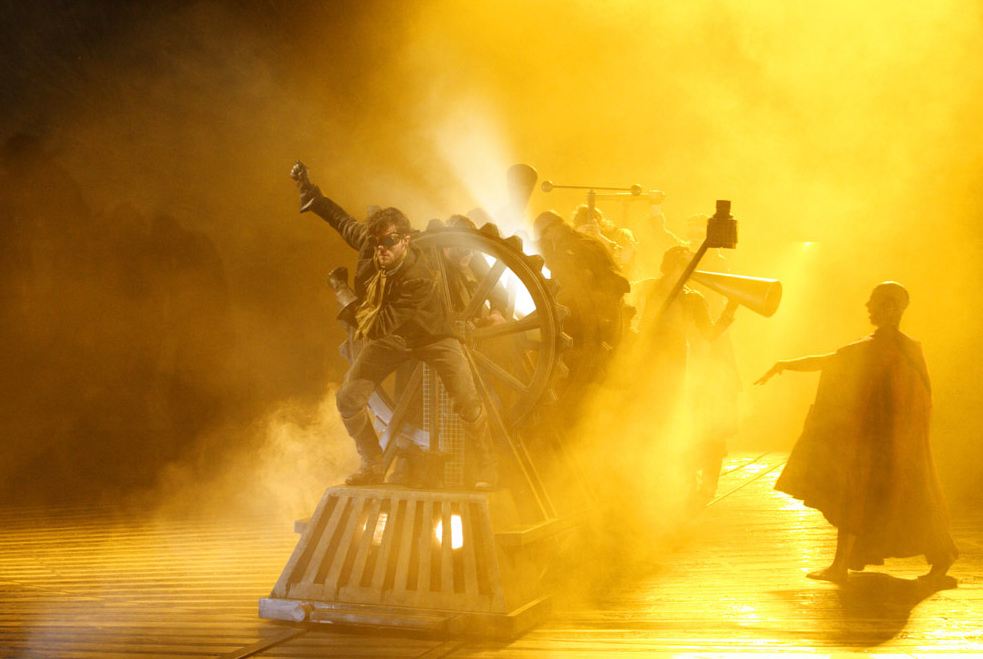
Unlike other adaptations of Mary Shelley's novel, the story is initially told through the eyes of The Creature - from his 'birth' pangs to Victor's rejection and on to his scary first experience of the real world and the hatred of strangers. It was a hypnotic beginning and one that acclimatised you to Jonny Lee Miller's astonishing physicality as the Creature. Naked, flapping and rolling about on the Olivier stage, Miller literally threw himself into the role. It also got you accustomed to Danny Boyle's vision of the play and his full use of all physical theatre trops - lighting, sound effects, music, water and fire, all of which culminated in the thrilling appearance of a steam train - all bright lights and showers of sparks.
The story then settled down to the Creature's education at the hands of Karl Johnson's kindly blind professor, driven from his university into a rural exile by a political regime. It was the first of many reflections and echoes between characters that Nick Dear has found in the tale. Needless to say, the Creature's idyll cannot last long as the Professor's son and daughter-in-law react in horror at his appearance and he responds by wreaking revenge on the family by burning the house.
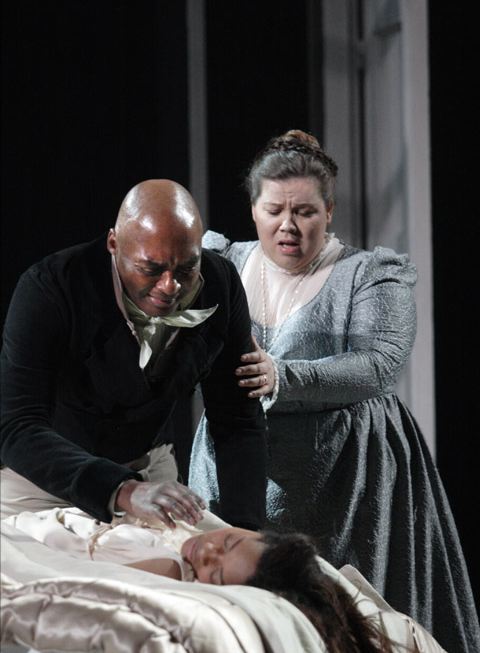
The Creature journeys to Geneva where Victor has returned to his father's house and to his fiancee Elizabeth, who he has ambivalent feelings for at best. Benedict Cumberbatch is not an actor I warm too but here his shtick of cerebrally emotional coldness was well-used as Victor. When Victor's infant brother is found murdered, he confronts his creation who presents him with an ultimatum - make him a female companion so he will know love and he will vanish from his creator's life. Initially horrified, Victor's vain-glorious ambition cannot be suppressed and he agrees to the deal, which, as we all know, leads to disaster...
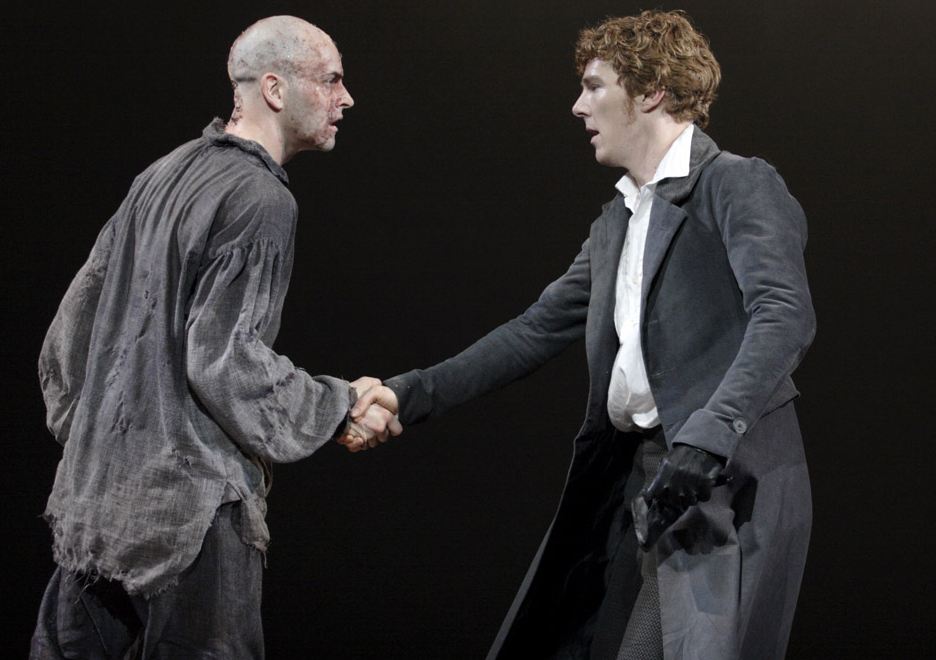
I will admit that at times Nick Dear's script was alarmingly thin when it came to the supporting characters but the confrontation scenes between Cumberbatch and Miller were wonderfully vivid, owing much to the chemistry between the two actors. The fact that they are alternating the roles I suspect gives them a rare insight into the characters and each other as performers.
As I have said, of the two I found Miller absolutely thrilling. He has filled out a bit since his Sick Boy days but this solidity works well for the Creature, making him more believable as a figure of menace. He gave a nuanced performance, by turns bitter, humorous, angry and with a genuine feeling of loneliness.
Karl Johnson made the most of his featured role as Professor De Lacey, just the right actor to 'settle' into the play with as his character is the first the Creature relates to after the sturm und drang of the production's opening.
Being the National we have the inevitable non-traditionalist
casting which works both for and against the production. Naomie Harris brought vitality and intelligence to the role of Elizabeth - I am still haunted by the execrable performance by Helena Bonham-Carter in the misguided Branagh film - but even she can do nothing with Dear's line of "We'll have less of that" when the Creature touches her breast in the bedroom scene. Excuse the pun but there were titters.
Sadly the same cannot be said for George Harris as Victor's father. All I can say is that Victor and murdered William must both take after their mother. It's not the fact that he's black that makes him stand out, it's the fact he is so under-powered as an actor. In a fairly anonymous support cast, Ella Smith was a delight as Elizabeth's maid Clarice.
It's 15 years since Danny Boyle directed a play and it seems that he has burst back onto the stage with a fevered imagination that rarely shows in his films - THE BEACH anyone? As I said the show is a real Sensurround experience with Mark Tildesley's set, Bruno Poet's lighting and Underworld's score all contributing to the experience, but it's Danny Boyle's vision that holds it all together.
How pissed must the National be that this sell-out production is only going to have a run of 3 months thanks to the lead actor's availability? I would hope that they will be able to revive it at a later date - but would it have the same impact with two other actors?
If only there was some way for Cumberbatch and Miller to be cloned... they could run it till the wheels dropped off then. Cloned... *reaches for test-tube and Bunsen burner*
So it turns out, you can keep your jukebox musicals or over-hyped film-to-stage west end shows... the show that is the #1 fight-for-a-ticket production is the National's FRANKENSTEIN by Nick Dear, directed by Danny Boyle and starring Benedict Cumberbatch and Jonny Lee Miller who are alternating the roles of 'Victor' and 'The Creature'.The Benedict Frankenstein/Jonny Creature combo was the one that made most sense to me but the only performance we managed to get was last Saturday matinee. It made an interesting contrast to leave the brilliant sunshine and chattery throng to sit in the darkened Olivier feeling the cold clutch of the undead. Well, I was never that much on sitting in the sun - give me a thumping, edge-of-the-seat work of pure theatre anytime.
Unlike other adaptations of Mary Shelley's novel, the story is initially told through the eyes of The Creature - from his 'birth' pangs to Victor's rejection and on to his scary first experience of the real world and the hatred of strangers. It was a hypnotic beginning and one that acclimatised you to Jonny Lee Miller's astonishing physicality as the Creature. Naked, flapping and rolling about on the Olivier stage, Miller literally threw himself into the role. It also got you accustomed to Danny Boyle's vision of the play and his full use of all physical theatre trops - lighting, sound effects, music, water and fire, all of which culminated in the thrilling appearance of a steam train - all bright lights and showers of sparks.
The Creature journeys to Geneva where Victor has returned to his father's house and to his fiancee Elizabeth, who he has ambivalent feelings for at best. Benedict Cumberbatch is not an actor I warm too but here his shtick of cerebrally emotional coldness was well-used as Victor. When Victor's infant brother is found murdered, he confronts his creation who presents him with an ultimatum - make him a female companion so he will know love and he will vanish from his creator's life. Initially horrified, Victor's vain-glorious ambition cannot be suppressed and he agrees to the deal, which, as we all know, leads to disaster...
As I have said, of the two I found Miller absolutely thrilling. He has filled out a bit since his Sick Boy days but this solidity works well for the Creature, making him more believable as a figure of menace. He gave a nuanced performance, by turns bitter, humorous, angry and with a genuine feeling of loneliness.
Being the National we have the inevitable non-traditionalist
Sadly the same cannot be said for George Harris as Victor's father. All I can say is that Victor and murdered William must both take after their mother. It's not the fact that he's black that makes him stand out, it's the fact he is so under-powered as an actor. In a fairly anonymous support cast, Ella Smith was a delight as Elizabeth's maid Clarice.
It's 15 years since Danny Boyle directed a play and it seems that he has burst back onto the stage with a fevered imagination that rarely shows in his films - THE BEACH anyone? As I said the show is a real Sensurround experience with Mark Tildesley's set, Bruno Poet's lighting and Underworld's score all contributing to the experience, but it's Danny Boyle's vision that holds it all together.
If only there was some way for Cumberbatch and Miller to be cloned... they could run it till the wheels dropped off then. Cloned... *reaches for test-tube and Bunsen burner*
Subscribe to:
Posts (Atom)