Showing posts with label Leonard Bernstein. Show all posts

Wednesday, December 29, 2021

DVD/150: WEST SIDE STORY (Robert Wise, Jerome Robbins, 1961)

In 2019 I blogged my 50 favourite musicals and WEST SIDE STORY was #8, largely due to the unshakeable memories of this film which won 10 Academy Awards - the only nomination it lost was for Ernest Lehman's screenplay, unsurprising as it's the weakest element.

Tony and Maria's love across sectarian divides in Manhattan actually only lasts two days but thanks to director Robert Wise and choreographer Jerome Robbins they give Shakespeare a run for his money.

Robbins was hired to direct and choreograph his first film but Wise was signed to co-direct to give him support with the dramatic scenes; but perfectionist Robbins pushed the filming into delays so he was removed but not before filming the iconic PROLOGUE, AMERICA, I FEEL PRETTY and COOL.

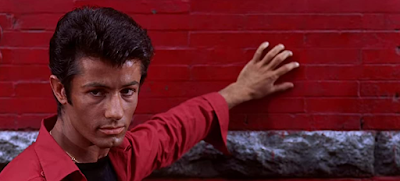
Natalie Wood and Richard Beymer don't have the best screen chemistry but Rita Moreno, George Chakiris and Russ Tamblyn's performances still defy the years.

Shelf or charity shop?  Leaping and twirling along the shelf.   It's pure musical cinema but filming wasn't easy: Richard Beymer soon discovered that Natalie Wood disliked him for some unknown reason and this reflects in their on-screen partnership; Wood's contract included that she would record her vocals - and she mimed to them while filming - but ultimately it was decided her voice was too thin and they were replaced by ghost-singer Marni Nixon.  Beymer was dubbed by singer Jimmy Bryant throughout, Russ Tamblyn's vocal for the THE JET SONG was dubbed by Tucker Smith who ironically plays his deputy Ice and who sings COOL, while Rita Moreno was dubbed by singer Betty Wand in A BOY LIKE THAT as she could not not manage the range.  In an even more bizarre twist, Betty Wand was meant to sing Moreno's last note in the QUINTET but she and Moreno both had a cold that day so Marni Nixon was brought back in after dubbing Wood's vocals - in essence harmonizing with herself!  Composer Leonard Bernstein criticized the orchestrations for the large studio orchestra as "overbearing" but did help Marni Nixon when she realised that her contract did not include getting paid for her vocals on the soundtrack album; Bernstein signed over a percentage of his profits to her - not bad as it became the best-selling album of the 1960s in America.  The sense of sharing extended to Robert Wise insisting on Jerome Robbins being billed as co-director despite him beng fired from the project.  The only person happy it seems was lyricist Stephen Sondheim who finally got his wish in having the comic song GEE OFFICER KRUPKE moved to before the Rumble; in the stage version it had come after the murderous fight where he argued it made no dramatic sense - he still hated his lyrics for I FEEL PRETTY however!  But despite all this... the glory endures.


Sunday, December 01, 2019

50 Favourite Musicals: 8: WEST SIDE STORY (1957) (Leonard Bernstein, Stephen Sondheim)

The 50 shows that have stood out down the years and, as we get up among the paint cards, the shows that have become the cast recording of my life.


First performed: 1957, Winter Garden, NY
First seen by me: 1984, Her Majesty's Theatre, London
Productions seen: two
  
Score: Leonard Bernstein / Stephen Sondheim
Book: Arthur Laurents
Plot: in 1957 New York, two young gangs - the American Jets and Puerto-Rican Sharks - fight for control of the streets.  Despite this, American Tony meets Puerto-Rican Maria and they fall in love.  But when the fighting results in two deaths, Tony and Maria are trapped in a dangerous momentum...

Five memorable numbers: TONIGHT, AMERICA, MARIA, SOMEWHERE, SOMETHING'S COMING

It's just always been there.  An early memory is going to see the film version at the Gaumont in Notting Hill Gate with my mum and a neighbour - no, not in 1961 - and enjoying the colour and music but my biggest memory is the two of them bawling at the end so I joined in, not terribly sure why.  I have always been suggestible, Constant Reader.  It's stunning songs were frequently sung on television variety shows and then the film was a constant staple of Bank Holiday films on television.  It truly was and is a global phenomenon. But it nearly didn't happen at all...


In 1947, choreographer Jerome Robbins, composer Leonard Bernstein and writer Arthur Laurents attempted an updating of Shakespeare's ROMEO AND JULIET, set in New York's Lower East Side focusing on the conflicts between Irish-Americans and Jews but it foundered on Bernstein's wish for it to be operatic and the realization that it was rehashing old themes.  This most quintessential of NY musicals was re-born in Los Angeles eight years later where the three men were working on separate projects; they decided to switch to the Upper West Side where a gang culture was growing between American teens and Puerto-Rican immigrants.  It must also be borne in mind that in the intervening years Robbins had been a 'friendly witness' in the McCarthy Communist witch hunt hearings; although they were not named by Robbins, Bernstein and Laurents had suffered from the resultant blacklisting of suspected persons.  Bernstein only wanted to write the music so when Arthur Laurents met his friend Stephen Sondheim at a party, 27 year-old Sondheim - recovering from his debut Broadway musical SATURDAY NIGHT being cancelled - was offered the lyricist role.  Sondheim was wary as he wanted to write his own material but his father-figure and mentor Oscar Hammerstein II advised he take it as working with such talents would be invaluable experience.  But two weeks before the start of rehearsals, producer Cheryl Crawford backed out; Sondheim sent the script to his producer friend Hal Prince who, after hearing Sondheim and Bernstein perform the score for him, jumped aboard.  During rehearsals, Robbins demanded a "Conceived by.." credit due to the extensive contribution his choreography had to the show; he received the credit but used it to his advantage, causing serious dissent from his collaborators.  The show opened to wild acclaim in 1957, Sondheim's lyrics almost always overlooked in reviews in the rush to praise Bernstein's music and Robbins' choreography.  For all it's shaking up of musical theatre, it only won two of it's six Tony nominations: Best Choreography and Best Scenic Design.  Carol Lawrence as Maria was the only acting nomination - bizarrely as Best Supporting Actress - but lost to Barbara Cook in THE MUSIC MAN as did the show for Best Musical!  The London production opened at Her Majesty's in 1958 and ran for two and a half years, some seven months longer than on Broadway, and won the Evening Standard Award for Best Musical.  In 1961, the film version co-directed by Robert Wise and Jerome Robbins - although in fact Robbins was fired during filming - exploded onscreen and went on to win ten Academy Awards, losing only one nomination for Best Adapted Screenplay.  Apart from it's two Broadway and three West End revivals, WEST SIDE STORY had also had countless regional productions


I first saw WEST SIDE STORY onstage in 1984 when the production from Leicester Haymarket moved to Her Majesty's and ran for over a year.  It was the last major production to play there until THE PHANTOM OF THE OPERA took up what looks like an eternal residency.  Robbins' partner Tommy Abbott - one of the original Jets on Broadway - reproduced Robbins' choreography to glorious effect and despite being note-perfect on the film version I was captivated with it when seen in it's original theatrical context.  I was also swept away by Jan Hartley's glorious Maria - it's a difficult role as Maria is the essence of purity which can be hard with more flashy characters around her but she was quite wonderful.  There was good work too from Steven Pacey as Tony, Richard Pettyfer as Riff and Lee Robinson as Anita.  In 2008 a touring 50th Anniversary production had a sold-out run at Sadlers' Wells and again, although the cast were picked for their dancing skills over their singing, it still was wonderfully powerful on stage.  In 2020 WEST SIDE STORY will be rising again: Ivo van Hove is directing a new Broadway revival and next December will see the release of Steven Spielberg's film remake.  The Variety newspaper theatre critic Hobe Morrison died in 2000 but I suspect he remembered his 1957 review of WEST SIDE STORY's Broadway opening for many years after:  
"The show seems a doubtful prospect for record album popularity and would need considerable revision as film material... at a guess it might be a sensation in London"
The obvious choice would be to include something from the film version but as this blog is about my favourite stage musicals I have chosen this dynamic version of the "Dance At The Gym" from the 2009 Tony Awards to show that while Jerome Robbins might have been difficult but his choreography is timeless.

Monday, April 16, 2018

Bernstein Triple Bill: YUGEN, THE AGE OF ANXIETY, CORYBANTIC GAMES at Covent Garden

Sometimes the Royal Ballet triple-bills can be a curate's egg but, every so often, all the pieces fall together and, while the individual one-acts dazzle, together they form a cohesive whole.  The Royal Ballet's recent celebration of Leonard Bernstein's centenary did just that.


Bernstein was such a giant of American music that it has taken three RB-favourite choreographers to stage this tribute: in tandem with Liam Scarlett's existing THE AGE OF ANXIETY, Wayne McGregor devised YUGEN and Christopher Wheeldon was given the final ballet CORYBANTIC GAMES.  All in their own way were exciting and Bernstein's soaring music sounded wonderful thanks to the Royal Opera House Orchestra.

Moving effortlessly between the classical and Broadway stages, Leonard Bernstein never forgot either as essential outlets for his creativity - indeed when a musical adaptation of THE SKIN OF OUR TEETH was abandoned because of creative differences, Bernstein reworked parts of the score to become a 1965 symphonic work which had been requested by the Dean of Chichester Cathedral two years earlier, waste not want not...  THE CHICHESTER PSALMS have been used by McGregor for his ballet YUGEN.


Utilizing his signature moves, McGregor had his dancers moving with vigour and astonishing physicality but also complementing the singing of the psalms in Hebrew.  The stark but intriguing design by Edmund De Waal of tall moving white light-boxes concentrated you on the remarkable dancers, as fluid as the red and purple costumes they wore.

I am sure it was just because it is the Bernstein score I know the most but I occasionally picked up the odd phrase that sounded straight out of WEST SIDE STORY in all three pieces.  I also saw a possible Matthew Bourne moment when a dancer did very noticeable swan-like swooping movements over three other crouching dancers.  McGregor can sometimes be all cerebral movement and little emotional involvement but here the lush musicality of Bernstein brought out the best in him, very much like Max Richter's music for WOOLF WORKS.


The second was a revival of Liam Scarlett's 2014 ballet THE AGE OF ANXIETY, written by Bernstein in 1949 and based on WH Auden's epic poem.  Bernstein's symphony throbs with the post-war feeling in New York of possible new beginnings under an air of lonely city living, Scarlett vividly moves his four lonely drinkers from a corner bar - an excellent design by John MacFarlane - to an apartment where they continue their drinking in the hope of making a connection.

They pal around, they flirt, they come together then break up leaving one of them, Malin, staring at the New York skyline at sunrise, eventually rushing towards it, ready to take up the challenge of another day, another possibility...  Sadly injury meant the wonderful Steven McRae had to pull out of the production and was replaced by fellow Aussie Alexander Campbell, but the lead quartet of Campbell, Sarah Lamb, Edward Gartside and Tristan Dyer were excellent, and Kevin Emerton was equally fine as the bartender.


After that blast of narrative, it was back to abstract for the last piece which was choreographed by Christopher Wheeldon.  He has set his ballet to Bernstein's Serenade after Plato's 'Symposium' - excuse me people - and the theme was carried through in Erdem Moralioglu's Hellenic-style costumes.  Through the five movements the constant theme seemed to be harking back to athletic running and leaping movement. 

I would love to see this again; Wheeldon's choreography was wonderfully alive, especially the 4th movement where a man and a woman, two men and two women danced variations to the same movements, perfectly embodying Bernstein's flowing music, before the whole ensemble at the end came together in kinetic, perfect fluidity.


As I said, the Royal Ballet triple bills may sometimes be unbalanced but in their tribute to Bernstein they triumphed.

Thursday, December 26, 2013

New Shows For Old...

Three of the productions I have seen recently are shows that I have either seen before or seen in different productions and had intrigued or delighted me enough to see again.

The first one was Mary O'Malley's ONCE A CATHOLIC - first seen in a far-flung 1979 at the Wyndhams Theatre.  It struck a chord with me and I saw it a few times, enjoying the memories it stirred with my own Catholic secondary school as well as the dirty jokes. 

ONCE A CATHOLIC at the Wyndhams, along with the National Theatre's transfer of BEDROOM FARCE at the Prince of Wales, both started a burgeoning interest in theatre-going but I wasn't in the right place to fully appreciate what theatre could do - that would come three years later with the NT's GUYS AND DOLLS.  But here we are years later in 2013 in the oddly-shaped Tricycle Theatre auditorium, would the play hold up?

The first thing that struck me was how much I remembered of the text - time and again I was remembering lines *just* as they were about to be said so I guess the play did have a lasting effect on me!

This production was directed by Kathy Burke and while she elicited good performances from her cast, the pace felt a bit sluggish - not helped by several ungainly scene changes.  I will admit we saw one of the previews so maybe this was just teething troubles.

ONCE A CATHOLIC is set in 1957 in a Catholic girl's school in Willesden and it's sense of place is excellently evoked - it was hugely enjoyable to be seeing the play not far from where it was set!  Three girls are preparing not only for their final exams but also their launch into the big world and more importantly Life and by natural extension, boys.  They are hindered rather than helped by the religious diktats handed out by the nuns who teach them and the priest who oversees their spiritual wellbeing.

 
The three are the studious Mary Gallagher (Katherine Rose Morley), the hapless Mary Mooney (Molly Logan) and the brassy Mary McGinty (Amy Morgan).  Mary Mooney is a girl who asks the wrong questions and who is always in the wrong place at the wrong time.  Good at heart and baffled by what the nuns insist is the truth, she constantly gets herself into trouble through no fault of her own.  Molly Logan played her with a delightful hangdog expression as if she seemed to expect to be in trouble all the time.  The odd thing is that she is the one who most wants to be devout but fate keeps tripping her up.  She oddly resembled a young Kathy Burke too!
 
 
After her scene-stealing performance in THE AMEN CORNER earlier this year, it was a joy to see Cecilia Noble again.  She was in excellent form as the three Marys' form teacher Mother Peter.  Whether she was ruling on the proper length of school knickers, enacting the miracle at Fatima or turning girlish in the presence of the priest she was a total joy.  Kate Lock played the dry and stern Mother Thomas Aquinas and Clare Cathcart was the scary science teacher Mother Basil.
 
 
There was also excellent support from Sean Campion as Father Mullarkey, the parish priest whose visits send the nuns a-twitter and the girls into boredom.  Campion was hilarious in his addresses to the class and gave the distinct impression of being one question away from cluelessness.  The know-it-all choirboy Cuthbert and horny teddy-boy Derek were played well by Oliver Coopersmith and Calum Callaghan.
 
 
It was good to see the show again and enjoy it's spiky, truthful humour once more.
 
I have seen the Leonard Bernstein musical CANDIDE twice before - but have never seen the same show twice as it's a piece that almost dares each director to make their production *the*  definitive version by adding dialogue, cutting songs or adding songs that other productions had previously dropped!  It's like everyone agrees the score is a jewel but the setting keeps getting hacked at, re-set and the jewel *still* looks wrong.

CANDIDE opened in 1956 with a book by Lillian Hellman (who originated the project), score by Leonard Bernstein and lyrics by John Latouche (who died before it opened), Dorothy Parker, the poet Richard Wilbur and Bernstein but it lasted only 73 performances.  However the original cast album grew in cult status - understandably so as it has fine performances from Robert Rounseville as Candide, Max Adrian as Dr. Pangloss and the wonderful Barbara Cook as Cunegonde singing the magnificent "Glitter And Be Gay".

Hal Prince directed a 1973 revival but Hellman refused to let her book be used so Hugh Wheeler provided a new one and Stephen Sondheim supplied a few new songs.  This version was a success but in 1988 Jonathan Miller's version for Scottish Opera added 30 minutes of music and in 1989 Bernstein had another go at the show, re-arranging the second act songs.  In 1999 John Caird rewrote the book *again* making it closer to Voltaire's original novel... and that's where the Menier comes in.
 
 
The Menier have based their production on the 1988 Scottish Opera version but the episodic nature of the show makes it still seem a ramshackle structure for Bernstein's great score so I really wouldn't be surprised if sometime down the line someone has another go at writing a definitive version.  Sigh.

Matthew White has bounced back from the pedestrian TOP HAT with a production that is ever inventive and eye-catching.  Played in the round you can bet there are always going to be moments that you don't catch as the cast are performing at the back of where you are sitting - and although I was seated on one of the inner aisles I managed to avoid the audience participation business... apart from getting pelted with torn-out pages from a book and getting sprayed with water when Candide's boat sank!


The premise is a troupe of players putting on CANDIDE, all elaborate gestures and patched costumes and Paul Farnsworth's designs were a delight as was his ramshackle set easily suggesting each of the locations where our hero shored up.

We follow the journeys and misadventures of Candide as he searches for his love, the beautiful but shallow Cunegonde, who he keeps finding but losing again as fate constantly intervenes.  Characters are seemingly killed only to pop up again in a different country, usually with a baffling reason for their survival but still Candide believes in the philosophy of his teacher Dr. Pangloss that "All's for the best in the best of all possible worlds", always optimistic despite what life throws at him.

The absurdly-named Fra Fee sang Candide well but was easy to forget when he shared the stage with the sensational Scarlett Strallen as Cunegonde and Jackie Clune as The Old Lady the eternal survivor (even with only one buttock).


The Old Lady gave Jackie Clune ample opportunities to display her considerable musical and comic talents while Scarlet Strallen followed up her energetic performance as 'Cassie' in A CHORUS LINE with a wonderful Cunegonde.

Both times I have seen the show before, the actresses playing the role had been too busy trying to sing the coloratura parts of "Glitter And Be Gay" to also bring out the humour in the lyrics but Strallen nailed it - while also making each word decipherable.  It was great to see her triumph in this particular song while also racing around snatching jewels not only from out of her treasure chest but also snatching the strings of diamonds from the chandelier too!

James Dreyfus was off  the night we went so the roles of Dr. Pangloss, Cacambo and Martin were played by Martin Cahill who rose to the occasion well.  A special mention as well for David Thaxton's Maximilian, it's a shame he was in such a small role as he sang it very well and had a commanding stage presence.

The show is also very well staged by Adam Cooper.  Oh and on the subject of Mr. Cooper...

The last show seen before Christmas was the one that made Cooper a star, yes it was time to return to Matthew Bourne's SWAN LAKE at Sadler's Wells.

 
This was the fourth time I had seen SWAN LAKE at Sadler's Wells - previous visits were in 2004, 2007 and 2009.  I can't believe it's four years since I saw it!  I have blogged about the 2007 production here and 2009 here so there is little more to be said about how much I love this production but suffice to say that it worked it's magic all over again as again I felt a tear or two trickle down my cheek at the heartbreaking climax.
 
What I will add is that we saw Jonathan Ollivier as The Swan / The Stranger who played the same role when we saw it in 2009!  He has a darkly charismatic presence on stage and was excellent.  Simon Williams was a tortured, troubled Prince - and we had seen him play the role in 2007.  Even more delightful is the fact that he was a mere swan ensemble member when we first saw it in 2004!!
 
 
The Christmas treat was that two other New Adventures favourites were on: the delightful Kerry Biggin was great as the clueless Girlfriend and Michela Meazza's Queen was imperiously cold.
 
This iconic production is on until 26 January 2014, you know you have to see it!