Showing posts with label Janie Dee. Show all posts

Wednesday, October 30, 2019

50 Favourite Musicals: 10: A LITTLE NIGHT MUSIC (1973) (Stephen Sondheim)

The 50 shows that have stood out down the years and, as we get up among the paint cards, the shows that have become the cast recording of my life:


First performed: 1973, Shubert Theatre, NY
First seen by me: 1989, Piccadilly Theatre, London
Productions seen: five
  
Score: Stephen Sondheim
Book: Hugh Wheeler

Plot: In 1900 Sweden, actress Desiree and lawyer Fredrik are two former lovers who rekindle their feelings for each other when she visits his town on a theatrical tour; however they are now paired with Anne, Fredrik's teenage bride, and Desiree's jealous lover Count Carl-Magnus.  Matters come to a head during a weekend party at Desiree's haughty mother Madame Armfeldt...

Five memorable numbers: SEND IN THE CLOWNS, THE MILLER'S SON, A WEEKEND IN THE COUNTRY, EVERY DAY A LITTLE DEATH, THE GLAMOROUS LIFE

Well, here are... the Top 10 Musicals; these are the ones whose scores mean the most to me.  We start with yet another Sondheim for a very good reason... he is my favourite musical composer.

After COMPANY and FOLLIES had shaken up the Broadway musical in the early 1970s with explorations into what could be done with the form, composer Stephen Sondheim and producer/director Hal Prince were in no mood to stop. They revisited an idea they had in 1964 when they wanted to create a modern take on an operetta-style romantic musical and decided to do an adaptation of Jean Anouilh's RING AROUND THE MOON but Anouilh said no - and said no again after they told him they had writer Hugh Wheeler on board!  Sondheim suggested two films that had a similar theme: Jean Renoir's THE RULES OF THE GAME and Ingmar Bergman's SMILES ON A SUMMER NIGHT as both feature a weekend country house party with romantic intrigues and jealousies enveloping both guests and servants.  Sondheim decided the Bergman had a subtlety that lent itself more to becoming a musical - and luckily Bergman agreed to the adaptation, his only stipulation being it be given a new title.  Hal Prince once described NIGHT MUSIC as "whipped cream with knives" but Sondheim is of the opinion that Prince was more interested in the former, he the latter.  Indeed what makes it such an interesting show is that all the characters are dissatisfied with something or unhappy at an other - they may be in love but it causes as much pain as pleasure - and Hugh Wheeler's witty book runs deceptively deep, something Sondheim has only grown to appreciate in the fullness of time and over many revivals.  Sondheim later asked Ingmar Bergman if he ever saw the show and was surprised when Bergman said he had and enjoyed it, brushing aside Sondheim's apologies about changing certain characters by saying "We are both eating from the same cake".  Oh and the cherry on that cake?  Soon after it opened, Jean Anouilh's 'people' contacted Hal Prince to say that the rights for RING AROUND THE MOON were now available - too late Jean!


Sondheim went into rehearsals with most of the score written but added - and subtracted - more along the way.  The rousing Act 1 closer A WEEKEND IN THE COUNTRY was written during the rehearsal period when Hal Prince felt all the story lines had to come together to send the audience out on a high; this also gave Sondheim the opportunity to write the song tailoring it to the cast's specific voices, and speaking of which... Sondheim and Prince has assumed they would cast a comedy actress for the lead role of Desiree who probably wouldn't be able to sing too well, and eventually decided on Glynis Johns who, they discovered, was able to sing in a breathy, delicate style.  Sondheim had given Desiree two duets in Act I and nothing in Act II but it was decided Glynis Johns had the musicality to be given a solo in the second act.  Hal Prince re-directed the scene to focus it on her while Sondheim turned up after two days with SEND IN THE CLOWNS.  Knowing her range meant she could not sustain long notes, he devised the song to comprise of short questions "Isn't it rich? Are we a pair?" that would fit on her voice perfectly.... the rest is history!  The show ran on Broadway for 18 months, was nominated for 12 Tony Awards and won 6 including Best Musical, Best Score, Best Book and Best Actress for Glynis Johns.  The London premiere was in 1975 with the dazzling cast of Jean Simmons, Joss Ackland, Hermione Gingold, David Kernan, Maria Aitkin and Diane Langton; the London cast recording remains my favourite with several definitive renditions especially Diane Langton as Petra, the practical maid, tearing the roof off with THE MILLER'S SON.


I first saw NIGHT MUSIC through Hal Prince's misguided film version starring a miscast Elizabeth Taylor; Sondheim had advised against it but Prince wanted to prove he was as good a film director as he was on stage - he wasn't.  I first saw it on stage in 1989 when Ian Judge's Chichester production transferred to the Piccadilly with Dorothy Tutin's unforgettable Desiree, Susan Hampshire's excellent Countess Charlotte and Sara Weymouth again mining gold with THE MILLER'S SON.  I saw Judi Dench's magnificent Desiree at the Olivier Theatre in 1995 which won her an Olivier Award in an otherwise over-directed production by Sean Mathias.  The Menier production in 2008 was a delightful chamber version, let down by Trevor Nunn's rather languorous pacing, not helped by his inclusion of the previously cut song SILLY PEOPLE but with winning lead performances from Hannah Waddington and Alexander Hanson.  Hanson transferred with the production to Broadway where I finally saw Angela Lansbury onstage as Madame Armfeldt; Catherine Zeta-Jones was an oddly lascivious Desiree but she reined in the Swansea barmaid interpretation to deliver a heartfelt SEND IN THE CLOWNS.  In 2015 we saw a concert version at the Palace Theatre with Janie Dee as Desiree, Joanna Riding as Charlotte, Jamie Parker as Carl-Magnus, Laura Pitt-Pulford as Petra (delivering yet another fiery THE MILLER'S SON) and Anne Reid as Madame Armfeldt.  It's a show I would happily see again but sadly the one that got away was a fundraising concert version in January 2009 for the Roundabout Theatre Company in New York with Natasha Richardson as Desiree, Victor Garber as Fredrik, Christine Baranski as Charlotte and Vanessa Redgrave as Madame Armfeldt; two months later Richardson was injured in a skiing accident and later died.

So which SEND IN THE CLOWNS will it be?  Despite memorable versions by Glynis Johns, Bernadette Peters, Barbara Cook and Angela Lansbury, for me it's Judi Dench in the 1995 NT production, seen here over the end credits of a South Bank Show profile.  It's not a good transfer but Dench delivers a nigh-on definitive rendition where every word comes straight from Desiree's broken heart...


Monday, February 25, 2019

FOLLIES at the Olivier, National Theatre - We're still here...

At the start of FOLLIES, the aged Broadway producer Dimitri Weismann welcomes his guests with "Welcome to our first - and last - reunion"... well Dimitri, we all had such a great time in 2017 that another one is being thrown on the Olivier stage.


Dominic Cooke's Olivier award-winning production was the theatrical sensation of 2017, and in my original blog I found it "...nigh-on perfect; an American classic given the production it deserves on our leading stage." (click on the link to read my 2017 blog) and, by the end of it's run, I had seen it four times, plus when it was screened to cinemas as part of NT Live.

And now it returns in a revival with some key cast changes: Joanna Riding and Alexander Hanson are now playing Sally Durant Plummer and Benjamin Stone while Harry Hepple, Ian McIntosh, Gemma Sutton and Christine Tucker play the ghosts of younger Buddy, Ben, Sally and Phyllis; the ex-Weismann Girls now feature Claire Moore belting out "Broadway Baby" while Heidi Schiller is being shared between two 1980s opera divas: Felicity Lott until April then taken over by the production's original star Josephine Barstow.


The interesting thing was to see how the show has been tweaked for the new cast and also to bring out some hitherto hidden moments.  The ghosts of the showgirls and the younger principals seem to be interacting with their older selves more pointedly, and in Joanna Riding's "Losing My Mind" and Alex Hanson's "Live Laugh Love" there are noticeable changes to the originals.  All in all, there are enough new touches to warrant another visit - needless to say I was clapping like a mad thing at the curtain call.

I had been most worried by the casting of Joanna Riding as Sally as Imelda Staunton had been so extraordinary in the role in the production's first incarnation, making Sally's mental breakdown shockingly real and painful.  Joanna Riding started slow, not having Staunton's immediate galvanizing onstage wattage, and played in a softer style.  To be honest, I have found her at times to be an anonymous actress; she has given performances I enjoyed while watching - THE PAJAMA GAME and a concert performance of A LITTLE NIGHT MUSIC (with FOLLIES co-star Janie Dee) - but nothing really stays in the mind.  However by the time, she hit her big moment "Losing My Mind" she gave an intriguing interpretation which I found oddly riveting.  Imelda Staunton sang it with an unbearable painful desolation but Riding, with some extra business swallowing a handful of pills, ends the number almost catatonic in isolation and on the last note pulling her blonde wig off as if to reveal the reality behind the artifice of her Harlow-esque costume.  She also played Sally's unrelenting despair in the final scene well so I guess she got there in the end.  I must admit I also liked her 'look' - like a suburban Dusty Springfield.


She was matched in a more subdued tone by Alexander Hanson as Ben Stone - and how nice it must be for both of them to have standing ovations and wild applause at their curtain call after their last show together, the Lloyd Webber flop STEPHEN WARD.  Philip Quast was a great physical presence on stage as Ben, singing the songs with a bruised masculinity which fitted his role as a jaded former-politician so his breakdown at the end was all the more affecting; here Hanson plays him with an exhausted ruefulness so Ben's final breakdown suggests more of a relief than anything else, I did enjoy his performance however.  There is also a change to his faltering in "Live Laugh Love" - whereas Philip Quast brought the number to a standstill while the chorus line kept looking around, attempting to feed him his next line or trying to kick-start the number, Hanson goes straight into the breakdown.

It's interesting to see how Janie Dee and Peter Forbes have recalibrated their performances to fit the playing styles of their two new co-stars; there is always the possibility that Janie Dee will just go large as the bitchy Phyllis but she keeps her character's pain grounded in frustrated anger.  Forbes' performance has grown on me now and his Buddy is also paired down to fit Riding's playing style.  The performances of Gemma Sutton, Christine Tucker, Ian McIntosh and the always-watchable Harry Hepple as the shadows of the leads' younger selves were all very good.


13 years ago I saw Claire Moore give a psychologically bruised performance as Sally in the unique experience which was the Landor Theatre's above-a-pub production of FOLLIES so it was nice to see her pop up here as Hattie, using her 1980s West End belt voice to punch across "Broadway Baby" to a huge cheer.

The role of Heidi Schiller, the oldest Weismann 'girl' at the reunion is played - and more importantly - sung by Dame Felicity Lott, who is playing the role until the production's original Heidi, Dame Josephine Barstow, again joins the show in April.  The soaring "One More Kiss", sung by Heidi and her younger self is one of my favourites and again it hit home for me - Young Heidi is once again wonderfully sung by Alison Langer - but Lott just missed out on the majesty that the richer-voiced Barstow brought to the song.  The returning star-turns were as good as before - and I even liked Tracie Bennett as Carlotta now she appears to have toned down the Judy Garlandisms.


Bill Deamer's choreography still sparkles with inventiveness and out-front flash, while Paule Constable and Vicki Mortimer's lighting and design still provide the perfect setting for Dominic Cooke's wonderful production.  We just had the one slip-up: during the "Loveland" number - where the chorus girls raise their glittering trains to spell out L-O-V-E-L-A-ND - the last one had her train fixed on her costume the wrong way round so we got L-O-V-E-L-A.... instead!

But once again what Dominic Cooke, his crew and cast have done more than anything else is to fill the National's Olivier stage with the sheer glory that is FOLLIES by treating James Goldman's book and Stephen Sondheim's score with the respect and love it deserves.  How wonderful it must be for people to see this version of FOLLIES as their introduction to the show.


FOLLIES is running until 11th May - if you didn't see it last time BOOK NOW... if you saw it last time STILL BOOK NOW!

Hats off... here they come...those Beautiful Girls...


Sunday, September 10, 2017

FOLLIES at the National Theatre - Now and Forever....

Since first sitting in the Olivier theatre on 6th August 1982 for Richard Eyre's legendary GUYS AND DOLLS, I have sadly seen my fair share of dog shows on that stage, and every time I have endured an EDWARD II or a WONDER.LAND, my mind has wandered to shows I would love to see on that stage and the one that always swayed to the front, glittering with beads and feathers, was Stephen Sondheim's FOLLIES.  And now it's here...


It has been such a long-held dream of mine to see FOLLIES there that I felt very nervous leading up to the lights going down as the first ghostly showgirl made her appearance on Vicki Mortimer's crumbling backstage set.  I must admit to having a few niggles with Dominic Cooke's production but as Imelda Staunton's Sally sings, "I'm so glad I came".

In 1965, Sondheim and writer James Goldman were looking for a project to collaborate on when Goldman had the idea of a murder mystery set at a reunion of showgirls.  Over the years the plot kept tripping them up but both loved the idea of the showgirls reunion and how regrets for what one did and more importantly didn't do, can haunt your life.  When Hal Prince became involved as director, he remembered a 1960 Life magazine photograph of a glamorous but fragile Gloria Swanson standing amidst the rubble of the Roxy cinema in New York which had opened with her film THE LOVES OF SUNYA. Prince felt this captured the essence of the project - the survivor, the glamour and the ruin.


It's 1971 and the Weismann Theatre is to be demolished to make way for a car park. The former owner Dimitri Weismann invites former stars and show-girls of his inter-war "Follies" productions to a first (and last) reunion onstage, the night before the demolition.  The guests compare how they have survived out of the spotlight but cannot resist running through their old numbers.  Among the guests are Phyllis and Ben Stone & Sally and Buddy Plummer - when they were showgirls in 1941, Phyllis and Sally were room-mates being courted by best friends Ben and Buddy but during the joint courtship, Ben led Sally to believe he loved her; he rejected her however and married Phyllis, and although Sally married Buddy she has never stopped obsessing about Ben.

Eventually the two couples finally confront each other - Sally reproaches Buddy for his mistresses while Buddy tells her it's only because she has shut him out emotionally while obsessing about Ben; Ben feels his life as a politician has been a lie and foolishly lets Sally believe he still loves her, while Phyllis accuses Ben of turning her into a frigid trophy wife and never really appreciating the real her.  As they argue with themselves - and the ghosts of their younger selves - it leads to an explosion of fantasy: they find themselves starring in their own "Follies", each singing a solo number which expresses their dilemma.  But the illusion cannot last forever...


Hal Prince's 1971 production ran for 522 performances but closed at a loss of over $720,000, due of the huge costs involved and audience ambivalence - despite 'names' like film stars Alexis Smith and Yvonne de Carlo, 1950s tv singer Dorothy Collins and veterans Ethel Shutta and Fifi D'Orsay, audiences found Goldman's book too downbeat.  It won seven of the ten Tony Awards it was nominated for but failed to win Best Musical.  Cult status grew through the original cast album but sadly Capitol Records would only release it as a single album, losing a lot of the score.  The show has had two further Broadway revivals in 2001 and 2011, but lost out winning the Best Musical Revival Tony Award both times.

1985 was the year FOLLIES hit me!  The lack of a full cast recording led to the decision to stage a concert version in New York to be recorded featuring the full song score with the jaw-dropping cast of Barbara Cook, Lee Remick, George Hearn, Mandy Patinkin, Elaine Stritch, Carol Burnett, Betty Comden and Adolph Green, Liliane Montevecchi et al.  But before this, I had already seen my first production of the show in Wythenshawe, Manchester.  Directed and choreographed by Paul Kerryson, the production swept me away and made me yearn for a London transfer.  However, when FOLLIES opened in 1987 at the Shaftsbury Theatre, it was a new production directed by Mike Ockrent. 


Cameron Mackintosh had asked Goldman and Sondheim if they would 'revisit' the work to make the tone more optimistic.  Goldman was happy to, Sondheim less so.  One night I was outside the Shaftsbury stage door after seeing a preview and Sondheim came out on his own.  While he signed my programme I told him I had seen the Manchester version, he shot me a look and asked which I preferred.  Cautiously I said that, although loving Julia McKenzie, David Healy, Dolores Gray and Lynda Baron, I felt that Manchester was better.  He replied that while shows can always stand a revision it was always possible to return to the original.  Point taken Steve...

Nineteen years later FOLLIES turned up at the Landor Theatre which seated a mere 48 in a production which made up for it's lack of grandeur with a cast guaranteed to have any musicals fan of the 1980s hug themselves with delight - Sarah Payne, Claire Moore, Adele Anderson, Rachel Izen, Carol Ball, Roni Page - my blog of that production is here.  But now here it is at the National Theatre, in a production that looks back to Hal Prince's original, in particular without the sub-par songs Sondheim wrote for the 1987 production and it plays straight through with no interval.


This is Dominic Cooke's debut musical production and if you think FOLLIES is too big an ask for a debut you would be wrong as Cooke handles the production with a thoroughness of vision which allows the musical numbers to flourish and stake their claim on the Olivier stage but is just as thorough at the emotional trauma the four main characters inflict amid the nostalgia.

I grew to like Vicki Mortimer's design but wanted to remind her that the wrecking-ball arrives the day after the reunion not the day before as her set was like a bombsite at the best of times, however Paule Constable's lighting was a wonder and Bill Deamer's choreography is also a pure delight, especially in the wonderful WHO'S THAT WOMAN where the aging showgirls gamely go through their steps unaware that they are being matched step-for-step by the shadows of their former selves.


When the production was announced I was excited as to who would be cast, imagining the National Theatre could and should get together some West End musical veterans who would rival MGM's slogan "More Stars Than There Are Heaven".  Well that didn't happen which is where I have a niggle with the production.  The pure joy of the Landor production, as I said earlier, was to see so many musical performers from the 1980s playing the ex-showgirls; FOLLIES cries out for that recognition of the history behind each of the performers.  Sadly the NT didn't do this so although ultimately it's a whinge probably only I have, I think a trick was missed out on.

My other stumbling block was with Tracie Bennett as Carlotta Campion, the Weismann girl who couldn't quite make it on stage but who found fame, first as a film star then as a tv actress.  As I suspected might happen, Bennett dispensed with a character all together and sang Carlotta's cri-de-coeur I'M STILL HERE as if reprising her Judy Garland role in OVER THE RAINBOW.  More than ever, some identification with the actress playing Carlotta works wonders - most notably when Dolores Gray then Eartha Kitt made it such a tour-de-force in the 1987 London production - but here it was just Tracie Bennett doing her shtick.


But why then did you see me wiping tears of happiness away at more than one occasion?  Because, despite those niggles, I was presented with the production of FOLLIES I have yearned for all those years.  Because when it hits, it hits hard and, despite Tracie Bennett, there are astonishing performances wherever you look.  It was a given that Imelda Staunton would be a great Sally but she is such an astonishing performer that she mines down within the character to find the raw, festering yearning that Sally has nursed for Ben, making her life as a wife and mother a sham.  To quote Neil Simon, Sally is worse than a hopeless romantic she's a hopeful one and watching that dream die in her was Imelda's triumph.

Janie Dee was equally great as Phyllis, the woman who once told Ben that she would read all the right books to make herself worthy of him and who now realizes that in doing so, she lost her most vital possession - herself.  A real treat was to see how a dropped idea from the 1971 production was re-used here: Hal Prince wanted Sally and Phyllis' Follies solos to be tributes to Jean Harlow and Rita Hayworth but it was dropped as it just didn't seem to fit - but here Cooke has Sally singing LOSING MY MIND in a white on white Harlow-esque boudoir while Phyllis' THE STORY OF LUCY AND JESSIE is shake and shimmied to as in a Hayworth film like MISS SADIE THOMPSON.


The real success of the show is Philip Quast as Ben, the man everyone looks up to as a shining beacon of success but who inside cannot understand why.  Owen asked me before were there any songs I didn't like and I said it was Ben's THE ROAD YOU DIDN'T TAKE but in Quast's deft handling it landed wonderfully.  Peter Forbes as Buddy was a little out-of-his-depth but then I was so bowled over by the late and great David Healy in the 1987 production that anyone would struggle.  Of the younger shadows, Zizi Strallen and Alex Young as the 1940s Phyllis and Sally really stood out.

The truly astonishing thing about FOLLIES is that Stephen Sondheim floors you with a fantastic song only to follow it up soon after with another.  It Is a credit that Dominic Cooke keeps the tension throughout and it doesn't become a stop-start affair of big numbers stopping the show, one after the other.  Di Botcher comes out swinging for BROADWAY BABY which was all the sweeter for being from someone I had always looked on as a play-as-cast performer - believe me, that song was still travelling when it hit the Olivier's back wall!  Dawn Hope invests WHO'S THAT WOMAN? with plenty of attitude and sass - she's come a long way since Crystal in LITTLE SHOP OF HORRORS at the Comedy.


But the one that utterly floored me was ONE MORE KISS which is sung supremely by Josephine Barstow as Heidi Schiller, the oldest of the Weismann girls who, before leaving the stage for the last time, sings the operetta aria that Oscar Straus wrote for her - or was it Franz Lehar?  A sad, lilting song of farewell, Heidi sings it to herself but also to Weismann who was once a lover who watches from the shadows, the song made doubly poignant as she is joined by her younger operatic self.

That the production managed to cast one of Britain's great operatic divas for the role is special enough, but within the short space of the song, you could hear a pin drop as her voice soared around the auditorium joined by Alison Langer as her younger self.  In a score of unstoppable great musical moments this was one to treasure.  Hopefully next time, Dame Josephine will be lit to fit her status.. someone should have given the follow-spot op a nudge.


I will be seeing FOLLIES again at the end of the month; by which time the wobbly preview ticks - Barstow's missed lighting, the feedback that distracted during Janie Dee's COULD I LEAVE YOU and the slightly unfocused ending - will be sorted.

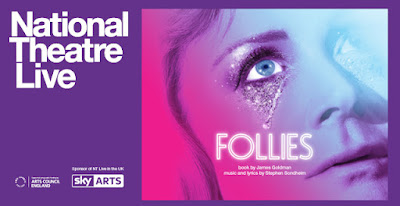
As it is, FOLLIES is nigh-on perfect; an American classic given the production it deserves on our leading stage. Surely a cast recording must follow on?  If you are unlucky enough not to to have booked a ticket already, the great news is that FOLLIES will be filmed live as part of the NT Live series and shown simultaneously in cinemas in the UK and abroad.on 16th November.

Clink the image to see where it's playing near you:

http://ntlive.nationaltheatre.org.uk/productions/63102-follies

Constant Reader, if you have ever loved this blog... go!

The ghostly Weismann showgirls are waiting to walk their stage just one more time...


Saturday, May 02, 2015

Design Overload: LIGHT SHINING IN BUCKINGHAMSHIRE and AH, WILDERNESS!

Seeing Caryl Churchill and Eugene O'Neill plays are never going to be the most laugh-heavy evenings but two recent theatre visits have been made harder by distracting scenic concepts.


Caryl Churchill wrote LIGHT SHINING IN BUCKINGHAMSHIRE in 1976 for the Joint Stock Theatre Group where it was performed by six actors.  Now here we are, revived at the National with a cast of eighteen with forty-four supernumeraries bulking out the stage.

I can understand why director Lyndsey Turner has wanted to flesh it out - election year, a play about the different protest factions left to flounder after the Civil War, big stage needing an epic play of the people etc. etc.  It just doesn't work - and it doesn't work with the scenic concept that has been clamped down over the text like a metal cloche.


The stage is filled with a huge wooden table - raked like a platform stage - at which are seated noblemen eating a candlelit dinner in the first act, puritan scribblers in the second.  The characters in Churchill's fragmented scenes clamber up onto the table and play their scenes with admirable commitment but without much interest generated for me as I nodded off a few times in the first act.

The play was arrived at through a research workshop and at times I felt I really ought to paying more attention as each scene felt like a 17th contemporary pamphlet being acted out but it's sheer relentless dourism made it hard to engage with anything - and just as you felt being drawn into a debate, we were treated to a group folk sing-song. Yawn.


Cromwell's New Model Army has won the Civil War but in it's wake troops of dissenters have appeared, all of whom think the time has come for their visions to be fulfilled but all of them had not realised that Cromwell was replacing one tyranny with another and he sounded the death knell for their hopes and ambitions.  The Ranters who believe that God is within and wanted sexual and political freedom, The Diggers who wanted all common ground to be given over to the common man, and the more politically-minded Levellers who drew support from unhappy members of the army are all represented.

The second act begins well with Gerrard Winstanley demanding his rights to farm on common land but again Turner's wish for a scenic Big Idea muffs the action by having the supernumeraries break up the large table with spades to disclose a huge allotment underneath.  A nice scenic idea but in practice it means that the following scenes are overshadowed by extras pulling up the planks of wood and slowly moving them off the stage, ridiculously distracting and something that should have been quashed during the technical rehearsals.


Performances from Nicholas Gleave, Ashley McGuire, Joe Caffrey and Ann Ogbomo were good, but they would have worked better in a smaller, less distracting production.  Bruno Poet's lighting is good, Soutra Gilmour's costumes are down to her usual drab standards and Es Devlin is responsible for the distracting set.  I must admit that while watching this first production under Rufus Norris' reign as NT Artistic Director, my heart sank a little - please don't let this be an omen.  I am also seeing Lyndsey Turner's HAMLET later this year at the Barbican which is again designed by Devlin.  Quakes.

Next was the Young Vic revival of Eugene O'Neill's 1933 play AH, WILDERNESS! which holds the distinction of being his only comedy.  Needless to say an O'Neill comedy is hardly Brian Rix material but it has a gentle charm where the comedy is more character-based than anything that happens within the plot.


Which is just as well as director Natalie Abrahami has thrown out O'Neill's stage directions and set it in and around sand dunes which have taken over a large clapboard house.  Oh and she has a character obviously meant to be O'Neill who hangs around the stage, pulling props out of the sand - a table yet! - and intoning in voice-over the stage directions.  This drafted-in character also has the last lines, a paraphrasing of a quote from the Rubaiyat of Omar Khayyam which O'Neill inscribed to his wife on his own copy of the play.

So why?  Is Abrahami so unsure of the material that a concept has to be imposed on it?  To make it more 'relevant' to the Young Vic, a theatre which relishes director-imposed reinventions of texts?  When, at the start of the play, the O'Neill character describes in taped voice-over the stage description of the Miller household with it's tasteful but tasteless furnishings, none are to be seen - just banks of sand which the actors gingerly clamber over like so many turn-of-the-century mountain goats.


Richard Miller is 16 and at *that* age, discovering literature for the first time and brooding that all of his life will be stymied by his parent's conventional lifestyle and the lack of intellectual freedom in his world.  We've all been there and O'Neill's sensitive handling of the archetypal prickly teenager is charmingly done.  He is angered by his mother's blinkered ideas of his advanced reading matter - there is a nice joke when Oscar Wilde is said to have been found guilty of bigamy - but not far beneath the surface he still loves her and his amiable, newspaper-owning father.

He shares the house with his older and younger brothers as well as with a maternal uncle and paternal aunt.  Aunt Lily is on her way to becoming an old maid but quietly loves Uncle Sid but his not-so-secret drinking is getting out of hand and will always be a barrier between them - and needless to say, there is also a cheeky Irish maid too.


Richard is also struggling with his feelings for his neighbour Muriel whose father does not approve of him but when he goes out for a 5th of July drink with his older brother, he is seduced by good-time girl Belle.  It was around now that I managed to transcend Abrahami's absurd concept and started to just enjoy O'Neill's writing.

The play culminates in a scene between Richard and Muriel, full of wonderfully hesitant writing as they deny then declare their love and this is played against Richard's parents expressing their continued love for each other.  See Miss Abrahami?  The play is definitely the thing.


The usually-dependable Janie Dee played Essie the mother, but here she noticeably stumbled over a few of her lines, but there were good performances from Martin Marquez as her husband Nat, Susannah Wise as Aunt Lily and Dominic Rowan as the wastrel Uncle Sid (although his drunk acting was a bit over the top).  By far the performance of the evening was George Mackay as Richard, usually prickly and intellectually snobbish but played with great guile and he even executed a funny belly-flop into the onscreen lake.

Charles Balfour's lighting was a major plus for the production while Dick Bird's monumental set finally came into it's own when a lake suddenly appeared from nowhere.  Ultimately what made me annoyed was that Abrahami's handling of the performers proves she's a worthy director so there really is no need for the unnecessary concept imposed on the play.  I am sure if O'Neill had wanted AH, WILDERNESS! to be a dreamy, memory play he would have written it as such.


An odd footnote: AH, WILDERNESS! inspired no less than two musical adaptations - in 1948 Mickey Rooney starred as Richard in the MGM film SUMMER HOLIDAY while in 1959 Jackie Gleason won a Tony award for his role of Uncle Sid in Bob Merrill's TAKE ME ALONG.

An even odder footnote: It was Bob Merrill's second O'Neill-inspired score as in 1957 he had written the music and lyrics to NEW GIRL IN TOWN starring Gwen Verdon and Thelma Ritter which was based on ANNA CHRISTIE.  Go figure.

Friday, January 30, 2015

A LITTLE NIGHT MUSIC: 40th Anniversary Concert

...sort of.

The show premiered in New York in 1973 but the semi-staged concert we saw at the Palace Theatre on Monday was to celebrate 40 years since it's first London production.  It opened at the Adelphi with the deliciously characterful cast of Jean Simmons, Joss Ackland, Hermione Gingold, David Kernan, Maria Aitkin and Diane Langton and their cast recording is still my favourite version.


Owen took great delight in pointing out that, for all my ranting about the current trend of adapting films into stage shows, that A LITTLE NIGHT MUSIC was based on Ingmar Bergman's "Smiles On A Summer Night".  Indeed Sondheim also did the screen-to-stage PASSION and is said to be working on a stage amalgamation of Luis Bunuel's THE DISCREET CHARM OF THE BOURGEOISIE and THE EXTERMINATING ANGEL.  A subtle but important difference to MADE IN DAGENHAM and KINKY BOOTS. 

Meanwhile, back to the Palace (sounds like INTO THE WOODS eh?)  The Palace really is a frightful barn with a particularly gloomy auditorium but it was good to see it so busy for this one-off event.  By the end of it I was aching to see a full revival of the show!


We were treated to a cast that most producer's would chew their leg off to have - namely Janie Dee as Desiree Armfeldt, Anne Reid as Mme. Armfeldt, Jamie Parker as Count Carl-Magnus, Joanna Riding as Countess Charlotte and Laura Pitt-Pulford as Petra.

I felt David Birrell as Frederick Egerman sang well but was a bit anonymous when acting opposite Dee or Parker while Fra Fee as Henrik made the oddest noise when singing in his higher register (which his character does), he sounded like a gurgling drain.


What was enjoyable was getting reacquainted with Hugh Wheeler's exquisite book, the perfect setting for the jewel of Sondheim's score.  A great book should give you the impression that, stripped of it's songs, it can stand alone as a play and when original director Hal Prince described the show as being like "whipped cream with knives" that is exactly what Hugh Wheeler wrote, he mixes comedy and drama to perfection.

Even in the semi-staged setting, the best performers sparkled.  Janie Dee was a lustrous Desiree with her trademark champagne-dry wit and she sang SEND IN THE CLOWNS with a resigned sadness.  Yes, she muffed the final moments during the CLOWNS reprise but by then she had won us over.


Jamie Parker and Joanna Riding were marvellously paired as Count and Countess Malcolm, both finding their laughs with ease.  In his solo number IN PRAISE OF WOMEN, Parker showed off his considerable singing skills as he had in last year's GUYS AND DOLLS at Chichester and was huge fun too in the duet IT WOULD HAVE BEEN WONDERFUL with Birrell. 

Joanna Riding had the audience in her hand with her cutting lines and also duetted well in EVERYDAY A LITTLE DEATH with Anna O'Byrne's Anne.  It would be a lovely change for Anne not to be played as a hysteric but O'Byrne was on firmer territory when singing.


As the all-knowing Madame Armfeldt Anne Reid was enormously enjoyable, her withering put-downs were as dry as dust and apart from a tiny stumble during her solo number LIAISONS she sang it well and it would be great to see her in a proper production, if only for her to have a proper setting for her performance.  Madame Armfeldt actually has the very last moment of the action which was lost in a concert setting.

However the best performance was Laura Pitt-Pulford's Petra, the sly and sexy maid who knows exactly what she wants out of life and love.  What is interesting is how her solo number THE MILLER'S SON comes straight after SEND IN THE CLOUDS, two songs of great self-awareness, but the latter gives a supporting actress a real moment to shine.  Diane Langton's titanic version lives on through the London cast recording and I have seen Sara Weymouth and Kaisa Hammarlund seize that moment to shine and now I can add Laura Pitt-Pulford to that list. She was quite electrifying.


The onstage orchestra sounded great under the musical direction of the curiously-bouncy Alex Parker and although Alastair Knights' direction kept the show moving along nicely, Andrew Wright's choreography was a trifle redundant.

When one thinks of how often theatres are dark it would be nice to think that they could be utilised for similar semi-staged productions or for a seasons of them such as Broadway's acclaimed Encores productions where classic or little-seen musicals are presented.


Well done Duncan Bell for the photographs that capture the event.

Monday, April 21, 2014

The British Birthday Play

After the hard-edged GOOD PEOPLE, it was time to relax into the chiffon-edged comedy of Noël Coward's BLITHE SPIRIT currently revived at the Gielgud Theatre with a long-overdue return to the London stage by Angela Lansbury.  All very appropriate as John Gielgud had starred in and directed an ENSA touring production of the comedy during World War 2.

 
Michael Blakemore had previously directed Angela Lansbury in 2009 on Broadway in the play which won her a fifth Tony Award and here they are reunited with a new cast and production team.  Unsurprisingly she has rooted herself into the character, making Madame Arcati her own.

Written by Coward in 1941, it was an instant hit - although Graham Greene found it "a wearisome exhibition of bad taste"!  It went on to hold the record for the longest running play in the West End until "The Mousetrap" overtook it in 1957.  David Lean filmed a screen adaptation in 1945 which featured the original players of Arcarti and Elvira, Margaret Rutherford and the delicious Kay Hammond, although this version had an alternate ending.  The play has been revived frequently and I first saw it in 1986 at the Vaudeville Theatre with the perfect cast of Simon Cadell, Jane Asher (Ruth), Joanna Lumley (Elvira) and Marcia Warren as Arcarti.

Author Charles Condomine and his wife Ruth hold a soirée with the village doctor and his wife as well as the local eccentric Madame Arcarti with the ulterior motive of getting her to hold a seance so Charles can get material for a novel he is planning.  During the seance however Arcarti "brings across" the ghost of Charles's glamorous first wife Elvira who has been dead for seven years and only Charles can see her.  Elvira, as capricious in death as in life, causes mischief around the house much to Ruth's anger and Charles' bemusement. 


He soon tires of her behaviour however when he realizes she has her own agenda when she fixes the brakes on his car hoping he will join her forever - but it's Ruth who uses the car first.  Now with two ghostly wives making his life a misery he calls in Madame Arcarti to try and get them back to the other side.  If only she knew how...

Michael Blakemore directs the comic business and Coward's devilishly witty dialogue to expert effect but also suggests the darker tones that lurk in the corners of the Condomine living room.  Written two years into World War II where death was in everyone's consciousness, it's musings on the lingering effects of those departed must have made for a very heightened experience when first presented.


Simon Higlett's set has just the right feel of a home counties living room and also is entertaining in it's own right when the other world encroaches in on it which is also well-evoked by Mark Jonathan's lighting design.

Blakemore's cast also rise to the occasion with one clanging exception.  The ever-reliable Charles Edwards is a delight as Charles, effortlessly spinning his lines with the lightest touch like the deftest of tennis players.  But he also plays a man quietly delighted to be given a change from his second, rather conformist, marriage.  Luckily Edwards is complemented perfectly by Janie Dee as Ruth.  She showed her excellent comic timing time and again particularly in the classic exchange:
  • Charles: Anything interesting in The Times?
  • Ruth: Don't be silly, Charles. 
Ruth can be a tough role - the character who wants to stop the madcap antics usually is - but Janie Dee is such an engaging stage performer that her dry delivery was a joy to behold.


I found the casting of Jemima Rooper to be a miscalculation however.  Her childishly petulant pouts and squeaky voice seemed to belong to a totally different production and more than once I felt she was totally out of her depth with the quality of performance onstage.  Simon Jones and Serena Evans made full use of their considerable experience to fill out the roles of Doctor and Mrs Bradman and Patsy Ferran made the most of the West End debut as Edith, the Condomine's gormless maid.

Needless to say Madame Arcarti's belated entrance on stage provoked a round of applause for Angela Lansbury, you don't get too many of those anymore but somehow within the context of Coward and BLITHE SPIRIT it didn't seem strange at all!  There was the odd stumbled line but that is more than allowed when you're 88 and in the process of giving a performance of pure star quality.  She played Arcarti as an intelligent and engaging authoress but one who didn't suffer fools gladly - I will treasure the exasperated daggers she shot at Mrs. Bradman's clueless questioning.


Yes, she stole scenes with her bizarre little dance in her pre-seance trance or in her delighted responses to Elvira's presence but that's what she's there to do!  Although the role didn't give her the opportunity to touch us in the way her Madame Armfelt did in A LITTLE NIGHT MUSIC on Broadway in 2010, it was an utter joy to see her on a West End stage and proving that this wasn't a case of stunt star casting - just like Arcarti, she brought sheer magic to us.

All this and being made Dame Angela last week too - it's about time!


Sunday, January 26, 2014

From Shakespeare to Sondheim...

...it's not too far.  Not in the West End anyway.

Two productions bracketed last week and their only link was that I enjoyed them both!  Oddly enough it's always harder to praise than to critique but I will give it a go for you Constant Reader.

First off the rank was HENRY V, Michael Grandage's final production in his season at the Noel Coward Theatre (it will always be the Albery to me) which has proved successful by having plenty of lower-price seats allied to the wattage of theatre 'names' starring in the shows.


I was under-impressed by the first production PRIVATES ON PARADE despite Simon Russell Beale's star turn and haven't felt sad to have missed PETER AND ALICE (Ben Wishaw & Judi Dench), THE CRIPPLE OF INISHMAAN (Daniel Radcliffe) or A MIDSUMMER NIGHT'S DREAM (Sheridan Smith & David Walliams) but the thought of Jude Law giving us HENRY V proved too tempting.

Although I am not a fan of Law's screen work - he always seems too lightweight for any role - HENRY V marks the fifth time I have seen him onstage and he should be applauded for returning to the stage when he could be making money doing negligible films.  I feel he has got better each time I have seen him, LES PARENTS TERRIBLES (National Theatre), TIS PITY SHE'S A WHORE (Young Vic), HAMLET (Wyndhams), ANNA CHRISTIE (Donmar) and now HENRY V, but there is still the occasional choice that pulls the focus a bit - a certain way of delivering a speech, the way he stands (he couldn't stop a pig in a passage) and, in some respects, sharing the impression I always had when I saw Kenneth Branagh - good enough, but come back in a few years and he will be better.

 
But despite these moments, I enjoyed his performance very much and he rose to the challenge of Henry's big speeches with ease - the St. Crispin's Day speech was excellent.  Henry is a mercurial character with flashes of anger that show he is no longer the playboy prince that the French think they will be facing on the battlefield and Law encompassed all these moods very well.  The only time it faltered for me was the final wooing scene with Princess Katherine which was played so much for laughs that it broke the through-line of the performance up to that point but I suspect Grandage being at fault there.
 
The production was very Grandage - well-paced, non-flashy, nothing distracting from the text.  They are always slightly under-cast - so no one upstages the lead? - the worst offenders being Ben Lloyd-Hughes' Dauphin who was a bit am-dram and Matt Ryan's Fluellen outstayed his welcome every time he appeared.  Richard Clifford also seemed to let his costume's fluttery sleeves do all his acting for him as the King of France.
 
 
However there was also Grandage stalwart Ron Cook who was a delightful Pistol, conniving and making sure he saved his own skin in battle, and he was expertly partnered in the Eastcheap scene with Noma Dumezweni's Mistress Quickley.  Her richly-voiced description of the death of Falstaff was one of the highlights of the show and her palpable sadness as she watched Pistol and the ragtag army recruits leave for war was beautifully judged.  She also was delightful as Alice, the French princess' knowledgeable maid.    
Another fine performance was given by Ashley Zhanghazha as the Chorus who guides the audience through the plot.  Shakespeare's use of the Chorus to remind the audience they are watching a play on a stage is remarkable - his exhortations to the audience to use their imagination to see castles, the channel, ships, horses is to pinpoint the joy of theatre.  I had also forgot that the Chorus provides a sombre end to the play undercutting the humour of the wooing scene with the fact that Henry was dead within two years and that his son's ineffectual rule led to The War of The Roses - "so many had the managing, that they lost France, and made his England bleed".
 

Christopher Oram's standing set of wooden painted slats was fine but he really needs a new 'look' and Neil Austin's lighting was as evocative as always.
 
Despite all the petty peeves I think this was the best production of HENRY V I have seen.  Click here if you can get to see it before it closes on February 15th.

Then later in the week it was time to finally get to go to the St. James Theatre which opened on the site of the old Westminster Theatre in 2012 - it took a Sondheim show to lure me through the doors!

Let's get the kvetch out of the way - Foster Wilson Architects who designed the theatre should be booted up the arse.  Entering an L-shaped space with a garish marble staircase taking up the axis, attempting to get to the bar is hampered by not only three rows of tables taking up the space but by the waiters squeezing past you with full or empty plates. I wouldn't have minded but said staircase leads up to a restaurant!  They could at least take out one of the rows of tables to give people space to move.  Then you go into a theatre which is too steeply angled to the playing area with minimal leg room - I felt like I was going to be watching an anatomy lecture.


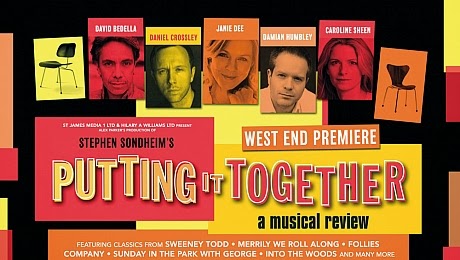
I think I was so thrown by the theatre's ugliness that it took me a while to get into what we had come to see, PUTTING IT TOGETHER a Sondheim revue that was originally conceived in 1992.

In 1992, eighteen years after SIDE BY SIDE BY SONDHEIM, it was suggested that a sequel was due as in those years he had written SWEENEY TODD, MERRILY WE ROLL ALONG, SUNDAY IN THE PARK WITH GEORGE, INTO THE WOODS and ASSASSINS!  So Sondheim and Julia McKenzie devised PUTTING IT TOGETHER, it's limited engagement premiere cast including Diana Rigg and Clarke Peters.  The next year Julia McKenzie directed the show off-Broadway which marked the return to New York theatre of Julie Andrews.  Five years later the show finally made it to Broadway (briefly) with Carol Burnett, George Hearn, John Barrowman, Ruthie Henshall and Bronson Pinchot.


So 22 years after it's Oxford premiere it finally makes the West End.  The premise suggests a cocktail party given by an older couple for a younger pair with an intermediate servant type floating about.  It vaguely works as a construct but we know and they know that it's a device to have them sing all the different songs at each other, some fitting the concept better than others.

As I said, it took me a while to settle in to the show possibly because I know the songs so well from their original settings but luckily the cast had the charm and the talent to ease me into the show - although at one point the three men were lined up singing and I thought "George Clooney, Daniel Craig and John McEnroe have gone off haven't they"?


Janie Dee was the true star of the show, easy to do when you have the 'bitter woman' songs such as "The Ladies Who Lunch", "Could I Leave You", "Not Getting Married Today"and "Like It Was" but she also had her marvellous comic timing and unalloyed charisma.  Caroline Sheen was o.k. as the ingénue and scored best with Madonna's songs from DICK TRACY "Sooner or Later" and "More".

David Bedella has always had "something of the night" about him so as the lecherous older man came easy to him with songs like "Have I Got A Girl For You" and "Good Thing Going" while Damian Humbley, who I last saw mugging away as Charley in MERRILY WE ROLL ALONG, here was much more restrained and therefore more affecting singing "Unworthy of Your Love", "Live Alone and Like It" and "Marry Me A Little".  I haven't seen Daniel Crossley in a lead role before but here he had ample opportunity to shine during "Everybody Ought To Have A Maid" and "Buddy's Blues".


A delightful show with a delightful cast, PUTTING IT TOGETHER is playing at the St. James until 1st February.