Showing posts with label Michael Grandage. Show all posts

Sunday, October 13, 2019

50 Favourite Musicals: 11: MERRILY WE ROLL ALONG (1981) (Stephen Sondheim)

The 50 shows that have stood out down the years and, as we get up among the paint cards, the shows that have become the cast recording of my life:


First performed: 1981, Alvin Theatre, NY
First seen by me: 1983, Bloomsbury Theatre, London
Productions seen: four
  
Score: Stephen Sondheim
Book: George Furth

Plot: Franklin Shepard is a successful composer and film producer but as he looks back over his 20 year career he can see how step-by-step his aspirations were lost along with his two best friends Charley Kingkas and Mary Flynn.

Five memorable numbers: MERRILY WE ROLL ALONG, OUR TIME. NOT A DAY GOES BY, GOOD THING GOING, OUR TIME

One show had to just lose out on the top 10 - how ironic it had to be MERRILY WE ROLL ALONG.  After their previous show SWEENEY TODD: THE DEMON BARBER OF FEET STREET won eight Tony Awards and nine Drama Desk Awards, the partnership of composer Stephen Sondheim and producer / director Hal Prince were expected to come up with another smash hit.  But it was not to be... MERRILY lasted a mere 44 performances after a troubled rehearsal period where the original leading man and choreographer where replaced and audiences walked out, confused by the back-to-front plotline.  Prince's concept of a cast of teenage performers, all in sweatshirts and jeans, backfired and the resultant failure had a lasting effect on it's devastated young cast as well as Sondheim and Prince who would not work together again on a new work for 22 years.  The odd thing is that the seemingly revolutionary plot-twist of having the story told backwards originated in 1934 in a play of the same name by George S Kaufman and Moss Hart, which had also closed losing money - albeit with more performances.  It was neglected at Awards time too, MERRILY received a single Tony nomination for Best Musical Score - which lost to Maury Yeston's NINE.  The palpable sadness of that original production has remained, especially as that cast's recording of the score has kept the show alive down the years - remarkable considering they recorded it the day after they closed.  Since then MERRILY has gone on to be reclaimed as one of Sondheim's most remarkable scores - particularly as the usual criticism thrown at him that he is too cerebral to be emotional is made ridiculous by songs such as NOT A DAY GOES BY and GOOD THING GOING which are tear-triggers of the highest magnitude.  Sondheim's score ripples with great songs whose tunes appear throughout the show in different guises so you can track them seemingly down the years as Charley, Frank and Mary's lives change and grow apart.


I was lucky enough to see MERRILY's European premiere when the Guildhall School's production transferred to the small Bloomsbury Theatre two months after it was first staged at the school.  Ian Judge's wonderful production swept me away and made the show instantly one of my favourites.  Over the years as it's status has grown with every UK and US revival, Sondheim has revisited the score and added new numbers for Frank and Gussie, the musical star he marries, but for me the original score is the one I return to.  After the 1983 Guildhall show I had to wait 17 years until another London production at the Donmar.  Michael Grandage's production featured career-defining performances from Samantha Spiro as Mary, Daniel Evans as Charley and Julian Ovenden as Frank and won three Olivier Awards for Best Musical, Best Actress and Best Actor for Evans; sadly no West End transfer occurred.  That happened three years later when Maria Friedman's production at the Menier Chocolate Factory transferred to the Pinter Theatre for a few months.  While happy that this remarkable show was finally seen in a proper West End house I was less enthusiastic by Friedman's garish and broad production - it did however win the Olivier for Best Musical Revival. The latest news on MERRILY is that Richard Linklater has announced he will make a film of it with the absurd idea of filming it over 20 years so the characters can be seen to age properly... one is tempted to think of Olivier's line to Dustin Hoffman while he was holding up filming doing his Method shenanigans "Why don't you try acting?".

A much more poignant and telling film take on MERRILY is Lonny Price's wonderful documentary BEST WORST THING THAT EVER COULD HAVE HAPPENED from 2016.  Initially a film about the making of MERRILY and the impact of it's failure on it's young cast, Price - who was the original Charley - had remembered ABC News filming all of the audition and rehearsals for a segment in one of their news programme but when they were informed they had an investment in MERRILY they stopped the filming and put out a statement that the footage was destroyed.  However the original videotapes were finally tracked down and Price utilizes the footage to recreate the excitement of the young cast turn to bewilderment at it's failure to work despite Sondheim and Prince's best efforts.  The bigger themes of looking back to see what you gave up to live your dreams - or giving up your dreams to live - are as palpable as MERRILY itself - do hunt it out...


Sunday, June 16, 2019

50 Favourite Musicals: 20: GRAND HOTEL (1989) (Robert Wright / George Forrest / Maury Yeston)

The 50 shows that have stood out down the years and, as we get up among the paint cards, the shows that have become the cast recording of my life:


First performed: 1989, Martin Beck Theatre, NY
First seen by me: 1992, Dominion, London
Productions seen: five

Score: Robert Wright / George Forrest / Maury Yeston
Book: Luther Davis
Plot:  Berlin, 1928: the Grand Hotel's visitors and staff live lives of quiet desperation and within 24 hours, some will be changed forever:  the famous ballerina Grushinskaya is fighting age and falling audiences attended by her dresser Raffaela who secretly loves her, Baron Felix Von Gaigern is eluding his creditors with dwindling success, businessman Hermann Preysing has lied to his board of directors about a financial merger and needs to travel to the US to save it, temp secretary Flaemmchen is just surviving between jobs and discovers she is pregnant when assigned to Preysing as a typist, and the dying book-keeper Otto Kringelein - who knows all of Preysing's secrets - has left his sanatorium to check into the Grand Hotel for one last happy memory...

Five memorable numbers: LOVE CAN'T HAPPEN, WE'LL TAKE A GLASS TOGETHER, I WANT TO GO TO HOLLYWOOD, ROSES AT THE STATION, AT THE GRAND HOTEL

A musical which shows you should never give up.  In 1958, book writer Luther Davis and song-writers George Forrest and Robert Wright decided to follow their hit KISMET with a musical based on Vicki Baum's novel and the MGM film GRAND HOTEL, titled AT THE GRAND starring KISMET actress Joan Deiner (with her husband signed to direct) and the 1930s film star Paul Muni.   But Muni was unhappy, and despite his role being made bigger, he eventually quit and AT THE GRAND closed on the West Coast.  Whip-pan to 1988: director/choreographer Tommy Tune was given AT THE GRAND to work his magic on after his recent Broadway hit NINE; as he did with his previous show he totally revised it and when Wright, Forrest and Davis balked at his changes, Tune gave the score to NINE composer Maury Yeston to doctor it and add several songs of his own.  The book was also doctored by Peter Stone who refused a writing credit.


Tune's chic, minimalist production ran on Broadway for over 2 years, winning five Tony Awards, although not for score or book. I saw Tune's production in 1992 at the Dominion Theatre when it opened with Lilianne Montevecchi reprising her role as Grushinskaya but the barn-like Dominion did the production no favours and it closed after only four months.  I could see good things in it but it just didn't grab me.  I saw GRAND HOTEL again in 2000 at the Guildhall school performed by final year students but finally 'connected' with it when Michael Grandage directed a thrilling Olivier award-winning production at the Donmar in 2004 with Julien Ovenden as the Baron, Mary Elizabeth Mastrantonio as Grushinskaya, Helen Baker as Flaemmchen and Daniel Evans as Kringelein.  Finally the show's strength was revealed in a smaller, more direct approach.  I felt more engaged with the characters and the hidden jewels in the score stood out more.  A further Guildhall production was followed by another chamber version at the Southwark Playhouse.  Staged as a traverse production, it was inventive and enjoyable but suffered at the end from a striving for profundity that was misplaced.  As with recent productions of CABARET, It's a bit of a lazy option to end any musical set in 1930s Germany with concentration camp imagery.  Although Forrest and Wright's score included such fine book numbers as "Maybe My Baby Loves Me", "Who Couldn't Dance With You?" and "We'll Take A Glass Together", it is Maury Yeston's songs that give the characters wonderful moments of clarity and depth: Flaemmchen's desperate "I Want To Go To Hollywood", Grushinskaya's sweeping "Toujours Amour" and more importantly The Baron's two solos "Love Can't Happen" and "Roses At The Station" are both remarkable compositions; it's Yeston's contributions that make GRAND HOTEL a show that suddenly touches your heart.

I was sorely tempted to post the wonderful Tony Awards segment of the late Michael Jeter and Brent Barrett stopping the show with "We'll Take A Glass Together" which illustrates how Jeter won a Tony Award for Best Supporting Actor for the role of Otto but that would not do justice to the rest of the score so here is a selection of songs from the 2018 Encores! staged concert.


Ps. click here!

Friday, June 01, 2018

RED at the Wyndhams Theatre - Molina's masterpiece

Two-handers are tricky plays to pull off.  There is the apocryphal story of two actors slogging through a two-hander when there was an offstage knock at a door which elicited a cry from the audience "Whoever it is... let them IN!"

I must admit there were a few times I felt someone... anyone... would be welcome additions while watching John Logan's play RED which is being revived at the Wyndhams Theatre.  The play premiered in 2009 at the Donmar directed by Michael Grandage while he was the artistic director there; the play transferred to Broadway, bypassing the West End, where it was won 6 Tony Awards including Best Play.  Astonishingly the one award it lost out on was for it's strongest asset, Alfred Molina as the painter Mark Rothko.


It's 1958 and the painter Mark Rothko is preparing for a major commission, the newly completed Seagram Building architects Mies Van der Rohe and Philip Johnson have asked Rothko to provide murals for the building's exclusive Four Seasons restaurant.  Rothko has hired a young studio assistant called Ken to help him mix the paints and stretch the canvasses.  Ken's admiration of the new Pop Art movement incurs Rothko's disdain but when Ken questions Rothko's decision to provide paintings for the Four Seasons' elite diners is when the paint really hits the fan...

My problem with the play - that runs 90 minutes with no interval - was that it very soon became fairly predictable: a series of squabbles where the two protagonists take black/white positions, it's all quite wearing no matter how well it's acted.  Great "themes" are raised but I felt Logan had no particular standpoint on any of them - they were raised just to give the actors something to do.


The thin play however is surrounded by an excellent production: it is well directed by Michael Grandage in his clear, understated style - the non-verbal highlight being where the two actors launch into priming a large blank canvas a dark red colour; working as an aria plays, Molina and Enoch speed paint the canvas, at one point thrillingly in time to the music.

Neil Austin's lighting is up to his usual high standard but the real winner here is Christopher Oram's wonderfully detailed set of Rothko's downtown art studio - during the more mundane stretches of Logan's script it was a pleasure to let my eyes wander over the set to relish the verisimilitude.


The fictional role of Ken was originated by Eddie Redmayne - even winning the Tony for Best Supporting Actor - but here the role goes to Alfred Enoch, late of the Harry Potter film franchise.  I cannot say he ever made any impression on me in them but here he gave a capable enough performance but the character never rang true - he was just an Aunt Sally for Rothko to argue against everything he hates about the current art scene.

As I said the main reason to see the play was Alfred Molina's marvellous portrayal of the conflicted genius Rothko.  Molina made him a real force of nature, a human bull-in-an-arts-supply-shop who knows his own worth but battles with an underlying dread that "one day the black will swallow the red" which of course happened in 1970 when he took his own life, possibly due to growing ill-health.  Molina knew how to colour the emotions though as in his character's crestfallen bitterness when he finally views the Four Seasons and realizes his error in agreeing the commission.


RED is worth seeing for Alfred Molina's larger-than-life Rothko and Michael Grandage's production but the play itself is a little like watching paint dry.


Sunday, January 26, 2014

From Shakespeare to Sondheim...

...it's not too far.  Not in the West End anyway.

Two productions bracketed last week and their only link was that I enjoyed them both!  Oddly enough it's always harder to praise than to critique but I will give it a go for you Constant Reader.

First off the rank was HENRY V, Michael Grandage's final production in his season at the Noel Coward Theatre (it will always be the Albery to me) which has proved successful by having plenty of lower-price seats allied to the wattage of theatre 'names' starring in the shows.


I was under-impressed by the first production PRIVATES ON PARADE despite Simon Russell Beale's star turn and haven't felt sad to have missed PETER AND ALICE (Ben Wishaw & Judi Dench), THE CRIPPLE OF INISHMAAN (Daniel Radcliffe) or A MIDSUMMER NIGHT'S DREAM (Sheridan Smith & David Walliams) but the thought of Jude Law giving us HENRY V proved too tempting.

Although I am not a fan of Law's screen work - he always seems too lightweight for any role - HENRY V marks the fifth time I have seen him onstage and he should be applauded for returning to the stage when he could be making money doing negligible films.  I feel he has got better each time I have seen him, LES PARENTS TERRIBLES (National Theatre), TIS PITY SHE'S A WHORE (Young Vic), HAMLET (Wyndhams), ANNA CHRISTIE (Donmar) and now HENRY V, but there is still the occasional choice that pulls the focus a bit - a certain way of delivering a speech, the way he stands (he couldn't stop a pig in a passage) and, in some respects, sharing the impression I always had when I saw Kenneth Branagh - good enough, but come back in a few years and he will be better.

 
But despite these moments, I enjoyed his performance very much and he rose to the challenge of Henry's big speeches with ease - the St. Crispin's Day speech was excellent.  Henry is a mercurial character with flashes of anger that show he is no longer the playboy prince that the French think they will be facing on the battlefield and Law encompassed all these moods very well.  The only time it faltered for me was the final wooing scene with Princess Katherine which was played so much for laughs that it broke the through-line of the performance up to that point but I suspect Grandage being at fault there.
 
The production was very Grandage - well-paced, non-flashy, nothing distracting from the text.  They are always slightly under-cast - so no one upstages the lead? - the worst offenders being Ben Lloyd-Hughes' Dauphin who was a bit am-dram and Matt Ryan's Fluellen outstayed his welcome every time he appeared.  Richard Clifford also seemed to let his costume's fluttery sleeves do all his acting for him as the King of France.
 
 
However there was also Grandage stalwart Ron Cook who was a delightful Pistol, conniving and making sure he saved his own skin in battle, and he was expertly partnered in the Eastcheap scene with Noma Dumezweni's Mistress Quickley.  Her richly-voiced description of the death of Falstaff was one of the highlights of the show and her palpable sadness as she watched Pistol and the ragtag army recruits leave for war was beautifully judged.  She also was delightful as Alice, the French princess' knowledgeable maid.    
Another fine performance was given by Ashley Zhanghazha as the Chorus who guides the audience through the plot.  Shakespeare's use of the Chorus to remind the audience they are watching a play on a stage is remarkable - his exhortations to the audience to use their imagination to see castles, the channel, ships, horses is to pinpoint the joy of theatre.  I had also forgot that the Chorus provides a sombre end to the play undercutting the humour of the wooing scene with the fact that Henry was dead within two years and that his son's ineffectual rule led to The War of The Roses - "so many had the managing, that they lost France, and made his England bleed".
 

Christopher Oram's standing set of wooden painted slats was fine but he really needs a new 'look' and Neil Austin's lighting was as evocative as always.
 
Despite all the petty peeves I think this was the best production of HENRY V I have seen.  Click here if you can get to see it before it closes on February 15th.

Then later in the week it was time to finally get to go to the St. James Theatre which opened on the site of the old Westminster Theatre in 2012 - it took a Sondheim show to lure me through the doors!

Let's get the kvetch out of the way - Foster Wilson Architects who designed the theatre should be booted up the arse.  Entering an L-shaped space with a garish marble staircase taking up the axis, attempting to get to the bar is hampered by not only three rows of tables taking up the space but by the waiters squeezing past you with full or empty plates. I wouldn't have minded but said staircase leads up to a restaurant!  They could at least take out one of the rows of tables to give people space to move.  Then you go into a theatre which is too steeply angled to the playing area with minimal leg room - I felt like I was going to be watching an anatomy lecture.


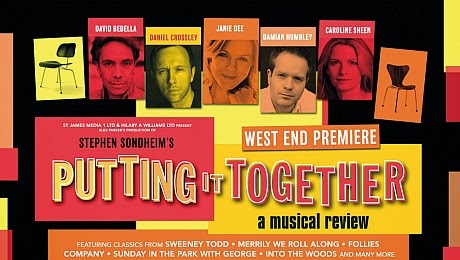
I think I was so thrown by the theatre's ugliness that it took me a while to get into what we had come to see, PUTTING IT TOGETHER a Sondheim revue that was originally conceived in 1992.

In 1992, eighteen years after SIDE BY SIDE BY SONDHEIM, it was suggested that a sequel was due as in those years he had written SWEENEY TODD, MERRILY WE ROLL ALONG, SUNDAY IN THE PARK WITH GEORGE, INTO THE WOODS and ASSASSINS!  So Sondheim and Julia McKenzie devised PUTTING IT TOGETHER, it's limited engagement premiere cast including Diana Rigg and Clarke Peters.  The next year Julia McKenzie directed the show off-Broadway which marked the return to New York theatre of Julie Andrews.  Five years later the show finally made it to Broadway (briefly) with Carol Burnett, George Hearn, John Barrowman, Ruthie Henshall and Bronson Pinchot.


So 22 years after it's Oxford premiere it finally makes the West End.  The premise suggests a cocktail party given by an older couple for a younger pair with an intermediate servant type floating about.  It vaguely works as a construct but we know and they know that it's a device to have them sing all the different songs at each other, some fitting the concept better than others.

As I said, it took me a while to settle in to the show possibly because I know the songs so well from their original settings but luckily the cast had the charm and the talent to ease me into the show - although at one point the three men were lined up singing and I thought "George Clooney, Daniel Craig and John McEnroe have gone off haven't they"?


Janie Dee was the true star of the show, easy to do when you have the 'bitter woman' songs such as "The Ladies Who Lunch", "Could I Leave You", "Not Getting Married Today"and "Like It Was" but she also had her marvellous comic timing and unalloyed charisma.  Caroline Sheen was o.k. as the ingénue and scored best with Madonna's songs from DICK TRACY "Sooner or Later" and "More".

David Bedella has always had "something of the night" about him so as the lecherous older man came easy to him with songs like "Have I Got A Girl For You" and "Good Thing Going" while Damian Humbley, who I last saw mugging away as Charley in MERRILY WE ROLL ALONG, here was much more restrained and therefore more affecting singing "Unworthy of Your Love", "Live Alone and Like It" and "Marry Me A Little".  I haven't seen Daniel Crossley in a lead role before but here he had ample opportunity to shine during "Everybody Ought To Have A Maid" and "Buddy's Blues".


A delightful show with a delightful cast, PUTTING IT TOGETHER is playing at the St. James until 1st February.

Sunday, July 21, 2013

Revivalists: Act two

Now Constant Reader, it might seem like I only see revivals at the National Theatre but I have actually gone to other theatres... like, in the actual West End.  All have featured fine performances but the actual productions themselves all felt wanting of real conviction.


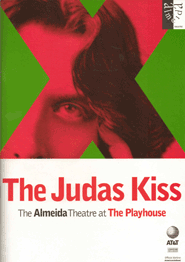
Having missed David Hare's THE JUDAS KISS at Hampstead I caught up with it finally at the Duke of Yorks, primarily to see Rupert Everett's lauded performance.


It is 15 years since I climbed the stairs to the Playhouse's peanut gallery to see the original Richard Eyre production which starred a rather out-of-place Liam Neeson as Oscar Wilde and a play-stealing turn from Tom Hollander as Lord Alfred 'Bosie' Douglas.  The play had vaguely stayed with me but I honestly didn't expect it to be revived anytime soon.  But now we had Australian director Neil Armfield's production and I was surprised how much I liked the play.

David Hare's play covers two key moments in the life of Oscar Wilde.  In April 1885, his libel case against the Marquis of Queensbury has collapsed leaving the way clear for his arrest for Gross Indecency.  His former lover Robbie Ross tips him off that the police are delaying his arrest, almost wanting him to flee to France but Wilde refuses.  Ross thinks he is staying to appease 'Bosie' his spoilt lover but Wilde stays because to flee would be to betray his life.

 
The second act takes place two years later in the run-down villa in Naples where the broken Wilde is now living with an unrepentantly petulant Lord Alfred who is shagging his way through the local Italian rough trade and looking to get away.  Again Ross appears to reprimand Wilde and remind him that his wife has threatened to refuse him any access to their sons if he sees 'Bosie' again but again Wilde refuses him.  He cannot live his life by other's demands, no matter the consequences or the obvious ruin that Bosie has led him to.  


Armfield's direction was minimal which may be fine for actors such as Everett and Cal MacAninch (superb at playing the vein-bursting frustration of Robbie Ross) but Freddie Fox as the awful 'Bosie' was left with nothing to do but stamp his foot and rant which got old very quickly.  Compared to Hollander's slyly manipulative portrayal, he was resolutely two-dimensional.


Something which cannot be levelled at Rupert Everett who gave a performance of total star power.  His Wilde, the agent of his own destruction, was played with real charisma - you simply couldn't watch anyone else when he was onstage.  It was the sudden shifts that surprised, the way his resigned and weary façade broke down at the simple generosity of the staff of the Cadogan Hotel where he was hiding.  He really came into his own in the second half as the broken ex-prisoner, shuffling around in his slippers when not huddled in his chair.  His weary, rueful manner giving way to one of total exhaustion, like a character out of Beckett.  After loving his recently published second book of memoir as well as enjoying his performance as Benedict Cumberbatch's brother in the BBC's PARADE'S END, it was great to see Everett triumph on stage too.

Further up St. Martin's Lane another actor was giving life to another revival.  Simon Russell Beale, taking a break from the National Theatre, appeared in the first production of Michael Grandage's season at the Noel Coward theatre PRIVATES ON PARADE.

 
This was a production I was looking forward to, Russell Beale is always worth seeing and I had only ever seen the film version of Peter Nichols' play which was a bit ho-hum.  Sadly the production promised more than it delivered.

At no time did it betray any need to be on that stage at that time.  Yes it's a play about the stupidity of war but it still didn't seem to chime with what's happening now in any other theatres (of war).  It felt more like Michael Grandage wanted Simon Russell Beale to open his theatre season and offered him a big camp role which is anarchic and outrageous but also provides the humanity and heart of the play.


Simon Russell Beale's audience had followed him over the river and there was plenty to drain their blue rinses: the soldiers' knobs got a good airing during the shower scene as well as a featured cameo appearance of Russell Beale's bum.  It must be odd to know that the big shocked reaction you have just heard from the audience is because you flashed your arse.  There was also more effing and jeffing than was probably heard in the whole Malayan conflict, mostly shouted by John Marquez' Corporal Bonny, who did little to dim the memory of Joe Melia's wonderful performance on screen.

It was all very well-directed and presented in the usual Donmar house-style thanks to the set by Christopher Oram and Neil Austin's excellent lighting and there were fine supporting performances from Davina Perera as Sylvia and Harry Hepple as Lance Corporal Charles Bishop but it somehow it just didn't move me.
 

There is no denying however that bestriding them all (usually in black stockings) was Simon Russell Beale as Acting Captain Terri Dennis who simply stole everything that wasn't nailed down with a performance that was outrageously funny and touchingly human.  He's some broad.

I also saw the revival of Terence Rattigan's THE WINSLOW BOY at the Old Vic.  Ever since his centenary those Rattigan productions just keep coming, everything it would seem but the Vivien Leigh screen version of THE DEEP BLUE SEA *fume*.


It was good to finally see the play as I had never seen either of the film versions and even managed to miss the 1989 BBC production which co-starred Emma Thompson as the titular boy's sister Catherine. 

Lindsay Posner directed this revival of Rattigan's 1946 hit play which he based on a real case in 1908 of a teenage boy expelled from a naval college after being accused of stealing a five shilling postal order.  Ronnie Winslow returns home in disgrace but his upstanding father Arthur is compelled to seek justice for him but as the Admiralty's ruling is considered an act of Government it can only be brought to trial by a decree from the.. um, Government.

With the family losing their place in 'good' society and Arthur becoming ill with the stress, their last hope rests with leading barrister Sir Robert Morton who is also a member of the opposition.  Winslow's suffragist daughter Catherine is strongly opposed to his involvement thinking he will only use the case to further his political career and because of his opposition to votes for women. 

In a scene which finally jolted Posner's rather tasteful production into life, Morton visits the house and ruthlessly cross-examines Ronnie in front of his appalled family, seeming to destroy the boy's story.  Morton then reveals he only did it to see how the boy might react to a courtroom and agrees to take on he case.

Through a mixture of guile and oratory Morton succeeds in getting the Government to agree to a court hearing which goes ahead with the Winslow home surrounded by newspaper reporters.  On the day of the trial Morton's ruthless cross-examinations force the Admiralty to withdraw it's charges against Ronnie and the family win the case.  But it's a hollow victory as the family is now near bankruptcy, Arthur's health is ruined as is Catherine's engagement to her Guardsman fiancée.


Any play about an individual trying to seek justice against an impossible bureaucracy will always be topical and Rattigan's play holds up well with it's expert construction.  Posner's production however felt safe and timid with several scenes seeming to tread water until the next entrance cue.  Owen asked me before it started what sort of a play it was and I assured him that at some point a scene would start with the maid turning on the study lamps and drawing the curtains.  And sure enough, there was Violet the loyal maid pulling the curtains and lighting the lamps on Peter McKintosh's rather obvious box set which looked like it belonged to a touring company.

Luckily what Posner was blessed with was a fine cast headed by Henry Goodman's benignly comfortable Arthur Winslow  who is broken by the system he has lived his life upholding.  There was good support from Deborah Findlay as Grace Winslow, ill-equipped to deal with the change wrought on her family and life, and also from Nick Hendrix as their oldest son Dickie who is happy enough learning the new dance steps rather than learn anything in Oxbridge - yes it was a silly-ass part but played with great wit.  Catherine was played by Naomi Frederick and a little more personality wouldn't have gone amiss while Charlie Rowe's Ronnie betrayed a lack of stage experience.  A special mention to Jay Villiers as the family solicitor who quietly loved Catherine.

However the stand-out performance was Peter Sullivan as Sir Robert Morton.  The production's synapses were jolted every time he appeared and his witty, self-assured, disdainful Sir Robert also gave the impression of having a heart under all that veneer.  I've seen Peter Sullivan a few times on stage and here he was finally allowed to take control of the play.  I certainly missed him when he was offstage.

There is a tragic postscript to the story of George Archer-Shee whose story was the inspiration for the play.  The case was won in 1910 but his father Martin, worn down by the two year fight for justice died in 1911.  In 1912, after completing his education, young George emigrated to New York to work on Wall Street.

Two years later in 1914 he returned to enlist in the war, and at the age of only 19, became one of the 17, 873 British soldiers reported missing in action after the first battle of Ypres.

Sunday, January 02, 2011

My last theatre visit of 2010 was the much-anticipated KING LEAR at the Donmar with Derek Jacobi playing the King more sinned-against than sinning (actually that's debatable).

As I said it was much-anticipated and when the lights went down I had a real sense of "Eyes down, here we go..." However despite many excellent things going for it, I felt afterwards a slight sense of disappointment. It was the production I had expected to see: well-acted, clearly directed, well-designed and lit... but all very mannered and contained. Maybe I am just used to the Grandage Donmar house-style.

Michael Grandage has given us a no-nonsense production that does nothing to divert attention from the text - it's one of the clearest and speediest LEARs I have seen.

Christopher Oram's setting also does nothing to pull focus from the text or performers - bare boards daubed with dabs of white paint, the smell of which still tweaks the nose, and costumes of black or grey. The production is atmospherically lit by the excellent Neil Austin.

Derek Jacobi's Lear is, as expected, beautifully thought-through and he invests his speeches with shades of meaning which make you feel you are hearing them for the first time. At all times however I felt that he and Grandage were plotting a course to the last scene - even in his maddest moments, I always felt Jacobi had one foot in the floor so to speak.
I think the problem I had with the production was that it had been cast so there would be no fireworks to distract from Jacobi's blazing rocket. Not that the acting was bad, they all just seemed to build to a certain point and then stop. I remember back to Ian Holm's stunning Lear at the Cottesloe - he dazzled, but so did Michael Bryant's Fool, Barbara Flynn and Amanda Redman's Goneril and Regen, Finbar Lynch's seductively evil Edmund et al. Here, the actors seem to knowingly stop short of pulling the focus from Jacobi.

I feel a bit guilty as I write this that I seem to be putting the blast on it - I did enjoy it and am mindful of how lucky I am to get a chance to see it as I presume the run is sold out and it will be unlikely to transfer. The good news is that the production will be screened live in cinemas here and abroad as the first production outside of the National Theatre to be so filmed in the NT's LIVE project - click HERE for details.
So... good things in the production: a great pulling-the-carpet-from-under-expectations moment by having the boarded set rattle and lighting quiver between the cracks during the storm scene but stop for Jacobi to whisper his "Blow winds" speech which is all the more unsettling for being done so; Justine Mitchell's Regen who, after dropping her placid and complaisant nature when confronted by Gloucester, made one wish that she had more scenes in the latter stages of the play; Ron Cook's cautionary Fool who showed again how great the role is when entrusted to an actor worthy of it.The most sublime moments belong to Jacobi however - his turn-on-a-groat changes from sovereign security to apoplectic rage when confronted by Cordelia's refusal to put her love for him into words, his violence in cursing Goneril to childlessness, his childlike madness, his joyful hopes to Cordelia that "We two alone will sing like birds" in hoped-for captivity and of course, his playing of the final heartbreaking scene.
All in all, a very suitable way to end a year of theatregoing.

Sunday, December 25, 2005

MERRY XMAS CONSTANT READER!!! A Wild Duck is no turkey...

 
Yes after all that pushing and shoving in shops and on Oxford Street, the regimental planning that goes into my card lists, the fear of starvation due to Budgens closing for one *whole* day... it's here! And what a quiet day it's been, what with O *and* m' Ma up in Newcastle - not together I hasten to add! As there is squit-all on the tv I have watched a few music dvds: 2 x Ed Sullivan Show complilations of Motown acts, Take That's video anthology and a collection of Barbara Cook's 1960s tv appearances.

Andrew dropped by this morning and gave me my Christmas Day present, the wonderful film DOWNFALL starring Bruno Ganz as Hitler. I'll have the paper hat on watching Mrs. Goebbels poison the kids soon...

Have I seen my last theatre of 2005? I went on Friday night to the Donmar Warehouse to see Ibsen's THE WILD DUCK in an excellent production directed by Michael Grandage.

A wonderfully ironic production to be on at this seaon of good will, this devastating play shows how sometimes ignorance really *is* bliss. Gregors Werle, the son of a wealthy businessman returns home after 15 years to discover that his father allowed Ekdal, his business partner, to carry the can for a wrong business move resulting in him falling on hard times. 


Ekdal's son, Hjalmar was his best friend at University and Gregors discovers too that his own father privately financed his friend to become the town portrait photographer and also engineered Hjalmar's marriage to a former servant who left his house when his wife accused them of having an affair. 

Gregors is furious and determines that Hjalmar must be told that his whole life is built on the money of the man who ruined his father. He talks his way into being Hjalmar's lodger and starts on his campaign of Truth.... with devastating results.

Ben Daniels is horrifyingly good as Gregors - the most hissable villain on stage this Christmas - a man who knowingly destroys his friend's life because some absurd notion of The Right Truth. In a world endanged by the terrorist and the neo-con this is a very timely play. 


Paul Hilton and Michele Fairley give fine performances as Hjalmar and Gina whose life is turned upside down due to an outsider's social experiment and Sinead Matthews is heart-breaking as their daughter Hedwig. Excellent support from Nicholas le Prevost as the neighbour doctor who sees through Gregors actions, William Gaunt and Peter Eyre as the two fathers and Susan Brown as Gregors' soon-to-be stepmother.