Ingmar Bergman followed his masterpiece DET SJUNDE INSEGLET (THE SEVENTH SEAL) with another, the wonderful SMULTRONSTALLET (WILD STRAWBERRIES).
As the old doctor who reviews his unhappy life while travelling to receive a university honour, Bergman cast the silent film director Victor Sjostrom who gives an astonishing performance.
Although Bergman had directed Sjostrom eight years earlier, he found Strostrom more frail and frustrated at his failing memory; co-star Ingrid Thulin agreed to insist it was her fault if one of their scenes together went wrong.
Troubled by unsettling dreams of mortality. Dr. Isak Borg travels by car to receive a lifetime achievement award from his old university. He is accompanied by daughter-in-law Marianne who admits that, like most people including his son, Borg is considered aloof and unlikeable.
A visit to his childhood summer home reawakens memories of his love for his cousin Sara, who married his brother.
Shelf or charity shop? Well it IS part of a cracking Bergman box-set... but even if on it's own, it's one to keep as it's Bergman at his most haunting and masterful. Helped immeasureably by Erik Nordgren's score and the poetic cinematography of Gunnar Fischer, it's a film to get lost in. As I said Sjostrom, in his last film, is remarkably in almost every scene but is wonderfully restrained so his final show of emotion seems unsurprisingly natural. He is supported by some of Bergman's favourite actors - Gunnel Lindblom appears as Borg's sister in flashback, Max von Sydow is a garage attendant who remembers Dr Borg as a caring local doctor, Gunnar Bjornstrand is Borg's son slowly turning into an unemotional shell like his father while Ingrid Thulin is excellent as Marianne, hiding her own secret from her father-in-law. Bergman's relationship was ending with Bibi Andersson but he shines a spotlight on her talent by casting her in two key roles: luminous in flashback as Borg's beloved cousin who he loved from afar and, in the present day, as the free-spirited young girl who hitch-hikes a ride with her two lovers from Borg and Marianne; seeing the young trio begins the thaw in Borg's heart. By avoiding the inherent sentiment - just think of all the Hollywood films where a crotchety old man finds 'redemption' - Bergman makes WILD STRAWBERRIES universal.
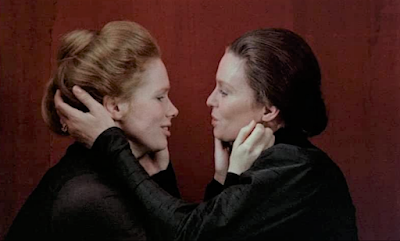
While filming THE TOUCH, Ingmar Bergman had a recurring idea: four women dressed in white in a large red room; he pursued it through his imagination and made it real in the unrelenting and powerful VISKNINGAR OCH ROP or CRIES AND WHISPERS.
Despite financing problems it won a Cannes jury prize and it's worldwide success culminated in the rare occurance of a foreign language film being nominated for five main Academy Awards, winning for Sven Nykvist's stunning cinematography.
In a large, nearly-empty family mansion, ornate clocks tick away Agnes' life as she slowly dies from cancer, watched over by her attentive maid Anna who mourns the death of her own daughter.
The only other occupants are Agnes' married sisters Katrin and Maria who have come to watch and wait...
The oppresive atmosphere conjours up unhappy memories in each sister; Agnes dies and the sisters let their polite masks drop...
Shelf or charity shop? Haunting the shelf. Even with Bergman's body of work the 50 year-old CRIES AND WHISPERS remains an unsettling, disturbing film with four extraordinary performances by the actresses he always envisioned playing the roles - although he actually originally wanted Mia Farrow as Anna the maid! Kari Sylwan appeared in her first Bergman film playing Anna, the only one who shows any real love for Agnes. His three other actresses each made 10 films with Bergman: Harriet Andersson is astonishing as the dying Agnes (in her 8th Bergman role), Ingrid Thulin (in her 9th Bergman role) is icily disdainful as the emotionally dead Katrin - the scene where she cuts her vagina with a broken wine glass has lost none of it's horrific intensity - but the most complex role goes to the magnificent Liv Ullmann who delivers wonderfully. In her 5th Bergman performance, Ullmann as Maria, whose beauty and sensuality covers an immature and petulant interior, is the one you always watch; in flashback she also plays the sister's mother, beautiful but remote. Only at the end does Bergman allow a flash of happiness, all the more touching coming after all we have witnessed.
The 50 shows that have stood out down the years and,
as we get up among the paint cards, the shows that have become the cast
recording of my life:
First performed: 1973, Shubert Theatre, NY
First seen by me: 1989, Piccadilly Theatre, London
Productions seen: five Score: Stephen Sondheim
Book: Hugh Wheeler
Plot: In 1900 Sweden, actress Desiree and lawyer Fredrik are two former lovers who rekindle their feelings for each other when she visits his town on a theatrical tour; however they are now paired with Anne, Fredrik's teenage bride, and Desiree's jealous lover Count Carl-Magnus. Matters come to a head during a weekend party at Desiree's haughty mother Madame Armfeldt...
Five memorable numbers: SEND IN THE CLOWNS, THE MILLER'S SON, A WEEKEND IN THE COUNTRY, EVERY DAY A LITTLE DEATH, THE GLAMOROUS LIFE
Well, here are... the Top 10 Musicals; these are the ones whose scores mean the most to me. We start with yet another Sondheim for a very good reason... he is my favourite musical composer.
After COMPANY and FOLLIES had shaken up the Broadway musical in the early 1970s with explorations into what could be done with the form, composer Stephen Sondheim and producer/director Hal Prince were in no mood to stop. They revisited an idea they had in 1964 when they wanted to create a modern take on an operetta-style romantic musical and decided to do an adaptation of Jean Anouilh's RING AROUND THE MOON but Anouilh said no - and said no again after they told him they had writer Hugh Wheeler on board! Sondheim suggested two films that had a similar theme: Jean Renoir's THE RULES OF THE GAME and Ingmar Bergman's SMILES ON A SUMMER NIGHT as both feature a weekend country house party with romantic intrigues and jealousies enveloping both guests and servants. Sondheim decided the Bergman had a subtlety that lent itself more to becoming a musical - and luckily Bergman agreed to the adaptation, his only stipulation being it be given a new title. Hal Prince once described NIGHT MUSIC as "whipped cream with knives" but Sondheim is of the opinion that Prince was more interested in the former, he the latter. Indeed what makes it such an interesting show is that all the characters are dissatisfied with something or unhappy at an other - they may be in love but it causes as much pain as pleasure - and Hugh Wheeler's witty book runs deceptively deep, something Sondheim has only grown to appreciate in the fullness of time and over many revivals. Sondheim later asked Ingmar Bergman if he ever saw the show and was surprised when Bergman said he had and enjoyed it, brushing aside Sondheim's apologies about changing certain characters by saying "We are both eating from the same cake". Oh and the cherry on that cake? Soon after it opened, Jean Anouilh's 'people' contacted Hal Prince to say that the rights for RING AROUND THE MOON were now available - too late Jean!
Sondheim went into rehearsals with most of the score written but added - and subtracted - more along the way. The rousing Act 1 closer A WEEKEND IN THE COUNTRY was written during the rehearsal period when Hal Prince felt all the story lines had to come together to send the audience out on a high; this also gave Sondheim the opportunity to write the song tailoring it to the cast's specific voices, and speaking of which... Sondheim and Prince has assumed they would cast a comedy actress for the lead role of Desiree who probably wouldn't be able to sing too well, and eventually decided on Glynis Johns who, they discovered, was able to sing in a breathy, delicate style. Sondheim had given Desiree two duets in Act I and nothing in Act II but it was decided Glynis Johns had the musicality to be given a solo in the second act. Hal Prince re-directed the scene to focus it on her while Sondheim turned up after two days with SEND IN THE CLOWNS. Knowing her range meant she could not sustain long notes, he devised the song to comprise of short questions "Isn't it rich? Are we a pair?" that would fit on her voice perfectly.... the rest is history! The show ran on Broadway for 18 months, was nominated for 12 Tony Awards and won 6 including Best Musical, Best Score, Best Book and Best Actress for Glynis Johns. The London premiere was in 1975 with the dazzling cast of Jean Simmons, Joss Ackland, Hermione Gingold, David Kernan, Maria Aitkin and Diane Langton; the London cast recording remains my favourite with several definitive renditions especially Diane Langton as Petra, the practical maid, tearing the roof off with THE MILLER'S SON.
I first saw NIGHT MUSIC through Hal Prince's misguided film version starring a miscast Elizabeth Taylor; Sondheim had advised against it but Prince wanted to prove he was as good a film director as he was on stage - he wasn't. I first saw it on stage in 1989 when Ian Judge's Chichester production transferred to the Piccadilly with Dorothy Tutin's unforgettable Desiree, Susan Hampshire's excellent Countess Charlotte and Sara Weymouth again mining gold with THE MILLER'S SON. I saw Judi Dench's magnificent Desiree at the Olivier Theatre in 1995 which won her an Olivier Award in an otherwise over-directed production by Sean Mathias. The Menier production in 2008 was a delightful chamber version, let down by Trevor Nunn's rather languorous pacing, not helped by his inclusion of the previously cut song SILLY PEOPLE but with winning lead performances from Hannah Waddington and Alexander Hanson. Hanson transferred with the production to Broadway where I finally saw Angela Lansbury onstage as Madame Armfeldt; Catherine Zeta-Jones was an oddly lascivious Desiree but she reined in the Swansea barmaid interpretation to deliver a heartfelt SEND IN THE CLOWNS. In 2015 we saw a concert version at the Palace Theatre with Janie Dee as Desiree, Joanna Riding as Charlotte, Jamie Parker as Carl-Magnus, Laura Pitt-Pulford as Petra (delivering yet another fiery THE MILLER'S SON) and Anne Reid as Madame Armfeldt. It's a show I would happily see again but sadly the one that got away was a fundraising concert version in January 2009 for the Roundabout Theatre Company in New York with Natasha Richardson as Desiree, Victor Garber as Fredrik, Christine Baranski as Charlotte and Vanessa Redgrave as Madame Armfeldt; two months later Richardson was injured in a skiing accident and later died.
So which SEND IN THE CLOWNS will it be? Despite memorable versions by Glynis Johns, Bernadette Peters, Barbara Cook and Angela Lansbury, for me it's Judi Dench in the 1995 NT production, seen here over the end credits of a South Bank Show profile. It's not a good transfer but Dench delivers a nigh-on definitive rendition where every word comes straight from Desiree's broken heart...
The first Bergman film to win the Best Foreign Language Film Academy Award, he later disparaged it as a bad attempt at copying Kurosawa, however it remains intensely powerful.
Medieval farmer Töre lives with his pious wife Märeta and indulged daughter Karin. Töre asks Karin to take candles to a faraway church; dressed in her best clothes Karin leaves accompanied by surly, pregnant maid Ingeri. Pagan Ingeri dislikes Karin and offers prayers to Odon to make her suffer.
Ingeri is scared by an old man in the woods so Karin continues alone; she is stopped by two goatherds and their younger brother and she requests they share her food. She slowly realizes their intent but they rape her, killing her afterward.
That night the rapists ask for shelter at Töre's house which he allows while Märeta worries about Karin. But when they offer Karin's clothes as payment, Töre exacts revenge...
Shelf or charity shop? The Virgin Spring resides in my storage box of coverless DVDs. I will keep it for the power of Bergman's direction, Sven Nykvist's glorious b/w cinematography and the performances of Max von Sydow as Töre - only 31 years old when it was filmed - Gunnel Lindblom's earthy Ingeri and Birgitta Pettersson as doomed Karin. Amazingly, it was the inspiration for Wes Craven's notorious THE LAST HOUSE ON THE LEFT.
Ingmar Bergman wanted to make a film with no dialogue but capitulated during filming however TYSTNADEN still only contains about 37 lines of text.
It serves the film's study of alienation: sisters Ester and Anna, are travelling home after a journey abroad with Anna's young son Johan, They are travelling during an oppressive heatwave through a country in the middle of a military coup.
External tensions match the internal... Ester has a consumptive illness and is fading, while Anna is losing patience with her assumed role of carer. They stop off in an un-named town, staying in a faded grand hotel.
Bored, Anna ventures into the noisy city, wordlessly picking up a waiter. Her son Johan wanders the gloomy corridors, as lonely as his mother and aunt. The uneasy sibling relationship shatters that night...
Searing performances from Ingrid Thulin and Gunnel Lindblom and young Jorgen Lindstrom illuminate the gloom.
Shelf or charity shop? Not the easiest film to experience but this third in Bergman's loose trilogy on "God's silence" is a keeper...
With NATTVARDSGASTERNA, Bergman proudly felt he had got his ideas onto the screen without compromising for commercial appeal.
Bergman's dissection of the loss of faith takes place in 77 real-time minutes: everything's pared to the bone.
Pastor Tomas Ericsson holds a nearly-empty mass on a bleak November morning. Attending are Marta, a teacher who is having an unhappy relationship with him, and married couple Jonas and Karin. Tomas is visited later by the couple: pregnant Karin tells Tomas that Jonas is struggling with depression, scared that China is developing an atomic bomb. Alone with Jonas, Tomas tells him he cannot help as he has lost his faith, believing God helps no one.
Afterwards, atheist Marta attempts to comfort Tomas but they hear Jonas has committed suicide...
Sven Nykvist's stunning cinematography and unsentimental performances from Gunnar Bjornstrand, Ingrid Thulin, Max von Sydow and Gunnel Lindblom make Bergman's vision unforgettable.
Shelf or charity shop? A difficult film to watch at times but for Bergman's humanist view of man alone in the world, this is one for the shelf...
.png)
.png)
.png)
.png)
.png)

.png)
.png)
.png)
.png)