Showing posts with label Simon Higlett. Show all posts

Monday, April 06, 2015

STEVIE at Hampstead Theatre

"Who or what is Stevie Smith? Is she woman? Is she myth?"
In his 1977 play Hugh Whitmore attempted to answer the humorist Ogden Nash's question, helped by an acclaimed performance from Glenda Jackson as Stevie Smith, the quirky, profound poet who lived in Palmers Green, North London with her maiden aunt.  Jackson's performance, with that of Mona Washbourne as her 'lion aunt', were immortalised on screen the next year.


38 years on, the play has been revived in a production that is illuminated by Zoe Wanamaker giving one of her best performances - at times I forgot it was her which I guess is the ultimate compliment you can gave a star performer.

It has been a good few years since I saw the film but every so often a certain scene would jog my memory, in particular Smith's visit to Buckingham Palace to receive the Gold Medal for Poetry in 1969 and having to make painful small-talk with the Queen.


Christopher Morahan has directed a subtle, nuanced production that doesn't completely overcome the drawbacks of Whitmore's style of playwriting; similar to his Portland Spies play PACK OF LIES which was narrated by a number of characters direct to the audience, STEVIE is narrated by The Man who also plays various men in Smith's life as well as Stevie who tells the story of her life to her aunt.  I couldn't help wondering why this was as surely her aunt would know it having lived with her most of her life!

However where Whitmore is wholly successful is in weaving Smith's poetry into his play so they seem to come directly from her life and really lift the play.  I cannot be the only one who left the show itching to read more of her work.  Smith seems to float in and out of popularity but she deserves to be reclaimed as one of the greats.


Complementing Wanamaker's performance is Lynda Baron as her redoubtable 'lion aunt' Margaret, barging around the house making tea or dinner, only stopping to have a glass of sherry and a flick through the local newspaper.  Less pixieish than Mona Washbourne, Baron came into her own in her final scene when the aunt appears suddenly changed, losing her robustness to become a shuffling querulous invalid.

Less successful was Chris Larkin as The Man but I suspect that was more due to the writing than any particular fault with the actor.  I suspect if anyone was asked to play a waspish, literary queen that dipping into a Maggie Smith impression would be top of your acting choices so it was a bit jaw-dropping to see Larkin do it as he is her eldest son.


But it's Zoe Wanamaker's show and from the start she gave an idiosyncratic performance as the hunched, scuttling Smith, barking her lines in a slightly lower register, turning on a sixpence from biting wit to pathos.  She brought Stevie Smith, ungainly in her odd clothes and awkward posture, to life and as I said earlier, there were times when I felt that Wanamaker disappeared completely within her.  She also beautifully suggests at the end of the play the tragedy of the encroaching brain tumour which robbed Stevie of her ability to write or speak.

Simon Higlett's stage design also contributed to the show's overall success, the detailed representation of the Palmers Green house on one side slowly breaking up and drifting away to seemingly mingle with the tall trees beyond.


STEVIE plays until April 18th at Hampstead Theatre and is well worth a visit.  By the way how ironic that the production should transfer from Chichester to Hampstead where the original Stevie, Glenda Jackson, has been the Member of Parliament!  I wonder if she has been to see it?

Saturday, July 26, 2014

Genius In West Sussex

Sometimes it does you good to get out of London's Theatreland and venture into the country's Theatreland instead.

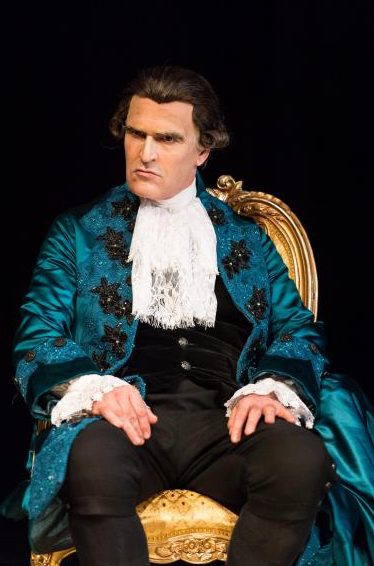
Last Saturday found us on a train chuffing down to Sussex to see what the renovation of the Chichester Festival Theatre were like but primarily it was to see Rupert Everett play the barnstorming role of Salieri in Peter Shaffer's AMADEUS.


I had seen Milos Forman's award-laden screen adaptation but had never seen the play on stage before.  The original directed by Peter Hall at the NT in 1979 with Paul Scofield and Simon Callow was three years before my Paulian conversion to the magic of theatre and I later missed Hall's revival at the Old Vic in 1998.  That version starred David Suchet as Salieri and Michael Sheen as the titular composer.  I am presuming my reason for not going was because if it wasn't Paul Scofield then there was really no point!

But when I heard that Rupert Everett was going to play Salieri to open the new season I knew I had to see it this time.  Chichester is only 90 minutes by train from Victoria so tickets were booked and it was off to a Saturday matinee.  Needless to say a matinee in Chichester can almost guarantee that I will be among the youngest in the audience!


Seeing it the first time on stage made me realise how theatrical the play is, a Shaffer trait.  The aged Salieri almost gives us a commentary on the play itself, signalling when the interval is going to be and what we can expect in the second half - when he has returned from evacuating his bowels!   The sinister opening with the citizens of Vienna in the theatre eerily whispering "Sssssalieriiiii" sets the unsettling tone of the play which culminates in a truly haunting final image.

I am also surprised that in 35 years this is only it's second major revival.  Shaffer's play gives the chance for two actors to play such well-written lead roles and the play always seems to have successful runs.

Salieri (Everett) is a recluse in his Viennese palazzo, a forgotten composer whose operas and compositions were once fashionable but the city is swirling with the rumour that he murdered his fellow composer Mozart (Joshua McGuire) 32 years before.  The decrepit Salieri takes us back to that era when he was the court composer to Emperor Joseph II (Simon Jones) and the rumour sweeping the city then was of the arrival of the gifted young Mozart.

Salieri, a man who as a teenager vowed his life to God for the chance to make music, is appalled to discover that the young man who composes music that Salieri thinks is Heaven-blessed, is an obnoxious, braggart who revels in childish behaviour and scatological humour.  If this is how God chooses to bestow his grace then what has Salieri's vow to be His servant on earth been for?  In a rage against God and life, Salieri sets out to ruin the young composer's chances of advancement, to wreck his musical career, to kill him. 


Who better to be our sardonic narrator than Everett?  He was quite magnificent.  Effortlessly moving from the crabby and aged Salieri to his suave and assured younger self with just a wig, two swipes of black across his eyebrows and a change in his voice, he held the attention for the whole length of the play with ease. 

By turns playful, murderous, anguished and self-pitying, he rose to the operatic finale of the play with a power that left me stunned.  His horror at the cruelty of life and God was wonderful to see.  As I watched him I felt grateful that he has decided to embrace the stage again because, as he proved as Oscar Wilde in THE JUDAS KISS, given the right part he is sublime.
  

McGuire's Mozart was less of a success, probably due to Shaffer's unwillingness to show us the soul where his music comes from; if Shaffer wants to show that Mozart could just 'turn it on' and produced music with such passion without having any himself then he has succeeded.  Only in his last scene, composing the music in his head as he dies in his wife's arms, did McGuire connect.

Jessie Buckley was a little revelation as Constanze, the wife who stands by her husband no matter what life throws at them.  She first came to my attention in the BBC series I'LL DO ANYTHING as one of the contestants vying to play Nancy in the revival of OLIVER! and I later found her ineffectual as Anne in the Menier's A LITTLE NIGHT MUSIC.  But last year she impressed as Princess Katherine to Jude Law's HENRY V and here she was very good as the playful wife who becomes a bewildered, hurt woman.  


I liked Simon Jones as the airy, ineffectual Joseph II and could see how marvellous the late and great John Normington would have been in the original production and there was a demonstration in excellent supporting performance from John Standing, Richard Clifford and Timothhy Kightley as the unmoving bastions of accepted music in the court.

Jonathan Church's production was atmospheric and moved at a good pace while losing none of Shaffer's literate script and certainly provided a wealth of memorable moments, helped immeasurably by Simon Higlett's spare set of frosted mirrored doors - encompassing crumbling Vienniese mansions and elegant court life - and Tim Mitchell's evocative lighting.  Fotini Dimou's costumes were a feast for the eyes as Paul Groothuis' sound design was for the ears.


I have heard nothing of a London transfer for the production - it would be a shame if it's short playing time at Chichester could not be extended elsewhere, giving a wider audience the chance to enjoy a fine production and to see how charismatic a stage actor we have in Rupert Everett.

Monday, April 21, 2014

The British Birthday Play

After the hard-edged GOOD PEOPLE, it was time to relax into the chiffon-edged comedy of Noël Coward's BLITHE SPIRIT currently revived at the Gielgud Theatre with a long-overdue return to the London stage by Angela Lansbury.  All very appropriate as John Gielgud had starred in and directed an ENSA touring production of the comedy during World War 2.

 
Michael Blakemore had previously directed Angela Lansbury in 2009 on Broadway in the play which won her a fifth Tony Award and here they are reunited with a new cast and production team.  Unsurprisingly she has rooted herself into the character, making Madame Arcati her own.

Written by Coward in 1941, it was an instant hit - although Graham Greene found it "a wearisome exhibition of bad taste"!  It went on to hold the record for the longest running play in the West End until "The Mousetrap" overtook it in 1957.  David Lean filmed a screen adaptation in 1945 which featured the original players of Arcarti and Elvira, Margaret Rutherford and the delicious Kay Hammond, although this version had an alternate ending.  The play has been revived frequently and I first saw it in 1986 at the Vaudeville Theatre with the perfect cast of Simon Cadell, Jane Asher (Ruth), Joanna Lumley (Elvira) and Marcia Warren as Arcarti.

Author Charles Condomine and his wife Ruth hold a soirée with the village doctor and his wife as well as the local eccentric Madame Arcarti with the ulterior motive of getting her to hold a seance so Charles can get material for a novel he is planning.  During the seance however Arcarti "brings across" the ghost of Charles's glamorous first wife Elvira who has been dead for seven years and only Charles can see her.  Elvira, as capricious in death as in life, causes mischief around the house much to Ruth's anger and Charles' bemusement. 


He soon tires of her behaviour however when he realizes she has her own agenda when she fixes the brakes on his car hoping he will join her forever - but it's Ruth who uses the car first.  Now with two ghostly wives making his life a misery he calls in Madame Arcarti to try and get them back to the other side.  If only she knew how...

Michael Blakemore directs the comic business and Coward's devilishly witty dialogue to expert effect but also suggests the darker tones that lurk in the corners of the Condomine living room.  Written two years into World War II where death was in everyone's consciousness, it's musings on the lingering effects of those departed must have made for a very heightened experience when first presented.


Simon Higlett's set has just the right feel of a home counties living room and also is entertaining in it's own right when the other world encroaches in on it which is also well-evoked by Mark Jonathan's lighting design.

Blakemore's cast also rise to the occasion with one clanging exception.  The ever-reliable Charles Edwards is a delight as Charles, effortlessly spinning his lines with the lightest touch like the deftest of tennis players.  But he also plays a man quietly delighted to be given a change from his second, rather conformist, marriage.  Luckily Edwards is complemented perfectly by Janie Dee as Ruth.  She showed her excellent comic timing time and again particularly in the classic exchange:
  • Charles: Anything interesting in The Times?
  • Ruth: Don't be silly, Charles. 
Ruth can be a tough role - the character who wants to stop the madcap antics usually is - but Janie Dee is such an engaging stage performer that her dry delivery was a joy to behold.


I found the casting of Jemima Rooper to be a miscalculation however.  Her childishly petulant pouts and squeaky voice seemed to belong to a totally different production and more than once I felt she was totally out of her depth with the quality of performance onstage.  Simon Jones and Serena Evans made full use of their considerable experience to fill out the roles of Doctor and Mrs Bradman and Patsy Ferran made the most of the West End debut as Edith, the Condomine's gormless maid.

Needless to say Madame Arcarti's belated entrance on stage provoked a round of applause for Angela Lansbury, you don't get too many of those anymore but somehow within the context of Coward and BLITHE SPIRIT it didn't seem strange at all!  There was the odd stumbled line but that is more than allowed when you're 88 and in the process of giving a performance of pure star quality.  She played Arcarti as an intelligent and engaging authoress but one who didn't suffer fools gladly - I will treasure the exasperated daggers she shot at Mrs. Bradman's clueless questioning.


Yes, she stole scenes with her bizarre little dance in her pre-seance trance or in her delighted responses to Elvira's presence but that's what she's there to do!  Although the role didn't give her the opportunity to touch us in the way her Madame Armfelt did in A LITTLE NIGHT MUSIC on Broadway in 2010, it was an utter joy to see her on a West End stage and proving that this wasn't a case of stunt star casting - just like Arcarti, she brought sheer magic to us.

All this and being made Dame Angela last week too - it's about time!


Saturday, November 06, 2010

You know what you have in store when the lights go down in a West End auditorium and the curtain goes up on a set that elicits a panto-style "Oooooooo" followed by a appreciative round.

Welcome to the Garrick Theatre and the revival of J.B. Priestley's WHEN WE ARE MARRIED.

I had seen this cosy comedy before when it was last revived in 1986 at the Whitehall Theatre in a production directed by the late Ronald Eyre. Needless to say, there are a few more lates from that production - Bill Fraser, Patsy Rowlands, Kathy Staff and John Stratton. I seem to remember it being... well, cosy.

Well... it's still cosy but having seen a few more Priestley plays since then I can see that underneath the gentility it still deals with his favorite subject of the passage of time.In a Yorkshire milltown in 1908, three well-to-do couples are celebrating their silver wedding anniversaries having all been married on the same day by the same vicar when they discover to their horror that he was not authorised to officiate at nuptials so technically they are not married.

Once the secret is out, the couples see each other with new eyes - hen-pecked and browbeaten spouses assert themselves for the first time as the 'lower orders' also let 'their betters' know exactly what they think of them.Add into the mix an ageing manhunter from Blackpool and a boozy photographer who has been asked to take an anniversary picture of the couples and you have a very English farce of manners and, of course, class.

Priestley's comedy runs like clockwork and hey if it ain't broke.... However there is little chance that it will ever be fashionable, unlike Stephen Daldrey's re-interpreting of AN INSPECTOR CALLS, as Priestley only toys with the sudden liberating possibilities for the main characters - hidden grudges are aired while the husband from one couple and the wife from another verge on the possibility of starting their old romance again - before suddenly providing an abrupt ending that restores the status quo. It is as if the idea of their starting again scares Priestley as much as his characters.There are moments when Christopher Luscombe's direction hints at the darker undercurrents of the play but these are brought out more by the subtle playing of the main cast.

Simon Rouse and David Horovitch splutter for all their worth as the two husbands with the most to lose socially while Sam Kelly is a delight as the henpecked worm that turns - his lip-smacking delight while savouring a forbidden drink is comedy gold. Maureen Lipman is in splendid form as the domineering wife who is brought to heel but Susie Blake seemed oddly anonymous as the social-climbing wife of the alderman. The surprise of the evening was Michele Dotrice who, while resembling a guinea-pig in an Edwardian dress, reveals a killer sense of comic timing especially when deflating her husband's presumption that she would want to marry him again.The supporting cast are led superbly by Roy Hudd who brings all his comic timing to bear in the role of Ormonroyd the drunk photographer - he does a double-take that's worth the price of admission alone! The lower orders are played robustly by Lynda Barron as the plain-speaking cook Mrs. Northrup and Jodie McNee as the back-chatting servant Ruby - in the Ronald Eyre production Ruby was played like Su Pollard with brain damage (I will allow you a minute to suffer that thought along with me) so McNee's delightful turn was particularly welcome.

As I said, Simon Higlett's Edwardian drawing room with no surface knowingly uncovered in lace, damask or ornaments caused near pandemonium when the curtain rose and he is know doubt receiving fan-mail from the home counties by the van-load.WHEN WE ARE MARRIED does exactly what is expected of it and while it won't change anyone's life, there is no denying the pleasure in seeing such comedy expertese in one place. Would that all West End revivals were such fun.