Showing posts with label Dominic Cooke. Show all posts

Friday, May 20, 2022

THE CORN IS GREEN at Lyttelton, National Theatre - The Play's Not The Thing....

An imagined conversation:

Mr Norris: Great news!  We have TV Land's own Nicola Walker coming back to the National.

Mr Cooke: Coolio!  What to do?

Mr Norris: So... it's got to be a Strong Independant Woman, out there on her own, facing down prejudice and division.  So maybe something which is "heritage"?  THE CORN IS GREEN has been mooted...

Mr Cooke: But that's a warhorse fit only for Chichester all-star revivals... it's hardly National Theatre is it?  Maybe once upon a time but not now...

Mr Norris: I know... so let's do the two Rs... Radical Reimagining!

Mr Cooke: Leave it to me boss!

THE CORN IS GREEN... but not as we know it.  For 84 years. Emlyn Williams' semi-autobiographical play of a dedicated teacher in a Welsh coal-mining village focussing on a young lad with a gift for writing to get him a scholarship to Oxford, has been delivering it's remit as a Well-Written Play with a beginning a middle and an end and a stonking female lead role.  But no.  That is not enough for the National Theatre... it has to be Radically Reinterpreted to make it Relevant.

The trouble is that all Dominic Cooke's meta trappings do is make a long play longer and appear tacky, lazy and shallow framing such a well-constructed piece, standing in the audience's way shouting LOOK AT ME LOOK AT ME for no good reason at all.

Cooke has taken a look at the play, snapped his fingers and said "Of course, it's a memory play" so has staged it as one - no matter that it detracts from the material.  So Emlyn Williams is now an onstage character, first seen walking out of a 1920s dance party to struggle through composing his play.  Although by the time he wrote THE CORN IS GREEN, Williams was already a successful playwright and had just had a huge success with his thriller NIGHT MUST FALL.

So we sit through an interminable set-up with Williams being serenaded by a Welsh pit choir as he envisions on an empty set his setting, the makeshift classroom for the soon-to-arrive Miss Moffat.  Oh yes the set... a totally empty stage until the interval, after which the curtain rises on a rudimentary stage set which by the final scene is fully 'realistic' and has it's own cutsey proscenium border.  Again this does absolutely nothing for the audience's understanding of the play, having run the first half's gamut of radio-style special effects to signify doors opening and closing, footsteps going upstairs etc.

Oh yes the singing... Dominic Cooke has scattered throughout the action, passages of singing from a group of Welsh miners - if he was so desperate to make his production a musical one wonders why he didnt just have a go at the 1970s US flop musical MISS MOFFAT in which Bette Davis attempted to revisit the role she had filmed in 1945, rewritten for the deep south instead of Wales, thankfully it died on the road.

The Emlyn Williams character reads out stage directions and the set design, occasionally changing lines as the characters say them and seemingly re-inventing the last act as it's being acted out.  As I said it all smacks of a director who doesnt trust his material - THE CORN IS GREEN is several things but what it isn't is THE GLASS MENAGERIE or OUR TOWN.

The emphasis on the Emlyn Williams / Morgan Evans character also tends to shift the focus from Nicola Walker as the centre of attention which should never be the case, it's her star role to play.  Miss Moffat was originally played by Sybil Thorndike in London and Ethel Barrymore on Broadway, Bette Davis made the afore-mentioned film while Katharine Hepburn made a TV movie in Wales in 1979 directed by George Cukor.  I had seen it before at the Old Vic in 1985 with a matronly Deborah Kerr as Miss Moffat and an Olivier-winning performance from Imelda Staunton as the teenage troublemaker Bessy Watty.

Nicola Walker certainly has a presence onstage, her Miss Moffat was determined and driven but it made the character hard to actually admire as she really showed no light or shade, hardly any emotion at all.  Iwan Davies had moments of fire but otherwise his Morgan Evans was hardly a match for Miss Moffat.  By far the best performance was from Saffron Coomber as Bessy, she actually made the best counter-point to Miss Moffat - as determined to better herself as the teacher wants for her pupil, but with inate knowledge of how to get what she wants now. not later.  Jo McInnes was fine as her cockney mother, former petty thief now a Salvation Army officer - a bit of a stretch there Emlyn - but the remaining cast hid behind their stock characters - spinster teacher, nice-but-dim squire, straight-laced teacher - without bringing them to life at all.

Again at the end of the play Cooke robs his leading lady of the final moment of quiet triumph; he has his production end with his Emlyn Williams character do a foxtrot to a 1930s tune with his fictional younger self.  What on earth was he thinking??

I won't be going back before it's last performance on 11th June.

Wednesday, November 10, 2021

THE NORMAL HEART at the Olivier, National Theatre - Anger is an energy...

Before Rock Hudson, Ian Charleson, Freddie Mercury and Keith Haring died, before ANGELS IN AMERICA and MY NIGHT WITH REG, before the UK's "Don't Die of Ignorance" campaign and Princess Diana shaking the hand of an AIDS patient, there was Larry Kramer's polemical play THE NORMAL HEART.

After it's 1985 Off-Broadway premiere, it quickly opened the following year at London's Royal Court in a production directed by David Hayman and starring US actor Martin Sheen as the combatative lead character Ned Weeks, based on Kramer himself.  I was lucky to see it twice - Martin Sheen was a favourite actor - but the play hit like a sledge-hammer, Kramer's take-no-prisoners approach did a lot to make me aware, probably for the first time, what was happening around me.

It's a production that stayed with me, for the concentrated fury in the writing but also for the committed performances of Martin Sheen and Paul Jesson, who won an Olivier Award for his performance as Felix, a New York Times journalist who manages to break through Ned's emotional defences.

Kramer had already had success as a writer: his 1960s career working in London at Columbia Pictures culminated when he wrote the script for Ken Russell's WOMEN IN LOVE for which he was nominated for an Academy Award but he moved to trying his hand writing a gay play which flopped so he moved again to writing books.  His 1978 novel "Faggots" annoyed gay readers who disliked it's negative view of gay promiscuity - and they remembered his name.

He had never been an activist but when friends started succumbing to a strange illness he arranged a meeting at his apartment with friends and a doctor who said that early research found the illness to be spreading.  In 1982 they started the Gay Men's Health Crisis which became the leading support group in New York for AIDS sufferers.  But as has happened so often before, the group soon were fracturing: Kramer wanted to push hard for funding from Mayor Ed Koch while the group's elected president Paul Popham wanted a less controversial approach.

Despairing that the group was not pushing harder, Kramer wrote a scathing article in a New York gay newspaper, condeming politicians and, controversially, closeted and Out gay men for ignoring their own health and the health of others.  Welcomed by some, it was also derided by others who remembered him as the writer of "Faggots" and later that year, Kramer was unceremoniously dumped by the GMHC.  He would have his revenge by writing THE NORMAL HEART and by helping set up AIDS Coalition To Unleash Power aka ACT-UP, a direct action group that hit hard with it's slogan SILENCE = DEATH.

In 1992 Kramer wrote a sequel to THE NORMAL HEART titled THE DESTINY OF ME which ran for a year Off-Broadway and was nominated for a Pulitzer Prize for Drama. Kramer died in 2020 aged 84 of Pneumonia, having lived with HIV for 33 years and long enough to see THE NORMAL HEART finally have a successful Broadway run in 2011 which won him a Tony Award for Best Revival, and now the National Theatre have given us a London revival, directed by Dominic Cooke, ironically a former artistic director of the Royal Court where THE NORMAL HEART had premiered.

There is no denying the force of anger that drives the writing but seen 35 years after the Royal Court production, Frank Rich's summing up in his review of THE DESTINY OF ME seems quite accurate "He has a good ear, but it's the ear of a journalist, not a poet".  There are four speeches in THE NORMAL HEART when the dialogue lifts: when Ned is faced with expulsion from the group for his aggresive approach, he says he belongs to a culture that produced famous gay writers, composers, artists, politicians who are not invisible men in history, and also when Doctor Brookner angrily denounces the Government's medical board when her research grant is denied. 

The character is based on Linda Laubenstein, a doctor who treated a patient for Karposi's sarcoma as early as 1979 and by 1982 was running a private practice just for the treatment of men with AIDS.  Her anger at the silence around the men dying daily in front of her led her to become an activist for AIDS research and her insistance that the gay bath-houses of New York be closed to arrest the spread of the disease was praised by Kramer, less so by members of the gay community who viewed it as puritanism.  Sadly she died in 1992 aged 45 of a heart attack. 

Kramer has the good grace to give the other good speeches to Ned's critics - the closeted and polished Bruce Niles who is made president of the group because he projects a better image, has a moving speech about his partner dying in a hospital where, as no medical staff will touch him, a porter smuggles his body out in a body bag for a backhander.  There is also a fine speech from fellow-activist Mickey Weeks, who cracks under the pressure of all that Ned expects from his comrades while they are trying to live through their own fears.

The production is designed by Vicki Mortimer as a gladiatorial circular arena - the Olivier is in the round presently - and Cooke seems to take his cue from that setting, so the scenes are usually blocked as two actors standing opposite each other or seated on opposing metal benches having at each other: an approach which eventually tires you out and you yearn for something to break up the 50/50 staging.  I think the Olivier is too large a space for such a play.

I found much to like in Ben Daniels' Ned Weeks but he is onstage for nearly all the running time and I eventually wished for the variety of performance that Martin Sheen delivered: Ned's flashes of humour hardly registered.  Dino Fetscher made for a strapping but dull Felix, I couldn't really believe in their relationship, or any of Fetscher's performance choices. Liz Carr as the motorised Dr Brookner had her moments: Brookner is there to punctuate the activists' shouting matches with cold, blunt facts and she certainly rose to the explosive speech where she finally lets her stoicism crack in the face of bigoted indifference but she too seemed to be playing an idea rather than a living character.  

The rest of the cast seemed to be concentrating harder on their American accents rather than giving any noticeable performances - the exception being Daniel Monks as the put-upon Mickey although a special mention goes to Richard Cant who delivered two good cameos: as a patient of Dr Brookner who remembers serving Ned in a store, and as the icy (and closeted) Mayor's assistant.

One cannot help but think of COVID as the ethics of how to deal with a pandemic where being loudly debated onstage but one hopes that this was not the sole reason for the play's appearance in the repertoire: those suffering and dying with AIDS were blamed solely for their predicament by the world at large.

I am glad I saw this revival but suspect I will always have that first production to draw on.  Dominic Cooke has a prologue to the play: the cast form a circle around a burning cauldron for what seems like a minute's silence and suddenly the stage is plunged into darkness only to be hit by strobe lights as the age of Disco is embodied by - you guessed it - Donna Summer's I FEEL LOVE blaring out. I FEEL LOVE - that lazy shortcut to suggest decadence.  Mind you, as lazy shortcuts go, it's always worth a blast.

Friday, April 10, 2020

50 Favourite Musicals: 1a: FOLLIES (1971) (Stephen Sondheim)

The 50 shows that have stood out down the years and, as we get up among the paint cards, the shows that have become the cast recording of my life. So here we are...  a year and 10 months in the making and we have reached the stage musical that is my favourite ever - and I cannot name one out of the four shows that I have left to consider.

I have tried every criteria, every angle and there is simply no way I can say that one of the four is better than the other.  One nearly lost the shared top place when I considered productions of it that I felt had not done it justice but, with that particular show, I simply had to overlook that, bearing in mind the first I saw was definitive.  So let's go... my Top Four Number One's (in alphabetical order)


First performed: 1971, Winter Garden Theatre, NY
First seen by me: 1985, Forum Theatre, Wythenshawe
Productions seen: four

Score: Stephen Sondheim
Book: James Goldman

Plot: In 1971, onstage at the derelict Weismann Theatre on the eve of it's demolition, producer Dimitri Weismann holds a reunion of the stars and chorus girls of his "Follies" which ran between the World Wars.  Old songs and routines are remembered, stirring up the ghosts of their younger selves.  But for former best friends and chorus girls, Sally and Phyllis and their husbands, salesman Buddy and diplomat Ben, it becomes a night of bitter recriminations and the chance for lost love to be found again... what will the cruel light of day reveal?

Five memorable numbers: LOSING MY MIND, IN BUDDY'S EYES, WHO'S THAT WOMAN, I'M STILL HERE, ONE MORE KISS

In 1965, Sondheim and writer James Goldman wanted to collaborate on a project together and agreed on Goldman's idea of a murder mystery set at a showgirls reunion.  The murder plot stalled but the showgirls reunion intrigued them especially how regrets for what one did and more importantly didn't do, can haunt your life.  Five years later, Sondheim was keen to follow up the success of his groundbreaking COMPANY with the show's producer/director Hal Prince and choreographer Michael Bennett and, when Prince heard of the reunion idea, he had an immediate visual reference: a 1960 Life magazine photograph of a glamorous but fragile 61 year-old Gloria Swanson, standing in the rubble of the Roxy Cinema in New York which had opened in 1927 with her film THE LOVES OF SUNYA. Prince felt this captured the essence of the project - the survivor, the glamour and the ruin.


Goldman and Sondheim brought in the bittersweet marital discord found in COMPANY and FOLLIES was born.  Prince's 1971 production ran for 522 performances but lost over $720,000, due of huge production costs and audience ambivalence - despite 'names' like film stars Alexis Smith and Yvonne de Carlo, 1950s singer Dorothy Collins, Broadway star John McMartin  and veteran performers Ethel Shutta and Fifi D'Orsay, audiences found Goldman's book too downbeat.  It won seven of the ten Tony Awards it was nominated for but failed to win Best Musical.  Cult status grew through the original cast album but sadly Capitol Records only released it on a single album meaning a lot of the score was abridged or not recorded.  The show has had two further Broadway revivals in 2001 and 2011, but lost out winning the Best Musical Revival Tony Award both times.

1985 was my FOLLIES year!  To rectify the abridged 1971 recording decision, Herbert Ross staged two concert versions at Lincoln Center to be recorded over both nights by Thomas Z Shepherd for RCA featuring the full score with a jaw-dropping cast of Barbara Cook, Lee Remick, George Hearn, Mandy Patinkin, Elaine Stritch, Carol Burnett, Betty Comden and Adolph Green, etc. which is the nigh-on definitive recording.  But before this, I had seen my first FOLLIES production in Wythenshawe, Manchester, directed and choreographed by the under-valued Paul Kerryson and starring the wonderful Josephine Blake,  The production swept me away, making me yearn for a London transfer.  However, when FOLLIES finally opened in London in 1987, it was with several new songs and a more upbeat ending; producer Cameron Mackintosh had asked the creators to 'revisit' the material to make it more optimistic - Goldman was happy to, Sondheim less so.  After seeing a preview, I was outside the Shaftesbury Theatre stage door and Sondheim came out on his own.  While he signed my programme, I told him I had seen the Manchester production; he shot me a look and asked which I preferred.  Cautiously I said that, while loving Julia McKenzie, David Healy, Dolores Gray and Lynda Baron in the new version, I felt that Manchester had the edge for being more true to the material.  He replied that while shows can always stand a revision, it was always possible to return to the original.  Point taken Steve...


In 2006, FOLLIES reappeared in the unlikely location of the Landor Theatre in Clapham which seated a mere 48 people above a pub!  But any lack of grandeur was compensated with a cast guaranteed to make any 1980s musicals fan giddy: Sarah Payne, Claire Moore, Adele Anderson, Rachel Izen, Carol Ball and Roni Page among others.  This small production scored over the National Theatre's opulent 2017 version in one key element which was also there in 1971: then as at the Landor, the cast were chosen not only for their talents but also because to most of the audience, they would conjure up memories of seeing them in earlier shows back in the day.  For FOLLIES to truly work I believe that an audience must have that nostalgic connection to the actors onstage - particularly for those who appear in the smaller but pivotal roles of the former Follies performers, then the audience can supply their own 'ghosts' for the performers; dimly remembered memories of them in previous shows.


It was with trepidation that I watched the National's FOLLIES for the first time in 2017 - I had longed for a production to be done on that stage for so many years, could it measure up?  Yes it did - despite the lack of 'names' in the smaller roles, despite Tracie Bennett's mugging through "I'm Still Here" - I got the FOLLIES I have yearned for. Because when it hit, it hit hard and with astonishing performances wherever you looked: Imelda Staunton's despairing Sally, Janie Dee's bone-dry Phyllis. Philip Quast's crumbling Ben, but especially Josephine Barstow's tear-enducing "One More Kiss" - that the production managed to cast one of Britain's great operatic divas for the small role was special enough, but within the short space of her song, you could hear a pin drop as her voice soared around the auditorium; in a score of unstoppable great musical moments this was one to treasure. The truly astonishing thing about FOLLIES is that Sondheim floors you with one fantastic song after another.  It was director Dominic Cooke's first musical and he gave his production a thoroughness of vision which allowed the musical numbers to flourish while being equally as thorough at the emotional trauma the four main characters inflict amid the nostalgia.

So... what video to pick?  FOLLIES is well represented on YouTube through productions and one-off performances of songs from the score - and with a score so all-encompassing as this how do you pick a represenative song?  How's about a few.. the stinging sophistication of "Could I Leave You" sung by Lee Remick at the 1985 Lincoln Center concert and then, from the same documentary, a fascinating clip of Barbara Cook rehearsing and then performing the pure emotion of "In Buddy's Eyes" and finally, from the NT Live screening of their 2017 production, Imelda Staunton's broken Sally. lost in her obsession, singing "Losing My Mind".


Sunday, July 21, 2019

Dvd/150: THE HOLLOW CROWN: THE WAR OF THE ROSES - RICHARD III (Dominic Cooke, 2016)

The second cycle of THE HOLLOW CROWN ends with Benedict Cumberbatch murdering his way to the throne as RICHARD III.


Starting with a tracking shot around Richard's grotesque twisted spine, Cumberbatch gives a subtle portrayal of evil shot through with a sense of murderous fun as he colludes with the viewer in his treacherous plans.


Ben Power's adaptation keeps the plot moving fast but in this part of the trilogy, some poetry is lost - Queen Elizabeth's plea to the stone walls of the Tower to protect her captive sons and, more unforgivably, Clarence's dream of drowning.


This is Dominic Cooke's first filmed work and the trilogy has an assured, cohesive vision.  Again Sophie Okonedo is marvellous as Queen Margaret, cursing the royal family who learn too late she is right, and in a relatively minor role as Richard's mother, Judi Dench is magnificent in her final denunciation scene with him.


Shelf or charity shop?  Ruling from the shelf, the final death toll incidentally is 25... farewell Clarence, Edward IV, Lords Hastings, Grey and Rivers, Princes Edward and Richard, Queen Anne. Buckingham, Catesby and of course, you know who...


Saturday, July 20, 2019

Dvd/150: THE HOLLOW CROWN: THE WAR OF THE ROSES - HENRY VI PT 2 (Dominic Cooke, 2016)

The plot - and spilled blood - thickens as the balance of power seesaws between the houses of Lancaster and York in Dominic Cooke and Ben Power's adaptation of HENRY VI PART 2.


Nearly all Shakespeare's original PART 2 is jettisoned - Irish wars, Jack Cade's revolt - to concentrate on his PART 3: the clamorous battle in the narrow streets St Albans results in York forcing Henry VI to disinherit his young son in favour of York's children. 


Furious Queen Margaret wreaks bloody vengeance on York and his youngest son, leading to his other three sons, Edward, George and infamous Richard, seeking revenge on her and the mentally-unstable Henry.


Allegiances change and change again and all the time, bodies keep falling - and Richard inches nearer and nearer the throne.


Standout performances include Benedict Cumberbatch as the murderous Richard, Sophie Okonedo as Margaret, Geoffrey Streatfeild as Edward IV and Stanley Townsend as Warwick.


Shelf or charity shop?  Fighting it out in gory detail on the shelf - the death toll is now 14...buying the farm here are the Dukes of York, Exeter and Suffolk, Prince Edward, Henry VI, Somerset, Warwick, Edmund Plantagenet, Young Lord Clifford - and you know there are more to come in RICHARD III...


Dvd/150: THE HOLLOW CROWN: THE WAR OF THE ROSES - HENRY VI PT 1 (Dominic Cooke, 2016)

What again??  Yes, after the BBC's THE AGE OF KINGS (1960) and the RSC's THE WAR OF THE ROSES (1965), I plunge again into the 30 year civil war with the BBC's second cycle of THE HOLLOW CROWN, four years after their version of The Henriad.


Luckily Dominic Cooke has a cast of well-known actors; all the better to keep track of the countless Dukes - Somerset, Winchester, Exeter, Suffolk, etc. - fighting to control weak Henry VI and secure their way to the crown.


Cooke and Ben Power have condensed one and a half plays into this version but keep the plot moving, from Henry V's burial to the murder of the Duke of Gloucester, which triggers the Yorkist rebellion.


Notable are Hugh Bonneville as the doomed Gloucester, Ben Miles as sly Somerset, Sophie Okonedo as devious Margaret of Anjou and Tom Sturridge's blankness works remarkably well as Henry VI


Shelf or charity shop?  a definite shelfer - oh and by the way... the death toll is currently five - the Duke of Gloucester, Sir Edmund Mortimer, Lord Talbot, John Talbot and Joan of Arc - watch this pile grow!


Monday, February 25, 2019

FOLLIES at the Olivier, National Theatre - We're still here...

At the start of FOLLIES, the aged Broadway producer Dimitri Weismann welcomes his guests with "Welcome to our first - and last - reunion"... well Dimitri, we all had such a great time in 2017 that another one is being thrown on the Olivier stage.


Dominic Cooke's Olivier award-winning production was the theatrical sensation of 2017, and in my original blog I found it "...nigh-on perfect; an American classic given the production it deserves on our leading stage." (click on the link to read my 2017 blog) and, by the end of it's run, I had seen it four times, plus when it was screened to cinemas as part of NT Live.

And now it returns in a revival with some key cast changes: Joanna Riding and Alexander Hanson are now playing Sally Durant Plummer and Benjamin Stone while Harry Hepple, Ian McIntosh, Gemma Sutton and Christine Tucker play the ghosts of younger Buddy, Ben, Sally and Phyllis; the ex-Weismann Girls now feature Claire Moore belting out "Broadway Baby" while Heidi Schiller is being shared between two 1980s opera divas: Felicity Lott until April then taken over by the production's original star Josephine Barstow.


The interesting thing was to see how the show has been tweaked for the new cast and also to bring out some hitherto hidden moments.  The ghosts of the showgirls and the younger principals seem to be interacting with their older selves more pointedly, and in Joanna Riding's "Losing My Mind" and Alex Hanson's "Live Laugh Love" there are noticeable changes to the originals.  All in all, there are enough new touches to warrant another visit - needless to say I was clapping like a mad thing at the curtain call.

I had been most worried by the casting of Joanna Riding as Sally as Imelda Staunton had been so extraordinary in the role in the production's first incarnation, making Sally's mental breakdown shockingly real and painful.  Joanna Riding started slow, not having Staunton's immediate galvanizing onstage wattage, and played in a softer style.  To be honest, I have found her at times to be an anonymous actress; she has given performances I enjoyed while watching - THE PAJAMA GAME and a concert performance of A LITTLE NIGHT MUSIC (with FOLLIES co-star Janie Dee) - but nothing really stays in the mind.  However by the time, she hit her big moment "Losing My Mind" she gave an intriguing interpretation which I found oddly riveting.  Imelda Staunton sang it with an unbearable painful desolation but Riding, with some extra business swallowing a handful of pills, ends the number almost catatonic in isolation and on the last note pulling her blonde wig off as if to reveal the reality behind the artifice of her Harlow-esque costume.  She also played Sally's unrelenting despair in the final scene well so I guess she got there in the end.  I must admit I also liked her 'look' - like a suburban Dusty Springfield.


She was matched in a more subdued tone by Alexander Hanson as Ben Stone - and how nice it must be for both of them to have standing ovations and wild applause at their curtain call after their last show together, the Lloyd Webber flop STEPHEN WARD.  Philip Quast was a great physical presence on stage as Ben, singing the songs with a bruised masculinity which fitted his role as a jaded former-politician so his breakdown at the end was all the more affecting; here Hanson plays him with an exhausted ruefulness so Ben's final breakdown suggests more of a relief than anything else, I did enjoy his performance however.  There is also a change to his faltering in "Live Laugh Love" - whereas Philip Quast brought the number to a standstill while the chorus line kept looking around, attempting to feed him his next line or trying to kick-start the number, Hanson goes straight into the breakdown.

It's interesting to see how Janie Dee and Peter Forbes have recalibrated their performances to fit the playing styles of their two new co-stars; there is always the possibility that Janie Dee will just go large as the bitchy Phyllis but she keeps her character's pain grounded in frustrated anger.  Forbes' performance has grown on me now and his Buddy is also paired down to fit Riding's playing style.  The performances of Gemma Sutton, Christine Tucker, Ian McIntosh and the always-watchable Harry Hepple as the shadows of the leads' younger selves were all very good.


13 years ago I saw Claire Moore give a psychologically bruised performance as Sally in the unique experience which was the Landor Theatre's above-a-pub production of FOLLIES so it was nice to see her pop up here as Hattie, using her 1980s West End belt voice to punch across "Broadway Baby" to a huge cheer.

The role of Heidi Schiller, the oldest Weismann 'girl' at the reunion is played - and more importantly - sung by Dame Felicity Lott, who is playing the role until the production's original Heidi, Dame Josephine Barstow, again joins the show in April.  The soaring "One More Kiss", sung by Heidi and her younger self is one of my favourites and again it hit home for me - Young Heidi is once again wonderfully sung by Alison Langer - but Lott just missed out on the majesty that the richer-voiced Barstow brought to the song.  The returning star-turns were as good as before - and I even liked Tracie Bennett as Carlotta now she appears to have toned down the Judy Garlandisms.


Bill Deamer's choreography still sparkles with inventiveness and out-front flash, while Paule Constable and Vicki Mortimer's lighting and design still provide the perfect setting for Dominic Cooke's wonderful production.  We just had the one slip-up: during the "Loveland" number - where the chorus girls raise their glittering trains to spell out L-O-V-E-L-A-ND - the last one had her train fixed on her costume the wrong way round so we got L-O-V-E-L-A.... instead!

But once again what Dominic Cooke, his crew and cast have done more than anything else is to fill the National's Olivier stage with the sheer glory that is FOLLIES by treating James Goldman's book and Stephen Sondheim's score with the respect and love it deserves.  How wonderful it must be for people to see this version of FOLLIES as their introduction to the show.


FOLLIES is running until 11th May - if you didn't see it last time BOOK NOW... if you saw it last time STILL BOOK NOW!

Hats off... here they come...those Beautiful Girls...


Monday, January 01, 2018

and the envelope please...

It's the end of the year so apart from comedy fireworks going off everywhere it also means it's time for the 11th Annual Chrissies...it's the one that they want.

BEST DRAMA (Original/Revival)
THE FERRYMAN - Jez Butterworth (Gielgud)

Nominees:
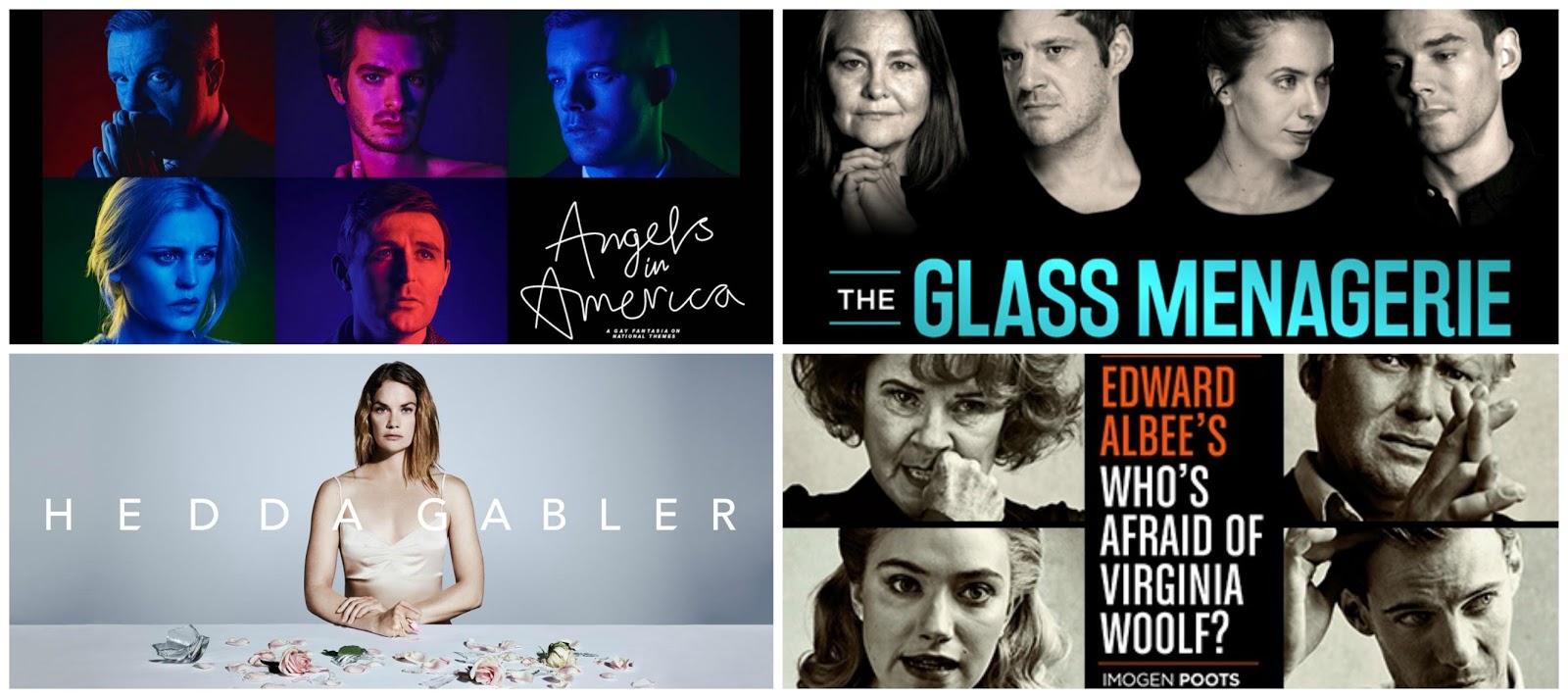
ANGELS IN AMERICA (Lyttelton) / THE GLASS MENAGERIE  (Duke of Yorks) /
HEDDA GABLER (Lyttelton) / WHO'S AFRAID OF VIRGINIA WOOLF? (Harold Pinter)

 BEST MUSICAL (Original/Revival)
 FOLLIES - Stephen Sondheim (Olivier)

 Nominees:
AN AMERICAN IN PARIS (Dominion) / EVERYBODY'S TALKING ABOUT JAMIE (Apollo) / 42nd STREET (Drury Lane) / THE LIFE (Southwark Playhouse)

BEST BALLET/OPERA
 ALICE'S ADVENTURES IN WONDERLAND - Christopher Wheeldon (Covent Garden)

Nominees:
THE DREAM; SYMPHONIC VARIATIONS; MARGUERITE AND ARMAND (Covent Garden) / FLIGHT PATTERN (Covent Garden) / JEWELS (Covent Garden) / MAYERLING (Covent Garden)

BEST ACTOR (Drama)
 ANDREW SCOTT - Hamlet (Almeida)

 Nominees:
SIMON RUSSELL BEALE (The Tempest) / PADDY CONSIDINE (The Ferryman) /
BRYAN CRANSTON (Network) / CONLETH HILL (Who's Afraid of Virginia Woolf?)

BEST ACTRESS (Drama)
IMELDA STAUNTON - Who's Afraid of Virginia Woolf? (Harold Pinter)

Nominees:
LAURA DONNELLY (The Ferryman) / CHERRY JONES (The Glass Menagerie) / 
 AUDRA McDONALD (Lady Day at Emerson's Bar & Grill) / RUTH WILSON (Hedda Gabler)

BEST ACTOR (Musical)
 PHILIP QUAST - Follies (Olivier)

Nominees:
ROBERT FAIRCHILD (An American in Paris) / ALEXANDER HANSON (...Committee...)
/ TOM LISTER (42nd Street) / JOHN McCREA (Everybody's Talking About Jamie)

BEST ACTRESS (Musical)
 IMELDA STAUNTON - Follies (Olivier)

 Nominees:
JANIE DEE (Follies) / CLARE HALSE (42nd Street) / 
SANDRA MARVIN (...Committee...) / JOSIE WALKER (Everybody's Talking About Jamie)

BEST SUPPORTING ACTOR (Drama)
NATHAN LANE - Angels In America (Lyttelton)

Nominees:
STUART GRAHAM (The Ferryman) / JOHN HODGKINSON (The Ferryman) /  
NATHAN STEWART-JARRETT (Angels In America) / PETER WIGHT (Hamlet)

BEST SUPPORTING ACTRESS (Drama)
DEARBHLA MOLLOY - The Ferryman (Gielgud)

Nominees:
BRID BRENNAN (The Ferryman) / SUSAN BROWN (Angels In America) / 
 KATE O'FLYNN (The Glass Menagerie) / JULIET STEVENSON (Hamlet)

BEST SUPPORTING ACTOR (Musical)
PETER FORBES - Follies (Olivier)

 Nominees:
MARK HADFIELD (Pinocchio) / CORNELL S. JOHN (The Life) / 
CHRIS KIELY (Yank!) / ANTHONY O'DONNELL (...Committee...)

BEST SUPPORTING ACTRESS (Musical)
 SHARON D. CLARKE - The Life (Southwark Playhouse)

Nominees:
JOSEPHINE BARSTOW (Follies) / DI BOTCHER (Follies) / 
DAWN HOPE (Follies) / LUCIE SHORTHOUSE (Everybody's Talking About Jamie)

BEST BALLET/OPERA MALE
AKRAM KHAN - Desh (Sadler's Wells)

Nominees:
DANNY COLLINS (Early Adventures) / STEVEN McRAE (The Dream) / 
STEVEN McRAE (Rubies) / LIAM MOWER (Cinderella)

  BEST BALLET/OPERA FEMALE
 ZENAIDA YANOWSKY - Marguerite and Armand (Covent Garden)

 Nominees:
LAUREN CUTHBERTSON (The Judas Tree) / LAUREN CUTHBERTSON (Mayerling) / ALESSANDRA FERRI (Woolf Works) / ZENAIDA YANOWSKY (Symphonic Dances)

BEST DIRECTOR
DOMINIC COOKE - Follies (Olivier)

Nominees:
MARIANNE ELLIOTT (Angels in America) / IVO VAN HOVE (Hedda Gabler)
JAMES MACDONALD (Who's Afraid of Virginia Woolf?) / SAM MENDES (The Ferryman)

BEST DESIGNER
 VICKI MORTIMER - Follies (Olivier)

 Nominees:
BOB CROWLEY (Alices's Adventures in Wonderland / BOB CROWLEY (An American In Paris) / IAN MacNEIL (Angels in America) / JAN VERSWEYVELD (Hedda Gabler)

BEST LIGHTING
  PAULE CONSTABLE - Angels in America (Lyttelton)

Nominees:
PAULE CONSTABLE (Follies) / NATASHA KATZ (An American In Paris)
NATASHA KATZ (The Glass Menagerie) / JAN VERSWEYVELD (Hedda Gabler)

BEST CHOREOGRAPHY (Musical)
 BILL DEAMER - Follies (Savoy)

Nominees:
TOM JACKSON GREAVES (The Life) / KATE PRINCE (Everybody's Talking About Jamie) / RANDY SKINNER, GOWER CHAMPION (42nd Street) / CHRISTOPHER WHEELDON (An American in Paris)

BEST CHOREOGRAPHY (Ballet)
CRYSTAL PITE - Flight Pattern (Covent Garden)

Nominees:
FREDERICK ASHTON (Marguerite and Armand) / KENNETH McMILLAN (Mayerling) / KENNETH McMILLAN (The Judas Tree) / CHRISTOPHER WHEELDON (Alice's Adventures in Wonderland)