Showing posts with label James Goldman. Show all posts

Friday, April 10, 2020

50 Favourite Musicals: 1a: FOLLIES (1971) (Stephen Sondheim)

The 50 shows that have stood out down the years and, as we get up among the paint cards, the shows that have become the cast recording of my life. So here we are...  a year and 10 months in the making and we have reached the stage musical that is my favourite ever - and I cannot name one out of the four shows that I have left to consider.

I have tried every criteria, every angle and there is simply no way I can say that one of the four is better than the other.  One nearly lost the shared top place when I considered productions of it that I felt had not done it justice but, with that particular show, I simply had to overlook that, bearing in mind the first I saw was definitive.  So let's go... my Top Four Number One's (in alphabetical order)


First performed: 1971, Winter Garden Theatre, NY
First seen by me: 1985, Forum Theatre, Wythenshawe
Productions seen: four

Score: Stephen Sondheim
Book: James Goldman

Plot: In 1971, onstage at the derelict Weismann Theatre on the eve of it's demolition, producer Dimitri Weismann holds a reunion of the stars and chorus girls of his "Follies" which ran between the World Wars.  Old songs and routines are remembered, stirring up the ghosts of their younger selves.  But for former best friends and chorus girls, Sally and Phyllis and their husbands, salesman Buddy and diplomat Ben, it becomes a night of bitter recriminations and the chance for lost love to be found again... what will the cruel light of day reveal?

Five memorable numbers: LOSING MY MIND, IN BUDDY'S EYES, WHO'S THAT WOMAN, I'M STILL HERE, ONE MORE KISS

In 1965, Sondheim and writer James Goldman wanted to collaborate on a project together and agreed on Goldman's idea of a murder mystery set at a showgirls reunion.  The murder plot stalled but the showgirls reunion intrigued them especially how regrets for what one did and more importantly didn't do, can haunt your life.  Five years later, Sondheim was keen to follow up the success of his groundbreaking COMPANY with the show's producer/director Hal Prince and choreographer Michael Bennett and, when Prince heard of the reunion idea, he had an immediate visual reference: a 1960 Life magazine photograph of a glamorous but fragile 61 year-old Gloria Swanson, standing in the rubble of the Roxy Cinema in New York which had opened in 1927 with her film THE LOVES OF SUNYA. Prince felt this captured the essence of the project - the survivor, the glamour and the ruin.


Goldman and Sondheim brought in the bittersweet marital discord found in COMPANY and FOLLIES was born.  Prince's 1971 production ran for 522 performances but lost over $720,000, due of huge production costs and audience ambivalence - despite 'names' like film stars Alexis Smith and Yvonne de Carlo, 1950s singer Dorothy Collins, Broadway star John McMartin  and veteran performers Ethel Shutta and Fifi D'Orsay, audiences found Goldman's book too downbeat.  It won seven of the ten Tony Awards it was nominated for but failed to win Best Musical.  Cult status grew through the original cast album but sadly Capitol Records only released it on a single album meaning a lot of the score was abridged or not recorded.  The show has had two further Broadway revivals in 2001 and 2011, but lost out winning the Best Musical Revival Tony Award both times.

1985 was my FOLLIES year!  To rectify the abridged 1971 recording decision, Herbert Ross staged two concert versions at Lincoln Center to be recorded over both nights by Thomas Z Shepherd for RCA featuring the full score with a jaw-dropping cast of Barbara Cook, Lee Remick, George Hearn, Mandy Patinkin, Elaine Stritch, Carol Burnett, Betty Comden and Adolph Green, etc. which is the nigh-on definitive recording.  But before this, I had seen my first FOLLIES production in Wythenshawe, Manchester, directed and choreographed by the under-valued Paul Kerryson and starring the wonderful Josephine Blake,  The production swept me away, making me yearn for a London transfer.  However, when FOLLIES finally opened in London in 1987, it was with several new songs and a more upbeat ending; producer Cameron Mackintosh had asked the creators to 'revisit' the material to make it more optimistic - Goldman was happy to, Sondheim less so.  After seeing a preview, I was outside the Shaftesbury Theatre stage door and Sondheim came out on his own.  While he signed my programme, I told him I had seen the Manchester production; he shot me a look and asked which I preferred.  Cautiously I said that, while loving Julia McKenzie, David Healy, Dolores Gray and Lynda Baron in the new version, I felt that Manchester had the edge for being more true to the material.  He replied that while shows can always stand a revision, it was always possible to return to the original.  Point taken Steve...


In 2006, FOLLIES reappeared in the unlikely location of the Landor Theatre in Clapham which seated a mere 48 people above a pub!  But any lack of grandeur was compensated with a cast guaranteed to make any 1980s musicals fan giddy: Sarah Payne, Claire Moore, Adele Anderson, Rachel Izen, Carol Ball and Roni Page among others.  This small production scored over the National Theatre's opulent 2017 version in one key element which was also there in 1971: then as at the Landor, the cast were chosen not only for their talents but also because to most of the audience, they would conjure up memories of seeing them in earlier shows back in the day.  For FOLLIES to truly work I believe that an audience must have that nostalgic connection to the actors onstage - particularly for those who appear in the smaller but pivotal roles of the former Follies performers, then the audience can supply their own 'ghosts' for the performers; dimly remembered memories of them in previous shows.


It was with trepidation that I watched the National's FOLLIES for the first time in 2017 - I had longed for a production to be done on that stage for so many years, could it measure up?  Yes it did - despite the lack of 'names' in the smaller roles, despite Tracie Bennett's mugging through "I'm Still Here" - I got the FOLLIES I have yearned for. Because when it hit, it hit hard and with astonishing performances wherever you looked: Imelda Staunton's despairing Sally, Janie Dee's bone-dry Phyllis. Philip Quast's crumbling Ben, but especially Josephine Barstow's tear-enducing "One More Kiss" - that the production managed to cast one of Britain's great operatic divas for the small role was special enough, but within the short space of her song, you could hear a pin drop as her voice soared around the auditorium; in a score of unstoppable great musical moments this was one to treasure. The truly astonishing thing about FOLLIES is that Sondheim floors you with one fantastic song after another.  It was director Dominic Cooke's first musical and he gave his production a thoroughness of vision which allowed the musical numbers to flourish while being equally as thorough at the emotional trauma the four main characters inflict amid the nostalgia.

So... what video to pick?  FOLLIES is well represented on YouTube through productions and one-off performances of songs from the score - and with a score so all-encompassing as this how do you pick a represenative song?  How's about a few.. the stinging sophistication of "Could I Leave You" sung by Lee Remick at the 1985 Lincoln Center concert and then, from the same documentary, a fascinating clip of Barbara Cook rehearsing and then performing the pure emotion of "In Buddy's Eyes" and finally, from the NT Live screening of their 2017 production, Imelda Staunton's broken Sally. lost in her obsession, singing "Losing My Mind".


Monday, February 25, 2019

FOLLIES at the Olivier, National Theatre - We're still here...

At the start of FOLLIES, the aged Broadway producer Dimitri Weismann welcomes his guests with "Welcome to our first - and last - reunion"... well Dimitri, we all had such a great time in 2017 that another one is being thrown on the Olivier stage.


Dominic Cooke's Olivier award-winning production was the theatrical sensation of 2017, and in my original blog I found it "...nigh-on perfect; an American classic given the production it deserves on our leading stage." (click on the link to read my 2017 blog) and, by the end of it's run, I had seen it four times, plus when it was screened to cinemas as part of NT Live.

And now it returns in a revival with some key cast changes: Joanna Riding and Alexander Hanson are now playing Sally Durant Plummer and Benjamin Stone while Harry Hepple, Ian McIntosh, Gemma Sutton and Christine Tucker play the ghosts of younger Buddy, Ben, Sally and Phyllis; the ex-Weismann Girls now feature Claire Moore belting out "Broadway Baby" while Heidi Schiller is being shared between two 1980s opera divas: Felicity Lott until April then taken over by the production's original star Josephine Barstow.


The interesting thing was to see how the show has been tweaked for the new cast and also to bring out some hitherto hidden moments.  The ghosts of the showgirls and the younger principals seem to be interacting with their older selves more pointedly, and in Joanna Riding's "Losing My Mind" and Alex Hanson's "Live Laugh Love" there are noticeable changes to the originals.  All in all, there are enough new touches to warrant another visit - needless to say I was clapping like a mad thing at the curtain call.

I had been most worried by the casting of Joanna Riding as Sally as Imelda Staunton had been so extraordinary in the role in the production's first incarnation, making Sally's mental breakdown shockingly real and painful.  Joanna Riding started slow, not having Staunton's immediate galvanizing onstage wattage, and played in a softer style.  To be honest, I have found her at times to be an anonymous actress; she has given performances I enjoyed while watching - THE PAJAMA GAME and a concert performance of A LITTLE NIGHT MUSIC (with FOLLIES co-star Janie Dee) - but nothing really stays in the mind.  However by the time, she hit her big moment "Losing My Mind" she gave an intriguing interpretation which I found oddly riveting.  Imelda Staunton sang it with an unbearable painful desolation but Riding, with some extra business swallowing a handful of pills, ends the number almost catatonic in isolation and on the last note pulling her blonde wig off as if to reveal the reality behind the artifice of her Harlow-esque costume.  She also played Sally's unrelenting despair in the final scene well so I guess she got there in the end.  I must admit I also liked her 'look' - like a suburban Dusty Springfield.


She was matched in a more subdued tone by Alexander Hanson as Ben Stone - and how nice it must be for both of them to have standing ovations and wild applause at their curtain call after their last show together, the Lloyd Webber flop STEPHEN WARD.  Philip Quast was a great physical presence on stage as Ben, singing the songs with a bruised masculinity which fitted his role as a jaded former-politician so his breakdown at the end was all the more affecting; here Hanson plays him with an exhausted ruefulness so Ben's final breakdown suggests more of a relief than anything else, I did enjoy his performance however.  There is also a change to his faltering in "Live Laugh Love" - whereas Philip Quast brought the number to a standstill while the chorus line kept looking around, attempting to feed him his next line or trying to kick-start the number, Hanson goes straight into the breakdown.

It's interesting to see how Janie Dee and Peter Forbes have recalibrated their performances to fit the playing styles of their two new co-stars; there is always the possibility that Janie Dee will just go large as the bitchy Phyllis but she keeps her character's pain grounded in frustrated anger.  Forbes' performance has grown on me now and his Buddy is also paired down to fit Riding's playing style.  The performances of Gemma Sutton, Christine Tucker, Ian McIntosh and the always-watchable Harry Hepple as the shadows of the leads' younger selves were all very good.


13 years ago I saw Claire Moore give a psychologically bruised performance as Sally in the unique experience which was the Landor Theatre's above-a-pub production of FOLLIES so it was nice to see her pop up here as Hattie, using her 1980s West End belt voice to punch across "Broadway Baby" to a huge cheer.

The role of Heidi Schiller, the oldest Weismann 'girl' at the reunion is played - and more importantly - sung by Dame Felicity Lott, who is playing the role until the production's original Heidi, Dame Josephine Barstow, again joins the show in April.  The soaring "One More Kiss", sung by Heidi and her younger self is one of my favourites and again it hit home for me - Young Heidi is once again wonderfully sung by Alison Langer - but Lott just missed out on the majesty that the richer-voiced Barstow brought to the song.  The returning star-turns were as good as before - and I even liked Tracie Bennett as Carlotta now she appears to have toned down the Judy Garlandisms.


Bill Deamer's choreography still sparkles with inventiveness and out-front flash, while Paule Constable and Vicki Mortimer's lighting and design still provide the perfect setting for Dominic Cooke's wonderful production.  We just had the one slip-up: during the "Loveland" number - where the chorus girls raise their glittering trains to spell out L-O-V-E-L-A-ND - the last one had her train fixed on her costume the wrong way round so we got L-O-V-E-L-A.... instead!

But once again what Dominic Cooke, his crew and cast have done more than anything else is to fill the National's Olivier stage with the sheer glory that is FOLLIES by treating James Goldman's book and Stephen Sondheim's score with the respect and love it deserves.  How wonderful it must be for people to see this version of FOLLIES as their introduction to the show.


FOLLIES is running until 11th May - if you didn't see it last time BOOK NOW... if you saw it last time STILL BOOK NOW!

Hats off... here they come...those Beautiful Girls...


Sunday, September 10, 2017

FOLLIES at the National Theatre - Now and Forever....

Since first sitting in the Olivier theatre on 6th August 1982 for Richard Eyre's legendary GUYS AND DOLLS, I have sadly seen my fair share of dog shows on that stage, and every time I have endured an EDWARD II or a WONDER.LAND, my mind has wandered to shows I would love to see on that stage and the one that always swayed to the front, glittering with beads and feathers, was Stephen Sondheim's FOLLIES.  And now it's here...


It has been such a long-held dream of mine to see FOLLIES there that I felt very nervous leading up to the lights going down as the first ghostly showgirl made her appearance on Vicki Mortimer's crumbling backstage set.  I must admit to having a few niggles with Dominic Cooke's production but as Imelda Staunton's Sally sings, "I'm so glad I came".

In 1965, Sondheim and writer James Goldman were looking for a project to collaborate on when Goldman had the idea of a murder mystery set at a reunion of showgirls.  Over the years the plot kept tripping them up but both loved the idea of the showgirls reunion and how regrets for what one did and more importantly didn't do, can haunt your life.  When Hal Prince became involved as director, he remembered a 1960 Life magazine photograph of a glamorous but fragile Gloria Swanson standing amidst the rubble of the Roxy cinema in New York which had opened with her film THE LOVES OF SUNYA. Prince felt this captured the essence of the project - the survivor, the glamour and the ruin.


It's 1971 and the Weismann Theatre is to be demolished to make way for a car park. The former owner Dimitri Weismann invites former stars and show-girls of his inter-war "Follies" productions to a first (and last) reunion onstage, the night before the demolition.  The guests compare how they have survived out of the spotlight but cannot resist running through their old numbers.  Among the guests are Phyllis and Ben Stone & Sally and Buddy Plummer - when they were showgirls in 1941, Phyllis and Sally were room-mates being courted by best friends Ben and Buddy but during the joint courtship, Ben led Sally to believe he loved her; he rejected her however and married Phyllis, and although Sally married Buddy she has never stopped obsessing about Ben.

Eventually the two couples finally confront each other - Sally reproaches Buddy for his mistresses while Buddy tells her it's only because she has shut him out emotionally while obsessing about Ben; Ben feels his life as a politician has been a lie and foolishly lets Sally believe he still loves her, while Phyllis accuses Ben of turning her into a frigid trophy wife and never really appreciating the real her.  As they argue with themselves - and the ghosts of their younger selves - it leads to an explosion of fantasy: they find themselves starring in their own "Follies", each singing a solo number which expresses their dilemma.  But the illusion cannot last forever...


Hal Prince's 1971 production ran for 522 performances but closed at a loss of over $720,000, due of the huge costs involved and audience ambivalence - despite 'names' like film stars Alexis Smith and Yvonne de Carlo, 1950s tv singer Dorothy Collins and veterans Ethel Shutta and Fifi D'Orsay, audiences found Goldman's book too downbeat.  It won seven of the ten Tony Awards it was nominated for but failed to win Best Musical.  Cult status grew through the original cast album but sadly Capitol Records would only release it as a single album, losing a lot of the score.  The show has had two further Broadway revivals in 2001 and 2011, but lost out winning the Best Musical Revival Tony Award both times.

1985 was the year FOLLIES hit me!  The lack of a full cast recording led to the decision to stage a concert version in New York to be recorded featuring the full song score with the jaw-dropping cast of Barbara Cook, Lee Remick, George Hearn, Mandy Patinkin, Elaine Stritch, Carol Burnett, Betty Comden and Adolph Green, Liliane Montevecchi et al.  But before this, I had already seen my first production of the show in Wythenshawe, Manchester.  Directed and choreographed by Paul Kerryson, the production swept me away and made me yearn for a London transfer.  However, when FOLLIES opened in 1987 at the Shaftsbury Theatre, it was a new production directed by Mike Ockrent. 


Cameron Mackintosh had asked Goldman and Sondheim if they would 'revisit' the work to make the tone more optimistic.  Goldman was happy to, Sondheim less so.  One night I was outside the Shaftsbury stage door after seeing a preview and Sondheim came out on his own.  While he signed my programme I told him I had seen the Manchester version, he shot me a look and asked which I preferred.  Cautiously I said that, although loving Julia McKenzie, David Healy, Dolores Gray and Lynda Baron, I felt that Manchester was better.  He replied that while shows can always stand a revision it was always possible to return to the original.  Point taken Steve...

Nineteen years later FOLLIES turned up at the Landor Theatre which seated a mere 48 in a production which made up for it's lack of grandeur with a cast guaranteed to have any musicals fan of the 1980s hug themselves with delight - Sarah Payne, Claire Moore, Adele Anderson, Rachel Izen, Carol Ball, Roni Page - my blog of that production is here.  But now here it is at the National Theatre, in a production that looks back to Hal Prince's original, in particular without the sub-par songs Sondheim wrote for the 1987 production and it plays straight through with no interval.


This is Dominic Cooke's debut musical production and if you think FOLLIES is too big an ask for a debut you would be wrong as Cooke handles the production with a thoroughness of vision which allows the musical numbers to flourish and stake their claim on the Olivier stage but is just as thorough at the emotional trauma the four main characters inflict amid the nostalgia.

I grew to like Vicki Mortimer's design but wanted to remind her that the wrecking-ball arrives the day after the reunion not the day before as her set was like a bombsite at the best of times, however Paule Constable's lighting was a wonder and Bill Deamer's choreography is also a pure delight, especially in the wonderful WHO'S THAT WOMAN where the aging showgirls gamely go through their steps unaware that they are being matched step-for-step by the shadows of their former selves.


When the production was announced I was excited as to who would be cast, imagining the National Theatre could and should get together some West End musical veterans who would rival MGM's slogan "More Stars Than There Are Heaven".  Well that didn't happen which is where I have a niggle with the production.  The pure joy of the Landor production, as I said earlier, was to see so many musical performers from the 1980s playing the ex-showgirls; FOLLIES cries out for that recognition of the history behind each of the performers.  Sadly the NT didn't do this so although ultimately it's a whinge probably only I have, I think a trick was missed out on.

My other stumbling block was with Tracie Bennett as Carlotta Campion, the Weismann girl who couldn't quite make it on stage but who found fame, first as a film star then as a tv actress.  As I suspected might happen, Bennett dispensed with a character all together and sang Carlotta's cri-de-coeur I'M STILL HERE as if reprising her Judy Garland role in OVER THE RAINBOW.  More than ever, some identification with the actress playing Carlotta works wonders - most notably when Dolores Gray then Eartha Kitt made it such a tour-de-force in the 1987 London production - but here it was just Tracie Bennett doing her shtick.


But why then did you see me wiping tears of happiness away at more than one occasion?  Because, despite those niggles, I was presented with the production of FOLLIES I have yearned for all those years.  Because when it hits, it hits hard and, despite Tracie Bennett, there are astonishing performances wherever you look.  It was a given that Imelda Staunton would be a great Sally but she is such an astonishing performer that she mines down within the character to find the raw, festering yearning that Sally has nursed for Ben, making her life as a wife and mother a sham.  To quote Neil Simon, Sally is worse than a hopeless romantic she's a hopeful one and watching that dream die in her was Imelda's triumph.

Janie Dee was equally great as Phyllis, the woman who once told Ben that she would read all the right books to make herself worthy of him and who now realizes that in doing so, she lost her most vital possession - herself.  A real treat was to see how a dropped idea from the 1971 production was re-used here: Hal Prince wanted Sally and Phyllis' Follies solos to be tributes to Jean Harlow and Rita Hayworth but it was dropped as it just didn't seem to fit - but here Cooke has Sally singing LOSING MY MIND in a white on white Harlow-esque boudoir while Phyllis' THE STORY OF LUCY AND JESSIE is shake and shimmied to as in a Hayworth film like MISS SADIE THOMPSON.


The real success of the show is Philip Quast as Ben, the man everyone looks up to as a shining beacon of success but who inside cannot understand why.  Owen asked me before were there any songs I didn't like and I said it was Ben's THE ROAD YOU DIDN'T TAKE but in Quast's deft handling it landed wonderfully.  Peter Forbes as Buddy was a little out-of-his-depth but then I was so bowled over by the late and great David Healy in the 1987 production that anyone would struggle.  Of the younger shadows, Zizi Strallen and Alex Young as the 1940s Phyllis and Sally really stood out.

The truly astonishing thing about FOLLIES is that Stephen Sondheim floors you with a fantastic song only to follow it up soon after with another.  It Is a credit that Dominic Cooke keeps the tension throughout and it doesn't become a stop-start affair of big numbers stopping the show, one after the other.  Di Botcher comes out swinging for BROADWAY BABY which was all the sweeter for being from someone I had always looked on as a play-as-cast performer - believe me, that song was still travelling when it hit the Olivier's back wall!  Dawn Hope invests WHO'S THAT WOMAN? with plenty of attitude and sass - she's come a long way since Crystal in LITTLE SHOP OF HORRORS at the Comedy.


But the one that utterly floored me was ONE MORE KISS which is sung supremely by Josephine Barstow as Heidi Schiller, the oldest of the Weismann girls who, before leaving the stage for the last time, sings the operetta aria that Oscar Straus wrote for her - or was it Franz Lehar?  A sad, lilting song of farewell, Heidi sings it to herself but also to Weismann who was once a lover who watches from the shadows, the song made doubly poignant as she is joined by her younger operatic self.

That the production managed to cast one of Britain's great operatic divas for the role is special enough, but within the short space of the song, you could hear a pin drop as her voice soared around the auditorium joined by Alison Langer as her younger self.  In a score of unstoppable great musical moments this was one to treasure.  Hopefully next time, Dame Josephine will be lit to fit her status.. someone should have given the follow-spot op a nudge.


I will be seeing FOLLIES again at the end of the month; by which time the wobbly preview ticks - Barstow's missed lighting, the feedback that distracted during Janie Dee's COULD I LEAVE YOU and the slightly unfocused ending - will be sorted.

As it is, FOLLIES is nigh-on perfect; an American classic given the production it deserves on our leading stage. Surely a cast recording must follow on?  If you are unlucky enough not to to have booked a ticket already, the great news is that FOLLIES will be filmed live as part of the NT Live series and shown simultaneously in cinemas in the UK and abroad.on 16th November.

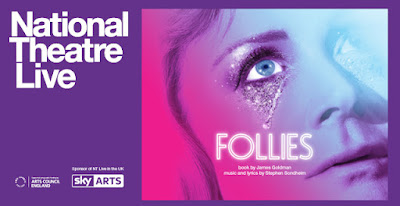
Clink the image to see where it's playing near you:

http://ntlive.nationaltheatre.org.uk/productions/63102-follies

Constant Reader, if you have ever loved this blog... go!

The ghostly Weismann showgirls are waiting to walk their stage just one more time...