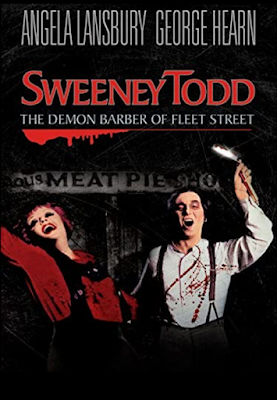
After hearing of Stephen Sondheim's passing, I had to watch this taped performance of his 1979 masterpiece SWEENEY TODD, filmed in LA in 1981 towards the end of the national tour.
SWEENEY won eight Tony Awards on Broadway and this won three Emmy Awards. Despite a central flaw, it remains essential to any musicals fan as a record of Hal Prince's original production.
The central flaw is that tv director Terry Hughes doesn't adapt performances for his medium, so while the actors are pushing energy to the back of the balcony, the camera is only a few feet away. Oddly enough, the women are the worst: Johanna's hydraulic soprano and the Beggar Woman's caterwauling are eventually irritating.
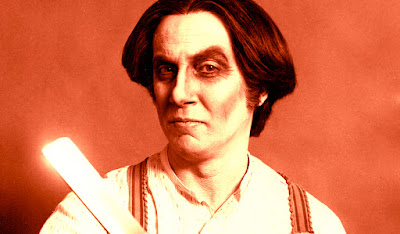
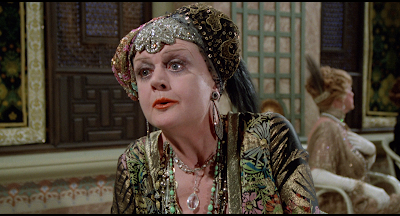
Angela Lansbury's Mrs Lovett, already a Music Hall grotesque, tips into sheer mugging; however she is so charismatic that you have to surrender to her. George Hearn's underplaying as Sweeney works a treat.
Shelf or charity shop? Of course, it's a shelf. Despite the over-pitched performances, it's great to see due to the quality of the production, Hugh Wheeler's marvellous book and, of course, Sondheim's magnificent score. As I have
often said, the final 20 minutes of the show - if done right - should be
one of the most relentlessly scary things you can experience, even if
you know the show It has an internal motor that if stoked properly
keeps gathering pace leaving dead bodies in it's wake and an icy, clammy
grip on
the back of your neck and here you get that as it should be.
Ex-actor Rick McKay took six years to film his oral history of the personalities who witnessed Broadway's golden age - roughly 1945 to 1967 - but his tenacity paid off as his illustrious cast look back at the creative period they all lived through.
His documentary is funny, tender, and tinged with a wistful sadness on the ghosts who haunt his cast's memories. As there are now 25 of the 87 interviewed still living, this increases the poignancy.
The cast reminisce on their first experience of New York, how they lived and auditioned while waiting for the big break, where they hung out and how New York and the theatre world changed around them.
In particular, his stars remember three actors whose performances still burn bright: Marlon Brando, Kim Stanley and Laurette Taylor as Amanda Wingfied in THE GLASS MENAGERIE.
Sadly, McKay didn't live to see his film sequel fully completed.
Shelf or charity shop? One for the shelf because, as well as his wonderful cast, McKay also has a dazzling treasure trove of archive material including an astonishing 1938 screen test that Laurette Taylor did for David Selznick; her natural line-readings would put Streep to shame but she wasn't employed as they felt she wasn't 'acting' as they thought it was. Standouts include Sondheim, Chita Rivera and Carol Lawrence on WEST SIDE STORY, Shirley Maclaine and Hal Prince on how she lived the cliché "understudy becoming a star" in THE PYJAMA GAME and memorable memories from Beatrice Arthur, Angela Lansbury, Ben Gazzara, Gena Rowlands, Maureen Stapleton, Uta Hagen, Frank Langella, Elaine Stritch, Kim Hunter, Julie Harris, Eva Marie Saint, Tommy Tune, Gwen Verdon, Carol Burnett, Carol Channing, and Barbara Cook among many others.
Following up MURDER ON THE ORIENT EXPRESS and DEATH ON THE NILE was going to be a tough act and so it proved with the moribund THE MIRROR CRACK'D.
Rather optimistically Angela Lansbury was signed to a three-picture deal to play Miss Jane Marple but then they choose a story that sidelines her with a twisted ankle, so Lansbury's scenes mostly consist of her sitting in her living room, being told how the murder investigation is progressing.
It took two people to write the adaptation but it never rises above the serviceable, with much-vaunted scenes of bitchy dialogue between rival actresses played by Elizabeth Taylor and Kim Novak proving to be duds.
The main fault lies with Guy Hamilton; no doubt happier filming his four Bond films, here he cannot give the material any menace as a poisoner stalks a Hollywood film company filming near St. Mary Mead.
Shelf or charity shop? A grudging shelf as it's part of a rather snazzy Agatha Christie box-set. Oddly enough, the film's premise which seems far-fetched in the telling is based on a real incident that happened to actress Gene Tierney. It begins brightly enough with a recreation of a 1950s b/w country house thriller starring Anthony Steel, Dinah Sheridan and Nigel Stock; this turns out to be a film Miss Marple is watching in the village hall. Fatally, Guy Hamilton directs the main story like he was directing this type of Merton Park b-picture, totally wasting his illustrious cast. Needless to say there were no more films for Angie's 3 picture-deal
The second of EMI's Agatha Christie adaptations was based on her 1937 novel and featured a new Poirot.
Albert Finney was unable to repeat his Hercule Poirot so Peter Ustinov replaced him and gives a more humane performance of the character and does not over-pitch it as he tended to do.
Heiress Linnet Ridgeway steals her best friend Jacqueline's boyfriend Simon, but Jacqueline appears on their Egyptian honeymoon, taunting them at every turn.
They elude her by boarding a Nile cruise whose passengers all bear Linnet a grudge: a German doctor she has ridiculed, a widow jealous of her pearls, the widow's companion whose family was ruined by Linnet's father, a romantic novelist sued by Linnet for libel, Linnet's embezzling lawyer - even her maid!
Jacqueline suddenly reappears and joins the cruise. That night, in drunken hysterics, she shoots Simon in the leg. The next morning, Linnet is found dead...
Shelf or charity shop? A much-loved film of mine so one for the shelf. The pace sometimes seems to match the leisurely cruise - in ORIENT EXPRESS, Sidney Lumet's suspects appeared to have no connection to the victim, here Guillermin has to have each of his confront Linnet with their grievance and then, when questioned by Poirot, he shoots possible scenes of each one killing her; it does get a bit repetitive. But any time spent watching Angela Lansbury's gloriously drunk novellist, the delicious sparring of Bette Davis and Maggie Smith, and Mia Farrow's quite remarkable performance of the playfully obsessive Jacqueline, is marvellous. Added to this, Anthony Powell's Oscar-winning costumes, Nino Rota's sweeping score and Jack Cardiff's lush cinematography makes it a joy to experience. Guillermin's best sustained sequence is the build-up to the attempt on Linnet's life in the Karnak's Hypostyle Hall as the suspects slowly drift from sunlight into the shadows, seemingly circling Linnet and Simon, in echoing silence...
Nearly 60 years old, THE MANCHURIAN CANDIDATE is frighteningly relevent to today's right-wing politics, a film as icy as it's main character.
A US platoon are captured in Korea by Chinese communists, and during a group brainwashing session, Raymond Shaw is selected to be a 'sleeper' assassin, dispassionately killing two of the other soldiers.
Two years later, they are released and Shaw is decorated as a hero when his colleague Major Bennett Marco - who has been hypnotized - reports that Shaw saved lives during their capture.
But Marco has recurring nightmares of Shaw's killings and when he learns another of the platoon has the same dreams, he starts to investigate.
Shaw's fame is exploited by his mother Eleanor to win her husband John Iselin - a dangerously populist Senator dominated by his ambitious wife - the nomination for Vice-President.
Shaw is 'triggered' to start killing but who is his deadly controller?
Shelf or charity shop? Living in the plastic storage box limbo, THE MANCHURIAN CANDIDATE is kept for Frankenheimer's marvellous direction and George Axelrod's darkly satirical take on Richard Condon's novel. Laurence Harvey's cold persona was the perfect match for Raymond Shaw, Sinatra was never better and Angela Lansbury delivers a performance of pure ice-cold malevolence - her Eleanor Iselin is as great a political villainess as I CLAUDIUS' Livia or Lady Macbeth; at the time of filming she was only three years older than 'son' Laurence Harvey! Sadly Janet Leigh is totally wasted in an unispiring role of Sinatra's girlfriend, a role so vacant that it's speculated that maybe she is a spy too.
The 50 shows that have stood out down the years and,
as we get up among the paint cards, the shows that have become the cast
recording of my life. So here we are... a year and 10 months in the
making and we have reached the stage musical that is my favourite ever -
and I cannot name one out of the four shows that I have left to
consider.
I have tried every criteria, every angle and there is simply no way I
can say that one of the four is better than the other. So let's
go... my Top Four Number One's (in alphabetical order)
First performed: 1979, Uris Theatre, NY
First seen by me: 1985, Half Moon Theatre, London
Productions seen: ten
Score: Stephen Sondheim
Book: Hugh Wheeler
Plot: Sweeney Todd arrives back in Victorian London, rescued from a floating raft by young sailor Anthony, He visits the Fleet Street pie shop of the widow Nellie Lovett who recognises him as Benjamin Barker, the barber who worked above her shop fifteen years before. Barker was transported to Australia by the corrupt pair Judge Turpin and Beadle Bamford so the
Judge could rape Barker's wife Lucy. Mrs Lovett tells Sweeney his wife poisoned herself and his young daughter Johanna is now the Judge's ward who he intends to marry. Mrs Lovett presents him with his old razors and he starts to work again, plotting his revenge - and as the bodies pile up, Mrs Lovett has a solution...
Five memorable numbers: A LITTLE PRIEST, THE WORST PIES IN LONDON, THE BALLAD OF SWEENEY TODD, JOHANNA, PRETTY WOMEN
,
In 1973, while in London for the UK premiere of GYPSY, Stephen Sondheim
went to the Theatre Royal Stratford East to see Chris Bond's
version of the melodrama SWEENEY TODD. Sondheim enjoyed the Grand Guignol
atmosphere and how street songs were incorporated into the action but
what really excited him was how Bond changed the plot from a
penny-dreadful melodrama into a revenge thriller with Sweeney seeking
vengeance on Judge Turpin: an idea was
born. In 1979, SWEENEY TODD: THE DEMON BARBER OF LONDON opened on Broadway starring Len Cariou and Angela Lansbury and, the following year, in London with Denis Quilley and Sheila Hancock and although audiences couldn't warm to the American take on a London villain, London has since taken the show
to it's heart as was Sondheim's original wish - the original production
(despite it's short run) won the Olivier Award for Best Musical and it has since won two further
Oliviers for Best Musical Revival.
Over time I realised I could happily watch a good production of SWEENEY TODD every day.
I have seen it ten times with only two productions I didn't like - a
ghastly am-dram one at the Bloomsbury Theatre in 1992 and the actor/musician John Doyle production that most loved but just got on my nerves. I think eight out of ten is a very
good batting average. The show is a good example of why Sondheim always gives praise to
his book writers. Hugh Wheeler's book for SWEENEY is a classic of
musical storytelling, there are nine main characters who are all vividly
drawn and it not only stands up to repeated viewings but the book
always throws up things I had never noticed before; despite the different directorial takes on it, it just *works*. Sondheim's score acts as an aural fog that whisps, curls and evelopes the characters through the plot, not only through the songs but the relentless underscoring that happens throughout the show, which gives the audience a feeling of foreboding... that all the characters are on a moving path to a very dark place. What I particularly love about the show is, after the introductory "The Ballad of Sweeney Todd" which gives you a flavour of the ominous atmosphere of the show, you are pitched right into the action with Sweeney and Anthony arriving in London, having their first meeting with the Beggar Woman, and onto the visit to the Pie Shop and the first appearance of Mrs Lovett - all within ten minutes.
Then you are off on the wonderful runaway ghost train that is SWEENEY TODD, an unstoppable ride to it's shattering conclusion. As I have
often said, the final 20 minutes of the show - if done right - should be
one of the most relentlessly scary things you can experience, even if
you know the show It has an internal motor that if stoked properly
keeps gathering pace leaving dead bodies in it's wake and an icy, clammy grip on
the back of your neck. My first introduction to the musical was through the Broadway cast recording which, for me, is still is the definitive version of the score, capturing the remarkable performances of Len Cariou and Angela Lansbury. In 1981 the US tour was filmed in Los Angeles with Lansbury's outrageous, glorious turn as Nellie Lovett immortalised with George Hearn, partnering her perfectly as Sweeney. It's interesting that when first offered the role Lansbury hesitated - she pointed out the show was called SWEENEY TODD and was reluctant to play what she felt was a less-than-lead role. Sondheim 'auditioned' some of Mrs Lovett's songs for her and she realised that she was being given the chance to create from the ground up such a memorable character and she was onboard. My first experience seeing it live was at the long-gone Half Moon Theatre in 1985, directed by Chris Bond, the writer of the original play that Sondheim had seen 12 years before. It was wonderful to see it finally and to see the book and score working as one, and it starred Leon Greene's larger-than-life Sweeney. In 1989 I saw it again, this time on Broadway at the Circle In The Square, the first of many 'chamber' versions of the show, with Bob Gunton and Beth Fowler as the killer couple.
SWEENEY made a triumphant return to London in the National Theatre's production directed by Declan Donnellan in 1993. Staged again in a 'chamber' version, it was a wonderfully thrilling production with an excellent cast of Alun Armstrong as Sweeney, Adrian Lester as a charismatic Anthony, Barry James as Beadle Bamford and Denis Quilley, London's original Sweeney, now playing Judge Turpin. But they were overshadowed by Julia McKenzie's magnificent Mrs Lovett - a gin-soaked cockney harridan, hilarious and amoral. She deservedly won the Olivier Award for Best Actress and later, when the show transferred to the larger Lyttelton Theatre shared the stage with Quilley again, this time returning to the role of Sweeney, Sadly this was the last Sondheim role Julia played onstage. The production never had a cast recording issued but the Radio 4 full-length broadcast is available on YouTube. In 2000 the Bridewell Theatre - too close to Fleet Street for comfort - staged a prominade performance with a memorable Mrs Lovett from Jessica Martin.
In the 2010s I saw three contrasting versions: Chichester gave us Jonathan Kent's dingy between-the-wars version with Michael Ball as Sweeney and Imelda Staunton as Mrs Lovett. Imelda gave us an all-too-real Mrs Lovett, gimlet-eyed and itching to be respectable, while Michael Ball downplayed his natural exuberance to almost a monotone. I then saw the concert version at the London Coliseum directed by Lonny Price starring Bryn Terfel as Sweeney who of course sang the bejesus out of it and Emma Thompson finally onstage again as Mrs Lovett, playing up the comedy but also finding the step-up to the drama at the end. It's a key moment in the second act when, while singing "Not While I'm Around", Tobias realises that Sweeney killed his boss, and, attempting to distract him, Mrs Lovett joins him in singing that nothing's going to harm him; you have to feel the murdererous intent behind the grotesque comedy harridan at that point - it's always a chilling moment and the great actresses who have played the role such as Lansbury, McKenzie, Staunton and Thompson can manage that transformation with ease. The last production I saw was in 2016 in a final-year production by the Royal Academy of Music's Musical Theatre students, what made it special was it was at the Theatre Royal Stratford East where 43 years before, Sondheim first saw Chris Bond's original.
Again, a true wealth of video is available for SWEENEY TODD on YouTube - as I said, the full Radio 4 broadcast of Denis Quilley and Julia McKenzie in the NT's production is there - so I shall stick with that production and Julia's full-throttle "Worst Pies In London" from that year's Olivier Awards ceremony...
Then Bryn Terfel's Sweeney and Emma Thompson as Mrs Lovett delighting in her new receipe for meat pies in "A Little Priest"
and finally, the music-hall out-front performance of Lansbury, secretly laying her own plans by giving George Hearn's Sweeney only some of the truth in "Poor Thing":
I hope you have enjoyed reading about these 50 great musicals as much as I have blogging about them...