Showing posts with label Christopher Wheeldon. Show all posts

Sunday, May 26, 2019

WITHIN THE GOLDEN HOUR / MEDUSA / FLIGHT PATTERN at Covent Garden

Royal Ballet mixed programmes can be a curate's egg at times: it all depends on the arranging of the ballets - is it better to have three pieces that are all the same tone or if you have a mixture, where do you put the downbeat ones - does the audience leave moved to euphoria or sadness?  It's a tricky balancing act.


The latest mixed bill celebrated new choreographers and was an impressive evening, again showing the range and versatility of the Royal Ballet company.  First out of the gate was Christopher Wheeldon's WITHIN THE GOLDEN HOUR which we saw twice three years ago.  Since then, the late Martin Pakledinaz' costumes have made way for sparkly gold ones by Jasper Conran which are actually a bit distracting - the only ersatz moment in an otherwise wonderful piece.

It premiered for San Francisco Ballet in 2008 and features a score by Ezio Bosso - incorporating a section of Vivaldi - to which fourteen dancers twirl, slide and undulate through pas de deux and ensemble movements in a constantly evolving, surprising, thrilling production; it's final moments are extraordinary.  Our ensemble was wonderful with great contributions from Sarah Lamb, Lauren Cuthbertson and Alexander Campbell.


The next one was the new production MEDUSA choreographed by the 'hot' Belgian Sidi Larbi Cherkaoui - remarkable what a job with Beyoncé can do for your profile.  He has used a score drawn from the music by Henry Purcell, augmented by electro beats.  Cherkaoui was also responsible for the deceptively simple but effective stage design.  Oddly topical, Cherkaoui tells the tale of Medusa, a devoted priestess of the goddess Athene, who attracts both the human Perseus and the god Poseidon.  Poseidon traps her and rapes her but as the angry Athene cannot punish a fellow god, she punishes the victim.  Medusa is turned into a Gorgon whose mere glance can turn men to stone - and yes, her lovely hair is turned into a nest of venomous snakes.

She kills all men who cross her path but when faced with Perseus she allows herself to be killed.  Freed from the goddess' curse, the ghostly Medusa dances alone in the temple...  With a running time of only 40 minutes, it managed to be engrossing and a little anti-climactic at the same time.  Natalia Osipova was a magnificent Medusa, danced with a committed fervour and passion.  I also liked the imperious Athene of Olivia Cowley, prowling the stage with a vengeful fury.  It just felt a little dull, maybe with a couple of years under it's belt it will loosen up.


Finally it was time to see again Crystal Pite's intense and powerful FLIGHT PATTERN, vividly depicting an eternal flight of a column of refugees.  It is an extraordinary piece which seems to exist in a single moment in time and truly stands out as an artistic response to this shifting recurring tragedy of displaced people that we see across the world.

Pite's wonderful choreography moves in waves across the stage illustrating the flight, in all senses of the word, but also in tiny moments of a couple's experience of migration which were exceptionally danced again by Kristen McNally and Marcellino Sambé.  Jay Gower Taylor's monumental design and Tom Visser's exceptional lighting made it, again, a thrillingly memorable experience.


Congratulations to Kevin O'Hare's Royal Ballet for again providing such an enjoyable but thought-provoking evening of dance.


Monday, April 16, 2018

Bernstein Triple Bill: YUGEN, THE AGE OF ANXIETY, CORYBANTIC GAMES at Covent Garden

Sometimes the Royal Ballet triple-bills can be a curate's egg but, every so often, all the pieces fall together and, while the individual one-acts dazzle, together they form a cohesive whole.  The Royal Ballet's recent celebration of Leonard Bernstein's centenary did just that.


Bernstein was such a giant of American music that it has taken three RB-favourite choreographers to stage this tribute: in tandem with Liam Scarlett's existing THE AGE OF ANXIETY, Wayne McGregor devised YUGEN and Christopher Wheeldon was given the final ballet CORYBANTIC GAMES.  All in their own way were exciting and Bernstein's soaring music sounded wonderful thanks to the Royal Opera House Orchestra.

Moving effortlessly between the classical and Broadway stages, Leonard Bernstein never forgot either as essential outlets for his creativity - indeed when a musical adaptation of THE SKIN OF OUR TEETH was abandoned because of creative differences, Bernstein reworked parts of the score to become a 1965 symphonic work which had been requested by the Dean of Chichester Cathedral two years earlier, waste not want not...  THE CHICHESTER PSALMS have been used by McGregor for his ballet YUGEN.


Utilizing his signature moves, McGregor had his dancers moving with vigour and astonishing physicality but also complementing the singing of the psalms in Hebrew.  The stark but intriguing design by Edmund De Waal of tall moving white light-boxes concentrated you on the remarkable dancers, as fluid as the red and purple costumes they wore.

I am sure it was just because it is the Bernstein score I know the most but I occasionally picked up the odd phrase that sounded straight out of WEST SIDE STORY in all three pieces.  I also saw a possible Matthew Bourne moment when a dancer did very noticeable swan-like swooping movements over three other crouching dancers.  McGregor can sometimes be all cerebral movement and little emotional involvement but here the lush musicality of Bernstein brought out the best in him, very much like Max Richter's music for WOOLF WORKS.


The second was a revival of Liam Scarlett's 2014 ballet THE AGE OF ANXIETY, written by Bernstein in 1949 and based on WH Auden's epic poem.  Bernstein's symphony throbs with the post-war feeling in New York of possible new beginnings under an air of lonely city living, Scarlett vividly moves his four lonely drinkers from a corner bar - an excellent design by John MacFarlane - to an apartment where they continue their drinking in the hope of making a connection.

They pal around, they flirt, they come together then break up leaving one of them, Malin, staring at the New York skyline at sunrise, eventually rushing towards it, ready to take up the challenge of another day, another possibility...  Sadly injury meant the wonderful Steven McRae had to pull out of the production and was replaced by fellow Aussie Alexander Campbell, but the lead quartet of Campbell, Sarah Lamb, Edward Gartside and Tristan Dyer were excellent, and Kevin Emerton was equally fine as the bartender.


After that blast of narrative, it was back to abstract for the last piece which was choreographed by Christopher Wheeldon.  He has set his ballet to Bernstein's Serenade after Plato's 'Symposium' - excuse me people - and the theme was carried through in Erdem Moralioglu's Hellenic-style costumes.  Through the five movements the constant theme seemed to be harking back to athletic running and leaping movement. 

I would love to see this again; Wheeldon's choreography was wonderfully alive, especially the 4th movement where a man and a woman, two men and two women danced variations to the same movements, perfectly embodying Bernstein's flowing music, before the whole ensemble at the end came together in kinetic, perfect fluidity.


As I said, the Royal Ballet triple bills may sometimes be unbalanced but in their tribute to Bernstein they triumphed.

Sunday, October 29, 2017

ALICE'S ADVENTURES IN WONDERLAND at Covent Garden - The Wonder of Wheeldon

It's four months since we last saw the Royal Ballet company at Covent Garden - yes, we saw LA BAYADERE in August but that was the Marinsky company so it was a welcome joy to be back in the Amphitheatre, pushing past the throng to get to our front row seats to Christopher Wheeldon's acclaimed version of ALICE'S ADVENTURES IN WONDERLAND.


I will admit to some trepidation going in as the last time I saw a theatrical production based on Lewis Carroll's evergreen children's story was the truly ghastly WONDER.LAND at the National Theatre, one of the most hideous experiences I have ever had in a theatre - click here to see my blog lynching here - but I really need not have worried.  Christopher Wheeldon's inventive choreography dazzled where WONDER.LAND embarrassed, the set invoked real wonder where WONDER.LAND just created clunking ugliness and Nicholas Wright adaptation managed to evoke the surreal atmosphere of Wonderland that Fiona Buffini's buffooonity didn't.

Christopher Wheeldon's ballet of ALICE premiered in 2011 to great success - which was probably matched by a collective sigh of relief from the Royal Ballet as, amazingly, it was that company's first full-length original work in 16 years.  Joby Talbot's score was also the first original ballet score for the company in 25 years - so as you cans see, a lot was riding on this production.  Wheeldon and Talbot have since rejigged the original two-act structure to a more traditional three-act form with added choreography for Alice and her romantic hero, the Knave of Hearts.


I was also vaguely dreading the 12am start matinee, expecting an auditorium crammed with whingeing Jeremy and Jemimas but they were all on their best behaviour and any worries were soon carried off by Talbot's exhilarating score and Wheeldon's inventive and witty choreography - he is a real story-teller in dance as was shown a few years later with his wonderful version of THE WINTER'S TALE.

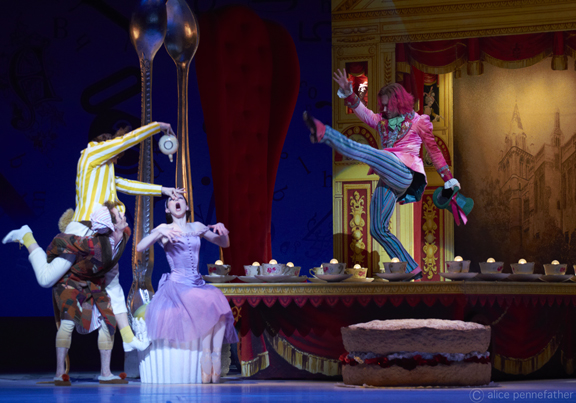
A major reason for the production's success is Bob Crowley's outlandish but always on-the-money set and costume designs which again fill the stage with colour but always stay true to Nicholas Wright's version of the tale.  Crowley's design fills the stage with invention and the sheer joy of visual story-telling: his Cheshire Cat looms large over with limbs that fly away to reform as the cat moves around - and his tail has a life of it's own, snaking around Alice keeping her in her place, while the Caterpillar is a sinuous Indian dancer with a retinue of dancers following behind him on point.


Crowley's costumes also hit the right witty note, from the crazed dandy of The Mad Hatter to the eye-popping red of the Queen of Hearts' outfit - I also liked the idea of her being transported everywhere in a heart-shaped cabinet by minions which, when finally opened revealed a quaking King of Hearts at her feet!  Alice's topsy-turvy adventure is also brought to vivid life by Natasha Katz's lighting and the video projections of Jon Driscoll and Gemma Carrington which instantly conjures up a world of vertiginous rabbit holes and halls of endless doors.

Nicholas Wright establishes a framing device which ends with a neat twist: Alice and her sisters are being read to by Lewis Carroll at a garden party, she then dances with her friend Jack, a young gardener, but her imperious mother castigates him for having a red rose in a bunch of white ones.  Jack gives Alice the offending rose and she gives him a jam tart from the party spread but her mother suspects he stole it and dismisses him on the spot.  Lewis Carroll tries to cheer the distraught Alice by taking her photograph; he puts the camera cloth over his head but he sprouts a bunny-tale and emerges as the White Rabbit... the chaos begins.  But don't worry... Alice and Jack are reunited at the end but not in the Victorian era...


Needless to say the cast were flawless: Anna Rose O'Sullivan was a delightfully feisty Alice, establishing a lively character from the start which continued through the Wonderland scenes.  Steven McRae originated the role of The Mad Hatter in 2011 as Wheeldon was impressed with his tap skills as the role consists of a long tap solo during the tea party scene but at our performance he played the roles of Alice's gardener friend Jack and the Jack of Hearts whose stealing of the Queen's jam tarts threads through the show until it climaxes with the anarchy of his trial.  I was disappointed not to see him as the Mad Hatter but it would have meant getting about 5 minutes of seeing him onstage so I happily settled for seeing him throughout the production instead.

Laura Morera was huge fun as the nasty Queen of Hearts, none more so than in her dance with three petrified courtiers, all too aware what will happen if they go wrong.  Based around the Rose Adagio from SLEEPING BEAUTY, Morera was hilarious as she twisted herself into grotesque ballerina positions clinging to her hapless partners for support.


There was also fine support from Alexander Campbell as Lewis Carroll and The White Rabbit, Joseph Sissens as the tapping Mad Hatter - but missed the charisma that McRae would naturally bring to the role - and Nicol Edmonds as the sinuous Caterpillar.

Sadly the performances are all over for this run but it was screened in cinemas last week and I am sure this new classic will be back in the repertoire soon, as Owen said it really would make a great Christmas show.


Monday, May 29, 2017

THE VERTIGINOUS THRILL OF EXACTITUDE / TARANTELLA / STRAPLESS / SYMPHONIC DANCES at Covent Garden

It's just over 2 years since we discovered through Wayne McGregor's wonderful WOOLF WORKS how the Royal Ballet are adept at contemporary as well as classical ballet and this has been demonstrated a few times by their scheduling of memorable triple bills based on choreographers or themes.  So, Constant Reader, what can be better than a triple bill?  A quadruple bill of course!


Last Saturday we took our amphitheatre seats for an evening of four one-act ballets, only one of which we had seen before.  The first of the four was choreographer William Forsythe's THE VERTIGINOUS THRILL OF EXACTITUDE - the title is almost as long as the ballet itself being only 15 minutes!

Forsythe's choreography uses the majestic finale of Shubert's 9th Symphony and it's constant flurry of movement - using classic moves but with wonky angles and straggly arms and legs - must be a trial for the three female and two male dancers, all vividly colourful against a black background, the men in bright purple and the women in bright lime-green.


The dancers mix and merge, coming and going, dancing in groups, trios, duets and solos all at a frenetic pace - a bit too frenetic for Itziar Mendizabel who came racing from the wings into the middle of a group and went down on her tutu to an intake of breath from the audience.  But she recovered well and found her way back into the music after a beat or two... well done Itziar.

After a pause we had Balanchine's cheeky TARANTELLA, a duet of great charm and character which allows it's male and female to really stamp personalities on the roles.  Capering around the stage and around each other, Meaghan Grace Hinkis and Alexander Campbell were delightful.


Next was the first revival of Christopher Wheeldon's narrative ballet STRAPLESS which we first saw last year as part of a Wheeldon triple bill; in my blog for that production I hoped that it would be revived sometime but I didn't expect it to be so soon!  Oddly enough, the jitters which might have explained Itziar's stumble in VERTIGINOUS THRILL... also affected STRAPLESS when, during the scenery change for the second act, one of the ballerinas positioning a panelled column for the Café L'Avenue set, pushed too hard and the column went BANG across the stage only for it to be dragged off ignominiously!  The ballerina I hasten to add just wandered off and left it!

It has been slightly reworked to focus more on the main characters of Amélie Gautreau and John Singer Sergeant - the model and artist of the notorious MADAME X painting which scandalized Paris in 1884 - but again I felt that the story proves too elusive when reduced down to just ballet.  But Lauren Cuthbertson captured the skittish society beauty Amélie very well and her haunting of her now-famous portrait remains a powerful moment; the modern-day gallery visitors blind to the real woman whose image they admire.


The last ballet was Liam Scarlett's new production SYMPHONIC DANCES based on Rachmaninoff's last composition.  Written in 1940, the composer had asked Mikhail Fokine if he would be interested in using the music for a three-part ballet but Fokine's death in 1942 ended the possibility of it happening in Rachmaninoff's lifetime.  Since then ballet productions have been mounted but Liam Scarlett's is the first in the UK.

STRAPLESS sits well with SYMPHONIC DANCES as it too is centred around the central figure of a statuesque diva, and for good reason... This season will be the last danced by Principal Ballerina Zenaida Yanowsky and Liam Scarlett in SYMPHONIC DANCES has choreographed a production in which she remains the centre of attention at all times.


Yanowsky looked every inch the diva in her opening costume, a strapless black bodice and huge, multi-layered skirt which became almost a character in itself as it whipped and swirled around her.  Red and black also ruled in Jon Morrell's stage design, a stark and empty Opera House stage glowed with red lighting amidst the onstage mist while a large metal lighting grid hanging above the stage cast ominous black shadows beneath it.

The second part of the first movement featured Yanowsky seemingly unmoved by the sinuous capering of James Hay; in the second scene she reappeared in a black and red tuxedo while it was the turn of the men in the ensemble to wear the full skirts - indeed there was a noticeable wobble from one of the men proving that the Devil works in threes after the Itziar and column incidents.


The final movement saw the metal grid horizontal to the stage with Yanowsky losing the tuxedo to appear in just a bodysuit, this time duetting with Reece Clarke, before Rachmaninoff's dramatic, oppressive score built to a devastating climax.  As Wayne McGregor says, an abstract ballet cannot help but have some sort of narrative because of the human element and Yanowsky and the ensemble made me think of an imperious Empress slowly thawing and allowing emotion into her life through her adoring acolytes.

Zenaida Yanowsky was cheered to the Opera House's Fabergé egg-like roof and rightly so; she was astonishingly powerful and totally in command of her stage; Laura Morera is playing the role too so it would be interesting to see it with another energy, another persona doing those moves.


All together, it was an evening of passionate performance and thrilling choreography.  I am still wondering about those three errors however, could it be that this company - who were different from the opening night apart from Yanowsky - had been under-rehearsed?  Ah well, I suppose it goes to show that they are human underneath all that well-drilled skill.

Tuesday, April 04, 2017

AN AMERICAN IN PARIS at the Dominion Theatre - S'Wonderful?

It's big, it's bold, it's ballet as well as a musical - a ballical!  AN AMERICAN IN PARIS won 4 Tony Awards on Broadway and now it's opened at a recently-renovated Dominion Theatre but did it leave me dancing up Tottenham Court Road?


To be honest, I have never been a fan of the 1951 film starring the winsome (losesome) Leslie Caron and the overbearing ego of Gene Kelly - I have always thought it a fairly lumbering, unfunny film and justifiably overshadowed by Kelly's next film SINGIN' IN THE RAIN.  But here we are, sitting down to see the stage version which comes tailing success and awards...

The musical is the first to be both directed and choreographed by the British ballet choreographer Christopher Wheeldon (he had previously done the dances for the 2002 musical SWEET SMELL OF SUCCESS) and was first staged in Paris at the Théatre du Chátelet - a unique theatre in that city that stages large-scale American musicals - which then did the 'coals to Newcastle' thing by transferring to New York. 


Wheeldon has done a wonderful job in making the show 'move' - even the dialogue scenes seem choreographed - and the show certainly moves along briskly.  His choreography is endlessly inventive and it really lifts the show as the book by Craig Lucas is shockingly mundane.  You get the distinct impression that a fairly straight-forward plot - American would-be artist in post-WWII Paris falls in love with an enigmatic girl who is also loved by two of his friends - is dragged out to snapping point with endless complications and a particularly drippy heroine.

The lame script ultimately gives the show no real heart and no matter how good a show's music, choreography, design or performances are, if you have no interest in the characters you are watching or care for their travails then there is no emotional engagement.  However - along with Wheeldon's wonderfully vibrant choreography which luckily punctuates Lucas' bland tale frequently - the production is always watchable thanks to Bob Crowley's wonderful design: filmic video projections of Paris streets being hand-drawn move the action along elegantly and right at the top of the show there is a wonderful moment when a Swastika is torn down to envelope the stage in a massive, billowing tricolor.


The best is left for last with two barn-storming numbers: I'LL BUILD A STAIRWAY TO PARADISE builds wonderfully from a singer's shaky performance in a Paris nightclub to a gloriously over-the-top fantasy sequence paying homage to New York's Chrysler Building, and finally the climactic 12 minute-plus title ballet explodes onto the stage with Crowley's Mondrian-inspired designs, Gershwin's evocative music and Wheeldon's delicious choreography.

The AMERICAN IN PARIS ballet also showcases the marvellous dancing of the two leads, Robert Fairchild (ex-New York City Ballet) as Jerry and Leanne Cope (ex-Royal ballet) as Lise, who are reprising their Broadway roles.  Fairchild is a real find: he has a nice personality onstage, a pleasing singing voice and needless to say his dancing is a joy to behold.  Leanne Cope has a harder task as Craig Lucas has saddled her with such a drip to play but her dancing is a true delight.  Kudos do have to go to the 15-strong orchestra who made the Gershwin songs sound great.


The supporting cast includes David Seadon-Young, Haydn Oakley, Zoe Rainey and Jane Asher but again Craig Lucas' script gives them unfunny lines to say and two-dimensional roles to play.  I also think a major problem is having the show in the Dominion; no matter what they have done to it, it was a barn before and it's a barn still with zero character.  It's a tough space to play 'heartwarming' - the elephantine quality is also matched in the programme being upgraded to an enormous souvenir brochure: bigger is not necessarily better. 

Would I recommend it?  Yes I think I would though I feel no urge to return to see it myself.  It was certainly a feast for the eyes and ears while leaving the heart unmoved.

Sunday, April 02, 2017

The HUMAN SEASONS / AFTER THE RAIN / FLIGHT PATTERN at Covent Garden - joy and pain

Think of The Royal Ballet and you probably will think of the artistry of classical ballet - a heroine in white tulle, an athletic leading man to support her and a full corps in attitudes around them.  But there is another Royal Ballet and it's gaining ground in the repertoire...

Contemporary Dance has always been vital to the company in helping establish new choreographers and allowing established ones to experiment with new forms and also for the dancers in the company to explore new ways of - literally - stretching their talents.  The Royal Ballet's resident choreographer Wayne McGregor is constantly finding new ways for Contemporary Dance to connect with the Opera House's audience and last week we saw their latest triple bill of one-act ballets which showcase the work of three fellow contemporary choreographers.


The first was THE HUMAN SEASONS choreographed by David Dawson and based on a poem of the same name by John Keats.  To be honest I didn't get that coming through, Dawson's piece purportedly charts the four seasons of man's life and while it had a spare elegance - with an ever-changing set of black and gold panels and neon straight-line lighting - and standout work from Eric Underwood, Marcelino Sambé and Sarah Lamb, it also was the one that I could skate over the most.  Speaking of which, I noticed a distinct trend across all three choreographers which was to get the dancers to slide across the stage... it gets noticeable after a while.

Christopher Wheeldon's AFTER THE RAIN was next and although I had seen it last year in a Wheeldon triple bill, it's elegant simplicity was a joy to see again. Danced to the hauntingly sparse music of Arvo Part initially by four dancers as embodiments of skittish rain drops, the piece is made truly memorable by the end pas de deux, a mesmerizing combination of delicacy and concentrated energy which is the perfect length to leave you wanting more.  This wonderful showcase for two dancers was danced beautifully by Zenaida Yankowsky and Reece Clarke.


The crowning achievement of the evening was the final ballet, Canadian choreographer Crystal Pite's FLIGHT PATTERN which featured a large ensemble of 36 dancers.  This was Pite's first work for The Royal Ballet and was danced to Henryk Górecki's Third Symphony.

This astonishingly sombre work is Pite's response to the eternal dilemma of displaced people: three rows of muted, cowed dancers slowly surge onto the stage from stage left, suggesting waves of people moving as a mass but made up of individuals.  They slowly move across the stage but as they do some of them break away, to fight among themselves, to seek support.


They reach a place to rest and while doing so, a man and woman break free and while mourning a lost child they are again on the move, towards a slowly closing door with gently falling snow beyond it.  The couple are left alone but this time it is the man who explodes into a violent solo as his wife sits slumped with her back to him, broken.

Crystal Pite's remarkable choreography was tensely hypnotic - only when the curtain fell could I exhale loudly - and it perfectly mirrored Górecki's haunting music.  There were such wonderful moments within the choreography that you left knowing it had to be seen again; the constant surging movements within the company - suggestive of both a death marches and mass exodus - the amazing moment when the rippling forms made a heaving wave which supported the grieving woman, the exhilarating movement of the ensemble's arms to almost suggest the wings of birds flying...


The dancing was stupendous from the whole ensemble with remarkable vignettes from Kristen McNally and Marcellino Sambé as the suffering couple.  Jan Gower Taylor's set design was hauntingly lit by Tom Visser and it was wonderful to see it on that stage, in that theatre.

A perfect evening within which to explore and experience the possibilities of contemporary dance - I would love to see them all again.


Sunday, June 12, 2016

OBSIDIAN TEAR / THE INVITATION / WITHIN THE GOLDEN HOUR at Covent Garden

Another visit to the Opera House, Covent Garden?  Well don't blame me... they are the ones who keep putting shows on! *points*

The latest triple bill puts three one-act ballets together by three of the Royal Ballet's most popular choreographers - Wayne McGregor's new production OBSIDIAN TEAR, Kenneth MacMillan's haunting THE INVITATION and Christopher Wheeldon's hypnotic WITHIN THE GOLDEN HOUR.  All together they made for an involving evening of dance styles and storytelling.


It was Wayne McGregor's WOOLF WORKS that started the current love-in with the Royal Ballet so we were interested in seeing his latest creation OBSIDIAN TOUR.  It was certainly a haunting experience if a little too austere to launch the evening totally successfully.

Set on a darkened bare stage apart from a broad orange strip along the apron of the stage, nine male dancers in different designer trousers or shirt-dresses perform MacGregor's exacting choreography: tender and physically lyrical to violent and confrontational.  Slowly the dancers circle the one dancer wearing red and he is eventually thrown into the glowing red pit at the back of the stage.  Two dancers - Edward Watson and Matthew Ball - are left onstage before one of them too vanishes into the pit on the very last note of Esa-Pekka Salonen's eerie score.


The nine dancers were all remarkable in their concentrated energy and power with Watson, Ball and Calvin Richardson outstanding as the three main dancers.  It was great to have Salonen there to conduct the score and the moody, bare set was designed by Wayne McGregor too.

At 30 minutes it certainly didn't outstay it's welcome and I would like another opportunity to see it again but must say I found it's stark remoteness hard to concentrate on at the start of the evening.


We were on more traditional ground with the next piece, Kenneth MacMillan's controversial THE INVITATION which debuted in 1960, restaged here by Gary Harris. THE INVITATION was MacMillan's first Royal Ballet production to a commissioned score and he was urged to do it by the company's founder Ninette De Valois.  He chose the Hungarian-born composer Mátyás Seiber to collaborate with but Seiber was tragically killed in a car crash just before the premiere.

A young, impressionable girl leaves boarding school and returns to her mother's austere home.  There she meets her cousin and they both express their tender love for each other.  However their lives change when they are invited to a house party given by a married couple who know the girl's mother.  From their first meeting the husband is drawn to the girl's innocence.


The husband is bored with his clinging wife and after the night's entertainment lead to the guests indulging in sexual dalliances, the wife seduces the confused but willing cousin.  The girl, left alone with the brooding husband, playfully teases him but, misreading the situation, the husband attacks and brutally rapes her.  The cousin reappears but the girl withdraws fearfully from him, her illusions shattered forever. 

Ninette De Valois was upset that MacMillan had choreographed the rape onstage and suggested he put it offstage but he was adamant that this brutality was essential to the action and needed be seen by the audience and she eventually backed him in his decision. 


THE INVITATION still packs a hefty emotional punch largely due to MacMillan starting the piece almost dreamlike thanks to the late Nicholas Georgiadis gauzy set design allied with little moments of characterful humour.  But his choreography is brutally ugly and the last section of the ballet feels shattered and muted after it.

Yasmine Naghdi was perfect as the girl, starting so bright and full of life and ending up a shadow of a shattered being.  David Donnelly as the gauche cousin, Olivia Cowley as the neglected wife and particularly Thomas Whitehead as the husband were all excellent too.


The final ballet was Christopher Wheeldon's shimmering, abstract WITHIN THE GOLDEN HOUR which we first saw earlier this year in another triple bill.  Again I found Wheeldon's choreography remarably fluid and hypnotic with any number of bends, slides and pivots across the stage.  The climax where all 14 dancers are bobbing and weaving seamlessly together like a well-oiled machine was a giddy delight.

There are quite a few visits to Covent Garden coming up due to Owen going a bit mad for the upcoming season by the Bolshoi but towards the end of the year we have a triple bill of Wayne McGregor works including a brand new ballet.  Exciting times ahead!


Friday, April 29, 2016

The WINTER'S TALE at Covent Garden - Don't Send In The Clowns...

For the third time in four months we saw Shakespeare's THE WINTER'S TALE only this time dancers peopled the gloomy court of King Leontes in Sicillia and the sunny fields of neighbouring Bohemia as we saw Christopher Wheeldon's Royal Ballet production.

Shakespeare's tragi-comedy is one that I enjoy a lot but how can a production of it be a success with the loss of his words?  Quite easily. Constant Reader, when you have a choreographer of Wheeldon's talent who, rather than doing a scene-for-scene transposing, instead conjures up the mood and the feelings behind the words.


By turn thrilling and emotional, Wheeldon is to be applauded for dropping the lengthy rude mechanicals comedy characters from the Bohemia scenes, instead the second act concentrates on a lengthy pas-de-deux between the young lovers Perdita and Florizel. As I said, what is remarkable about the production is that with no words to concentrate on, Wheeldon can instead focus on the emotions that drive Shakespeare's story and can linger on certain moments that are overlooked in the rush of words.

Christopher Wheeldon provides a prologue showing Leontes and Polixenis as young friends, separated when they become the rulers of Sicillia and Bohemia only to be reunited as adults with Leontes' wife Hermione.  When Polixenes cancels his return to Bohemia because Hermione asks him to, Leontes is thrown into a jealous rage suspecting them of having an affair, which Wheeldon choreographs in a fascinating scene where Leontes clambers over the court sculptures to spy on the couple, who he imagines making love.


Polixenes flees but Leontes has Hermione arrested and put on trial. Witnessing his mother's trial, Prince Mamillius collapses and dies which causes Hermione to collapse too. Her chief supporter Paulina announces the Queen is dead and Leontes finally is confronted by the disastrous consequences of his misguided jealousy. Paulina's husband Antigonus is killed when he leaves Hermione's recently-born baby daughter to die on the shores of Bohemia and the baby is adopted by a shepherd - and all of that in the first half!

Wheeldon's choreography was remarkably involving and he was also helped enormously by the ominous design of Sicillia's court by Bob Crowley and the atmospheric lighting of Natasha Katz. Joby Talbot's score was also very fine, particularly stark and sombre as Leontes' jealous madness takes hold only to blossom into lyricism for the second act when we see the grown-up daughter Perdita falling in love with Florizel, the son of Polixenes.  Again Bob Crowley's setting of a large tree was quite marvellous.


Most of the conclusion in Shakespeare's play frustratingly happens offstage but Wheeldon has the reunion between Leontes and Perdita happen onstage when he recognizes his wife's pendant that was left with her as a baby.  Of course what was lost in the climax was Shakespeare's wonderful poetry when Leontes is confronted with a statue of Hermione 'coming to life' - one line that always gets me is Leontes' "O she's warm" when he touches his wife's arm - but the gentle lyricism of Wheeldon's choreography went some way to making up for this.

In fact Wheldon's final moments provided a touching coda that is not found in the original play: Crowley's design for Hermione's plinth has her standing with a figure of her son Mamillius and, as Hermione and Perdita left the stage to get to know each other after their lives apart, Leontes eagerly touched the statue of his son hoping for 'magic' to happen twice... only to be led away by Paulina as if to say "No your son *is* dead" and as the King left with his thoughts, Paulina bowed down in memory of the lost Prince.  Quite lovely and enhancing Shakespeare's plot rather than ruining it.


The lead dancers all gave excellent performances while never losing the feel of a dedicated company: Bennet Gartside as Leontes, Marianela Nunez (so good previously in Wheeldon's AFTER THE RAIN and GISELLE) as a noble Hermione and, in, particular Itziar Mendizabel was wonderful as Paulina, expressing aching grief with every movement.  It was good to see her again so quickly after her impressive featured role in GISELLE. Special mention too for Beatriz Stix-Brunell and Vadim Muntagirov as Perdita and Florizel in their lengthy second act pas-de-deux.

A worthy addition to any ballet fan's repertoire and a credible choice as the nearest related-production seen before the 400th anniversary of Shakespeare's death.