Showing posts with label Bob Crowley. Show all posts

Wednesday, October 03, 2018

THE INHERITANCE at the Noel Coward - "Only connect the prose and the passion..."


We first heard about Matthew Lopez' play THE INHERITANCE in July 2017 after a rehearsed reading of BENT at the Lyttelton; in an after-show Q+A director Stephen Daldry said that his next project was an epic two-part play for the Young Vic called THE INHERITANCE.  When it was announced that Vanessa Redgrave would be appearing in it I managed to snap up tickets for both parts last May.

In May we got about 20 minutes into Part One before the lights blew!  After an agonizing 45 minutes, Daldry appeared onstage to announce that the problem could not be fixed and the show was cancelled - AUGH!  An agonizing wait for replacement tickets led to finally hearing that the Young Vic had re-booked us for it's West End transfer to the Noel Coward Theatre.  So, we begin...


Matthew Lopez was raised in the conservative Florida Panhandle, with feelings of otherness as his family were the only Puerto Ricans in town and also bullied at school for being gay.  His aunt is the actress Priscilla Lopez - the original 'Diana' in A CHORUS LINE - and he saw Broadway shows on family trips to New York, sparking interest in theatre. A concomitant love of films led him at the age of 15 to see James Ivory's HOWARDS END with his teacher mother, primarily because Emma Thompson was being considered a front runner for the Best Actress Oscar.  In his own words "that day changed my life".

Lopez was haunted by EM Forster's story and when his mother bought him the original book, he read it repeatedly.  Ten years later, Lopez was living in New York and finally realized why HOWARDS END meant so much to him when he learnt that Forster was homosexual.  Galvanized by Forster's influence and using HOWARDS END as a template, Lopez started writing a play about a group of professional gay men living in the New York of today and the often unspoken dichotomy of what has been gained since the AIDS crisis in the early 1980s and more importantly, what has been lost.


The NY gay community, the AIDS crisis and the two-part play of course echoes Tony Kushner's ANGELS IN AMERICA and THE INHERITANCE can be seen as a complement - and reaction to - that epic's polemic and storytelling.  I think it's remarkable that both plays have had huge success in early productions in London: in fact THE INHERITANCE has still to be performed in America.

Ten students wrestle with how to tell a story.  An older man appears and selects one to show how to structure a narrative, he asks the student to use a favourite book as a template - of course the book is HOWARDS END and the older man is revealed as the spirit of EM Forster.  Out of the group emerge the young man's central couple: Eric Glass and Toby Darling.


Eric and Toby live together in an upper-East Side rent-controlled apartment that previously belonged to Eric's grandmother.  They lead a busy cultural and politically-engaged life surrounded by similar gay professional friends.  Toby has published a successful novel about a handsome, wealthy gay man in New York which he is adapting into a Broadway play.  They take Adam, a young actor and adopted son of a wealthy couple, under their wing.  He is cast as the lead in Toby's play and Toby joins him in a Boston preview tryout. Toby becomes obsessed with the enigmatic Adam, while Eric, alone in the apartment, befriends Walter, an older neighbour who lives with his longtime partner, Henry Willcox, a rich property investor.

Walter tells Eric of his life and how he is haunted by the devastation that AIDS brought to his friends and the fear and stigma they all felt. Walter also discloses how his and Henry's relationship  suffered when, on finding an old friend called Peter destitute and dying, Walter brought him to their upstate NY country house to spend his last days in comfort.  When Henry found out, he angrily denounced Walter for bringing the disease to their home and handed over the house to Walter, washing his hands of it. Walter made it a place to bring other gay men to die in peace as Peter had.


Walter dies suddenly before he can show Eric his house.  The bereft Eric - also rocked by Hillary Clinton's defeat - finally admits to Toby that their apartment is being reclaimed as it was in his grandmother's name only and they have to leave; Toby provokes a fight with Eric and walks out on their life, however when he tells Adam this, Toby is shocked to discover that the actor is dating the play's director.  Toby can't shake his obsession for Adam and sleeps with Leo, a rent-boy who resembles the actor.

Eric shares his grief over Walter with the enigmatic Henry Willcox who slowly becomes charmed with Eric's goodness; but even he is appalled when a note is found written by Walter saying he would like Eric to have the summer house.  Henry and his two grown sons destroy the note, swearing to keep it secret.  After Henry finds Eric a new apartment, he takes Eric to Walter's country home.  As Eric explores the deserted house, he is welcomed by the ghosts of the men who died there, including Walter's friend Peter.  Eric has found his spiritual home....


In the second play we see the ramifications of the characters' actions: Toby starts a relationship with Leo but as his chems addiction grows, Leo is left hurt emotionally and physically but still sees an anonymous, rich 'john'.  Despite Eric's friends being horrified that Henry is a Republican who happily financed the Trump campaign, Eric still agrees to marry Henry when he proposes.  Their wedding is disrupted by a drugged-up Toby, but Henry's violent anger at the presence of Toby's guest Leo makes Eric realize that he has been the anonymous man using Leo for sex.

The hurt and anger that all the characters feel make for new alliances: Toby finally confronts the fact that his assumed 'golden boy' status was in fact as unreal as his book - he came from a deprived home and faked his way into the NY scene, while Eric becomes friends with a contrite Adam again and discovers Leo destitute and badly sick with HIV.  Disgusted at Henry's refusal to help Leo - and haunted by Walter's actions - he takes Leo to Walter's old house.  On arrival, they meet Margaret, an elderly neighbour who has become almost a caretaker to the house, both physically and spiritually.  Eric discovers that, rather than just storing his grandmother's old furniture from the apartment there, Margaret has furnished the empty house with it.


Margaret reveals her son was one of the men who Walter brought to the house; she had never accepted her son's gayness and was reconciled with him only moments before he died.  She stayed on to nurse the following dying men to atone in some way for her actions and her revelations bring the story full-circle and all the characters to a conclusion which echoes Forster's famous phrase "only connect".

Stephen Daldrey's wonderful production - despite it's combined length of 6 and a half hours - never once lost my attention, his incisive direction knowing exactly when and how long to linger on a scene or a line, knowing that particular moment would gain greater resonance further into the story.  It was a pleasure to be able to pinpoint the moments that reference Forster's book - and rather than seem to be ripping off HOWARDS END, it illuminates the characters and the play.  Daldrey's patience in telling the story reaps massive rewards.


Lopez's play also touches on so many different levels and each play leaves space for two hugely enjoyable - almost Shavian - arguments: in the first, Eric and his friends debate the uneasy balance of gay life in the 21st Century, by gaining access to the straight world, does that mean that gay identity is defanged, it's history forgotten and it's very words co-opted and devalued into the straight world.  In the second play Lopez dissects the gay response to Trump when Eric's Hillary-voting circle of friends are appalled that Henry Willcox is not just a Republican but also contributed financially to Trump's campaign.  His polished intellectual debate to their emotive one is fascinating to watch.

But it's not all politics; Matthew Lopez slowly constructs fascinating characters whose inner lives are slowly revealed while also leading to highly emotional climaxes that really strike at the heart.  It is also as wildly funny as it is tender and hard-hitting.  What is THE INHERITANCE of the title?  The apartment that was Eric's family home? The inherited sadness of the AIDS crisis on the gay community?  The inheritance of the art and culture of previous generations?  The denied inheritance of Walter's house to Eric?  It's all of these and more.  Bob Crowley's wonderful design of a stark marble stage rising and lowering to suit the play's mood against the black backdrop which parts to reveal certain locations, make you really concentrate the mind to the characters and what they are saying.  Jon Clark's lighting and Paul Englishby's score also help to make the plays' shine.


Six and a half hours is a long time to concentrate on just 14 performers but Daldry's ensemble act with an intensity and fearlessness that is truly thrilling.  Kyle Soller takes on the central role of Eric and is magnificent: it is difficult to play someone who is a force of goodness and compassion but he manages it by making Eric warm and sympathetic that you root for him from the start, while Andrew Burnap, again in a difficult role, makes Toby also charismatic and interesting, even at his most heartless.

John Benjamin Hickey is excellent in the difficult role of Henry Willcox, a man used to living his life to his own intellectual rules who can only react with anger when faced with emotional decisions that cannot register in his ordered mind, and Paul Hilton is equally fine as ethereal Walter, a man out of time, and he deliciously turns on a sixpence to become the intellectual and conservative Forster, also in a sense out of his time, quietly marvelling at the quality of life he was never allowed living in the Edwardian era.


Samuel H. Levine again showed marvellous versatility in his dual roles as Toby's obsessions: Adam, the gay Eve Harrington who worms his way into the lead in Toby's play, and Leo, the lonely hustler with the bruised heart and secret love of literature.  He captured the narcissism and desperation of the two characters wonderfully.  And then there was Vanessa Redgrave as Margaret: you have to wait a long time for her as she appears in the penultimate scene of Part 2, but once she is onstage she illuminates all that has gone before.

In her thrilling monologue, Vanessa hits the grieving but loving heart of the play; Margaret is forever haunted by her disgust at her son's teenage revelation of being gay and her subsequent blotting him out of her life.  Without sentiment but conveying the truth of the character, Vanessa played the remembered moments of seeing her dying son and their fleeting reunion before his death, a tremor in her voice and a catch in her throat was all that was needed to show the grief.  As important as her performance is to the play, her sheer presence alone is special - while watching her I could not forget her first husband Tony Richardson died from an AIDS-related illness in 1991, a year after the death of her friend Ian Charleson.  There was also another reason to celebrate her appearance in Matthew Lopez' play: she, of course, played Margaret Willcox in the film of HOWARDS END that so inspired him as a teenager - the film is even mentioned in the play which provokes a character to yell "Emma Thompson!  Vanessa Redgrave!!"


The other actors all deserve to be mentioned: Hugo Bolton, Robert Boulter, Hubert Burton, Syrus Lowe, Michael Marcus, Jack Riddiford, Michael Walters and Joshua De La Warr.

THE INHERITANCE is at the Noel Coward Theatre until the 19th January, click on the cast shot below to book tickets...

https://www.inheritanceplay.com/

An already memorable year in theatre-going has just been made more wonderful by THE INHERITANCE.  If you love theatre and the alchemy of a wonderful script, committed performances and exquisite direction, you must see THE INHERITANCE.


Friday, June 22, 2018

MY NAME IS LUCY BARTON at The Bridge Theatre: from the page to the stage...

...something can get lost along the way.

When it was announced that US stage and screen actress Laura Linney was to make her UK stage debut directed by Richard Eyre I jumped at the chance to go; since she first came to my attention in the late 1990s, Laura Linney has been an actress that I have admired for her crisp and cool performances in both comedy and drama on both big and small screens.  She did not disappoint, she was remarkable on stage... the play however...


It was all the more annoying as Eyre's production is beautifully nuanced and paced throughout it's 90 minute running time, helped by Peter Mumford's subtle lighting and Bob Crowley's elegant set design.  Sadly the play - an adaptation by Rona Munro of a novel by Elizabeth Strout - felt too thin for the energy expended on it by the creative team.

Laura Linney played the titular character Lucy Barton, a successful novelist living in her beloved New York with her husband  and two children, everything the way it should be.  But Lucy is admitted to an up-market hospital with an illness that proves hard to diagnose so her expected short stay drags on for weeks and she feels herself coming adrift from her life despite the trust she puts in her elderly Jewish doctor.  Worried how Lucy is alone most of the time, her husband calls Lucy's estranged mother from the Midwest to come and keep her company in the hospital.


This situation is fraught with problems, especially as mother and daughter have had a distant relationship for some years with little points of contact.  As her mother bombards her with long-forgotten inhabitants of the same town where Lucy grew up, the daughter muses on their relationship and the more painful memories of living with a father who returned from WWII psychologically damaged.

What her childhood did give Lucy was a yearning to read and write and instilled in her the desire to get away from her limited options for success in her small town and escape to NY to become a writer.  A wary relationship develops between mother and daughter again but as soon as Lucy appears to be on the mend, her mother disappears as abruptly as she arrived; it is only later on when Lucy has to re-evaluate her life that she can join the dots between her parents and her own children.


I am sure that people who know the book might get something more out of seeing it dramatized but I found myself enervated by the story which for all it's psychological digging and attempt to write about the current landscape of American lives, I just found to be just a modern take on the big-dreams-in-a-small-city tale which in the past would have served as the engine to many a Joan Crawford or Barbara Stanwyck star vehicle, or a mundane tv-movie of the week. 

Added to that, the rather tentative psychological insights of the play - which takes in such touchstones as the Holocaust, the AIDS crisis in the 1980s and 1990s, and September 11th - reminded me of what Virginia Woolf said of the writing of a contemporary female writer "It aims to soar but agrees to perch". Although to be honest, it was in this last part of the play, when Lucy tells us of all that happened after leaving the hospital, that Laura Linney really came into her own and held us all in the palm of her hand.


Her cool, reserved quality was a good way in to the play and Crowley's spare set of a hospital bed, a night-stand and a chair, meant that all attention was focused on her exquisite performance which included a subtle shift in accent when playing the mother which gave that character a distinctive personality.  Linney's humane Lucy Barton held the audience rapt until the final well-deserved ovation.

I am so pleased to have seen this remarkable actress finally on stage in such a nicely calibrated production... it's just a shame I found the play to not be worthy of their talents.  I have now been to The Bridge three times and each time have left vaguely unsatisfied.  Maybe it's the space itself?


Sunday, October 29, 2017

ALICE'S ADVENTURES IN WONDERLAND at Covent Garden - The Wonder of Wheeldon

It's four months since we last saw the Royal Ballet company at Covent Garden - yes, we saw LA BAYADERE in August but that was the Marinsky company so it was a welcome joy to be back in the Amphitheatre, pushing past the throng to get to our front row seats to Christopher Wheeldon's acclaimed version of ALICE'S ADVENTURES IN WONDERLAND.


I will admit to some trepidation going in as the last time I saw a theatrical production based on Lewis Carroll's evergreen children's story was the truly ghastly WONDER.LAND at the National Theatre, one of the most hideous experiences I have ever had in a theatre - click here to see my blog lynching here - but I really need not have worried.  Christopher Wheeldon's inventive choreography dazzled where WONDER.LAND embarrassed, the set invoked real wonder where WONDER.LAND just created clunking ugliness and Nicholas Wright adaptation managed to evoke the surreal atmosphere of Wonderland that Fiona Buffini's buffooonity didn't.

Christopher Wheeldon's ballet of ALICE premiered in 2011 to great success - which was probably matched by a collective sigh of relief from the Royal Ballet as, amazingly, it was that company's first full-length original work in 16 years.  Joby Talbot's score was also the first original ballet score for the company in 25 years - so as you cans see, a lot was riding on this production.  Wheeldon and Talbot have since rejigged the original two-act structure to a more traditional three-act form with added choreography for Alice and her romantic hero, the Knave of Hearts.


I was also vaguely dreading the 12am start matinee, expecting an auditorium crammed with whingeing Jeremy and Jemimas but they were all on their best behaviour and any worries were soon carried off by Talbot's exhilarating score and Wheeldon's inventive and witty choreography - he is a real story-teller in dance as was shown a few years later with his wonderful version of THE WINTER'S TALE.

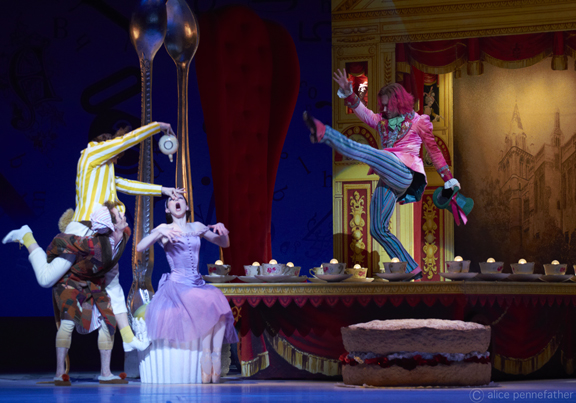
A major reason for the production's success is Bob Crowley's outlandish but always on-the-money set and costume designs which again fill the stage with colour but always stay true to Nicholas Wright's version of the tale.  Crowley's design fills the stage with invention and the sheer joy of visual story-telling: his Cheshire Cat looms large over with limbs that fly away to reform as the cat moves around - and his tail has a life of it's own, snaking around Alice keeping her in her place, while the Caterpillar is a sinuous Indian dancer with a retinue of dancers following behind him on point.


Crowley's costumes also hit the right witty note, from the crazed dandy of The Mad Hatter to the eye-popping red of the Queen of Hearts' outfit - I also liked the idea of her being transported everywhere in a heart-shaped cabinet by minions which, when finally opened revealed a quaking King of Hearts at her feet!  Alice's topsy-turvy adventure is also brought to vivid life by Natasha Katz's lighting and the video projections of Jon Driscoll and Gemma Carrington which instantly conjures up a world of vertiginous rabbit holes and halls of endless doors.

Nicholas Wright establishes a framing device which ends with a neat twist: Alice and her sisters are being read to by Lewis Carroll at a garden party, she then dances with her friend Jack, a young gardener, but her imperious mother castigates him for having a red rose in a bunch of white ones.  Jack gives Alice the offending rose and she gives him a jam tart from the party spread but her mother suspects he stole it and dismisses him on the spot.  Lewis Carroll tries to cheer the distraught Alice by taking her photograph; he puts the camera cloth over his head but he sprouts a bunny-tale and emerges as the White Rabbit... the chaos begins.  But don't worry... Alice and Jack are reunited at the end but not in the Victorian era...


Needless to say the cast were flawless: Anna Rose O'Sullivan was a delightfully feisty Alice, establishing a lively character from the start which continued through the Wonderland scenes.  Steven McRae originated the role of The Mad Hatter in 2011 as Wheeldon was impressed with his tap skills as the role consists of a long tap solo during the tea party scene but at our performance he played the roles of Alice's gardener friend Jack and the Jack of Hearts whose stealing of the Queen's jam tarts threads through the show until it climaxes with the anarchy of his trial.  I was disappointed not to see him as the Mad Hatter but it would have meant getting about 5 minutes of seeing him onstage so I happily settled for seeing him throughout the production instead.

Laura Morera was huge fun as the nasty Queen of Hearts, none more so than in her dance with three petrified courtiers, all too aware what will happen if they go wrong.  Based around the Rose Adagio from SLEEPING BEAUTY, Morera was hilarious as she twisted herself into grotesque ballerina positions clinging to her hapless partners for support.


There was also fine support from Alexander Campbell as Lewis Carroll and The White Rabbit, Joseph Sissens as the tapping Mad Hatter - but missed the charisma that McRae would naturally bring to the role - and Nicol Edmonds as the sinuous Caterpillar.

Sadly the performances are all over for this run but it was screened in cinemas last week and I am sure this new classic will be back in the repertoire soon, as Owen said it really would make a great Christmas show.


Sunday, April 23, 2017

THE GLASS MENAGERIE at the Duke of Yorks - truth through illusion...

By a lovely coincidence one of my favourite plays is currently on in London, just in time for my birthday!  I had been quietly - and not-so-quietly - looking forward to seeing this Broadway import and I am happy to say I wasn't disappointed!


With it's 1945 Broadway premiere, THE GLASS MENAGERIE catapulted Tennessee Williams into the forefront of American playwrights which was confirmed with his second play A STREETCAR NAMED DESIRE - his remarkable style of autobiographical poetic realism hitting an unknown chord at the time which has resounded down the years.  They remain his most revived plays and for good reason, they have become plays that actors want to test themselves against.  Personally I find them both incredibly moving plays to experience.

THE GLASS MENAGERIE is a four-hander and each role is wonderfully mined by Williams to give any actor who plays them so many opportunities.  The play's premiere delivered a seismic shock across the theatre world and not only just for Tennessee's writing, as Laurette Taylor's performance as Amanda has echoed down the years - anyone who saw it said her naturalness in playing burned itself onto their memories and her death in 1946 aged only 63 surely robbed us of it being immortalized on screen, in the 1950 film version the British musical star Gertrude Lawrence played Amanda, a decision that Williams called "a dismal error".


What is interesting is that Taylor's performance was acclaimed because of the naturalness of her acting - Martin Landau said it was like an ordinary woman had wandered through the stage door and was moving around the stage - however it is usually the tendency for Amanda to be played in a barnstorming diva-style manner but in John Tiffany's excellent revival Cherry Jones is certainly barn-storming but totally within the world of the production; Tom, the narrator, tells us at the start that what we will see is what plays in his memory and his mother Amanda simply swamps his memory of life at home.

Tom Wingfield is a man haunted by memories of when he lived with his southern belle mother Amanda and his shy, withdrawn sister Laura in a cramped apartment in St Louis during the 1930s.  Mr Wingfield left 16 years before - "a telephone man who fell in love with long distances" as Amanda bitterly says - and since then she has managed to raise her children but her overbearing love drives them to distraction.  Tom longs to be a writer but has to work as a clerk in a shoe factory which he loathes and stays out at night to visit local cinemas and bars.  This piece of autobiographical writing is given resonance when we read that Williams' regular trips to his local cinema were, in part, to have sex with men in the dark.


Laura's lack of self-confidence due to a crippled leg and pathological shyness have led her to pretend to go to a business school which drives Amanda to despair when she finds out.  Amanda decides that Laura's only option is to find a man like the "gentleman callers" she remembers from her youth. Tom invites his only friend at work for dinner much to Amanda's delight but Jim O'Connor's appearance sets off a chain of events that will change the Wingfields forever.  Tom tells Jim he has used the electricity bill money to register for the navy and when the lights cut out, Amanda encourages Jim to sit with Laura by candlelight but we know this is exquisite torture for her as she used to silently adore Jim at high school.

This scene is beautifully written - Williams taking the time to set the characters up so the scene plays almost like a thriller as we hang on their every words: Jim trying to build up Laura's confidence, Laura's hesitant introducing Jim to her beloved glass menagerie and, above all, the realization that Jim would be the perfect boyfriend for Laura; her hopes smashed - like her favourite glass unicorn figurine that Jim knocks against - when he reveals that he is already engaged, the sadness becoming unbearable when she gives Jim the broken unicorn as a parting gift to remember her by.  Amanda's rage at Tom's ignorance of at his friend's engagement drives him from the flat for the last time and now his mother and sister haunt his peripatetic life.


As with most of Williams' plays it was arrived at through different permutations: it first appeared as a 1943 short story "Portrait of a Girl In Glass" and one of the interesting diversions from the play is when after The Gentleman Caller leaves, Laura enigmatically suggests that maybe she wasn't the only Wingfield child who was in love with Jim....  Williams also tried out the idea as a film script in the early 1940s when he had a six-month contract with MGM.  Luckily it all came together as a play.

John Tiffany's production was beautifully realized; Bob Crowley's stripped-down set seemingly hanging in darkness and - unseen by us from the back of the stalls - surrounded by inky-black water.  There was a surprising theatre moment when Michael Esper's Tom literally pulled Kate O'Flynn's timid Laura from the depths of the living room couch only to have her disappear within it at the end - this was a production which constantly reminded us through the use of Steven Hoggett's choreographed movement and Nico Muhly's tinking score that we were watching a non-realistic representation of Tom's memories.


In all the productions I have seen before, there was an imbalance in the level of performance but here John Tiffany elicited strong performances from all four: Cherry Jones and Brian J. Smith had played their characters in Boston and New York but they have still meshed well with the UK additions of Michael Esper (straight from the Bowie musical LAZARUS) and the English actress Kate O'Flynn so they feel like a real ensemble.

Esper was fine as Tom, wanting a life denied to him by his dead-end job and unhappy home life but you still felt his inner struggle with leaving the family home while Brian J. Smith was very good as Jim The Gentleman Caller who enters the home unaware of the weight of expectations awaiting him; he also added a larger-than-life quality to Jim giving him an air of the outside world that is missing from the crepuscular Wingfield home.


Kate O'Flynn gave an unsentimental performance as Laura, her shyness even with her mother and brother shown by her swallowing every word she spoke but she also rose to the challenge of slowly flowering into happiness when finally alone with her adored Jim; her slow withdrawal back into her interior world at the news of Jim's engagement was heartbreaking to watch.  In other productions on both stage and screen Laura's crippled leg has been played up but here it is hardly noticeable; John Tiffany's take seems to be that Laura has convinced herself that she is a helpless cripple despite Amanda, Tom and Jim's protestations to the contrary. 

I had seen Cherry Jones on Broadway in 2005 as Sister Aloysius in DOUBT and now she is making her much-anticipated London debut in a dazzling star performance. Her Amanda Wingfield is a woman whose life has not measured up to what she expected; brought up to expect a life of pampered marital leisure but who has had to raise her children alone, with no work experience to fall back on, in the challenging decades of the 1920s and 1930s.  Amanda's tragedy is that she sacrifices everything for her children's future without seemingly asking what they want their future to be.  Cherry Jones was funny, formidable, affecting, terrifying and, primarily, all-too-human.


John Tiffany has since had much acclaim with his direction of the Harry Potter plays but with THE GLASS MENAGERIE he lived up to Tom's opening speech - unlike the stage magician who "gives you illusion that has the appearance of truth, I give you truth in the pleasant disguise of illusion".

This play continues to haunt you long after it ends, just as Tom is haunted by his memories of Laura and in reality Williams was haunted by the fate of his sister Rose who was given a frontal lobotomy on the agreement of their mother Edwina while Tennessee was away, working at MGM.  Their initial closeness had given way under the pressure of Rose's mental condition and he turned against her when she revealed his homosexuality to their mother.  But his lingering guilt at her treatment made him ensure that she was kept in the best rest homes and that she would be well cared for after his death.  But the guilt remained... as it does for Tom:
Oh, Laura, Laura, I tried to leave you behind me, but I am more faithful than I intended to be!  I reach for a cigarette, I cross the street, I run into the movies or a bar, I buy a drink, I speak to the nearest stranger - anything that can blow your candles out - for nowadays the world is lit by lightning!  Blow out your candles, Laura - and so good-bye.
 

Tuesday, April 04, 2017

AN AMERICAN IN PARIS at the Dominion Theatre - S'Wonderful?

It's big, it's bold, it's ballet as well as a musical - a ballical!  AN AMERICAN IN PARIS won 4 Tony Awards on Broadway and now it's opened at a recently-renovated Dominion Theatre but did it leave me dancing up Tottenham Court Road?


To be honest, I have never been a fan of the 1951 film starring the winsome (losesome) Leslie Caron and the overbearing ego of Gene Kelly - I have always thought it a fairly lumbering, unfunny film and justifiably overshadowed by Kelly's next film SINGIN' IN THE RAIN.  But here we are, sitting down to see the stage version which comes tailing success and awards...

The musical is the first to be both directed and choreographed by the British ballet choreographer Christopher Wheeldon (he had previously done the dances for the 2002 musical SWEET SMELL OF SUCCESS) and was first staged in Paris at the Théatre du Chátelet - a unique theatre in that city that stages large-scale American musicals - which then did the 'coals to Newcastle' thing by transferring to New York. 


Wheeldon has done a wonderful job in making the show 'move' - even the dialogue scenes seem choreographed - and the show certainly moves along briskly.  His choreography is endlessly inventive and it really lifts the show as the book by Craig Lucas is shockingly mundane.  You get the distinct impression that a fairly straight-forward plot - American would-be artist in post-WWII Paris falls in love with an enigmatic girl who is also loved by two of his friends - is dragged out to snapping point with endless complications and a particularly drippy heroine.

The lame script ultimately gives the show no real heart and no matter how good a show's music, choreography, design or performances are, if you have no interest in the characters you are watching or care for their travails then there is no emotional engagement.  However - along with Wheeldon's wonderfully vibrant choreography which luckily punctuates Lucas' bland tale frequently - the production is always watchable thanks to Bob Crowley's wonderful design: filmic video projections of Paris streets being hand-drawn move the action along elegantly and right at the top of the show there is a wonderful moment when a Swastika is torn down to envelope the stage in a massive, billowing tricolor.


The best is left for last with two barn-storming numbers: I'LL BUILD A STAIRWAY TO PARADISE builds wonderfully from a singer's shaky performance in a Paris nightclub to a gloriously over-the-top fantasy sequence paying homage to New York's Chrysler Building, and finally the climactic 12 minute-plus title ballet explodes onto the stage with Crowley's Mondrian-inspired designs, Gershwin's evocative music and Wheeldon's delicious choreography.

The AMERICAN IN PARIS ballet also showcases the marvellous dancing of the two leads, Robert Fairchild (ex-New York City Ballet) as Jerry and Leanne Cope (ex-Royal ballet) as Lise, who are reprising their Broadway roles.  Fairchild is a real find: he has a nice personality onstage, a pleasing singing voice and needless to say his dancing is a joy to behold.  Leanne Cope has a harder task as Craig Lucas has saddled her with such a drip to play but her dancing is a true delight.  Kudos do have to go to the 15-strong orchestra who made the Gershwin songs sound great.


The supporting cast includes David Seadon-Young, Haydn Oakley, Zoe Rainey and Jane Asher but again Craig Lucas' script gives them unfunny lines to say and two-dimensional roles to play.  I also think a major problem is having the show in the Dominion; no matter what they have done to it, it was a barn before and it's a barn still with zero character.  It's a tough space to play 'heartwarming' - the elephantine quality is also matched in the programme being upgraded to an enormous souvenir brochure: bigger is not necessarily better. 

Would I recommend it?  Yes I think I would though I feel no urge to return to see it myself.  It was certainly a feast for the eyes and ears while leaving the heart unmoved.

Sunday, November 06, 2016

ANASTASIA - The Royal Ballet's Romanov Revival

Looking back it's remarkable that, while Anna Anderson's identity was still being disputed in European courts, it also provoked books, plays and films, most notably ANASTASIA which marked Ingrid Bergman's Hollywood 'rehabilitation' after the scandal of her extra-marital affair with Roberto Rossellini, indeed the film led to the ultimate Hollywood acceptance, an Academy Award.  Anna Anderson and her persistent claim that she was the Grand Duchess Anastasia, believed killed with the rest of the Russian royal family in 1918, also inspired choreographer Kenneth McMillan to create his version of her story also called ANASTASIA which premiered in 1971.


MacMillan had originally staged ANASTASIA as a one-act ballet in 1967 while artistic director of Berlin's Deutsche Oper with his muse Lynn Seymour as Anna but he expanded the ballet to three acts in 1971 when he assumed creative control at Covent Garden, his original one-act becoming the third act.  It fitted perfectly into MacMillan's volte-face idea for the production; the first two acts, showing Anastasia's pre-revolution life, is danced to symphonic music by Tchaikovsky and the third act which illustrates the fractured mental state of Anna Anderson is danced to a dissonant symphony by Bohuslav Martinu and a specially recorded electronic soundscape.

At first, Anastasia is seen to be a vivacious and precocious girl, dancing with her sisters and with the sailors on the Royal yacht, watched by her parents Nicholas and Alexandra, her brother Alexey and the silent, ominous Rasputin.  The fun ends however when the hemophiliac Alexey falls and hurts himself and Tsar Nicholas receives news that WWI has been declared.  MacMillan's choreography was wonderfully joyous, Anastasia being almost slid across the stage in the arms of her dancing sailors and ultimately being spun over their heads to be caught by another row of sailors behind them.


The second act takes place during a court ball in 1917; in the ballroom the lords and ladies still dance their elegant dances unaware of the revolution growing outside until it overcomes them.  Meanwhile Anastasia becomes aware of strange tensions within her family as Rasputin's hold over the Tsarina grows more intense and Nicholas dances with a former lover, the ballerina Mathilde Kschessinska.

This act featured some excellent ensemble work from the corps - the female dancers' beaded frocks audibly swishing round as they moved - and there were excellent featured performances from Sarah Lamb as Mathilde and Steven McRae as her partner, as well as a bigger spotlight on Itziar Mendizabel as the haughty but emotional Tsarina and the omnipresent Rasputin of Eric Underwood.


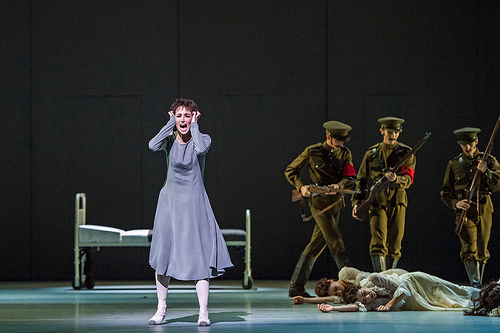
The third act shone it's harsh light on Lauren Cuthbertson as Anna; her Anastasia had shown a sunny happiness clouded with doubts but she was put through the physical mill with MacMillan's strenuous choreography for the mentally disturbed Anna.  It's quite a wrench for the audience too, confronted with the metallic score which starts the third act - overlaid with taped muttered conversations and grainy projections on the back of the set of the Romanov family which freeze-frame on the face of the real Anastasia - added to the stripped-down set and lighting.

Were the first two acts her real life or the imaginings of Anna's damaged mind?  She imagines the murder of the Royal family, marauding soldiers, the groups of eager onlookers who come to gawp, the man who became her husband as well as her nemesis Rasputin.  Did she really know them?  MacMillan secretly wished Anderson's story to be true and it was only after his and Anderson's death that DNA evidence ruled conclusively that she was a fraud.  But MacMillan ends the act with Anderson in regal parade around the stage on her moving bed, the figures from Anastasia's past looking on... Anna is certain of who she is.


It's not the easiest ballet to take in and I suspect it is one to be admired rather than liked but it is never less than thought-provoking and Gary Harris' revival is helped immeasurably by Bob Crowley's sets and costumes, John B. Reid's lighting and the committed (no pun intended) performances of all onstage.

The real star however is the choreography and genius of Kenneth MacMillan...


Friday, April 29, 2016

The WINTER'S TALE at Covent Garden - Don't Send In The Clowns...

For the third time in four months we saw Shakespeare's THE WINTER'S TALE only this time dancers peopled the gloomy court of King Leontes in Sicillia and the sunny fields of neighbouring Bohemia as we saw Christopher Wheeldon's Royal Ballet production.

Shakespeare's tragi-comedy is one that I enjoy a lot but how can a production of it be a success with the loss of his words?  Quite easily. Constant Reader, when you have a choreographer of Wheeldon's talent who, rather than doing a scene-for-scene transposing, instead conjures up the mood and the feelings behind the words.


By turn thrilling and emotional, Wheeldon is to be applauded for dropping the lengthy rude mechanicals comedy characters from the Bohemia scenes, instead the second act concentrates on a lengthy pas-de-deux between the young lovers Perdita and Florizel. As I said, what is remarkable about the production is that with no words to concentrate on, Wheeldon can instead focus on the emotions that drive Shakespeare's story and can linger on certain moments that are overlooked in the rush of words.

Christopher Wheeldon provides a prologue showing Leontes and Polixenis as young friends, separated when they become the rulers of Sicillia and Bohemia only to be reunited as adults with Leontes' wife Hermione.  When Polixenes cancels his return to Bohemia because Hermione asks him to, Leontes is thrown into a jealous rage suspecting them of having an affair, which Wheeldon choreographs in a fascinating scene where Leontes clambers over the court sculptures to spy on the couple, who he imagines making love.


Polixenes flees but Leontes has Hermione arrested and put on trial. Witnessing his mother's trial, Prince Mamillius collapses and dies which causes Hermione to collapse too. Her chief supporter Paulina announces the Queen is dead and Leontes finally is confronted by the disastrous consequences of his misguided jealousy. Paulina's husband Antigonus is killed when he leaves Hermione's recently-born baby daughter to die on the shores of Bohemia and the baby is adopted by a shepherd - and all of that in the first half!

Wheeldon's choreography was remarkably involving and he was also helped enormously by the ominous design of Sicillia's court by Bob Crowley and the atmospheric lighting of Natasha Katz. Joby Talbot's score was also very fine, particularly stark and sombre as Leontes' jealous madness takes hold only to blossom into lyricism for the second act when we see the grown-up daughter Perdita falling in love with Florizel, the son of Polixenes.  Again Bob Crowley's setting of a large tree was quite marvellous.


Most of the conclusion in Shakespeare's play frustratingly happens offstage but Wheeldon has the reunion between Leontes and Perdita happen onstage when he recognizes his wife's pendant that was left with her as a baby.  Of course what was lost in the climax was Shakespeare's wonderful poetry when Leontes is confronted with a statue of Hermione 'coming to life' - one line that always gets me is Leontes' "O she's warm" when he touches his wife's arm - but the gentle lyricism of Wheeldon's choreography went some way to making up for this.

In fact Wheldon's final moments provided a touching coda that is not found in the original play: Crowley's design for Hermione's plinth has her standing with a figure of her son Mamillius and, as Hermione and Perdita left the stage to get to know each other after their lives apart, Leontes eagerly touched the statue of his son hoping for 'magic' to happen twice... only to be led away by Paulina as if to say "No your son *is* dead" and as the King left with his thoughts, Paulina bowed down in memory of the lost Prince.  Quite lovely and enhancing Shakespeare's plot rather than ruining it.


The lead dancers all gave excellent performances while never losing the feel of a dedicated company: Bennet Gartside as Leontes, Marianela Nunez (so good previously in Wheeldon's AFTER THE RAIN and GISELLE) as a noble Hermione and, in, particular Itziar Mendizabel was wonderful as Paulina, expressing aching grief with every movement.  It was good to see her again so quickly after her impressive featured role in GISELLE. Special mention too for Beatriz Stix-Brunell and Vadim Muntagirov as Perdita and Florizel in their lengthy second act pas-de-deux.

A worthy addition to any ballet fan's repertoire and a credible choice as the nearest related-production seen before the 400th anniversary of Shakespeare's death.