Showing posts with label Lauren Cuthbertson. Show all posts

Wednesday, February 13, 2019

ASPHODEL MEADOWS / THE TWO PIGEONS at Covent Garden

Second theatre trip - second Royal Ballet!  What can I say - I like their ice-cream.

We saw another of their mixed programmes which, as I have said before, certainly allows the company to show their versatility in contrasting productions: this time it was Liam Scarlett's 2010 debut ballet for the company ASPHODEL MEADOWS paired with Sir Frederick Ashton's lyrical 1961 production of La Fontaine's THE TWO PIGEONS.


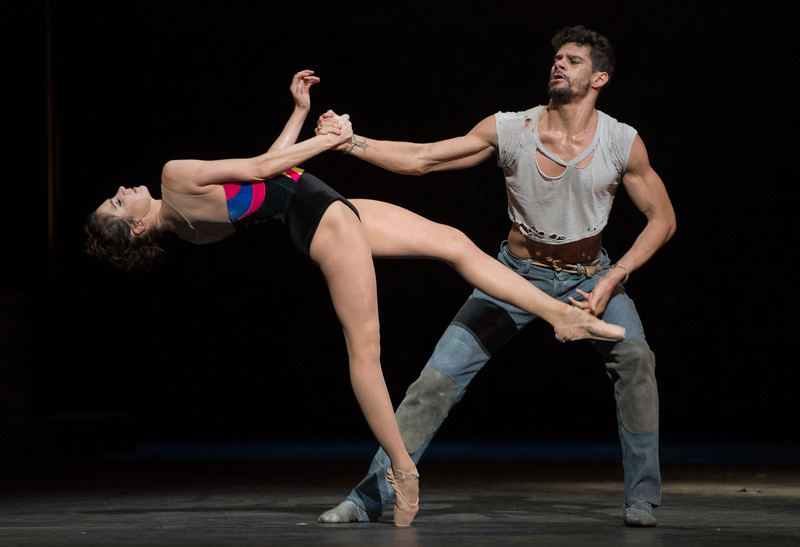
ASPHODEL MEADOWS was Liam Scarlett's first ballet choreographed for the Royal Ballet in 2010, the company that he trained with as a teenager.  The ballet is only 25 minutes but it's concentrated energy is quite hypnotic added to the tension in the score by early 20th century French composer Francis Poulenc.  Within a company of 20 dancers, the main focus is three sets of couples who all have a moment to shine in differing pas de deux.

In Greek mythology the Asphodel Meadow was where the souls of ordinary citizens went after death and there certainly was an endless tension in Liam Scarlett's choreography of couples locked in an endless dance.  It's a production I would be very interested to see again. 


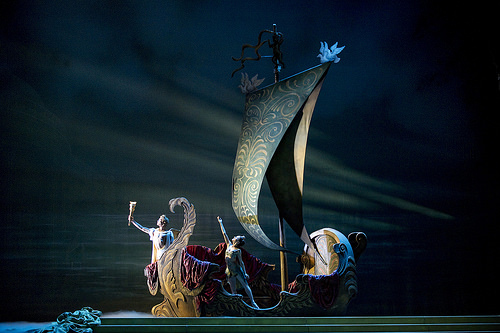
It was paired with Ashton's charming but slight THE TWO PIGEONS which we first saw in 2015.  A painter is losing his patience with his young girlfriend's unwillingness to stay still while he tries to paint her in his Parisian roof-top garret.  Things aren't helped when her friends appear, closely followed by a troupe of passing gypsies.  The painter is captivated by a fiery gypsy dancer and he follows her to their encampment, leaving his girlfriend alone.  However the gypsy leader turns on the painter and humiliates him, finally chasing him out of the camp.  The two lovers are reunited in the attic, their love personified by two pigeons who settle near them.

Based on an original ballet from 1912, Frederick Ashton choreographed a shorter version which premiered, appropriately, on Valentine's Day 1961.  It's all a bit generic - inconstant lover, spirited girl, flashy but hard-hearted gypsies - but oddly enough, when the two sad lovers are reunited and the audience's attention is riveted to the two live pigeons on stage, the piece wins you over.


Restaged again by Christopher Carr, the thin characters were vibrantly danced by Vadim Muntagirov and Lauren Cuthbertson as the lovers and Laura Morera as the passionate but fickle gypsy girl.  The late Jacques Dupont's original scenic design still charms.

It was a very enjoyable evening of two uplifting ballets, I am sure there will be more mixed programmes in the coming months...


Monday, December 04, 2017

SYLVIA at Covent Garden - Ashton's Arcadia

For my last visit to Covent Garden in 2017, we stepped back in time to see Sir Frederick Ashton's 1952 version of Léo Delibes' ballet SYLVIA, which was first seen at Paris' Palais Garnier in 1876, in fact the first ever ballet to be staged there.


The actual ballet had a checkered history down the years and Ashton primarily restructured it for the Royal Ballet for his muse Margot Fonteyn to have a whacking big star role in.  He tinkered with it through the years and his lack of confidence in it resulted in only Sylvia's third act solo still being performed, although the score has always been liked in concert.

Ashton's production got a full restaging in 2004 by the Royal Ballet for Ashton's centenary celebrations and, although still not in the first flight of ballets, the lead role has been personal successes for Darcey Bussell (who coached the lead ballerinas for this revival), Zenaida Yanowsky and Marianela Nunez in subsequent years.  Christopher Newton, who staged the 2004 revival, almost had to start from scratch as very little archive material remained from Ashton's 1952 production.  Maybe that is what accounts for the slightly flimsy feel to the ballet?  However that said, it was a perfectly pleasant diversion with many opportunities for our Sylvia to shine and as it was danced by Lauren Cuthbertson, shine she did!


The plot is fairly paper-thin - Sylvia is one of the goddess Diana's huntress nymphs and she is loved from afar by the shepherd Aminta who at a shrine to Eros strays too far and is shot by the angry Sylvia.  The statue of Eros turns into the real god and he too shoots an arrow at the huntress, slightly wounding her but making her realize her mistake in hurting someone who loved her.  Unknown to her, another hunter Orion has also been stalking her and before she can revive Aminta, Orion carries her off to his lair.  But fear not!  Eros revives Aminta to help bring her back.

At Orion's lair, he attempts to win Sylvia over with jewels but she pines for Aminta, cradling the arrow she received from the gods which proves his love.  When Orion steals it from her she pretends to carouse with the hunter and his minions until they are all passed out drunk and after a quick prayer to Eros he rescues her in his magical boat!


Back at the temple of Diana, Aminta is reunited with Sylvia during a festival for Bacchus but Orion catches up with them and when Sylvia flees into the temple he attempts to follow her.  Angered by his actions, Diana appears and fells him with another arrow.  But Diana then refuses Sylvia to love Aminta as she is one of her huntresses...  luckily Eros is on hand to remind her that she too loved a human once and all ends happily.

The scenario is real wing-and-a-prayer stuff but was danced with such conviction and mounted in such a simple way that you could not help but like it, helped in part by Delibes' music - even Tchaikovsky said his own SWAN LAKE score paled into insignificance in comparison.  I think Tchaikovsky was overstating the issue but it is a delightful work and includes a genuine entry in Ballet's Greatest Hits, the Pizzicato solo...


Lauren Cuthbertson was marvellous in the lead role - there always seem to be hidden depths to this dancer so her strength in the first act, her cunning in the second act and her loving in the third all seem to come from a very genuine source, like the best ballerinas she is an actress as well as a dancer.

None of the other roles really allow for much investigation but Reece Clarke was very nice in his tiny Hellenic skirt and made the most of his solo in the last act.  As said before, Ashton really just wanted to show off the lead ballerina so Aminta spends most of the first act lying wounded on the floor, disappears for the second, and is lovestruck in the third!


All in all, a nice way to end a year of productions from the Royal Ballet.


Sunday, November 05, 2017

KENNETH MACMILLAN Triple Bill at Covent Garden: 25 years on, the passion remains...

It's now 25 years since the choreographer Sir Kenneth MacMillan suffered a fatal heart-attack backstage at Covent Garden during a revival of his production MAYERLING and since that tragic event his ballets such as ROMEO AND JULIET, MANON, ANASTASIA, MAYERLING etc. have been revived and re-interpreted by a new generation of dancers in many different companies.  So when Kevin O'Hare, director of the Royal Ballet, saw the Northern Ballet production of ROMEO AND JULIET, it struck him how the upcoming 25th anniversary of his death should be on a wider scale than just his company.


With the agreement of MacMillan's widow Deborah, the season included the Royal Ballet, English National Ballet, Birmingham Royal Ballet, Northern Ballet, Scottish Ballet and the Yorke Dance Project coming together to give a nationwide appreciation of his enduring legacy.

Of the five events we selected the one which showed the range of MacMillan's choreography: the elegiac GLORIA, the thrilling and disturbing THE JUDAS TREE and the playful, colourful world of ELITE SYNCOPATIONS.


The first of the one-act ballets was MacMillan's GLORIA, premiered in 1980, which was danced by Northern Ballet.  It had been inspired the previous year when MacMillan watched the BBC series TESTAMENT OF YOUTH based on Vera Brittan's memoir of her experiences as a field nurse in World War I and in particular, the loss of her fiancée, her brother and their two best friends.  MacMillan was moved by her story and also by the memory of his father's involvement in the battle of The Somme which his father refused to talk about in the years after. 

He chose Francis Poulenc's Gloria in G Major as his music and the abstract choreography of the male and female dancers in a barren desolate landscape is counterpoint to the music's glorifying of God; it makes for a good distillation of the sacrifice of life against the vaunted ideals of what they were doing it for.  It was well danced but with no particular stand-out performances.


The second ballet was MacMillan's controversial THE JUDAS TREE from 1992, the last ballet that he completed for the Royal Ballet.  Set to an unsettling score by Brian Ellis, the ballet concerns the mysterious appearance of a scantily-clad woman on a London building site where a group of builders work like a dangerous, suspicious pack of animals. MacMillan's thrilling and highly-charged choreography is constantly shifting the power balance: one minute the woman is, literally, walking all over them as she delights in her female power over them but that changes on a toe-twirl to her being victimized by the men, the brutish foreman and his two young friends. 

One is always gentler with her and this ultimately leads to an explosion of violence in which the woman is beaten then gang-raped by the gang then murdered.  The quieter man, who did not take part in the wilding, tries to assimilate with the others but is rejected violently. In a sudden volte-face the foreman crawls along a crane arm and hangs himself where he is observed by the woman, her head covered Magdalene-like. The curtain-call felt like an almost grudging, muted ovation.  However it's power to rivet the attention cannot be denied and the committed performances by Thiago Soares as the Foreman, the remarkable Edward Watson as his gentle friend and, above all, the extraordinary Lauren Cuthbertson as the woman.


The final ballet was MacMillan's 1974 souffle ELITE SYNCOPATIONS, a set of party-piece routines danced to Scott Joplin and other ragtime composers.  With eye-popping costume designs and the relaxed air of a cast party onstage, it was a delightful way to end the show and included guest soloists from Birmingham, Northern and Scottish ballets, with delightful turns from Laura Morera, Yasmine Naghdi, Ryoichi Hirano and Kevin Poeung.

But the troubled shadows of THE JUDAS TREE continued to linger in my mind and, although ELITE SYNCOPATIONS was a fine example of the lighter side of MacMillan's talent, THE JUDAS TREE is the one that will stay with me.  The 25th Anniversary season is over now but MacMillan's MANON will be at the Opera House next year.


Monday, May 29, 2017

THE VERTIGINOUS THRILL OF EXACTITUDE / TARANTELLA / STRAPLESS / SYMPHONIC DANCES at Covent Garden

It's just over 2 years since we discovered through Wayne McGregor's wonderful WOOLF WORKS how the Royal Ballet are adept at contemporary as well as classical ballet and this has been demonstrated a few times by their scheduling of memorable triple bills based on choreographers or themes.  So, Constant Reader, what can be better than a triple bill?  A quadruple bill of course!


Last Saturday we took our amphitheatre seats for an evening of four one-act ballets, only one of which we had seen before.  The first of the four was choreographer William Forsythe's THE VERTIGINOUS THRILL OF EXACTITUDE - the title is almost as long as the ballet itself being only 15 minutes!

Forsythe's choreography uses the majestic finale of Shubert's 9th Symphony and it's constant flurry of movement - using classic moves but with wonky angles and straggly arms and legs - must be a trial for the three female and two male dancers, all vividly colourful against a black background, the men in bright purple and the women in bright lime-green.


The dancers mix and merge, coming and going, dancing in groups, trios, duets and solos all at a frenetic pace - a bit too frenetic for Itziar Mendizabel who came racing from the wings into the middle of a group and went down on her tutu to an intake of breath from the audience.  But she recovered well and found her way back into the music after a beat or two... well done Itziar.

After a pause we had Balanchine's cheeky TARANTELLA, a duet of great charm and character which allows it's male and female to really stamp personalities on the roles.  Capering around the stage and around each other, Meaghan Grace Hinkis and Alexander Campbell were delightful.


Next was the first revival of Christopher Wheeldon's narrative ballet STRAPLESS which we first saw last year as part of a Wheeldon triple bill; in my blog for that production I hoped that it would be revived sometime but I didn't expect it to be so soon!  Oddly enough, the jitters which might have explained Itziar's stumble in VERTIGINOUS THRILL... also affected STRAPLESS when, during the scenery change for the second act, one of the ballerinas positioning a panelled column for the Café L'Avenue set, pushed too hard and the column went BANG across the stage only for it to be dragged off ignominiously!  The ballerina I hasten to add just wandered off and left it!

It has been slightly reworked to focus more on the main characters of Amélie Gautreau and John Singer Sergeant - the model and artist of the notorious MADAME X painting which scandalized Paris in 1884 - but again I felt that the story proves too elusive when reduced down to just ballet.  But Lauren Cuthbertson captured the skittish society beauty Amélie very well and her haunting of her now-famous portrait remains a powerful moment; the modern-day gallery visitors blind to the real woman whose image they admire.


The last ballet was Liam Scarlett's new production SYMPHONIC DANCES based on Rachmaninoff's last composition.  Written in 1940, the composer had asked Mikhail Fokine if he would be interested in using the music for a three-part ballet but Fokine's death in 1942 ended the possibility of it happening in Rachmaninoff's lifetime.  Since then ballet productions have been mounted but Liam Scarlett's is the first in the UK.

STRAPLESS sits well with SYMPHONIC DANCES as it too is centred around the central figure of a statuesque diva, and for good reason... This season will be the last danced by Principal Ballerina Zenaida Yanowsky and Liam Scarlett in SYMPHONIC DANCES has choreographed a production in which she remains the centre of attention at all times.


Yanowsky looked every inch the diva in her opening costume, a strapless black bodice and huge, multi-layered skirt which became almost a character in itself as it whipped and swirled around her.  Red and black also ruled in Jon Morrell's stage design, a stark and empty Opera House stage glowed with red lighting amidst the onstage mist while a large metal lighting grid hanging above the stage cast ominous black shadows beneath it.

The second part of the first movement featured Yanowsky seemingly unmoved by the sinuous capering of James Hay; in the second scene she reappeared in a black and red tuxedo while it was the turn of the men in the ensemble to wear the full skirts - indeed there was a noticeable wobble from one of the men proving that the Devil works in threes after the Itziar and column incidents.


The final movement saw the metal grid horizontal to the stage with Yanowsky losing the tuxedo to appear in just a bodysuit, this time duetting with Reece Clarke, before Rachmaninoff's dramatic, oppressive score built to a devastating climax.  As Wayne McGregor says, an abstract ballet cannot help but have some sort of narrative because of the human element and Yanowsky and the ensemble made me think of an imperious Empress slowly thawing and allowing emotion into her life through her adoring acolytes.

Zenaida Yanowsky was cheered to the Opera House's Fabergé egg-like roof and rightly so; she was astonishingly powerful and totally in command of her stage; Laura Morera is playing the role too so it would be interesting to see it with another energy, another persona doing those moves.


All together, it was an evening of passionate performance and thrilling choreography.  I am still wondering about those three errors however, could it be that this company - who were different from the opening night apart from Yanowsky - had been under-rehearsed?  Ah well, I suppose it goes to show that they are human underneath all that well-drilled skill.

Wednesday, May 17, 2017

MAYERLING at Covent Garden: Kenneth MacMillan's Obsessional Classic...

Mystery still hangs over the deaths in 1889 of the heir to the Austro-Hungarian Empire Crown Prince Rudolph and his mistress Baroness Mary Vetsera in the Imperial hunting lodge of Mayerling.  He was 30 and she was 17, and as soon as their bodies were found a cover-up started to protect both the Hapsburg Empire and the image of the happily-married Prince.  The story has been told several times on film but Kenneth MacMillan's 1978 ballet MAYERLING for the Royal Ballet casts a gripping spell.


Needless to say the reality in 1889 was anything but what was reported at the time.  History has revealed Rudolf to be a morbid death-obsessed womanizer who at the time of his death was riddled with syphilis and addicted to morphine.  His politically expedient marriage to Princess Stephanie of Belgium left both miserable but his request that they separate was refused by his father Emperor Franz Josef - an act of gross hypocrisy as his father and mother, the Empress Elizabeth, lived fairly separate lives with their own lovers.

A former mistress of Rudolf was Empress Elizabeth's niece and lady-in-waiting Countess Marie Larisch who was a friend of Mary Vetsera's mother, and these two women who both craved advancement at court, actively promoted Rudolf's attraction to young Mary.  She was a wilful, highly-strung teenager passionately in love with her Prince Charming (as she saw him) and would do anything for The Grand Gesture.  That came on 31st January, three months after their meeting, when they were both found dead in his bedroom.


Marie left a letter full of fateful talk of them going into an uncertain beyond but they were going together.  Needless to say, this was the last thought on the Hapsburg Empire's collective mind after their bodies were found: Mary's uncles were summoned to Mayerling and, propping her up between them in a carriage, was buried immediately in a nearby monastery cemetery, while Rudolf was mourned as having died from a heart rupture. Eventually a version of the murder/suicide was released but with the emphasis that the Prince's mind was deranged so the church allowed for his body to be buried in the Hapsburg burial crypt.

Kenneth MacMillan's brooding masterpiece opens with a moonlit burial, only when it is repeated at the end do we know this is the hasty funeral of pathetic Mary Vetsera.  The ballet flashbacks to the wedding of Rudolf and Princess Stephanie but unsettling undercurrents swirl around the court as Stephanie is terrorized by the crazed Rudolf in their room.  The second act has Rudolf making his wife accompany him as he tours the taverns drinking and womanizing, Stephanie leaving in distress when he dances with his ex-lover Mitzi Caspar who eventually hides him from a police raid; meanwhile Countess Larisch visits Mary and her mother and tricks the girl into believing that her destiny is to be Rudolf's lover.  The act ends with the first tumultuous lovemaking of Rudolf and Mary.


The third act opens with a shooting party where Rudolf shoots a courtier dead who is standing near the Emperor (an incident that happened in reality) and while the Empress discerns the hand of Countess Larisch in the relationship, Mary and Rudolf decide on their fate.  At Mayerling, the Prince's servant tries to entertain the couple as he has done before but stops when he realizes the couple are totally self-absorbed, fatally leaving the couple alone...

39 years after it's debut performance MacMillan's ballet is a darkly glittering masterwork; a driven, haunting work of tortured sexuality that leads inexorably to the grave.  It's fascinating that MacMillan ends the first and second acts with Rudolf having violent sex but whereas the first act has Stephanie manhandled by Rudolf and cowering as he brandishes a revolver, in the second act Rudolf finds Mary a match for him, a match made in a dangerously out-of-control place.  MacMillan's extraordinary choreography is still a hypnotic, thrilling thing to see.


The ballet, which is based on a scenario by Gillian Freeman, has been re-staged by Christopher Saunders, Grant Coyle and Karl Burnett and uses the original designs by the late Nicholas Georgiades.  The lead roles of Rudolf and Mary were danced by Thiago Soares and Lauren Cuthbertson, and while Cuthbertson brought the wildly passionate teenager to vivid and thrilling life I found Soares to be quite uncharismatic and almost lumpen, I can only imagine the electric quality that more live-wire performers like Edward Watson and Steven McRae would bring to the role.

There was much more to be enjoyed in the supporting roles: Yuhui Choe played the distressed Stephanie well while Claire Calvert was a vibrantly sensual Mitzi Caspar, the real-life mistress of Rudolf who reported him to the authorities when he suggested a suicide pact.  I enjoyed Tristan Dyer as the Prince's servant Bratfisch who has a delightful solo in the tavern and whose faltering repeat of it at Mayerling was very touching.  However they were all outshone by the always watchable Itziar Mendizabal as the devious Countess Marie Larisch, the go-between for the lovers. 


In real life, Countess Marie was ostracized by Empress Elizabeth when her involvement in the deaths was revealed and she led a peripatetic life, marrying often and living in various countries, always trying to make money off of her involvement with the Hapsburg royalty.

MAYERLING was wonderful to see and stands as a tribute to the remarkable choreographic genius of Kenneth MacMillan, who tragically died of a heart-attack backstage at Covent Garden during a revival performance of the ballet in 1992.

Sunday, November 06, 2016

ANASTASIA - The Royal Ballet's Romanov Revival

Looking back it's remarkable that, while Anna Anderson's identity was still being disputed in European courts, it also provoked books, plays and films, most notably ANASTASIA which marked Ingrid Bergman's Hollywood 'rehabilitation' after the scandal of her extra-marital affair with Roberto Rossellini, indeed the film led to the ultimate Hollywood acceptance, an Academy Award.  Anna Anderson and her persistent claim that she was the Grand Duchess Anastasia, believed killed with the rest of the Russian royal family in 1918, also inspired choreographer Kenneth McMillan to create his version of her story also called ANASTASIA which premiered in 1971.


MacMillan had originally staged ANASTASIA as a one-act ballet in 1967 while artistic director of Berlin's Deutsche Oper with his muse Lynn Seymour as Anna but he expanded the ballet to three acts in 1971 when he assumed creative control at Covent Garden, his original one-act becoming the third act.  It fitted perfectly into MacMillan's volte-face idea for the production; the first two acts, showing Anastasia's pre-revolution life, is danced to symphonic music by Tchaikovsky and the third act which illustrates the fractured mental state of Anna Anderson is danced to a dissonant symphony by Bohuslav Martinu and a specially recorded electronic soundscape.

At first, Anastasia is seen to be a vivacious and precocious girl, dancing with her sisters and with the sailors on the Royal yacht, watched by her parents Nicholas and Alexandra, her brother Alexey and the silent, ominous Rasputin.  The fun ends however when the hemophiliac Alexey falls and hurts himself and Tsar Nicholas receives news that WWI has been declared.  MacMillan's choreography was wonderfully joyous, Anastasia being almost slid across the stage in the arms of her dancing sailors and ultimately being spun over their heads to be caught by another row of sailors behind them.


The second act takes place during a court ball in 1917; in the ballroom the lords and ladies still dance their elegant dances unaware of the revolution growing outside until it overcomes them.  Meanwhile Anastasia becomes aware of strange tensions within her family as Rasputin's hold over the Tsarina grows more intense and Nicholas dances with a former lover, the ballerina Mathilde Kschessinska.

This act featured some excellent ensemble work from the corps - the female dancers' beaded frocks audibly swishing round as they moved - and there were excellent featured performances from Sarah Lamb as Mathilde and Steven McRae as her partner, as well as a bigger spotlight on Itziar Mendizabel as the haughty but emotional Tsarina and the omnipresent Rasputin of Eric Underwood.


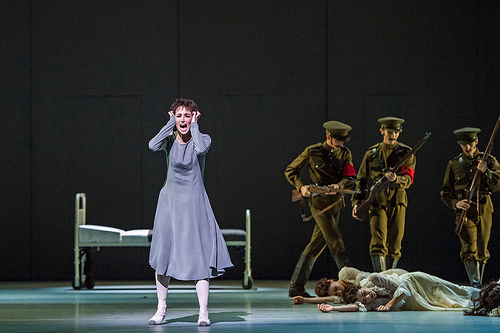
The third act shone it's harsh light on Lauren Cuthbertson as Anna; her Anastasia had shown a sunny happiness clouded with doubts but she was put through the physical mill with MacMillan's strenuous choreography for the mentally disturbed Anna.  It's quite a wrench for the audience too, confronted with the metallic score which starts the third act - overlaid with taped muttered conversations and grainy projections on the back of the set of the Romanov family which freeze-frame on the face of the real Anastasia - added to the stripped-down set and lighting.

Were the first two acts her real life or the imaginings of Anna's damaged mind?  She imagines the murder of the Royal family, marauding soldiers, the groups of eager onlookers who come to gawp, the man who became her husband as well as her nemesis Rasputin.  Did she really know them?  MacMillan secretly wished Anderson's story to be true and it was only after his and Anderson's death that DNA evidence ruled conclusively that she was a fraud.  But MacMillan ends the act with Anderson in regal parade around the stage on her moving bed, the figures from Anastasia's past looking on... Anna is certain of who she is.


It's not the easiest ballet to take in and I suspect it is one to be admired rather than liked but it is never less than thought-provoking and Gary Harris' revival is helped immeasurably by Bob Crowley's sets and costumes, John B. Reid's lighting and the committed (no pun intended) performances of all onstage.

The real star however is the choreography and genius of Kenneth MacMillan...