It's four months since we last saw the Royal Ballet company at Covent Garden - yes, we saw LA BAYADERE in August but that was the Marinsky company so it was a welcome joy to be back in the Amphitheatre, pushing past the throng to get to our front row seats to Christopher Wheeldon's acclaimed version of ALICE'S ADVENTURES IN WONDERLAND.
I will admit to some trepidation going in as the last time I saw a theatrical production based on Lewis Carroll's evergreen children's story was the truly ghastly WONDER.LAND at the National Theatre, one of the most hideous experiences I have ever had in a theatre - click here to see my blog lynching here - but I really need not have worried. Christopher Wheeldon's inventive choreography dazzled where WONDER.LAND embarrassed, the set invoked real wonder where WONDER.LAND just created clunking ugliness and Nicholas Wright adaptation managed to evoke the surreal atmosphere of Wonderland that Fiona Buffini's buffooonity didn't.
Christopher Wheeldon's ballet of ALICE premiered in 2011 to great success - which was probably matched by a collective sigh of relief from the Royal Ballet as, amazingly, it was that company's first full-length original work in 16 years. Joby Talbot's score was also the first original ballet score for the company in 25 years - so as you cans see, a lot was riding on this production. Wheeldon and Talbot have since rejigged the original two-act structure to a more traditional three-act form with added choreography for Alice and her romantic hero, the Knave of Hearts.
I was also vaguely dreading the 12am start matinee, expecting an auditorium crammed with whingeing Jeremy and Jemimas but they were all on their best behaviour and any worries were soon carried off by Talbot's exhilarating score and Wheeldon's inventive and witty choreography - he is a real story-teller in dance as was shown a few years later with his wonderful version of THE WINTER'S TALE.
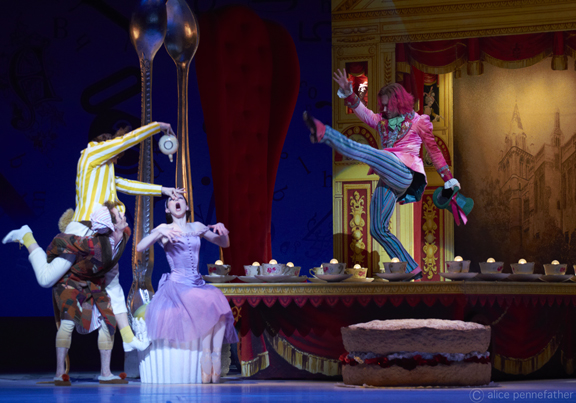
A major reason for the production's success is Bob Crowley's outlandish but always on-the-money set and costume designs which again fill the stage with colour but always stay true to Nicholas Wright's version of the tale. Crowley's design fills the stage with invention and the sheer joy of visual story-telling: his Cheshire Cat looms large over with limbs that fly away to reform as the cat moves around - and his tail has a life of it's own, snaking around Alice keeping her in her place, while the Caterpillar is a sinuous Indian dancer with a retinue of dancers following behind him on point.
Crowley's costumes also hit the right witty note, from the crazed dandy of The Mad Hatter to the eye-popping red of the Queen of Hearts' outfit - I also liked the idea of her being transported everywhere in a heart-shaped cabinet by minions which, when finally opened revealed a quaking King of Hearts at her feet! Alice's topsy-turvy adventure is also brought to vivid life by Natasha Katz's lighting and the video projections of Jon Driscoll and Gemma Carrington which instantly conjures up a world of vertiginous rabbit holes and halls of endless doors.
Nicholas Wright establishes a framing device which ends with a neat twist: Alice and her sisters are being read to by Lewis Carroll at a garden party, she then dances with her friend Jack, a young gardener, but her imperious mother castigates him for having a red rose in a bunch of white ones. Jack gives Alice the offending rose and she gives him a jam tart from the party spread but her mother suspects he stole it and dismisses him on the spot. Lewis Carroll tries to cheer the distraught Alice by taking her photograph; he puts the camera cloth over his head but he sprouts a bunny-tale and emerges as the White Rabbit... the chaos begins. But don't worry... Alice and Jack are reunited at the end but not in the Victorian era...
Needless to say the cast were flawless: Anna Rose O'Sullivan was a delightfully feisty Alice, establishing a lively character from the start which continued through the Wonderland scenes. Steven McRae originated the role of The Mad Hatter in 2011 as Wheeldon was impressed with his tap skills as the role consists of a long tap solo during the tea party scene but at our performance he played the roles of Alice's gardener friend Jack and the Jack of Hearts whose stealing of the Queen's jam tarts threads through the show until it climaxes with the anarchy of his trial. I was disappointed not to see him as the Mad Hatter but it would have meant getting about 5 minutes of seeing him onstage so I happily settled for seeing him throughout the production instead.
Laura Morera was huge fun as the nasty Queen of Hearts, none more so than in her dance with three petrified courtiers, all too aware what will happen if they go wrong. Based around the Rose Adagio from SLEEPING BEAUTY, Morera was hilarious as she twisted herself into grotesque ballerina positions clinging to her hapless partners for support.
There was also fine support from Alexander Campbell as Lewis Carroll and The White Rabbit, Joseph Sissens as the tapping Mad Hatter - but missed the charisma that McRae would naturally bring to the role - and Nicol Edmonds as the sinuous Caterpillar.
Sadly the performances are all over for this run but it was screened in cinemas last week and I am sure this new classic will be back in the repertoire soon, as Owen said it really would make a great Christmas show.
Showing posts with label Natasha Katz. Show all posts
Sunday, October 29, 2017
Friday, April 29, 2016
The WINTER'S TALE at Covent Garden - Don't Send In The Clowns...
For the third time in four months we saw Shakespeare's THE WINTER'S TALE only this time dancers peopled the gloomy court of King Leontes in Sicillia and the sunny fields of neighbouring Bohemia as we saw Christopher Wheeldon's Royal Ballet production.
Shakespeare's tragi-comedy is one that I enjoy a lot but how can a production of it be a success with the loss of his words? Quite easily. Constant Reader, when you have a choreographer of Wheeldon's talent who, rather than doing a scene-for-scene transposing, instead conjures up the mood and the feelings behind the words.
By turn thrilling and emotional, Wheeldon is to be applauded for dropping the lengthy rude mechanicals comedy characters from the Bohemia scenes, instead the second act concentrates on a lengthy pas-de-deux between the young lovers Perdita and Florizel. As I said, what is remarkable about the production is that with no words to concentrate on, Wheeldon can instead focus on the emotions that drive Shakespeare's story and can linger on certain moments that are overlooked in the rush of words.
Christopher Wheeldon provides a prologue showing Leontes and Polixenis as young friends, separated when they become the rulers of Sicillia and Bohemia only to be reunited as adults with Leontes' wife Hermione. When Polixenes cancels his return to Bohemia because Hermione asks him to, Leontes is thrown into a jealous rage suspecting them of having an affair, which Wheeldon choreographs in a fascinating scene where Leontes clambers over the court sculptures to spy on the couple, who he imagines making love.
Polixenes flees but Leontes has Hermione arrested and put on trial. Witnessing his mother's trial, Prince Mamillius collapses and dies which causes Hermione to collapse too. Her chief supporter Paulina announces the Queen is dead and Leontes finally is confronted by the disastrous consequences of his misguided jealousy. Paulina's husband Antigonus is killed when he leaves Hermione's recently-born baby daughter to die on the shores of Bohemia and the baby is adopted by a shepherd - and all of that in the first half!
Wheeldon's choreography was remarkably involving and he was also helped enormously by the ominous design of Sicillia's court by Bob Crowley and the atmospheric lighting of Natasha Katz. Joby Talbot's score was also very fine, particularly stark and sombre as Leontes' jealous madness takes hold only to blossom into lyricism for the second act when we see the grown-up daughter Perdita falling in love with Florizel, the son of Polixenes. Again Bob Crowley's setting of a large tree was quite marvellous.
Most of the conclusion in Shakespeare's play frustratingly happens offstage but Wheeldon has the reunion between Leontes and Perdita happen onstage when he recognizes his wife's pendant that was left with her as a baby. Of course what was lost in the climax was Shakespeare's wonderful poetry when Leontes is confronted with a statue of Hermione 'coming to life' - one line that always gets me is Leontes' "O she's warm" when he touches his wife's arm - but the gentle lyricism of Wheeldon's choreography went some way to making up for this.
In fact Wheldon's final moments provided a touching coda that is not found in the original play: Crowley's design for Hermione's plinth has her standing with a figure of her son Mamillius and, as Hermione and Perdita left the stage to get to know each other after their lives apart, Leontes eagerly touched the statue of his son hoping for 'magic' to happen twice... only to be led away by Paulina as if to say "No your son *is* dead" and as the King left with his thoughts, Paulina bowed down in memory of the lost Prince. Quite lovely and enhancing Shakespeare's plot rather than ruining it.
The lead dancers all gave excellent performances while never losing the feel of a dedicated company: Bennet Gartside as Leontes, Marianela Nunez (so good previously in Wheeldon's AFTER THE RAIN and GISELLE) as a noble Hermione and, in, particular Itziar Mendizabel was wonderful as Paulina, expressing aching grief with every movement. It was good to see her again so quickly after her impressive featured role in GISELLE. Special mention too for Beatriz Stix-Brunell and Vadim Muntagirov as Perdita and Florizel in their lengthy second act pas-de-deux.
A worthy addition to any ballet fan's repertoire and a credible choice as the nearest related-production seen before the 400th anniversary of Shakespeare's death.
Shakespeare's tragi-comedy is one that I enjoy a lot but how can a production of it be a success with the loss of his words? Quite easily. Constant Reader, when you have a choreographer of Wheeldon's talent who, rather than doing a scene-for-scene transposing, instead conjures up the mood and the feelings behind the words.
By turn thrilling and emotional, Wheeldon is to be applauded for dropping the lengthy rude mechanicals comedy characters from the Bohemia scenes, instead the second act concentrates on a lengthy pas-de-deux between the young lovers Perdita and Florizel. As I said, what is remarkable about the production is that with no words to concentrate on, Wheeldon can instead focus on the emotions that drive Shakespeare's story and can linger on certain moments that are overlooked in the rush of words.
Christopher Wheeldon provides a prologue showing Leontes and Polixenis as young friends, separated when they become the rulers of Sicillia and Bohemia only to be reunited as adults with Leontes' wife Hermione. When Polixenes cancels his return to Bohemia because Hermione asks him to, Leontes is thrown into a jealous rage suspecting them of having an affair, which Wheeldon choreographs in a fascinating scene where Leontes clambers over the court sculptures to spy on the couple, who he imagines making love.
Polixenes flees but Leontes has Hermione arrested and put on trial. Witnessing his mother's trial, Prince Mamillius collapses and dies which causes Hermione to collapse too. Her chief supporter Paulina announces the Queen is dead and Leontes finally is confronted by the disastrous consequences of his misguided jealousy. Paulina's husband Antigonus is killed when he leaves Hermione's recently-born baby daughter to die on the shores of Bohemia and the baby is adopted by a shepherd - and all of that in the first half!
Wheeldon's choreography was remarkably involving and he was also helped enormously by the ominous design of Sicillia's court by Bob Crowley and the atmospheric lighting of Natasha Katz. Joby Talbot's score was also very fine, particularly stark and sombre as Leontes' jealous madness takes hold only to blossom into lyricism for the second act when we see the grown-up daughter Perdita falling in love with Florizel, the son of Polixenes. Again Bob Crowley's setting of a large tree was quite marvellous.
Most of the conclusion in Shakespeare's play frustratingly happens offstage but Wheeldon has the reunion between Leontes and Perdita happen onstage when he recognizes his wife's pendant that was left with her as a baby. Of course what was lost in the climax was Shakespeare's wonderful poetry when Leontes is confronted with a statue of Hermione 'coming to life' - one line that always gets me is Leontes' "O she's warm" when he touches his wife's arm - but the gentle lyricism of Wheeldon's choreography went some way to making up for this.
In fact Wheldon's final moments provided a touching coda that is not found in the original play: Crowley's design for Hermione's plinth has her standing with a figure of her son Mamillius and, as Hermione and Perdita left the stage to get to know each other after their lives apart, Leontes eagerly touched the statue of his son hoping for 'magic' to happen twice... only to be led away by Paulina as if to say "No your son *is* dead" and as the King left with his thoughts, Paulina bowed down in memory of the lost Prince. Quite lovely and enhancing Shakespeare's plot rather than ruining it.
The lead dancers all gave excellent performances while never losing the feel of a dedicated company: Bennet Gartside as Leontes, Marianela Nunez (so good previously in Wheeldon's AFTER THE RAIN and GISELLE) as a noble Hermione and, in, particular Itziar Mendizabel was wonderful as Paulina, expressing aching grief with every movement. It was good to see her again so quickly after her impressive featured role in GISELLE. Special mention too for Beatriz Stix-Brunell and Vadim Muntagirov as Perdita and Florizel in their lengthy second act pas-de-deux.
A worthy addition to any ballet fan's repertoire and a credible choice as the nearest related-production seen before the 400th anniversary of Shakespeare's death.
Tuesday, July 21, 2015
CINDERELLA - Dutch National Ballet at the Coliseum
Last time it was to see operetta with Mike Leigh's PIRATES OF PENZANCE but now it was to see Prokofiev's CINDERELLA performed by the Dutch National Ballet choreographed by Christopher Wheeldon. The production was first performed in Holland in 2012 and this was it's UK premiere.
It was odd to think I was listening to the same score that inspired Matthew Bourne's re-imagined version a few years ago that updated it to WWII London which was bold, imaginative and visually striking. This was... pretty, and occasionally visually striking.
It was certainly sweepingly romantic but as usual with this style of ballet, I found it's form to be a barrier stopping any enjoyment on my part. Call it the Isadora Duncan in me. I can appreciate the technique but not the emotion, I can appreciate the production but see no passion.
I certainly could appreciate Julian Crouch's set and costume design, in particular the ball scene where the corps' costumes were various shades of blue, lilac and violet - Cinderella singularly flouting the dress code by wearing a little gold number. The settings were suitably palatial and pastoral for the scenes around the massive tree that grows by the grave of Cinderella's mother. I also liked Natasha Katz' atmospheric lighting.
Basil Twist should also be mentioned for his clever - if slightly too long - transformation scene which closed the first act, Cinderella vanishing into the truck of the tree as a collection of nymphs, bird people and tree gnomes cavorted before she reappeared with a billowing white silk train which became the coach.
I can't say any of the dancers stood out as exceptional but they were all good at what they did. Christopher Wheeldon's choreography was fluid and suitably traditional for this to stay in repertoires for a long time and I have to admit the big romantic pas de deux was very good. He has just won a Tony award for his choreography for the Broadway production of AN AMERICAN IN PARIS and I can certainly see how his romantic style would fit that production.
One moment which sticks out - more as an image than for any specific choreography - was the start of the third act when a row of palace chairs were placed along the front of the stage for various characters - including a wood gnome and the Prince's equerry - to sit out their turn at trying on the glass slipper. When they all fled at the Prince's exasperation the chairs were all whisked upwards to hang in a surreal fashion over the rest of the scene. It didn't add much to the story but was certainly visually arresting.
The Prince was featured a lot in this production, showing him growing up unhappy in the rigidity of court life, but it struck me that this seemed to borrow from Bourne's SWAN LAKE scenario and also that, in truth, the least interesting character in CINDERELLA is actually the Prince!
I'm glad I saw it as an experiment in dance but ultimately found that I had more of an emotional connection to Bourne's version of the ballet.
Sad to report yet another twat audience member in the row in front of us forgot he was sitting in a theatre when about 10 minutes into the production he turned on his mobile phone and proceeded to turn it on and off intemittently. That is until a woman a few seats down from us gave him a swift jab in the shoulder. He did turn it off but then was so enthralled in the action that, by the second interval, he and his two children were fast asleep as his wife sat and glowered at the stage.
And again, where were the bloody ushers to do the job they are paid to do? Probably bitching about the Wicked Stepmother's port de bras on the stairs outside and picking their teeth with the used ticket stubs.
Subscribe to:
Posts (Atom)


