Friday, August 16, 2013

Big Characters On Small Stages...

Constant Reader what is to be done with Broadway musicals that were written to be staged in big theatres with casts to match but no producer wants to take the risk of staging in one such space?

You downsize of course.  Why have a big chorus when your cast can meet themselves going off as they come on in a different wig?  Why have an auditorium like a barn when you can happily re-envision it for a small space in a converted workspace, railway arch or former public toilet?  Why have a full orchestra when the score can be orchestrated for a couple of synths and a man playing bog-paper on a comb?

 
DEAR WORLD is an ideal candidate for downsizing.  Based on Giraudoux's THE MADWOMAN OF CHAILLOT, the musical was written by Jerry Herman following the success of MAME as a vehicle for it's star Angela Lansbury.  Countess Aurelia is an eccentric who lives in the basement of a Parisian bistro.  Along with her equally misfit countess friends and a sewerman, she is appalled to learn that the area will be destroyed by businessmen who believe there's a lake of oil under it.  She sets about to destroy them instead.
 
The production, while aided by Herman's charmingly slight score, was beset by 'creative differences', the sacking of two directors and a choreographer.  It opened in February 1969 only to close three months later, although it did lead to Lansbury winning her 2nd Tony Award for Best Musical Actress and a cast recording left to posterity.  Now show queens love nothing more than a juicy flop with a Diva belting out her solos on the cast album.  The DEAR WORLD cast recording has amassed the obligatory 'cult following' but with it's flop status still uppermost in theatrical minds who would be bold enough to stage a production in a large theatre for it's UK debut?  Easy - go ickle!


That's how DEAR WORLD found itself in the ever-strange Charing Cross Theatre - the latest renaming of the old Players Theatre under the arches of Charing Cross station.  It's narrow auditorium always leaves me vaguely uncomfortable and of course any show staged there has to compete with the nearby thundering trains.  I haven't seen too many productions there but I have never sat in a full auditorium for any of them.  The whole theatre gives off the air of rejection and transitiveness which is not the best atmosphere for a light and whimsical Parisian fable.

It was all perfectly pleasant with a nice revolving bistro revealing Aurelia's luxurious basement home and nice colourful costumes for the ladies.  But all the time I was watching it I was also aware of the compromised air about the production. Oh for a bigger stage for the dance routines - hell even a bigger space around the bistro for the cast to get on and off the stage!  But despite these drawbacks I did like Gillian Lynne's brisk direction and choreography.
 
 
A more, ahem, compact stage means that any faults in the book soon become exposed.  Even with a revised book DEAR WORLD would have you believe that the bistro waitress and young hero are in love because she sings a solo ballad about never having loved before.  In a busier show such plot shorthand can go unnoticed but here I just wondered "Where did THAT come from?"  Playing to a half-empty auditorium didn't help with the book's amiable jokes getting smiles rather than laughs.  I always feel in such situations an extra tension as an audience member: I must clap louder than I would at the end of the songs just to let the cast know they are not wasting their time being there.
 
There is also the problem of casting: have the actors been cast because they are the best for the role - or because they were all they could get?  Harsh I know, but when you look through the programme and all you see are performers who have done tours and understudy jobs you do begin to despair.


Although this production had these problems - and the additional of the dreaded loveable/punchable 'mute character - I did enjoy Katy Treharne as waitress Nina, she sang her afore-mentioned solo nicely.  Annabel Leventon and Rebecca Lock as Aurelia's equally cracked friends didn't overplay the grotesquerie and earned most of the laughs going.  Paul Nicholas was surprisingly good as the philosophical Sewerman who knows the world is going to ruin by the rubbish he finds.  It was very odd to see his subdued performance and think of 'Cousin Kevin' from TOMMY and the jiggly eejit in the white suit who sang 'Dancing With The Captain' on Top of The Pops!
 
Of course any show that is constructed as a star vehicle needs a star.  Luckily - somehow - this rather hole-in-the-arches production had bona-fide Broadway star Betty Buckley playing Countess Aurelia.  While DEAR WORLD was limping onto the Broadway stage in 1969, Betty Buckley was starring in London in Bacharach and David's musical PROMISES PROMISES at the Prince of Wales and was now back again after 44 years, albeit with the odd cabaret appearance betwixt times.


I first saw her in her film debut as the sympathetic gym teacher in CARRIE and then through the cast recording of THE MYSTERY OF EDWIN DROOD in which she 'Edwin'.  I was also aware of her version of 'Memory' as she was Broadway's original Grizabella in CATS which might explain why Trevor Nunn was in the audience.  Seeing him reminded me of Buckley's appearance in the documentary BROADWAY: THE GOLDEN AGE recalling the exhaustive auditions she went through to get it.

It is a tribute to her professionalism that despite the half-empty house and reduced production, she gave an exquisitely charismatic performance.  Not a barnstorming Diva turn but true to the character and perfectly judged for the production she was in.  Her performance of the Countess' cri de coeur "I Don't Want To Know" was particularly moving.  It was a pleasure to finally see her in a proper show.  But it was not a big surprise to later hear that the show closed two weeks early.
 
 
What is important when downsizing a big show to a more intimate space is to have a vision and that's exactly what John Doyle had done with the Menier Chocolate Factory's production of THE COLOR PURPLE.
 
 
I was in two minds about seeing it as when it appeared on Broadway in 2005 it seemed to be just a big vanity project for Oprah Winfrey and I couldn't see what value it would have here.  I had read Alice Walker's novel back in the day as well as seeing the Spielberg screen adaptation which apart from some fine performances was like all the rainy Sundays in your life put together.  But for want of something to see I booked.
 
John Doyle was lauded for his 2004 scaled-down version of SWEENEY TODD where the cast played the instruments too.  "How visionary" the critics cried, to which I replied "How cheap"!  He worked at the Watermill Theatre Newbury for God's sake - like they can afford an orchestra!  However he delivered a good production of Sondheim's ROAD SHOW at the Menier - with actual musicians! - and with Nicola Hughes and Christopher Colquhoun in the cast I decided to give it a go.
 
 
The first surprise was to find the Menier auditorium reconfigured again.  Instead of the proscenium for MERRILY WE ROLL ALONG we had a thrust stage with seating at the sides and end.  Doyle is also the set designer and his stage is of bare, clapboard which immediately suggested country shacks and a number of wooden chairs hanging on the back wall.  Clean, economic, perfect.  The costumes are by reliable Matthew Wright, using pale, earthy colours until the arrival of blues singer Shug Avery when we get a splash of colour.
 
Marsha Norman had the tough job of adapting Alice Walker's novel with it's large number of characters and plot threads.  In pairing it back to keep our focus on the heroine Celie, her book skips over the plot like a hard-flung pebble which can only result in some drastic telescoping of character's timelines - we are introduced to Sofia and about 20 minutes later she has five children!  Sofia's brutal beating also is incorporated into a musical sequence and feels perfunctory.  

 
Celie and Nettie are sisters who support each other in their stepfather's joyless home.  Teenage Celie has had two children by her stepfather who has taken them both away from her. The stepfather refuses Mister's offer of marry Nettie and instead palms him off with Celie and a cow. Celie moves into Mister's equally joyless home and is distraught when Nettie vanishes after spurning Mister's advances.  Celie, thinking Nettie dead, is resigned to a life of drudgery alleviated by her friendship with the no-nonsense Sofia, wife of Harpo who is Mister's kind-hearted son.
 
Celie's salvation comes in the unlikely shape of blues singer Shug Avery.  Self-assertive and confident, she is a force of nature who even Mister can't control.  While staying in Mister's house, Shug and Celie are slowly drawn into a relationship which allows Celie to experience joy and love for the first time.  Shug also gives Celie letters that Mister has been hiding, they are from Nettie who has written constantly over the years revealing that not only is she is teaching with a missionary couple in Africa, but the couple also adopted Celie's two illegitimate children.  And that's all just the first half!
 

The ever-present music is composed by three accomplished songwriters: Brenda Russell ("Get Here"; "Piano In The Dark"), Allee Willis ("What Have I Done To Deserve This"; "Boogie Wonderland") and Stephen Bray ("Into The Groove; "Express Yourself") and it is a very tuneful score, notably using various styles of black music: spiritual, gospel, rolling blues, jazzy up-tempo numbers integrated into the more generic show tunes.

The score has been skilfully supervised by Menier favourite Catherine Jayes and is played by the eight piece band in a stripped-down style which suits the whole direction of Doyle's production.  This is also carried on through Ann Yee's lucid choreography which shows off the ensemble very well.  Speaking of the ensemble leads me onto the cast of seventeen which while being quite a big number by Menier standards is exactly half the size of the original Broadway cast!  Take it from me they sound better than the Broadway cast.
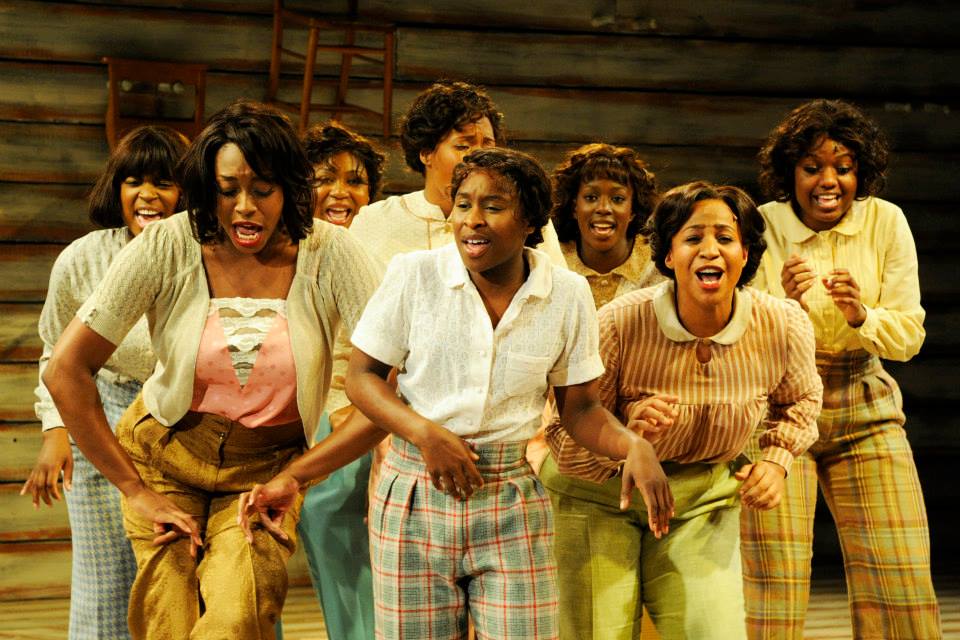
 
They are collectively splendid, singing in excellent voice with great timing and each has an individual quality rare these days.  You really get the feeling that Doyle has taken time over the casting.  Particular standouts are Sophia Nomvete as no-nonsense Sofia, Adebayo Bolaji as Harpo, caught between the rock of Sofia and the hard place of his tyrannical father and Lakesha Cammock as Squeak who takes up with Harpo when Sofia leaves him.  Abiona Omonua as Nettie was also fine although again Norman's book doesn't allow enough space for the reuniting of the sisters which should be the emotional g-spot of the evening.
 
In the difficult role of Mister, who has to go through a character volte-face towards the end, Christopher Colquhoun was charismatic and suggested the deeper hurt in Mister that made him the man he is long before the script demands it of him.  The role of Shug Avery needs an actress who can give the production a jolt of pure energy and justify the big build-up her character gets, as well as have a range that goes from gimlet-eyed brassiness to tender and loving.  The wonderful Nicola Hughes gives all that and more, she performs with a radiant energy that dazzles.  

 
The role of Celie is the glue that binds all the elements together. She is rarely offstage and grows up on it but, and most importantly, has to be able to convince the audience of the hidden passion and determination that flares up in the second half.  A self-pitying performance by the actress cast would make the evening a very long night.
 
Cynthia Erivo plays Celie with a quiet watchfulness that suits the character perfectly.  Her mask-like demeanour covers every slight, every insult thrown at her, every deprivation suffered.  Her stoicism raises laughs in the scene where she talks to Shug for the first time and says straight-faced that until Shug arrived she never realised her husband had a Christian name.  Erivo plays Celie's blossoming into a woman capable of loving and being loved with a simplicity which is truly touching and, in the important scene when she finally stands up to Mister, turns up the power so effortlessly that it's breath-taking. 
 

When Shug leaves her for a second time to take up with a teenage musician, Erivo plays Celie's refusal to be left behind with a righteous determination which leads into her eleven o'clock solo 'I'm Here' where Celie understands that she can finally stand on her own.  Cynthia Erivo takes what on paper sounds like a standard self-justifying ballad and turned it into a tour-de-force that was all the more thrilling to be sung on an empty stage in such an intimate space - you could feel the energy pouring out of her.  Constant Reader, what I think I'm trying to impart is that she sang the arse out of it and she deserved every clap of the thunderous ovation it received.

By the end there wasn't a dry eye in the house nor a seat left sat in when the cast took their bows.  The wearying Pavlovian response in audiences now to stand to applaud even the fire curtain is truly annoying but every so often you see a company who deserve to know how good they are.  This is such a cast and this is such a production.

 
It is sold out at the Menier until it's last night on September 14th - If ever a show cried out for a transfer it is this one.

Monday, August 12, 2013

Sing The Book...

Constant Reader, I have quite a few musicals to get blogging about. I have been thrashing about wondering how to tackle this task but I have come up with an ingenious way to do it.  I am going to stick my hand into the pile of programmes!


I saw THE BOOK OF MORMON on the first Saturday matinee after it's opening night and there was that certain buzz in the air of an audience almost delirious at having tickets for A Big Hit.  A similar feeling was in the air when I saw Patti LuPone in GYPSY on Broadway a few days after it's opening night.  I actually don't think it's the best circumstance to see a show, the balance is slightly off as everything and anything gets huge laughs and practically all the songs get standing ovations.  We audiences are excitable buggers sometimes.

I had no idea if I was going to like it. I vaguely knew the premise - two bright-eyed Mormon missionaries are sent to Uganda and find their optimistic outlook at odds with the poverty and violence they find - and had remained immune to the whole Trey Parker / Matt Stone phenomenon.  I had however loved AVENUE Q so knew I would probably enjoy Robert Lopez' score.


What surprised me the most was not the much-vaunted outrageousness but how savvy it is to the tenets of how a Broadway show works - take away the odd AIDS joke or 'cunt' word and you have a show that any coach party will enjoy!  It was rather obvious that it's outrage would be viewed slightly differently on this side of the pond.  It's often the case that what's viewed as cutting edge on Broadway raises but an eyebrow here.

However it was all rather endearing and I was soon won over by it's sheer joy in being able to make knob jokes amid the kick-steps.  Not knowing the first thing about the birth of Mormonism I found it all too ludicrous to be true - people actually believe this?  But while Parker and Stone enjoy their lampooning the whole set-up, it of course all ends happily for everyone, Mormon and warlord alike.  Oh and yes, Robert Lopez' score is wonderfully catchy and packed with memorable songs.

What makes the show so likeable is the the cast and in particular, the fabulous Gavin Creel who stars as the ever-smiling but ruthlessly self-centred Elder Price.  Three years ago he was here leading the wondrous HAIR tribe at the Gielgud and Owen and I also got to see him perform his own material at the Jazz CafĂ© so it's great to see him brightening up the West End again.

His charismatic, wonderfully-sung and funny performance as Elder Price lights up the Prince of Wales stage and he is one of those rare performers who you can just relax while watching as you know he will deliver the goods and he does.

Jared Gertner plays the hapless Elder Cunningham and certainly has the harder role as he really is playing an escapee from SOUTH PARK.  With no recognisable human qualities at all he occasionally grates but he certainly grabs his big moments such as the first act closer MAN UP and BAPTIZE ME.  Gertner and Creel previously played the roles in the American road tour and have an easy and natural partnership on stage.


Another stand-out is Stephen Ashfield as the ever-smiling, ever-closeted Elder Cunningham who runs the Ethiopian missionary.  His first act number TURN IT OFF is a real showstopper and he knocks it out of the (south) park with a twinkle in the eye and great energy.  I must admit it was the number that made me think "Oh I know I am enjoying myself now!"  I find that usually 20 minutes into a new musical, a song will pop up and I know I can relax... it's going to be a good show.  He also delivers with the second act paean of European Afro-centric condescension I AM AFRICA.

Giles Terera plays the village spokesman Mafala and has good fun with the 'welcome to Africa' number HASA DIGA EEBOWAI while Alexia Khadime shines with an unaffected innocence as his daughter Nabulungi, eager to escape to the heaven-on-earth SAL TLAY KA SITI.


I really enjoyed Casey Nicholow's energetic and inventive choreography although Scott Pask's set design is rather alarmingly low-rent at times.  I had a hugely enjoyable time so get yourself to the Prince of Wales and get Mormonised.  Hello!


I haven't blogged about MATILDA THE MUSICAL??? But I saw that *yonks* ago!  I mean to say, Bertie Carvel is playing Miss Trunchbull on Broadway now!  Well the programme is in my Poly Styrene 'Generation Indigo' tote bag and that's where unblogged progs go so... um *tries to dredge up what I thought of it*


I remember I enjoyed it more than I was expecting to, the combination of Roald Dahl and the RSC had left a sinking feeling within despite all the good reviews.  But I had reckoned without Dennis Kelly's involving book with it's darker moments and it's inventive retelling of Dahl's tale of a young girl who loves to read and has kinetic powers - I'm amazed the RSC took in on as it sound like a more family-friendly version of CARRIE which the RSC famously staged as a musical with disastrous consequences.

In fact the book takes over at times - God there's a lot of plot!  Matilda's parents hate her but are unknowingly involved with the Russian mafia, Matilda is telling a librarian an immensely convoluted tragic story of an escapologist and his wife, her teacher Miss Honey is living in a shed due to the evil plotting of her aunt Miss Trunchbull who also happens to be the headmistress of Matilda's school.  Luckily there is Tim Minchin's quirky and sophisticated score to break up the relentless plot. 


Although I was not enthused enough to buy the cast recording as Owen was, the score works within the confines of the show and does include one genuinely lovely song WHEN I GROW UP which got my eyes a bit moist, sung as the children soar out over the orchestra pit on swings!  The show is a triumph for choreographer Peter Darling, energetic and inventive for both young and adult performers. 

Rob Howell delivers colourful and eccentric costumes and an all-encompassing set design which even extends beyond the confines of the proscenium arch with building blocks tumbling and inching along the Cambridge Theatre walls.  Hugh Vanstone's lighting is also hugely effective and adds to the theatrical excitement.


Matthew Warchus' direction keeps the pace going but even he can't keep up the momentum of the second act plot log-jam.

I was lucky enough to see the first company - despite an a.w.o.l. Paul Kaye as Matilda's father - but it was great to see Josie Walker as Matilda's ballroom-dancing mother and Lauren Ward as the sympathetic schoolteacher Miss Honey while our Matilda for the evening Cleo Demetriou gave a performance which was a pure delight.

 
But towering over MATILDA - both the character and the show - was Bertie Carvel's astonishing Miss Trunchbull the domineering head mistress.  Part Richard III, part Anne Widdicombe, Carvel gave a performance that was frighteningly hilarious and hilariously frightening.  Although primarily a supporting part, he made his character larger-than-life and made you feel sorry for whoever has to follow him in the role.


MATILDA is still running at the Cambridge Theatre, I wonder if a second visit would enhance or wreck one's memory of it?

Saturday, August 10, 2013

50 Questions, 50 music acts...


It's nearly 4 years since I did this - 50 questions on my top 50 artists on Last.fm - I hasten to add it's done in a random order:

1) How did you get into Diana Ross?
Um... she's just always been there! I'M STILL WAITING was one of the first singles I remember played constantly...

2) What was the first song you ever heard by Marianne Faithfull?
Probably AS TEARS GO BY

3) What’s your favourite lyric by Tammi Terrell?
“Ha! My love is alive / Way down in my heart / Although we are miles apart...”

4) What is your favourite album by The Kinks?
Just have THE SINGLES COLLECTION

5) How many albums by Chris Clark do you own?
Two: SOUL SOUNDS and THE MOTOWN COLLECTION (and she's on a few compilations)

6) What is your favourite song by Sinéad O'Connor?
DADDY I'M FINE

7) Is there a song by The Supremes that makes you sad?
5:30 TRAIN

8) What is your favourite album by Bjork?
HOMOGENIC

9) What is your favourite song by Bessie Smith?
OUTSIDE OF THAT

10) Is there a song by Blondie that makes you happy?
HANGING ON THE TELEPHONE

11) What is your favourite album by Suzanne Vega?
TRIED AND TRUE

12) What is your favourite song by Beverley Knight?
GREATEST DAY

13) What is a good memory you have involving Marvin Gaye?
The first time I heard AIN'T NO MOUNTAIN HIGH ENOUGH on THE MOTOWN STORY box set with Marvin introducing it

14) What is your favourite song by Morrissey?
THE MORE YOU IGNORE ME, THE CLOSER I GET

15) Is there a song by Shelby Lynne that makes you happy?
KILLIN' KIND

16) How many times have you seen David McAlmont live?
Twice as McAlmont & Butler, twice as a guest vocalist, four times on his own

17) What is the first song you ever heard by Dusty Springfield?
Probably I ONLY WANT TO BE WITH YOU

18) What is your favourite album by Diana Ross & The Supremes?
THE SUPREMES SING MOTOWN

19) Who is a favourite member of Pet Shop Boys?
Sorry Chris, it's got to be Neil Tennant

20) Have you ever seen Alicia Keys live?
Never felt the urge...

21) What is a good memory involving The Smiths?
The first time I heard THIS CHARMING MAN

22) What is your favourite song by Culture Club?
TIME (CLOCK OF THE HEART)

23) What is the first song you ever heard by Mary Wells?
MY GUY

24) What is your favourite album by Aretha Franklin?
WHO'S ZOOMIN' WHO?

25) What is your favourite song by Sugababes?
ABOUT YOU NOW

26) What is the first song you ever heard by Madonna?
HOLIDAY

27) What is your favourite album by Angie Stone?
MAHOGANY SOUL

28) What is your favourite song by Alphabeat?
More than one but I will pick BOYFRIEND

29) What was the first song you ever heard by Grace Jones?
I NEED A MAN

30) What is your favourite song by Barbara Cook?
ERROL FLYNN

31) How many times have you seen Boy George live?
9, I think... and twice in TABOO as Leigh Bowery

32) Is there a song by Mary J. Blige that makes you happy?
JUST FINE

33) What is your favourite album by David Bowie?
STATION TO STATION (maybe)

34) What is the worst song by Tom Tom Club?
Maybe DOGS IN THE TRASH

35) What was the first song you ever heard by Little Jackie?
THE WORLD SHOULD REVOLVE AROUND ME

36) What is your favourite album by Peggy Lee?
JUMP FOR JOY

37) How many times have you seen The Temptations live?
Never have...

38) What is your favourite song by Linda Lewis?
THE MOON AND I

39) What was the first song you ever heard by Prince?
I WANNA BE YOUR LOVER

40) What is your favourite album by Carole King?
TAPESTRY

41) Is there a song by Kirsty MacColl that makes you happy?
LONDON BRIDGE IS FALLING DOWN

42) What is your favourite album by Lulu?
SOMETHING TO SHOUT ABOUT

43) What is your favourite song by Cher?
HALF-BREED

44) What is a good memory you have involving Martha Reeves & The Vandellas?
Singing MY BABY LOVES ME along with Martha Reeves as she was signing an autograph for me!

45) What is your favourite song by The Marvelettes?
DON'T MAKE HURTING ME A HABIT

46) Is there a song by Laura Nyro that makes you happy?
WEDDING BELL BLUES

47) What is your favourite album by Amanda Palmer?
AMANDA PALMER GOES DOWN UNDER

48) What is your favourite song by Macy Gray?
I TRY

49) What is the first song you ever heard by Gladys Knight & The Pips?
I HEARD IT THROUGH THE GRAPEVINE

50) How many albums do you own by Brenda Holloway?
Two – THE MOTOWN ANTHOLOGY and GREATEST HITS AND RARE CLASSICS

Come back in 4 years time and see who has dropped out of my Top 50!

Saturday, August 03, 2013

All Singing! All Dancing! All Reviving!

Sorry for the hiccup in blogging - those Battersea dogs and cats can't do their own admin you know.

In an odd reversal for me, this year I have seen more new musicals than revivals.  One usually struggles to find decent first run musicals but this year it's the revivals that I am finding thin on the ground.  It's not looking any better for the rest of 2013, with only THE SOUND OF MUSIC and MISS SAIGON upcoming.  Like, no.

I had such high hopes for MERRILY WE ROLL ALONG at the Menier.  Great reviews bolstered the expectation that this production would be on par with previous productions I had seen - both of which had been hugely enjoyable and profoundly moving: the Guildhall School production from 1983 (my first Sondheim show) and the 2000 Donmar Warehouse production which was revived in concert form in 2010 to celebrate Sondheim's 80th birthday.

 To quote the last act closer: "Now You Know".

 
Stephen Sondheim's wonderful, loving score is one of my absolute favourites with such classics as OLD FRIENDS, GOOD THING GOING, NOT A DAY GOES BY and OUR TIME which tell the story of the fracturing of Frank, Mary and Charley's friendship over 20 years - told in reverse - and has always had the hidden tripwires that start my blubbing.

We saw it just after it had been announced that the production was transferring to the West End which might explain why they performed in such a self-aggrandising manner.  They mugged, they belted where belt was not required and they played the jokes with all the subtlety of the Three Stooges.  I really cannot understand what show the reviewers saw if they performed like this.


There was also the problem that the show was directed by Maria Friedman who somehow seems to have got the cast to sing in her style: declamatory with consonants being hit harder than a cow's arse with a banjo.  It made for an ugly sound, especially as they were all miked up - the Menier, remember, only has a 180 seat capacity.

Another downer was that they were using the re-written book and score which attempts to 'explain' the main character's Franklin's motivations.  Why?  It actually does the show a disservice as these additions feel so bolted on.  Franklin's motivations are there in the text anyway - the whole show is about how we change through the decades and friends become estranged through tiny betrayals and slights.


Of the central trio of friends, Mark Umbers as Frank and Jenna Russell as Mary gave the best performances, sadly Damian Humbley was just irritating as Charley.  The largely irksome supporting cast were regularly shown up by the subtle performances of Glyn Kerslake as the hapless Broadway producer Joe Josephson and Clare Foster as Beth, Franklin's discarded first wife.  Her emotional rendition of NOT A DAY GOES BY was a real highlight.  Josefina Gabrielle played Gussy, the temperamental Broadway actress with her usual clanging stridency.
 
This was a real disappointment although it seems to have done well enough in it's transfer to the Harold Pinter Theatre.  Nope... that doesn't work, it will always be the Comedy Theatre to me.
 
The big revival in February was A CHORUS LINE at the London Palladium in it's first West End appearance since it's original production at Drury Lane in 1976, winning the first ever Society of West End Theatre/Olivier Award for Best Musical.  The show has toured occasionally but it's a mystery why it has taken so long to play a West End theatre.
 

The production is a recreation of Michael Bennett's original production which always throws a little confusion into the mix.  Bob Avian was the original co-choreographer and now he is the director re-creating Bennett's legendary musical, Baayork Lee was the original 'Connie' and now she is restaging Bennett's choreography - so are we applauding his work or theirs?

I saw this archetypal Broadway show there in the early 1990s at the Shubert Theatre where it played for 15 years and have loved the original cast recording for years so I was curious if it would hold it's magic with this production.  Of course it did - and the front row of the dress circle also helped!


Here they all were again... the chosen 17 dancers who have survived the strenuous dance auditions to stand on the line and be quizzed relentlessly by the director/choreographer Zach.  He can't hire them all, he only needs 4 boys, 4 girls.  Although he is only casting for an anonymous chorus line behind the upcoming show's star he wants performers who have real personality and more than that, dancers who *need* to dance.

Who will get through? The testy latina Diana or quiet Paul? The cheeky Chinese Connie or the very gay and Jewish Greg? Brassy Val or mocking Sheila? The married couple Al and Kristine? Don the ex-stripper, cocky Mike or Ritchie who swopped basketball for dancing? And what of Cassie?  An ex-love of Zach's who has had success in the past and left him to try her luck as an actress in L.A.?


Played without an interval, we have two hours to get to know them and to guess who Zach will pick, who deserves it more?  The news that the production is coming off early was a real surprise.  Surely in this culture that loves nothing more than watching performers being eliminated from a race to a showbiz crown A CHORUS LINE should be able to find an audience.  It's very sad that this great show is not getting a bigger audience.

The cast certainly give it there all in the dance routines, if I have a criticism it might be that apart from the performers who have slightly higher profiles within the show, the others are a bit anonymous, you tend to remember them by the colour of their dance clothes rather than for any particular performing quality.


 But their are some fine performances: John Partridge is an odd choice as Zach, he doesn't really suggest a feared/revered director/choreographer but his anonymous quality does help with the character's sphinx-like watchfulness.  Leigh Zimmerman won the Olivier Award for Best Supporting Musical Performance and it was richly deserved.  As Sheila, the seen-it-all, danced-it-all glamour girl she steals scenes with her great comic timing and stylish dancing.  Scarlett Strallen, while not having the real natural charisma that Cassie should unknowingly exude, does a fierce solo on her big number THE MUSIC AND THE MIRROR and in the preceding scene with Zach, is touching in her recounting of her failed career in L.A.  
 
As Diana, the wary latina, Victoria Hamilton-Barritt certainly punches over her two big numbers NOTHING and the score's biggest hit WHAT I DID FOR LOVE.  As is usually the case the latter, which has too many supper-club associations when heard outside it's show context, within it makes perfect sense.  By the time this 11 o'clock number is sung in the show, we know how much the dancers have had to give up to be where they are.
 
The interesting thing about the song is that it is in fact the musical coda to what actually is the emotional heart of the show, Paul's speech about his unhappy family life while growing up gay and the redemption he found as a drag artist.  It's a wonderfully written speech - the standout moment in James Kirkwood and Nicholas Dante's book - and Gary Wood gave a pitch-perfect performance.  There wasn't a dry eye in my seat. 
 
The design of Robin Wagner still thrills in it's simplicity, Theoni V. Aldredge's dance costumes are still excellently un-theatrical until the glittering finale and Tharon Musser's lighting design still gives expression to the action.
 
Sadly Robin Wagner is the only one of the original show's creators still alive.
 
Lyricist Edward Kleban died in 1987, book writers James Kirkwood and Nicholas Dante died in 1989 and 1991 respectively, lighting designer Tharon Musser died in 2009, costume designer Theoni V. Aldredge died in 2010 and composer Marvin Hamlisch died in 2012.
 
But above all the show stands as a living monument to Michael Bennett who died in 1987.  It was his particular theatrical genius to take something so basically theatrical and turning it into something universal.
 
The show is running until 31st August and I cannot recommend it highly enough.  After all these years it really is One Singular Sensation.


Sunday, July 21, 2013

Revivalists: Act two

Now Constant Reader, it might seem like I only see revivals at the National Theatre but I have actually gone to other theatres... like, in the actual West End.  All have featured fine performances but the actual productions themselves all felt wanting of real conviction.


Having missed David Hare's THE JUDAS KISS at Hampstead I caught up with it finally at the Duke of Yorks, primarily to see Rupert Everett's lauded performance.


It is 15 years since I climbed the stairs to the Playhouse's peanut gallery to see the original Richard Eyre production which starred a rather out-of-place Liam Neeson as Oscar Wilde and a play-stealing turn from Tom Hollander as Lord Alfred 'Bosie' Douglas.  The play had vaguely stayed with me but I honestly didn't expect it to be revived anytime soon.  But now we had Australian director Neil Armfield's production and I was surprised how much I liked the play.

David Hare's play covers two key moments in the life of Oscar Wilde.  In April 1885, his libel case against the Marquis of Queensbury has collapsed leaving the way clear for his arrest for Gross Indecency.  His former lover Robbie Ross tips him off that the police are delaying his arrest, almost wanting him to flee to France but Wilde refuses.  Ross thinks he is staying to appease 'Bosie' his spoilt lover but Wilde stays because to flee would be to betray his life.

 
The second act takes place two years later in the run-down villa in Naples where the broken Wilde is now living with an unrepentantly petulant Lord Alfred who is shagging his way through the local Italian rough trade and looking to get away.  Again Ross appears to reprimand Wilde and remind him that his wife has threatened to refuse him any access to their sons if he sees 'Bosie' again but again Wilde refuses him.  He cannot live his life by other's demands, no matter the consequences or the obvious ruin that Bosie has led him to.  


Armfield's direction was minimal which may be fine for actors such as Everett and Cal MacAninch (superb at playing the vein-bursting frustration of Robbie Ross) but Freddie Fox as the awful 'Bosie' was left with nothing to do but stamp his foot and rant which got old very quickly.  Compared to Hollander's slyly manipulative portrayal, he was resolutely two-dimensional.


Something which cannot be levelled at Rupert Everett who gave a performance of total star power.  His Wilde, the agent of his own destruction, was played with real charisma - you simply couldn't watch anyone else when he was onstage.  It was the sudden shifts that surprised, the way his resigned and weary façade broke down at the simple generosity of the staff of the Cadogan Hotel where he was hiding.  He really came into his own in the second half as the broken ex-prisoner, shuffling around in his slippers when not huddled in his chair.  His weary, rueful manner giving way to one of total exhaustion, like a character out of Beckett.  After loving his recently published second book of memoir as well as enjoying his performance as Benedict Cumberbatch's brother in the BBC's PARADE'S END, it was great to see Everett triumph on stage too.

Further up St. Martin's Lane another actor was giving life to another revival.  Simon Russell Beale, taking a break from the National Theatre, appeared in the first production of Michael Grandage's season at the Noel Coward theatre PRIVATES ON PARADE.

 
This was a production I was looking forward to, Russell Beale is always worth seeing and I had only ever seen the film version of Peter Nichols' play which was a bit ho-hum.  Sadly the production promised more than it delivered.

At no time did it betray any need to be on that stage at that time.  Yes it's a play about the stupidity of war but it still didn't seem to chime with what's happening now in any other theatres (of war).  It felt more like Michael Grandage wanted Simon Russell Beale to open his theatre season and offered him a big camp role which is anarchic and outrageous but also provides the humanity and heart of the play.


Simon Russell Beale's audience had followed him over the river and there was plenty to drain their blue rinses: the soldiers' knobs got a good airing during the shower scene as well as a featured cameo appearance of Russell Beale's bum.  It must be odd to know that the big shocked reaction you have just heard from the audience is because you flashed your arse.  There was also more effing and jeffing than was probably heard in the whole Malayan conflict, mostly shouted by John Marquez' Corporal Bonny, who did little to dim the memory of Joe Melia's wonderful performance on screen.

It was all very well-directed and presented in the usual Donmar house-style thanks to the set by Christopher Oram and Neil Austin's excellent lighting and there were fine supporting performances from Davina Perera as Sylvia and Harry Hepple as Lance Corporal Charles Bishop but it somehow it just didn't move me.
 

There is no denying however that bestriding them all (usually in black stockings) was Simon Russell Beale as Acting Captain Terri Dennis who simply stole everything that wasn't nailed down with a performance that was outrageously funny and touchingly human.  He's some broad.

I also saw the revival of Terence Rattigan's THE WINSLOW BOY at the Old Vic.  Ever since his centenary those Rattigan productions just keep coming, everything it would seem but the Vivien Leigh screen version of THE DEEP BLUE SEA *fume*.


It was good to finally see the play as I had never seen either of the film versions and even managed to miss the 1989 BBC production which co-starred Emma Thompson as the titular boy's sister Catherine. 

Lindsay Posner directed this revival of Rattigan's 1946 hit play which he based on a real case in 1908 of a teenage boy expelled from a naval college after being accused of stealing a five shilling postal order.  Ronnie Winslow returns home in disgrace but his upstanding father Arthur is compelled to seek justice for him but as the Admiralty's ruling is considered an act of Government it can only be brought to trial by a decree from the.. um, Government.

With the family losing their place in 'good' society and Arthur becoming ill with the stress, their last hope rests with leading barrister Sir Robert Morton who is also a member of the opposition.  Winslow's suffragist daughter Catherine is strongly opposed to his involvement thinking he will only use the case to further his political career and because of his opposition to votes for women. 

In a scene which finally jolted Posner's rather tasteful production into life, Morton visits the house and ruthlessly cross-examines Ronnie in front of his appalled family, seeming to destroy the boy's story.  Morton then reveals he only did it to see how the boy might react to a courtroom and agrees to take on he case.

Through a mixture of guile and oratory Morton succeeds in getting the Government to agree to a court hearing which goes ahead with the Winslow home surrounded by newspaper reporters.  On the day of the trial Morton's ruthless cross-examinations force the Admiralty to withdraw it's charges against Ronnie and the family win the case.  But it's a hollow victory as the family is now near bankruptcy, Arthur's health is ruined as is Catherine's engagement to her Guardsman fiancĂ©e.


Any play about an individual trying to seek justice against an impossible bureaucracy will always be topical and Rattigan's play holds up well with it's expert construction.  Posner's production however felt safe and timid with several scenes seeming to tread water until the next entrance cue.  Owen asked me before it started what sort of a play it was and I assured him that at some point a scene would start with the maid turning on the study lamps and drawing the curtains.  And sure enough, there was Violet the loyal maid pulling the curtains and lighting the lamps on Peter McKintosh's rather obvious box set which looked like it belonged to a touring company.
Luckily what Posner was blessed with was a fine cast headed by Henry Goodman's benignly comfortable Arthur Winslow  who is broken by the system he has lived his life upholding.  There was good support from Deborah Findlay as Grace Winslow, ill-equipped to deal with the change wrought on her family and life, and also from Nick Hendrix as their oldest son Dickie who is happy enough learning the new dance steps rather than learn anything in Oxbridge - yes it was a silly-ass part but played with great wit.  Catherine was played by Naomi Frederick and a little more personality wouldn't have gone amiss while Charlie Rowe's Ronnie betrayed a lack of stage experience.  A special mention to Jay Villiers as the family solicitor who quietly loved Catherine.

However the stand-out performance was Peter Sullivan as Sir Robert Morton.  The production's synapses were jolted every time he appeared and his witty, self-assured, disdainful Sir Robert also gave the impression of having a heart under all that veneer.  I've seen Peter Sullivan a few times on stage and here he was finally allowed to take control of the play.  I certainly missed him when he was offstage.

There is a tragic postscript to the story of George Archer-Shee whose story was the inspiration for the play.  The case was won in 1910 but his father Martin, worn down by the two year fight for justice died in 1911.  In 1912, after completing his education, young George emigrated to New York to work on Wall Street.

Two years later in 1914 he returned to enlist in the war, and at the age of only 19, became one of the 17, 873 British soldiers reported missing in action after the first battle of Ypres.