Showing posts with label Terence Rattigan. Show all posts

Tuesday, September 29, 2020

DVD/150: THE BROWNING VERSION (Anthony Asquith, 1951)

Of the ten films made by director Anthony Asquith and writer Terence Rattigan, the most resonant remains THE BROWNING VERSION, released three years after Rattigan's one-act play opened.


Rattigan deservedly won the Best Screenplay Award at the Cannes Film Festival for his adaptation.

Michael Redgrave won the Cannes Best Actor Award while also giving one of the great screen performances as Andrew Crocker-Harris, a classics master who, after 18 years teaching in a boys school, has atrophied into a pedantic, remote man.  When it's announced that Crocker-Harris is leaving the next day due to ill health, he is made aware of the dislike of pupils and colleagues.

His wife Millie is also openly contemptuous, barely hiding an affair with science teacher Frank, but when she learns Andrew has been refused an expected school pension, she goes on the attack.

But a pupil's unexpected goodbye present changes everything...

Shelf or charity shop?  Currently living in my plastic storage box, THE BROWNING VERSION is a film that delivers a quietly devastating emotional punch.  Beautifully directed by Asquith, his film allows you to slowly side against the malign forces facing Crocker-Harris both professionally and personally.  As I said, Michael Redgrave delivers not only his best screen performance but one of the truly great screen performances; staying within the strict parameters of the character but by through the smallest, precise timing of gesture and voice, you will be totally on his side by the end of the film.  There is excellent support from Jean Kent as the vindictive Millie, Nigel Patrick as her lover Frank who makes amends for their deception and Wilfred Hyde White as the smoothly unfeeling headmaster.  A special mention for Brian Smith as young Taplow whose unexpected farewell present to Crocker-Harris starts a chain reaction.  This scene where his small act of kindness causes Crocker-Harris to finally break down in halting sobs is the film's devastating core.

Sunday, June 07, 2020

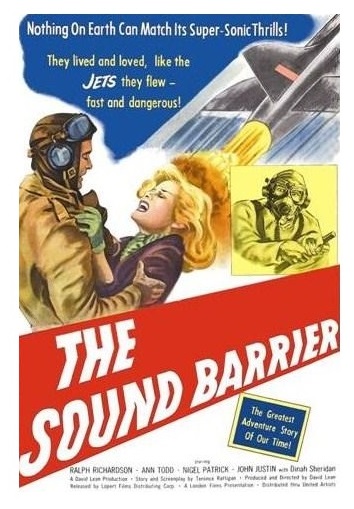
DVD/150: THE SOUND BARRIER (David Lean, 1952)

It shows how good a director David Lean was that a film that should make me run a mile - ex-WWII RAF pilots attempt to break the sound barrier - is, in fact, an involving drama.


It's popularity here and in America was reflected at award time: Terence Rattigan was nominated for an Academy Award for his screenplay and it righly won for Best Sound with it's excellent use of silence, echoes and the sudden whoosh of jets.  At the BAFTA Awards it won Best Film, Best British Film and Best British Actor for Ralph Richardson.


Richardson - I think playing a Yorkshire man but going a bit Gorbals at times - plays John Ridgefield, the owner of a jet building company who, while obsessively developing a jet to break the sound barrier, remains emotionally distant from his daughter and son.


Father and daughter are reconciled but at a high cost to them.


Shelf or charity shop? THE SOUND BARRIER is part of a David Lean box-set but I am happy to keep it for Sir Ralph's Ibsen-like Ridgefield and the performances of Nigel Patrick as his son-in-law pilot Tony, Joseph Tomelty as his over-worked jet designer and I even like Ann Todd who, although glacial as ever, finally proves effective as Ridgefield's daughter Susan.  A special mention too for Jack Hildyard's excellent cinematography; his striking visuals really lift the film out of the ordinary.

Saturday, July 27, 2019

WHILE THE SUN SHINES at the Orange Tree - Wartime Bedfellows...

Terence Rattigan's centenary in 2011 heralded a continuing wave of successful revivals of his plays and re-evaluation of his mastery for exposing the sadness in the lives of the English upper-middle class in his most well-known works.  However Rattigan's first big success had been the comedy FRENCH WITHOUT TEARS which was revived in 2015 by the small Orange Tree Theatre in Richmond which proved so successful that they produced it again the following year.


Now the Orange Tree has revived another Rattigan comedy WHILE THE SUN SHINES, which premiered in the West End in 1943, next door to the theatre where his wartime drama FLAREPATH was already playing.  Remarkably - bearing in mind Rattigan also wrote such hits as THE DEEP BLUE SEA, THE WINSLOW BOY and SEPARATE TABLES - his longest West End run was WHILE THE SUN SHINES.  Interesting too that these two productions played next door to each other on Shaftesbury Avenue as they are two sides of the same coin - both contemporary plays set in WWII England, both focus on men and women in uniform but one is an emotional drama and the other a comedy.  WHILE THE SUN SHINES was such a hit that Anthony Asquith directed a film version four years later.

FLAREPATH is the better play but it is fascinating to see WHILE THE SUN SHINES especially as Rattigan works in several occasional gay references, needless to say, these moments are fleeting and soon explained away but must have made his gay audience members recognize them for what they were.  The Orange Tree's Artistic Director Paul Miller directed their revival of FRENCH WITHOUT TEARS and he returns to Rattigan here with the same gossamer touch, it's a production full of grace and humour.


Bobby, the young Earl of Harpenden is on leave from the Navy to marry his sweetheart Lady Elisabeth who is also in the services.  He is an affable, genial soul who tries for promotion but knows he will never amount to much in the Navy.  On the day before the wedding, Bobby's butler finds him in bed with an American Lieutenant Joe Mulvaney - Bobby had found Joe raving drunk in Piccadilly and brought him back to his flat in The Albany to sleep it off.

Joe is thrilled to see inside the world of the aristocracy so Bobby leaves him there while he goes for yet another promotion interview but not before phoning up his sometime-mistress Mabel Crum, a typist in the Ministry who is also the easiest party girl in London, to come over as she has a penchant for Americans.  Appearing instead is Lady Elisabeth to surprise Bobby - and of course Joe thinks she is Mabel and gets her sozzled before realizing too late who she really is.


But that's only the start of an evening of misunderstandings and changed allegiances - the confusion being added to by the appearance of Elisabeth's military father The Duke who cannot resist a chance to gamble, a Free French officer Colbert who Elizabeth met on the train to London and who now swears devotion to her and of course Mabel, who watches the romantic to-ings and fro-ings with the resigned air of someone who knows what she wants but settles for what she can get.

While never uproariously funny, Miller bounces the play along on a bright and breezy tone and is helped enormously by a charming cast who all play their characters with a similar light touch.  I particularly liked Philip Labey's Bobby who, while playing the louche aristo well, also hinted at an inner life of listless wandering, as well as Michael Lumsden's Duke, full of splenetic fury which vanishes as soon as a game of cards or dice is offered.  There was also a nice display of suppressed emotions too from John Hudson's butler Horton.


By far the best performance was Dorothea Myer-Bennett as practical party girl Mabel Crum, loving life in the blackouts but aware that she has to make hay while the sun shines.  A few years ago we saw Shaw's THE PHILANDERER at the Orange Tree and Myer-Bennett shone in that as a woman trying to be a Shavian New Woman but ruled by her volatile emotions and that element of loving cynicism shot through her performance as Mabel too; every time she was packed off to the offstage kitchen to keep one of the men out of the way, I wanted to follow her as she was by far the most interesting character.

I also want to highlight Simon Daw's cleverly economic set which suggested well the living room of Bobby's Albany flat.  I really enjoyed this opportunity to see yet another facet of Rattigan's ability to craft that sometimes derided thing - the well-constructed play - with a collection of characters who even at their silliest were all delightful.  Paul Miller has again triumphed in bringing an admittedly minor Rattigan work to his stage and making it shine.


Friday, April 07, 2017

LOVE IN IDLENESS at the Menier - Rattigan Reimagined

Just when it looked like the revivals of plays by Terence Rattigan were over, up pops another one at the Menier Chocolate Factory, a highly unlikely home for this writer.


It turns out that LOVE IN IDLENESS is a bit of a cut-and-shunt job.  In 1944 Terence Rattigan wanted to write a play which reflected the conflicts of the time - when confidence in winning the war was tempered by worries of what the country would do next - as well as write a typical Shaftesbury Avenue comedy star vehicle.  Gertrude Lawrence turned it down unread but the acting (and married) partnership of Alfred Lunt and Lynn Fontanne picked it up.

The title was LESS THAN KIND which hints at the play's riffing on HAMLET but Lunt felt it's plot - young man burning with Socialist idealism returns from wartime evacuation to Canada to discover that his widowed mother has moved in with an industrialist currently serving in Churchill's wartime cabinet - was not humorous enough for him so Rattigan rewrote it, dropping most of the confrontations over politics.  Later on he recanted saying that he wished he had kept the play as it was and not bowed to star power.


Fast forward to 2016: Trevor Nunn was looking for another Rattigan project after his successful revival of FLARE PATH in 2011 and discovered the two similar projects and after urging from the Rattigan estate to meld the two scripts - reinstating some of the political debate but also keeping it light and amusing - we now have LOVE IN IDLENESS.  Incidentally the unperformed LESS THAN KIND was given a belated debut in 2011 too at the tiny Jermyn Street Theatre (home of the hags, don't get me started).

I must admit to some trepidation at the thought of Trevor Nunn imposing his love of playing length on what sounded like a frothy comedy (and it does come down after nearly three hours) but remarkably his production delighted in it's brio and in the winning performances.  True, Rattigan weights the plot in favour of the industrialist Sir John Fletcher but when he is played so delightfully by Anthony Head it's a point one is willing to concede.


I was also hugely surprised by Eve Best as the high society-loving Olivia Brown.  Best is *ahem* best at roles which usually find her mournful and constantly wiping away tears or blowing her nose on a hankie secreted up the arm of her dowdy dress but here she blossoms as a gushingly over-indulgent mother but whose sense of fun is nicely balanced with a sense of fair play.  There were several times during the play that I thought what a nice part this would have been for Emma Thompson to have played had she not seemingly turned her back on theatre (SWEENEY TODD withstanding).

As I said Anthony Head is utterly charming as Sir John, possibly the best I have seen him on stage.  He captures the combination of a believable powerful man of influence while also being totally thrown by the emotional devastation that Olivia's truculent son brings with his arrival back from Canada.  As Michael, Olivia's son determined to break up his mother from a man who represents everything he despises, Edward Bluemel starts a bit wobbly but gained in strength during the evening, eventually playing Michael's selfish side well.


Another performance which really surprised me was Helen George as the society girl Diana.  Nicely introduced as what you expect to be a girl that Michael has picked up, the reveal that she is in fact Sir John's estranged wife is nicely done and she plays Diana's ruthless determination very well.  She more than holds her own against her more illustrious co-stars. Sadly the other supporting cast members are all a bit weak but the four leads carry them well.

Stephen Brimson Lewis has designed a pleasing Mayfair apartment for the primary action to take place which converts nicely into a low-rent Baron's Court flat for the final scene and it's a nice touch to have the time and place so well established with old Pathe News clips projected onto the wraparound scrim curtain.


Yes it's lightweight and throwaway, and not really Rattigan's best work, but it entertains and proves that sometimes experience does count for everything.  I was somewhat surprised to hear that it will transfer to the Apollo, Shaftesbury Avenue in May but wish it well as it is a play written to be seen on the Avenue.  I hope it finds it's audience.


Tuesday, October 04, 2016

KENNY MORGAN at the Arcola Theatre - art imitating art imitating life...

In June we saw Terence Rattigan's THE DEEP BLUE SEA at the National Theatre, the play that is acknowledged to be his masterpiece.  A reason for this could possibly be because the story came from an incident in his own life.  What Rattigan did however was to do something he could not do in real life... he could change the ending.

Mike Poulton does not have that luxury as his new acclaimed play KENNY MORGAN documents the incident Rattigan could only change in fiction.


Kenneth Morgan was a young actor who in 1940 won a Best Newcomer award for his role in the film of Terence Rattigan's stage success FRENCH WITHOUT TEARS but more importantly he met Rattigan during the filming and they became friends.

They met again after WW2 ended and started a relationship but this was the 1940s and Rattigan was terrified that his homosexuality would become common knowledge.  Not only was homosexuality a criminal act but he also was worried his aged parents would find out.  Rattigan's sexuality was known to his theatrical friends but that was all.  Rattigan lived at the Albany near Piccadilly Circus but he also had the lease for a small flat on another floor which was used for visiting friends and that's where Morgan had to stay when he visited.


Morgan's career had lost it's momentum and he was depressed by his life as the famous writer's secret affair so, while Rattigan was preparing his Alexander The Great play ADVENTURE STORY, Morgan ended the relationship and went to live with another actor Alec Ross in Camden.  Rattigan was upset but assumed Morgan would return.  He did not.  It soon became clear that Ross did not return Morgan's feelings and at the end of his tether, Morgan gassed himself.

Rattigan was in Liverpool with the play's director Peter Glenville when he heard the news and was profoundly shocked but by the evening he envisioned the start of a play where a body was found in front of a gas fire.  It's interesting that Rattigan immediately started to re-write Morgan's fate in theatrical terms as a way of dealing with it.


Poulton's play uses the plot of THE DEEP BLUE SEA as his template but changes a main fact: Rattigan was not in London when Morgan died but Poulton has him making three appearances.  Like THE DEEP BLUE SEA, the play covers the day and night after a suicide attempt with various characters coming and going, attempting to discover what drove the main character to that action, an action that in 1949 was in itself a criminal act; in Poulton's programme notes he estimates that in 1949, 300 people were charged with attempting to kill themselves.

It would appear that in real-life Morgan was successful at his first attempt but to fit the DEEP BLUE SEA narrative, Poulton has him being found in the morning slumped by the gas fire by a neighbour and the landlady and as in Rattigan's play, the neighbour calls a number in a found address book - in the play it's Hester's husband, here it's the playwright.  Also as in the original, Morgan is helped by another neighbour, a European former doctor, struck off under mysterious circumstances.


Also as in the original, Morgan attempts to hide his suicide letter from Alec but it is found which triggers the start of Alec's emotional cruelty and the end of their affair.  In the Rattigan's version, Hester finally sees a chance of redemption after a long talk with the doctor, in this version that chance is also offered through the doctor's appeal to life but one last twist of the knife by Alec destroys Kenny's optimism and he reaches for the gas tap again...

I am still in two minds whether it was a good thing to have seen THE DEEP BLUE SEA so recently: it was good to see how Poulton not only uses Rattigan's structure but also to see how he has referenced certain moments and individual lines in his own play but manipulated them to give it a new meaning.  However I also feel that having THE DEEP BLUE SEA so fresh in one's mind, Poulton's play can only come across as an inferior copy; surely Morgan's despair felt more painful than a copy of a well-constructed play?  It almost felt like a dramatist's exercise - can you write a new play based on the structure of an older one?  Occasionally I wished Poulton could have broken away from THE DEEP BLUE SEA to make us feel Morgan's distress more intently.


There is also a problem with the character of Kenny himself; by writing him as a self-pitying lachrymose gay victim, speaking in the clipped manner of a 1940s juvenile lead, Poulton does make it hard to feel any sympathy for him which is the play's chief failing.  The frequent traffic on the small Arcola stage also felt a bit too mechanical at times: it felt that Poulton was too interested in his characters to leave any of them offstage for long - did Rattigan really need to appear three times?

However I did enjoy the play very much, as well as Lucy Bailey's production which concentrated all the attention on that cramped living room like a pressure-cooker; the flat's design by Robert Innes Hopkins had just the right down-at-heel, drab feel.


Bailey also elicits nuanced performances from her cast: Paul Keating as Kenny had to struggle with the strait-jacketed character of Kenny but was very effective in his scenes in extremis especially when Alec destroyed his last chance of escape with his withering scorn, you could almost see the light go out in him.

As the men in Kenny's life, Simon Dutton was fine as Terence Rattigan, caring for Kenny in his own way but unable to get past his closeted outlook and Piero Niel-Mee was marvellously self-absorbed as Alec, retreating into his bi-sexuality when Kenny's love becomes too suffocating.


Circling these main characters were well-drawn roles that put gentle spins on Rattigan's own supporting characters: Matthew Bulgo was a delight as Kenny's upstairs neighbour, the mild-mannered Dafydd who works in an office job in the Admiralty, lives with his sister and who knows his life is quietly slipping by unnoticed, Marlene Sideaway was good as Mrs. Simpson, the spiky landlady who cares in her way but is suspicious of Kenny and his 'theatrical' ways.

Lowenna Melrose made an impression as Norma Hastings, a young actress friend of Alec who he sleeps with as if to prove to Kenny that he is not gay; Melrose nicely suggested that she was no fool where Alec was concerned.  Rounding out the cast was George Irving as the mysterious neighbour Mr Ritter, a man nursing his past with a quick, sly wit and canny understanding.  His accent strayed occasionally into Mittel-Europeanspeak but he was excellent in his arguments for life to be lived, even the bleak times.


Apart from the problem of Poulton's too-slavish adherence to the structure of THE DEEP BLUE SEA, this was well worth seeing and it would be nice if it had a life beyond it's current run.  It is also a telling reminder of the crushing strictures that the law imposed during that period on the lives of, what Tennessee Williams called "the fugitive kind".


Thursday, June 16, 2016

THE DEEP BLUE SEA at the Lyttelton Theatre - Helen McCrory's turn to dive in...

Peggy Ashcroft, Vivien Leigh, Penelope Keith, Penelope Wilton, Harriet Walter, Greta Scaachi, Rachel Weisz... quite a line-up eh?  Now Helen McCrory can be added to that list as she is the latest actress to play the desperate Hester Collyer in Terence Rattigan's masterpiece THE DEEP BLUE SEA which is now revived by Carrie Cracknell at the Lyttelton.


What makes this play Rattigan's masterpiece?  I think because this play more than any other seemed to spring directly from a moment in his life.  Rattigan, a closeted homosexual, had been in a relationship with a young actor Kenneth Morgan in the 1940s who decided to end the relationship, frustrated by his life in the shadows of Rattigan's world.  After a subsequent relationship failed, a distraught Morgan gassed himself.

Three years later and after much revising, THE DEEP BLUE SEA opened in the West End with Peggy Ashcroft as Hester, Kenneth More as her lover Freddie Page and Roland Culver as her estranged husband Sir William Collyer.  Watching the play again, it is remarkable how Rattigan - despite his relationship with Morgan - manages to balance out empathy among these characters and not make it all stacked up in Hester's corner.


West London, 1950s: Hester Collyer is found by her neighbours and landlady lying in front of her living-room gas fire, saved by the fact that the gas meter ran out of money.  Another neighbour who has vague medical experience deals with her ingestion of sleeping pills but what drove her to this, at the time, criminal act of Attempted Suicide?  Over the course of the day we discover that Hester has been driven to despair by the knowledge that her lover Freddie is falling out of love with her.

Hester left a safe, middle-class life as the wife of High Court judge Sir William Collyer soon after meeting the dashing, young WWII test pilot Freddie Page.  Freddie gave Hester the sexual fulfillment she never had with Sir William but, with work becoming increasingly hard due to his drinking, Freddie is tiring of Hester's emotional needs and when he decides to stay at a golfing event rather than return to celebrate her birthday Hester decides to choose "The Deep Blue Sea".


When Freddie returns Hester tries to cover up her actions but when he discovers her suicide note he responds angrily that he can no longer live like this and leaves.  An increasingly desperate Hester discovers he has been given a job offer in South America and attempts to manoeuvre him to return so she can win him back.

Instead she is visited twice by Sir William who, against all odds, offers her the possibility of returning to their married life together but Hester has grown emotionally away from him and ultimately it's Miller, the secretive neighbour with a medical past who provides Hester with a suggestion of renewal.


Carrie Cracknell's stays clear of any revisionist tricks - although the production has a superfluous 'auralscape' which groans and rumbles away as if Hester's West London boarding house will collapse at any minute, it's such a redundant addition.  Other than that production stumble, Cracknell does well in suggesting the quiet desperation in the lives of all the tenants in Mrs Elton's boarding house, not just Hester and Miller but also in the Welchs, a young married couple who are already showing hairline fractures in their life together.

Tom Scutt's boarding-house set has translucent walls which allow you to see the neighbour's comings and goings and shut-in lives which certainly suggests the secrets that Hester is faced with keeping - her unmarried life with Freddie and the hushed-up suicide attempt.  It's problem is that Hester and Freddie's flat is hardly the dingy one that Rattigan envisioned Hester trapped in alone.


At times I felt the production was a bit under-powered in it's male casting.  In the important role of Freddie Tom Burke could certainly do the "surly teenager" behaviour of Hester's lover but I didn't believe for a minute that this man would inspire grand passion in anyone, no matter how good he was in bed.

I also felt Nick Fletcher was too lightweight for the shadowy Mr Miler.  It is slowly revealed that Miller has served time in prison which has resulted in him losing the right to practise medicine and his brusque exterior hides someone who feels just as ostracized as Hester and it is he who plants the vital thought of how she can get through her pain.  It's a great part but here Fletcher seemed to just shine it on.


Much better was Peter Sullivan as Hester's estranged husband Sir William, played younger here than usual.  Collyer is not a bad man, he just cannot give Hester what she now has experienced with Freddie and despite his suggesting that the door is still open for her at the family home, he knows that his safe and mundane life will go on without her and Sullivan captured this perfectly.

There is nice support too from Marion Bailey as the genial landlady Mrs Elton and Yolanda Kettle as the newly-married neighbour Ann, a potential Hester-like wife who pines for her frequently absent husband.


But of course any production of THE DEEP BLUE SEA needs an actress at the top of her game and Helen McCrory gives a performance of nerve-shredding anxiety.  Over the course of the play's single day setting we see Hester defeated, cowed, cunning, loving, distraught but finally... herself.  On paper she can seem a silly, over-emotional woman so you need an actress who is willing to go all the way off the scale to make her situation real and McCrory does just that.  Even though I know the play she still had me wondering how she could come back from the edge of disaster.

It's a talk with Mr Miller who starts the rebirth of Hester followed by a resigned last meeting with Freddie and Helen McCrory was sensational in this last beautifully-written section of the play, as the parting lovers skirt over the undertow of pain in their parting with niceties and attempts to be 'decent' about things.  In the silent last moments of the play, McCrory was magnetic... who else could make cooking a scrambled egg so absorbing? Again, magnificent McCrory makes a role all her own.