Constant Reader what is to be done with Broadway musicals that were written to be staged in big theatres with casts to match but no producer wants to take the risk of staging in one such space?
You downsize of course. Why have a big chorus when your cast can meet themselves going off as they come on in a different wig? Why have an auditorium like a barn when you can happily re-envision it for a small space in a converted workspace, railway arch or former public toilet? Why have a full orchestra when the score can be orchestrated for a couple of synths and a man playing bog-paper on a comb?
DEAR WORLD is an ideal candidate for downsizing. Based on Giraudoux's THE MADWOMAN OF CHAILLOT, the musical was written by Jerry Herman following the success of MAME as a vehicle for it's star Angela Lansbury. Countess Aurelia is an eccentric who lives in the basement of a Parisian bistro. Along with her equally misfit countess friends and a sewerman, she is appalled to learn that the area will be destroyed by businessmen who believe there's a lake of oil under it. She sets about to destroy them instead.
The production, while aided by Herman's charmingly slight score, was beset by 'creative differences', the sacking of two directors and a choreographer. It opened in February 1969 only to close three months later, although it did lead to Lansbury winning her 2nd Tony Award for Best Musical Actress and a cast recording left to posterity. Now show queens love nothing more than a juicy flop with a Diva belting out her solos on the cast album. The DEAR WORLD cast recording has amassed the obligatory 'cult following' but with it's flop status still uppermost in theatrical minds who would be bold enough to stage a production in a large theatre for it's UK debut? Easy - go ickle!

That's how DEAR WORLD found itself in the ever-strange Charing Cross Theatre - the latest renaming of the old Players Theatre under the arches of Charing Cross station. It's narrow auditorium always leaves me vaguely uncomfortable and of course any show staged there has to compete with the nearby thundering trains. I haven't seen too many productions there but I have never sat in a full auditorium for any of them. The whole theatre gives off the air of rejection and transitiveness which is not the best atmosphere for a light and whimsical Parisian fable.
It was all perfectly pleasant with a nice revolving bistro revealing Aurelia's luxurious basement home and nice colourful costumes for the ladies. But all the time I was watching it I was also aware of the compromised air about the production. Oh for a bigger stage for the dance routines - hell even a bigger space around the bistro for the cast to get on and off the stage! But despite these drawbacks I did like Gillian Lynne's brisk direction and choreography.

A more, ahem, compact stage means that any faults in the book soon become exposed. Even with a revised book DEAR WORLD would have you believe that the bistro waitress and young hero are in love because she sings a solo ballad about never having loved before. In a busier show such plot shorthand can go unnoticed but here I just wondered "Where did THAT come from?" Playing to a half-empty auditorium didn't help with the book's amiable jokes getting smiles rather than laughs. I always feel in such situations an extra tension as an audience member: I must clap louder than I would at the end of the songs just to let the cast know they are not wasting their time being there.
There is also the problem of casting: have the actors been cast because they are the best for the role - or because they were all they could get? Harsh I know, but when you look through the programme and all you see are performers who have done tours and understudy jobs you do begin to despair.
Although this production had these problems - and the additional of the dreaded loveable/punchable 'mute character - I did enjoy Katy Treharne as waitress Nina, she sang her afore-mentioned solo nicely. Annabel Leventon and Rebecca Lock as Aurelia's equally cracked friends didn't overplay the grotesquerie and earned most of the laughs going. Paul Nicholas was surprisingly good as the philosophical Sewerman who knows the world is going to ruin by the rubbish he finds. It was very odd to see his subdued performance and think of 'Cousin Kevin' from TOMMY and the jiggly eejit in the white suit who sang 'Dancing With The Captain' on Top of The Pops!
Of course any show that is constructed as a star vehicle needs a star. Luckily - somehow - this rather hole-in-the-arches production had bona-fide Broadway star Betty Buckley playing Countess Aurelia. While DEAR WORLD was limping onto the Broadway stage in 1969, Betty Buckley was starring in London in Bacharach and David's musical PROMISES PROMISES at the Prince of Wales and was now back again after 44 years, albeit with the odd cabaret appearance betwixt times.
I first saw her in her film debut as the sympathetic gym teacher in CARRIE and then through the cast recording of THE MYSTERY OF EDWIN DROOD in which she 'Edwin'. I was also aware of her version of 'Memory' as she was Broadway's original Grizabella in CATS which might explain why Trevor Nunn was in the audience. Seeing him reminded me of Buckley's appearance in the documentary BROADWAY: THE GOLDEN AGE recalling the exhaustive auditions she went through to get it.
It is a tribute to her professionalism that despite the half-empty house and reduced production, she gave an exquisitely charismatic performance. Not a barnstorming Diva turn but true to the character and perfectly judged for the production she was in. Her performance of the Countess' cri de coeur "I Don't Want To Know" was particularly moving. It was a pleasure to finally see her in a proper show. But it was not a big surprise to later hear that the show closed two weeks early.
What is important when downsizing a big show to a more intimate space is to have a vision and that's exactly what John Doyle had done with the Menier Chocolate Factory's production of THE COLOR PURPLE.
I was in two minds about seeing it as when it appeared on Broadway in 2005 it seemed to be just a big vanity project for Oprah Winfrey and I couldn't see what value it would have here. I had read Alice Walker's novel back in the day as well as seeing the Spielberg screen adaptation which apart from some fine performances was like all the rainy Sundays in your life put together. But for want of something to see I booked.
John Doyle was lauded for his 2004 scaled-down version of SWEENEY TODD where the cast played the instruments too. "How visionary" the critics cried, to which I replied "How cheap"! He worked at the Watermill Theatre Newbury for God's sake - like they can afford an orchestra! However he delivered a good production of Sondheim's
ROAD SHOW at the Menier - with actual musicians! - and with Nicola Hughes and Christopher Colquhoun in the cast I decided to give it a go.
The first surprise was to find the Menier auditorium reconfigured again. Instead of the proscenium for MERRILY WE ROLL ALONG we had a thrust stage with seating at the sides and end. Doyle is also the set designer and his stage is of bare, clapboard which immediately suggested country shacks and a number of wooden chairs hanging on the back wall. Clean, economic, perfect. The costumes are by reliable Matthew Wright, using pale, earthy colours until the arrival of blues singer Shug Avery when we get a splash of colour.
Marsha Norman had the tough job of adapting Alice Walker's novel with it's large number of characters and plot threads. In pairing it back to keep our focus on the heroine Celie, her book skips over the plot like a hard-flung pebble which can only result in some drastic telescoping of character's timelines - we are introduced to Sofia and about 20 minutes later she has five children! Sofia's brutal beating also is incorporated into a musical sequence and feels perfunctory.

Celie and Nettie are sisters who support each other in their stepfather's joyless home. Teenage Celie has had two children by her stepfather who has taken them both away from her. The stepfather refuses Mister's offer of marry Nettie and instead palms him off with Celie and a cow. Celie moves into Mister's equally joyless home and is distraught when Nettie vanishes after spurning Mister's advances. Celie, thinking Nettie dead, is resigned to a life of drudgery alleviated by her friendship with the no-nonsense Sofia, wife of Harpo who is Mister's kind-hearted son.
Celie's salvation comes in the unlikely shape of blues singer Shug Avery. Self-assertive and confident, she is a force of nature who even Mister can't control. While staying in Mister's house, Shug and Celie are slowly drawn into a relationship which allows Celie to experience joy and love for the first time. Shug also gives Celie letters that Mister has been hiding, they are from Nettie who has written constantly over the years revealing that not only is she is teaching with a missionary couple in Africa, but the couple also adopted Celie's two illegitimate children. And that's all just the first half!

The ever-present music is composed by three accomplished songwriters: Brenda Russell ("Get Here"; "Piano In The Dark"), Allee Willis ("What Have I Done To Deserve This"; "Boogie Wonderland") and Stephen Bray ("Into The Groove; "Express Yourself") and it is a very tuneful score, notably using various styles of black music: spiritual, gospel, rolling blues, jazzy up-tempo numbers integrated into the more generic show tunes.
The score has been skilfully supervised by Menier favourite Catherine Jayes and is played by the eight piece band in a stripped-down style which suits the whole direction of Doyle's production. This is also carried on through Ann Yee's lucid choreography which shows off the ensemble very well. Speaking of the ensemble leads me onto the cast of seventeen which while being quite a big number by Menier standards is exactly half the size of the original Broadway cast! Take it from me they sound better than the Broadway cast.
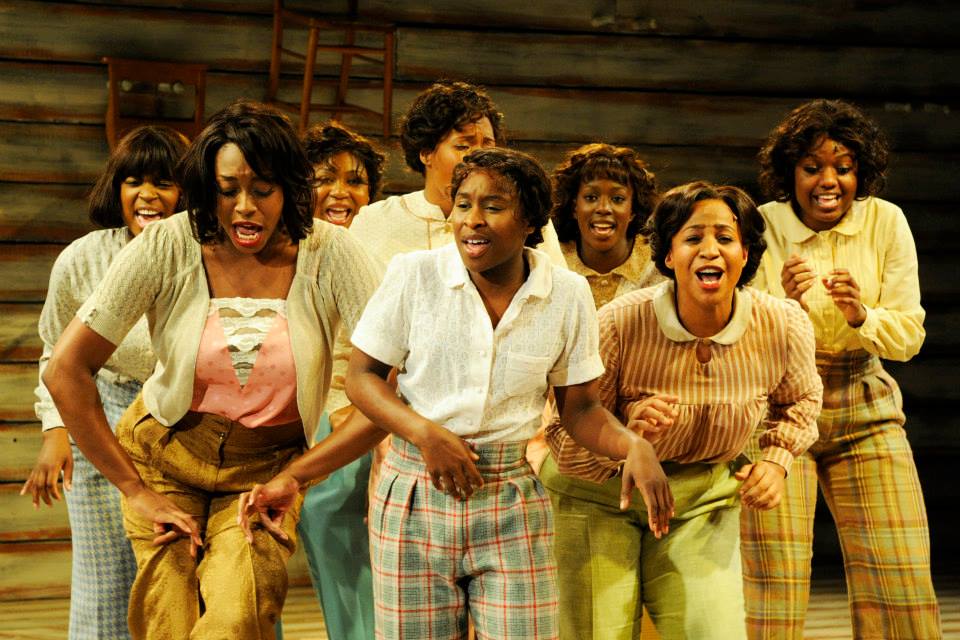
They are collectively splendid, singing in excellent voice with great timing and each has an individual quality rare these days. You really get the feeling that Doyle has taken time over the casting. Particular standouts are Sophia Nomvete as no-nonsense Sofia, Adebayo Bolaji as Harpo, caught between the rock of Sofia and the hard place of his tyrannical father and Lakesha Cammock as Squeak who takes up with Harpo when Sofia leaves him. Abiona Omonua as Nettie was also fine although again Norman's book doesn't allow enough space for the reuniting of the sisters which should be the emotional g-spot of the evening.
In the difficult role of Mister, who has to go through a character volte-face towards the end, Christopher Colquhoun was charismatic and suggested the deeper hurt in Mister that made him the man he is long before the script demands it of him. The role of Shug Avery needs an actress who can give the production a jolt of pure energy and justify the big build-up her character gets, as well as have a range that goes from gimlet-eyed brassiness to tender and loving. The wonderful Nicola Hughes gives all that and more, she performs with a radiant energy that dazzles.
The role of Celie is the glue that binds all the elements together. She is rarely offstage and grows up on it but, and most importantly, has to be able to convince the audience of the hidden passion and determination that flares up in the second half. A self-pitying performance by the actress cast would make the evening a very long night.
Cynthia Erivo plays Celie with a quiet watchfulness that suits the character perfectly. Her mask-like demeanour covers every slight, every insult thrown at her, every deprivation suffered. Her stoicism raises laughs in the scene where she talks to Shug for the first time and says straight-faced that until Shug arrived she never realised her husband had a Christian name. Erivo plays Celie's blossoming into a woman capable of loving and being loved with a simplicity which is truly touching and, in the important scene when she finally stands up to Mister, turns up the power so effortlessly that it's breath-taking.
When Shug leaves her for a second time to take up with a teenage musician, Erivo plays Celie's refusal to be left behind with a righteous determination which leads into her eleven o'clock solo 'I'm Here' where Celie understands that she can finally stand on her own. Cynthia Erivo takes what on paper sounds like a standard self-justifying ballad and turned it into a
tour-de-force that was all the more thrilling to be sung on an empty stage in such an intimate space - you could feel the energy pouring out of her. Constant Reader, what I think I'm trying to impart is that she sang the arse out of it and she deserved every clap of the thunderous ovation it received.
By the end there wasn't a dry eye in the house nor a seat left sat in when the cast took their bows. The wearying Pavlovian response in audiences now to stand to applaud even the fire curtain is truly annoying but every so often you see a company who deserve to know how good they are. This is such a cast and this is such a production.
It is sold out at the Menier until it's last night on September 14th - If ever a show cried out for a transfer it is this one.


