Showing posts with label Lindsay Posner. Show all posts

Wednesday, May 28, 2014

California Dreaming...


A few weeks ago we saw GOOD PEOPLE by David Lindsay-Abaire, a recent off-Broadway play about the echoes of the past catching up with a woman and last week we saw another recent off-Broadway play about, um, the past catching up with a woman.  I guess when it comes to American imports there are only seven stories.

The Old Vic has reconfigured it's auditorium for Jon Robin Baitz' OTHER DESERT CITIES so it is played in the round and it was great fun to sit in that familiar theatre but with a totally new viewing experience.


It was also a good choice for this play.  I suspect if the play had been presented within it's proscenium arch it might not have been too involving.

Baitz has had a career on both stage and small screen - he was the creator of the Sally Field TV series "Brothers and Sisters" - and towards the end of the play The Big Reveal had all the elements of a end-of-season cliffhanger.  For the most part I enjoyed it but, as with most plays that arrive here garlanded with awards and the praise of NY critics, the overall feeling is one of thinness.


The play takes place in the luxurious Palm Springs home of ex-actor Lyman Wyeth and his ex-scriptwriter wife Polly in 2003 against a backdrop of the first Iraqi war.  The Christmas family gathering includes daughter Brooke who has just flown in from her home in New York - immediate shorthand for 'rebellious daughter' - TV executive son Trip (oh those names) and Polly's outlandish sister Silda, who co-wrote with Polly in the 1960s and now spends most of her life checking in and out of rehab.

Brooke has not visited in six years as she has been struggling with depression while attempting a follow-up to her debut novel and she soon locks ideological horns with her Republican parents while Silda snipes from the sidelines.  Trip, who produces a courtroom reality tv series, is the voice for populism and just having a happy time.  Brooke has not arrived empty-handed however as she has brought the proofs for her new book: a family memoir that includes her older brother Henry, now dead after killing himself in a terrorist bomb plot.


Baitz' play has distinct echoes of Edward Albee's more enigmatic A DELICATE BALANCE - married, well-off couple are beset by the wife's alcoholic sister and their resentful daughter - but, while being a general state-of-the-nation play, his work mostly touches on the responsibility of the artist using their family as inspiration, the spiky relationships between siblings both old and young, and of course, the eternal push-pull atmosphere between parents and children.

As I said, Baitz delivers a plot twist towards the end which I felt reduced the play to a soap-opera but I guess it did set up a nicely poetic final scene for Martha Plimpton's Brooke.


What I enjoyed most about the production, which was directed with a good sense of pace by Lindsay Posner, was the three central female performances: Clare Higgins, Sinead Cusack and Martha Plimpton.

Clare Higgins played Silda with her usual hard-edged style but Baitz does not really give her a good meaty scene to let rip, this addicted sister was an oddly muted character for all the fireworks that were expected.  No such problems with Sinead Cusack who was excellent as the unapologeticly right-wing Polly, a mother who views her daughter as a total stranger - an addition to the Broadway cannon of unforgiving mothers.  Martha Plimpton has morphed from being a child star of the 1980s into an accomplished stage performer and, making her London stage debut as Brooke, she was always watchable and more than held her own against two of our most charismatic actresses.


The men had less chance to shine against these fine actresses but Peter Egan was less milquetoast than usual as the urbane father who cracks at the seeming betrayal of his daughter's family memoir and is the keeper of A Big Secret while Daniel Lapaine had good fun as Trip, exasperated by his warring relatives.

An enjoyable play with an excellent cast but one that seemed to choose a distinctly Hollywood ending.

Sunday, July 21, 2013

Revivalists: Act two

Now Constant Reader, it might seem like I only see revivals at the National Theatre but I have actually gone to other theatres... like, in the actual West End.  All have featured fine performances but the actual productions themselves all felt wanting of real conviction.


Having missed David Hare's THE JUDAS KISS at Hampstead I caught up with it finally at the Duke of Yorks, primarily to see Rupert Everett's lauded performance.
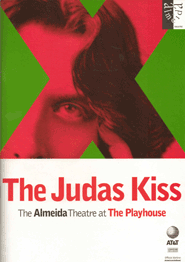

It is 15 years since I climbed the stairs to the Playhouse's peanut gallery to see the original Richard Eyre production which starred a rather out-of-place Liam Neeson as Oscar Wilde and a play-stealing turn from Tom Hollander as Lord Alfred 'Bosie' Douglas.  The play had vaguely stayed with me but I honestly didn't expect it to be revived anytime soon.  But now we had Australian director Neil Armfield's production and I was surprised how much I liked the play.

David Hare's play covers two key moments in the life of Oscar Wilde.  In April 1885, his libel case against the Marquis of Queensbury has collapsed leaving the way clear for his arrest for Gross Indecency.  His former lover Robbie Ross tips him off that the police are delaying his arrest, almost wanting him to flee to France but Wilde refuses.  Ross thinks he is staying to appease 'Bosie' his spoilt lover but Wilde stays because to flee would be to betray his life.

 
The second act takes place two years later in the run-down villa in Naples where the broken Wilde is now living with an unrepentantly petulant Lord Alfred who is shagging his way through the local Italian rough trade and looking to get away.  Again Ross appears to reprimand Wilde and remind him that his wife has threatened to refuse him any access to their sons if he sees 'Bosie' again but again Wilde refuses him.  He cannot live his life by other's demands, no matter the consequences or the obvious ruin that Bosie has led him to.  


Armfield's direction was minimal which may be fine for actors such as Everett and Cal MacAninch (superb at playing the vein-bursting frustration of Robbie Ross) but Freddie Fox as the awful 'Bosie' was left with nothing to do but stamp his foot and rant which got old very quickly.  Compared to Hollander's slyly manipulative portrayal, he was resolutely two-dimensional.


Something which cannot be levelled at Rupert Everett who gave a performance of total star power.  His Wilde, the agent of his own destruction, was played with real charisma - you simply couldn't watch anyone else when he was onstage.  It was the sudden shifts that surprised, the way his resigned and weary façade broke down at the simple generosity of the staff of the Cadogan Hotel where he was hiding.  He really came into his own in the second half as the broken ex-prisoner, shuffling around in his slippers when not huddled in his chair.  His weary, rueful manner giving way to one of total exhaustion, like a character out of Beckett.  After loving his recently published second book of memoir as well as enjoying his performance as Benedict Cumberbatch's brother in the BBC's PARADE'S END, it was great to see Everett triumph on stage too.

Further up St. Martin's Lane another actor was giving life to another revival.  Simon Russell Beale, taking a break from the National Theatre, appeared in the first production of Michael Grandage's season at the Noel Coward theatre PRIVATES ON PARADE.

 
This was a production I was looking forward to, Russell Beale is always worth seeing and I had only ever seen the film version of Peter Nichols' play which was a bit ho-hum.  Sadly the production promised more than it delivered.

At no time did it betray any need to be on that stage at that time.  Yes it's a play about the stupidity of war but it still didn't seem to chime with what's happening now in any other theatres (of war).  It felt more like Michael Grandage wanted Simon Russell Beale to open his theatre season and offered him a big camp role which is anarchic and outrageous but also provides the humanity and heart of the play.


Simon Russell Beale's audience had followed him over the river and there was plenty to drain their blue rinses: the soldiers' knobs got a good airing during the shower scene as well as a featured cameo appearance of Russell Beale's bum.  It must be odd to know that the big shocked reaction you have just heard from the audience is because you flashed your arse.  There was also more effing and jeffing than was probably heard in the whole Malayan conflict, mostly shouted by John Marquez' Corporal Bonny, who did little to dim the memory of Joe Melia's wonderful performance on screen.

It was all very well-directed and presented in the usual Donmar house-style thanks to the set by Christopher Oram and Neil Austin's excellent lighting and there were fine supporting performances from Davina Perera as Sylvia and Harry Hepple as Lance Corporal Charles Bishop but it somehow it just didn't move me.
 

There is no denying however that bestriding them all (usually in black stockings) was Simon Russell Beale as Acting Captain Terri Dennis who simply stole everything that wasn't nailed down with a performance that was outrageously funny and touchingly human.  He's some broad.

I also saw the revival of Terence Rattigan's THE WINSLOW BOY at the Old Vic.  Ever since his centenary those Rattigan productions just keep coming, everything it would seem but the Vivien Leigh screen version of THE DEEP BLUE SEA *fume*.


It was good to finally see the play as I had never seen either of the film versions and even managed to miss the 1989 BBC production which co-starred Emma Thompson as the titular boy's sister Catherine. 

Lindsay Posner directed this revival of Rattigan's 1946 hit play which he based on a real case in 1908 of a teenage boy expelled from a naval college after being accused of stealing a five shilling postal order.  Ronnie Winslow returns home in disgrace but his upstanding father Arthur is compelled to seek justice for him but as the Admiralty's ruling is considered an act of Government it can only be brought to trial by a decree from the.. um, Government.

With the family losing their place in 'good' society and Arthur becoming ill with the stress, their last hope rests with leading barrister Sir Robert Morton who is also a member of the opposition.  Winslow's suffragist daughter Catherine is strongly opposed to his involvement thinking he will only use the case to further his political career and because of his opposition to votes for women. 

In a scene which finally jolted Posner's rather tasteful production into life, Morton visits the house and ruthlessly cross-examines Ronnie in front of his appalled family, seeming to destroy the boy's story.  Morton then reveals he only did it to see how the boy might react to a courtroom and agrees to take on he case.

Through a mixture of guile and oratory Morton succeeds in getting the Government to agree to a court hearing which goes ahead with the Winslow home surrounded by newspaper reporters.  On the day of the trial Morton's ruthless cross-examinations force the Admiralty to withdraw it's charges against Ronnie and the family win the case.  But it's a hollow victory as the family is now near bankruptcy, Arthur's health is ruined as is Catherine's engagement to her Guardsman fiancée.


Any play about an individual trying to seek justice against an impossible bureaucracy will always be topical and Rattigan's play holds up well with it's expert construction.  Posner's production however felt safe and timid with several scenes seeming to tread water until the next entrance cue.  Owen asked me before it started what sort of a play it was and I assured him that at some point a scene would start with the maid turning on the study lamps and drawing the curtains.  And sure enough, there was Violet the loyal maid pulling the curtains and lighting the lamps on Peter McKintosh's rather obvious box set which looked like it belonged to a touring company.

Luckily what Posner was blessed with was a fine cast headed by Henry Goodman's benignly comfortable Arthur Winslow  who is broken by the system he has lived his life upholding.  There was good support from Deborah Findlay as Grace Winslow, ill-equipped to deal with the change wrought on her family and life, and also from Nick Hendrix as their oldest son Dickie who is happy enough learning the new dance steps rather than learn anything in Oxbridge - yes it was a silly-ass part but played with great wit.  Catherine was played by Naomi Frederick and a little more personality wouldn't have gone amiss while Charlie Rowe's Ronnie betrayed a lack of stage experience.  A special mention to Jay Villiers as the family solicitor who quietly loved Catherine.

However the stand-out performance was Peter Sullivan as Sir Robert Morton.  The production's synapses were jolted every time he appeared and his witty, self-assured, disdainful Sir Robert also gave the impression of having a heart under all that veneer.  I've seen Peter Sullivan a few times on stage and here he was finally allowed to take control of the play.  I certainly missed him when he was offstage.

There is a tragic postscript to the story of George Archer-Shee whose story was the inspiration for the play.  The case was won in 1910 but his father Martin, worn down by the two year fight for justice died in 1911.  In 1912, after completing his education, young George emigrated to New York to work on Wall Street.

Two years later in 1914 he returned to enlist in the war, and at the age of only 19, became one of the 17, 873 British soldiers reported missing in action after the first battle of Ypres.

Tuesday, February 01, 2011

FINALLY! My 2011 theatre-going duck has been broken. I knew there was a reason why I was feeling unduly jittery. It's been so long I had to think twice to make sure I was sitting in the seat properly. And what was the production that saw me back in the theatrical saddle? The rather underwhelming AN IDEAL HUSBAND at the Vaudeville Theatre.

I had wanted to see this for a while and, mindful that it was due to close in February, I booked two in the circle using a £10 off discount. Well, I'm not sure what the stalls were doing but my, we were an intimate collection of punters in the Dress - there were 5 of us in J row - and we were seated in seats 1-5! Needless to say there was much spreading out in the interval. In all other rows there were yawning spaces - between the yawning audience.

The production just feels tired, as if the cast had expended all energy in the months leading up to Christmas in the expectation that it would close early. But no, here we are in it's third month and it seemed to me that all the actors were appearing in different plays. If they had a cohesion under Lindsay Posner's direction initially it seems to have been given the go-by. I sat in my little seat in J row and pined for Oliver Parker's screen version - and I didn't expect to say that anytime soon.Oscar Wilde's play is certainly worth this timely revival with it's plot of a seemingly teflon-coated politician gliding his way slowly but surely up the parliamentary foodchain until confronted with evidence from his past which will ruin him if exposed. Peter Hall's acclaimed and long-running revival in the early 1990s also seemed au courant during the end of John Major's Conservative government. But I guess a politician with a secret is never going to be out of fashion - and in the week when it was announced that the Police were going to re-open the News Of The World phone-hacking case it was particularly thrilling to hear Robert Chiltern say "Spies are of no use nowadays... the newspapers do their work instead"!

What also struck me was how prophetic it was of Wilde's own destiny. The play premiered in January 1895 and only three months later Wilde was in court for the criminal libel charge he brought against the Marquise of Queensberry which led to his own trial for gross indecency and sodomy. Time and again in the play, the subject of a public figure ruined by scandal is raised and while watching it I could see Wilde at his writing desk writing a line, looking up, half-smiling and continuing on to possibly write:

Mrs Cheverley: Sir Robert, you know what your English newspapers are like. ... Think of their loathsome joy, of the delight they would have in dragging you down, of the mud and mire they would plunge you in. Think of the hypocrite with his greasy smile penning his leading article, and arranging the foulness of the public placard.

Oh Oscar you silly arse.What was so annoying about the production was the way all the performances - and accents - seemed to clash. From High Comedy to naturalistic, from idiosyncratic to BBC 3 sitcom there was no unity of style, time and again a character would come on stage and suddenly you are forced to adapt to a new acting style so you are never sure on which level the play truly sits.

Charles Kay is so busy with his harrumphing codger as Lord Goring's father that you can hear the rhythm of the accent while the actual words get lost in the bluster, Rachael Sterling as Lady Chiltern is so similar in her honking tone to her mother Diana Rigg that it keeps pulling focus and Fiona Button plays the Thoroughly Modern Miss that is Sir Robert's younger sister in the usual high-pitched voice that seems the default condescending accent now for The Ingenue. Of course one goes to a Wilde play to be pinioned by the darts of epigrammatic wit but here they are mostly confined to one very long second scene and all delivered by one character Lady Markby, played here by Caroline Blakiston. However as hers is such a one-note performance you begin to wonder is it ever going to end and it begins to resemble nothing more than the most hackneyed sitcom: line - line - joke, line - line joke.

Which brings me to Elliot Cowan as Lord Goring. In the role he was born to play Rupert Everett was sublime in the film version but here Cowan as Wilde's cynical playboy throws away one good laugh line after another by speaking in the most bizarre accent. I suspect that somewhere along the line he has heard the recording allegedly of Wilde reading THE BALLAD OF READING GAOL and has adopted the ew-sew mannered way of speaking with leeeengthened vowellls and what haeve yoooo that you want to punch him silent.
What makes this absurd is that he is the only one speaking like this and when he plays scenes with Alexander Hanson as Sir Robert, who speaks his lines in the most conversational way possible, it leaves you no way to just relax into the scene. Hanson is fine, but I joined Owen in wondering why he can't walk across a stage without skiffing the soles of his shoes. I kept expecting his blackmailed politician to break into a buck and wing.

Thank God for Samantha Bond! Although she appears to be channeling her frequent co-star Judi Dench vocally, she alone knows how to play High Comedy on stage while still creating a character with a possible internal life. Her sly and calculating Mrs. Cheverley was a pure delight and I pined for her when she was not onstage - Oscar you clown, why on earth did you not have her make an appearance in the final long-winded scene?

The supporting company all played the long party scene at the top of the play with an anonymity which almost had them semaphoring "don't worry, the stars will be on soon". One bright spot was Max Digby as Goring's manservant Phipps who got a bigger laugh with one line than Cowan managed with a whole speech.

Stephen Brimson Lewis can usually be relied upon for a glittery design but here we got a standing set of burnished gold which suggested that he too had seen MADAME DE SADE at the Wyndhams two years ago. Apart from his costumes for Mrs. Cheverley, the costumes for the women all looked like they were bolts of fabric ready to go back to Borovics in the morning.Oh well. Onwards and upwards into the theatreland of 2011....