Showing posts with label musical. Show all posts

Saturday, November 16, 2013

Ghost Light documentaries


I had two visits to the recent London Film Festival but in an odd twist, it was to see two documentaries that took Broadway legends as it's subjects: Marvin Hamlisch and Elaine Stritch.  With similar subject matter, it was also interesting to compare the two styles of documentary.

MARVIN HAMLISCH: WHAT HE DID FOR LOVE was directed by Dori Berinstein who was also the director of the wonderful SHOW BUSINESS: THE ROAD TO BROADWAY which chronicled the fortunes of four shows during the 2003-4 Broadway season.  Dori was at the screening and told us that she had finished editing it only a few days before.  Also in the audience was Maria Friedman who featured in the latter part of the film.


Dori Berinstein knew Hamlisch personally and her documentary is a loving tribute to the composer who in the space of three years won 3 Academy Awards (all in one night!), a Tony Award, the Pulitzer Prize and a Grammy Award.  His later Emmy Award made him one of only eleven performers who have won all these major performance honours.  A Julliard-trained pianist, he went from being a child prodigy to a career on Broadway and in films rather than into the expected classical concert halls.

Although shy when growing up, with his fame came a new bravura which made Hamlisch a popular chat-show guest on both sides of the pond which provides Berinstein with a wealth of footage, an odd occurrence for a composer.  She has also interviewed a wide-ranging group of artists that Hamlisch worked with over the years: Barbra Streisand, Liza Minnelli, Carly Simon, Ann-Margret, Quincy Jones, Tim Rice, John Lithgow, Carole Bayer Sager, Alan & Marilyn Bergman, Idina Menzel, Steven Soderbergh, Christopher Walken... they're all here.

Dori Berinstein covers his career in a fluid and involving style, from a cossetted Jewish upbringing to his Julliard years, and his stint as the FUNNY GIRL rehearsal pianist which led to his lifelong friendship with Barbra Streisand.  His moonlighting as a pianist at private parties led to meeting film producer Sam Spiegel and an entrĂ©e into composing for films but his first love was the Broadway musical.  After the massive success of A CHORUS LINE and the popular THEY'RE PLAYING OUR SONG Hamlisch found it difficult to keep up the momentum and the film covers his despondency over this.  Interviews with his wife Terre Blair give us an insight into the private man and his sudden death in 2012 is obviously deeply felt by her and colleagues.

 
Later on in the day, while crossing Waterloo Bridge, we bumped into Dori Berinstein so I took the opportunity to tell her how much I had enjoyed the film!  I also told her how much I had enjoyed SHOW BUSINESS and we had a lovely long chat about theatre in NY and London.  She was very interested in my memories of Hamlisch's musical JEAN SEBERG at the National Theatre which I had seen 5 times - never seeing the same show twice.  She said "I should have had you in the film"!  I was thrilled.

The second documentary was ELAINE STRITCH: SHOOT ME, a film by Chiemi Karasawa on the unstoppable Broadway star.  The director was at the screening as well as Stritch's music director Rob Bowman and her friend Julie Keyes.  We arrived at the ICA in the middle of a torrential downpour so watching the film was a very clammy experience as the audience was a mass of leaking shoes and steaming clothes.

Karasawa's film is sometimes hilarious, sometimes queasy, always fascinating look at how an 88 year old woman is still pursuing a career in show business, despite failing faculties and beset by fluctuating blood sugar levels.

The film covers the year 2011 when Stritch had just finished appearing in the revival of A LITTLE NIGHT MUSIC opposite Bernadette Peters, filmed her last appearance in 30 ROCK and started rehearsing for her cabaret turn SINGING SONDHEIM... ONE SONG AT A TIME at the Carlyle Hotel (where she was a resident) - a full schedule for even someone half her age.  I think it is telling that of her 5 Tony Award nominations, she managed to finally win for her one-woman show.  She is her best performance.

We watch as Stritch paces the show out in rehearsal with her patient m.d. Rob Bowman which is at times painful to watch as she grows more angry with each forgotten song lyric.  Bowman truly displays the patience of Job but, with a career that has already encompassed 5 Tony nominations, 8 Emmy nominations, working with Bela Lugosi, originating roles in musicals from Coward to Sondheim, Stritch has high professional standards that refuse to compromise to piffling things such as health and age.  She also keeps up a series of one-nighter appearances and it is during one of these out-of-town that she is hospitalised.  But she refuses to compromise: tickets have been sold for the Carlyle show as well as a one-nighter at New York Town Hall and she must deliver the goods.
 

When we finally see the shows it is a revelation: what to the audience are jokes about forgetting lines and the running order etc. are actually the truth.  Stritch even tells the Carlyle audience that the reason the show is called ONE SONG AT A TIME is because that's all she can hope to remember.  Needless to say the audience roars with laughter.  But having seen the rehearsals we know that it's not just a schtick, she is telling them the truth.  It comes as no surprise that, after another hospitalisation after her Carlyle shows, that she confesses that the only real love she has ever felt is the audience's.

Indeed the level of access the director has had at times seems intrusive but Chiemi Karasawa said afterwards that although Stritch was very disappointed with the film when she first saw it - "the honeymoon period was over" quipped Julie Keyes, "we've all been there" - now she is very happy with it, possibly because she has seen how positive the reactions are of audiences to it.  Karasawa said Stritch had given her notes on what to edit out but she hasn't touched it! 


As with the Hamlisch film, there are many fans of her work interviewed: Tina Fey, Alec Baldwin, George C. Woolf, Cherry Jones, Hal Prince, John Turturro and the late James Gandolfini (who would have thought he would be the first to go?) all praise her.  Chiemi Karasawa said after it that the one person who wouldn't appear was Sondheim.  She said that they have a loving but wary relationship - we see his telegram on her opening night at the Carlyle excusing his absence but ruefully noting she can change his lyrics now.  Karasawa said that after his refusals to appear, she had been worried about using his music in the concert footage as the film's budget was miniscule but she said they managed to get all they wanted. 

Both these documentaries are highly recommended and worth seeking out.

Saturday, November 02, 2013

Let's Hear It For The Boys!

Two American theatrical imports, two different styles of telling true stories through a musical form.
 
 
Constant Reader, no one was more surprised than me to find myself sitting in the Prince Edward last Saturday about to watch JERSEY BOYS, a production I thought I would never see.
 
Jukebox musicals don't do it for me and The Four Seasons never made any impression on me so I was happy to avoid it.  I was surprised when I read in the programme that the production opened FIVE years ago - I thought it had been running for about two!
 
 
What surprised me too was the sinewy and punchy script that placed us firmly in New Jersey and the blue-collar and mob-friendly background that the group sprang from.  Former Woody Allen co-writer Marshall Brickman and Rick Elice's script may skimp on real characterisation but they have hit on the idea of having the four members of the group each take a turn narrating the plot which gives each of them a definite identity.  It's also funny to think that of all the pop groups who have cultivated a bad-boy image, that it was the squeaky clean Four Seasons who actually had real criminal backgrounds.  I also learnt something new in that a young Joe Pesci used to be a gopher for the band!
 
The production zooms through the group's genesis and fitting the final jigsaw-piece that was Bob Gaudio and his facilty for penning a memorable pop song.  What was a bit irksome about the show was the relegating of Gaudio's song-writing partner Bob Crewe to a walk-on as the band's camp record producer.  Another major contribution to the show's success however is that you are never too far away from a song and the production is so sure of itself that it sometimes gives you just a verse and chorus of a song so it can plough on.
 
 
Des McAnuff's polished and slick production gives us success and failure, compromise and triumph, life and death.  Of course we get a handy telescoping of time.  According to the show, Tony DeVito's massive gambling and personal debts to the mob result in a forced relocation to Las Vegas and having to quit the band which also motivates Nick Massi to quit, whereas in real life Massi left the band five years before DeVito!  The show also takes in the death of Valli's daughter which in reality happened in 1980 and their induction into the Rock 'n' Roll Hall of Fame which happened in 1990 - all with no signs of aging among the cast at all.
 
A simple set of an elevated metal walkway and dodgy Lichtenstein-esque projections leaves the stage clear for the performers to hurtle around and although it would be asking too much for good acting too, there were lively and engaging performances from Jon Boydon as Tony DeVito, Edd Post as Bob Gaudio and - yes I really am writing this - ex-S Club 7 member Jon Lee as Frankie Valli.
 
 
Although I have never bought any of their records, the songs were immediately familiar - SHERRY, WALK LIKE A MAN, BIG GIRLS DON'T CRY, RAG DOLL, LET'S HANG ON, CAN'T TAKE MY EYES OFF YOU, BEGGIN',  DECEMBER 1963 (OH WHAT A NIGHT) and WHO LOVES YOU are all socked over the footlights to haunt you out onto the street and all the way home.  I guess the show did it's trick as I now have a compilation thanks to Owen!  Another major-plus for the show was there was no dreaded post-curtain-call megamix.  This probably annoyed the punters around me who were eager to clap along off-the-beat to anything played onstage but not me.
 
My only real titty-lip about JERSEY BOYS was the exclusion of their signing to Motown in the early '70s.  Although they had no hits while briefly on the label, it was where they recorded THE NIGHT, later a huge UK hit for them when reissued three years later in 1975.  But I must say thank you to Owen's brother and sister-in-law for wanting to see the show on their visit to London as I would otherwise not have seen this example of how a jukebox musical can be made enjoyable.
 
 
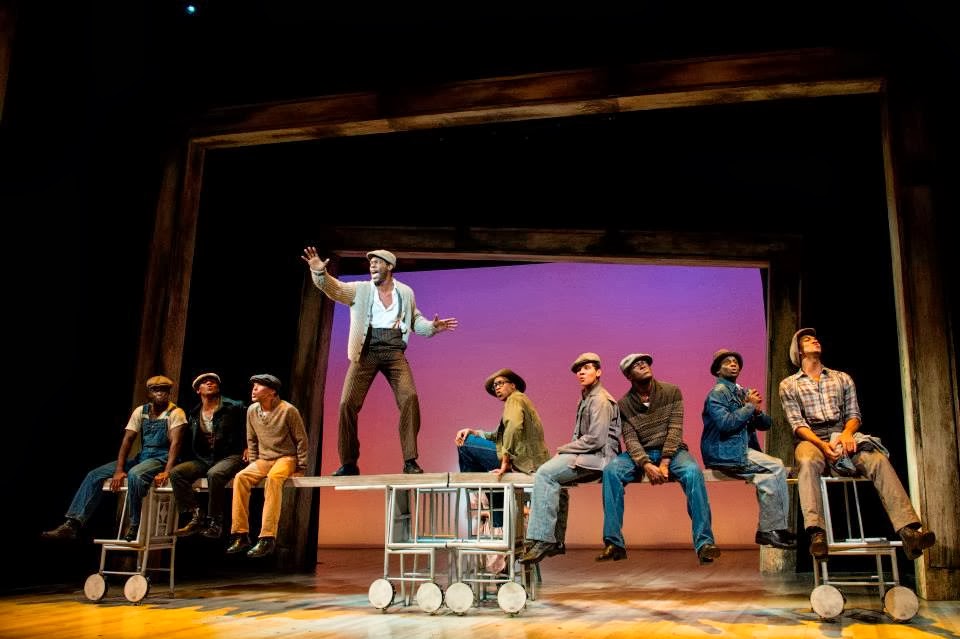
After this it was time to journey south - over the river to the Young Vic and from Jersey to Alabama with John Kander and the late Fred Ebb's THE SCOTTSBORO BOYS.
 
The show opened off-Broadway in 2010 for a two month limited run and received very good reviews.  Later that year it opened on Broadway in a bigger theatre but couldn't find an audience and closed, again after only two months.  The Tony Award committee recognised it with a staggering 12 nominations but it didn't win any of them, losing out mostly to THE BOOK OF MORMON juggernaut. 
 
 
Now director/choreographer Susan Stroman and her creative team have revived the production at the Young Vic and have given us an involving, inventive show that shocks as it delights.  In their two greatest scores Kander & Ebb have used showbiz forms to comment on uncomfortable events: The Kit-Kat Klub illustrates the growing power of the Nazis in CABARET while within CHICAGO's Vaudeville format lies a caustic look at the corrupt US justice system and tawdry celebrity.  THE SCOTTSBORO BOYS also deals with the US justice system but also how, to quote Richard Pryor (and David Thompson's book), when black Americans look for justice that's all they find, "just us". 
 
 
In 1931 nine black teenagers, travelling through Alabama to Memphis, were falsely accused of raping two white girls Victoria Price & Ruby Bates and sentenced to death.  For the next six years, they saw their sentences commuted only to be re-tried and found guilty again - despite one of the women admitting in court that she lied.  Their defence was funded by the American Communist Party and a successful New York lawyer defended them for free.  But he too was confronted by the racism that the boys were subjected to - the prosecution asked the re-trial jury "Is justice in the case going to be bought and sold in Alabama with Jew money from New York?"  In 1937, the four youngest defendants were allowed their freedom and bizarrely they were booked onto a vaudeville tour.  The remaining five either escaped or were paroled - the last being Andy Wright, paroled in 1950 after 19 years of wrongful imprisonment.


In an inspired artistic choice, THE SCOTTSBORO BOYS is told through the form of a minstrel show.  The minstrel form - white performers blacked-up - is subverted here by black performers playing white characters while still under the guidance of a white Interlocutor and refracts the racism of the real story through the accepted racism of the minstrel form.
 
 
On a bare stage apart from a pile of chairs, a white Interlocutor introduces his company of eleven black performers.  One of them asks if this time they can present the story as it happened while the Interlocutor assigns the roles of white authority to the company's two resident clowns Mr. Tambo and Mr. Bones.  All the while a woman, unseen by them all, shadows the action, watching as it unfolds.  She provides the coda to the show in a scene that I had guessed might be coming up after her first appearance at the top of the evening but according to the programme notes it does have a bearing with the Scotsboro case.
 
 
David Thompson's fine book has the minstrel performers slowly find their own voice through the retelling of the Scotsboro case - when the genial but threatening Interlocutor insists on hearing a good ol' soothing negro song the company duly deliver but slowly the lyrics change to take in lynchings and the Klan.  By the time of the finale, with his performers performing in blackface, the Interlocutor demands they join him in a traditional cakewalk but they refuse.
 
 
Kander & Ebb's score vibrates with various styles such as cakewalks, tap dances, point numbers and plaintive ballads, some of which homage their back catalogue e.g. a big comedy production number when Ruby Bates, the penitent white girl, changes her story in the courtroom echoes "When Velma Takes The Stand" from CHICAGO but the score is solid and each song adds depth to the story while propelling it forward.
 
 
Susan Stroman's excellent cast includes six American performers, five of whom have appeared in the show before.  Colman Domingo and Forrest McClendon reprise their Tony-nominated roles of Messrs. Bones and Tambo, Christian Dante White and James T. Lane ('Ritchie' in the recent revival of A CHORUS LINE) are riotous when playing Victoria Price and Ruby Bates and the lead role of Haywood Paterson, who refused to lie even if it meant the possibility of early release, is powerfully played by Kyle Scatliffe.
 
Julian Glover was an amiable but threatening Interlocutor, Dawn Hope had little to do as The Woman but did it with grace and Adebayo Bolaji ('Harpo' in the Menier COLOR PURPLE) was good as the combative Clarence Norris.
 
 
Beowulf Boritt's set design and Toni-Leslie James' costume designs are major contributors to the show's success as is Ken Billington's lighting design.  Stroman's choreography is inventive and insightful and she directs the show with clarity and power. 
 
In 2010 Susan Stroman co-directed and Beowulf Boritt designed the almighty dog-show that was PARADISE FOUND at the Menier but at the Young Vic with a remarkable cast and the genius team of John Kander and Freb Ebb they have triumphed in one of the shows of the year.
 
Do the clicky on the picture below to book tickets:
 
http://www.youngvic.org/whats-on/the-scottsboro-boys
 

Tuesday, August 27, 2013

TITANIC finally docks in London

A week or so ago I blogged about the pros and cons of seeing large-scale musicals revised to be staged in smaller venues.  Well you can't get bigger and/or smaller than the Maury Yeston musical TITANIC at the Southwark Playhouse.


I had never been to the Southwark Playhouse before.  It has a seating capacity of 240 and is designed so you enter through quite a large bar, get funnelled down a corridor then into the auditorium.  Sound ok?  Not on one of the hottest days of the year when the queue to get into the auditorium to nab one of the un-numbered seats joined the scrum in the bar and all the time the temperature went up or was that just my blood boiling at the sheer ineptness of fringe theatres to get a house in?  If you don't want to piss off your audience NUMBER YOUR BLOODY SEATS.  The Menier Chocolate Factory started off like that but has now entered civilization so come on!  Is there to be *no* progress?

Added to that tsouris we had the always fresh hell of the musical theatre drama students shrieking their heads off at each other allied to the seething hiss of the aged show queen.  I wouldn't put it past them to say they knew the band on the ill-fated ship.

 
Although this was the first time I had seen the show performed I have always been a huge fan of Maury Yeston's score thanks to the 1997 Broadway cast recording.  The derision that greeted the news of a Titanic musical lasted up to it's opening in April with mostly negative reviews but the show found an audience and lasted for nearly two years - indeed, although James Cameron's film opened in December 1997, it actually helped increase the show's attendance rather than the reverse as had been suggested.  At award time, the show's director and cast were all ignored but it won each of the five Tony Awards it was nominated for including Peter Stone's book, Yeston's score and the big one, Best Musical. 
 
By far the best component of the show is Yeston's score which takes in a wide range of contemporaneous musical styles of 1912: he gives us ragtime trots, Gilbert & Sullivan pastiches, stirring Elgar-esque themes, hymns, folk airs, all filtered through a traditional Broadway score of ballads and up-tempo numbers.  As much as I like Yeston's scores for GRAND HOTEL and NINE, his TITANIC score hits greatness with it's sweep of intimate and epic moments.
 
 
The design for the show was a simple bare floor stage, a moveable metal staircase and a single upper level/balcony which you entered under.  To get to the seats you walked past Greg Castiglioni as Thomas Andrews, the designer of the ill-fated ship, scribbling away at his desk.  Despite this, director Thom Sutherland took the opening song away from him, allocating it instead to Simon Green's J. Bruce Ismay, the owner of the White Star Line who famously not only pressurised the Captain to increase speed but who also survived by jumping into a lifeboat.  This production started with the cast shouting abuse at Ismay who turns to the audience and sings IN EVERY AGE.
 
 
The production boasts a cast of 20 which is remarkable for a production this size, Broadway boasted 37 cast members.  Of course this meant them rushing off as a 3rd class Irish immigrant to emerge minutes later as a 1st class millionaire but it's to the cast's credit that they all still managed to give strong, definable performances.  There were a couple of dodgy ones - Castiglioni's important second act solo MR. ANDREWS' VISION was horribly over-sung - even if he did had to contend with a platform tipping up underneath him (maybe I have explained him not singing the opening number?)  I was also praying for Jonathan David Dudley's Bellboy to drown, preferably five minutes after leaving Southampton.
 
 
But these were more than compensated by the very fine performances which were full of character, more than are given them in Stone's good but rather spare book: Green's Ismay was superbly hissable while James Austen-Murray stood out as the stoker Barrett.  His solo number, setting up the class divisions within the ship, was excellently sung, even if he had to contend with the distracting modern dance interpretations of shovelling coal around him!  His duet THE NIGHT WAS ALIVE with Matthew Crowe's radioman Harold Bride was also a stand-out, it was almost staged as a love song between the two men which certainly added a frisson to the number.
 
 
Celia Graham was very good as 2nd Class passenger Alice Beane, eager to mix with the upper echelons (vocally better than Victoria Clark on the cast recording) and as her disapproving husband Edgar, Oliver Hemsborough delivered a strong character above and beyond what the book provided for him.  James Hume was fine as Etches the 1st Class steward and SiĂ´n Lloyd was in fine voice as Officer Murdoch, although Stone's book propagates the unsubstantiated story that he shot himself as the ship sank which goes against what several credible eyewitnesses said.
 
 
Victoria Serra made a spirited Kate McGowan travelling to America with a hope for the future of herself and her unborn child while Dudley Stevens and Judith Street made the most of their touching ballad STILL, sung as their characters Isador and Ida Strauss prepare for death on the sinking ship rather than be separated.
 
These were the cast members who stood out for me but the ensemble singing was wonderful too on such numbers as GODSPEED TITANIC (a number that always gets my tear ducts going), LADIES MAID, NO MOON, WE'LL MEET TOMORROW and the FINALE.
 
 
Thom Sutherland's direction was very good given the constraints on his production and David Woodhead's design made invention out of necessity.  Howard Hudson's lighting also contributed to the show's overall success.  Although I would have loved to have had Yeston's sweeping score played by a full orchestra - as it was meant to be heard - Mark Aspinall's band of only six did well.  It was also a nice touch for the show to end with the names of those who died in the tragedy scrolling up the stage.  Indeed all the characters in Stone's book are based on real people aboard the ship although he does play God and alter a couple of fates to suit his story.
 
Although the show was running late, we stayed behind as - totally unbeknownst at the time of booking - Maury Yeston was actually there to give a talk with the ever-gushing critic Mark Shenton.  Now answer me this... why have the cast all head-mic'd for the show but not provide even hand-mics for the interview?  Sadly most of what Yeston had to say about the genesis of the show, his other works and his thoughts on musicals in general was *just* audible from where we were sitting - and as I said it's not that big an auditorium.  Again the cluelessness of this theatre just seemed to end up standing on my one good nerve.
 
But I am very happy that I had the opportunity to finally see TITANIC - and in such an inventive production - so as to fully understand how this excellent score serves the show.


Sunday, August 18, 2013

Heaven? You're in Heaven??

Are you still resting your reading eyes from my last extra-long blog?  Apologies Constant Reader, but when I get on a roll...  I can assure you this one will not be as long as I won't have to deal with such a production as the Menier's THE COLOR PURPLE.

Earlier this year the screen-to-stage musical TOP HAT won three Olivier Awards, which I must admit surprised me so I tied up my tap shoes and clacked off to the Aldwych Theatre.

 
One of the incidental pleasures in going was a rare visit to the Aldwych, one of London's most historically important theatres that has become a dumping ground for long-running screen-to-stage musicals like FAME and DIRTY DANCING, productions I would not be caught dead at.  This makes it an obvious fit for TOP HAT but how the ghosts of the Aldwych farceurs and the spectres from it 's time as the original London home of the Royal Shakespeare Theatre must sit in the gods with faces like slapped arses.
 
Perhaps the most famous of the Fred Astaire & Ginger Rogers films, TOP HAT (1935) has retained it's frothy, deliciously frivolous charm down the years.  The best Astaire & Rogers films conform to the template of boy meets girl, boy and girl tap dance, boy loses girl, boy and girl do a romantic dance, boy gets girl.  While Fred & Ginger break up to make up, they are usually helped and hindered by a comic supporting cast.  TOP HAT reunites the stars with their pals from THE GAY DIVORCEE (which I prefer to TOP HAT): Edward Everett Horton, Eric Blore and Erik Rhodes with the addition of Helen Broderick.
 
 
The scripts might now raise more smiles than laughs but their marvellous performances divert you from this.  Sadly this was not the case on stage.
 
Musical star Jerry has come to London to appear in producer Horace's show but his loud hoofing in Horace's hotel room annoys the neighbour Dale. When she complains Jerry falls hopelessly in love while Dale assumes he is Horace as she has been told who's room it is.  When she goes to Venice to model clothes for Italian designer Alberto Beddini, Jerry and Horace follow and who should be there too but Madge, Dale's best friend - and Horace's wife.  Of course you cry, Madge is her best friend but has never seen even a picture of her husband!  Jerry pursues Dale, Dale thinks he is Horace so makes a play for Beddini - endless romantic complications ensue.
 
 
As I said this plot can be sustained on film with practiced comedy performers all kept afloat on the gossamer choreography of Astaire and Hermes Pan.  Here, director Matthew White and Howard Jacques' script manages to sustain the action during the first act but by the second act with the switch to Italy fatigue sets in and I found myself caring less and less about the convolutions of the plot as so much of it rested on the supporting cast.
 
Olivier award winner Jon Morrell's costumes were colourful, Hildegarde Bechtler's set was efficient but boiled down to two flats and a middle revolve and Olivier Award winner Bill Deamer's choreography was smart and inventive but seemed to be aware of itself a little too much. To be honest, it seemed at it's best when delivered by the male members of the cast.
 
 
The show came into being as a vehicle for STRICTLY COME DANCING winner Tom Chambers but he had just been replaced by Gavin Lee.  Guess what?  Gavin Lee wasn't on so we had his understudy Alan Burkitt as Jerry who gave a perfectly fine performance but one totally devoid of star quality which is essential for the role.  We all know who has played the role before so you need to Bring It.
 
The other male performance of any note was from Alex Gaumond as the vain Italian designer Beddini who gave a spark of style to his role but he always seemed to have the air of looking faintly embarrassed - no need to be Alex, you were also one of the few saving graces in LEGALLY BLONDE a few years ago.
 
 
Dale was played by American import Kristen Beth Williams who seemed weighed down (probably by the extra name) in the quicksilver role of Dale Tremont.  There was also a certain tart quality to her performance which always seemed to jar with the overall whipped cream atmosphere.  She did however dance very well.
 
I have commented before about recent productions I have seen which seem to be cast with under-whelming supporting performers.  To be brutally honest, the level of performances in TOP HAT was like a bad am/dram company on a rainy Wednesday in Rhyl.  Yes, you Vivien Parry as Madge: a performance of quite rare banality especially when set against the flimsy performance of Clive Hayward as Horace.  I am sure it was a comic masterpiece in his dressing-room mirror.
 
 
TOP HAT also won the Olivier for Best Musical, it's opposition was the other screen-to-stage musical THE BODYGUARD, a yoof musical called LOSERVILLE and a glorified Tina Turner tribute show SOUL SISTER.  Against that line-up I too would have given it to TOP HAT, but quietly and probably wrapped in an old Tesco bag turned inside out.

Friday, August 16, 2013

Big Characters On Small Stages...

Constant Reader what is to be done with Broadway musicals that were written to be staged in big theatres with casts to match but no producer wants to take the risk of staging in one such space?

You downsize of course.  Why have a big chorus when your cast can meet themselves going off as they come on in a different wig?  Why have an auditorium like a barn when you can happily re-envision it for a small space in a converted workspace, railway arch or former public toilet?  Why have a full orchestra when the score can be orchestrated for a couple of synths and a man playing bog-paper on a comb?

 
DEAR WORLD is an ideal candidate for downsizing.  Based on Giraudoux's THE MADWOMAN OF CHAILLOT, the musical was written by Jerry Herman following the success of MAME as a vehicle for it's star Angela Lansbury.  Countess Aurelia is an eccentric who lives in the basement of a Parisian bistro.  Along with her equally misfit countess friends and a sewerman, she is appalled to learn that the area will be destroyed by businessmen who believe there's a lake of oil under it.  She sets about to destroy them instead.
 
The production, while aided by Herman's charmingly slight score, was beset by 'creative differences', the sacking of two directors and a choreographer.  It opened in February 1969 only to close three months later, although it did lead to Lansbury winning her 2nd Tony Award for Best Musical Actress and a cast recording left to posterity.  Now show queens love nothing more than a juicy flop with a Diva belting out her solos on the cast album.  The DEAR WORLD cast recording has amassed the obligatory 'cult following' but with it's flop status still uppermost in theatrical minds who would be bold enough to stage a production in a large theatre for it's UK debut?  Easy - go ickle!


That's how DEAR WORLD found itself in the ever-strange Charing Cross Theatre - the latest renaming of the old Players Theatre under the arches of Charing Cross station.  It's narrow auditorium always leaves me vaguely uncomfortable and of course any show staged there has to compete with the nearby thundering trains.  I haven't seen too many productions there but I have never sat in a full auditorium for any of them.  The whole theatre gives off the air of rejection and transitiveness which is not the best atmosphere for a light and whimsical Parisian fable.

It was all perfectly pleasant with a nice revolving bistro revealing Aurelia's luxurious basement home and nice colourful costumes for the ladies.  But all the time I was watching it I was also aware of the compromised air about the production. Oh for a bigger stage for the dance routines - hell even a bigger space around the bistro for the cast to get on and off the stage!  But despite these drawbacks I did like Gillian Lynne's brisk direction and choreography.
 
 
A more, ahem, compact stage means that any faults in the book soon become exposed.  Even with a revised book DEAR WORLD would have you believe that the bistro waitress and young hero are in love because she sings a solo ballad about never having loved before.  In a busier show such plot shorthand can go unnoticed but here I just wondered "Where did THAT come from?"  Playing to a half-empty auditorium didn't help with the book's amiable jokes getting smiles rather than laughs.  I always feel in such situations an extra tension as an audience member: I must clap louder than I would at the end of the songs just to let the cast know they are not wasting their time being there.
 
There is also the problem of casting: have the actors been cast because they are the best for the role - or because they were all they could get?  Harsh I know, but when you look through the programme and all you see are performers who have done tours and understudy jobs you do begin to despair.


Although this production had these problems - and the additional of the dreaded loveable/punchable 'mute character - I did enjoy Katy Treharne as waitress Nina, she sang her afore-mentioned solo nicely.  Annabel Leventon and Rebecca Lock as Aurelia's equally cracked friends didn't overplay the grotesquerie and earned most of the laughs going.  Paul Nicholas was surprisingly good as the philosophical Sewerman who knows the world is going to ruin by the rubbish he finds.  It was very odd to see his subdued performance and think of 'Cousin Kevin' from TOMMY and the jiggly eejit in the white suit who sang 'Dancing With The Captain' on Top of The Pops!
 
Of course any show that is constructed as a star vehicle needs a star.  Luckily - somehow - this rather hole-in-the-arches production had bona-fide Broadway star Betty Buckley playing Countess Aurelia.  While DEAR WORLD was limping onto the Broadway stage in 1969, Betty Buckley was starring in London in Bacharach and David's musical PROMISES PROMISES at the Prince of Wales and was now back again after 44 years, albeit with the odd cabaret appearance betwixt times.


I first saw her in her film debut as the sympathetic gym teacher in CARRIE and then through the cast recording of THE MYSTERY OF EDWIN DROOD in which she 'Edwin'.  I was also aware of her version of 'Memory' as she was Broadway's original Grizabella in CATS which might explain why Trevor Nunn was in the audience.  Seeing him reminded me of Buckley's appearance in the documentary BROADWAY: THE GOLDEN AGE recalling the exhaustive auditions she went through to get it.

It is a tribute to her professionalism that despite the half-empty house and reduced production, she gave an exquisitely charismatic performance.  Not a barnstorming Diva turn but true to the character and perfectly judged for the production she was in.  Her performance of the Countess' cri de coeur "I Don't Want To Know" was particularly moving.  It was a pleasure to finally see her in a proper show.  But it was not a big surprise to later hear that the show closed two weeks early.
 
 
What is important when downsizing a big show to a more intimate space is to have a vision and that's exactly what John Doyle had done with the Menier Chocolate Factory's production of THE COLOR PURPLE.
 
 
I was in two minds about seeing it as when it appeared on Broadway in 2005 it seemed to be just a big vanity project for Oprah Winfrey and I couldn't see what value it would have here.  I had read Alice Walker's novel back in the day as well as seeing the Spielberg screen adaptation which apart from some fine performances was like all the rainy Sundays in your life put together.  But for want of something to see I booked.
 
John Doyle was lauded for his 2004 scaled-down version of SWEENEY TODD where the cast played the instruments too.  "How visionary" the critics cried, to which I replied "How cheap"!  He worked at the Watermill Theatre Newbury for God's sake - like they can afford an orchestra!  However he delivered a good production of Sondheim's ROAD SHOW at the Menier - with actual musicians! - and with Nicola Hughes and Christopher Colquhoun in the cast I decided to give it a go.
 
 
The first surprise was to find the Menier auditorium reconfigured again.  Instead of the proscenium for MERRILY WE ROLL ALONG we had a thrust stage with seating at the sides and end.  Doyle is also the set designer and his stage is of bare, clapboard which immediately suggested country shacks and a number of wooden chairs hanging on the back wall.  Clean, economic, perfect.  The costumes are by reliable Matthew Wright, using pale, earthy colours until the arrival of blues singer Shug Avery when we get a splash of colour.
 
Marsha Norman had the tough job of adapting Alice Walker's novel with it's large number of characters and plot threads.  In pairing it back to keep our focus on the heroine Celie, her book skips over the plot like a hard-flung pebble which can only result in some drastic telescoping of character's timelines - we are introduced to Sofia and about 20 minutes later she has five children!  Sofia's brutal beating also is incorporated into a musical sequence and feels perfunctory.  

 
Celie and Nettie are sisters who support each other in their stepfather's joyless home.  Teenage Celie has had two children by her stepfather who has taken them both away from her. The stepfather refuses Mister's offer of marry Nettie and instead palms him off with Celie and a cow. Celie moves into Mister's equally joyless home and is distraught when Nettie vanishes after spurning Mister's advances.  Celie, thinking Nettie dead, is resigned to a life of drudgery alleviated by her friendship with the no-nonsense Sofia, wife of Harpo who is Mister's kind-hearted son.
 
Celie's salvation comes in the unlikely shape of blues singer Shug Avery.  Self-assertive and confident, she is a force of nature who even Mister can't control.  While staying in Mister's house, Shug and Celie are slowly drawn into a relationship which allows Celie to experience joy and love for the first time.  Shug also gives Celie letters that Mister has been hiding, they are from Nettie who has written constantly over the years revealing that not only is she is teaching with a missionary couple in Africa, but the couple also adopted Celie's two illegitimate children.  And that's all just the first half!
 

The ever-present music is composed by three accomplished songwriters: Brenda Russell ("Get Here"; "Piano In The Dark"), Allee Willis ("What Have I Done To Deserve This"; "Boogie Wonderland") and Stephen Bray ("Into The Groove; "Express Yourself") and it is a very tuneful score, notably using various styles of black music: spiritual, gospel, rolling blues, jazzy up-tempo numbers integrated into the more generic show tunes.

The score has been skilfully supervised by Menier favourite Catherine Jayes and is played by the eight piece band in a stripped-down style which suits the whole direction of Doyle's production.  This is also carried on through Ann Yee's lucid choreography which shows off the ensemble very well.  Speaking of the ensemble leads me onto the cast of seventeen which while being quite a big number by Menier standards is exactly half the size of the original Broadway cast!  Take it from me they sound better than the Broadway cast.
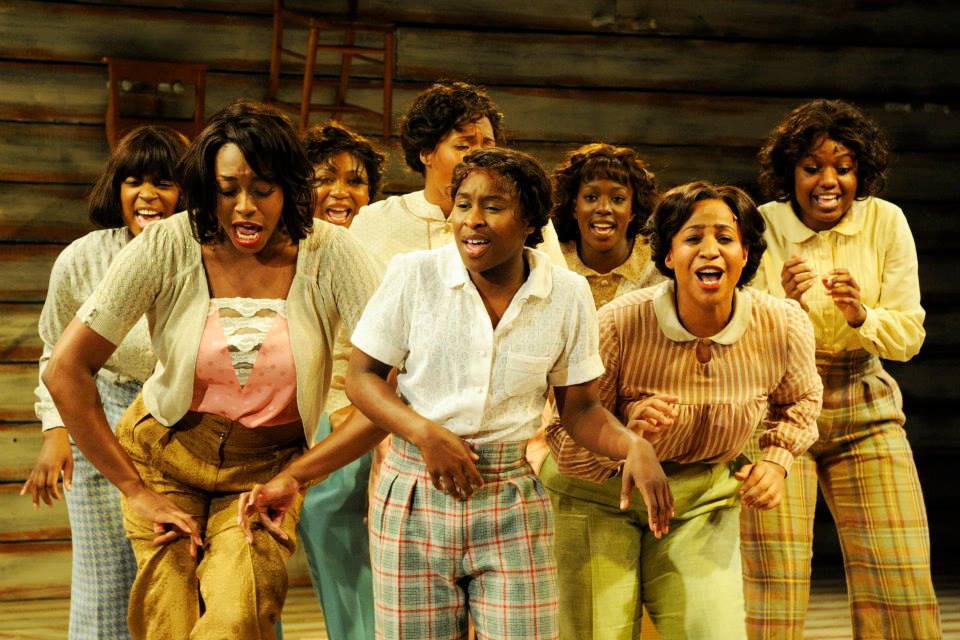
 
They are collectively splendid, singing in excellent voice with great timing and each has an individual quality rare these days.  You really get the feeling that Doyle has taken time over the casting.  Particular standouts are Sophia Nomvete as no-nonsense Sofia, Adebayo Bolaji as Harpo, caught between the rock of Sofia and the hard place of his tyrannical father and Lakesha Cammock as Squeak who takes up with Harpo when Sofia leaves him.  Abiona Omonua as Nettie was also fine although again Norman's book doesn't allow enough space for the reuniting of the sisters which should be the emotional g-spot of the evening.
 
In the difficult role of Mister, who has to go through a character volte-face towards the end, Christopher Colquhoun was charismatic and suggested the deeper hurt in Mister that made him the man he is long before the script demands it of him.  The role of Shug Avery needs an actress who can give the production a jolt of pure energy and justify the big build-up her character gets, as well as have a range that goes from gimlet-eyed brassiness to tender and loving.  The wonderful Nicola Hughes gives all that and more, she performs with a radiant energy that dazzles.  

 
The role of Celie is the glue that binds all the elements together. She is rarely offstage and grows up on it but, and most importantly, has to be able to convince the audience of the hidden passion and determination that flares up in the second half.  A self-pitying performance by the actress cast would make the evening a very long night.
 
Cynthia Erivo plays Celie with a quiet watchfulness that suits the character perfectly.  Her mask-like demeanour covers every slight, every insult thrown at her, every deprivation suffered.  Her stoicism raises laughs in the scene where she talks to Shug for the first time and says straight-faced that until Shug arrived she never realised her husband had a Christian name.  Erivo plays Celie's blossoming into a woman capable of loving and being loved with a simplicity which is truly touching and, in the important scene when she finally stands up to Mister, turns up the power so effortlessly that it's breath-taking. 
 

When Shug leaves her for a second time to take up with a teenage musician, Erivo plays Celie's refusal to be left behind with a righteous determination which leads into her eleven o'clock solo 'I'm Here' where Celie understands that she can finally stand on her own.  Cynthia Erivo takes what on paper sounds like a standard self-justifying ballad and turned it into a tour-de-force that was all the more thrilling to be sung on an empty stage in such an intimate space - you could feel the energy pouring out of her.  Constant Reader, what I think I'm trying to impart is that she sang the arse out of it and she deserved every clap of the thunderous ovation it received.

By the end there wasn't a dry eye in the house nor a seat left sat in when the cast took their bows.  The wearying Pavlovian response in audiences now to stand to applaud even the fire curtain is truly annoying but every so often you see a company who deserve to know how good they are.  This is such a cast and this is such a production.

 
It is sold out at the Menier until it's last night on September 14th - If ever a show cried out for a transfer it is this one.