Showing posts with label Peter Sullivan. Show all posts

Thursday, June 16, 2016

THE DEEP BLUE SEA at the Lyttelton Theatre - Helen McCrory's turn to dive in...

Peggy Ashcroft, Vivien Leigh, Penelope Keith, Penelope Wilton, Harriet Walter, Greta Scaachi, Rachel Weisz... quite a line-up eh?  Now Helen McCrory can be added to that list as she is the latest actress to play the desperate Hester Collyer in Terence Rattigan's masterpiece THE DEEP BLUE SEA which is now revived by Carrie Cracknell at the Lyttelton.


What makes this play Rattigan's masterpiece?  I think because this play more than any other seemed to spring directly from a moment in his life.  Rattigan, a closeted homosexual, had been in a relationship with a young actor Kenneth Morgan in the 1940s who decided to end the relationship, frustrated by his life in the shadows of Rattigan's world.  After a subsequent relationship failed, a distraught Morgan gassed himself.

Three years later and after much revising, THE DEEP BLUE SEA opened in the West End with Peggy Ashcroft as Hester, Kenneth More as her lover Freddie Page and Roland Culver as her estranged husband Sir William Collyer.  Watching the play again, it is remarkable how Rattigan - despite his relationship with Morgan - manages to balance out empathy among these characters and not make it all stacked up in Hester's corner.


West London, 1950s: Hester Collyer is found by her neighbours and landlady lying in front of her living-room gas fire, saved by the fact that the gas meter ran out of money.  Another neighbour who has vague medical experience deals with her ingestion of sleeping pills but what drove her to this, at the time, criminal act of Attempted Suicide?  Over the course of the day we discover that Hester has been driven to despair by the knowledge that her lover Freddie is falling out of love with her.

Hester left a safe, middle-class life as the wife of High Court judge Sir William Collyer soon after meeting the dashing, young WWII test pilot Freddie Page.  Freddie gave Hester the sexual fulfillment she never had with Sir William but, with work becoming increasingly hard due to his drinking, Freddie is tiring of Hester's emotional needs and when he decides to stay at a golfing event rather than return to celebrate her birthday Hester decides to choose "The Deep Blue Sea".


When Freddie returns Hester tries to cover up her actions but when he discovers her suicide note he responds angrily that he can no longer live like this and leaves.  An increasingly desperate Hester discovers he has been given a job offer in South America and attempts to manoeuvre him to return so she can win him back.

Instead she is visited twice by Sir William who, against all odds, offers her the possibility of returning to their married life together but Hester has grown emotionally away from him and ultimately it's Miller, the secretive neighbour with a medical past who provides Hester with a suggestion of renewal.


Carrie Cracknell's stays clear of any revisionist tricks - although the production has a superfluous 'auralscape' which groans and rumbles away as if Hester's West London boarding house will collapse at any minute, it's such a redundant addition.  Other than that production stumble, Cracknell does well in suggesting the quiet desperation in the lives of all the tenants in Mrs Elton's boarding house, not just Hester and Miller but also in the Welchs, a young married couple who are already showing hairline fractures in their life together.

Tom Scutt's boarding-house set has translucent walls which allow you to see the neighbour's comings and goings and shut-in lives which certainly suggests the secrets that Hester is faced with keeping - her unmarried life with Freddie and the hushed-up suicide attempt.  It's problem is that Hester and Freddie's flat is hardly the dingy one that Rattigan envisioned Hester trapped in alone.


At times I felt the production was a bit under-powered in it's male casting.  In the important role of Freddie Tom Burke could certainly do the "surly teenager" behaviour of Hester's lover but I didn't believe for a minute that this man would inspire grand passion in anyone, no matter how good he was in bed.

I also felt Nick Fletcher was too lightweight for the shadowy Mr Miler.  It is slowly revealed that Miller has served time in prison which has resulted in him losing the right to practise medicine and his brusque exterior hides someone who feels just as ostracized as Hester and it is he who plants the vital thought of how she can get through her pain.  It's a great part but here Fletcher seemed to just shine it on.


Much better was Peter Sullivan as Hester's estranged husband Sir William, played younger here than usual.  Collyer is not a bad man, he just cannot give Hester what she now has experienced with Freddie and despite his suggesting that the door is still open for her at the family home, he knows that his safe and mundane life will go on without her and Sullivan captured this perfectly.

There is nice support too from Marion Bailey as the genial landlady Mrs Elton and Yolanda Kettle as the newly-married neighbour Ann, a potential Hester-like wife who pines for her frequently absent husband.


But of course any production of THE DEEP BLUE SEA needs an actress at the top of her game and Helen McCrory gives a performance of nerve-shredding anxiety.  Over the course of the play's single day setting we see Hester defeated, cowed, cunning, loving, distraught but finally... herself.  On paper she can seem a silly, over-emotional woman so you need an actress who is willing to go all the way off the scale to make her situation real and McCrory does just that.  Even though I know the play she still had me wondering how she could come back from the edge of disaster.

It's a talk with Mr Miller who starts the rebirth of Hester followed by a resigned last meeting with Freddie and Helen McCrory was sensational in this last beautifully-written section of the play, as the parting lovers skirt over the undertow of pain in their parting with niceties and attempts to be 'decent' about things.  In the silent last moments of the play, McCrory was magnetic... who else could make cooking a scrambled egg so absorbing? Again, magnificent McCrory makes a role all her own.


Sunday, July 21, 2013

Revivalists: Act two

Now Constant Reader, it might seem like I only see revivals at the National Theatre but I have actually gone to other theatres... like, in the actual West End.  All have featured fine performances but the actual productions themselves all felt wanting of real conviction.


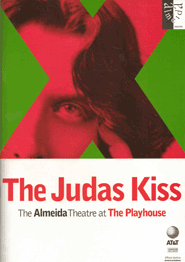
Having missed David Hare's THE JUDAS KISS at Hampstead I caught up with it finally at the Duke of Yorks, primarily to see Rupert Everett's lauded performance.


It is 15 years since I climbed the stairs to the Playhouse's peanut gallery to see the original Richard Eyre production which starred a rather out-of-place Liam Neeson as Oscar Wilde and a play-stealing turn from Tom Hollander as Lord Alfred 'Bosie' Douglas.  The play had vaguely stayed with me but I honestly didn't expect it to be revived anytime soon.  But now we had Australian director Neil Armfield's production and I was surprised how much I liked the play.

David Hare's play covers two key moments in the life of Oscar Wilde.  In April 1885, his libel case against the Marquis of Queensbury has collapsed leaving the way clear for his arrest for Gross Indecency.  His former lover Robbie Ross tips him off that the police are delaying his arrest, almost wanting him to flee to France but Wilde refuses.  Ross thinks he is staying to appease 'Bosie' his spoilt lover but Wilde stays because to flee would be to betray his life.

 
The second act takes place two years later in the run-down villa in Naples where the broken Wilde is now living with an unrepentantly petulant Lord Alfred who is shagging his way through the local Italian rough trade and looking to get away.  Again Ross appears to reprimand Wilde and remind him that his wife has threatened to refuse him any access to their sons if he sees 'Bosie' again but again Wilde refuses him.  He cannot live his life by other's demands, no matter the consequences or the obvious ruin that Bosie has led him to.  


Armfield's direction was minimal which may be fine for actors such as Everett and Cal MacAninch (superb at playing the vein-bursting frustration of Robbie Ross) but Freddie Fox as the awful 'Bosie' was left with nothing to do but stamp his foot and rant which got old very quickly.  Compared to Hollander's slyly manipulative portrayal, he was resolutely two-dimensional.


Something which cannot be levelled at Rupert Everett who gave a performance of total star power.  His Wilde, the agent of his own destruction, was played with real charisma - you simply couldn't watch anyone else when he was onstage.  It was the sudden shifts that surprised, the way his resigned and weary façade broke down at the simple generosity of the staff of the Cadogan Hotel where he was hiding.  He really came into his own in the second half as the broken ex-prisoner, shuffling around in his slippers when not huddled in his chair.  His weary, rueful manner giving way to one of total exhaustion, like a character out of Beckett.  After loving his recently published second book of memoir as well as enjoying his performance as Benedict Cumberbatch's brother in the BBC's PARADE'S END, it was great to see Everett triumph on stage too.

Further up St. Martin's Lane another actor was giving life to another revival.  Simon Russell Beale, taking a break from the National Theatre, appeared in the first production of Michael Grandage's season at the Noel Coward theatre PRIVATES ON PARADE.

 
This was a production I was looking forward to, Russell Beale is always worth seeing and I had only ever seen the film version of Peter Nichols' play which was a bit ho-hum.  Sadly the production promised more than it delivered.

At no time did it betray any need to be on that stage at that time.  Yes it's a play about the stupidity of war but it still didn't seem to chime with what's happening now in any other theatres (of war).  It felt more like Michael Grandage wanted Simon Russell Beale to open his theatre season and offered him a big camp role which is anarchic and outrageous but also provides the humanity and heart of the play.


Simon Russell Beale's audience had followed him over the river and there was plenty to drain their blue rinses: the soldiers' knobs got a good airing during the shower scene as well as a featured cameo appearance of Russell Beale's bum.  It must be odd to know that the big shocked reaction you have just heard from the audience is because you flashed your arse.  There was also more effing and jeffing than was probably heard in the whole Malayan conflict, mostly shouted by John Marquez' Corporal Bonny, who did little to dim the memory of Joe Melia's wonderful performance on screen.

It was all very well-directed and presented in the usual Donmar house-style thanks to the set by Christopher Oram and Neil Austin's excellent lighting and there were fine supporting performances from Davina Perera as Sylvia and Harry Hepple as Lance Corporal Charles Bishop but it somehow it just didn't move me.
 

There is no denying however that bestriding them all (usually in black stockings) was Simon Russell Beale as Acting Captain Terri Dennis who simply stole everything that wasn't nailed down with a performance that was outrageously funny and touchingly human.  He's some broad.

I also saw the revival of Terence Rattigan's THE WINSLOW BOY at the Old Vic.  Ever since his centenary those Rattigan productions just keep coming, everything it would seem but the Vivien Leigh screen version of THE DEEP BLUE SEA *fume*.


It was good to finally see the play as I had never seen either of the film versions and even managed to miss the 1989 BBC production which co-starred Emma Thompson as the titular boy's sister Catherine. 

Lindsay Posner directed this revival of Rattigan's 1946 hit play which he based on a real case in 1908 of a teenage boy expelled from a naval college after being accused of stealing a five shilling postal order.  Ronnie Winslow returns home in disgrace but his upstanding father Arthur is compelled to seek justice for him but as the Admiralty's ruling is considered an act of Government it can only be brought to trial by a decree from the.. um, Government.

With the family losing their place in 'good' society and Arthur becoming ill with the stress, their last hope rests with leading barrister Sir Robert Morton who is also a member of the opposition.  Winslow's suffragist daughter Catherine is strongly opposed to his involvement thinking he will only use the case to further his political career and because of his opposition to votes for women. 

In a scene which finally jolted Posner's rather tasteful production into life, Morton visits the house and ruthlessly cross-examines Ronnie in front of his appalled family, seeming to destroy the boy's story.  Morton then reveals he only did it to see how the boy might react to a courtroom and agrees to take on he case.

Through a mixture of guile and oratory Morton succeeds in getting the Government to agree to a court hearing which goes ahead with the Winslow home surrounded by newspaper reporters.  On the day of the trial Morton's ruthless cross-examinations force the Admiralty to withdraw it's charges against Ronnie and the family win the case.  But it's a hollow victory as the family is now near bankruptcy, Arthur's health is ruined as is Catherine's engagement to her Guardsman fiancée.


Any play about an individual trying to seek justice against an impossible bureaucracy will always be topical and Rattigan's play holds up well with it's expert construction.  Posner's production however felt safe and timid with several scenes seeming to tread water until the next entrance cue.  Owen asked me before it started what sort of a play it was and I assured him that at some point a scene would start with the maid turning on the study lamps and drawing the curtains.  And sure enough, there was Violet the loyal maid pulling the curtains and lighting the lamps on Peter McKintosh's rather obvious box set which looked like it belonged to a touring company.

Luckily what Posner was blessed with was a fine cast headed by Henry Goodman's benignly comfortable Arthur Winslow  who is broken by the system he has lived his life upholding.  There was good support from Deborah Findlay as Grace Winslow, ill-equipped to deal with the change wrought on her family and life, and also from Nick Hendrix as their oldest son Dickie who is happy enough learning the new dance steps rather than learn anything in Oxbridge - yes it was a silly-ass part but played with great wit.  Catherine was played by Naomi Frederick and a little more personality wouldn't have gone amiss while Charlie Rowe's Ronnie betrayed a lack of stage experience.  A special mention to Jay Villiers as the family solicitor who quietly loved Catherine.

However the stand-out performance was Peter Sullivan as Sir Robert Morton.  The production's synapses were jolted every time he appeared and his witty, self-assured, disdainful Sir Robert also gave the impression of having a heart under all that veneer.  I've seen Peter Sullivan a few times on stage and here he was finally allowed to take control of the play.  I certainly missed him when he was offstage.

There is a tragic postscript to the story of George Archer-Shee whose story was the inspiration for the play.  The case was won in 1910 but his father Martin, worn down by the two year fight for justice died in 1911.  In 1912, after completing his education, young George emigrated to New York to work on Wall Street.

Two years later in 1914 he returned to enlist in the war, and at the age of only 19, became one of the 17, 873 British soldiers reported missing in action after the first battle of Ypres.

Monday, April 11, 2011

Two...count 'em two... visits to the National Theatre in the past week.

Midweek I flew solo to the Lyttleton Theatre launchpad to take Clifford Odets' ROCKET TO THE MOON. There, got all the puns in at the start. Owing to Owen's continued lurgy I had the option of an empty seat next to me to use as a table for coat, programme, bag etc. Better that than offering the ticket back to the box office due to the worrying sign Tickets Available for the Lyttleton.In 1984, Bill Bryden directed a revival of Odets' boxing melodramatic GOLDEN BOY at the Lyttleton and 27 years later the National Theatre have decided to do another of his plays!

When it comes to productions in London, Odets definitely loses out in the shakes to Tennessee Williams and Arthur Miller and after seeing ROCKET TO THE MOON I'm not that surprised. His plays are well-constructed with well-drawn, meat-and-potatoes working class characters but they lack that extra something to lift them to a more profound level.
Last produced in London in 1982 at Hampstead which transferred briefly to the West End, ROCKET TO THE MOON takes place in New York during the broiling summer of 1938. In the stifling offices of dentist Ben Stark business has dropped as the heat has risen, and with the empty hours comes restlessness and temptation.

Ben had ambitions once but they have been stymied through circumstance and is happy to be under the benign thumb of his wife Belle, both of them trying to move on from the death three years earlier of their baby son. Their main point of contention is his friendliness with her father who she has distanced herself from since her mother's death.
Ben sublets his offices to a fellow dentist Phil Cooper, whose sardonic asides barely cover his desperation at his livelihood vanishing. Into this tinderbox situation sashays Ben's new dental nurse Cleo Singer whose office and nursing skills leave much to be desired but whose zest for life and affability can not be matched.

When Cleo confesses to Ben that her stories of a happy family background are told to cover up her real existence as the only wage-earner in an ungrateful household, they are drawn together and start an affair, Cleo's love making him believe in himself again. But when Ben's father-in-law starts laying siege to Cleo's affections too - and the Talent Agent down the hall starts sniffing around too - it can only lead to disappointment and regret.
The play, for all it's blue-collar ranginess of 'little' people struggling to keep their head's above the flow of the times, feels oddly paced and is hampered by a fairly long first half and a second which abruptly changes emphasis. It is as if Odets approached the play differently every time he came to write a new scene. One can only surmise that the actions of the Ben, Cleo and Belle characters mirrored at times his own life as at the time of writing he was married to Hollywood screen star Luise Rainer while romancing another, Frances Farmer.

Odets had started the affair with Farmer the previous year after she left Hollywood in an attempt to gain some kudos as a stage performer by appearing with The Group Theatre company in GOLDEN BOY. The Group Theatre - who had staged all Odets' plays since his ground-breaking debut about the unions WAITING FOR LEFTY in 1935 - was *the* theatre company to work for but Farmer eventually felt disenchanted with the company and, when no further roles were offered, had the impression she had only been used as a box office draw for the play. It was indeed their most successful play financially.Director Angus Jackson tries to keep the various shifts of emphasis under control and it's not entirely his fault or his company that the last odd lurch of the play doesn't quite ring true. He is not helped either by the play being staged on the expanse of the Lyttleton stage, no wonder Ben's business is dodgy - he is paying rent on an office the size of Grand Central Station. The play and Jackson's direction seemingly cries out for the intimacy of a space such as the Cottesloe or the Donmar.

That is not to put the blast on Anthony Ward's set which is virtually a 3-d rendering of an Edward Hopper painting - large windows illuminating solitary figures surrounded by suffocating silence.

Bizarrely enough I was even more impressed with the small corridor at the left of the stage - the perfect recreation of the awful, drab corridors found in any NY office block from the period. My attention however kept getting drawn to the fact that the top section of the set wasn't joined to the main back wall so kept waiting for a massive set change that never happened.


One thing Odets knew how to do was give actors chewy characters to work with and mostly they make good. Joseph Millson was an interesting choice as Ben, I suspect the character should be played by an older, more burnt-out actor but if there is one thing Millson does well it's the conflicted leading man and he made Ben more sympathetic for that age shift. Keeley Hawes however could do nothing with the role of the exasperated Belle, it was a portrayal that seemed to entirely consist of mannerisms with no interior spark.
Making the most of their supporting roles were Nicholas Woodeson as the wealthy and gregarious Mr. Prince, Ben's father-in-law and Peter Sullivan as the unlucky fellow-dentist. Always 'on' and with the rejoinders of a Catskills resort comic Mr. Prince can be an exhausting character but Woodeson played him with a roguish charm no more so than in his brusque proposal of marriage to Cleo, merely a business merger for their mutual gain.

Peter Sullivan was excellent as the flailing, failing fellow-dentist, denied help at every turn and finally becoming a paid blood donor to make ends meet. Through this role and Sullivan's performance one gets a suggestion of why the play is being performed now with his fear of being unable to pay the never-ending bills that his family and failing business engender.The performance of the evening was Jessica Raine as the endearingly naive Cleo. In a role that Marilyn Monroe would - and should - have triumphed in, Cleo's ditsy exterior covers a heart as cowed and afraid as the men surrounding her and in the final scene, when Odets gives her the possibility of a shining future lived according to her own ideals, you find yourself willing her on.

Odets seems entranced with his glittering creation and I suspect Cleo would have had a more depressing end in the hands of other writers. Raine went from fluttering Judy Holliday-like daftness to wordly-but-wise Jean Harlow go-getting broad in the blink of an eye and was utterly enchanting.If you want a meandering but solidly well-acted night at the theatre, than you could do a lot worse than visit the Lyttleton. Ultimately however, I left feeling once again that Clifford Odets' literary reputation isn't fully justified.

I guess you had to be there at the time.