Showing posts with label Liam Mower. Show all posts

Tuesday, October 26, 2021

Back to Before: The Theatre - THE MIDNIGHT BELL at Sadler's Wells

On 10th March 2020, I went to Covent Garden to see Liam Scarlett's SWAN LAKE.

On 9th October 2021, I went to Sadler Wells to see Matthew Bourne's THE MIDNIGHT BELL.

In the lockdown months I wondered what production would lure me back to sit in an auditorium with, like, germ-riddled strangers.  It would have to be something amazing, a favourite choreographer embracing the works of a favourite author maybe?  "Hold my pint" said Matthew Bourne, putting down his copy of HANGOVER SQUARE...

Patrick Hamilton has a strange legacy; his fame was as the writer of two very successful plays that were made into famous films GASLIGHT and ROPE but more importantly now are the books he wrote before, during and after WWII which chronicle the pathetic lives of those who skulk in the shadows of London and commuter towns; nervy spinsters, predatory tarts and anonymous men who pass you by on the street but who might bore you at the pub, fleece you of your money or worse.
 

The quiet desperation that drives his characters poured from Hamilton - his life hit a critical peak in the late 1920s when the pain from an obsessive love for a prostitute only heightened when he was run over by a car which disfigured him.  An alcoholic for most of his life, he died aged 58 of cirrhosis of the liver.

Luckily the two plays were huge successes which helped finance his novel-writing, and if you have ever read his magnificent trilogy TWENTY-THOUSAND STREETS UNDER THE SKY (1935), HANGOVER SQUARE (1941) or THE SLAVES OF SOLITUDE (1947) they will have seeped into your memory and Matthew Bourne has brought Hamilton's memorable characters to life in THE MIDNIGHT BELL.


Although he has taken the pub setting from TWENTY THOUSAND STREETS, Bourne gives us Hamilton fans the wonderful premise of the main characters from his greatest novels all meeting there - Bob, Ella, Jenny and Ernest Eccles (TWENTY-THOUSAND STREETS), George Harvey Bone and Netta (HANGOVER SQUARE), Miss Roach (SLAVES OF SOLITUDE) and Ernest Gorse (THE GORSE TRILOGY).  In an inspired move, Bourne has invented two new characters: west end chorus boy Albert and a secretive pub customer Frank who become covert lovers.
 
In the early 1930s, Bob and Ella are co-workers in The Midnight Bell pub in Marylebone; their easy cameraderie hides Ella's unrequited love for him,  One night, Bob is attracted to a young prostitute Jenny when she visits the pub.  Bob becomes obsessed but the relationship is unbalanced by Jenny being sometimes loving, sometimes dismissive.  Sadly watching from the sidelines, Ella finds herself hounded by pub bore Ernest Eccles.
 

Also in the pub, lonely Miss Roach is singled out for attention by the swindler Gorse when he spots how wealthy she is, Albert and Frank send coded flirtations in the bar and end up in an unhappy relationship, while George Harvey Bone devotedly trails behind the disdainful Netta, an out-of-work actress who delights in humiliating him, although she is unaware that Bone is subjected to sudden schizophrenic fugues.

I loved THE MIDNIGHT BELL - well I would wouldn't I? - at only two hours long Bourne packs so much into his scenario and allows his choreography to stay grounded in a hypnotic style; content dictates form here and he has not fallen back into his regular choreographic style which can sometimes not serve the story - here his more signature moves are used to heighten the mood of the storyline: the gay lovers furtive love-making on a park bench echoes the gay lovers in THE INFERNAL GALLOP, a sprightly pas-de-deux danced by Bob and Ella illustrates a film musical watched in a cinema - unlike the real life Bob and Ella, musical lovers are always happy.  The approach is perfectly captured in the opening: Bob dances a solo worthy of Astaire which ends abruptly when his alarm going off and he is back in the drab bedroom over the pub.


His cast of ten dancers make a wonderful ensemble but there are a few real standouts: last seen as Bourne's neurotic Romeo, Paris Fitzpatrick made an equally lovelorn Bob, tormented by the noncommital Jenny, very well danced by Bryony Wood as she slowly becomes a blank-eyed tart. Bourne regular Michela Meazza added another fine portrayal to her repertoire as the prim Miss Roach falling in love with the nasty Gorse while another Bourne veteran Daisy May Kemp was an imperious nasty Netta. 
 
Richard Winsor has had an extended break from the New Adventures world with a regular role in "Casualty" but he's back in the fold and was marvellous as the dangerously schizo Bone.  Liam Mower, another longtime Bourne dancer, was great as the aloof chorus boy who seduces the new pub customer who hides a secret.


Bourne has reunited with his longtime production collaborators too and all contribute to the show's success: Lez Brotherston's spare, evocative design places it in the drab pubs and back bedrooms of Soho and Fitzrovia, Paule Constable's lighting design illuminates a word of shadow and cigarette-smoke haze while Terry Davies' mournful score is punctuated, PENNIES FROM HEAVEN style, by perfectly chosen 1930s pop songs which provide a bittersweet counterpoint to the characters' sad lives; the artists included are Hutch, Elisabeth Welch, Arthur Tracy and the incomparable Al Bowlly.
 
It's two-month tour is coming to it's end with dates in Oxford, Poole, Coventry, Inverness and Bath, do see it if you can but hopefully it won't be too long before it returns for a longer stay.  It deserves it.  So, back to theatres - will it last?  One has to wonder as in the two venues I have visited I was disappointed how what I assumed would be knowledgable audiences, most were not masked.

Stay safe, Constant Reader...


Sunday, December 30, 2018

SWAN LAKE at Sadler's Wells - Bourne Again...

I last saw Matthew Bourne's iconic SWAN LAKE in 2013 and in the intervening five years - thanks to Wayne McGregor's WOOLF WORKS for the Royal Ballet - I have had a wider exposure to both classical and modern ballet, mostly at Covent Garden.  So it was with added excitement that I took my seat - K row stalls of course - to see again this very special production.


This was my fifth time seeing Bourne's SWAN LAKE in the theatre and it never fails to move me emotionally in it's dying moments; other Bourne productions may now seem too much style over content - EDWARD SCISSORHANDS, DORIAN GRAY - but SWAN LAKE taps into the emotions and always delivers.

Bourne has re-visited his masterpiece and now has Paule Constable as the lighting designer and added video images by Duncan McLean, it was delightful to see the little touches that kept it fresh.  Lez Brotherston's designs are still wonderfully atmospheric and the excellent Bourne dancer Kerry Biggin has re-staged the show wonderfully.


Bourne's scenario stays the same: A lonely Prince has a distant relationship with his mother The Queen while surrounded by the soulless life at court.  Attempting to elude the plotting of the corrupt Private Secretary - who has paid a silly blonde to be his girlfriend - The Prince runs off into the night determined to drown himself in a lake. Once there he is surrounded by a bevy of swans and he instantly becomes enraptured by their leader, an imperious, mysterious Swan who guardedly returns the Prince's friendliness until they share a romantic pas-de-deux.  The Prince runs off exultant.

However the appearance of a dark and dangerous stranger at the Palace ball throws the Prince into a mental tailspin when the Stranger - who seems to embody the same magnetism as The Swan - jeers at the Prince and is determined to seduce the all-too-willing Queen.  When the Prince pulls a gun on the couple, all hell breaks loose, the girlfriend is shot trying to shield the Prince and he is dragged away.  Alone and delirious, his salvation appears with the arrival of the Swan but the bevy of jealous swans surround them wanting blood...


It's a production that just immerses me in it's tragic plot and as I said, in it's final moments I was again blinking back the tears.  The performances across the cast were as strong as always: Bourne favourite Liam Mower was a wonderfully fluid Prince, his smallest movements were tremulous and full of pain, making his final breakdown all the more heartbreaking; he really invested the character with an aching solitude.

Katrina Lyndon was a brittle yet lusty Queen and Freya Field found all the laughs in the clutzy girlfriend role while Glenn Graham was fine as the Private Secretary; the ensemble all gave committed performances and the four cygnet dancers got a huge and deserved ovation for their wonky, flapping set-piece.  The Swan / Stranger was commandingly danced by Max Westwell, making his debut with the New Adventures company, and he rose to the challenge of the two roles well.


So there we are... SWAN LAKE is back and brighter than ever.  All Sadler's Wells dates are sold out but it is then going on an extensive UK tour from January to May, visiting Milton Keynes, Birmingham, Southampton, Dublin, Glasgow, Bristol, Canterbury, Norwich, Liverpool, Wimbledon, Hull, Woking, Newcastle and Sheffield - check for availability by clicking here

Swans: Now and Forever...


Friday, December 29, 2017

CINDERELLA at Sadler's Wells: Cinders Bourne again...

If it's Christmas then there will be a Matthew Bourne production at Sadler's Wells and this year it's a return for his version of Prokofiev's CINDERELLA which we last saw there in 2010.


It was a delight to see it again but I also feel a bit more able to critique it now after having had more exposure to dance through seeing the work of the Royal Ballet.

Bourne sets his CINDERELLA in wartime London 1941 which is a good framework for the story as the chances of happiness were fleeting and could be snatched away quickly.  Cinderella is the put-upon child of a withdrawn father, isolated in his wheelchair, and her stepmother, a glamorous Joan Crawfordesque drunken maneater.  She shares the house with her 5 step-siblings: two vain sisters and 3 brothers: one a gay clothes designer, a shoe fetishist and a hyper-active lad.


Into their life stumbles an RAF pilot, disorientated and dishevelled, who Cinderella instantly falls for.  He runs out of the house with Cinders in hot pursuit and her life changes forever.  Cinderella is watched over by a ghostly angel who guides her through the London blitz and who even recreates the just-bombed nightclub the Cafe de Paris so Cinderella can have her moment in a pretty dress dancing with her RAF prince.

A night of love between them ends with the angel summoning Cinderella to flee at midnight but, caught again in the dangerous streets, Cinderella and her pilot both end up in the hospital - what chance for a happy ending now?


What dazzled most was the excellent set and costume design by Lez Brotherston who conjures haunting imagery - none more so than in the Cafe de Paris scene, based on the real event in March 1941 when the assumed-safe underground club was struck by two bombs that fell through a ventilation shaft and exploded on the dancefloor, killing 34 people and injuring 80.  Neil Austin's excellent lighting adds to the thrilling visual power.

Bourne excels in strong narratives but in CINDERELLA he loses clarity towards the end especially in the lengthy hospital scene which also includes a confusing flashback of her stepmother shooting her father then appearing in the hospital to smother Cinderella - why?  Up until then, the stepmother is portrayed as a comic vamp; the sudden lurch into melodrama just feels forced.


The central relationship between Cinderella and the pilot also feels ultimately negligible, they seem to be do a lot of rushing around chasing each other through the blackouts but they never really seem to connect as a couple, their best duet being in his bedroom while air-raids threaten overhead.  The idea of having five siblings for Cinderella dissipates the tension within their relationships; her two sisters are oddly anonymous as the brothers are given more attention-getting characters.

Bourne's choreography has it's signature moves but it would be good if you were not able to second guess some of them: the straight arms crossing at the elbows as couples dance being one.  As I said, some natural, clean lines would be nice occasionally.


However Ashley Shaw was delightful as Cinderella, creating a real sympathetic character - none more so than in her lovely solo with her brother's tailoring dummy which then turns into a duet with her hero - and Bourne regulars Michela Meazza and Liam Mower were excellent as nasty Sybil the stepmother and Cinderella's other-worldly Angel.

CINDERELLA is still a wonderful theatrical experience with our charming heroine, tormented hero, heavenly guide, nocturnal trouser-jiggling rentboys, brassy tarts, gas-mask dogs, glamorous nightclub patrons and lonely love-lorn Londoners all mixing together as the bombs fall and Prokofiev's dramatic, moody score soars. 


Next Christmas at Sadler's Wells?  Let's just say I'll be there...


Saturday, December 24, 2016

THE RED SHOES at Sadler's Wells - Bourne to dance...

After what has seemed an interminable wait, finally last Thursday it was time to see Matthew Bourne's new ballet, his stage adaptation of the classic ballet film, THE RED SHOES at Sadler's Wells.  It was certainly worth the wait, it is a wonderful feat of story-telling through dance to the lush music of film composer Bernard Herrmann.


I cannot say I have ever been totally sold on the film which I find rather emotionally sterile - not the first time I have felt that regarding a Michael Powell and Emeric Pressburger film - but it's cinematography and music certainly create memorable moments during the central 15 minute ballet sequence.  Personally I am with Val in A CHORUS LINE who shocks the other dancers by saying "Oh, yeah, let's get one thing straight.  See,  I  never heard about "The Red Shoes",  I  never saw "The Red Shoes",  I didn't give a fuck about "The Red Shoes."

The story remains the same - imperious ballet impresario  Boris Lermontov sees young ballerina Victoria Page dancing at a party given by her aunt and is impressed enough to offer her an audition for his company based in Monte Carlo.  Lermontov discreetly follows her progress as a member of the chorus so when the star ballerina Irina is injured , he promotes Victoria to her roles and ultimately to star in the company's new production, a version of Hans Christian Andersen's THE RED SHOES.


Victoria triumphs in the role of a girl who tries on a pair of magic red shoes only to find she cannot stop dancing in them, and also starts a relationship with the composer of the ballet Julian Craster .  The jealous Lermontov sacks Craster and Victoria chooses love over her career and leaves the company.  Their relationship founders however when they return to London after Victoria can only find work dancing in a tatty music hall.   She returns to Lermontov but the red shoes will again change her fate...

The intensely cinematic story is turned by Bourne into a wonderfully vivid and fluid ballet told through many different styles of dance: from classical ballet to romantic duets, from stiff social dancing to the routines of the music hall comedians and showgirls...


THE RED SHOES provides Matthew Bourne with a fantastic opportunity to tell a story which is never less than gripping and shows all his strengths as a master of narrative through dance, there are opportunities for him to show his fondness for character work - the ballet company and backstage creative team - but the importance of keeping the focus on the three main protagonists stops any indulgences in minor characters being too distracting as in his flawed version of EDWARD SCISSORHANDS.

Bourne is reunited with his previous collaborators, designer Lez Brotherston, lighting designer Paule Constable and orchestrator Terry Davies who all contribute hugely to the show's excellence - Brotherston's  evocative and atmospheric design of a rotating proscenium arch takes us both front and backstage  within seconds and his costumes are ravishing; Constable's powerful lighting creates mood and place on the stage, while Terry Davies has woven Herrmann's scores for films as diverse as CITIZEN KANE, THE GHOST AND MRS MUIR and FAHRENHEIT 451 into a seamless whole.


As usual, Bourne uses a  rotating cast of dancers who have all had previous experience in his productions: on the night we went, the luminous Cordelia Braithwaite was quite wonderful  as Victoria while the opposing, brooding men in her life were Sam Archer as Lermentov and Chris Trenfield as Craster.

As I said, Matthew Bourne gives great opportunities for supporting performers to shine and  here Liam Mower and Michela Meazza were excellent as the star performers in Lermontov's company - their jaded Covent Garden rehearsal was great fun to watch, and Glenn Graham was very effective as the company's ballet master and featured dancer.


It was thrilling to see Matthew Bourne again delivering an absolute classic  and THE RED SHOES provides a fitting climax to the year which started with his receiving a knighthood for services to dance.  Next year is New Adventures' 30th Anniversary which will see a regional tour for THE RED SHOES after it finishes it's sold out run at Sadler's Wells, a tour of Bourne early works called EARLY ADVENTURES and the year finishes with a revival of his production of CINDERELLA at Sadler's Wells.   

If you can I urge you to see THE RED SHOES, it has remained dancing around my mind like the red shoes of the title...


Wednesday, August 21, 2013

Bourne's Beauty

 
Quite a few months ago I went with Owen to have my senses well and truly shaken at the latest Matthew Bourne production SLEEPING BEAUTY.

Having missed it at Sadler's Wells we caught up with it on it's subsequent tour at Wimbledon.  How good that New Adventures, after playing in a major London venue for a month and a half, still include a London date on their tour.

Despite the best efforts of the shambolic Wimbledon Theatre staff - obviously conditioned to dealing with half-empty houses for the tribute act tat that is their usual fare but go into utter meltdown when faced with a sold out show - as well as the shockingly poor audience I was in the middle of, I have retained enough of a memory of the show to blog for you, Constant Reader.


My only experience of the SLEEPING BEAUTY ballet was being taken by my school to a English National Ballet production back in the day.  Indeed my only real memory of it was the teacher's long and laborious explanation of why we had to be vigilant for the 'Rose Adagio' danced by Princess Aurora in Act 1.  In the interval she then quizzed us on it but I guess I had nodded off or was looking at something else.

2012 saw the 25th anniversary of New Adventures and with SLEEPING BEAUTY Bourne completes his Tchaikovsky trilogy after his productions of NUTCRACKER! and SWAN LAKE which have both done so much to bring ballet to a wider audience.  His version of SLEEPING BEAUTY ditches Petipa's traditional tale and gives us a darkly romantic tale of Aurora, her love for the palace gardener Leo and the other-worldly creatures who alter their destiny.


Bourne retains the basic storyline but sets the start of the story in 1890, the year that SLEEPING BEAUTY premiered.  A childless King and Queen, having sought the help of the dark fairy Carabosse to have a baby, forget to invite her to their daughter's christening.  Carabosse appears and casts the famous spell that will see the Princess Aurora die at the age of 21 by pricking her finger. 

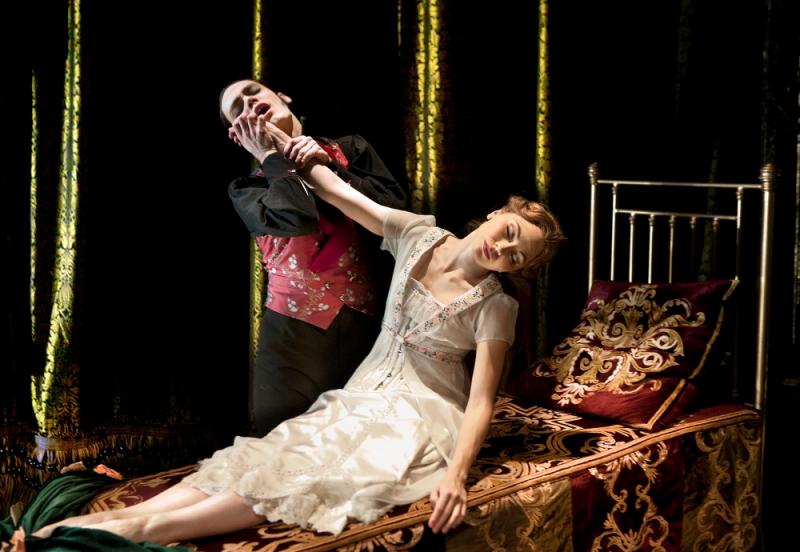
However The Lilac Fairy and his rag-tag retinue of fairies called Feral, Tantrum etc. arrive and mollify the spell so Aurora will not die but fall asleep for 100 years.  This scene introduced us not only to Liam Mower's wonderfully characterised Lilac Fairy but to Bourne's ingenious idea of having the baby Princess represented by a puppet who garnered laughs as she scampered around the stage and even up the curtains.

 
Flash forward to 1911 and Aurora's Edwardian 21st birthday party which she steals away from to spend time with Leo the gardener who loves her.  However a tall dark stranger appears who turns out to be Caradoc, the vengeful son of the now-dead Carabosse.  He implements his mother's plan and Aurora falls into a dead sleep as does the whole court.
 
But here Bourne encountered the problem of the story's insurmountable plot flaw - if Aurora has to sleep for 100 years, what then of Leo?  Here he has introduced a great zeitgeist idea of his own and the First Act ends with The Lilac Fairy biting Leo's neck turning him into an ageless vampire.  That's got the teenage girl audience sewn up!  This act introduced us to Hannah Vassallo's spirited and delightful Aurora, Bourne regulars Dominic North as Leo and Adam Maskell as the evil Caradoc (he had also played Carabosse).
 
 
The second act takes place in 2011 as Leo enters the palace's moonlit gardens to awaken Aurora with true love's kiss but he is foiled by the nasty Caradoc again who awakens Aurora instead to become his prisoner bride.  Leo and The Lilac Fairy then have to rescue Aurora from her fate worth than death and the climactic fight to the death between Leo and Caradoc takes place in the moody surroundings of a black and red nightclub which is the haunt of the evil retinue of Caradoc. 
 
Will Leo triumph?  Well, this IS a fairy tale... and there was also a delightful surprise at the end of the production which guaranteed it a massive round of applause.
 
I thoroughly enjoyed the sheer Gothic romanticism of Bourne's reimagining, his always entertaining choreography, the excellent performances of his lead dancers and tireless ensemble, and Les Brotherston's marvellous set design and costumes.  I particularly liked the punk elegance of The Lilac Fairy and his retinue with their frock coats and distressed layers of lace and silk.  He thoroughly deserved his Olivier award nomination.  Paule Constable's lighting design also contributed towards the success of the mis en scène.
 

If I did have a tiny complaint it's that not enough time is spent establishing Aurora and Leo's love story.  They had one lengthy pas de deux but that was all, it all felt a bit rushed and just assumed.  This is no reflection on the dancer's who were a delight to watch but on the sometimes thin quality of Bourne's scenarios.  Oddly enough it is usually felt most in establishing the love between his principal romantic couples.
 
This small quibble aside, I hope there will be another opportunity to see this wonderful addition to Bourne's canon of work again in the not too distant future.  I certainly wouldn't want to have to wait 100 years.