Showing posts with label Dulwich Picture Gallery. Show all posts

Sunday, April 18, 2021

Exit Through The Giftshop - Pictures At An Exhibition #22

More treasures of pleasures past...

1) STILL LIFE ON CORNER OF A MANTLEPIECE (1914) - Vanessa Bell

  
I bought this at the Dulwich Picture Gallery at their impressive Vanessa Bell exhibition in 2017 which sought to celebrate her as an artist rather than as merely a member of the Bloomsbury Group. 

Painted in her living room in Gordon Square, the composition shows her continued interest in post-impressionism, with a spray of paper flowers from The Omega Workshops providing inspiration for the painting and it's harmony of colours.

2) THE VIRGIN AND CHILD WITH SAINT JOHN AND ANGELS (circa 1494) - Michelangelo


As this painting is in the National Gallery collection, I presume I bought it there as part of a Renaissance exhibition.  It is understood to be one of the earliest surviving paintings of Michelangelo and, due to it's inclusion in the 1857 Manchester Art Exhibition, it is known widely as 'The Manchester Madonna',

Odd that if it is one of his earliest paintings he could never be bothered to finish it!  But it's the unfinished state that appeals to me, the ghostly angels at the left of the painting and the unpainted sections of the Virgin's cloak give it a solarised look that looks almost surrealist against the fully realised infant Christ and John the Baptist.  I like the small detail of the infant Christ reaching for the book that the Virgin is trying to keep away from him... As usual, Michelangelo's figures have a marble-like solidity.  And on the subject of Michelangelo's marble...

3) THE PIETA BANDINI (Detail) (1547-1555) - Michelangelo


This was bought at the Museo dell' Opera dei Duomo in Florence; it's a strange museum which houses most of the original works once in the Duomo... like, they could just move them back?  Michelangelo struggled with the sculpture for eight years before he damaged it, allegedly, in a fit of wilful destruction stating that the marble was flawed.  It is widely believed that the looming figure of Nicodemus is a self-portrait of the artist, then in his mid-seventies. 

Michelangelo's damage was extensive but was mostly restored by a sculpter named Tiberio Calcagni who had helped the Master with some of his commissions.  It had been allocated to Calcagni by Francesco Bandini, prelate of Siena, who had acquired it when Michelangelo left it with one of his servants.  It was originally to be used as decoration for Michelangelo's tomb but his unhappiness with it put paid to that.  The supporting figures of Mary Magdelene and the Virgin Mary are fairly unremarkable but the figure of Christ has a slippery solidity while the figure of the standing Nicodemus / Michelangelo commands the attention.

4) PORTRAIT OF MARIE ADELAIDE OF FRANCE IN TURKISH COSTUME (1753) - Jean-Etienne Liotard


I bought this at the Uffizi in Florence where the French Princess reads on, unconcerned at the steady stream of visitors to the gallery.  Liotard was fascinated by all things Turkish and he had a penchant for dressing his subjects in exotic clothing.  What I love about this is the thought that Princess Marie-Adelaide got all dressed up to go to a costume party then changed her mind and started reading on her couch!

Marie-Adelaide was the fourth daughter of Louis XV and lived at Versailles up until the Royal family were taken to live in Paris at the start of the revolution.  She never married due to a dearth of available Catholic princes but was a favourite of her father and as such, took a dislike to his official mistresses Madame de Pompadour and later Madame du Barry.  She attempted to recruit her niece by marriage Marie Antoinette to have du Barry socially ostracised but failed when the Dauphine spoke to du Barry.  This put Marie Antoinette on the Princess' hate list too.  She and her sisters managed to escape to Italy before the reign of terror and died in exile aged 67.

5) THE SITTING ROOM, MONK'S HOUSE, RODMELL, EAST SUSSEX


A very happy memory is visiting Monk's House on a sunny day in 2014.  Virginia and Leonard Woolf bought the house in an auction in 1919 for £700 and over the years, as they both became successful, they started making improvements to the rudimentary interior and garden.  They lived increasingly at Monk's House during the 20s and 30s due to Virginia's recurring mental breakdowns which were exacerbated by London life, and became a much-loved part of their life.  After Virginia's suicide in 1941, Leonard lived on at Monk's House until his own death in 1969.

Now operated by the National Trust, the sitting room is one of the ground-floor rooms available to view and it is a particular thrill to walk around it's stone-flagged floors and wondering how on earth the long and lanky Lytton Strachey managed to not brain himself on the low ceilings.  The sitting room has light green walls, painted by Virginia, which gives the room a cool, subterrranean feel.  I'd love to visit again.

Sunday, February 14, 2021

Exit Through The Giftshop - Pictures At An Exhibition #19

 Memories of treasures past...

1) CLOISTER OF SAINT ANTONINUS, SAN MARCO, FLORENCE (1436-1446) - Michelozzo

A favourite place in Florence, this is the cloister you enter into when you visit the San Marco convent.  From the busy square of the same name, you suddenly find yourself in the tranquil cloister with a large fresco of Saint Dominic with the crucified Christ by Fra Angelico facing you at the end of the first corridor. To your right is the entrance to the former pilgrim's hospice which houses many works by Fra Angelico in a single large room.  

The site of a monastery since the 12th Century, in 1437 the occupant order of monks were ordered to leave, making room for the Dominicans from the nearby village of Fiesole.  Finding the buildings in a bad state of disrepair, the monks requested help from Cosimo Medici The Elder who commissioned the architect Michelozzo to rebuild San Marco.  It's a must-see when visiting Florence.

2) AMERICAN GOTHIC (1930) - Grant Wood


An icon of 20th Century American painting, Grant Wood's AMERICAN GOTHIC has had a life of it's own from being used for endless parodies and instant cultural references.  I saw this at the Royal Academy's 2017 exhibition AMERICA AFTER THE FALL which looked at American art from the 1930s. Wood was born in Iowa in 1891 and started painting at an early age, drawing on the midwest landscape and people that surrounded him and he would later teach painting at the University of Iowa.  He died the day before his 51st birthday of pancreatic cancer.  

He lives on in his work and of course with AMERICAN GOTHIC, a painting of his sister Nan and his dentist Dr McKeeby!  The American Gothic alludes to the tall window in the farmhouse behind the couple.  Wood rejected all the reviewers who thought it must be a satire of mid-western people and said he meant it to be an honest representation, it is certainly hard to view without all the parodies coming to mind.

3) MAN OF SORROWS (1441) - Fra Angelico


One of the many stunning frescoes on the first floor of the San Marco convent (after you have past through the lovely cloister as seen above).  This is in cell 26 and the cell paintings were never meant to be seen by anyone but the Dominican monks who occupied the cells.  That is why the cell frescoes have a distilled quality to them, these are for meditation on the subject - here the suffering of Christ. 

Christ stands in his tomb presenting his wounds to a sorrowful Mary and the kneeling Saint Thomas.  What I love about it is the startling background: the cross, spear and sponge are physical objects of the crucifixion while - almost in filmic cut-aways - Christ is seen being kissed by Judas, St Peter being identified as an apostle, Christ is spat at and beaten with sticks while 30 pieces of silver are passed from hand to hand.  It's wonderful...

4) DUNCAN GRANT IN FRONT OF A MIRROR (1915-17) - Vanessa Bell

This was bought at the Dulwich Picture Gallery's fine exhibition of paintings by Vanessa Bell in 2017.  No doubt painted at Charleston, the painting gives an immediate sense of intimacy as Duncan poses with a coloured towel draped over his head, staring at himself and Vanessa in the mirror.

Duncan and his lover David Garnett had declared themselves concientious objectors during World War I which led to Vanessa finding Charleston Farmhouse in Firle to move into so the couple could stay there too while working as fruit farmers.  Friends since 1909, Vanessa and Duncan would briefly become lovers during this period which resulted in the birth of their daughter Angelica in 1918 - a fact that was kept from her until she was 18.

5) MADONNA OF HUMILITY (1440) - Fra Angelico


I bought this at Amsterdam's Rijks Museum where one of Fra Angelico's paintings of the Madonna of Humility is on permanent display.  Fra Angelico had a particular talent for this style of Madonna and child interpretation, representing not so much a static religious image but more of a tender moment caught between mother and child.

The glorious colour is lost in the postcard reproduction but Mary's blue cloak drapes and folds around her, the delicate gold edging coming and going among the folds.  This blue is offset by the rich gold of the emroided cloth that serves as a backdrop as well as the pattened golden cushion that she sits on.  A heartwarming rendition of a over-familiar image.

Sunday, January 31, 2021

Exit Through The Giftshop - Pictures At An Exhibition #17

As museums and galleries are still locked down here are some memories from the past...

1) THE LAST JUDGEMENT (detail) (1435-1440) - Fra Angelico


I bought this at the Gemaldegalerie in Berlin where Fra Angelico's impressive triptych of the Day of Judgement is on display. The central panel is Christ triumphant surrounded by his sainted besties and on the left panel he shows those blessed with life eternal and on the right those being tortured in Hell.  It possibly needs renovating to bring the painting back to what one assumes was it's vibrant life.

The postcard features a detail from the left panel where those bound for Heaven are being led by dancing angels; the flowing robes are beautifully realised in such tiny detail and they really stand out against the dark background as do the tiny buds and shrubs.


2) THE ANNUNCIATION (1440 - 1445) - Fra Angelico


This came from the San Marco monastery in Florence which is the home of this fresco, one of Fra Angelico's two masterpieces showing The Annunciation, the other is in the Prado.  In one of the great moments of "art theatre" you ascend the wide staircase to the first floor of San Marco where the monks' cells are located and as you turn the corner, you see this large fresco facing you at the top of the staircase - a real wow moment.

Fra Angelico, through the held gaze between the Angel Gabriel and The Virgin Mary, creates a captured moment of being; there is nothing to distract from the intensity of that moment, you believe the world has stopped outside.  It is marvellous to stand and revel at it's detail: the intricate painting of the relief at the top of the portico's pillars which give the image a perspective that breaks with the traditional flat look of Gothic paintings, the vivid pink and gold of Gabriel's robe is contrasted against Mary's blue cloak and his lovely multi-coloured wings also contains intricate detailing.  It's interesting how the flat rendering of the garden is offset by the depths of the trees beyond the fence.

3) THE TOWNEY DISKOBOLOS (circa 2nd Century AD) - unknown


This marvellous Roman marble statue was discovered near Hadrian's villa in Tivoli in 1791 and later acquired for the British Museum.  It is based on a now lost bronze statue, sculpted in the 5th Century BC by the Greek artist Myron.

When it was found, the statue was missing it's head but when it was purchased by Charles Townley he was told that the head had been found nearby.  Down the years there has been much conjecture as to whether it actually was the original head as another marble statue had been found a few years before with the athlete's head turned looking at the discus. Whatever it's genesis, it is still a wonderful rendering of the athlete about to launch his discus into the void.

4) THE BROKEN COLUMN (1944) - Freda Kahlo

One of the most famous and revealing of Frida Kahlo's self-portraits, she painted it in 1944 after she had spinal surgery to correct the injury she received 19 years before in a trolley-bus crash   I bought this in 2005 at Tate Modern when they had a major retrospective of her work.

Frida stands alone, impassively staring out at the viewer in a landscape that is as broken and split as her body.  Her torso is cracked open to reveal a broken but still-standing stone column instead of her spine.  She wears the cumbersome harness that doctors had her wear to correct her posture and her body is pierced with nails as in her own crucifiction.  Although there are tears on her face, she is still standing, still surviving.

5) PORTRAIT OF A GIRL WEARING A BLUE JERSEY (DORA CARRINGTON) (1912) - Mark Gertler


Bought at the marvellous CRISIS OF BRILLIANCE exhibition at the Dulwich Picture Gallery in 2013 which brought together six contempories who studied at the Slade Art School in the 1910s: Bomberg, Nevinson, Spencer, Nash and, as seen here, Mark Gertler and his subject Dora Carrington.

Through his arresting portrait you can feel Gertler attempting to capture the quicksilver modernity of Carrington, then aged 19, with her placid but determined stare, her self-cropped hair and the cool tones of her blue jersey against the sky. Gertler was to become obsessed with Carrington only to find that CRW Nevinson was also pursuing her.  Carrington, however kept them both at arm's length, wanting their friendship but not sex.  She later gave in to Gertler's persistance but it left them both unhappy and they kept a distant friendship afterwards.  Carrington committed suicide in 1932 in despair after the death of Lytton Strachey, the love of her life, and Gertler killed himself in 1939, lost in a swell of depression.

Sunday, August 14, 2016

Exit Through The Giftshop - Postcards at an exhibition....

More postcards from exhibitions and galleries...

1) UNVEILING COOKHAM WAR MEMORIAL (1922) - Stanley Spencer


I cannot remember if I bought this at the Dulwich Picture Gallery at their CRISIS OF BRILLIANCE exhibition or at the Stanley Spencer Gallery in his home town of Cookham.  That was quite a special visit as on the way there we visited the Memorial that is portrayed in his painting.

It was a bit quieter than the scene Spencer painted - his figures are squashed around the towering war memorial just after it has been unveiled with a billowing Union Jack being pushed out of the picture frame.  At the other side, young men lounge on the grass, almost deliberately ignoring the throng around the memorial, the people standing beside them look like they are in their best clothes and also seem to be ignoring the hubbub.  However Stanley draws our attention to the white-clad schoolgirls who are laying flowers at the base, doing their best to ignore the misbehaving schoolboys standing behind them although one of them is turning around to acknowledge them.  Oh and the bank of trees are in the distance?  That is now obscured by a large pub where we had our lunch!

2) LE DOCTEUR PAUL GACHET (1828-1909) (1890) - Vincent Van Gogh


This was bought at marvellous Musée D'Orsay in Paris.  Dr. Gachet not only knew a number of artists but was also an avid collector of their work.  Gachet's house was painted in a landscape by Cézanne and he numbered among his friends and clients Victor Hugo, Gustave Courbet, Camille Pissaro, Auguste Renoir and Eduard Manet.

Van Gogh's vibrant but turbulent painting of his doctor was one of his last paintings, completed only a month before his suicide.  The painter thought little of his doctor and Gachet's weary expression probably reflects his relationship with his troubled patient.

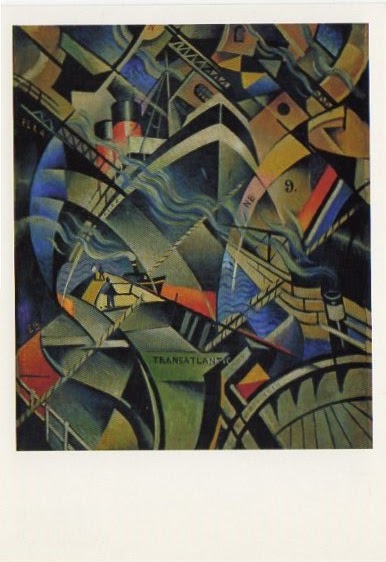
3) THE ARRIVAL (1913) - CRW Nevinson


Although this is a Tate postcard I suspect I bought it at the CRISIS OF BRILLIANCE exhibition at Dulwich Picture Gallery which celebrated the pre-world war class at the Slade School which included Mark Gertler, Dora Carrington, Paul Nash, Stanley Spencer and Christopher Nevinson.  It was an unhappy time for him; he fell in love with Carrington at the same time as his friend Gertler but she favoured the latter which ended his relationship with his friend, and he left with a lifelong grudge against his professor Henry Tonks who had advised him to give up painting.

In Paris just before WWI he met the Futurist painter Marinetti and immediately allied himself with the movement as well as it's UK spokesman Wyndham Lewis.  Their constant sniping at Bloomsbury and the British art world no doubt had been provoked by Nevinson's Slade experiences.  However, as is the nature of movements, their relationship foundered when Nevinson and Marinetti published a UK Futurist manifesto without consulting Lewis who in spite set up the Vorticist movement from which Nevinson was barred!  THE ARRIVAL however is a fascinating mixture of Cubist themes - the fractured planes of view, the numbers and lettering - but also the dynamic Futurist subject of the large ship looming into harbour and the streaming steam from the two tugboats in the foreground.

4) ANNE OF CLEVES (1540) - Hans Holbein the Younger


I bought this at a Holbein exhibition at Tate Britain in 2006.  All art misleads but sometimes it misleads famously.  Anxious to be married again, Henry VIII was urged by Thomas Cromwell, his feared advisor, to consider the German Anne of Cleves as a good prospect as her father was a staunch Protestant and could be an ally against the Pope.  Along with written accounts of her provided by Cromwell, court painter Hans Holbein was sent to paint several portraits of her.  Henry liked what he saw so it was full steam ahead.  On New Year's Eve 1539 the couple finally met - and the steam disappeared.

It turns out Holbein's full-on face portrait disguised her rather protruding nose as well as her pitted skin.  Holbein was not on the end of Henry's anger but Cromwell was.  The marriage was annulled as quickly as possible.  However Anne proved herself so amenable to the agreement that she had property and gifts lavished on her and was granted status as Henry's "beloved sister".  All of which left him free to marry Anne's previous lady-in-waiting Catherine Howard - on the same day that Cromwell was executed, a fate that Catherine suffered only 19 months later.  Anne's obvious common sense and pragmatism shines out from her infamous portrait.

5) MARIE ANTOINETTE A LA ROSE (1783) - Élisabeth Louise Vigée Le Brun


Another court-approved painter, another Queen, I bought this at the marvellous Vigée LeBrun exhibition at the Grand Palais, Paris last year.  Marie Antoinette, unhappy with the portraits that had been painted of her, turned in 1778 to the popular society painter Elisabeth Louise Vigée Le Brun to paint her portrait for her mother Empress Marie Theresa.  Both women were only 23 years old and developed a friendly working relationship; Vigée Le Brun was soon the unofficial court painter to the Queen and her family.  Skilled at downplaying any obvious failings in her sisters, Vigée Le Brun's portraits also glow with a warm-hearted humanity

In 1783, with the Queen's help, the painter was accepted into the Académie Royale and exhibited in the Salon for the first time.  It was, of course, a portrait of Marie Antoinette but it caused uproar as Vigée Le Brun had painted the Queen in a white muslin dress, holding a rose and wearing a plumed summer hat and no jewellery, a style the Queen favoured when at her own palace La Petit Trianon at Versailles.  The horrified opinion was that this was *not* how a Queen of France should be presented so it was quickly withdrawn and Vigée Le Brun painted a replacement with the Queen still holding a rose but more 'appropriately' attired in grey silk, lace and ribbons, pearls, a gold necklace, rouged and wearing a powdered wig with plumes.  Ironic isn't it that one of the charges against Marie Antoinette was that she too extravagant?  Vigée Le Brun's changing the setting from an indoor to an outdoor one also gives the portrait a more classical Romantic feel.

Friday, June 27, 2014

For Art's Sake 2: "...the God-given genius of certain individuals..."

There have been quite a few visits to galleries this year, some more memorable than others.

We went to the Dulwich Picture Gallery to see their exhibition titled DAVID HOCKEY: PRINTMAKER and while not making me any more of a fan, it certainly showed the breadth of his ever-roaming interest in creating art - the show even ended with artworks he has created on a photocopier. The colours were particularly vibrant and lush...


We also saw the exhibition at the National Gallery, STRANGE BEAUTY: MASTERS OF THE GERMAN RENAISSANCE.  Again it didn't exactly rock my world - once you have seen one North European wizened, monkey-like face you have seen them all.  But there were some that I really liked... Jan Van Eyck's famous "Arnolfini Portrait" of the named couple looking very stately yet mysterious, Lucas Cranach the Elder's enigmatic "Portrait of A Woman" and Hans Holbein was well represented by a cameo of Anne of Cleves as well as "A Lady With A Squirrel And A Starling" - the squirrel was particularly lovely!


At Tate Britain, there was a very interesting exhibition called KENNETH CLARKE: LOOKING FOR CIVILISATION which was an overview of the wide-ranging art collection which belonged to the art historian and broadcaster, whose 1969 BBC series CIVILISATION was one of the first 'personal view' arts series.

Across the exhibition you follow Clark's life, from his privileged upbringing to his remarkable ascension to being, at 30, the youngest ever director of the National Gallery.  He used his influence - and private wealth - to help artists on their way (particularly during WWII).  Also during WWII, he saved the National Gallery's finest works from the London bombings by hiding them in Welsh caves while keeping the building open for free lunch-time recitals. 

 
The show has been criticised for showing his traditionalist interests - he was famously dismissive of the 1950s explosion in Modern Art - but there was plenty to enjoy.  It is unsurprising however that Clark himself remained an elusive, anonymous subject - can you understand anyone simply by their interest in art?

Clark was a particular fan of Bloomsbury and in one of the rooms Duncan Grant and Vanessa Bell's self-portraits are close to each other, as well as Vanessa's portrait of daughter Angelica as a Russian princess and home furnishings designed by them too for Roger Fry's Omega Workshop.


 I was particularly excited to see two paintings by Seurat which I had never seen before: the mysterious and hazy "The Forest at Pontaubert" from 1881 and the glorious "Le Bec du Hoc, Grandcamp" from 1885.  The reproduction really does not do it justice - his remarkable use of colour in his pointillist style was hypnotic and I stood for a long time in front of it, lost in it's rhythm.

I was hugely engaged walking around the exhibition and among other fine works were a glowing Samuel Palmer painting from around 1830, some moody works by Victor Pasmore and John Piper and Paul Nash's epic BATTLE OF BRITAIN from 1941.


Sharing the space with this huge canvas were smaller, more painful works based on the human experience of conflict.  Henry Moore's cramped and gloomy sketches of people huddled together in the tube stations during the Blitz and the evocative and haunting works of Mary Kessell, a WWII accredited war artist who was based in Europe at the end of the conflict and was well-placed to document the refugees and the revealed horrors of the concentration camps.

I particularly liked her 1945 work "Refugees: '... pray ye that your fight be not in the winter...' Matthew XXIV, 20" of refugees trudging through an impenetrable winter.


This hugely enjoyable exhibition is on until 10th August.

Thursday, January 02, 2014

The Chrissies... Art, Music, Cinema, Events

It's the start of a new year so tradition must be upheld to look back on what I enjoyed in the previous 12 months.  After a year of little sensory pleasures 2013 gave me much to savour and enjoy, very little to ignore.
ART
 
From the unknown artists of the Ice Age to the pop age of Roy Lichtenstein, from the 1901 paintings of Picasso to the Profumo scandal of 1963 via George Catlin's paintings of native Americans, it has been a varied and fascinating year for exhibitions.


The Hayward Gallery's LIGHT SHOW collated installations including Ivan Navarro's mirrored, neon-lit telephone box, Carlos Cruz-Diez's chromatic series of single-colour rooms, Leo Villareal's shimmering cascade of white neon on silver and Olafur Eliasson's dizzying Model For A Timeless Garden (fountains of water seemingly frozen in time by neon light);  the National Portrait Gallery's MAN RAY: PORTRAITS showed his astounding experiments in photography; the Victoria & Albert's DAVID BOWIE IS took you on a journey through the ch-ch-ch-ch-changes of the first artist to fully understand how late 20th Century pop would be a real marriage of Sound and Vision while the Royal Academy's exhibition MODERN AMERICAN LIFE opened my eyes to the work of American painter and printmaker George Bellows.

 
But the Art Chrissie goes to A CRISIS OF BRILLIANCE at the Dulwich Picture Gallery which linked the artists Paul Nash, Christopher R.W. Nevinson, Stanley Spencer, Mark Gertler, Dora Carrington and David Bomberg who all attended the Slade Art School in the years 1908 -1912.  Although not a large exhibition, there was plenty to spark a curiosity in artists I had been too quick to overlook in the past, in particular Nevinson.  It also gave me an opportunity to commune with one of my favourite paintings, Carrington's portrait of Lytton Strachey.
 

It was an inspiring exhibition that was exhilarating but also moving as for most of the featured artists the 'crisis of brilliance' that their Slade Professor Henry Tonks accused them of having was never fully resolved.  I would like to take this opportunity to thank Stuart Kirk-Spriggs who has given me a new appreciation of some of the trickier areas of 20th Century art thanks to his inspired teaching. 

MUSIC
 
It's been a good year for gigs, mostly a string of awesome shows under the auspices of Yoko Ono's Meltdown festival on the South Bank.  Somehow - I'm still sure how - Owen managed to get tickets for both of the Siouxsie shows that were much sought after.  It made me remember how good Patti Smith's Meltdown festival had been in 2005.  Maybe all Meltdowns in future should be curated by female singers in their over-50s?

This year I've seen Boy George twice (thinner and bursting with confidence), Liza Minnelli (with the remnants of her voice and hips but glowing with pure star wattage), Petula Clark at 81 dominating the barn of Theatre Royal Drury Lane with class and showmanship, two alternative music queens Sinéad O'Connor and Viv Albertine wowing with passion and humour and an incandescent Pet Shop Boys show that lit up the O2.  Hopefully 2014 will see them back again now we are familiar with the new material.


For her Meltdown show, Marianne Faithfull turned the Queen Elizabeth Hall into an intimate club as she strolled through her back catalogue with guitarist Bill Frisell (she will back in November to celebrate 50 years in music); The B-52s brought their unique lunatic genius to the IndigO2 while, back at Meltdown, Patti Smith brought along the kids Jackson and Jessie to accompany her in an evening of prose and music where she was wonderfully goofy, caustic and relaxed!  And in the afore-mentioned shows, Siouxsie was quite magnificent, encased in a white PVC ensemble as she showcased the entire Banshees KALEIDOSCOPE album from 1980 then plunging into songs from their back catalogue as well as from her solo career.  They were her first shows in 5 years and she owned the stage - as some hapless oaf found out when he foolishly attempted to climb up.


But my Music Chrissie, and I am a bit surprised by this, goes to Amanda Palmer at the Roundhouse.  With her new band the Grand Theft Orchestra she showcased most of her 2012 album THEATRE IS EVIL (sez she) as well as older and some unrecorded songs.  As with the four acts mentioned above, Amanda creates her own unique world when she performs and this time was just as memorable.  What makes each show different is that she is unique in being able to take whatever is happening to her at that precise moment in her life and spin the show around it, making each one moment-specific.

The two great moments were when she sang BIGGER ON THE INSIDE a painfully honest examination of her recent spell of depression and DEAR DAILY MAIL in which she lambasted that ridiculous paper for highlighting her recent Glastonbury gig when her breast popped out of her bra.  She was, quite simply, her.

CINEMA

In rediscovered cinema I am grateful for the National Film Theatre (nope, still can't call it BFI Southbank) in giving me the chance to see three favourite actresses - Jean Seberg, Vivien Leigh, Vanessa Redgrave - on the big screen with screenings of BONJOUR TRISTESSE (in a sparkling new print), THE DEEP BLUE SEA (I've finally seen it!!) and an advance screening of the BBC film THE THIRTEENTH TALE in which Vanessa was excellently paired with Olivia Colman in Christopher Hampton's atmospheric version of Diane Setterfield's novel.  The same cinema also provided the cinematic highspot during Yoko's Meltdown festival when it showed Eisenstein's BATTLESHIP POTEMKIN with the score by the Pet Shop Boys (with Neil on hand to introduce it) - yes comrades, the revolution WILL have a Disco Beat!


I've seen more recent films this year but nothing that totally knocked me out - the most enjoyable being the two Broadway documentaries I saw at the London Film Festival, Dori Berinstein's MARVIN HAMLISCH and Chiemi Karasawa's ELAINE STRITCH: SHOOT ME - equally enjoyable in different variations in the documentary form.

 
EVENTS
 
In the course of any year there are those shows that you can't quite fit into other categories and I had a few of them in 2013.
 
I saw the remarkable Rita Moreno give an insightful talk at the covert racism she faced in the Hollywood of the 50s & 60s while also rubbishing the film she was there to introduce - now that takes guts.  David McAlmont was in the audience to ask her about THE RITZ and I also saw him giving a talk at the National Portrait Gallery.  Tracey Thorn, Derek Jacobi and Ray Davies gave us idiosyncratic glimpses into the process of writing their autobiographies and Simon Russell Beale gave us his memories on working at the National Theatre.
 

In particular I enjoyed a reading of A CHRISTMAS CAROL at the Queen Elizabeth Hall with Griff Rhys Jones as Dickens and an excellently cast Bill Paterson as Scrooge.  The supporing cast included Tim Pigott-Smith as Marley and Janine Duvitski as Mrs. Dibber and as I watched them I wished they could be playing it for real at the National next door.  At the same venue earlier in the year Rupert Everett gave a hugely entertaining and insightful talk about his autobiography VANISHED YEARS while at the Leicester Square Theatre, Patti LuPone gave an odd combination of concert & talk (with Seth Rudetsky) which covered all areas of her acting career.  It gave her ample opportunity to bury a few axes in appropriate backs but the high points were when she simply sang songs from EVITA, THE BAKER'S WIFE, LES MISERABLES, GYPSY and most surprisingly "With One Look" from SUNSET BOULEVARD, the first time she had performed it since being so ingraciously fired from the London production.  The biggest surprise came when at the climax of her final song - "The Ladies Who Lunch" from COMPANY - she punctuated the final "RISE!" with hurling her drink into the first few rows. Guess who got splooshed?  A dryer but wonderful 45 minutes were spent in the company of Imelda Staunton and Jim Carter as they reminisced about their experiences working at the National Theatre which of course included memories of my beloved 1982 production of GUYS AND DOLLS, which was were they first met.


But the Chrissie for Best Event goes to the similar National Histories talk with actress Julie Walters and director Richard Eyre.  A delightful 45 minutes sped by as these two favourite people showed a delightful chemistry as they reminisced about their NT memories.  Of course I would love it as Richard Eyre talked at length about his 1982 production of GUYS AND DOLLS but it was also an emotional moment too when they both talked about Ian Charleson with Eyre obviously moved when talking about how he came to cast Ian as HAMLET in 1989 when they both knew he was dying. 

The lovely thing is by clicking here you can watch the Walters & Eyre talk and here you will find Carter & Staunton's talk.

As an intermission act I will leave you in the capable hands of Amanda Palmer and her riotous song DEAR DAILY MAIL from the Roundhouse gig.  After the interval?  The Theatre Chrissies...


Monday, July 01, 2013

So... where was I?

Hopefully Constant Reader you are still there.
 
It's been a while.
 
It's a funny thing but when you lose faith in what you think of things then it is difficult to think that others will be interested too.
 
So I have not shared my thoughts on this, that and t'other and have wondered what might make me start again.  That production? That film? That gig? That exhibition?
 
Well no.  Not that exhibition.
 
But this exhibition has!
 
Yesterday afternoon Owen and I had an adventure and made our way to the leafy 'burbs of Dulwich.  It's like another world!  Hard to believe it's only 20-something minutes from Brixton by bus.  I presume it's twinned with Richmond.  You know, the kind of place where you wonder how did we ever lose an Empire.
 
Which was all very appropriate as we went to see an exhibition at the Dulwich Picture Gallery (I do like the use of the word Picture) which covered the years 1908 - 1922 in the artistic lives of six students of the Slade Art School: Paul Nash, C.R.W. Nevinson, Stanley Spencer, Mark Gertler, David Bomberg and, my own favourite, Dora Carrington.
 
It's not a huge exhibition but it does give you an insight into the six artists and in particular, their humanity.  Time and again your read their own comments on the changes they are living through - their struggles with what movement best represents them and in particular, the men's response to the all-encompassing impact of World War I.
 
 
I knew Carrington and, to a lesser degree, Gertler and Spencer, but it was good to get more familiar with the work of the other three, Nevinson in particular.  I had written him off as one of Wyndham Lewis' lot but was heartened to find out that they had fallen out.  His modernist works such as 'Dance Hall Scene' give way to the more, blocky woodcut-like paintings of the War years.  Along with Paul Nash's desolate paintings of the blasted Western Front, they make for sombre viewing,
 
It strikes me that Carrington is the most under-represented of the six artists while David Bomberg remains the most elusive to define.  The exhibition does leave you feeling oddly sad, as so few of them seemed to fulfil the genuine promise of their pre-war years.  Of the six, Carrington and Gertler killed themselves, Nevinson and Bomberg ended their lives in obscurity while Nash and Spencer thrived.  Spencer is the strangest case, his unique vision remains the most constant throughout the exhibition.  I wonder if this points to a reason for his more long-term success over his contemporaries.
 
Last year I had recourse to research more into Carrington's life so it was a joy to see her work again.  From her early pencil sketches - her study of Gertler is particularly fine - and a delightfully illustrated letter to Paul Nash, to her paintings, she reveals how she made the personal public.  None more so than in her hypnotic portrait of her beloved Lytton Strachey.

 
I stood looking at this picture for a long time, caught up in the intensity of her concentration, with, I don't mind telling you, a tear welling.  Entering the last room I read on the wall the entry she wrote 21 days after Lytton's death from undiagnosed cancer "Everything was for you... I see my paints, & think it is no use for Lytton will never see my pictures now, & I cry" and felt so sad.    

The exhibition is open until September 22nd so there is still plenty of time to experience it for yourselves - clicky on the image below:


Um.

It's good to be back x