Showing posts with label Uffizi Gallery. Show all posts

Sunday, April 18, 2021

Exit Through The Giftshop - Pictures At An Exhibition #22

More treasures of pleasures past...

1) STILL LIFE ON CORNER OF A MANTLEPIECE (1914) - Vanessa Bell

  
I bought this at the Dulwich Picture Gallery at their impressive Vanessa Bell exhibition in 2017 which sought to celebrate her as an artist rather than as merely a member of the Bloomsbury Group. 

Painted in her living room in Gordon Square, the composition shows her continued interest in post-impressionism, with a spray of paper flowers from The Omega Workshops providing inspiration for the painting and it's harmony of colours.

2) THE VIRGIN AND CHILD WITH SAINT JOHN AND ANGELS (circa 1494) - Michelangelo


As this painting is in the National Gallery collection, I presume I bought it there as part of a Renaissance exhibition.  It is understood to be one of the earliest surviving paintings of Michelangelo and, due to it's inclusion in the 1857 Manchester Art Exhibition, it is known widely as 'The Manchester Madonna',

Odd that if it is one of his earliest paintings he could never be bothered to finish it!  But it's the unfinished state that appeals to me, the ghostly angels at the left of the painting and the unpainted sections of the Virgin's cloak give it a solarised look that looks almost surrealist against the fully realised infant Christ and John the Baptist.  I like the small detail of the infant Christ reaching for the book that the Virgin is trying to keep away from him... As usual, Michelangelo's figures have a marble-like solidity.  And on the subject of Michelangelo's marble...

3) THE PIETA BANDINI (Detail) (1547-1555) - Michelangelo


This was bought at the Museo dell' Opera dei Duomo in Florence; it's a strange museum which houses most of the original works once in the Duomo... like, they could just move them back?  Michelangelo struggled with the sculpture for eight years before he damaged it, allegedly, in a fit of wilful destruction stating that the marble was flawed.  It is widely believed that the looming figure of Nicodemus is a self-portrait of the artist, then in his mid-seventies. 

Michelangelo's damage was extensive but was mostly restored by a sculpter named Tiberio Calcagni who had helped the Master with some of his commissions.  It had been allocated to Calcagni by Francesco Bandini, prelate of Siena, who had acquired it when Michelangelo left it with one of his servants.  It was originally to be used as decoration for Michelangelo's tomb but his unhappiness with it put paid to that.  The supporting figures of Mary Magdelene and the Virgin Mary are fairly unremarkable but the figure of Christ has a slippery solidity while the figure of the standing Nicodemus / Michelangelo commands the attention.

4) PORTRAIT OF MARIE ADELAIDE OF FRANCE IN TURKISH COSTUME (1753) - Jean-Etienne Liotard


I bought this at the Uffizi in Florence where the French Princess reads on, unconcerned at the steady stream of visitors to the gallery.  Liotard was fascinated by all things Turkish and he had a penchant for dressing his subjects in exotic clothing.  What I love about this is the thought that Princess Marie-Adelaide got all dressed up to go to a costume party then changed her mind and started reading on her couch!

Marie-Adelaide was the fourth daughter of Louis XV and lived at Versailles up until the Royal family were taken to live in Paris at the start of the revolution.  She never married due to a dearth of available Catholic princes but was a favourite of her father and as such, took a dislike to his official mistresses Madame de Pompadour and later Madame du Barry.  She attempted to recruit her niece by marriage Marie Antoinette to have du Barry socially ostracised but failed when the Dauphine spoke to du Barry.  This put Marie Antoinette on the Princess' hate list too.  She and her sisters managed to escape to Italy before the reign of terror and died in exile aged 67.

5) THE SITTING ROOM, MONK'S HOUSE, RODMELL, EAST SUSSEX


A very happy memory is visiting Monk's House on a sunny day in 2014.  Virginia and Leonard Woolf bought the house in an auction in 1919 for £700 and over the years, as they both became successful, they started making improvements to the rudimentary interior and garden.  They lived increasingly at Monk's House during the 20s and 30s due to Virginia's recurring mental breakdowns which were exacerbated by London life, and became a much-loved part of their life.  After Virginia's suicide in 1941, Leonard lived on at Monk's House until his own death in 1969.

Now operated by the National Trust, the sitting room is one of the ground-floor rooms available to view and it is a particular thrill to walk around it's stone-flagged floors and wondering how on earth the long and lanky Lytton Strachey managed to not brain himself on the low ceilings.  The sitting room has light green walls, painted by Virginia, which gives the room a cool, subterrranean feel.  I'd love to visit again.

Sunday, February 14, 2021

The 20th Exit Through The Giftshop - Pictures At An Exhibition

...and finally we get to the 100th postcard!

1) ERNEST HEMINGWAY (1923) - Man Ray

I bought this at the National Portrait Gallery's excellent Man Ray retrospective in 2013.  I was immediately struck by his wonderful photograph of the 24 year-old Ernest Hemingway who stares at us out of the darkness.  Wearing a soft cotton shirt, a tie and woolly jumper, he looks handsome, brooding and contained.

Hemingway was married and living in Paris at the time of the photograph working as the foreign correspondant for the Toronto Star newspaper.  More importantly he was moving in the modernist circles of Gertrude Stein, James Joyce and Ezra Pound and, later that year, would publish his first collection of short stories and poems. What a face, what a photograph..

2) CAVALCATA DEL MAGI (detail) (1459-1461) - Benozzo Gozzoli


I bought this on our first visit to Florence when we visited the imposing Palazzo Medici-Riccardi; inside the Palazzo is the small Magi Chapel which houses the remarkable Gozzoli fresco on all four walls. showing the lavish process of the three wise men to visit Christ, along with various members of the all-powerful Medici family, their noblemen and the last Byzantine Emperor John VIII.  Smirking here in a yellow tunic is Caspar the youngest of the Magi which is believed to be based on Lorenzo de Medici.

Like the Sistine Chapel, here you are surrounded by art but due to it's smaller size, you can appreciate it all the more.  Gozzoli was a pupil of Fra Angelico and helped him with several of the San Marco cell frescos and the Niccoline Chapel in The Vatican.  Because of it's intimacy it is easier to become fascinated by the masterly detailing on the clothes and livery, the jagged landscape, the draughtsmanship of the animals and the many faces on display.
 
3) UGO FOSCOLO (1939) - Antonio Berti

 
I was immediately struck when visiting the wonderful Basilica of Santa Croce in Florence by the Byronic sweep of this statue of Ugo Foscolo - if only I knew who he was!  I had never heard of him but he was obviously importatnt to stand alongside the graves of Michelangelo, Galileo and Rossini.

It turned out I was right about the 'Byronic sweep' as Foscolo was a 19th Century Italian poet, writer on politics and critic.  He moved to England for the last eleven years of his life and died aged 49 in Turnham Green of all places.  44 years later, his remains were reburied in Santa Croce as part of a reclaiming of Italian civic heroes after the unification of Italy.  Over 60 years later, Berti's romantic sculpture was added.

4) HOLY FAMILY WITH THE INFANT ST JOHN THE BAPTIST (1506-1508) - Michelangelo Buonarroti


I bought this at the Uffizi Gallery in Florence which is the home for this remarkable rondo by Michelangelo.  It was commissioned by the merchant Agnolo Doni and Michelangelo completed it before he started work on the Sistine Chapel at the Vatican.

The circular form must have challenged Michelangelo as to it's content but he painted a complicated but remarkable image. The Virgin Mary kneels on the ground in a beautifully-draped gown and twists to accept the baby Jesus from Joseph seated behind her. It could be ungainly and awkward but Michelangelo's solid fleshy figures and blocks of colour make your eyes travel around the painting with ease.

5) THE DESTRUCTION OF POMPEII AND HERCULANEUM (1822-1826) - John Martin

Who needed cinema in the 1820s when you had John Martin on tour?  I bought this at Tate Britain's John Martin exhibition in 2011 featuring his huge historical and biblical landscapes.  This is actually his second smaller version on the subject which now resides in Manchester University, the original resides in the Tate archives.

John Martin's paintings were hugely popular and they would be toured around the country with special lighting effects to summon up the right reactions of shock and awe.  Needless to say the critics viewed his paintings less than the public did and there is something soulless about his work, it's gargantuan with huge skies and tons of lowering clouds of smoke with tiny figures washed up on the shores across from the doomed cities of Pompeii and Herculaneum but where is the emotion?  You decide...

Tuesday, June 28, 2016

Exit Through The Giftshop - Postcards at an exhibition....

More postcards from exhibitions and galleries...

1) THE FOUNTAIN, VILLA TORLONIA, FRASCATI, ITALY (1907) - John Singer Sargent


This came from the recent marvellous National Portrait Gallery exhibition of portraits by John Singer Sargent.  In this atmospheric study, a woman has perched herself onto a stone ballustrade to paint her canvas, dressed for the outdoors in her veiled hat and white coat and dress with her brushes arrayed beside her.  Her companion relaxes beside her and Sargent has captured him either humourously regarding her painting or closing his eyes for a nap.  Behind them the fountain of the painting's title splashes away, matching the white of their clothes and contrasting with the lush green trees beyond.  A painting I could stare at for hours...

2) THE REBELLIOUS SLAVE (1513-15) - Michelangelo


From the Louvre in Paris, this is one of the two in Michelangelo's series of slave staues that is not unfinished and seeming to break free from the block of marble that surrounds it.  Here a bound slave - with the all-important swath of material over his groin - strains and twists to escape his fate.  The similarity facially to his David statue is very noticeable.

3) PORTRAITS OF BATTISTA SFORZA AND FEDERICO DA MONTEFELTRO, DUKE OF URBINO (1465-72) - Piero della Francesca


A double portrait of the Duke and Duchess of Urbino with their city spread out behind them which is one of the many treasures in the Uffizi Gallery in Florence.  Reality dictated their positioning as the Duke has lost an eye and was scarred on the right side of his face from a tournament which had also broke his nose.  The Duchess' jewels and brocaded dress accentuate her grave beauty.   Oddly the Duke and Duchess are also painted on the reverse on these double portraits in a different pose.

4) PORTRAIT OF GIACOMO DORIA (1533-5) - Titian


This imposing portrait by Titian confers on his sitter all the trops of power - the swaggering volumous black garment, the direct gaze of the merchant who was also a diplomat and the marble column he stands in front of.  This can be seen in Oxford's Ashmoleon Museum.

5) OH, JEFF... I LOVE YOU, TOO... BUT... (1964) - Roy Lichtenstein


One of Lichtenstein's classic Pop Art portraits in all it's garish Benday-dotted Magna colour, a picture that while celebrating the banalness of commercial art also holds it's own mystique.  Oddly enough, this exhibition felt unsatisfactory.

Saturday, June 04, 2016

Exit Through The Giftshop - Postcards at an exhibition....

Now I have sorted out my scanner (bloody Windows 10!) here are some more postcards from exhibitions and galleries...

1) SOFA and CHAIRS (1898 - 1904) - Antoni Gaudi with Aleix Clapés


This came from the Gaudí museum at his home in Parc Guell, and features one of his furniture designs for the Ibarz-Marco family.  Now I love a couch and this one screamed "sit on me"!  Great art nouveau fin de siécle furniture and loving the big and boldly distinctive floral design.

2) HIPPOPOTAMUS (1981 - 1885 bc) - unknown


I spent ages walking around the Egyptian rooms in the NY Metropolitan Museum trying to find this chap as he featured heavily in the gift shop in many different shapes and sizes but eventually found him in a glass case along with other finds from the tomb of Senbi.  He is tiny so can be easily overlooked - I think he's gorgeous and would have him away if I could.  He dates from Ancient Egypt's 12th Dynasty.

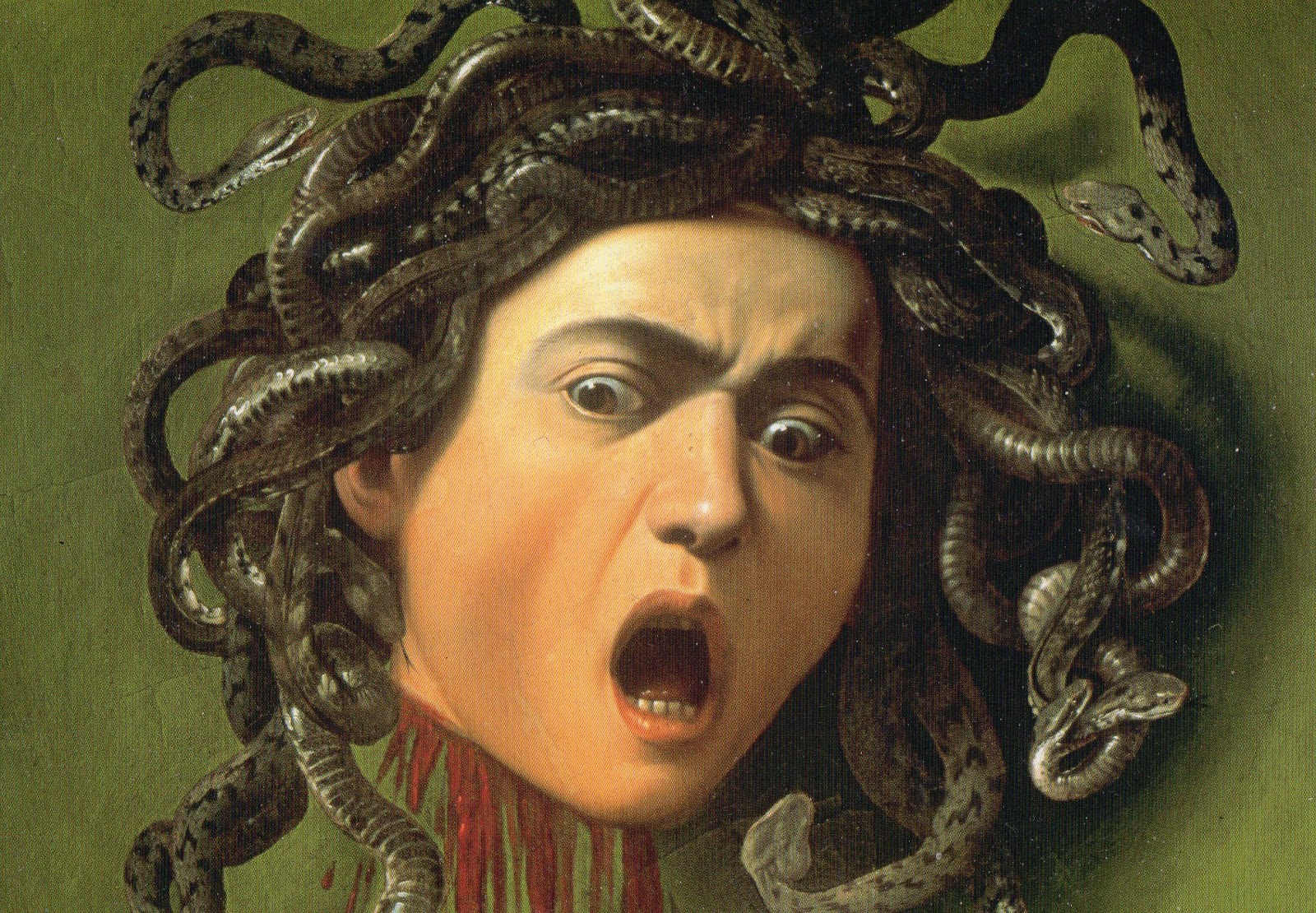
3) MEDUSA (1595-8) - Michelangelo Merisi de Caravaggio


This is a detail of Caravaggio's magnificent depiction of Medusa's decapitated head frozen forever on Perseus' shield.  If you ever want to find it in the Uffizi in Florence just head for the exit and it is one of the last paintings you will see - just look for the permanent huddle of viewers around it.  A visceral, fascinating image to contemplate.

4) The WINGED VICTORY OF SAMOTHRACE (circa 190 bc) - unknown


How can something so solid and imposing also be so suggestive of movement and grace?  The white marble figure of Nike is awesome in all it's shattered majesty and a must-see when visiting the Louvre in Paris.

5) The BREWHOUSE, COOKHAM (1957) - Stanley Spencer


Bought at the charming Stanley Spencer Gallery in his hometown of Cookham in Berkshire, this is a wonderfully detailed painting of the late 15th Century listed building in the village.  You can fair hear the hum of bees and the clatter of plates coming through the open doorway as you marvel at Spencer's intricate handling of the foliage that softens the bricks and mortar of the house 

Sunday, February 28, 2016

Exit Through The Giftshop - Postcards at an exhibition....

More postcards from exhibitions and galleries...

1) ELS COLOMINS (1957) - Pablo Picasso


A wonderfully exuberant and vibrant painting of the view from Picasso's Calais window, I bought this at the Museu Picasso in Barcelona.  I love his punky white pigeons, the propped-up palette, the azure sea and magnificent tree in front of his studio window.

2) LE COURONNEMENT D'EPINES (1602-3) - Michelangelo Merisi de Caravaggio


Well I never knew Caravaggio was a Michelangelo too!  I bought this at the Musée Jacquemart-André when they held an exhibition named FROM GIOTTO TO CARAVAGGIO.  Caravaggio lights the scene with his usual shaft of light from one side to illuminate his fleshy, all-too-human Christ, held by two soldiers, as a third forces the crown of thorns onto his head with a stick. I like how Caravaggio has both Christ and the soldier holding him staring into the face of the soldier forcing the crown on as well as the emphasis on the hands of all involved.

3) LA NASCITA DI VENERE (1484) - Sandro Botticelli


Botticelli's iconic Birth of Venus isn't exactly one of my favourite paintings ever but when you go to the Uffizi Gallery shop you have to buy a copy of it - they call the police if you don't!  For such an image of idealised beauty Botticelli's Venus is all over the shop physically but I prefer to dwell on the figure in the billowing drapery who hurries to cover Venus' modesty.

4) WOODEN CRUCIFIX (circa 1412) - Fillipo Brunelleschi


This wonderfully realised crucifix is in the Church of Santa Maria Novella in Florence and is one of the many remarkable works of art displayed there.  According to the biographer/artist Vasari, Brunelleschi was compelled to make this crucifix after criticizing the one that Donatello had just unveiled in Santa Croce.  Donatello's is certainly more realistic than Brunelleschi's idealised, stark figure but if you wish to decide for yourself, head to the Capella Gondi at Novella.

5) ANNE BOLEYN (circa 1533) - unknown


 Um.  The shame.  I have never actually visited this portrait at the National Portrait Gallery!  And me a big Boleyn fan.  I am telling myself that this is for the best as I would probably try to stick it in my bag!  An iconic portrait of an iconic woman, this has been the first stop for any costume designer and/or casting director in the countless retellings of Anne's sorry tale.  I do love the stark quality of the portrait, Anne's jet black veil and gown accentuated by the brown furry sleeves and heavily-worked gold and pearls of the dress's neckline - and of course the directness of Anne's coolly knowing gaze, it almost feels like she is saying down the years, "Me?  Guilty??"