Showing posts with label Vincent Van Gogh. Show all posts

Saturday, December 04, 2021

Exit Through The Giftshop - Pictures At An Exhibition #24

More visual memories of art past...

1) LAMENTATION (1441) - Fra Angelico

I bought this in the San Marco monastery in Florence which is the place to visit to be surrounded by the work of Brother Giovanni aka Fra Angelico.  From various clues in the painting it has been deduced that the painting had been done over 5 years, with Fra Angelico taking a break from it when he lived in Cortona for a year.

I like the quiet intensity of the painting, the vivid colours of the attendants' robes and the closeness of the Virgin Mary's sorrowful face to Jesus.  The painting has a wavy cut-off line along the bottom from the extensive water damage it sustained during the flood that swept through Florence on 3rd and 4th November, 1966. 

2) OLIVE TREES (1889) - Vincent van Gogh


This was bought at the National Gallery, I am guessing at an exhibition of van Gogh's work as this painting is in the collection of Minneapolis Institute of Art.  This is one of a series of paintings of olive trees by van Gogh while in the asylum at Saint-Rémy-de-Provence.  Vincent was allowed to go into the surrounding fields to paint the trees as the ever-changing colours of the trees fascinated him.  This was painted during the November of 1889.

The all-seeing sickly yellow sun dominates the landscape while the busy olive leaves shine and shimmer, the shadows of the trees casting purple-ish shadows on the ground.  Again, the sense of movement and colour is vibrant.

3) PORTRAIT OF A YOUNG GIRL (1797) - Élisabeth Vigée Le Brun

This was bought at the Grand-Palais in Paris when it held the first ever retrospective of Élizabeth Vigée Le Brun in 2015, 163 years after her death.  Le Brun was Marie-Antoinette's favourite portrait painter so when the French Revolution erupted, Le Brun fled France with her young daughter. She travelled to Italy, Austria and Russia, her association with the French aristocracy gaining her wealthy clients. 

This was painted during her six year stay in Russia, although titled 'Portrait of A Young Girl' the sitter bares an uncanny resemblance to Varvara Golovina, a courtier noted for her writing. A fine example of Le Brun's style, a direct focus on the sitter's face, the flowing hair and a marvellous rendering of the lady's millinary.  It's quite lovely.

4) DAVID (1501-4) - Michelangelo

 
I bought this in Florence at the Galleria dell'Accademia where Michelangelo's epic David stands in solitary majesty in a stark setting.

The statue was originally placed in the Piazza della Signoria beside the magnificent Palazzo Vecchio where he stayed for 369 years until being relocated to it's present location in 1873.  If the history of art's eternal female is the Mona Lisa, surely the male counterpart is Michelangelo's DAVID.

5) ORCHARD IN BLOSSOM (APRICOT TREES) (1888) - Vincent van Gogh

This was bought at the Scottish National Gallery where van Gogh's painting is on display.  It was painted in 1888 in Arles; van Gogh had moved there after struggling with excessive drinking and for a while he was happy there, but his hope of founding an artist's colony with Paul Gauguin foundered when the latter appeared and their friendship collapsed.

The branches of the spindly orchard trees burst forth with bright pink blossoms against a drab sky and the far-off town.  White flowers below counter-balance the brightness above and it bursts with the joy of nature.

Tuesday, June 22, 2021

Exit Through The Giftshop - Pictures At An Exhibition #23

More memories from viewings past...

1) BAPTISM OF THE NEOPHYTES (1427) - Masaccio

I bought this when I saw the remarkable frescos in the Brancacci Chapel within the Church of Santa Maria del Carmine in Florence.  The frescos can only be viewed on short timed visits, you enter through the cloisters next to the church, so the vibrant paintings are not damaged by constant visitors.  Masaccio began his frescos in 1425 but stopped when he had to travel to Rome in 1428 where he died aged only 27.  Filippino Lippi completed them 55 years later.  

St. Peter is seen baptizing believers in a river, a supplicant kneels before him as the holy water runs over his head, the river eddying around his knees.  Again, one is drawn to the remarkable cast of characters - the man who is waiting to be baptized who is obviously already freezing, the acolyte of Peter who is helping the man undress in the queue and, at the back, a man in a green tunic who really looks like he is thinking "What have I let myself in for?" as he looks nervously around him. 

2) LADY WITH CAPE AND HAT (1890) - Gustav Klimt


This was bought at the Royal Academy exhibition of drawings by Klimt and Egon Schiele from the Albertina Museum in Vienna in 2018.  The Albertina has for many years been the main research centre for the artist's life and work.  Klimt drew this haunting composition using black and red chalk aged 28.

Say the name Klimt and one thinks of art nouveau stylized, highly coloured portraits of glamorous women but this earlier drawing of a young woman in a black coat with high collar and a large hat is haunting in it's simplicity; her mournful expression beautifully caught as it is lit from the side.  Klimt was to embark on years of upheaval when in 1892 both his father and brother died and their families were dependant on Gustav for their well-being.

3) VIRGINIA AND LEONARD WOOLF'S WRITING LODGE (1934)

A very happy memory is visiting Monk's House on a sunny day in 2014.  Virginia and Leonard Woolf bought the house in an auction in 1919 for £700 and over the years, as they both became successful, they started making improvements to the rudimentary interior and garden.  They lived increasingly at Monk's House during the 20s and 30s due to Virginia's recurring mental breakdowns which were exacerbated by London life, and became a much-loved part of their life.  After Virginia's suicide in 1941, Leonard lived on at Monk's House until his own death in 1969.

The garden lodge was built in 1934 and, apart from being a place to store apples in the loft, it served as Virginia's writing retreat being only a short walk across the lawn from the main house.  Apart from her articles, she would have written the bulk of THE YEARS and BETWEEN THE ACTS here.  I blogged at the time "We were told that we were lucky that they had a full compliment of volunteers so the lodge was actually open to visitors and it was wonderful to stand there by her writing desk, her glasses and cigarettes still there waiting to be used.  The volunteer said sadly all we could do in there was look and breathe in the air.  That was fine for me."

4) SELF PORTRAIT WITH MONKEY (1938) - Frida Kahlo


Another of the great self-portraits by Frida Kahlo.  This was bought in 2005 at Tate Modern when they had a major retrospective of her work.  It had been a commission painting for the then-president of New York's Museum of Modern Art. Anson Conger Goodyear.  1938 was a pretty good year for Frida: she had made her first notable sale when the actor Edward G Robinson bought four paintings for $800 and she was invited to New York to hold her first US exhibition which, while dismissed by critics, was financially successful. 

She had met the Surrealist André Breton earlier in the year in Mexico who invited her to Paris to exhibit and famously described her art as "a ribbon tied around a bomb".  Frida stares out at us at an angle, coiffed and elegant, defiantly uni-browed and with a mousetache showing, against a background of large tropical leaves.  Her spider-monkey pet Fulang-Chang sits behind her with a protective paw around her neck, as if to guard her against the sudden explosion of interest in her and her art.  


5) PIETÁ (AFTER DELACROIX) (1889) - Vincent van Gogh

I bought this at the wonderful van Gogh Museum in Amsterdam: we wandered over that way one late afternoon and saw a smallish queue outside which we joined more as a dare to see how long we would stand there but to our delight it wasn't that long before we were shifting along and we were in, to discover the nooks and crannys of the modernist interior - and of course revel in the glorious paintings within.

Of course the knowledge that this was painted the year before his suicide makes one read more iinto the subject matter than one should, for most of the year Vincent was in the asylum in Saint Rémy-de-Provence where his access for inspiration came mostly from prints of other artists' work that he had with him as well as the grounds of the asylum.  He had always admired Delacroix and one day, when his print of his Pietá fell in some oils, Vincent decided to do his own.  Although based on another work, Vincent was working from a b/w print so the swirling and turbulant colour is his own imagination and memories of Delacroix's style.  I really love the colours: the many blues he finds in Mary's garments, offset against the paler tones of Jesus' skin and his sheet.  As usual when looking at his work you just feel sadness for the poor guy.

Sunday, November 01, 2020

Exit Through The Giftshop - Postcards at an exhibition....

More purchases from museum and exhibition gift shops...

1) FUNERAL DE SAN ANTONIO ABAD (1426-1430) - Fra Angelico

 
I bought this at the Prado in Madrid which holds a number of Fra Angelico paintings, this a small predella from an alterpiece dedicated to the saint dying in the painting. 

The picture is so small I wonder how it took four years to complete!  What I like about it is the formality of the composition and the hushed sadness in the huddled monks.  In close-up the monks wail and whisper among themselves at their Abbot's passing while behind them the monastery stands tall, it's white walls nicely complemented by the blue sky and solitary tree. 


2) THE CONVERSION OF ST PAUL (1600-1601) - Michelangelo Caravaggio


I bought this in at Santa Maria del Popolo in Rome where the painting hangs in the Cerasi Chapel. named after Tiberio Cerasi, the pope's treasurer-general who had commisoned this and THE CRUCIFIXION OF ST. PETER which hangs opposite it; Cerasi died before the works were completed.

As usual, Caravaggio lights his subject from a single source which illuminates the stricken figure of St Paul who saw a blinding light on the road of Damascus which made him fall from his horse; he then heard the voice of Christ telling him to stop persecuting his followers and to become one himself.  Paul stretches his arms out in the direction of the light while his servant tries to calm the horse from which Paul has fallen.  The horse's massive looming flank and raised hoof are dynamically captured as your eyes follow the arrangement of limbs around the painting.

3) LADY HAMILTON AS A BACCHANTE (1792) - Élizabeth Vigée Le Brun

This was bought at the Grand-Palais in Paris which, astonishingly, held the first ever retrospective of Élizabeth Vigée Le Brun in 2015, 163 years after her death.  Le Brun had been Marie-Antoinette's favourite portrait painter so when the French Revolution flared up, Le Brun escaped France with her young daughter rather than face certain death. She travelled to Italy, Austria and Russia, her association with the French aristocracy gaining her wealthy clients.  In Naples, visiting Queen Maria Carolina - Marie-Antoinette's sister - she met the Queen's friend Emma Hart, mistress of the British Envoy Sir William Hamilton.

Élizabeth attended one of Emma's 'attitudes' evenings where she would pose in tableaux of classical paintings.  This resulted in her posing for a number of portraits, all of a classical nature in which Le Brun captured Emma's legendary beauty.  This portrait was painted in 1792, a year after Emma's marriage to Sir William Hamilton, and shows Emma as a wild Bacchante dancing in front of a smoking Vesuvius which Lady Hamilton could see from her villa.  Demure yet abandoned, Emma dances with her tambourine, her hair tumbling and her Empire line dress clinging to her.  While Le Brun appreciated Emma's beauty she disliked her personally.  It was in the following year that Emma met Nelson and the rest, as they say, is history...

4) LES VESSENOTS EN AUVERS (1890) - Vincent Van Gogh

 
This comes from the excellent Museo Thyssen-Bornemisza in Madrid which boasts two standing collections under one roof - Baron Thyssen-Bornemisza's on one side of the building and his son's on the other!  From Gothic through to Modern, it's collection includes practically all of art's greatest names including, of course, Van Gogh.
 
This landscape was one of the seventy paintings Van Gogh completed in the two months before his death as he painted the countryside around Auvers.  Les Vessenots was the village where Van Gogh's friend Dr Gachet lived.  The lush green of the grassy hills and wind-swept trees surround the humble cottages in the distance; but the sickly yellow flowers that floods most of the painting gives it an jaundiced, disturbing air.


5) MARY, QUEEN OF SCOTS (c. 1610-1615) - Unknown


This comes from the impressive Scottish National Portrait Gallery in Edinburgh.  The painting was painted by an unknown artist over 20 years after Mary's execution.  It is belived to be based on a cameo that had been painted while she was imprisoned in England.
 
This was painted when her son had become James I of England and it is suspected that these portraits were painted to reclaim her reputation, which might explain why the crucifix and rosary she wears give her such a pious look.  Mary's sombre dark dress is offset by the lace that she wears as well as the vibrant red table-cloth, patterned carpet and the swag curtain behind her.

Monday, March 16, 2020

Exit Through The Giftshop - Postcards at an exhibition....

Well it has been more than six months since I explored my many postcards from exhibitions and galleries, so let's dive in again...

1) THE PRISON COURTYARD (1890) - Vincent van Gogh


I was immediately struck by this absorbing painting when I saw the VAN GOGH AND BRITAIN exhibition at Tate London in 2019.  Van Gogh based his painting on a Doré engraving but whereas the original of prisoners in the cramped exercise yard at Newgate Prison was dark and dingy, van Gogh's painting lightens the tone considerably but with a sickly green-yellow paint that makes me think the skies are about to open and drench the inmates.

Van Gogh painted this in the last year of his life while still hospitalised in Saint-Rémy asylum and the endless circular trudging of the depressed prisoners surely echoes his mental condition; the ghostly stare of the Vincent look-a-like, the only one looking at the viewer, haunts you when you consider what happened later in 1890.

2) THE SISTINE CHAPEL (1508-1512 / 1536-1541) - Michelangelo


This was bought at the Vatican in 2017 after a pricey but marvellous tour of the Vatican palace - including the little-seen Niccoline Chapel with it's Fra Angelico frescos - which ended in our small tour group getting about 15 minutes in an empty Sistine Chapel.

It was a strange experience, as it is whenever you are finally confronted with anything huge and iconic that you have only seen before in manageable forms like books or films; here it was even more surreal to be actually inside the art. The ceiling and side walls were too far away to fully engage with but the Day of Judgement fresco was just magnificent because you could get so close to it by the altar.  A memorable day...

3) CAVALCATA DEL MAGI (detail) (1459=1461) - Benozzo Gozzoli


This was bought on our first visit to Florence when we visited the imposing Palazzo Medici-Riccardi; inside the Palazzo is the small Magi Chapel which houses the remarkable Gozzoli fresco on all four walls. showing the lavish process of the three wise men to visit Christ, along with various members of the all-powerful Medici family, their noblemen and King John VIII (seen here), the last Byzantine Emperor.

Like the Sistine Chapel, here you are in the middle of the art which surrounds you but due to it's much smaller size, you can appreciate it all the more.  Gozzoli was a pupil of Fra Angelico and helped him with several of the San Marco cell frescos and, indeed, the previously mentioned Niccoline Chapel in The Vatican.  Because of it's intimacy it is easier to become fascinated by the masterly detailing on the clothes and livery, the rolling landscape, the draughtsmanship of the animals and the many faces on display, although here it looks like all the pages had the same model!

4) DAVID (detail) (1501-4) - Michelangelo


I of course bought this in Florence at the Galleria dell'Accademia where Michelangelo's David stands in solitary majesty in a stark setting.  At the gift shop, they have multiple postcards of David from every angle - you either go tasteful or out there, I was definitely Out There.

David was originally placed outside in the Piazza della Signoria beside the Palazzo Vecchio where he stayed for 369 years until moved to the Galleria in 1873.  David done be serving some serious arse, surely the most famous in art history?  Michelangelo certainly had a loving hand...

5) THE BATLLÓ MAJESTY (1150?) - Anonymous


I bought this at my only visit to the Museu Nacional d'Art de Catalunya in Barcelona which we tried to do it all in one day which was a bit of an error - by the end of it you are slightly jaded by the constant shout of "Yes I know everyone was doing this but Catalonia did it too!" - and there is so much of it as well.

To be honest the only rooms I really liked were the last few with it's charming impressionist-style paintings but the early medieval rooms are impressive just for the sheer volume of items in there - this crucifix really caught my eye with it's vivid colourful cross and the doleful Jesus dressed in a multi-coloured robe - this 'Majesty' clothes style, as opposed to other more realistic representations. was to signify Christ's triumph over death.  Me? I just like the disco Jesus.

Sunday, August 14, 2016

Exit Through The Giftshop - Postcards at an exhibition....

More postcards from exhibitions and galleries...

1) UNVEILING COOKHAM WAR MEMORIAL (1922) - Stanley Spencer


I cannot remember if I bought this at the Dulwich Picture Gallery at their CRISIS OF BRILLIANCE exhibition or at the Stanley Spencer Gallery in his home town of Cookham.  That was quite a special visit as on the way there we visited the Memorial that is portrayed in his painting.

It was a bit quieter than the scene Spencer painted - his figures are squashed around the towering war memorial just after it has been unveiled with a billowing Union Jack being pushed out of the picture frame.  At the other side, young men lounge on the grass, almost deliberately ignoring the throng around the memorial, the people standing beside them look like they are in their best clothes and also seem to be ignoring the hubbub.  However Stanley draws our attention to the white-clad schoolgirls who are laying flowers at the base, doing their best to ignore the misbehaving schoolboys standing behind them although one of them is turning around to acknowledge them.  Oh and the bank of trees are in the distance?  That is now obscured by a large pub where we had our lunch!

2) LE DOCTEUR PAUL GACHET (1828-1909) (1890) - Vincent Van Gogh


This was bought at marvellous Musée D'Orsay in Paris.  Dr. Gachet not only knew a number of artists but was also an avid collector of their work.  Gachet's house was painted in a landscape by Cézanne and he numbered among his friends and clients Victor Hugo, Gustave Courbet, Camille Pissaro, Auguste Renoir and Eduard Manet.

Van Gogh's vibrant but turbulent painting of his doctor was one of his last paintings, completed only a month before his suicide.  The painter thought little of his doctor and Gachet's weary expression probably reflects his relationship with his troubled patient.

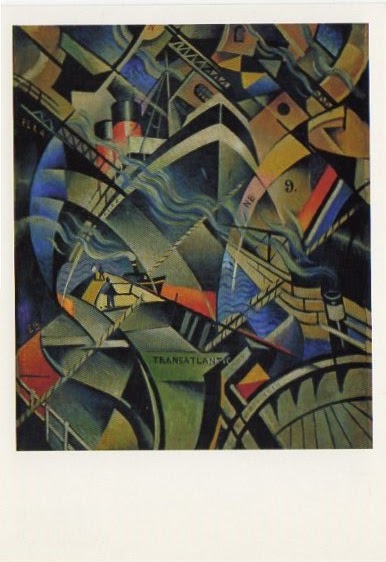
3) THE ARRIVAL (1913) - CRW Nevinson


Although this is a Tate postcard I suspect I bought it at the CRISIS OF BRILLIANCE exhibition at Dulwich Picture Gallery which celebrated the pre-world war class at the Slade School which included Mark Gertler, Dora Carrington, Paul Nash, Stanley Spencer and Christopher Nevinson.  It was an unhappy time for him; he fell in love with Carrington at the same time as his friend Gertler but she favoured the latter which ended his relationship with his friend, and he left with a lifelong grudge against his professor Henry Tonks who had advised him to give up painting.

In Paris just before WWI he met the Futurist painter Marinetti and immediately allied himself with the movement as well as it's UK spokesman Wyndham Lewis.  Their constant sniping at Bloomsbury and the British art world no doubt had been provoked by Nevinson's Slade experiences.  However, as is the nature of movements, their relationship foundered when Nevinson and Marinetti published a UK Futurist manifesto without consulting Lewis who in spite set up the Vorticist movement from which Nevinson was barred!  THE ARRIVAL however is a fascinating mixture of Cubist themes - the fractured planes of view, the numbers and lettering - but also the dynamic Futurist subject of the large ship looming into harbour and the streaming steam from the two tugboats in the foreground.

4) ANNE OF CLEVES (1540) - Hans Holbein the Younger


I bought this at a Holbein exhibition at Tate Britain in 2006.  All art misleads but sometimes it misleads famously.  Anxious to be married again, Henry VIII was urged by Thomas Cromwell, his feared advisor, to consider the German Anne of Cleves as a good prospect as her father was a staunch Protestant and could be an ally against the Pope.  Along with written accounts of her provided by Cromwell, court painter Hans Holbein was sent to paint several portraits of her.  Henry liked what he saw so it was full steam ahead.  On New Year's Eve 1539 the couple finally met - and the steam disappeared.

It turns out Holbein's full-on face portrait disguised her rather protruding nose as well as her pitted skin.  Holbein was not on the end of Henry's anger but Cromwell was.  The marriage was annulled as quickly as possible.  However Anne proved herself so amenable to the agreement that she had property and gifts lavished on her and was granted status as Henry's "beloved sister".  All of which left him free to marry Anne's previous lady-in-waiting Catherine Howard - on the same day that Cromwell was executed, a fate that Catherine suffered only 19 months later.  Anne's obvious common sense and pragmatism shines out from her infamous portrait.

5) MARIE ANTOINETTE A LA ROSE (1783) - Élisabeth Louise Vigée Le Brun


Another court-approved painter, another Queen, I bought this at the marvellous Vigée LeBrun exhibition at the Grand Palais, Paris last year.  Marie Antoinette, unhappy with the portraits that had been painted of her, turned in 1778 to the popular society painter Elisabeth Louise Vigée Le Brun to paint her portrait for her mother Empress Marie Theresa.  Both women were only 23 years old and developed a friendly working relationship; Vigée Le Brun was soon the unofficial court painter to the Queen and her family.  Skilled at downplaying any obvious failings in her sisters, Vigée Le Brun's portraits also glow with a warm-hearted humanity

In 1783, with the Queen's help, the painter was accepted into the Académie Royale and exhibited in the Salon for the first time.  It was, of course, a portrait of Marie Antoinette but it caused uproar as Vigée Le Brun had painted the Queen in a white muslin dress, holding a rose and wearing a plumed summer hat and no jewellery, a style the Queen favoured when at her own palace La Petit Trianon at Versailles.  The horrified opinion was that this was *not* how a Queen of France should be presented so it was quickly withdrawn and Vigée Le Brun painted a replacement with the Queen still holding a rose but more 'appropriately' attired in grey silk, lace and ribbons, pearls, a gold necklace, rouged and wearing a powdered wig with plumes.  Ironic isn't it that one of the charges against Marie Antoinette was that she too extravagant?  Vigée Le Brun's changing the setting from an indoor to an outdoor one also gives the portrait a more classical Romantic feel.