Showing posts with label Élisabeth Louise Vigée Le Brun. Show all posts

Saturday, December 04, 2021

Exit Through The Giftshop - Pictures At An Exhibition #24

More visual memories of art past...

1) LAMENTATION (1441) - Fra Angelico

I bought this in the San Marco monastery in Florence which is the place to visit to be surrounded by the work of Brother Giovanni aka Fra Angelico.  From various clues in the painting it has been deduced that the painting had been done over 5 years, with Fra Angelico taking a break from it when he lived in Cortona for a year.

I like the quiet intensity of the painting, the vivid colours of the attendants' robes and the closeness of the Virgin Mary's sorrowful face to Jesus.  The painting has a wavy cut-off line along the bottom from the extensive water damage it sustained during the flood that swept through Florence on 3rd and 4th November, 1966. 

2) OLIVE TREES (1889) - Vincent van Gogh


This was bought at the National Gallery, I am guessing at an exhibition of van Gogh's work as this painting is in the collection of Minneapolis Institute of Art.  This is one of a series of paintings of olive trees by van Gogh while in the asylum at Saint-Rémy-de-Provence.  Vincent was allowed to go into the surrounding fields to paint the trees as the ever-changing colours of the trees fascinated him.  This was painted during the November of 1889.

The all-seeing sickly yellow sun dominates the landscape while the busy olive leaves shine and shimmer, the shadows of the trees casting purple-ish shadows on the ground.  Again, the sense of movement and colour is vibrant.

3) PORTRAIT OF A YOUNG GIRL (1797) - Élisabeth Vigée Le Brun

This was bought at the Grand-Palais in Paris when it held the first ever retrospective of Élizabeth Vigée Le Brun in 2015, 163 years after her death.  Le Brun was Marie-Antoinette's favourite portrait painter so when the French Revolution erupted, Le Brun fled France with her young daughter. She travelled to Italy, Austria and Russia, her association with the French aristocracy gaining her wealthy clients. 

This was painted during her six year stay in Russia, although titled 'Portrait of A Young Girl' the sitter bares an uncanny resemblance to Varvara Golovina, a courtier noted for her writing. A fine example of Le Brun's style, a direct focus on the sitter's face, the flowing hair and a marvellous rendering of the lady's millinary.  It's quite lovely.

4) DAVID (1501-4) - Michelangelo

 
I bought this in Florence at the Galleria dell'Accademia where Michelangelo's epic David stands in solitary majesty in a stark setting.

The statue was originally placed in the Piazza della Signoria beside the magnificent Palazzo Vecchio where he stayed for 369 years until being relocated to it's present location in 1873.  If the history of art's eternal female is the Mona Lisa, surely the male counterpart is Michelangelo's DAVID.

5) ORCHARD IN BLOSSOM (APRICOT TREES) (1888) - Vincent van Gogh

This was bought at the Scottish National Gallery where van Gogh's painting is on display.  It was painted in 1888 in Arles; van Gogh had moved there after struggling with excessive drinking and for a while he was happy there, but his hope of founding an artist's colony with Paul Gauguin foundered when the latter appeared and their friendship collapsed.

The branches of the spindly orchard trees burst forth with bright pink blossoms against a drab sky and the far-off town.  White flowers below counter-balance the brightness above and it bursts with the joy of nature.

Saturday, February 13, 2021

Exit Through The Giftshop - Pictures At An Exhibition #18

Memories from when galleries and museums were open...

1) SELF PORTRAIT WITH CERISE RIBBONS (1782) - Elisabeth Vigée Le Brun

This was bought at the wonderful Le Brun exhibition that was on at the Grand-Palais in Paris which I saw in 2016, the first ever retrospective of her portraits both pre- and post-revolution.  

Elisabeth, aged 27, looks out at us fresh-faced and apple-cheeked, a vision of prettiness with her hair tumbling naturally to her shoulders.  Her soft white dress as accenuated by the bright cerise pussy-bow and sash, and the black lace shawl and jaunty plumed hat.  For a working portraitist, it also served as unoffical advertising, showing the fashionable women of Paris that she could paint them like this too.

2) LADY AGNEW OF LOCHNAW (1892) - John Singer Sargent

A century on from Le Brun, the society painter of choice was John Singer Sargent who, like Elisabeth, gave the sitter exactly what they wanted only with more insight.  The commission came through from the 9th Baronet of Lochnaw Castle to paint his wife Gertrude (née Vernon).  I bought this at the National Gallery of Scotland where she sits in residence.

A glorious portrait, Sargent always managed to give the impression of capturing his subjects 'live', negating the length of time it would have taken to paint.  Her full white dress is accentuated by the mauve sash which also ties in the tones of the silk backdrop and French upholstery of the chair.  She holds a white rose in her lap and languidly drapes her arm over the arm of the chair to hold the chair frame.  She stares directly at Sargent and at us, almost saying "Kiss all this opulence...".

3) STATUE OF EBIH-IL (circa 2400 BC) - unknown

This glorious chap is Ebih-Il, the superintendant of the ancient city of Mari, now in Syria, sculpted at his prayers.  I made his acquaintance at the Louvre in Paris where he is currently residing.  He was discovered in 1934 by French archaelogist André Parrot at the site of the temple of Ishtar.

He is seated on a whicker seat and wears a bulky skirt of animal skin. What makes it stand out however is the marvellous rendering of his face with his happy smile and the vivid blue of his lapis lazuli eyes.  He stands - or sits - just over 20 inches tall and I would head straight for him when the Louvre let me run around with a shopping trolley.

4) THE RAISING OF THE SON OF THEOPHILIS (detail) (1428-1484) - Masaccio and Filippino Lippi

Part of the marvellous fresco cycle which adorn the walls of the Brancacci Chapel within the Church of Santa Maria del Carmine in Florence.  The frescos can only be viewed on short timed visits through the cloisters next to the church so the vibrant paintings are not damaged by constant visitors.

I was immediately drawn to this group of observers who rather dispassionately are watching Saint Peter raise a young man from the dead.  Their faces are remarkable and you will definitely have seen them walking along the streets of Florence to find the church of Santa Maria del Carmine. My personal favourite is the man second from the right, turning to his neighbour with a resigned look on his face. Work on the frescos started in 1425 by the painter Masaccio but he stopped when he had to travel to Rome in 1428 where he died aged only 27.  Filippino Lippi completed them 55 years later!

5) THE LAOCOON GROUP (possibly circa 27BC and 68AD) - unknown

One of the most iconic works of art, it's wonderful to see it in 'the marble' and to realise you are looking at a statue that Pliny The Elder wrote about.  If Laocoon and the lads hadn't suffered enough, they are missing a couple of limbs - and a bit of upraised snake - but it does not detract from the overall power of the work and your feeling of helplessness observing it.  The postcard was bought at the Vatican where the statue stands in the Pio-Clementino Mueum.

The Trojan High Priest Laocoon's fate was written about by Sophocles in a now-lost tragedy and by Virgil who tells of him throwing a spear at the Trojan Horse and being killed along with his sons by venomous snakes sent by the god Poseidon.  Sophocles had another take on it and sexed up the tale by having the gods send the snakes to kill his sons in revenge for him breaking his vow of chastity to the god Apollo.  The huge statue was re-discovered in 1506 and Michelangelo was one of the first to inspect it - you can definitely see the influence in his work.  The statue's actual date is still widely open for conjecture and there is no definite idea if it is Greek of Roman.  What most - apart from silly old John Ruskin - are agreed on is it's tragic power.

Saturday, August 08, 2020

Exit Through The Giftshop - Postcards at an exhibition....

Another selection of postcards that have grabbed my eye at exhibitions and galleries...

1) HANGING LAMP (1905) - Francesc Berenguer

Bought at Parc Guell in Barcelona, this monumental hanging light is in the Casa Museu Gaudi, the impressive house where Gaudi lived, now a museum.

The architect Francesc Berenguer designed the four storey house within Parc Guell, as part of the hoped-for garden city in north Barcelona envisioned by industrialist Eusebi Guell and architect Antonio Gaudi, but the project stalled in 1914.  The park and the houses are, of course, essential viewing in Barcelona.

2) The HONOURABLE MRS GRAHAM (1777) - Thomas Gainsborough

I bought this in the Scottish National Gallery where Mrs Graham stands in splendid isolation, it was bequeathed to the gallery by Mr Graham on the proviso that it never leaves Scotland.

Gainsborough painted the 20 year-old Mary Graham, who had married a Perthshire landowner aged 17, in the height of expensive fashion as she gives some serious side-eye in the usual Arcadian landscape.  Sadly Mary died aged only 35.

3) A CONVERSATION (1916) - Vanessa Bell

Another Courtauld Gallery purchase!  This was to tie-in with their 2009 exhibition "Beyond Bloomsbury: Designs of The Omega Workshops".  I love this painting!  

Three women sit closely together ignoring the delights of the sunny garden outside to have a good gossip, I suspect someone's ears are burning somewhere.  Virginia Woolf said of her sister that while she was a remarkable painter, that she was also "...a short story writer of great wit and able to bring off a situation in a way that rouses my envy."

4) LA TENDRESSE MATERNELLE (1786) - Élisabeth Louise Vigée Le Brun

This magnificent work of self-promotion by Madame Le Brun shows her with her beloved daughter Julie aged 6, showing that despite being a portraitist to the ruling classes, she was still a loving mother (and a fine calling-card if you wanted a similar portrait) 

This was bought at the Louvre where Elisabeth and Julie are on display to all, Three years after painting this, the French Revolution drove Le Brun into exile with Julie.  In the ensuing 12 years, she moved from Italy to Austria to Russia, surviving on her talent and the good graces of their ruling classes through her reputation as Marie-Antoinette's unofficial painter.  She finally was allowed to return to France and died 40 years later, aged 86.  What a woman!

5) LE RADEAU DE LA MÉDUSE (1819) - Théodore Géricault


This was bought in the Louvre where the painting is on permanent display, Géricault's powerful epic still has the power to move and appal.  Originally called Shipwreck Scene when Géricault painted it aged only 27, he based his painting on a real incident in 1816 which was still fresh in the collective memory in France.

The frigate Medusa, carring 400 people, ran aground off the coast of West Africa and only had space for 250 people in it's lifeboats.  A raft was cobbled together and 147 attempted the 60 mile journey to the coast but when finally rescued, only 15 people were found. They told of the horror of survival: the others had fallen or been thrown into sea, and those that had starved to death on board had been cannibalised.  Géricault captures the moment when a ship is spotted on the horizon, the panicked attempt to attract it's attention is shown in the sweeping triangular movement up to the waved material, meanwhile those in the foreground are beyond help.

Sunday, August 14, 2016

Exit Through The Giftshop - Postcards at an exhibition....

More postcards from exhibitions and galleries...

1) UNVEILING COOKHAM WAR MEMORIAL (1922) - Stanley Spencer


I cannot remember if I bought this at the Dulwich Picture Gallery at their CRISIS OF BRILLIANCE exhibition or at the Stanley Spencer Gallery in his home town of Cookham.  That was quite a special visit as on the way there we visited the Memorial that is portrayed in his painting.

It was a bit quieter than the scene Spencer painted - his figures are squashed around the towering war memorial just after it has been unveiled with a billowing Union Jack being pushed out of the picture frame.  At the other side, young men lounge on the grass, almost deliberately ignoring the throng around the memorial, the people standing beside them look like they are in their best clothes and also seem to be ignoring the hubbub.  However Stanley draws our attention to the white-clad schoolgirls who are laying flowers at the base, doing their best to ignore the misbehaving schoolboys standing behind them although one of them is turning around to acknowledge them.  Oh and the bank of trees are in the distance?  That is now obscured by a large pub where we had our lunch!

2) LE DOCTEUR PAUL GACHET (1828-1909) (1890) - Vincent Van Gogh


This was bought at marvellous Musée D'Orsay in Paris.  Dr. Gachet not only knew a number of artists but was also an avid collector of their work.  Gachet's house was painted in a landscape by Cézanne and he numbered among his friends and clients Victor Hugo, Gustave Courbet, Camille Pissaro, Auguste Renoir and Eduard Manet.

Van Gogh's vibrant but turbulent painting of his doctor was one of his last paintings, completed only a month before his suicide.  The painter thought little of his doctor and Gachet's weary expression probably reflects his relationship with his troubled patient.

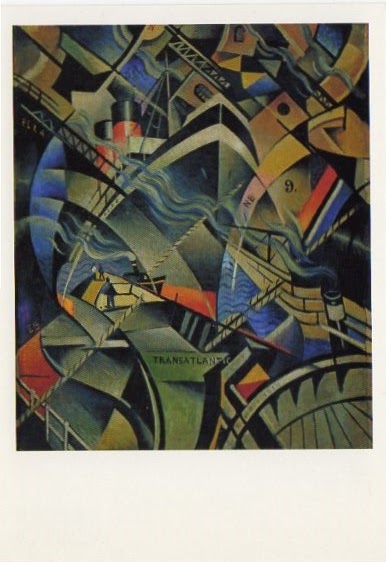
3) THE ARRIVAL (1913) - CRW Nevinson


Although this is a Tate postcard I suspect I bought it at the CRISIS OF BRILLIANCE exhibition at Dulwich Picture Gallery which celebrated the pre-world war class at the Slade School which included Mark Gertler, Dora Carrington, Paul Nash, Stanley Spencer and Christopher Nevinson.  It was an unhappy time for him; he fell in love with Carrington at the same time as his friend Gertler but she favoured the latter which ended his relationship with his friend, and he left with a lifelong grudge against his professor Henry Tonks who had advised him to give up painting.

In Paris just before WWI he met the Futurist painter Marinetti and immediately allied himself with the movement as well as it's UK spokesman Wyndham Lewis.  Their constant sniping at Bloomsbury and the British art world no doubt had been provoked by Nevinson's Slade experiences.  However, as is the nature of movements, their relationship foundered when Nevinson and Marinetti published a UK Futurist manifesto without consulting Lewis who in spite set up the Vorticist movement from which Nevinson was barred!  THE ARRIVAL however is a fascinating mixture of Cubist themes - the fractured planes of view, the numbers and lettering - but also the dynamic Futurist subject of the large ship looming into harbour and the streaming steam from the two tugboats in the foreground.

4) ANNE OF CLEVES (1540) - Hans Holbein the Younger


I bought this at a Holbein exhibition at Tate Britain in 2006.  All art misleads but sometimes it misleads famously.  Anxious to be married again, Henry VIII was urged by Thomas Cromwell, his feared advisor, to consider the German Anne of Cleves as a good prospect as her father was a staunch Protestant and could be an ally against the Pope.  Along with written accounts of her provided by Cromwell, court painter Hans Holbein was sent to paint several portraits of her.  Henry liked what he saw so it was full steam ahead.  On New Year's Eve 1539 the couple finally met - and the steam disappeared.

It turns out Holbein's full-on face portrait disguised her rather protruding nose as well as her pitted skin.  Holbein was not on the end of Henry's anger but Cromwell was.  The marriage was annulled as quickly as possible.  However Anne proved herself so amenable to the agreement that she had property and gifts lavished on her and was granted status as Henry's "beloved sister".  All of which left him free to marry Anne's previous lady-in-waiting Catherine Howard - on the same day that Cromwell was executed, a fate that Catherine suffered only 19 months later.  Anne's obvious common sense and pragmatism shines out from her infamous portrait.

5) MARIE ANTOINETTE A LA ROSE (1783) - Élisabeth Louise Vigée Le Brun


Another court-approved painter, another Queen, I bought this at the marvellous Vigée LeBrun exhibition at the Grand Palais, Paris last year.  Marie Antoinette, unhappy with the portraits that had been painted of her, turned in 1778 to the popular society painter Elisabeth Louise Vigée Le Brun to paint her portrait for her mother Empress Marie Theresa.  Both women were only 23 years old and developed a friendly working relationship; Vigée Le Brun was soon the unofficial court painter to the Queen and her family.  Skilled at downplaying any obvious failings in her sisters, Vigée Le Brun's portraits also glow with a warm-hearted humanity

In 1783, with the Queen's help, the painter was accepted into the Académie Royale and exhibited in the Salon for the first time.  It was, of course, a portrait of Marie Antoinette but it caused uproar as Vigée Le Brun had painted the Queen in a white muslin dress, holding a rose and wearing a plumed summer hat and no jewellery, a style the Queen favoured when at her own palace La Petit Trianon at Versailles.  The horrified opinion was that this was *not* how a Queen of France should be presented so it was quickly withdrawn and Vigée Le Brun painted a replacement with the Queen still holding a rose but more 'appropriately' attired in grey silk, lace and ribbons, pearls, a gold necklace, rouged and wearing a powdered wig with plumes.  Ironic isn't it that one of the charges against Marie Antoinette was that she too extravagant?  Vigée Le Brun's changing the setting from an indoor to an outdoor one also gives the portrait a more classical Romantic feel.