Showing posts with label Stanley Spencer. Show all posts

Sunday, August 25, 2019

Exit Through The Giftshop - Postcards at an exhibition....

More bootiful booty from museum and exhibition gift shops...

1) TITLE PAGE OF THE FIRST FOLIO OF WILLIAM SHAKESPEARE'S PLAYS (1623) - Martin Droeshout


I bought this in Stratford-on-Avon at Shakespeare's birthplace - it seemed the most obvious purchase really.  The First Folio was published in 1623, seven years after Shakespeare's death, by John Heminges and Henry Condell who were actors in The King's Men, the acting company that the Bard wrote for.  Although many of Shakespeare's plays had been published in smaller Quarto publications, these were cheaply produced and fluctuated in quality. 

The First Folio compiled 36 plays, 18 of which for the first time including THE TEMPEST, ANTONY AND CLEOPATRA, MEASURE FOR MEASURE, JULIUS CAESAR and MACBETH.  It is believed about 750 editions were published and is now considered one of the most important publications in history.  A copy was sold in 2001 at Christies, NY for over £3 million.  21 year-old Martin Droeshout's engraving has become the one that most Shakespeare imagery is based on.

2) PLEIN AIR (1890-1) - Ramon Casas


I bought this in the MNAC Gallery in Barcelona which celebrates Catalonian art.  In 1890 the 25 year-old Casas was living and working in Paris and his painting 'Plein Air' shows the influence of the Impressionist painters on him.

Casas' painting has a haunting quality as a smartly-dressed woman sits outside at a table in the gloaming, staring at a man across the empty courtyard who is turned away from her gaze, looking out of the gate to the town beyond.  The white of the tablecloth and the red wine in the carafe is contrasted against the black of the woman's outfit giving the viewer a focus in the surrounding muted colours.

3) MAP READING (1932) - Stanley Spencer


I bought this at Somerset House when they recreated Stanley Spencer's 19 canvasses in situ as they appear at the Sandham Memorial Chapel in Burghclere, Hampshire.  The Chapel was commissioned to honor Lieutenant Henry Sandham who died in 1920 by his sister and brother-in-law.  They turned to Stanley Spencer to decorate the Chapel with the paintings for which he drew on his memories and observations while working as an orderly in the Royal Army Medical Corps in WWI.

Over his cycle of paintings we follow Spencer's experiences from the training hospital in Bristol where he was confronted with the injured and maimed from the Front in the benign surroundings of the hospital to being an orderly in the field in Macedonia.  In "Map Reading", an officer studies a map of the Macedonian terrain while his soldiers lounge on either side of the road, some clambering among bilberry bushes for food while one sits feeding the officer's horse who stares out at the viewer with an accusing stare.  As usual, what I love about Spencer's painting is the topsy-turvy lay-out, the humanity and gentle humour that he finds in the scene, and in particular the glaring horse - is he angry about being used as a desk by the officer or at the world that has made the situation happen?

4) THE ANNUNCIATION (CELL 3) (1438) - Fra Angelico


I bought this at the former Dominican friary San Marco in Florence which now houses many works by the Renaissance painter Fra Angelico who lived there from 1436 to 1445.  The first floor of the friary contains a number of frescoes by Fra Angelico that make it an essential place to visit for any art lover.  As you climb the broad staircase and turn the corner to the last flight up to the first floor you see ahead of you his magnificent fresco of "The Annunciation", one of the great works of Renaissance religious art, but the first floor also has a wonderful collection of frescoes that he painted for each of the monk's cells as subjects for contemplation during prayer. 

The austere beauty of these works is reflected in this fresco of The Annunciation.  Only a few doors down from the more-well known and larger fresco that greets you as you turn the stairs, this one has a stripped down beauty which highlights the Fra's use of perspective and his genius for distilling a deep tension between his figures:  Mary kneels in a pale pink gown, disturbed from her reading by the Angel Gabriel whose multi-coloured wings hide the lurking figure of Saint Dominic who bears witness to what is about to happen.  The glowing simplicity and held moment in time dazzles.

5) SUPPER IN EMMAUS (1861) - Augusto Betti


I bought this at the Medici Chapel in Florence.  I can find no reference to this anywhere online so guess I will just have to describe why I like it!

Betti gives us a reduced almost geometric look to the scene where Jesus appeared to two of his Apostles days after rising from the dead and their rapt attention is offset by the servant who is pouring water out of a jug and the dozing, scruffy dog under the table.  Outside the evening falls...  I like the unfussy painting which stood out against some of the more florid works in the Medici Chapel.

Sunday, August 14, 2016

Exit Through The Giftshop - Postcards at an exhibition....

More postcards from exhibitions and galleries...

1) UNVEILING COOKHAM WAR MEMORIAL (1922) - Stanley Spencer


I cannot remember if I bought this at the Dulwich Picture Gallery at their CRISIS OF BRILLIANCE exhibition or at the Stanley Spencer Gallery in his home town of Cookham.  That was quite a special visit as on the way there we visited the Memorial that is portrayed in his painting.

It was a bit quieter than the scene Spencer painted - his figures are squashed around the towering war memorial just after it has been unveiled with a billowing Union Jack being pushed out of the picture frame.  At the other side, young men lounge on the grass, almost deliberately ignoring the throng around the memorial, the people standing beside them look like they are in their best clothes and also seem to be ignoring the hubbub.  However Stanley draws our attention to the white-clad schoolgirls who are laying flowers at the base, doing their best to ignore the misbehaving schoolboys standing behind them although one of them is turning around to acknowledge them.  Oh and the bank of trees are in the distance?  That is now obscured by a large pub where we had our lunch!

2) LE DOCTEUR PAUL GACHET (1828-1909) (1890) - Vincent Van Gogh


This was bought at marvellous Musée D'Orsay in Paris.  Dr. Gachet not only knew a number of artists but was also an avid collector of their work.  Gachet's house was painted in a landscape by Cézanne and he numbered among his friends and clients Victor Hugo, Gustave Courbet, Camille Pissaro, Auguste Renoir and Eduard Manet.

Van Gogh's vibrant but turbulent painting of his doctor was one of his last paintings, completed only a month before his suicide.  The painter thought little of his doctor and Gachet's weary expression probably reflects his relationship with his troubled patient.

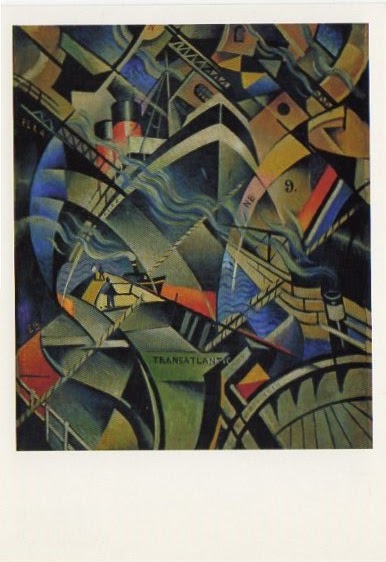
3) THE ARRIVAL (1913) - CRW Nevinson


Although this is a Tate postcard I suspect I bought it at the CRISIS OF BRILLIANCE exhibition at Dulwich Picture Gallery which celebrated the pre-world war class at the Slade School which included Mark Gertler, Dora Carrington, Paul Nash, Stanley Spencer and Christopher Nevinson.  It was an unhappy time for him; he fell in love with Carrington at the same time as his friend Gertler but she favoured the latter which ended his relationship with his friend, and he left with a lifelong grudge against his professor Henry Tonks who had advised him to give up painting.

In Paris just before WWI he met the Futurist painter Marinetti and immediately allied himself with the movement as well as it's UK spokesman Wyndham Lewis.  Their constant sniping at Bloomsbury and the British art world no doubt had been provoked by Nevinson's Slade experiences.  However, as is the nature of movements, their relationship foundered when Nevinson and Marinetti published a UK Futurist manifesto without consulting Lewis who in spite set up the Vorticist movement from which Nevinson was barred!  THE ARRIVAL however is a fascinating mixture of Cubist themes - the fractured planes of view, the numbers and lettering - but also the dynamic Futurist subject of the large ship looming into harbour and the streaming steam from the two tugboats in the foreground.

4) ANNE OF CLEVES (1540) - Hans Holbein the Younger


I bought this at a Holbein exhibition at Tate Britain in 2006.  All art misleads but sometimes it misleads famously.  Anxious to be married again, Henry VIII was urged by Thomas Cromwell, his feared advisor, to consider the German Anne of Cleves as a good prospect as her father was a staunch Protestant and could be an ally against the Pope.  Along with written accounts of her provided by Cromwell, court painter Hans Holbein was sent to paint several portraits of her.  Henry liked what he saw so it was full steam ahead.  On New Year's Eve 1539 the couple finally met - and the steam disappeared.

It turns out Holbein's full-on face portrait disguised her rather protruding nose as well as her pitted skin.  Holbein was not on the end of Henry's anger but Cromwell was.  The marriage was annulled as quickly as possible.  However Anne proved herself so amenable to the agreement that she had property and gifts lavished on her and was granted status as Henry's "beloved sister".  All of which left him free to marry Anne's previous lady-in-waiting Catherine Howard - on the same day that Cromwell was executed, a fate that Catherine suffered only 19 months later.  Anne's obvious common sense and pragmatism shines out from her infamous portrait.

5) MARIE ANTOINETTE A LA ROSE (1783) - Élisabeth Louise Vigée Le Brun


Another court-approved painter, another Queen, I bought this at the marvellous Vigée LeBrun exhibition at the Grand Palais, Paris last year.  Marie Antoinette, unhappy with the portraits that had been painted of her, turned in 1778 to the popular society painter Elisabeth Louise Vigée Le Brun to paint her portrait for her mother Empress Marie Theresa.  Both women were only 23 years old and developed a friendly working relationship; Vigée Le Brun was soon the unofficial court painter to the Queen and her family.  Skilled at downplaying any obvious failings in her sisters, Vigée Le Brun's portraits also glow with a warm-hearted humanity

In 1783, with the Queen's help, the painter was accepted into the Académie Royale and exhibited in the Salon for the first time.  It was, of course, a portrait of Marie Antoinette but it caused uproar as Vigée Le Brun had painted the Queen in a white muslin dress, holding a rose and wearing a plumed summer hat and no jewellery, a style the Queen favoured when at her own palace La Petit Trianon at Versailles.  The horrified opinion was that this was *not* how a Queen of France should be presented so it was quickly withdrawn and Vigée Le Brun painted a replacement with the Queen still holding a rose but more 'appropriately' attired in grey silk, lace and ribbons, pearls, a gold necklace, rouged and wearing a powdered wig with plumes.  Ironic isn't it that one of the charges against Marie Antoinette was that she too extravagant?  Vigée Le Brun's changing the setting from an indoor to an outdoor one also gives the portrait a more classical Romantic feel.

Saturday, June 04, 2016

Exit Through The Giftshop - Postcards at an exhibition....

Now I have sorted out my scanner (bloody Windows 10!) here are some more postcards from exhibitions and galleries...

1) SOFA and CHAIRS (1898 - 1904) - Antoni Gaudi with Aleix Clapés


This came from the Gaudí museum at his home in Parc Guell, and features one of his furniture designs for the Ibarz-Marco family.  Now I love a couch and this one screamed "sit on me"!  Great art nouveau fin de siécle furniture and loving the big and boldly distinctive floral design.

2) HIPPOPOTAMUS (1981 - 1885 bc) - unknown


I spent ages walking around the Egyptian rooms in the NY Metropolitan Museum trying to find this chap as he featured heavily in the gift shop in many different shapes and sizes but eventually found him in a glass case along with other finds from the tomb of Senbi.  He is tiny so can be easily overlooked - I think he's gorgeous and would have him away if I could.  He dates from Ancient Egypt's 12th Dynasty.

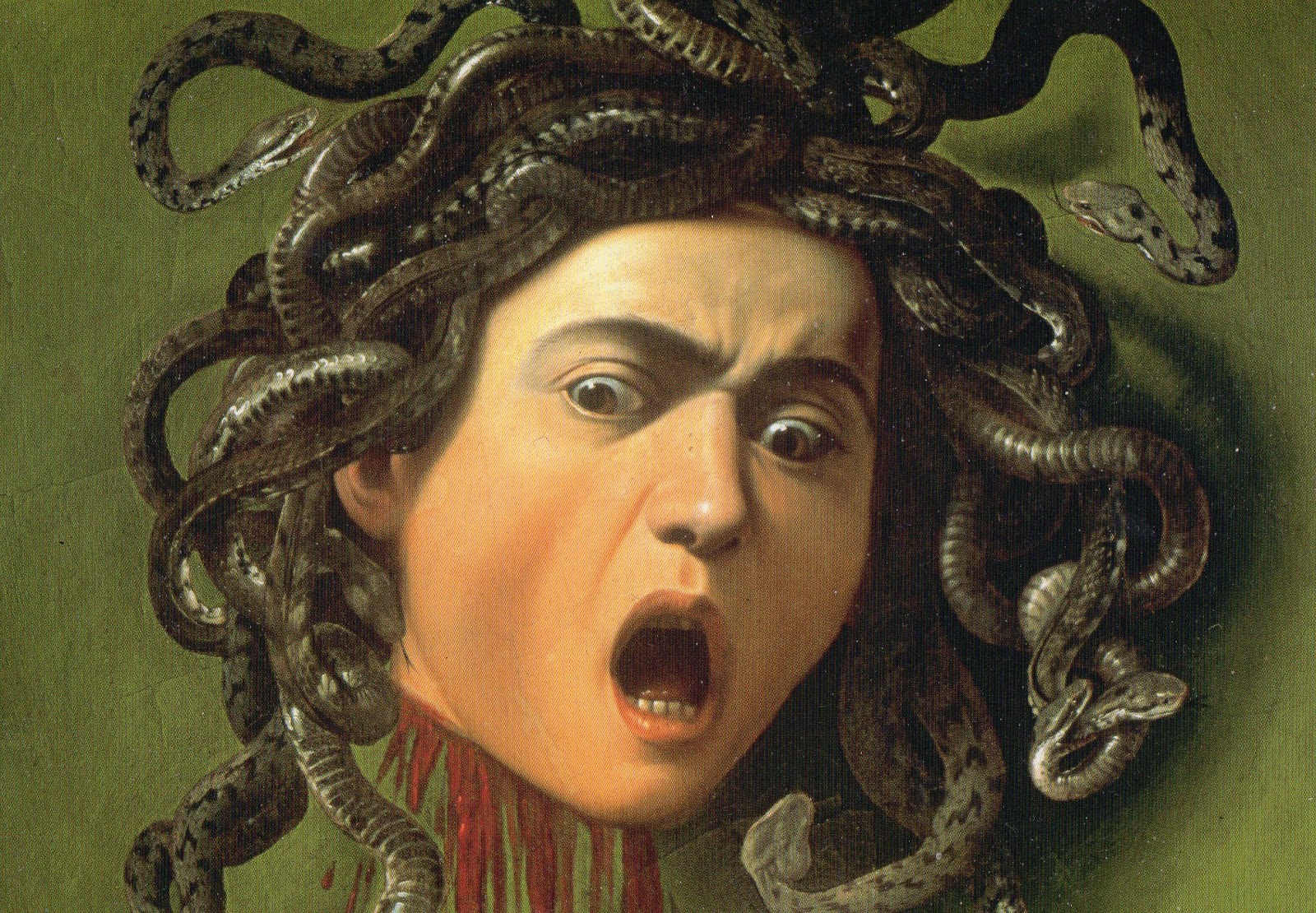
3) MEDUSA (1595-8) - Michelangelo Merisi de Caravaggio


This is a detail of Caravaggio's magnificent depiction of Medusa's decapitated head frozen forever on Perseus' shield.  If you ever want to find it in the Uffizi in Florence just head for the exit and it is one of the last paintings you will see - just look for the permanent huddle of viewers around it.  A visceral, fascinating image to contemplate.

4) The WINGED VICTORY OF SAMOTHRACE (circa 190 bc) - unknown


How can something so solid and imposing also be so suggestive of movement and grace?  The white marble figure of Nike is awesome in all it's shattered majesty and a must-see when visiting the Louvre in Paris.

5) The BREWHOUSE, COOKHAM (1957) - Stanley Spencer


Bought at the charming Stanley Spencer Gallery in his hometown of Cookham in Berkshire, this is a wonderfully detailed painting of the late 15th Century listed building in the village.  You can fair hear the hum of bees and the clatter of plates coming through the open doorway as you marvel at Spencer's intricate handling of the foliage that softens the bricks and mortar of the house 

Sunday, July 13, 2014

Vision... Henri Matisse, Stanley Spencer

In the past few weeks I have been lucky enough to experience close-up that particular joy of seeing the works of two men who were visionary artists, two men who Sir Kenneth Clarke surely was thinking about when, in discussing his personal beliefs, he said "Above all, I believe in the God-given genius of certain individuals, and I value a society that makes their existence possible."


After an initial liking of his work, last year found me fully appreciating Stanley Spencer's idiosyncratic and uplifting art largely due to his inclusion in the wonderful exhibition CRISIS OF BRILLIANCE which set him within the context of his Slade art school contemporaries.

Earlier this year we saw the equally amazing exhibition at Somerset House of the site-specific WWI canvasses he painted for the Sandham Memorial Chapel so a week ago we decided to journey north-west to the commuter town of Cookham in Berkshire to visit the Stanley Spencer Museum, a few doors along the high street from the house where he was born.


The museum is in a converted Wesleyan hall where Spencer attended meetings in his youth and there is even a drawing in the museum from around 1937 called "Ecstasy in a Wesleyan Chapel" of a congregation getting the spirit.  It's a very odd experience to look at it in the very space that he was inspired by.

It's a bright airy hall with nothing to distract you from the paintings on display.  The museum seems to have different exhibitions twice a year and when we visited they were showing PARADISE REGAINED: Stanley Spencer In The Aftermath Of WWI, which ties in nicely with the centenary of WWI this year.

 
The War came two years after Spencer left the Slade and initially he resisted the call to sign up as he was establishing his career but the sight of his generation returning to the town from the front made him decide to join the Medical Corps. and after training in Bristol, he served in Macedonia.  The happiness of returning at the end of the War was tempered by the death of his brother Sydney two months before the armistice.

His experiences in wartime and the return to his birthplace are reflected in his work, none more so than in his 1922 painting "Unveiling Cookham's War Memorial" which we had seen in the CRISIS OF BRILLIANCE show.  His busy canvas, teaming with life and good humour, shows the memorial seconds after the unveiling with the rows of onlookers crowding around.  It is interesting that the ones least interested are the young men who lounge on the green, ignoring the hub-bub, no doubt glad to be rid of the War as they were the ones who had to risk their lives.  Schoolboys misbehave with the schoolgirls dressed in white that stand before them while one girl moves the flag aside to find which name? - Father? Brother? Both?


After leaving the Museum we walked back up through the town and there was the Memorial, a bit more built up from that day in 1919 that Spencer immortalised three years later.  Indeed the wooded hills seen in his painting are now hidden by a very nice pub where we had our lunch!  Easily found among the memorial names is Stanley's brother Sidney, seen in the picture above, standing with Stanley beside their seated brother, Percy.  Stanley's clean-shaven and slightly wary gaze is also echoed in his excellent self-portrait in the museum from 1914.


Along with his allegorical paintings which are usually set around and about Cookham, the Museum also boasts a huge unfinished work called "Christ Preaching At Cookham Regatta" (1952-59) with Christ seated in a punt addressing the crowds on the bank of the Thames.  Spencer struggled to complete the work - a search for a sponser for the painting proved fruitless - and it is fascinating to see what he completed and what he left for another day which sadly never arrived.  Another delight were his paintings of trees and shrubs growing around houses in the area.


This small, delightful Museum also deserves high praise for it's well-illustrated and detailed exhibition catalogue as well as an extensive postcard selection - for once a Museum that knows what the public really wants!

I am looking forward to another visit when there is a new theme explored in this extraordinary but ordinary artist's life and work.

The biggest thrill of all however was our visit to the life-affirming HENRI MATISSE: THE CUT-OUTS at Tate Modern.


In 1941, after establishing himself as one of the most groundbreaking 20th Century artists, Henri Matisse was felled by the third of three momentous events.  In 1939, as well as the outbreak of the 2nd World War, Matisse had a bitter separation from his wife of over 40 years and now he had become incapacitated by an intestinal operation which even his doctors thought would extend his life by only three years.

Confined to his bed or a wheelchair, Matisse's urge to create burned as strong as ever and he utilised a technique that he had previously only used while preparing earlier paintings: he had used rough cut-out shapes to pin on his canvas and move around until happy with the composition of colours.  Why not just use the cut-outs now?


In 1947, he completed JAZZ a large book which included his cut-outs alongside his writings on them.  In the exhibition you can contrast the printed versions with the original designs and I knew exactly how Matisse felt when he saw the finished work, yes the designs stand out from the page due to their stark modernity but the sheer vibrancy of the colours are lost in the printing process.


It's hard to believe that Tate Modern has come up with another show to match their PAUL KLEE earlier this year but this too is a glorious exhibition.  Luckily we went to one of the Saturday late-night openings and while busy it was not crowded so it was easy to walk around and enjoy the cut-outs at leisure.

There were so many works to treasure: OCEANA, the underwater cut-out murals that Matisse covered his living room walls with as well as works from his studio which leap out and dazzle due to the colour combinations - sadly we do not experience them as Matisse and his helpers did as he pinned them loosely to the wall so they would undulate in the breeze.


There is a room dedicated to his work designing the Dominican Chapel of the Rosary in Vence.  He did it as a gesture of thanks to Monique Bourgeois, a young nurse who had helped Matisse recover from his 1941 operation and who had become a Dominican nun in 1946.  They maintained a friendship and when she asked him to design a window for her chapel, he instead took over the design of the whole interior, even down to the priest's vestments.

There is also a lovely work called The Bees that dazzles the eye with it's vibrant colour and modernist design.  Again, as with the Paul Klee exhibition, I was reminded of Seurat's thoughts of the harmony that can happen when the two right colours are placed together and THE BEES is a true harmony of colour and movement.


Then there are the works using just one colour such as the Blue Nudes which need to be seen "in the paper" where instead of just flat colour, you can see where Matisse added different pieces of paper built up to give the figures a real texture.  Also it is telling to recall that while he was creating these images of flowing, intricate, plastic movement he himself was increasingly frail and confined to his bed or chair.

The exhibition then has increasingly larger works - vast wall-size designs which again dazzle with the simplicity of the vision - until we reach their apotheosis, the massive work from 1953 THE SNAIL.


All his years of fauvism, post-modernism, his explorations into colour and into abstractionism have led him to this wonderful distillation of his vision.  It's fascinating to contemplate and also to observe up close, most of the large blocks of coloured paper have smooth edges while some are torn - you can almost see him tearing through the paper with his large scissors - and to see the tiny pinholes in the paper where his assistants have moved them to *just* the right place.

I was involved in a convoluted debate in an art class a few years ago over this painting, one guy simply refusing to give himself over to it and repeating "But why is it called The Snail"?  Because the man in the wheelchair says it is... that's good enough for me.


The year after completing THE SNAIL, Matisse suffered a heart attack, dying three days later aged 84.

Matisse said "By creating these coloured paper cut-outs, it seems to me that I am happily anticipating things to come.  I don't think that I have ever found such balance as I have in creating these paper cut-outs.  But I know that it will only be much later that people will realise to what extent the work I am doing today is in step with the future."

The cut-outs are not only ageless but they pulse with the energy and life of their creator.  A life-long atheist, he said he only believed in God when he worked.  Oddly enough, I only believe in God when I see his work and those of any artist of true vision.

Sunday, June 15, 2014

For Art's Sake 1: "A Line Is A Dot That Went For A Walk"

Well, Constant Reader, here we are, halfway through the year so a good time to look back on exhibitions that I have held off blogging about.  Let's see how many of these I remember...

The first was the National Gallery show FACING THE MODERN: THE PORTRAIT IN VIENNA 1900 which set out to tell "the story of Vienna's middle classes - their rise and fall in political power, their hopes for the future and their claims to the past".  If that was the intention it was unsuccessful.


My memory of it is of the woeful lay-out: three large rooms led into a thin room made worse for being divided in two making it feel like a rat's maze - it was impossible to get a good look at any of the pictures on either side of the space due to the cramped corridors.

After a room full of dreary portraits of the monied classes in various poses of wealth or family groupings, the more interesting expressionistic paintings of Gustav Klimt, Oskar Kokoschka, Egon Schiele and Richard Gerstl appeared.  What was interesting was the way these avante-garde painters were still courted by the middle/upper-classes to paint their portraits and the way the artists responded.


Saying that, one of the portraits I liked best was Klimt's uncharacteristically naturalistic Portrait of a Lady In Black (1884) along with Schiele's fascinating Self Portrait With Raised Shoulder (1912), Kokoscka's fevered Portrait of Hans and Erica Tielze-Conrat (1909), Gerstl's (in all senses) revelatory Nude Self Portrait With Palette (1908) - unhappy after a failed love affair, he stabbed and hung himself shortly after painting it - and Schiele's vibrant Portrait of Albert Paris von Gütersloh (1918).

1918 sounded the death-knell not only for the Austro-Hungarian Empire but also for two of it's artists.  In February Klimt died from a stroke while suffering from the deadly Spanish Flu pandemic which swept Europe at the close of the War and which, in October, also claimed Schiele's wife Edith and, three days later, Schiele too.  His last sketch, finished a few hours before Edith's death shows her staring resigned at the viewer as she almost swirls away in a charcoal scrawl.  Looking at these joyless and tortured works one can fully appreciate they were created in the same era as Sigmund Freud's explorations of the psyche.
The exhibition ended memorably with Klimt's Portrait of Amalie Zuckerkandl, unfinished in 1918 due to his death.  Amalia stares out of her status portrait at the viewer, secure in her wealth and successful marriage, facing the modern world and her future with an enigmatic smile. 


She died in a Nazi death camp.

On the same day as all that miserabilism we also saw the life-affirming HEAVEN IN A HELL OF WAR at Somerset House, an exhibition of Stanley Spencer's large canvas paintings which usually hang in the Sandham Memorial Chapel in Hampshire.


In a well-designed space echoing the chapel's shape, the 16 canvases reflect Spencer's memories of being an orderly in a military hospital near Bristol then a soldier in Salonika.  Spencer painted them all from memory as he started work on the canvasses in 1926 and completed in 1932 and I wonder if that time between experience and representation gave him a chance to reflect more benignly on what he went though than if he had started them directly after 1918.

The works become almost a wartime stations of the cross which start with Convoy Arriving With The Wounded then Scrubbing The Floor, Ablutions, Sorting and Moving Kit Bags, Kit Inspection, Sorting The Laundry, Dug-Out or Stand-To, Filling Tea Urns, Reveille, Frostbite, Filling Water-Bottles, Tea In The Hospital Ward, Map-Reading, Bedmaking, Firebelt and Washing Lockers.


Apart from the sheer pleasure of seeing the works in a bright well-lit room, what made it such a pleasurable experience was to see everyone there - including Alan Bennett - looking about themselves with big smiles on their face, revelling in Spencer's humorous and humane art.

The canvases are filled with large figures that Spencer stretches and bends into each corner, filling them with life and a host of small details which made them fascinating to look at and return to such as in Washing Lockers where the orderly squeezed between the vibrant red tubs is Stanley himself, Tea In The Hospital Ward where a patient painstakingly combs his hair looking in a small mirror at his feet and in Bedmaking a patient lies swaddled in his blanket with his feet on a water-bottle while an orderly makes up his bed. 


In Map-Reading Spencer shows the only officer in the cycle, sitting on a large chestnut horse studying an unfolded map of SalonikaAgain it's full of clever detailing: the soldiers enjoying a moment's peace while laying on the grass or picking bilberries in billowing bushes as well as the doleful horse staring out under the edge of the map while enjoying a chomp on some oats.  He almost seems to be saying "So now I'm a table as well am I?"

The exhibition culminated in a small room with a 21 foot-sized projection of his altarpiece painting The Resurrection of The Soldiers which is painted onto the wall of the chapel.  In an explosion of movement, soldiers appear out of a cemetry, shaking hands with their collegues, looking about themselves bewildered while horses also rear up into life again, a young soldier gazes in sad contemplation at the figure of Christ on his memorial cross as behind him the real Christ collects crosses from the resurrected men like a teacher collecting sports equipment at the end of a game.


It was an exhibition that by turns moved, enlightened and made one happy.

Soon after this we went to the Ben Uri Gallery off Abbey Road - so tiny we walked past it once trying to find it! - to see UPROAR!, a celebration of the first 50 years of The London Group.


The London Group was formed in 1913 in opposition to the Royal Academy because the participating artists felt that the RA had become too conservative and sterile.  They were an uneasy alliance of painters - the Camden Town Group were an all-male collective joining forces with the Fitzroy Street Group which included female artists while, in another corner, the Vorticists continually bitched about the Bloomsbury contingency.

They had no collective style, they were only an exhibiting group staging their own shows but they also allowed open submissions from any struggling artists to be displayed alongside the Group member's paintings.  The first Ben Uri Gallery opened two years after the Group was formed and had a close association with it due to the large number of Jewish artists associated with the Group.


Coming so soon after Dulwich Picture Gallery's excellent CRISIS OF BRILLIANCE exhibition it was good to see some of the artists who had featured there - Gertler's The Creation of Eve (1914) made a reappearance while David Bomberg's oppressive Ghetto Theatre (1920), CRW Nevinson's modernist Returning To The Trenches (1915) and Paul Nash's spare, deconstructed King's Cross Station Northern Adventure (1929) were good to see.

Although the Ben Uri has the cramped feeling of a converted newsagents, they certainly filled it well with 50 works of art and although the quality was varied, on the whole it was an enjoyable experience - Hell, I even bought the catalogue as there were enough works that I wanted to know more about.


If I could do a "Supermarket Sweep" of the exhibition - a game Owen and I always play after an exhibition - as well as the four already mentioned, I would nab Gertrude Hermes' flowing walnut sculpture Butterfly (1937), Henri Gaudier-Brzeska's disturbing bronze Bird Swallowing Fish (1914) - he was killed the following year on the Western Front - Edward Wadsworth's evocative Rue Fontaine de Caylus, Marseilles, France (1924), William Roberts' claustrophobic At The Hippodrome (1920), Roger Fry's portrait of Nina Hamnett (1917) - Owen exclaimed "Suzanne Vega!" when he saw it - and, my favourite of all, Duncan Grant's wonderful Window, South of France (1928) where the cool interior of his room, with it's flowered wallpaper and cut flowers in their vase, are seen against the sunlit landscape of Provence.  Gorgeous.

I will end this blog with the truly wonderful PAUL KLEE - MAKING VISIBLE which was at Tate Modern.


What made it so special was that walking through the 17 rooms containing nearly 200 of his works, my eyes were opened to Klee's wonderous world of colour, light and the possibilities of the line - this is the man who wrote that "a line is a dot that went for a walk".

Born into a musical family in Switzerland, Klee switched between music and art as he grew up.  Playing violin brought in money but artistically he struggled to find his own language.  In 1911, he met the Russian artist Wassily Kandinsky who was in the process of setting up Der Blaue Reiter, a group devoted to finding new ways to connect modern art to a freer use of colour.  Klee was in good company with fellow-German artists Franz Marc and August Macke.

A trip to France opened his eyes to the new Cubist painters and holidaying in Tunisia made him see colour and light in a new way: "Colour has taken possession of me; no longer do I have to chase after it, I know that it has hold of me forever."  The First World War brought the deaths in combat of his friends Macke in 1914 and Marc in 1916 and, a week after the latter, he too was drafted into the infantry.  But this coincided with an edict being passing whereby artists were given preferential postings so Klee never saw active service.  Oddly enough, the chaos of the War freed him and his work in abstract painting finally found him finding his own artistic voice.  The work poured forth: abstract paintings of small rectangles which create a harmony of colour, abstract landscapes and cityscapes, strangely drawn figures lost in an expanse of canvas, kinetic shapes suggesting fish or flowers circle each other - all the time making him an artist difficult to categorize.

In the early 1920s he was invited to teach at the Bauhaus where he was joined two years later by his old friend Kandinsky and by the mid 1920s his work was being praised by the Surrealists, Louis Aragon pointing out "the lightness, grace, spirit, charm and finesse that are his essential qualities".


But in 1930 Germany became a changed place. He resigned from the Bauhaus - the increased workload was stopping him painting - as well as because of the external political pressures on the school and he started to teach in Dusseldorf but two years later he was dismissed due to his being included in the Nazi's list of 'degenerate artists'.  He emigrated to Switzerland but by now had started to show symptoms of the degenerative illness that would eventually kill him.  

He continued to work on through failing health and his paintings during this decade are remarkably varied including experimenting with abstract pointilism.  I wonder how influenced he was by Seurat - I would like to think he was as Klee's musical sense would chime with Seurat's idea of colours side by side having there own harmony.  Inevitably his debilitating illness led to his art becoming more stark, his colour palatte becoming drained as his lines became heavier.  


The last room were sad to experience, the pure joy of 1938's Park Near Lu (with it's happy tree in the centre) and his largest canvas Rich Port giving way to the coiled, angst-ridden images of 1939 but these too give way to the last painting in the exhibition Twilight Flowers which was also Klee's last ever painting completed a few months before his death in 1940.  A row of flowers, different shapes and colours, stand defiant and in complete harmony.

I left the exhibition exhilarated to have seen Klee's genius at first hand - the colours, the simplicity, his tangible joy of life and the sheer breadth of his talent made it an incredibly moving experience.


Redgreen and Violet - Yellow Rhythms (1920), Static-Dynamic Graduation (1923), Fire In The Evening (1929), The Gaze of Silence (1932), Fire at Full Moon (1933)

Needless to say, I bought the catalogue!