Showing posts with label Ian Judge. Show all posts

Sunday, October 13, 2019

50 Favourite Musicals: 11: MERRILY WE ROLL ALONG (1981) (Stephen Sondheim)

The 50 shows that have stood out down the years and, as we get up among the paint cards, the shows that have become the cast recording of my life:


First performed: 1981, Alvin Theatre, NY
First seen by me: 1983, Bloomsbury Theatre, London
Productions seen: four
  
Score: Stephen Sondheim
Book: George Furth

Plot: Franklin Shepard is a successful composer and film producer but as he looks back over his 20 year career he can see how step-by-step his aspirations were lost along with his two best friends Charley Kingkas and Mary Flynn.

Five memorable numbers: MERRILY WE ROLL ALONG, OUR TIME. NOT A DAY GOES BY, GOOD THING GOING, OUR TIME

One show had to just lose out on the top 10 - how ironic it had to be MERRILY WE ROLL ALONG.  After their previous show SWEENEY TODD: THE DEMON BARBER OF FEET STREET won eight Tony Awards and nine Drama Desk Awards, the partnership of composer Stephen Sondheim and producer / director Hal Prince were expected to come up with another smash hit.  But it was not to be... MERRILY lasted a mere 44 performances after a troubled rehearsal period where the original leading man and choreographer where replaced and audiences walked out, confused by the back-to-front plotline.  Prince's concept of a cast of teenage performers, all in sweatshirts and jeans, backfired and the resultant failure had a lasting effect on it's devastated young cast as well as Sondheim and Prince who would not work together again on a new work for 22 years.  The odd thing is that the seemingly revolutionary plot-twist of having the story told backwards originated in 1934 in a play of the same name by George S Kaufman and Moss Hart, which had also closed losing money - albeit with more performances.  It was neglected at Awards time too, MERRILY received a single Tony nomination for Best Musical Score - which lost to Maury Yeston's NINE.  The palpable sadness of that original production has remained, especially as that cast's recording of the score has kept the show alive down the years - remarkable considering they recorded it the day after they closed.  Since then MERRILY has gone on to be reclaimed as one of Sondheim's most remarkable scores - particularly as the usual criticism thrown at him that he is too cerebral to be emotional is made ridiculous by songs such as NOT A DAY GOES BY and GOOD THING GOING which are tear-triggers of the highest magnitude.  Sondheim's score ripples with great songs whose tunes appear throughout the show in different guises so you can track them seemingly down the years as Charley, Frank and Mary's lives change and grow apart.


I was lucky enough to see MERRILY's European premiere when the Guildhall School's production transferred to the small Bloomsbury Theatre two months after it was first staged at the school.  Ian Judge's wonderful production swept me away and made the show instantly one of my favourites.  Over the years as it's status has grown with every UK and US revival, Sondheim has revisited the score and added new numbers for Frank and Gussie, the musical star he marries, but for me the original score is the one I return to.  After the 1983 Guildhall show I had to wait 17 years until another London production at the Donmar.  Michael Grandage's production featured career-defining performances from Samantha Spiro as Mary, Daniel Evans as Charley and Julian Ovenden as Frank and won three Olivier Awards for Best Musical, Best Actress and Best Actor for Evans; sadly no West End transfer occurred.  That happened three years later when Maria Friedman's production at the Menier Chocolate Factory transferred to the Pinter Theatre for a few months.  While happy that this remarkable show was finally seen in a proper West End house I was less enthusiastic by Friedman's garish and broad production - it did however win the Olivier for Best Musical Revival. The latest news on MERRILY is that Richard Linklater has announced he will make a film of it with the absurd idea of filming it over 20 years so the characters can be seen to age properly... one is tempted to think of Olivier's line to Dustin Hoffman while he was holding up filming doing his Method shenanigans "Why don't you try acting?".

A much more poignant and telling film take on MERRILY is Lonny Price's wonderful documentary BEST WORST THING THAT EVER COULD HAVE HAPPENED from 2016.  Initially a film about the making of MERRILY and the impact of it's failure on it's young cast, Price - who was the original Charley - had remembered ABC News filming all of the audition and rehearsals for a segment in one of their news programme but when they were informed they had an investment in MERRILY they stopped the filming and put out a statement that the footage was destroyed.  However the original videotapes were finally tracked down and Price utilizes the footage to recreate the excitement of the young cast turn to bewilderment at it's failure to work despite Sondheim and Prince's best efforts.  The bigger themes of looking back to see what you gave up to live your dreams - or giving up your dreams to live - are as palpable as MERRILY itself - do hunt it out...


Saturday, August 31, 2019

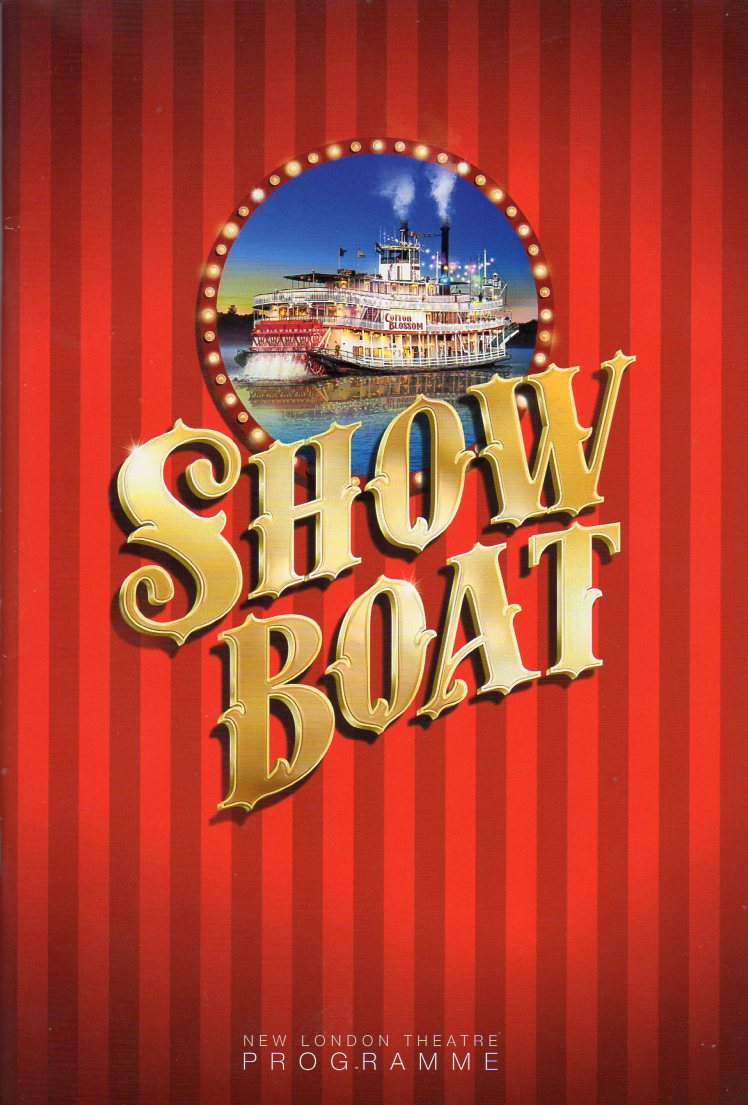
50 Favourite Musicals: 15: SHOW BOAT (1927) (Jerome Kern / Oscar Hammerstein II, PG Wodehouse)

The 50 shows that have stood out down the years and, as we get up among the paint cards, the shows that have become the cast recording of my life:


 First performed: 1927, Ziegfeld Theatre, NY
First seen by me: London Palladium, 1991
Productions seen: two

Score: Jerome Kern / Oscar Hammerstein II, P.G. Wodehouse
Book: Oscar Hammerstein II

Plot: The lives and loves of the performers on Capt'n Andy's show boat "The Cotton Blossom" as it sails up and down the Mississippi River span 40 years and the evolving styles of American popular entertainment...

Five memorable numbers: OL' MAN RIVER, CAN'T HELP LOVIN' DAT MAN, MAKE BELIEVE, BILL, LIFE UPON THE WICKED STAGE

You would have thought that the show acknowledged to be the one that first presented a narrative with a fully integrated score and believable characters - not just an evening of skits, songs and production numbers or imported European operetta - would be handled with more respect but no, SHOW BOAT has been revised and rewritten with practically every revival on stage or screen.  Incidentally how interesting that the original SHOW BOAT was produced by Florenz Ziegfeld whose splashy revues were wiped away in the coming years by Musical Comedy productions.  The story stays the same - professional gambler Gaylord Ravanel meets aspiring actress Magnolia Hawks aboard her father's show boat and they marry unhappily ever after - but songs are dropped to be added to the film to be added to the revival to be dropped again etc. etc.  However, no matter what version you see the magic always happens - Edna Ferber's original characters are all sympathetically drawn by Hammerstein and you are never far away from a cracking song whatever the production. 


My first voyage on the SHOW BOAT was James Whale's 1936 film version with the excellent cast of Irene Dunne as Magnolia, Helen Morgan repeating her original stage role as Julie Laverne the Cotton Blossom's leading lady who has to leave when it is revealed that she is half-black, Hattie McDaniel as the boat's cook Queenie and the legendary Paul Robeson as her husband Joe.  Incidentally 'Joe' was written for Robeson but because Ziegfeld's production was delayed he had to withdraw because of other commitments, he played it instead in the original London production.  I first saw it onstage in 1991 when Ian Judge directed an RSC & Opera North co-production at the London Palladium with a memorable cast of Jan Hartley (Magnolia), Bruce Hubbard (Joe), Marilyn Cutts (Julie), David Healy (Cap'n Andy), Karla Burns (Queenie) and Margaret Courtenay (Parthy).  It was a wonderful production that made me realize the show's power.  Then in 2016 Daniel Evans directed an excellent revival for the Sheffield Crucible which later transferred to the New London Theatre for a shamefully short run.  At the Crucible the show had lovely performances from Michael Xavier (Gaylord), Gina Beck (Magnolia), Allan Corduner (Cap'n Andy), Emmanuel Kojo (Joe), Sandra Marvin (Queenie), Danny Collins (Frank) and particularly Rebecca Trehearn's haunting Julie - the character has my two favourite numbers from the show "Can't Help Lovin' Dat Man" and "Bill" (originally written by Kern with PG Wodehouse in 1917).  It was wonderful to experience SHOW BOAT on stage again, and it proved that a historical milestone from 1927 can be as vital, touching and entertaining as ever.

Again I am confronted with there being so many fabulous songs in SHOW BOAT over so many productions... which to choose?  I kept returning to this, a promo for the New London production with Rebecca Trehearn showing why she won the Olivier Award for Best Supporting Actress In A Musical for playing tragic Julie and delivering such a thrilling version of "Bill"...


Friday, May 31, 2019

50 Favourite Musicals: 22: HOW LUCKY CAN YOU GET (1985) (John Kander / Fred Ebb)

The 50 shows that have stood out down the years and, as we get up among the paint cards, the shows that have become the cast recording of my life:


First performed: 1985, Donmar Warehouse, London
First seen by me: as above
Productions seen: one

Score: John Kander / Fred Ebb
Plot:  Four West End stars deliver a song-by-song tribute to the dazzling songbook of John Kander and Fred Ebb.

Five memorable numbers: MAYBE THIS TIME, A QUIET THING, ARTHUR IN THE AFTERNOON, THE GRASS IS ALWAYS GREENER; CITY LIGHTS

Before the Donmar was taken over by Sam Mendes in 1992 to become a proper producing theatre and quickly established itself as one of THE important theatres in London, it had been run as a fringe space with an ever-changing array of shows such as stand-up, Edinburgh Festival transfers and an important performance space for cabaret singers who were bereft of small spaces to accommodate them "off-West End".  In 1985, the musicals star David Kernan started a season of shows called SHOW PEOPLE that consisted of evening performances and late night shows at the weekend.  The inaugural show was KERN GOES TO HOLLYWOOD, a tribute to Jerome Kern based on the old SIDE BY SIDE BY SONDHEIM format of songs linked loosely by biographical information - indeed Kernan revived SIDE BY SIDE itself the following year.  But one of the first late-night and weekend shows was Ian Judge's wonderful HOW LUCKY CAN YOU GET - a tribute to the dazzling back catalogue of John Kander and Freb Ebb.  It's stellar cast included veteran West End star Josephine Blake - recently returned to the London stage from semi-retirement, the current stars Angela Richards and the unstoppable Diane Langton, and the lone male performer was Martin Smith, a late replacement after Ray Evans pulled out.  Judge dropped the linking device and let the songs speak for themselves, drawn from the Kander & Ebb shows FLORA THE RED MENACE, CABARET, THE HAPPY TIME, 70 GIRLS 70, CHICAGO, THE ACT, WOMAN OF THE YEAR and their latest show THE RINK; the show also included songs from their film and tv work such as LIZA WITH A Z, FUNNY LADY and LOVE FROM A TO Z.  All of them turned in fantastic performances and a few have now - for me - become definitive.  Diane Langton was always one of my favourite West End belters and here she excelled: her "Maybe This Time" will never be bettered - as she sang the final "Maybe This Time / I'll Win", she soared up the notes on "...Iaaaaaaaaaaaaall Win" all on a single sensational breath; equally her version of "A Quiet Thing" was wonderfully sung, going large in the middle section before bringing it back down to almost a whisper, and "Arthur In The Afternoon" gave her ample opportunity to connect to her audience as only she could.  Jo Blake found a natural home in the gimlet-eyed cynicism of Kander & Ebb's songbook and turned in memorable performances of "City Lights" and in "The Grass Is Always Greener" duet with Angela Richards who herself turned in a magnetic performance of "I In My Chair", almost a one-act play of marital betrayal.  Martin Smith's easy charm resulted in sweet performances of "Mr Cellophane" and "Sometimes A Day Goes By" - what a loss it was when he died in 1994 from an AIDS-related illness.

Sadly no video exists of HOW LUCKY CAN YOU GET but a number of it's songs feature in ths glorious celebration of Kander and Ebb musicals from the 1984 Tony Awards, the year before this show.  Sit back and let Liza, Chita, Gwen and Raquel (!) have a Diva-off...