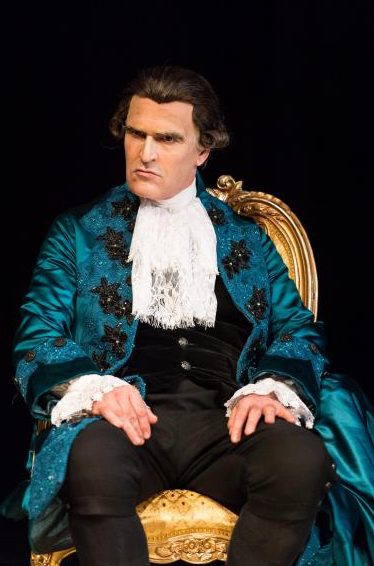
Peter Shaffer died four months before the opening of this revival of his 1979 masterpiece AMADEUS, I am sure he would have been thrilled to see it back on the National Theatre's mainstage 37 years later. Sadly that production was before I got the theatre bug in that same theatre three years later with GUYS AND DOLLS, I would loved to have seen it as my dear friend John Normington played the fussy Emperor Joseph II. As usual, I am used to seeing ghosts walk the Olivier stage....
I first saw AMADEUS on stage in 2014 in a revival at Chichester with a masterful, charismatic lead performance from Rupert Everett as Salieri, the 18th Century composer who found himself usurped in popularity by the young genius Mozart and schemes to ruin him. Shaffer has a reclusive and dying Salieri narrate the story; he has made sure that all Vienna is awash with the rumours that he murdered Mozart but takes us back to their first meeting and the start of his enmity.
What angers Salieri is that God is seemingly mocking him; from a young age he dedicated his life to the service of enriching the world and serving God through his music and while it has brought him success he has yet to fully believe that the Lord is truly in his compositions. He can sense the divine in Mozart's work but is appalled that the composer is a dissolute and obnoxious person. Salieri decides to avenge himself on his uncaring God by seeking to destroy his chosen one.
The script bristles with Peter Shaffer's distinctive literary wit and phrasing but I felt that language did not seem to be uppermost in director Michael Longhurst's three hour production. Once again we have a director who seems to follow the Emma Rice school of directing: namely distrust the words and go for the sensation - the choreographed movement, the modern anachronisms, the minimalist standing set, the gender and race-blind casting, the vague air of alienation theory. It all smacks of attempts to jazz up the form but all one is left with are tropes, no substance.
As usual what gets lost in this approach is any genuine emotion in the piece - you watch the actors going through the motions but nothing they ever do seems to connect, or even attempt to. I suspect it would be seen as old school to do that but if you are spending three hours staring at a production, something needs to have an effect surely.
Longhurst has the potentially inspiring idea of using the 21-strong Southbank Sinfonia acting as supernumeraries and also to create choreographed movement at times - all waving or pulsing to a certain strain of music. I have to admit it did make for some memorable moments but that was what they were - moments. At other times all you had were 21 people staring gormlessly about themselves and into the auditorium.
Despite the raves he has received from the critics I found Lucian Msamati ultimately wearying as Salieri; it's not entirely his fault, by the end of the play you do rather wish that Shaffer would speed up his musing on musical history and for the most part Msamati was strong enough to lead the production and give it a central focus, but his speech pattern did not really suit the writing and it became hectoring rather than insinuating. Rupert Everett gave a much more nuanced performance at Chichester and as such made the character more resonant. One applauds Msamati for the endurance but not the actual performance.
Adam Gillen as Mozart and Karla Crome as his wife Constanze also have the same affliction - both end the play as they started it; Gillen braying and whinnying and Crome like an 18th century character from Eastenders. Both Amadeus and Constanze age ten years during the play as they dwindle into poverty but you really would have no idea from their performances.
Yes Gillen was supposed to be an annoying twat but in his final scene, dying while trying to finish his own requiem, he was just as squeaky and punchable. Joshua Maguire played Amadeus in the Chichester production and at least varied the tone, finally winning some sympathy for the character.
One of the actors did however make a splash; Tom Edden - last seen gurning about in dirty underwear in the woeful DOCTOR FAUSTUS - was delightful as the petulant Emperor Joseph II. Two actors who were good in the previous Olivier production THE THREEPENNY OPERA here play Salieri's gossiping Venticelli and gave such jarringly amateur performances that they shall remain nameless.
Chloe Lamford's production design managed to be both sparse and cluttered at the same time, mainly consisting of a movable stepped dais and projected gauze's and scrims while Jon Clark's lighting design did all the heavy lifting in setting moods and place. However, there was no denying the excellent musical direction of Simon Slater who made the classical music sound wonderfully bravura.
The production is sold out until February but will continue in the repertoire further into 2017 and it will, of course, be screened in cinemas as part of the NT Live events.
Back to that original National Theatre production... AMADEUS won the Evening Standard award for Best New Play and Paul Scofield was filmed for the television coverage in the scene where Salieri hears Mozart's music for the first time; it's an acting masterclass in microcosm and is thrilling to watch and hear:
Showing posts with label Peter Shaffer. Show all posts
Sunday, November 13, 2016
Saturday, July 26, 2014
Genius In West Sussex
Sometimes it does you good to get out of London's Theatreland and venture into the country's Theatreland instead.
Last Saturday found us on a train chuffing down to Sussex to see what the renovation of the Chichester Festival Theatre were like but primarily it was to see Rupert Everett play the barnstorming role of Salieri in Peter Shaffer's AMADEUS.
I had seen Milos Forman's award-laden screen adaptation but had never seen the play on stage before. The original directed by Peter Hall at the NT in 1979 with Paul Scofield and Simon Callow was three years before my Paulian conversion to the magic of theatre and I later missed Hall's revival at the Old Vic in 1998. That version starred David Suchet as Salieri and Michael Sheen as the titular composer. I am presuming my reason for not going was because if it wasn't Paul Scofield then there was really no point!
But when I heard that Rupert Everett was going to play Salieri to open the new season I knew I had to see it this time. Chichester is only 90 minutes by train from Victoria so tickets were booked and it was off to a Saturday matinee. Needless to say a matinee in Chichester can almost guarantee that I will be among the youngest in the audience!
Salieri (Everett) is a recluse in his Viennese palazzo, a forgotten composer whose operas and compositions were once fashionable but the city is swirling with the rumour that he murdered his fellow composer Mozart (Joshua McGuire) 32 years before. The decrepit Salieri takes us back to that era when he was the court composer to Emperor Joseph II (Simon Jones) and the rumour sweeping the city then was of the arrival of the gifted young Mozart.
Salieri, a man who as a teenager vowed his life to God for the chance to make music, is appalled to discover that the young man who composes music that Salieri thinks is Heaven-blessed, is an obnoxious, braggart who revels in childish behaviour and scatological humour. If this is how God chooses to bestow his grace then what has Salieri's vow to be His servant on earth been for? In a rage against God and life, Salieri sets out to ruin the young composer's chances of advancement, to wreck his musical career, to kill him.
Who better to be our sardonic narrator than Everett? He was quite magnificent. Effortlessly moving from the crabby and aged Salieri to his suave and assured younger self with just a wig, two swipes of black across his eyebrows and a change in his voice, he held the attention for the whole length of the play with ease.
By turns playful, murderous, anguished and self-pitying, he rose to the operatic finale of the play with a power that left me stunned. His horror at the cruelty of life and God was wonderful to see. As I watched him I felt grateful that he has decided to embrace the stage again because, as he proved as Oscar Wilde in THE JUDAS KISS, given the right part he is sublime.
McGuire's Mozart was less of a success, probably due to Shaffer's unwillingness to show us the soul where his music comes from; if Shaffer wants to show that Mozart could just 'turn it on' and produced music with such passion without having any himself then he has succeeded. Only in his last scene, composing the music in his head as he dies in his wife's arms, did McGuire connect.
Jessie Buckley was a little revelation as Constanze, the wife who stands by her husband no matter what life throws at them. She first came to my attention in the BBC series I'LL DO ANYTHING as one of the contestants vying to play Nancy in the revival of OLIVER! and I later found her ineffectual as Anne in the Menier's A LITTLE NIGHT MUSIC. But last year she impressed as Princess Katherine to Jude Law's HENRY V and here she was very good as the playful wife who becomes a bewildered, hurt woman.
I have heard nothing of a London transfer for the production - it would be a shame if it's short playing time at Chichester could not be extended elsewhere, giving a wider audience the chance to enjoy a fine production and to see how charismatic a stage actor we have in Rupert Everett.
Last Saturday found us on a train chuffing down to Sussex to see what the renovation of the Chichester Festival Theatre were like but primarily it was to see Rupert Everett play the barnstorming role of Salieri in Peter Shaffer's AMADEUS.
I had seen Milos Forman's award-laden screen adaptation but had never seen the play on stage before. The original directed by Peter Hall at the NT in 1979 with Paul Scofield and Simon Callow was three years before my Paulian conversion to the magic of theatre and I later missed Hall's revival at the Old Vic in 1998. That version starred David Suchet as Salieri and Michael Sheen as the titular composer. I am presuming my reason for not going was because if it wasn't Paul Scofield then there was really no point!
But when I heard that Rupert Everett was going to play Salieri to open the new season I knew I had to see it this time. Chichester is only 90 minutes by train from Victoria so tickets were booked and it was off to a Saturday matinee. Needless to say a matinee in Chichester can almost guarantee that I will be among the youngest in the audience!
Seeing it the first time on stage made me realise how theatrical the play is, a Shaffer trait. The aged Salieri almost gives us a commentary on the play itself, signalling when the interval is going to be and what we can expect in the second half - when he has returned from evacuating his bowels! The sinister opening with the citizens of Vienna in the theatre eerily whispering "Sssssalieriiiii" sets the unsettling tone of the play which culminates in a truly haunting final image.
I am also surprised that in 35 years this is only it's second major revival. Shaffer's play gives the chance for two actors to play such well-written lead roles and the play always seems to have successful runs.
Salieri, a man who as a teenager vowed his life to God for the chance to make music, is appalled to discover that the young man who composes music that Salieri thinks is Heaven-blessed, is an obnoxious, braggart who revels in childish behaviour and scatological humour. If this is how God chooses to bestow his grace then what has Salieri's vow to be His servant on earth been for? In a rage against God and life, Salieri sets out to ruin the young composer's chances of advancement, to wreck his musical career, to kill him.
Who better to be our sardonic narrator than Everett? He was quite magnificent. Effortlessly moving from the crabby and aged Salieri to his suave and assured younger self with just a wig, two swipes of black across his eyebrows and a change in his voice, he held the attention for the whole length of the play with ease.
By turns playful, murderous, anguished and self-pitying, he rose to the operatic finale of the play with a power that left me stunned. His horror at the cruelty of life and God was wonderful to see. As I watched him I felt grateful that he has decided to embrace the stage again because, as he proved as Oscar Wilde in THE JUDAS KISS, given the right part he is sublime.
McGuire's Mozart was less of a success, probably due to Shaffer's unwillingness to show us the soul where his music comes from; if Shaffer wants to show that Mozart could just 'turn it on' and produced music with such passion without having any himself then he has succeeded. Only in his last scene, composing the music in his head as he dies in his wife's arms, did McGuire connect.
Jessie Buckley was a little revelation as Constanze, the wife who stands by her husband no matter what life throws at them. She first came to my attention in the BBC series I'LL DO ANYTHING as one of the contestants vying to play Nancy in the revival of OLIVER! and I later found her ineffectual as Anne in the Menier's A LITTLE NIGHT MUSIC. But last year she impressed as Princess Katherine to Jude Law's HENRY V and here she was very good as the playful wife who becomes a bewildered, hurt woman.
I liked Simon Jones as the airy, ineffectual Joseph II and could see how marvellous the late and great John Normington would have been in the original production and there was a demonstration in excellent supporting performance from John Standing, Richard Clifford and Timothhy Kightley as the unmoving bastions of accepted music in the court.
Jonathan Church's production was atmospheric and moved at a good pace while losing none of Shaffer's literate script and certainly provided a wealth of memorable moments, helped immeasurably by Simon Higlett's spare set of frosted mirrored doors - encompassing crumbling Vienniese mansions and elegant court life - and Tim Mitchell's evocative lighting. Fotini Dimou's costumes were a feast for the eyes as Paul Groothuis' sound design was for the ears.
Subscribe to:
Posts (Atom)