Showing posts with label Richard Cant. Show all posts

Wednesday, November 10, 2021

THE NORMAL HEART at the Olivier, National Theatre - Anger is an energy...

Before Rock Hudson, Ian Charleson, Freddie Mercury and Keith Haring died, before ANGELS IN AMERICA and MY NIGHT WITH REG, before the UK's "Don't Die of Ignorance" campaign and Princess Diana shaking the hand of an AIDS patient, there was Larry Kramer's polemical play THE NORMAL HEART.

After it's 1985 Off-Broadway premiere, it quickly opened the following year at London's Royal Court in a production directed by David Hayman and starring US actor Martin Sheen as the combatative lead character Ned Weeks, based on Kramer himself.  I was lucky to see it twice - Martin Sheen was a favourite actor - but the play hit like a sledge-hammer, Kramer's take-no-prisoners approach did a lot to make me aware, probably for the first time, what was happening around me.

It's a production that stayed with me, for the concentrated fury in the writing but also for the committed performances of Martin Sheen and Paul Jesson, who won an Olivier Award for his performance as Felix, a New York Times journalist who manages to break through Ned's emotional defences.

Kramer had already had success as a writer: his 1960s career working in London at Columbia Pictures culminated when he wrote the script for Ken Russell's WOMEN IN LOVE for which he was nominated for an Academy Award but he moved to trying his hand writing a gay play which flopped so he moved again to writing books.  His 1978 novel "Faggots" annoyed gay readers who disliked it's negative view of gay promiscuity - and they remembered his name.

He had never been an activist but when friends started succumbing to a strange illness he arranged a meeting at his apartment with friends and a doctor who said that early research found the illness to be spreading.  In 1982 they started the Gay Men's Health Crisis which became the leading support group in New York for AIDS sufferers.  But as has happened so often before, the group soon were fracturing: Kramer wanted to push hard for funding from Mayor Ed Koch while the group's elected president Paul Popham wanted a less controversial approach.

Despairing that the group was not pushing harder, Kramer wrote a scathing article in a New York gay newspaper, condeming politicians and, controversially, closeted and Out gay men for ignoring their own health and the health of others.  Welcomed by some, it was also derided by others who remembered him as the writer of "Faggots" and later that year, Kramer was unceremoniously dumped by the GMHC.  He would have his revenge by writing THE NORMAL HEART and by helping set up AIDS Coalition To Unleash Power aka ACT-UP, a direct action group that hit hard with it's slogan SILENCE = DEATH.

In 1992 Kramer wrote a sequel to THE NORMAL HEART titled THE DESTINY OF ME which ran for a year Off-Broadway and was nominated for a Pulitzer Prize for Drama. Kramer died in 2020 aged 84 of Pneumonia, having lived with HIV for 33 years and long enough to see THE NORMAL HEART finally have a successful Broadway run in 2011 which won him a Tony Award for Best Revival, and now the National Theatre have given us a London revival, directed by Dominic Cooke, ironically a former artistic director of the Royal Court where THE NORMAL HEART had premiered.

There is no denying the force of anger that drives the writing but seen 35 years after the Royal Court production, Frank Rich's summing up in his review of THE DESTINY OF ME seems quite accurate "He has a good ear, but it's the ear of a journalist, not a poet".  There are four speeches in THE NORMAL HEART when the dialogue lifts: when Ned is faced with expulsion from the group for his aggresive approach, he says he belongs to a culture that produced famous gay writers, composers, artists, politicians who are not invisible men in history, and also when Doctor Brookner angrily denounces the Government's medical board when her research grant is denied. 

The character is based on Linda Laubenstein, a doctor who treated a patient for Karposi's sarcoma as early as 1979 and by 1982 was running a private practice just for the treatment of men with AIDS.  Her anger at the silence around the men dying daily in front of her led her to become an activist for AIDS research and her insistance that the gay bath-houses of New York be closed to arrest the spread of the disease was praised by Kramer, less so by members of the gay community who viewed it as puritanism.  Sadly she died in 1992 aged 45 of a heart attack. 

Kramer has the good grace to give the other good speeches to Ned's critics - the closeted and polished Bruce Niles who is made president of the group because he projects a better image, has a moving speech about his partner dying in a hospital where, as no medical staff will touch him, a porter smuggles his body out in a body bag for a backhander.  There is also a fine speech from fellow-activist Mickey Weeks, who cracks under the pressure of all that Ned expects from his comrades while they are trying to live through their own fears.

The production is designed by Vicki Mortimer as a gladiatorial circular arena - the Olivier is in the round presently - and Cooke seems to take his cue from that setting, so the scenes are usually blocked as two actors standing opposite each other or seated on opposing metal benches having at each other: an approach which eventually tires you out and you yearn for something to break up the 50/50 staging.  I think the Olivier is too large a space for such a play.

I found much to like in Ben Daniels' Ned Weeks but he is onstage for nearly all the running time and I eventually wished for the variety of performance that Martin Sheen delivered: Ned's flashes of humour hardly registered.  Dino Fetscher made for a strapping but dull Felix, I couldn't really believe in their relationship, or any of Fetscher's performance choices. Liz Carr as the motorised Dr Brookner had her moments: Brookner is there to punctuate the activists' shouting matches with cold, blunt facts and she certainly rose to the explosive speech where she finally lets her stoicism crack in the face of bigoted indifference but she too seemed to be playing an idea rather than a living character.  

The rest of the cast seemed to be concentrating harder on their American accents rather than giving any noticeable performances - the exception being Daniel Monks as the put-upon Mickey although a special mention goes to Richard Cant who delivered two good cameos: as a patient of Dr Brookner who remembers serving Ned in a store, and as the icy (and closeted) Mayor's assistant.

One cannot help but think of COVID as the ethics of how to deal with a pandemic where being loudly debated onstage but one hopes that this was not the sole reason for the play's appearance in the repertoire: those suffering and dying with AIDS were blamed solely for their predicament by the world at large.

I am glad I saw this revival but suspect I will always have that first production to draw on.  Dominic Cooke has a prologue to the play: the cast form a circle around a burning cauldron for what seems like a minute's silence and suddenly the stage is plunged into darkness only to be hit by strobe lights as the age of Disco is embodied by - you guessed it - Donna Summer's I FEEL LOVE blaring out. I FEEL LOVE - that lazy shortcut to suggest decadence.  Mind you, as lazy shortcuts go, it's always worth a blast.

Saturday, February 07, 2015

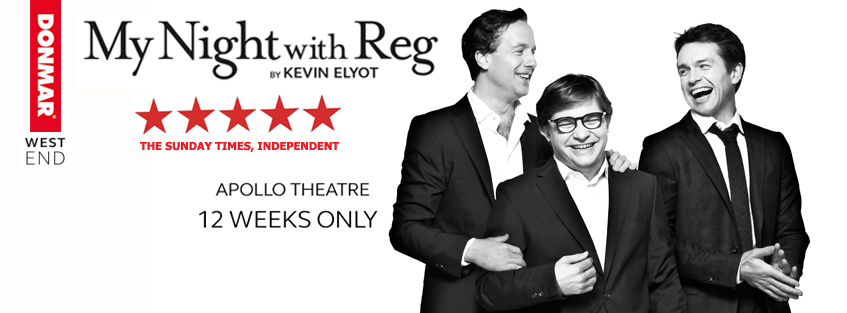
MY NIGHT WITH REG - revisited at the Apollo Theatre


Last year the best production I saw on stage was Robert Hastie's revelatory revival of Kevin Elyot's MY NIGHT WITH REG, a play that had languished in memories for nearly 20 years.  The National should hang their head in shame for leaving Elyot's key work on the shelf.  But then we probably would not have had this revival with this particular cast.  My original blog is here


I was lucky enough to see it at the Donmar twice but now it has transferred for a limited season to the Apollo Theatre - ceiling staying up nicely - and it was great to see it again.  It was interesting to see it on the bigger proscenium stage and to see how the cast were adapting their performances to a bigger auditorium.


I am happy to report that apart from a slight broadening of a couple of performances, Hastie's production is still a marvel, funny and profound by turn with the cast of six working seamlessly together to keep the action ricocheting between them while beneath lies caverns of subtext.


Kevin Elyot always plays with the concepts of time, consequences and memory and what struck me seeing REG again was how skillfully he does this, how something significant at the start of the play is dismissed as a half-remembered memory by the end, how things important to one person are forgotten by the other, how when someone dies what remains are half-remembered moments in time.


Geoffrey Streatfeild as art-dealer Daniel, Julian Ovendon as the rootless John, Jonathan Broadbent as lonely Guy, Richard Cant as the terminally dull Bernie, Matt Bardock as the ever-randy Benny and Lewis Reeves as the plain-speaking younger lad Eric are giving memorable, heartbreaking performances that deserve all the plaudits they have received - do yourself a favour and get to see this once-in-a-lifetime production.


What I am now wondering is if I can make it a four-in-a-lifetime production...  Click on the banner to book.

http://www.nimaxtheatres.com/apollo-theatre/my_night_with_reg

Here the cast give you an introduction to the play:


Friday, August 08, 2014

*My* Night With Reg

Scary but true.  It's been three years since I have been to the Donmar Warehouse.

I have seen two Donmar productions in the past year but I have not visited the theatre!  By way of explanation, I saw CORIOLANUS at the NT Live showing at the Ritzy Cinema (an experience I am still trying to get my head around) and I also saw THE WEIR when it transferred to the Wyndhams Theatre but nope, no actual visit since seeing Jude Law and Ruth Wilson in ANNA CHRISTIE.

It's not that I haven't wanted to see recent productions there but the Donmar is now one of the theatres that usually sell out by the time of the first preview so as you can't beat them, you have to join 'em!  So back on the mailing list and back in the front row of the circle...


And what a production to come back to, a timely revival of Kevin Elyot's quietly devastating 1994 play MY NIGHT WITH REG.  It has taken 20 years to get a London revival - the sadness is that Elyot died less than two months ago during the pre-production for this production.  He was such a fine writer, perceptive but with a deadly cutting wit, and it's a shame that he leaves only a handful of plays alongside his other writing credits for television, namely his Agatha Christie adaptations which included the last David Suchet Poirot episode and my personal favourite, his BBC adaptation of Patrick Hamilton's TWENTY THOUSAND STREETS UNDER THE SKY.

MY NIGHT WITH REG opened at the Royal Court in 1994 and was such a success that it transferred to the Criterion and then the Playhouse Theatres, later being filmed for the BBC with the original cast of Anthony Calf (John), David Bamber (Guy), Joe Duttine (Eric), John Sessions (Daniel), Roger Frost (Bernie) and the late Kenneth MacDonald (Benny)


With that great cast I had doubts if I could really enjoy this revival but the combination of Elyot's timeless writing, Robert Hastie's insightful direction and a cast that is truly an ensemble made for a wonderful experience.

The play has been compared to US plays that dealt with the AIDS crisis - THE NORMAL HEART, AS IS etc. - but, like Tony Kushner's ANGELS IN AMERICA, Elyot was already looking back to the 1980s when writing his play so with hindsight, he could view the crisis with less hysteria than the Americans.  Unlike these other plays REG has a profundity and a universality that leaves the American plays thin and trite.  I remember seeing the film version of Terrence McNally's LOVE! VALOR! COMPASSION, also written in 1994 and also based around a group of gay men and almost ran from the cinema at the sheer banal cutesiness of it all compared to what Elyot had written.


Shy and lonely Guy is throwing a housewarming party in his new ground floor flat and has invited his old University friend John who he has silently adored for years although they hardly see each other.  John, oblivious to Guy's unrequited love, confides in him about his sex life and, after another University friend Daniel stops by briefly between air flights, John tortures Guy further by telling him he slept with Daniel's partner Reg the night before. Exasperated by his friends' teasing about his non-existent sex life, Guy blurts out that on a recent trip to Lanzarote he had unprotected sex with a man who got him drunk.  Also at the party is Eric, a young chap who is helping to paint Guy's conservatory and who acts oblivious to the passes made at him by John and Geoffrey.

Imperceptibly the scene jumps ahead in time to the get-together after Reg's funeral and the same group are joined by Guy's friends Bernie and Benny, a couple who separately also confess to the hapless Guy that they too slept with Reg.  Guy, who also has to listen to his beloved John's pain over losing his sometime lover Reg, is encouraged by the others to make a pass at Eric.  he clumsily attempts to but is equally clumsily rebuffed.  It's only after another time shift and another funeral that some truths are revealed and some lies are maintained.


As in Chekhov, Elyot puts the audience through the exquisite pain of watching his characters desperately trying to find love but being unwittingly rebuffed or misunderstood while also making them multi-faceted and surprising at every turn, six excellent characters that the exceptional cast mine for every inch of surface wit and sub-textual pain.

Excellent performances abound from Julian Ovenden as John, the golden boy who doesn't have to try too hard for whatever he wants; Geoffrey Streatfeild as the flamboyantly outrageous art dealer Geoffrey; Lewis Reeves as the tantalisingly young but surprisingly moral Eric and the double act of Richard Cant and Matt Bardock as the couple Bernie and Benny, whose every conversation ends in a skirmish.


If I don't include Jonathan Broadbent as the lovelorn Guy in that line-up it's because he was the one who ultimately failed to erase memories of the original cast member but then again, David Bamber was unforgettable.  Broadbent slightly overdoes a Harry Potter-ish schtick which fails to match Bamber who played the role with no concessions to audience sympathy but won it nevertheless.  Broadbent was certainly effective in his scenes of desperation as his unattainable object of desire confided in him of his own sex life.

Robert Hastie's excellently subtle direction draws you slowly into the devastating fall-out of the friends' lives and judges the pace beautifully, almost situation-comedy moments suddenly giving way to moments of aching pathos and unwitting cruelty.


Peter McKintosh's design and the always-admirable Paul Pyant's lighting give the production a solid unity that supports the play well.

I had forgotten how skilfully Kevin Elyot plays with time through the course of REG and seeing it again made me want to experience the memory plays that he wrote after it: THE DAY I STOOD STILL (1998) and MOUTH TO MOUTH (2001).

Robert Hastie's Donmar production of MY NIGHT WITH REG is a fitting tribute to this under-rated and sadly-missed writer.