Showing posts with label Benedict Cumberbatch. Show all posts

Sunday, July 21, 2019

Dvd/150: THE HOLLOW CROWN: THE WAR OF THE ROSES - RICHARD III (Dominic Cooke, 2016)

The second cycle of THE HOLLOW CROWN ends with Benedict Cumberbatch murdering his way to the throne as RICHARD III.


Starting with a tracking shot around Richard's grotesque twisted spine, Cumberbatch gives a subtle portrayal of evil shot through with a sense of murderous fun as he colludes with the viewer in his treacherous plans.


Ben Power's adaptation keeps the plot moving fast but in this part of the trilogy, some poetry is lost - Queen Elizabeth's plea to the stone walls of the Tower to protect her captive sons and, more unforgivably, Clarence's dream of drowning.


This is Dominic Cooke's first filmed work and the trilogy has an assured, cohesive vision.  Again Sophie Okonedo is marvellous as Queen Margaret, cursing the royal family who learn too late she is right, and in a relatively minor role as Richard's mother, Judi Dench is magnificent in her final denunciation scene with him.


Shelf or charity shop?  Ruling from the shelf, the final death toll incidentally is 25... farewell Clarence, Edward IV, Lords Hastings, Grey and Rivers, Princes Edward and Richard, Queen Anne. Buckingham, Catesby and of course, you know who...


Saturday, July 20, 2019

Dvd/150: THE HOLLOW CROWN: THE WAR OF THE ROSES - HENRY VI PT 2 (Dominic Cooke, 2016)

The plot - and spilled blood - thickens as the balance of power seesaws between the houses of Lancaster and York in Dominic Cooke and Ben Power's adaptation of HENRY VI PART 2.


Nearly all Shakespeare's original PART 2 is jettisoned - Irish wars, Jack Cade's revolt - to concentrate on his PART 3: the clamorous battle in the narrow streets St Albans results in York forcing Henry VI to disinherit his young son in favour of York's children. 


Furious Queen Margaret wreaks bloody vengeance on York and his youngest son, leading to his other three sons, Edward, George and infamous Richard, seeking revenge on her and the mentally-unstable Henry.


Allegiances change and change again and all the time, bodies keep falling - and Richard inches nearer and nearer the throne.


Standout performances include Benedict Cumberbatch as the murderous Richard, Sophie Okonedo as Margaret, Geoffrey Streatfeild as Edward IV and Stanley Townsend as Warwick.


Shelf or charity shop?  Fighting it out in gory detail on the shelf - the death toll is now 14...buying the farm here are the Dukes of York, Exeter and Suffolk, Prince Edward, Henry VI, Somerset, Warwick, Edmund Plantagenet, Young Lord Clifford - and you know there are more to come in RICHARD III...


Friday, August 28, 2015

HAMLET at the Barbican - When Cumberbatch Met Shakespeare...

After all the hype, the year-long wait for tickets, the brouhaha over director Lynsey Turner moving "To be or not to be" to the start of the play, press reviewing the first previews... after all that, how exactly did HAMLET at the Barbican pan out?


As I said I've had a year to build up to the production with only the poster art to whet one's appetite.  The design of a troubled younger Hamlet, with trademark Cumberbatch hair, staring out while other unhappy kids - maybe Laertes, Ophelia, Horatio and Fortinbras? - mope about in the background at a miserable party, is really not reflected in the final production, who knows if it ever did?

To be honest, after all the press and social media jabber about Benedict Cumberbatch stepping up to the plate to play the melancholy prince, I actually wasn't looking forward to seeing the production.  It all seemed whipped up and over-blown, and more importantly, we had seen Lynsey Turner's dire over-conceptualised production of LIGHT SHINING IN BUCKINGHAMSHIRE at the National which made me fear the most.  But there I was last Monday, taking my place in the front row - THE FRONT ROW - with my over-sized £10 programme.  I resisted the tshirts and mugs on sale in the foyer.


At first my heart sank as Hamlet was revealed listening to a Dansette playing Nat King Cole's "Nature Boy" but I didn't dare grind my teeth as Cumberbatch was only a stone's throw away - and we all know how distracted he can get by his audience!  Turner has dropped the opening scene on the ramparts and gallops straight into the first court scene, all the quicker to get her star on the stage as quickly as possible.

The subsequent action all takes place on Es Devlin's extraordinary, angled set which suggests a low ceilinged Middle-European palatial hunting lodge, almost CinemaScope in aspect as it reaches across the large Barbican stage.  It's painstakingly detailed with mounted stags-heads, royal family portraits and, tellingly, an old rocking-horse and boxes of toys stored almost out-of-side under the impressive staircase and first-floor landing.  It could have been somewhere Nicholas and Alexandra might have stayed when they wanted to be a 'normal' family in the summer months.


When we first we see it it is also festooned with large hanging white garlands to celebrate the marriage of Claudius and Gertrude with a long table attended by courtiers dressed in bright colours - apart of course from Hamlet in his inky coat of mourning.  His first monologue "O that this too too solid flesh would melt..." is played direct to the audience with him climbing over the table while all around the others do their best sloow-motion acting.

Turner's streamlining of the text focusing all on Hamlet makes for a swift first act although the interval was placed quite late in the action after Hamlet is shipped off to England and as if to make up for it closing on a non-Cumberbatch scene, Turner has the doors of the set suddenly blow open as leaves and dust swirl through them engulfing the solo figure of Ciaran Hind's Claudius.  It did leave the nagging feeling that Elsinore was the latest venue for SLAVA'S SNOW SHOW.


Sadly the second act built on the niggles I felt during the first act and possibly because Cumberbatch was offstage for awhile, the pace slackened and never really recovered.  A main contributor to that was the fact that in the interval the set is changed to a desolate shell of it's former self with the the stage now covered in mounds of dirt and rock.  Yes it's a good visual flagging up of the fact that the second half of the play focuses on the spiralling paranoia within Elsinore and the threat of war without but it didn't help the flow of the scenes with the cast gingerly climbing over the mounds like worried mountain goats in Jane Cox's gloomy lighting.

In retrospect I think the production highlights all of Lyndsey Turner's worst aspects of vision and direction - the visual over-emphasis and the feeling that the actors are playing in their own sealed spaces and not connecting onstage was all very prevalent.  I also found the whole visual idea for Hamlet distracting: his mad scenes are played while dressed up as a toy soldier and he even finally resorts to dragging on his own large fort to hide in.  It all felt overly-cute and done to get easy laughs for Cumberbatch to the cost of the rhythm of the play - and why for the play scene did he sport a Ziggy Stardust t-shirt??


I had expected Ciaran Hinds as Claudius to really put a stamp on the production and give Cumberbatch a run for his money but he made only fitful impressions, usually when he was in scenes with others.  Anastasia Hille isn't an actress I particularly like but I also felt she was colourless as Gertrude - at no time did I feel any connection between her and Claudius and in particular between her and Hamlet - the closet scene might as well have been two people standing at a bus stop.

I was looking forward to Jim Norton as Polonius but he too seemed to gave a muted, underplayed performance while Ophelia was played by the colourless Sian Brooke.  Turner has thrown greater emphasis on Ophelia in this production, she wanders around snapping away with a box brownie camera during the first act and in her final scene, she drags on a large trunk which Gertrude opens to find hundreds of her photographs and her camera, then watches as mad Ophelia walks away from her up one of the rubble dunes to her watery death.  The trouble is that Brooke does nothing to impose any personality on the role.  Nice black lacy frock though....


The current trend seems to have been to cast a black actress as Ophelia but here the non-traditionalist casting is switched so Kobna Holdbrook-Smith plays Laertes and he at least has a forceful presence when he returns as the avenging angel.  There is also a strong performance from Sergio Vares as Fortinbras, demonstrating the strength of purpose that shows why he will thrive where Hamlet failed.  Karl Johnson, although anonymous as the Ghost was excellent as the Gravedigger. These three actors all stood out in the moribund second act.

The duel scene at the end of the play again showed the frustrating quality of the production, the swordplay was good but Gertrude's poignant last line was allotted to Horatio, her positioning was off to one side away from the action and in the final injustice, absurdly ended up doubled over on one of the mounds with her bum in the air.  Claudius's demise was also oddly bungled, happening upstage and behind the banister on the staircase, it was almost like they had to positioned to be as far away from the centre of the stage which was Cumberbatch's permanent domain.


The whole reason the production was there however was not for Lyndsey Turner's direction, Es Devlin's set, Anastasia Hille's Gertrude or Jim Norton's Polonius... it was for Benedict Cumberbatch as Hamlet.  To be honest he gave the performance I expected to give - he shot through the first act like an arrow, he spoke the text with clarity, waspish humour and with an intelligence that showed genuine understanding and radiated a real star wattage.

And yet.. and yet... and yet...  at no time did I feel Hamlet had taken over him, he remained Benedict Cumberbatch at all times.  This is of course what a star does, they give us various facets of an established persona and there was plenty here to please the 'Sherlock' fans in the house particularly in the cutesy business in the dress-up madness scenes.


But he didn't move me, not like the best Hamlets I have seen have done.  Derek Jacobi (1980, BBC TV), Simon Russell Beale (2000, NT), Rory Kinnear (2010, NT) and the greatest of all Ian Charleson (1989, NT) have all broken through to the real soul of the part so that by the end, when "the rest is silence", you mourn the loss of him in his world and in ours. 

In a few years Cumberbatch might have a chance of playing the role again, only hopefully with a director who can possibly connect him to a more integrated production and cast.


Friday, April 15, 2011

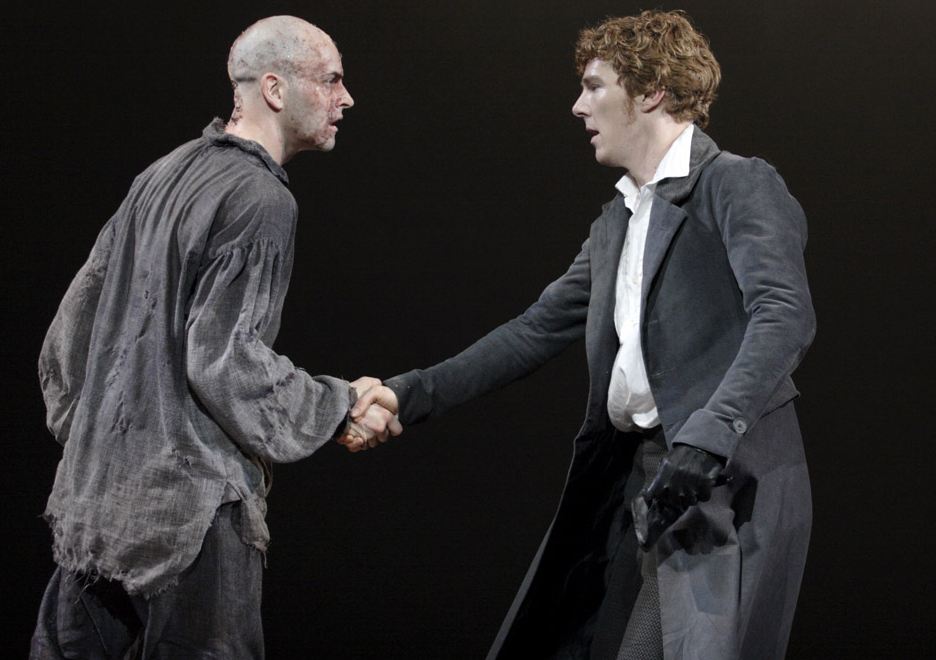
Constant Reader I am ALL behind... now where was I? Oh yes. National Theatre Part 2.So it turns out, you can keep your jukebox musicals or over-hyped film-to-stage west end shows... the show that is the #1 fight-for-a-ticket production is the National's FRANKENSTEIN by Nick Dear, directed by Danny Boyle and starring Benedict Cumberbatch and Jonny Lee Miller who are alternating the roles of 'Victor' and 'The Creature'.

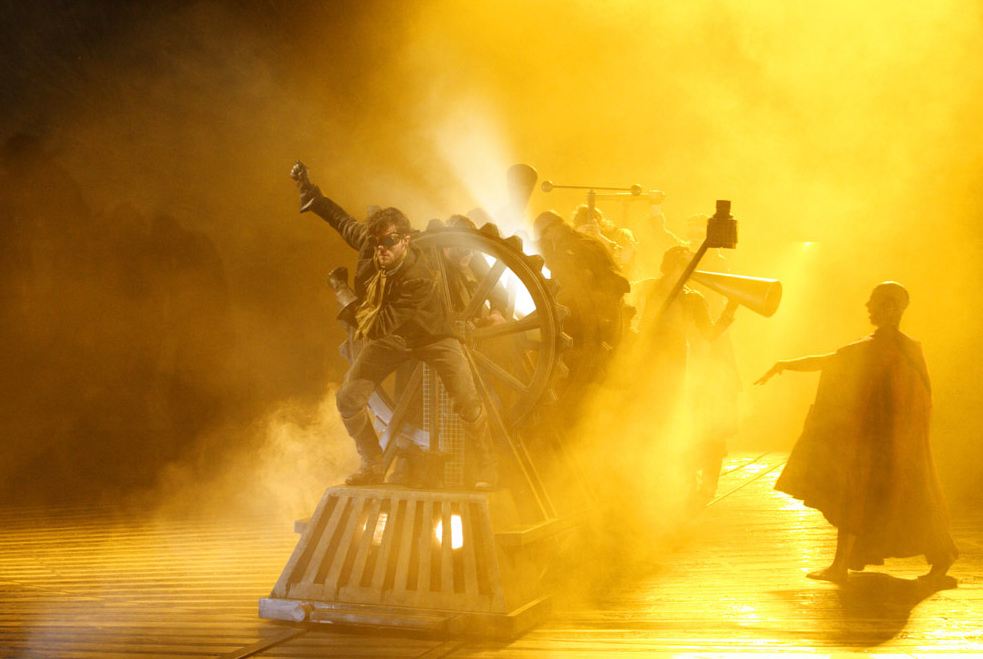
The Benedict Frankenstein/Jonny Creature combo was the one that made most sense to me but the only performance we managed to get was last Saturday matinee. It made an interesting contrast to leave the brilliant sunshine and chattery throng to sit in the darkened Olivier feeling the cold clutch of the undead. Well, I was never that much on sitting in the sun - give me a thumping, edge-of-the-seat work of pure theatre anytime. The immersion begins even before the play starts - Underworld's unsettling, electronic soundscape plays in the foyer as you enter the Olivier (the urge to use their BORN SLIPPY track was obviously ignored!) and, as we settled into our stalls seat in the red-lit auditorium, we nervously eyed the huge bell that hung above the stalls with an actor waiting patiently underneath holding a rope! Sure enough BONG went the bell and all attention was on the circular frame that had slowly rotated on the stage showing the form of the Creature within, echoing Leonardo's Vitruvian Man.

Unlike other adaptations of Mary Shelley's novel, the story is initially told through the eyes of The Creature - from his 'birth' pangs to Victor's rejection and on to his scary first experience of the real world and the hatred of strangers. It was a hypnotic beginning and one that acclimatised you to Jonny Lee Miller's astonishing physicality as the Creature. Naked, flapping and rolling about on the Olivier stage, Miller literally threw himself into the role. It also got you accustomed to Danny Boyle's vision of the play and his full use of all physical theatre trops - lighting, sound effects, music, water and fire, all of which culminated in the thrilling appearance of a steam train - all bright lights and showers of sparks.
The story then settled down to the Creature's education at the hands of Karl Johnson's kindly blind professor, driven from his university into a rural exile by a political regime. It was the first of many reflections and echoes between characters that Nick Dear has found in the tale. Needless to say, the Creature's idyll cannot last long as the Professor's son and daughter-in-law react in horror at his appearance and he responds by wreaking revenge on the family by burning the house.

The Creature journeys to Geneva where Victor has returned to his father's house and to his fiancee Elizabeth, who he has ambivalent feelings for at best. Benedict Cumberbatch is not an actor I warm too but here his shtick of cerebrally emotional coldness was well-used as Victor. When Victor's infant brother is found murdered, he confronts his creation who presents him with an ultimatum - make him a female companion so he will know love and he will vanish from his creator's life. Initially horrified, Victor's vain-glorious ambition cannot be suppressed and he agrees to the deal, which, as we all know, leads to disaster...
I will admit that at times Nick Dear's script was alarmingly thin when it came to the supporting characters but the confrontation scenes between Cumberbatch and Miller were wonderfully vivid, owing much to the chemistry between the two actors. The fact that they are alternating the roles I suspect gives them a rare insight into the characters and each other as performers.

As I have said, of the two I found Miller absolutely thrilling. He has filled out a bit since his Sick Boy days but this solidity works well for the Creature, making him more believable as a figure of menace. He gave a nuanced performance, by turns bitter, humorous, angry and with a genuine feeling of loneliness.Karl Johnson made the most of his featured role as Professor De Lacey, just the right actor to 'settle' into the play with as his character is the first the Creature relates to after the sturm und drang of the production's opening.

Being the National we have the inevitable non-traditionalist casting which works both for and against the production. Naomie Harris brought vitality and intelligence to the role of Elizabeth - I am still haunted by the execrable performance by Helena Bonham-Carter in the misguided Branagh film - but even she can do nothing with Dear's line of "We'll have less of that" when the Creature touches her breast in the bedroom scene. Excuse the pun but there were titters.

Sadly the same cannot be said for George Harris as Victor's father. All I can say is that Victor and murdered William must both take after their mother. It's not the fact that he's black that makes him stand out, it's the fact he is so under-powered as an actor. In a fairly anonymous support cast, Ella Smith was a delight as Elizabeth's maid Clarice.

It's 15 years since Danny Boyle directed a play and it seems that he has burst back onto the stage with a fevered imagination that rarely shows in his films - THE BEACH anyone? As I said the show is a real Sensurround experience with Mark Tildesley's set, Bruno Poet's lighting and Underworld's score all contributing to the experience, but it's Danny Boyle's vision that holds it all together.How pissed must the National be that this sell-out production is only going to have a run of 3 months thanks to the lead actor's availability? I would hope that they will be able to revive it at a later date - but would it have the same impact with two other actors?

If only there was some way for Cumberbatch and Miller to be cloned... they could run it till the wheels dropped off then. Cloned... *reaches for test-tube and Bunsen burner*

Thursday, June 24, 2010

Twice this week I have come away from the National Theatre pondering how hard it must be for artistic directors as to how to fill their schedules.

The Donmar or the Menier for example are looked upon as having a certain caché but with runs allotted to a month or so that means these theatres at best can stage only 12 productions a year - and what plays get chosen? Monetary demands mean that a healthy sprinkling of popular titles and playwrights crop up again and again... but what gets left behind? What falls through the cracks?

The reason for these musings is down to seeing two excellent revivals of little-known early plays by Terence Rattigan and Tennessee Williams currently playing to packed houses at the NT.

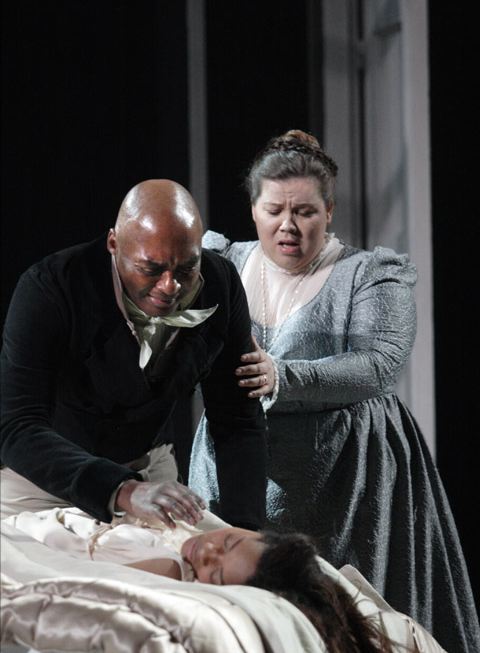
Think of a Rattigan that gets revived and you will probably have THE WINSLOW BOY, THE DEEP BLUE SEA or SEPARATE TABLES on your list. At the Lyttleton however, Thea Sharrock has directed a revival of Rattigan's second play AFTER THE DANCE which I saw with Owen, Sharon and Eamonn.It opened in June 1939 to good reviews and enthusiastic audiences who no doubt responded to not only the high drama onstage but Rattigan's capturing of the zeitgeist of the country as it approached an unavoidable war. However this very atmosphere also was the production's downfall and as the situation worsened the play ended it's run after 2 months, less than a month before war was declared.

Rattigan appears to have had mixed feelings about it in hindsight, not including it in his Collected Plays when first published, probably because of it's failing to achieve as big a box office success as his later plays. There is also a theory that he was haunted by using the possible suicide of a young lover as a plot device in the play but then he is accused of using the same incident 13 years later in THE DEEP BLUE SEA so it appears to have been a handy haunting.The years in between might have lost out but it is this year's gain as what Sharrock's production showcases is a beautifully-crafted three-act play which nails a moment in time perfectly while also providing 5 cracking parts for actors to shine in.

Surprisingly only now making his NT debut, Benedict Cumberbatch (God, that name) is paired with the always-watchable Nancy Carroll as David and Joan, an archetypal Golden Couple who now find themselves at the wrong end of the 1930s after 12 years of marriage and secretly realise that their excessive round of drinks, parties, larks and more drinks will not stand scrutiny in the gray light of a possible war in Europe.

Independently wealthy, David is drinking himself into an early grave while half-heartedly writing a biography of a little-known Balkan hero. Joan fills in her time by being the effortlessly chic hub of a circle of feckless, equally-sensation-craving group of drinking friends. She also chooses to ignore her husband's frequent but non-threatening flings with pretty young things for to mind would of course be a crashing bore.

They also share their large London flat with John (Adrian Scarborough) one of their drinking friends who has become an unofficial lodger and spends his time happily lying on the couch singing for his supper by keeping them amused with his cutting quips about all and sundry. Also sharing the flat is David's cash-strapped cousin who he 'employs' to type up the occasional page of his never-ending book and the couple are friendly with his fiancee Helen (Faye Castelow) who is a frequent visitor.

Of course what soon becomes apparent is that Helen is besotted with David, determined to lead him to the right road of Great Writing and Sobriety through her devotion. She manages to get her doctor brother to examine David and he is confronted with the fact that he is in the early stages of Cirrhosis. David's vanity cannot withstand Helen's passionate declarations and eventually confesses that he has fallen for her too and knows with her help he can lead a Life With Meaning.Helen then becomes that most dreaded creature, one who knows that everyone will be happier if they all know the plain truth. She confronts Joan on the afternoon of a huge party being held at the flat and tells her plainly that Joan's marriage is over as David now loves her.

Joan responds just as Helen and David expect, calm and excepting of the ways of the world, however the reality is witnessed by an appalled John who finds Joan, broken and in despair. The party goes ahead but events take a shattering turn from which their lives are changed just as the approaching war will change their world forever.

Thea Sharrock's direction is a model of empathy and clarity, her handling of characters who could easily be looked upon as irritating and distancing are instead presented to us with an immediacy and sympathy that is rare among today's directors. Both Scarborough and Castelow appeared last year on the same stage in Rupert Goold's take on J.B. Priestley's TIME AND THE CONWAYS in which the characters were treated as mere caricature. Here Sharrock is unafraid of allowing her characters to have an inner emotional life which resonates strongly.

She has elicited strong performances from her cast, namely from Cumberbatch, Carroll and Scarborough, all of whom know exactly how to balance the brittle, knowing banter of the opening scenes with the raw emotional hurt that all the stylish wit is a carapace for.

Nancy Carroll was quite breathtaking as Joan, her early scenes suggesting the unforced, confidant glamour of Kay Hammond but shattering that image with her lonely devastation at the news of her husband wanting to end their life together.

Cumberbatch fitted almost seamlessly into the role of David, he even resembled any number of tall, ramrod-backed, English leading men like Michael Rennie or David Farrar. However like Carroll he also found layers of emotion within David which while not making him sympathetic, did make his choices understandable.

My friend Sharon asked me afterwards if I thought Adrian Scarborough was a possible future Knight of the theatre and his performance here suggested it's possibly only a matter of his getting a tiny step up to some good lead parts. Again he gave a subtle and nuanced performance as John, scathingly funny with the timing of death but able to suggest the anger, fear and loneliness of a man all to aware of the superficiality of his place in life.
Faye Castelow was fine as the frighteningly single-minded Helen although even Rattigan would have been alarmed by her Cut Glaws Eckcent which could have been slightly toned down. In a fine supporting cast special mention must be made for yet another exquisite performance by Jenny Galloway as Miss Potter, the no-nonsense, Widdecombe-esque copy typist that David finally employs.

A special word of praise for Hildegard Bechtler's deliciously sprawling set design for David and Joan's apartment and ravishing costumes, especially for Nancy Carroll. In particular, I really liked the subtle changes that turned the set from the casually elegant, lived-in home of the first two acts to the cold and empty haunted space of the third. Mark Henderson's lighting also was beautifully used to enhance the play.Next year is Rattigan's centenary and it is being marked with not only a retrospective at the National Film Theatre of films and tv plays based on his many works - PLEASE let them show the 1955 film of THE DEEP BLUE SEA starring Vivien Leigh - but a tribute at Chichester (where he has never gone out of fashion) and yet another screen remake of THE DEEP BLUE SEA but directed by Terence Davies which sounds quite exciting. So roll on next year!

In the meantime get yourself to the National Theatre to see AFTER THE DANCE.