Showing posts with label Karl Johnson. Show all posts

Saturday, September 24, 2022

THE CRUCIBLE at the Olivier, National Theatre - Children will listen...

The last time I saw Arthur Miller's THE CRUCIBLE, I was keen to see it again.  12 years later, I have...

I was not too keen when the National's new production was announced as it was directed by Lyndsey Turner who delivered a dreary LIGHT SHINING IN BUCKINGHAMSHIRE a few years ago; I was also dreading what they were going to do with the text - set it in Ukraine or Carnaby Street - the actors holding handheld microphones or texting their lines to each other? 

I need not have worried, Turner delivered a sturdy, in-period production, stripped down to concentrate on Miller's oak-like text, there is hardly any deviation from the grim relentlessness of his narrative.  Apart from the 2010 Regent's Park production I had also only ever seen the play in a 1980 BBC version with a great cast including Eric Porter, Daniel Massey, Denis Quilley and Peter Vaughn - and Nicholas Hytner's 1996 film with Daniel Day Lewis and a chilling Paul Scofield as Danforth.

Arthur Miller wrote it in 1953 as a response to the anti-communist atmosphere that was cloaking America, mainly with the McCarthy trials in the early part of that decade when Miller was himself called to the later House Un-American Activities Commitee where he refused to name names. Mirroring this "scoundrel time" as Lilian Hellman called it, Miller found himself drawn to the 1692 Salem Witch-hunting case when twenty innocent people were executed on the evidence of some of the town's young schoolgirls.

What could be dated polemic, in the hands of Miller, becomes a play which feels as contemporary as the day it was written. Time and again we have seen a situation when what is unreal and unseen is more important that what is real and provable, as long as there is a small group of people whipping up hatred and blame based on a handy believe system, THE CRUCIBLE will be timely - the most obvious recent case being the anti-semitism scam against Jeremy Corbyn and the left-wing Labour members. Miller based his play around the real people in the case with a little dramatic seasoning to give the terrible occurrences a believable basis. 

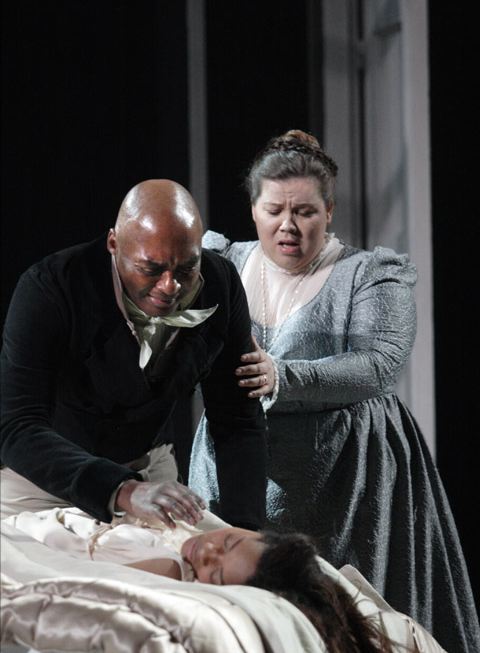
In the hardline Puritanical community of Salem, as misogynistic as it is pious, the schoolgirls have to think fast when they are caught dancing in the woods at night so their ringleader Abigail Williams declares they were made to commune with the Devil through the spells of a black slave Tituba.

When brutally questioned by her owner and his fellow menfolk Tituba agrees that she was made by the Devil to do his work - as were the people whose names she saw written in The Devil's Book. Soon the girls are caught up in the frenzy of the moment and scream out names of older women and men who they say send their spirits to torment them at night. Abigail seizes her moment for revenge by naming Elizabeth, the wife of farmer John Proctor with whom Abigail had an adulterous liaison when she was their servant but who was thrown out when Elizabeth found out about the affair.

Slowly we watch a small community lose it's collective mind, where to question the madness means that you are a suspect and every moment of possible salvation evaporates as their world spins off into a place where every denial is an obvious admission of guilt and recriminations are fuelled by grudges and petty dislikes.

Es Devlin's bare stone-flagged set with sturdy wooden furniture is very impressive, made even more claustrophobic by walls of pouring, bleak rain obscuring the stage before and during the action. Tim Lutkin's lighting is also kept to the minimum, creating an air of oppression.

The cast are uniformly fine: Australian actor Brendan Cowell makes a sturdy John Proctor, riven with guilt at unwaringly setting the madness in place by rejecting Abigail's advances after the end of their affair although he didn't quite hit the heights at the climax of the play when Proctor realises that, in admitting his guilt, he robs himself of the only thing he can call his own - his name.   

He was well partnered with Eileen Walsh as Elizabeth, a woman whose sense of duty leads her to not only inadvertently condemn her husband in the court's eyes but to make her realise that it had stifled their life together. She perfectly captured a woman whose joy has been lost through childbearing and subsequent illnesses as well as suspicion at her husband's affair.


Nick Fletcher gave us a hissable Reverend Parris who uses the hysteria of the girls to gain a place in the important male power structure of Salem, Zoe Aldrich made Ann Putnam an all too-recognizable figure of provincial snobbery and venal prejudice, Fisayo Akinade was equally effective as Reverand Hale the only authority figure who eventually realises what is really being perpetrated while the doomed forces of good were well played by Tilly Tremaine and Karl Johnson as the tragic real life figures of Rebecca Nurse and Giles Corey.

Erin Doherty was fine as the calculating Abigail Williams, the catalyst for the madness who is always one step ahead of the patriarchy but she was matched by Rachelle Diedericks as Mary Warren; her swift changes from sullen stroppiness to suggesting the loneliness of an orphan in a society ruled by the family to her defiance at facing her co-accusers in court and attempting to clear the name of the Proctors. Her terror was palpable when she in turn is accused by them and her final capitulation was heartbreaking.

Also impressive was Matthew Marsh as Deputy-Governer Danforth. He dominated the trial scene with his flinty determination that the letter of the law be adhered to - even as those letters were being twisted to suit the meaning he gave them: a frightening representation of power which ultimately is what the play is about - the perverting of justice and the truth by those who should be it's custodians.

Although the production had a few timing flaws - I suspect due to it being the first preview - it deserves to be seen.


Sunday, November 20, 2016

KING LEAR at the Old Vic - Glenda's Back and Shakespeare's Got Her...

If you are gonna go, go big. 

When Glenda Jackson stood down last year from being the Member of Parliament of Hampstead and Highgate after 23 years, it was assumed she might make a return to acting but in what?  Her first role was in a Zola radio adaptation but there are no great leading roles for an 80 year-old actress in the theatre.  Simple, take over a male role...


The result is a performance of mighty power and endurance and her casting really has no effect on the play, at times seemingly channeling Wilfred Brambell in STEPTOE AND SON, Jackson gave us a wily, querulous old man, capable of angry rages at all and sundry.

It was a magnificent achievement but it came with conditions: it's rare for me to not be moved at the end of the play with it's shattering final scene, no matter how awful Lear has behaved, but here it was only thanks to Shakespeare's words that a tear trickled.  Jackson might have given us a powerful Lear but it was one that was hard to feel any empathy for.


Appropriately, it was at the Old Vic I first saw Glenda Jackson on stage, 32 years ago as Phedra in Philip Prowse's remarkable production.  I subsequently saw her a few times more onstage and always found her to be easy to appreciate but hard to like.  I think it was/is largely due to her testy and abrasive vocal delivery, she has never had a particularly warm voice which is why she made a such a success in roles that called for a certain tart, sardonic quality.

Here she exploits that to the full, raging at Cordelia for her refusal to say how much she loves Lear, raging at Regen and Goneril who are so quick to undermine his attempts at being an independent retired King by refusing him a retinue of 100 knights, raging at the storm that dares to whip around him at his lowest ebb and raging at the sanity that is fast escaping him.  The moments of tenderness were less effective: the reunion with Cordelia felt thrown away and, as I said, the final scene seemed to be a missed moment.


This could very possibly be more of a result of Deborah Warner's over-imagined production.  It's like she read through my previous blogs, made a list of what I hate then based all her creative decisions on them.  I so wanted to enjoy the production but kept being confronted by the usual, dreary, look-at-me-look-at-me Director Theatre tropes.

My new bete noir is the nonsense of pretending the curtain is down when the audience enters the auditorium: we were treated to an interminable period of understudies wandering about, shifting the minimal flats that make up the scenery, talking into head-mikes, hoovering or carpet cleaning (very badly it would seem as they took ages on the same spots) or our leads sitting on chairs reading newspapers, talking to each other then wandering off to presumably get their make-up on.  Does Warner really think we buy all this cock - the audience saying to each other "Ooo look, that's what happens on the stage before the curtain goes up, aren't we lucky the Old Vic doesn't seem to own tabs?".


The only time I felt the minimalist design by Warner and Jean Kalman was effective was during the storm scene, seemingly done with black rubbish sacks sealed together that rippled, blew and flapped to show the ferocity of Lear's storm.  I did however like Kalman's atmospheric lighting.

Much was made of the starry cast that Warner has surrounded Jackson with but I felt they were all rather under-powered - if they feel drained by Warner's Brechtian approach then they are not to blame but I honestly was expecting more from Celia Imrie as Goneril and Jane Horrocks as Regen.  Imrie was bland and Horrocks seemed to make her high heels do most of her work for her although she did rouse herself briefly when she snarled her anger at Lear in their confrontation scene.  She also had the best piece of business too when she hurled Gloucester's eye out into the stalls!


Morfydd Clark's Cordelia was a bit more animated than I have usually seen her but it really is a thankless role: each time she appears she is different - rebellious daughter, forgiving daughter, liberating invader, corpse.  Danny Webb and Karl Johnson made an impression as Cornwall and Gloucester, William Chubb was a sympathetic cuckolded Albany and I liked Gary Sefton as the oily courtier Oswald.

Sefton would have made an excellent Edmund but we were stuck with the woeful Simon Manyonda who played the role like a Southwark estate 'yoof'.  Against such a ghastly performance, Harry Melling could only impress as the good brother Edgar even if he had a rather ill-starred nude scene.  Sargon Yelda also was an underwhelming Kent, especially when one remembers how Stanley Townsend mined the role for marvellous moments in Sam Mendes' National Theatre production.


Rhys Ifans I also found problematic as Lear's Fool; any momentum the first act developed came to a juddering halt whenever he appeared in his grubby Superman outfit as Warner has seemingly allowed him to add scene-stealing business but which just left me staring at him in dismay.  Warner also disposes with any idea as to the Fool's disappearance from the second act - he is left sitting in a shopping trolley at the end of act one!

I am sure I will remember this KING LEAR for Glenda Jackson's astonishing performance but probably not much else sadly.


Friday, August 28, 2015

HAMLET at the Barbican - When Cumberbatch Met Shakespeare...

After all the hype, the year-long wait for tickets, the brouhaha over director Lynsey Turner moving "To be or not to be" to the start of the play, press reviewing the first previews... after all that, how exactly did HAMLET at the Barbican pan out?


As I said I've had a year to build up to the production with only the poster art to whet one's appetite.  The design of a troubled younger Hamlet, with trademark Cumberbatch hair, staring out while other unhappy kids - maybe Laertes, Ophelia, Horatio and Fortinbras? - mope about in the background at a miserable party, is really not reflected in the final production, who knows if it ever did?

To be honest, after all the press and social media jabber about Benedict Cumberbatch stepping up to the plate to play the melancholy prince, I actually wasn't looking forward to seeing the production.  It all seemed whipped up and over-blown, and more importantly, we had seen Lynsey Turner's dire over-conceptualised production of LIGHT SHINING IN BUCKINGHAMSHIRE at the National which made me fear the most.  But there I was last Monday, taking my place in the front row - THE FRONT ROW - with my over-sized £10 programme.  I resisted the tshirts and mugs on sale in the foyer.


At first my heart sank as Hamlet was revealed listening to a Dansette playing Nat King Cole's "Nature Boy" but I didn't dare grind my teeth as Cumberbatch was only a stone's throw away - and we all know how distracted he can get by his audience!  Turner has dropped the opening scene on the ramparts and gallops straight into the first court scene, all the quicker to get her star on the stage as quickly as possible.

The subsequent action all takes place on Es Devlin's extraordinary, angled set which suggests a low ceilinged Middle-European palatial hunting lodge, almost CinemaScope in aspect as it reaches across the large Barbican stage.  It's painstakingly detailed with mounted stags-heads, royal family portraits and, tellingly, an old rocking-horse and boxes of toys stored almost out-of-side under the impressive staircase and first-floor landing.  It could have been somewhere Nicholas and Alexandra might have stayed when they wanted to be a 'normal' family in the summer months.


When we first we see it it is also festooned with large hanging white garlands to celebrate the marriage of Claudius and Gertrude with a long table attended by courtiers dressed in bright colours - apart of course from Hamlet in his inky coat of mourning.  His first monologue "O that this too too solid flesh would melt..." is played direct to the audience with him climbing over the table while all around the others do their best sloow-motion acting.

Turner's streamlining of the text focusing all on Hamlet makes for a swift first act although the interval was placed quite late in the action after Hamlet is shipped off to England and as if to make up for it closing on a non-Cumberbatch scene, Turner has the doors of the set suddenly blow open as leaves and dust swirl through them engulfing the solo figure of Ciaran Hind's Claudius.  It did leave the nagging feeling that Elsinore was the latest venue for SLAVA'S SNOW SHOW.


Sadly the second act built on the niggles I felt during the first act and possibly because Cumberbatch was offstage for awhile, the pace slackened and never really recovered.  A main contributor to that was the fact that in the interval the set is changed to a desolate shell of it's former self with the the stage now covered in mounds of dirt and rock.  Yes it's a good visual flagging up of the fact that the second half of the play focuses on the spiralling paranoia within Elsinore and the threat of war without but it didn't help the flow of the scenes with the cast gingerly climbing over the mounds like worried mountain goats in Jane Cox's gloomy lighting.

In retrospect I think the production highlights all of Lyndsey Turner's worst aspects of vision and direction - the visual over-emphasis and the feeling that the actors are playing in their own sealed spaces and not connecting onstage was all very prevalent.  I also found the whole visual idea for Hamlet distracting: his mad scenes are played while dressed up as a toy soldier and he even finally resorts to dragging on his own large fort to hide in.  It all felt overly-cute and done to get easy laughs for Cumberbatch to the cost of the rhythm of the play - and why for the play scene did he sport a Ziggy Stardust t-shirt??


I had expected Ciaran Hinds as Claudius to really put a stamp on the production and give Cumberbatch a run for his money but he made only fitful impressions, usually when he was in scenes with others.  Anastasia Hille isn't an actress I particularly like but I also felt she was colourless as Gertrude - at no time did I feel any connection between her and Claudius and in particular between her and Hamlet - the closet scene might as well have been two people standing at a bus stop.

I was looking forward to Jim Norton as Polonius but he too seemed to gave a muted, underplayed performance while Ophelia was played by the colourless Sian Brooke.  Turner has thrown greater emphasis on Ophelia in this production, she wanders around snapping away with a box brownie camera during the first act and in her final scene, she drags on a large trunk which Gertrude opens to find hundreds of her photographs and her camera, then watches as mad Ophelia walks away from her up one of the rubble dunes to her watery death.  The trouble is that Brooke does nothing to impose any personality on the role.  Nice black lacy frock though....


The current trend seems to have been to cast a black actress as Ophelia but here the non-traditionalist casting is switched so Kobna Holdbrook-Smith plays Laertes and he at least has a forceful presence when he returns as the avenging angel.  There is also a strong performance from Sergio Vares as Fortinbras, demonstrating the strength of purpose that shows why he will thrive where Hamlet failed.  Karl Johnson, although anonymous as the Ghost was excellent as the Gravedigger. These three actors all stood out in the moribund second act.

The duel scene at the end of the play again showed the frustrating quality of the production, the swordplay was good but Gertrude's poignant last line was allotted to Horatio, her positioning was off to one side away from the action and in the final injustice, absurdly ended up doubled over on one of the mounds with her bum in the air.  Claudius's demise was also oddly bungled, happening upstage and behind the banister on the staircase, it was almost like they had to positioned to be as far away from the centre of the stage which was Cumberbatch's permanent domain.


The whole reason the production was there however was not for Lyndsey Turner's direction, Es Devlin's set, Anastasia Hille's Gertrude or Jim Norton's Polonius... it was for Benedict Cumberbatch as Hamlet.  To be honest he gave the performance I expected to give - he shot through the first act like an arrow, he spoke the text with clarity, waspish humour and with an intelligence that showed genuine understanding and radiated a real star wattage.

And yet.. and yet... and yet...  at no time did I feel Hamlet had taken over him, he remained Benedict Cumberbatch at all times.  This is of course what a star does, they give us various facets of an established persona and there was plenty here to please the 'Sherlock' fans in the house particularly in the cutesy business in the dress-up madness scenes.


But he didn't move me, not like the best Hamlets I have seen have done.  Derek Jacobi (1980, BBC TV), Simon Russell Beale (2000, NT), Rory Kinnear (2010, NT) and the greatest of all Ian Charleson (1989, NT) have all broken through to the real soul of the part so that by the end, when "the rest is silence", you mourn the loss of him in his world and in ours. 

In a few years Cumberbatch might have a chance of playing the role again, only hopefully with a director who can possibly connect him to a more integrated production and cast.


Friday, April 15, 2011

Constant Reader I am ALL behind... now where was I? Oh yes. National Theatre Part 2.So it turns out, you can keep your jukebox musicals or over-hyped film-to-stage west end shows... the show that is the #1 fight-for-a-ticket production is the National's FRANKENSTEIN by Nick Dear, directed by Danny Boyle and starring Benedict Cumberbatch and Jonny Lee Miller who are alternating the roles of 'Victor' and 'The Creature'.

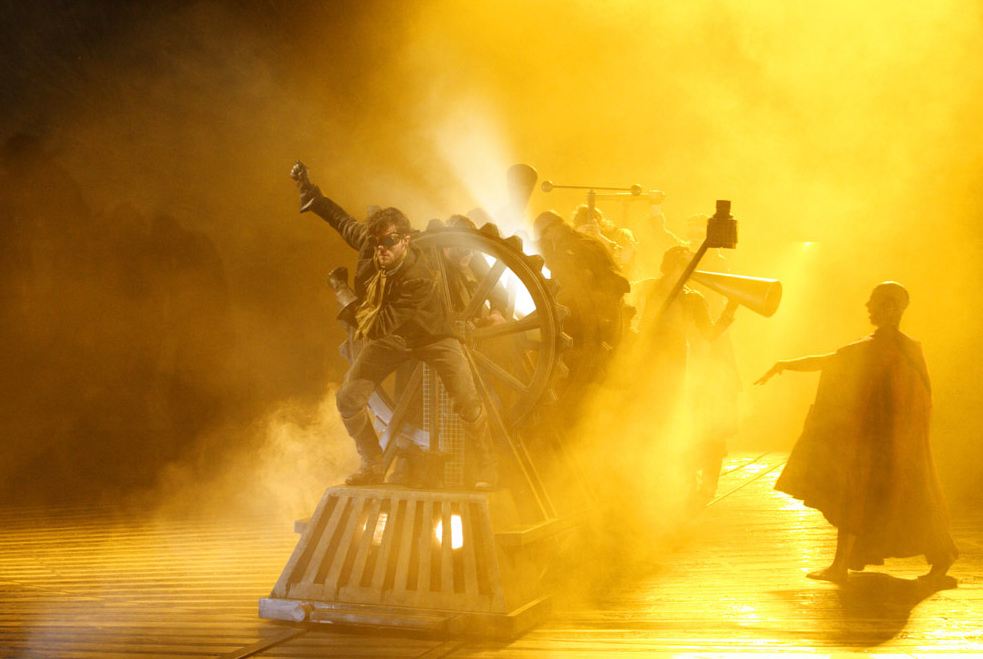
The Benedict Frankenstein/Jonny Creature combo was the one that made most sense to me but the only performance we managed to get was last Saturday matinee. It made an interesting contrast to leave the brilliant sunshine and chattery throng to sit in the darkened Olivier feeling the cold clutch of the undead. Well, I was never that much on sitting in the sun - give me a thumping, edge-of-the-seat work of pure theatre anytime. The immersion begins even before the play starts - Underworld's unsettling, electronic soundscape plays in the foyer as you enter the Olivier (the urge to use their BORN SLIPPY track was obviously ignored!) and, as we settled into our stalls seat in the red-lit auditorium, we nervously eyed the huge bell that hung above the stalls with an actor waiting patiently underneath holding a rope! Sure enough BONG went the bell and all attention was on the circular frame that had slowly rotated on the stage showing the form of the Creature within, echoing Leonardo's Vitruvian Man.

Unlike other adaptations of Mary Shelley's novel, the story is initially told through the eyes of The Creature - from his 'birth' pangs to Victor's rejection and on to his scary first experience of the real world and the hatred of strangers. It was a hypnotic beginning and one that acclimatised you to Jonny Lee Miller's astonishing physicality as the Creature. Naked, flapping and rolling about on the Olivier stage, Miller literally threw himself into the role. It also got you accustomed to Danny Boyle's vision of the play and his full use of all physical theatre trops - lighting, sound effects, music, water and fire, all of which culminated in the thrilling appearance of a steam train - all bright lights and showers of sparks.
The story then settled down to the Creature's education at the hands of Karl Johnson's kindly blind professor, driven from his university into a rural exile by a political regime. It was the first of many reflections and echoes between characters that Nick Dear has found in the tale. Needless to say, the Creature's idyll cannot last long as the Professor's son and daughter-in-law react in horror at his appearance and he responds by wreaking revenge on the family by burning the house.

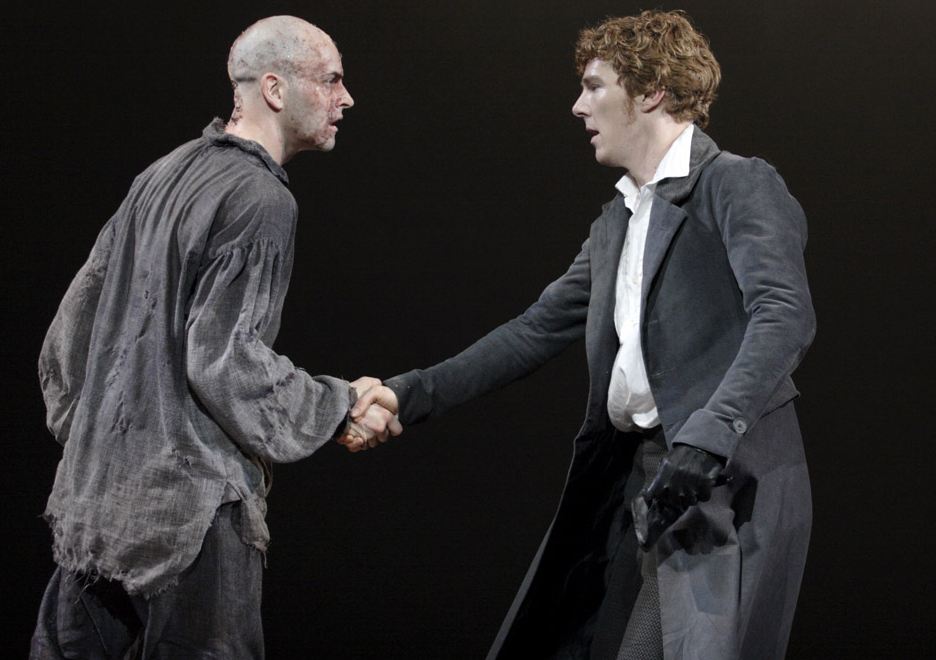
The Creature journeys to Geneva where Victor has returned to his father's house and to his fiancee Elizabeth, who he has ambivalent feelings for at best. Benedict Cumberbatch is not an actor I warm too but here his shtick of cerebrally emotional coldness was well-used as Victor. When Victor's infant brother is found murdered, he confronts his creation who presents him with an ultimatum - make him a female companion so he will know love and he will vanish from his creator's life. Initially horrified, Victor's vain-glorious ambition cannot be suppressed and he agrees to the deal, which, as we all know, leads to disaster...
I will admit that at times Nick Dear's script was alarmingly thin when it came to the supporting characters but the confrontation scenes between Cumberbatch and Miller were wonderfully vivid, owing much to the chemistry between the two actors. The fact that they are alternating the roles I suspect gives them a rare insight into the characters and each other as performers.

As I have said, of the two I found Miller absolutely thrilling. He has filled out a bit since his Sick Boy days but this solidity works well for the Creature, making him more believable as a figure of menace. He gave a nuanced performance, by turns bitter, humorous, angry and with a genuine feeling of loneliness.Karl Johnson made the most of his featured role as Professor De Lacey, just the right actor to 'settle' into the play with as his character is the first the Creature relates to after the sturm und drang of the production's opening.

Being the National we have the inevitable non-traditionalist casting which works both for and against the production. Naomie Harris brought vitality and intelligence to the role of Elizabeth - I am still haunted by the execrable performance by Helena Bonham-Carter in the misguided Branagh film - but even she can do nothing with Dear's line of "We'll have less of that" when the Creature touches her breast in the bedroom scene. Excuse the pun but there were titters.

Sadly the same cannot be said for George Harris as Victor's father. All I can say is that Victor and murdered William must both take after their mother. It's not the fact that he's black that makes him stand out, it's the fact he is so under-powered as an actor. In a fairly anonymous support cast, Ella Smith was a delight as Elizabeth's maid Clarice.

It's 15 years since Danny Boyle directed a play and it seems that he has burst back onto the stage with a fevered imagination that rarely shows in his films - THE BEACH anyone? As I said the show is a real Sensurround experience with Mark Tildesley's set, Bruno Poet's lighting and Underworld's score all contributing to the experience, but it's Danny Boyle's vision that holds it all together.How pissed must the National be that this sell-out production is only going to have a run of 3 months thanks to the lead actor's availability? I would hope that they will be able to revive it at a later date - but would it have the same impact with two other actors?

If only there was some way for Cumberbatch and Miller to be cloned... they could run it till the wheels dropped off then. Cloned... *reaches for test-tube and Bunsen burner*