Showing posts with label Jenny Galloway. Show all posts

Thursday, August 09, 2018

50 Favourite Musicals: 39: NINE (1982) (Maury Yeston)

The 50 shows that have stood out down the years and, as we get up among the paint cards, the shows that have become the cast recording of my life:


First performed: 1982, 46th Street Theatre, NY
First seen by me: 1997, Donmar
Productions seen: one

Score: Maury Yeston
Book: Arthur Kopit

Plot:  1960s Venice; Guido Contini, a famous film director, wrestles with the subject of his overdue next film while thinking of the women in his life, both current and in the past...

Five memorable numbers: FOLLIES BERGERES, BE ON YOUR OWN, MY HUSBAND MAKES MOVIES, UNUSUAL WAY, BE ITALIAN

It's odd how you come to some musicals... I came to NINE through Elaine Paige's "Be On Your Own" on an 1983 album 'Stages'; the song intrigued me with it's compelling, snaking through-line that calls out an unfaithful lover.  I was so intrigued I bought the Broadway cast album and found that in it's original setting, it wasn't Paige's 80s power pop ballad but a downbeat, powerful, cold-as-ice dismissal.  The more I played the album, the more I was drawn into Maury Yeston's thrilling musical of Federico Fellini's film "8 1/2"  that gives a dizzying array of numbers to his lead character Guido and the women in his life: his long-suffering wife Luisa, his mistress Carla, his favourite actress Claudia, his producer Liliane and in his memory, Saraghina, the ample prostitute he desired as a boy.  Tommy Tune famously made his original production a chic black & white-themed show in which Raul Julia was the only male (along with a boy actor) in a cast of women.  I finally got to see the show in David Levaux's Donmar production which made a virtue of it's small playing area but still flooded the stage to show us Guido's vision of "The Grand Canal".  Laconic Larry Lamb played Guido and he was surrounded by some great musical actresses: Clare Burt, Eleanor David, Sara Kestelman and, in particular, Susannah Fellows who brought real heartbreak to Luisa, and a show-stopping turn from Jenny Galloway as the voluptuous Saraghina.  Despite the clunking screen version, this is a show that could definitely take a revival...

The 1982 Tony Awards delivered a shock when NINE beat the highly-touted DREAMGIRLS to Best Musical along with winning four other awards; the telecast immortalized the late Kathi Moss' rattling performance as Saraghina and her big number "Be Italian"...

Friday, October 16, 2015

MR FOOTE'S OTHER LEG at Hampstead - Beale strides to glory!

There is no stopping Simon Russell Beale. 

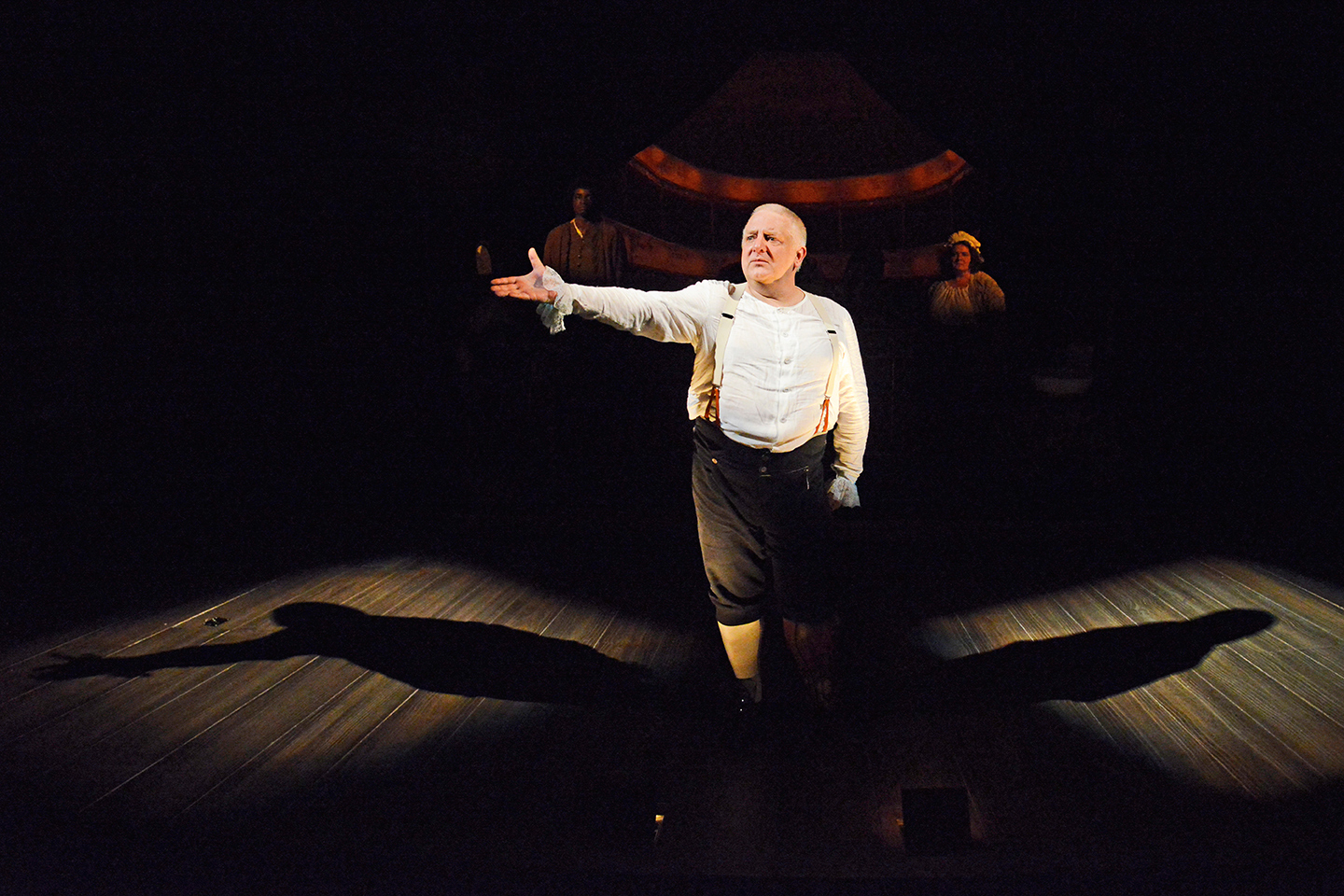
After delivering a sensitive, subtle performance earlier this year in the Donmar's TEMPLE, Beale is now firing on all cylinders and giving a larger-than-life performance at the Hampstead Theatre in actor/playwright Ian Kelly's MR. FOOTE'S OTHER LEG, based on his biography of the Georgian actor and comedian Samuel Foote.


Ian Kelly has resurrected Samuel Foote from the historical shadows and what a dazzling personality he was.  As David Garrick was re-inventing the dramatic theatre to a more naturalistic style of performance and production, Samuel Foote was establishing himself as a gifted comedic actor who subversively flouted the censorship laws by staging his productions in the early evening and calling them "tea parties". His productions were filled with sly satires on public figures and in what must have been a glorious moment in theatre, he appeared as Othello in a production that played as a comedy - now THAT I would liked to have seen!

For such a savage satiric player as Foote, it was remarkable that he became a friend of both the future George III when he was Prince of Wales and his younger brother the Duke of York.  Indeed it was the Duke of York who was instrumental in the first major crisis in Foote's life.  Attending a royal house party, Foote accepted a wager to race the Duke's horse which ended in disaster when he was thrown from the horse resulting in his left leg being crushed and an immediate amputation.


Astonishingly Samuel Foote was back on stage within months of the accident and retained his popularity in roles which were written to feature his disability. However, what was undiagnosed at his accident was a head trauma which led to spells of troubling personality disorders.  He parlayed the Royals' guilt in his accident by getting them to grant a Royal charter for his theatre, the Theatre Royal Haymarket.  One wonders whether his brain injury may have led him to his second disaster?  He wrote a play satirising the Duchess of Kingston who had been involved in a salacious divorce case and she retaliated by seeking out reports from former-employees of his that he had made homosexual advances to them.

The following year the Duchess was tried for bigamy and Foote could not resist staging his play again just as the press reported another allegation of sodomy against him.  Foot's luck ran out and he was sent to trial, although he was released on a technicality, with the King's veiled assistance in asking Foote to stage a Command Performance.  It says a lot for Foote's bravery that he still faced an audience at the Haymarket even while he was being traduced in the papers.  The trial robbed him of his career and his health and he died the following year in Dover, waiting for a boat to take him to exile in France.  He was 57 and had lived life to the brim.


Kelly's play could be accused of trying to cram too much in and the play sometimes wanders off to show Foote's connections with the electrical experiments of Benjamin Franklin who was a keen London theatregoer and his friend surgeon John Hunter who explored the subject of neuro-science.  Where Kelly excels is in the backstage world of the 18th Century West End with actors bitching about each other, the helter-skelter staging of productions and the glowering indifference of the grumpy stage manager.

Ian Kelly has also written himself a tasty supporting part of the Prince of Wales and very funny he is too as the foppish twit destined to become George III who of course had his own flirtations with mental instability.  There are also excellent supporting performances from the always-dependable Jenny Galloway as the dyspeptic stage manager, Micah Balfour as Foote's black servant Frank and Joseph Millson is very effective as David Garrick, changing from a thick-tongued northern theatrical newcomer to a pompous Shakespearean star actor who nevertheless can forgive Foote his excesses.


First seen as a heavily-brogued Irish ingenue, Dervla Kerwin gives a delightful performance as the 18th Century actress Peg Woffington, who worked often with both Foote and Garrick and was the latter's mistress for a while.  She suggests the star quality that Woffington must have had which made her adept at both comedy and drama, and equally switches from being a brassy and hard-living actress to the reflective woman who learns she has cancer.  It's the best performance I have seen Kerwin give.

Richard Eyre's direction elicits these fine performance and his delight in the theatrical material is palpable.  He has found his perfect leading man in Simon Russell Beale who brings Samuel Foote to such vivid life.  It's remarkable how each new portrayal one sees of his show an even deeper versatility from this actor who should be even more feted than he is.  He truly is the successor to Ralph Richardson, an actor who can play a wide-ranging array of characters - both dramatic, tragic or comical - but always retain a real humanity.


He is given ample opportunity to show all these sides as Samuel Foote and creates such a warm, likable, 'human' personality that it is a relief that Kelly ends the play with Foote down - threatened with public humiliation - but not out - his bravery in going out onstage before his audience.  Whether as the eager new actor, the bitchy star of his own comedies, writhing in agony as he is operated on, flying into frightening rages or begging for affection, Beale is never less than stunning.

Eyre has reunited his design team from GHOSTS and again they deliver: Peter Mumford's lighting is fluid and evocative while Tim Hatley's set and costumes are a constant delight.  The Hampstead Theatre run sold out very quickly and the very exciting news is that MR FOOTE'S OTHER LEG will transfer to the Theatre Royal Haymarket from 28th October to 23rd January.  Somewhere there will be a one-legged ghost very happy although the current Haymarket theatre building is to the right of where Foote's Haymarket stood.  Either way, run - or hop - to see it!


Monday, August 29, 2011

My other belated theatre blog is for the latest production at the Donmar, Eugene O'Neill's 1921 play of redemption and a life on the ocean wave, ANNA CHRISTIE.
It's strange that it has taken this long for the play to appear at the Donmar as it seems a shoe-in for any smallish theatre needing a solid well-made prestige play - it also only has four major roles! It has not been seen in the West End since Natasha Richardson's award-winning performance nineteen years ago at the Young Vic - when she repeated the role the next year in NY opposite Liam Neeson it led to their marriage and her re-locating to live there.
The piece is most well-known for providing the vehicle for Greta Garbo's debut in talking pictures in 1930. Two years elapsed between the release of Al Jolson's THE JAZZ SINGER and the release of ANNA CHRISTIE and during that time Garbo had starred in 6 silent films as M-G-M searched for just the right film to launch their Swedish star onto the now listening public. But Anna's Swedish background gave Garbo the the perfect role and she went on to garner her first Academy Award nomination for her performance. Her opening lines, "Gimme a whisky, ginger ale on the side... and don't be stingy baby" have entered film history. But what of the Donmar production? The production is directed by Rob Ashford who was responsible for the theatre's 2009 revival of A STREETCAR NAMED DESIRE and both productions share the same downbeat spit-and-sawdust atmosphere - how different to his HOW TO SUCCEED IN BUSINESS WITHOUT REALLY TRYING which we saw earlier this year in New York!

O'Neill's play tells the story of Anna, a young woman who comes east to the docks of New York to find the father who entrusted her to relatives on a farm after the death of her mother while he worked on his coal barge. Old Chris is nervously excited about seeing her after so long, only knowing from her infrequent letters that she worked as a nursemaid in Minnesota. His drink-sozzled mistress Marthy knows better when she spots Anna enter the dockside bar and their wary, cagey conversation reveals that Anna was working in a brothel until arrested and sent to jail. All options shot, she now wants her father to support her. During a storm at sea, Chris and Anna rescue sailors from a shipwreck and the last one saved is Mat Burke, a belligerent Irish stoker whose rollicking Blarney steamrollers Anna into a love affair. When Mat and Chris battle for the right to 'own' Anna, she angrily denounces them both and the long line of men who have used and abused her. Confronted with the truth of Anna's past how forgiving will her father and lover be?

O'Neill certainly powers his plot along in only four scenes and, despite the clunky repetition of Old Chris' simile of "that old devil sea", his rangy and muscular dialogue still keeps you rolling with the punches. He certainly created one of the great female roles of the last century in Anna and it's a shame we have not seen more actresses have the opportunity to play her.
Ruth Wilson played her with Anna's raw nerves fully exposed: from her first appearance staring down the hungry looks of the bar-room men to her last, alone again but stronger than before, she delivered a powerful performance which would have been a great performance if she had found more space for Anna's humanity.

The performance of the evening however was from Jude Law as Mat. Proving to be as much of a force of nature as the storm in which he makes his first appearance, this was the best I have ever seen him on stage. Even if his brogue was tempest tossed from Kerry in Ireland to Kingston in Jamaica, Law gave such a bravura performance that you could not take your eyes off him. For once he gave a performance which justified his star status.
David Hayman wrestled with the potentially deadly role of the salty Sveedish sea dog and eventually managed to overcome the hurdy-gurdy accent and repetitive dialogue to give a well-rounded performance.

Jenny Galloway proved that when it comes to scene-stealing she's the best around. However she really needs to find a play that allows her the chance to do her larceny more than once - here as in CAUSE CELEBRE and AFTER THE DANCE she only appeared in one scene! Although not written by O'Neill it would have been nice if Ashford had interpolated the extra scene included in the 1930 film for Marie Dressler as Marthy when she turns up begging while Anna and Mat are in a Coney Island beer garden. The production was aided immeasurably by Paul Wills' adaptable set, Howard Harrison's evocative moody lighting and Adam Cork's sound design. All in all, another memorable Donmar visit.

Wednesday, June 08, 2011

Last week it was time for my second Terence Rattigan play in this, his centenary year. Following on from FLARE PATH, we now have his last play CAUSE CÉLEBRE, he died four months after it's premiere at Her Majesty's Theatre in 1977.The Rattigan revival was kicked off last year by the huge success of Thea Sharrock's production of his little-remembered second play AFTER THE DANCE at the Lyttleton and here she is reunited with her stage designer from that production Hildegard Bechtler to work their magic again - and they do.

Rattigan based his play on a 1935 murder trial that had haunted him. In 1934, in that febrile hothouse Bournemouth, 18 year old George Stoner answered an ad in the Daily Echo "Daily willing lad, 14-18, for house-work; Scout-trained preferred. Apply between 11-12, 8-9 at 5 Manor Road, Bournemouth". The ad was placed by retired architect Francis Rattenbury, 67 and his younger songwriter wife Alma, 39. Before long Alma and George were openly having an affair with Francis' tacit approval as he was not only impotent but a heavy drinker. Six months later, the police arrived in the early hours to find him with his head bashed in and Alma in a state of drunken hysteria.

Alma and George were put on trial for murder in an atmosphere of lurid press headlines that played up the "experienced woman - innocent lad" angle. In a sensational outcome George was found guilty but Alma was found not guilty. A few days later Alma took a train to Christchurch near Bournemouth, found a spot near the River Avon and, believing her lover soon to hang, stabbed herself to death.

The irony was that after a petition of 320,000 signatures, his sentence was commuted to Life. However, in 1942 he was released on early parole, joined the army and fought in WWII, and was even reported to have been seen in the audience at Her Majesty's seeing his 18 year old self be seduced by Glynis Johns as Alma. He died in 2000 aged 83 on the 65th anniversary of the murder.Rather than retell the sad story as is, Rattigan seeks to spotlight the atmosphere of sexual hypocrisy that the case was rife with by contrasting Alma's trial with the fictional story of Edith Davenport, a sexually-frigid, emotionally-cold woman whose own marriage is collapsing due to her husband's small affairs and her puritanical attempts at keeping her teenage son with her and away from the temptations of the world. Out of the blue she is summoned for jury duty - and to her horror, is made foreman of Alma's jury.

He neatly shows that while Mr. Davenport's dalliances for sexual gratification are seemingly understood and turned a blind-eye to by society, the same cannot be granted to Alma whose sexual frustration is seen as something abhorrent especially when her lover is a younger man, the poor boy preyed upon by a wicked woman. The fact of a woman being judged more for her morals rather than any perceived crime had been the case over ten years before with the tragic hanging of Edith Thompson and was certainly a factor twenty years later in the case of Ruth Ellis.Rattigan said he didn't have far to look for his inspiration for Edith as he based the emotionally-fraught scenes between her and her sexually curious son on the relationship between him and his mother. In a remarkably hard-edged performance, Niamh Cusack excelled as Edith, a woman who finds at the end of the play that the woman she despised but could not find guilty thanks to her own morality, could not live on because of her own morality.

She was complemented well by Simon Chandler as her husband John, exhausted by years of living by her rules and Lucy Robinson as her more gregarious sister Stella, mad with excitement about the latest gossip from the jury room.Rattigan has great fun with the legal scenes in showing the court-room cat & mouse games between the defense and prosecuting councils are merely the public jousting to revenge losses between them on the golf courses. Nicholas Jones is a stand-out as T.J. O'Connor, Alma's wily Defence Council who gambles constantly with his handling of her case.

In a a role that only amounted to two bookend scenes, the consummate supporting actress Jenny Galloway still managed to shine as Alma's live-in companion Irene Riggs and Tommy McDonnell was a cocky and dangerous-to-know George in this, his professional stage debut. The echoes of AFTER THE DANCE were in the casting of Benedict Cumberbatch's father Timothy Carlton as the doomed Francis.
But the show was rightly dominated by Anne-Marie Duff's high-voltage performance as Alma. First seen playing with the gauche George by adopting a stolen-from-the-movies divinely decadent lady of the manor demeanor, the play's structure of flashback scenes had her moving from bring strained and drawn in court to be blindly hysterical while blindly drunk to being finally a shattered woman, her declared innocence a hollow victory. She was mesmerising.

The play's strangely amorphous quality where scenes move from place to place, forwards and back in time, betray it's origins as a 1975 radio play which starred Diana Dors as Alma (wow!) - both Rattigan's radio script and an initial stage version were edited together by the director Robin Midgeley with the ailing Rattigan re-writing when necessary. Thea Sharrock however keeps a firm grip on the narrative and the play is helped immeasurably by Hildegard Bechtler's set which opens up the whole of the Old Vic stage with walls constantly moving between scenes to provide new vistas with several hugely effective uses of the stage's depth. Again these visually arresting scenes emerge from the shadowy gloom of Bruno Poet's dreamlike stage lighting.When Rattigan wrote his play he left out some intriguing facts about the case: Alma was actually Canadian, having met George in 1923 while he lived and worked there as an architect of some renown Alma's first husband was killed in the Battle of the Somme and she volunteered to be a nurse in the French Red Cross where she was wounded twice in action and was awarded the Croix de Guerre. Her second husband was a Pakenham so was distantly related to Lord Longford who later was such a supporter for the release of Myra Hindley.

When George's first wife refused him a divorce he harassed her mercilessly - stripping their home of furniture and turning off the power. He eventually moved Alma in and forced his wife to live on the first floor until she eventually agreed to a divorce and they were married in 1925. These actions were seen as in the Canadian newspapers as a shocking scandal. In 1929 they left Canada after his first wide died and his sons by that marriage disowned him. So his murder at the hands of Alma's lover 12 years later was headline news here and there.

The Rattenbury's youngest son John was evacuated to Canada in WWII and eventually, following in his father's footsteps, became an architect and joined Frank Lloyd Wright's practice helping with the design of the Guggenheim Museum amongst others.

Thursday, June 24, 2010

Twice this week I have come away from the National Theatre pondering how hard it must be for artistic directors as to how to fill their schedules.

The Donmar or the Menier for example are looked upon as having a certain caché but with runs allotted to a month or so that means these theatres at best can stage only 12 productions a year - and what plays get chosen? Monetary demands mean that a healthy sprinkling of popular titles and playwrights crop up again and again... but what gets left behind? What falls through the cracks?

The reason for these musings is down to seeing two excellent revivals of little-known early plays by Terence Rattigan and Tennessee Williams currently playing to packed houses at the NT.

Think of a Rattigan that gets revived and you will probably have THE WINSLOW BOY, THE DEEP BLUE SEA or SEPARATE TABLES on your list. At the Lyttleton however, Thea Sharrock has directed a revival of Rattigan's second play AFTER THE DANCE which I saw with Owen, Sharon and Eamonn.It opened in June 1939 to good reviews and enthusiastic audiences who no doubt responded to not only the high drama onstage but Rattigan's capturing of the zeitgeist of the country as it approached an unavoidable war. However this very atmosphere also was the production's downfall and as the situation worsened the play ended it's run after 2 months, less than a month before war was declared.

Rattigan appears to have had mixed feelings about it in hindsight, not including it in his Collected Plays when first published, probably because of it's failing to achieve as big a box office success as his later plays. There is also a theory that he was haunted by using the possible suicide of a young lover as a plot device in the play but then he is accused of using the same incident 13 years later in THE DEEP BLUE SEA so it appears to have been a handy haunting.The years in between might have lost out but it is this year's gain as what Sharrock's production showcases is a beautifully-crafted three-act play which nails a moment in time perfectly while also providing 5 cracking parts for actors to shine in.

Surprisingly only now making his NT debut, Benedict Cumberbatch (God, that name) is paired with the always-watchable Nancy Carroll as David and Joan, an archetypal Golden Couple who now find themselves at the wrong end of the 1930s after 12 years of marriage and secretly realise that their excessive round of drinks, parties, larks and more drinks will not stand scrutiny in the gray light of a possible war in Europe.

Independently wealthy, David is drinking himself into an early grave while half-heartedly writing a biography of a little-known Balkan hero. Joan fills in her time by being the effortlessly chic hub of a circle of feckless, equally-sensation-craving group of drinking friends. She also chooses to ignore her husband's frequent but non-threatening flings with pretty young things for to mind would of course be a crashing bore.

They also share their large London flat with John (Adrian Scarborough) one of their drinking friends who has become an unofficial lodger and spends his time happily lying on the couch singing for his supper by keeping them amused with his cutting quips about all and sundry. Also sharing the flat is David's cash-strapped cousin who he 'employs' to type up the occasional page of his never-ending book and the couple are friendly with his fiancee Helen (Faye Castelow) who is a frequent visitor.

Of course what soon becomes apparent is that Helen is besotted with David, determined to lead him to the right road of Great Writing and Sobriety through her devotion. She manages to get her doctor brother to examine David and he is confronted with the fact that he is in the early stages of Cirrhosis. David's vanity cannot withstand Helen's passionate declarations and eventually confesses that he has fallen for her too and knows with her help he can lead a Life With Meaning.Helen then becomes that most dreaded creature, one who knows that everyone will be happier if they all know the plain truth. She confronts Joan on the afternoon of a huge party being held at the flat and tells her plainly that Joan's marriage is over as David now loves her.

Joan responds just as Helen and David expect, calm and excepting of the ways of the world, however the reality is witnessed by an appalled John who finds Joan, broken and in despair. The party goes ahead but events take a shattering turn from which their lives are changed just as the approaching war will change their world forever.

Thea Sharrock's direction is a model of empathy and clarity, her handling of characters who could easily be looked upon as irritating and distancing are instead presented to us with an immediacy and sympathy that is rare among today's directors. Both Scarborough and Castelow appeared last year on the same stage in Rupert Goold's take on J.B. Priestley's TIME AND THE CONWAYS in which the characters were treated as mere caricature. Here Sharrock is unafraid of allowing her characters to have an inner emotional life which resonates strongly.

She has elicited strong performances from her cast, namely from Cumberbatch, Carroll and Scarborough, all of whom know exactly how to balance the brittle, knowing banter of the opening scenes with the raw emotional hurt that all the stylish wit is a carapace for.

Nancy Carroll was quite breathtaking as Joan, her early scenes suggesting the unforced, confidant glamour of Kay Hammond but shattering that image with her lonely devastation at the news of her husband wanting to end their life together.

Cumberbatch fitted almost seamlessly into the role of David, he even resembled any number of tall, ramrod-backed, English leading men like Michael Rennie or David Farrar. However like Carroll he also found layers of emotion within David which while not making him sympathetic, did make his choices understandable.

My friend Sharon asked me afterwards if I thought Adrian Scarborough was a possible future Knight of the theatre and his performance here suggested it's possibly only a matter of his getting a tiny step up to some good lead parts. Again he gave a subtle and nuanced performance as John, scathingly funny with the timing of death but able to suggest the anger, fear and loneliness of a man all to aware of the superficiality of his place in life.
Faye Castelow was fine as the frighteningly single-minded Helen although even Rattigan would have been alarmed by her Cut Glaws Eckcent which could have been slightly toned down. In a fine supporting cast special mention must be made for yet another exquisite performance by Jenny Galloway as Miss Potter, the no-nonsense, Widdecombe-esque copy typist that David finally employs.

A special word of praise for Hildegard Bechtler's deliciously sprawling set design for David and Joan's apartment and ravishing costumes, especially for Nancy Carroll. In particular, I really liked the subtle changes that turned the set from the casually elegant, lived-in home of the first two acts to the cold and empty haunted space of the third. Mark Henderson's lighting also was beautifully used to enhance the play.Next year is Rattigan's centenary and it is being marked with not only a retrospective at the National Film Theatre of films and tv plays based on his many works - PLEASE let them show the 1955 film of THE DEEP BLUE SEA starring Vivien Leigh - but a tribute at Chichester (where he has never gone out of fashion) and yet another screen remake of THE DEEP BLUE SEA but directed by Terence Davies which sounds quite exciting. So roll on next year!

In the meantime get yourself to the National Theatre to see AFTER THE DANCE.