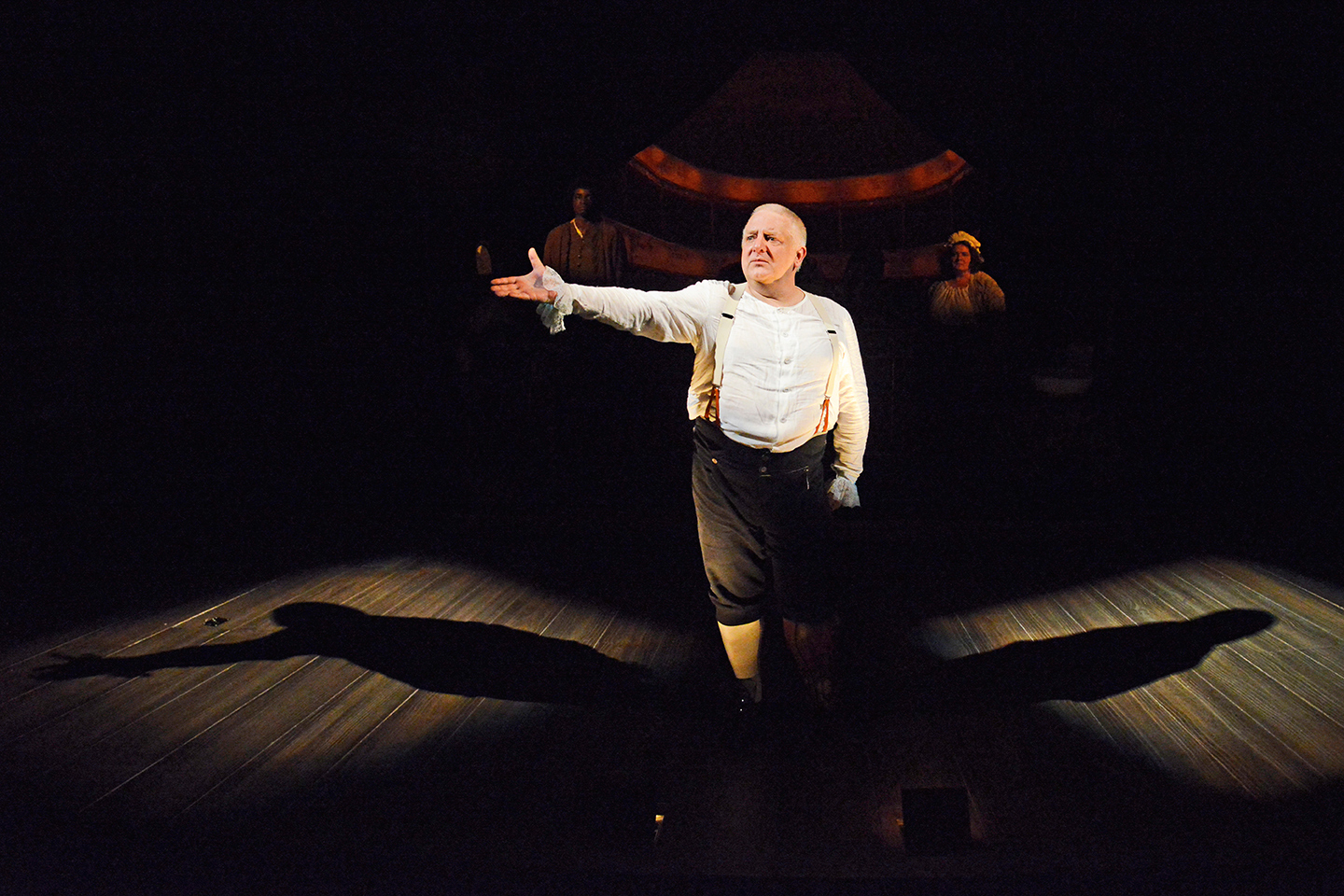
Monday, November 16, 2015

WASTE at the National Theatre: private morality made public

Included in the wonderful John Singer Sargent exhibition at the National Portrait Gallery this year was a chalk drawing from 1900 of a handsome young man, matching Sargent's gaze with a knowing smile as if to say "Make sure you capture *all* of my handsome looks won't you?"  The subject was 23 year-old Harley Granville Barker.


1900 was an important year for the young actor, not only did he become a lead player with the forward-thinking Stage Society but he also wrote his first play "The Marrying of Ann Leete".

It was through the Stage Society that Barker made two particularly close friends, George Bernard Shaw and the critic William Archer.  Shaw's use of language and dialogue-heavy style of drama influenced Barker in his playwriting and that is very evident in his play WASTE which is now revived at the Lyttelton.


It is fitting that the play should be staged at the National Theatre as it was written in the same year that Barker and Archer wrote "A Scheme and Estimates For The National Theatre", a costed document for the establishment of a UK national theatre, listing everything from staff wages to an idea of the repertoire.  Nothing came of it immediately but the idea refused to go away and long after Barker and Archer's passing, the National Theatre launched in 1963 under the direction of Laurence Olivier.  

For an architect of the concept behind the place, Barker has hardly been well-served by his dreamchild: THE MADRAS HOUSE was staged in 1977 with Paul Scofield and THE VOYSEY INHERITANCE appeared in 1989 and 2006.  Now we have his controversial play WASTE, directed by Roger Michell.  Initially banned by the official Censor in 1907, Barker gave several private productions of it under the auspices of the Stage Society to gain it a copyright - in the first one he even played the lead - but it was not professionally produced until 1936.


To be honest, WASTE is a play that can be admired rather than liked, Barker's scenes can sometimes trip over into being too prolix for their own good - especially if there are more than one character onstage - but usually the scenes involving just two characters create biting argument and tension.

Henry Trebell is an independent MP who is invited by the Conservative Government to head up a bll that he is passionate about, to dis-establish the Church of England.  Trebell is an ambitious politician who need not worry about home distractions as his adoring sister Frances runs that for him.  However at a country house weekend party Henry starts a dalliance with Amy O'Connell, a 'modern', opinionated, separated wife of an Irish freedom agitator.


Although popular with the men, Amy is quietly disliked by the women of the party including Frances for her free-spiritedness, but she suits Henry's teflon life.  All of that is turned upside down when Amy appears in his office in a frantic state after finding out she is pregnant and is determined to have an abortion despite Treball's insistance that she have it.  Days later Amy is dead from a back street abortion that went wrong and Trebell is suddenly facing disgrace with his former political colleagues willing to throw him under the bus.

As I said, my trouble with the play is that while individual scenes are gripping - Amy and Henry confronting each other over the pregnancy, Frances trying to give Henry a reason to live, Frances denouncing her former friend - his scenes with a group of characters soon become a static talking shop with little to animate them.


Roger Michell sadly doesn't really speed the play along, this is really material for a forensic director like Peter Gill or Howard Davies and while Hildegard Bechtler's design can be seen as a tribute to Barker's wish for non-specific theatre design, I suspect the grey & earth tones of her sliding panel set and costumes would suit something a little less site-specific than Edwardian parliamentary London.  I did enjoy watching the pretty patterns during the scene changes.

If you want someone to be put-upon and upper-class then Charles Edwards is your go-to guy.  Henry Trebell follows his roles of Richard II, Charles Condomine in BLITHE SPIRIT and Charles Marsden in STRANGE INTERLUDE and while he again delivers a very fine performance, he cannot make Trebell's singularly callous approach to anyone outside his House of Commons colleagues particularly understandable.
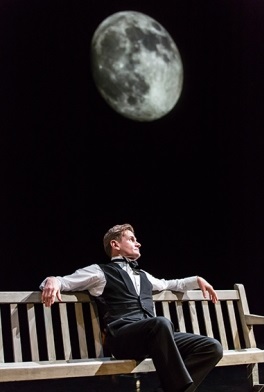

There are good performances from others in the cast but I felt the best came from Trebell's put-upon women.  Olivia Williams has never really bleeped my radar before but here in her climactic scene, she was electrifying: Amy's terror at being pregnant and her panic at the closing down of her opportunities leapt off the stage and swept away the verbose scenes that had gone before.

Sylvestra Le Touzel also gave a very fine performance as Frances, Trebell's protective sister who comes into her own at the end when she realises that her brother is determined on a course of action that she tries desperately to change.  The final scene that finds Frances with a blank canvas for a life gave her ample scope to scrape away at the poised veneer her character has hitherto presented.


All of this is rather swamped by a bizarre design trick just for the curtain call.  Any thoughts about what Barker was referring to by his title: the waste of Treball's life, of Amy's life, of Frances' happiness, of a career, of ideals, is defeated when the cast take their bows on a bare stage apart from a larger-than-life tipped-over wastepaper basket which featured in the final scene when Trebell's secretary was throwing away his post into it.  This clunky, "do-you-get-it?" motif throws the air of quiet desperation that the final scenes suggest into a cocked hat.  Or an upturned, giant wastepaper bin.

Oddly enough, some might say that the title might be pinned on Barker himself who, with his second marriage to the American writer Helen Huntingdon, turned his back on the British theatre for good as she had little time for it.  Shaw could never forgive him for this or for the marriage and they were never reconciled as Barker moved to Paris.  Although never actively involved in theatre again he did translate several plays with his wife as well as writing his "Prefaces To Shakespeare" where for the first time, several key plays were investigated not by a critic or academic but by someone who had directed or acted in them.  This once and future king of British theatre died in 1946.

Monday, November 09, 2015

ROMEO AND JULIET at Covent Garden: a 50 year old love affair...

On February 9th 1965 the choreographer Kenneth MacMillan premiered his ballet of ROMEO AND JULIET with the iconic pairing of Margot Fonteyn and Rudolph Nureyev playing Shakespeare's star-crossed lovers but it wasn't meant to be them.

MacMillan had originally planned - and indeed collaborated - with the younger dancers Christopher Gable and Lynn Seymour in the roles but they were relegated to the second cast, they even had to help teach the more famous pair their roles due to time constraints in rehearsals. 


It was all due to the promoter of the American tour that was scheduled after the London opening who wanted guaranteed box-office names to sell tickets.  The production was filmed for cinema release the following year and since then the production has been staged countless times in the Royal Ballet's repertoire and here it is back again in it's 50th anniversary year.

Just in time to fit into our year of New Cultural Things (aka ballet and opera).  It's interesting how ballet and opera companies will keep a production going year after year; where are the National Theatre productions from the 1960s directed by John Dexter or Laurence Olivier or the RSC productions by Peter Hall or Peter Brook in the company's repertoires?  Not to be seen.


But what did I think of this year's production which has been recreated by Julie Lincoln and Christopher Saunders?  Well Constant Reader, I thought it was excellent, thanks for asking.

Prokofiev's almost filmic score sounded big and bold under the baton of Koen Kessels and MacMillan's choreography was still thrilling in it's sweep, lyricism and sheer story-telling bravura.


The cast we saw were all very good: Steven McRae was a vital, virile Romeo (despite his lute-playing) and Iana Salenko was excellent in Juliet's short journey from innocent rapture at her first love to her desperate anguish in the tomb.

Alexander Campbell was a quicksilver Mercutio and was well-partnered with Thomas Whitehead (an ex-Matthew Bourne Swan King) as Tybalt.  The co-stager Christopher Saunders was an imperious Lord Capulet and Genesia Rosato made the most of Lady Capulet's anguish over the death of Tybalt.  A special mention too for Itziar Mendizabal, Olivia Cowley and Helen Crawford who were feisty and spirited as the three tarts of Verona!


Nicholas Georgiadis' evocative set is a timeless design which allows for both grandeur and intimacy and I am sure the production will last for many years to come in the repertoire.

I think our adventures into the more rarefied arts this year have been interesting but for me the dance productions are out in front so far.

Wednesday, November 04, 2015

THE BARBER OF SEVILLE at English National Opera - a short back and sides blog...

Last week was another of our New Cultural Doings In 2015 with a visit to the always pretty London Coliseum to see the English National Opera's production of Rossini's comic opera THE BARBER OF SEVILLE.


I had been quite busy all week and, come Friday, I was looking forward to seeing the opera but sadly it all caught up with me and I drifted in and out of snooze despite the best efforts of the loud and lively ENO orchestra and the singers.

The production actually dates from 1987 and Jonathan Miller's direction is here recreated by Peter Relton and while it is usually the case that if it ain't broke don't fix it, I felt that what was funny in 1987 might not still be true today, even when reviving an early 19th Century opera.  And the set was mainly beige... beige!  Tanya McCallin, what was going on with your colour palate back then?


It is quite rollicking and certainly raced through the plot of Figaro, the barber of the title, helping Count Almaviva to woo and win pretty Rosina away from Dr. Bartolo, her crotchety guardian who wants her for his own.  Just typing that makes me think of Sweeney Todd!

There's nice work being done by Morgan Pearse as Figaro, a cheeky chappy on the make, Kathryn Rudge as Rosina (no wilting ingenue she, she gave as good as she got!) and Andrew Shore made the most of the foolish Dr Bartolo, in very much the same way that he milked the role of The Major General in THE PIRATES OF PENZANCE which we saw earlier this year.  Among the ensemble, Katherine Broderick was a feisty and full-throated Berta, servant to Bartolo.


All in all it was a nice way to spend the evening, drowsing along to Rossini's delightful score.  I'm sure it will still be around in a year or so if I feel the urge to see it again.

Tuesday, November 03, 2015

AS YOU LIKE IT at the Olivier, National Theatre... well, did I?

Although it's often produced, I have only ever seen AS YOU LIKE IT once when in 1990 Sophie Thompson played the role of Rosalind for the RSC with a cast including Gillian Bevan, Jerome Flynn, Hugh Ross and Mark Williams.  For some reason I just never get round to seeing it when it is performed... maybe I am in mourning for the fact that I can never see Vanessa Redgrave's legendary star-making performance, again for the RSC in 1962.


But that was then and this is now and 36 years after it's last appearance on the Olivier stage at the National Theatre it has now returned in a production directed by Polly Findlay and designed by Lizzie Clachan, the same team behind last year's TREASURE ISLAND.

The star of that show Patsy Ferran is here returned as Celia, the gentle cousin of the heroine Rosalind who was due to be played by Andrea Riseborough who, when she pulled out citing 'personal reasons', was replaced by Rosalie Craig, an actress more known for musicals.


Now all opinions here must reflect the fact that the production was still in preview so is still feeling it's way through the play with a paying audience.  But as I have oft said before, a paying audience is a paying audience.  Did I like it, AS YOU LIKE IT?  Ummm.... not really if honest.  I found it a superficial production where the set and cast were all surface with no real insight offered or found.

Although she gave a perfectly acceptable performance, there was nothing particularly eye-catching about Craig's Rosalind.  Here one of Shakespeare's most memorable female characters seemed on a powered by a fairly neutral star wattage.  Patsy Ferran is also showing signs of becoming an eccentric stage actress which works well for most of the production but eventually you can have enough of her gauche line readings and dizzy perambulations around the stage, like a pixilated unicyclist who has come off her bike.


It can't be often that one leaves AS YOU LIKE IT thinking that the actor playing Orlando gave the best performance but Joe Bannister was a strong presence onstage but also giving a light comic shading to galumphing but loving Orlando.

I didn't find either Mark Benton as Touchstone of Paul Chahidi as Jaques to be as particularly funny as they should have been, Chahidi underplaying to such an extent that I felt in some scenes that his suit had been send out with him not in it.


However I did like Patrick Godfrey's feisty retainer Adam, John Ramm's exiled Duke and Gemma Lawrence's headstrong Phebe.  There was however a truly ghastly performance from Leo Wringer as the usurping Duke Frederick, it was real Amateur Hour in the Duchy.

As with TREASURE ISLAND, Clachan provides a big OOOOOOH moment when her set transforms itself totally.  The set for the Duchy is a presumably deliberately ugly open-plan, low ceilinged office which did not so much suggest the Court of the Duchy than the IT room of a Las Vegas gambling casino.  When Rosalind, Celia and Touchstone escape from the nasty Duke's court into the forest of Arden, the whole metal set is lifted from the back to noisily clang and clank itself up to the full height of the Olivier stage - tables, chairs, light-fittings etc. all hang down like an industrialised forest.  All terribly impressive but once it's done we are stuck with it and apart from the odd pretty lighting effect through the dangling metal it ultimately again strikes one as a fairly shallow experience.  Christina Cunningham's costumes are also quite ugly.


So, more a case of AS YOU DIDN'T LIKE IT.  Owen enjoyed it much more than I did and I might be willing to give it another go after they have all settled into the run but it was all a bit disappointing on the first visit.

Sunday, November 01, 2015

HEY, OLD FRIENDS! Sondheim's 85th Birthday Gala at Drury Lane

Now here is a something you don't see often these days... a Sunday all-star gala charity event.  Last Sunday we went to see HEY, OLD FRIENDS! an 85th birthday gala celebrating the career of Stephen Sondheim at the Theatre Royal, Drury Lane.


Back in the 1980s and 1990s it seemed there was one every other weekend, mostly fundraisers for AIDS charities.  The same faces usually were in the cast and one got used to the curate's egg quality of the shows but there were some that live long in the memory: the all-day THING-A-THON, the Ray Cook memorial concert A COOK'S TOUR which ended with Angela Lansbury and Beatrice Arthur singing their "Bosom Buddies" duet from MAME and SUNDAY WITH SONDHEIM, directed by Julia McKenzie at the Shaftesbury.

The good old days of charity events seem to have died out so it was fun to step back in time to see this one.  26 years before I had seen another Sondheim tribute show at the same theatre - and a couple of charity gala stalwarts were also in this one!  Step forward Bonnie Langford, Lorna Dallas and Robert Meadmore.  I am sure Ned Sherrin, Elaine Stritch, Denis Quilley, Martin Smith, Dursley McLindon and Eartha Kitt would like to have appeared again had they been able to.


But back to 2015... the show was well staged by Bill Deamer who also choreographed in his lively if slightly generic style and apart from the longueurs that always happen when Nicholas Parsons appears on stage, the show moved along at a good pace.  Unlike some of the old concerts there didn't appear to be a through-line, songs were dropped in next to others from all across Sondheim's career, only towards the end was there an obvious trio of comedy numbers followed by Julia McKenzie introducing the final selection of 11 o'clock numbers (although the Sondheimite in me noted that FOLLIES' "Broadway Baby" and "I'm Still Here" are more like 8.25 and 9.30 numbers).

Ah, Julia.  The woman who helped to make me a theatre fan thanks to her performance as 'Miss Adelaide' in GUYS AND DOLLS and whose status as one of the great West End leading ladies seems to be diminishing in some people's minds in favour of her television appearances.  She was one of the show's comperes tonight, teamed with her friend and SIDE BY SIDE BY SONDHEIM co-star Millicent Martin, and although Millie gamely picked her way through "I Never Do Anything Twice", Julia didn't sing.  I fear those days are gone now which is quite a sad thing to contemplate.  Deamer tweeted this rehearsal picture of him, Julia and Millie side by side, by side.


So... highlights?  Quite a few actually.  There was a rousing version from Joseph Shovelton of "Beautiful Girls" featuring a walk-down of the night's female stars but as we were in the vertiginous balcony seats I couldn't make out who half of them were!  Anita Harris used her tremulous tone to good effect singing the wistful "Take Me To The World" from EVENING PRIMROSE - it made me wonder if any theatre director would ever have the mad / brilliant idea of adapting this Sondheim tv musical to the stage as a one-act musical?  There was a surprising inclusion of INTO THE WOODS' "The Last Midnight" which was belted out to the chandelier by Rosemary Ashe who also had great fun with Laura Pitt-Pulford in the camp duet that is "There's Always A Woman" cut from ANYONE CAN WHISTLE.

There were other good pairings with Daniel Evans, Simon Green and Michael Peavoy singing "Pretty Lady" from PACIFIC OVERTURES and Evans was then joined by Anna Francolini for "Move On" from SUNDAY IN THE PARK WITH GEORGE which was topped by them being joined by the Arts Educational students to sing a wonderful choral "Sunday".   I wasn't the only one a-blub as Julia McKenzie sounded very emotional after it too.  Inexplicably this did not end the first act but McKenzie introduced Sally Ann Triplet (who played the younger Julia in the '87 FOLLIES) for a lengthy "Lucy and Jessie" from the same show.  It outstayed it's welcome as did Triplett's slashed gown - I kept being reminded of the Forbidden Broadway lyric: "flashing some guy / with my Stubby Kaye thigh".


The second act highlights included Bonnie Langford - yes Bonnie Langford - dancing up a storm with Anton Du Beke from "Strictly Come Dancing" wherein she did the splits and hung upside down from him. Ms Langford is 51!  Charity gala veteran Lorna Dallas gave us a lovely version of "In Buddy's Eyes", she had been introduced by Anita Dobson who said Dallas had been off the scene for a while with personal issues, illness maybe?  She seemed genuinely touched by her ovation.

As I said earlier Millicent Martin sparkled in her solo number "I Never Do Anything Twice" which she first sang nearly 40 years ago in SIDE BY SIDE BY SONDHEIM and she radiated pure star quality.  Her number was only topped by Julia McKenzie watching her exit into the wings before saying "And she can still walk unaided" which brought the house down!  After that it was time for the afore-mentioned 11 O'Clock Number section - Tracie Bennett and Charlotte Page oversung "Broadway Baby" and "Losing My Mind" to an alarming degree but luckily Haydn Gwynne (supported by Daniel Evans) sang a lovely, rueful "Send In The Clowns" while Kim Criswell socked over "I'm Still Here".  Finally it was left to the marvellous Michael Xavier to give us an impassioned "Being Alive", all the better for being sung as in COMPANY with the rest of the cast chipping in little asides during the song's build-up.


All in all it was an enjoyable night which also raised money for the Silver Line charity and the Stephen Sondheim Society.


Tuesday, October 27, 2015

XANADU at Southwark Playhouse - You Have To Believe This Is Magic!

Let me spirit you back in time Constant Reader....

While in New York in April 2008, Owen and I saw the stage musical XANADU at the Helen Hayes Theater.  We got last minute tickets the night before online but really had no idea what we were going to see.... but it was fabulous!  Played with no interval, XANADU blasted off the stage with laughs, campness, great songs, a delightful cast and more mirror-balls than you could shake a stick at.


Seven years later XANADU has finally made an appearance in London, I was beginning to give up hope!  Shite jukebox and/or screen-to-stage adaptations have come and gone but no XANADU but now it's here at the Southwark Playhouse, which is quickly becoming the home for risky Broadway musicals IN THE HEIGHTS, GRAND HOTEL, CARRIE, TITANIC and the coming soon GREY GARDENS.  

I had been very nervous about the show.  I enjoyed it so much on Broadway - and the cast recording was one of the albums that kept me going through the dark days of working in Borehamwood - so was very worried that the production would not deliver the goods.  But luckily, apart from some slightly clunky playing, the production worked it's pink and glittery magic.


Writer Douglas Carter Beane was in the audience and he must have been blown away by the rapturous reception it received - it was also nice to see GREY GARDENS star Jenna Russell clapping away like mad in the back row.

Beane's XANADU is a delirious take on the woeful 1980 film of the same name which finished Olivia Newton-John's screen career and was the reason that the Hollywood Razzies were created to honour it's sheer rubbishness.  But looking back can be a good thing and Beane has great delight in skewering the play's inane plot, the 1980s and the whole meta musical thing works wonderfully.  I think this is becomes Beane's script is very generous of spirit and he realises that the enemy is not the dumb little film but the  crassness of the 1980s and the absurdities of the current Broadway musical scene.


Beane has hung onto the show's daft plot - Sonny a street artist is visited by Clio, one of Zeus' artistic muses, who decides to make him achieve his goal of opening a roller disco (!) while realising she is in danger of falling in love with a mortal.

What drives the show along too is the wonderful score of Electric Light Orchestra and John Farrar songs - although the film was a massive flop, it's soundtrack album was a huge hit and the thumping pop-disco hits of ELO and the winsome pop songs written by Farrar for Newton-John combine to get you clapping and singing along!


Director Paul Warwick Griffin scoots the action along with great glee although an unnecessary interval does break the mood, Morgan Large's set slowly unfolds during the show to culminate in the ultimate disco - although sadly there is no room for the Mirror-Balls From Heaven which appeared from nowhere on Broadway.  Nathan M Wright's choreography whizzes and whirls the actors around the set on their roller skates and Ben Cracknell's lighting dazzled.

Still in previews, a couple of the cast were too strident and lost out on laughs because of it - Lizzy Connolly as Caliope, one of Clio's bad sisters, squawked away while pushing too hard for laughs and Samuel Edwards has not yet found the lack of guile that Cheyenne Jackson brought so effortlessly to the role.  There's an important difference between laughing at a character's stupidity and laughing with it.


No such problems with Alison Jiear who brings all her experience to make Melpomene, the baddest sister of them all, a huge success and Carly Anderson is a sheer delight as Clio, she sings like a dream and has a nice comic style.  The other performers all have their moments to shine and have a real happy ensemble vibe.

XANADU is playing at Southwark Playhouse until 21st November - get your skates on and enjoy one of the most joyous shows in town!

Monday, October 26, 2015

THE HAIRY APE at the Old Vic - more misery for Carvel

I was in two minds whether to see the new production of Eugene O'Neill's THE HAIRY APE.  The Old Vic for some reason always seems to be more expensive than most but Matthew Warchus' tenure as Artistic Director has kicked off with a new initiative with half the preview seats being available for £10 each - so I went!


Of course one must always allow that if it's still in preview then the actors are still feeling their way into the production before an audience.  But a paying audience is still a paying audience... 

Eugene O'Neill's play was written two years after THE EMPEROR JONES and both told a non-naturalistic, nightmarish story of an egotistical man, the self-made king of his world, brought down by hubris.  Although only Jones was written for a black performer, iconic black actor Paul Robeson had a huge success playing both the roles on the London stage.


In this production, Bertie Carvel is 'Yank', the bull-headed 'leader' of the stokers aboard a transatlantic liner, whose brooding intensity keeps his fellow multi-national workers in check. His brutalist life comes crashing down when the spoilt daughter of a steel magnet ridicules him in front of the co-workers by calling him a filthy beast.

This sets Yank on a tailspin through New York, he starts a fight but is beaten by the police and thrown in jail where he learns of the Wobblies, a Communist group striving for the overthrow of Capitalism.  When he is released he seeks them out but they too turn on him when they mistake his eagerness for him being a spy.  Rejected by all levels of society and with his ship long since sailed, Yank finds himself in front of an ape's cage at the Zoo...


The annoying thing was that underneath Richard Jones' pretentious production values, you could catch glimpses of what has fascinated directors about this play down the years - the stripped-down tale of an archetypal brute reduced to staring his destruction in the face - but Jones' distancing post-modernist production makes it difficult to engage with it.

It is all the usual shtick from this most annoying of directors, who imposes his design-led style on everything so that he presents you with productions where you just sit and watch, they are productions that don't reach out to the audience - they might as well play it with the safety curtain down.


It seems to me that Bertie Carvel, after gaining success playing the outrageous Miss Trunchbull in the RSC musical MATILDA, is accepting every miserable job that comes along to distance him from that performance.  After his role earlier this year in the Almeida's production of BAKKAI as the doomed King Penthius he follows it up here with the surly Yank who comes to a crushing end.  Bertie - lighten up for fucks sake!

The American accents on display here are shockingly bad too, for a while I really couldn't get where Yank was from - THAT was an American accent??  In a cast of 15 not one, apart from Carvel, deliver a performance in any way memorable.  That's a fib actually, Rosie Sheedy as the spoilt little madam delivers a performance that makes you wish she wanders into the ape cage.


At no point did you feel any sense of menace during Yank's downward spiral as the situations are designed by Stewart Laing with no nightmare quality at all but in a half-arsed post modernist way.  I did like Mimi Jordan Sherin's lighting however.

To say I was disappointed by this production is an understatement but as I said, underneath it all, I could see O'Neill's play still exerting a spell.

Saturday, October 24, 2015

TRIPLE BILL BALLET (or TRIPLE BALL BILLET) at Sadler's Wells

On Friday we continued this year's journey into dance by seeing Birmingham Royal Ballet's triple bill of one-act pieces at Sadler's Wells.  It was down to Owen being a bit curious that we booked to see it - and I'm glad we did as I thought it was a perfectly-judged evening, each act being very different from the others.  The good thing was that I had no idea what I was going to see - apart from some ballet!


The first act was choreographer George Balanchine's THEME AND VARIATIONS, danced to the final movement of Tchaikovsky's Suite no. 3. Balanchine, the 'father' of American ballet, trained at the Russian Imperial school and was Diaghilev's last choreographer for the Ballets Russes.  THEME AND VARIATIONS is his tribute to the Imperial ballet style: romantic, formal and precise.

Comprising two principals, eight featured dancers and a corps of twelve, it was a sumptuous visual treat but also fascinating to watch as Balanchine's choreography showcased twisting turns and athletic prowess, echoing the 19th Century style with the elasticity of contemporary dance.


The principals - Momoko Hirata and Joseph Caley - were very charismatic and Peter Teigen's lighting and Peter Farmer's set design added to the lavish feel of the piece.

Sadly a long day at work, the Edwardian weight of Elgar's ENIGMA VARIATIONS and the sepia, autumnal set had me nodding away.  Frederick Ashton's choreography looked very elegiac but I am afraid I didn't see too much of it.


After a bracing lemon sorbet though I was fully awake for the last act which luckily enough just happened to be the best!

David Bintley's hypnotic THE KING DANCES slowly drew one in and echoed the earlier Balanchine of referencing past dance history to point the way to contemporary dance. THE KING DANCES takes us back to 23 February 1653 when the French King Louis XIV - aged only 15 - danced as Apollo in the ballet "Le Ballet de la Nuit" which gave him his historical name The Sun King and during his life, through his patronage, turned ballet from a court entertainment into a major art form.


Wonderfully realised by Katrina Lindsay's black and gold design and Peter Mumford's lighting, David Bintley's darkly thrilling work has four movements to celebrate the quarters of a single night: a threatening soloist appears on a darkened stage with eight dancers holding flaming torches, in the second movement the King dances with his court ladies and also with the elusive woman in the moon.

The third movement finds the King haunted by a nightmare populated by demons, magicians and hounds from Hell (though they looked quite fun!) until the mysterious, sinister soloist is revealed to be his powerful First Minister Cardinal Mazarin who intones a serious introduction to the King who suddenly appears as a burst of golden light, the dark backdrop splitting apart to reveal The Sun King in a glittering gold-sequined costume as Stephen Montague's score reaches a frenzied apotheosis.


It was utterly thrilling to watch and Bintley's excellent contemporary choreography was danced wonderfully by William Bracewell as the young King and Tyrone Singleton was the sinister soloist.

This triple bill was an utter delight, perfectly judged and a fitting tribute to the three choreographers.  If you ever get a chance to see it I would fully recommend it.


Friday, October 16, 2015

MR FOOTE'S OTHER LEG at Hampstead - Beale strides to glory!

There is no stopping Simon Russell Beale. 

After delivering a sensitive, subtle performance earlier this year in the Donmar's TEMPLE, Beale is now firing on all cylinders and giving a larger-than-life performance at the Hampstead Theatre in actor/playwright Ian Kelly's MR. FOOTE'S OTHER LEG, based on his biography of the Georgian actor and comedian Samuel Foote.


Ian Kelly has resurrected Samuel Foote from the historical shadows and what a dazzling personality he was.  As David Garrick was re-inventing the dramatic theatre to a more naturalistic style of performance and production, Samuel Foote was establishing himself as a gifted comedic actor who subversively flouted the censorship laws by staging his productions in the early evening and calling them "tea parties". His productions were filled with sly satires on public figures and in what must have been a glorious moment in theatre, he appeared as Othello in a production that played as a comedy - now THAT I would liked to have seen!

For such a savage satiric player as Foote, it was remarkable that he became a friend of both the future George III when he was Prince of Wales and his younger brother the Duke of York.  Indeed it was the Duke of York who was instrumental in the first major crisis in Foote's life.  Attending a royal house party, Foote accepted a wager to race the Duke's horse which ended in disaster when he was thrown from the horse resulting in his left leg being crushed and an immediate amputation.


Astonishingly Samuel Foote was back on stage within months of the accident and retained his popularity in roles which were written to feature his disability. However, what was undiagnosed at his accident was a head trauma which led to spells of troubling personality disorders.  He parlayed the Royals' guilt in his accident by getting them to grant a Royal charter for his theatre, the Theatre Royal Haymarket.  One wonders whether his brain injury may have led him to his second disaster?  He wrote a play satirising the Duchess of Kingston who had been involved in a salacious divorce case and she retaliated by seeking out reports from former-employees of his that he had made homosexual advances to them.

The following year the Duchess was tried for bigamy and Foote could not resist staging his play again just as the press reported another allegation of sodomy against him.  Foot's luck ran out and he was sent to trial, although he was released on a technicality, with the King's veiled assistance in asking Foote to stage a Command Performance.  It says a lot for Foote's bravery that he still faced an audience at the Haymarket even while he was being traduced in the papers.  The trial robbed him of his career and his health and he died the following year in Dover, waiting for a boat to take him to exile in France.  He was 57 and had lived life to the brim.


Kelly's play could be accused of trying to cram too much in and the play sometimes wanders off to show Foote's connections with the electrical experiments of Benjamin Franklin who was a keen London theatregoer and his friend surgeon John Hunter who explored the subject of neuro-science.  Where Kelly excels is in the backstage world of the 18th Century West End with actors bitching about each other, the helter-skelter staging of productions and the glowering indifference of the grumpy stage manager.

Ian Kelly has also written himself a tasty supporting part of the Prince of Wales and very funny he is too as the foppish twit destined to become George III who of course had his own flirtations with mental instability.  There are also excellent supporting performances from the always-dependable Jenny Galloway as the dyspeptic stage manager, Micah Balfour as Foote's black servant Frank and Joseph Millson is very effective as David Garrick, changing from a thick-tongued northern theatrical newcomer to a pompous Shakespearean star actor who nevertheless can forgive Foote his excesses.


First seen as a heavily-brogued Irish ingenue, Dervla Kerwin gives a delightful performance as the 18th Century actress Peg Woffington, who worked often with both Foote and Garrick and was the latter's mistress for a while.  She suggests the star quality that Woffington must have had which made her adept at both comedy and drama, and equally switches from being a brassy and hard-living actress to the reflective woman who learns she has cancer.  It's the best performance I have seen Kerwin give.

Richard Eyre's direction elicits these fine performance and his delight in the theatrical material is palpable.  He has found his perfect leading man in Simon Russell Beale who brings Samuel Foote to such vivid life.  It's remarkable how each new portrayal one sees of his show an even deeper versatility from this actor who should be even more feted than he is.  He truly is the successor to Ralph Richardson, an actor who can play a wide-ranging array of characters - both dramatic, tragic or comical - but always retain a real humanity.


He is given ample opportunity to show all these sides as Samuel Foote and creates such a warm, likable, 'human' personality that it is a relief that Kelly ends the play with Foote down - threatened with public humiliation - but not out - his bravery in going out onstage before his audience.  Whether as the eager new actor, the bitchy star of his own comedies, writhing in agony as he is operated on, flying into frightening rages or begging for affection, Beale is never less than stunning.

Eyre has reunited his design team from GHOSTS and again they deliver: Peter Mumford's lighting is fluid and evocative while Tim Hatley's set and costumes are a constant delight.  The Hampstead Theatre run sold out very quickly and the very exciting news is that MR FOOTE'S OTHER LEG will transfer to the Theatre Royal Haymarket from 28th October to 23rd January.  Somewhere there will be a one-legged ghost very happy although the current Haymarket theatre building is to the right of where Foote's Haymarket stood.  Either way, run - or hop - to see it!