Showing posts with label Theatre Royal Haymarket. Show all posts
Monday, August 22, 2016
150 word review: MR FOOTE'S OTHER LEG by Ian Kelly
I was interested in reading Ian Kelly's award-winning biography of the Georgian stage actor and celebrity Samuel Foote after seeing Kelly's play of the same name which starred the dazzling Simon Russell Beale.
Kelly tells the stranger-than-fiction life story well although I found the first section dealing with Foote's first burst of fame - as a true-crime writer when an uncle murdered his older brother - quite lumpy.
However Kelly excels when Foote decides on a stage career, effortlessy conjuring up the exciting, tinderbox atmosphere of being a stage performer in 18th Century London. Kelly draws the needling friendship between Foote and David Garrick very well and handles well the wide-ranging supporting cast of nobles, artists, scientists and doctors as well as servants, lawyers, murderers and prostitutes.
Kelly navigates the quickening rapids of Foote's downfall particularly well - a celebrity seemingly destroyed by his own fame.
Highly recommended.
Friday, October 16, 2015
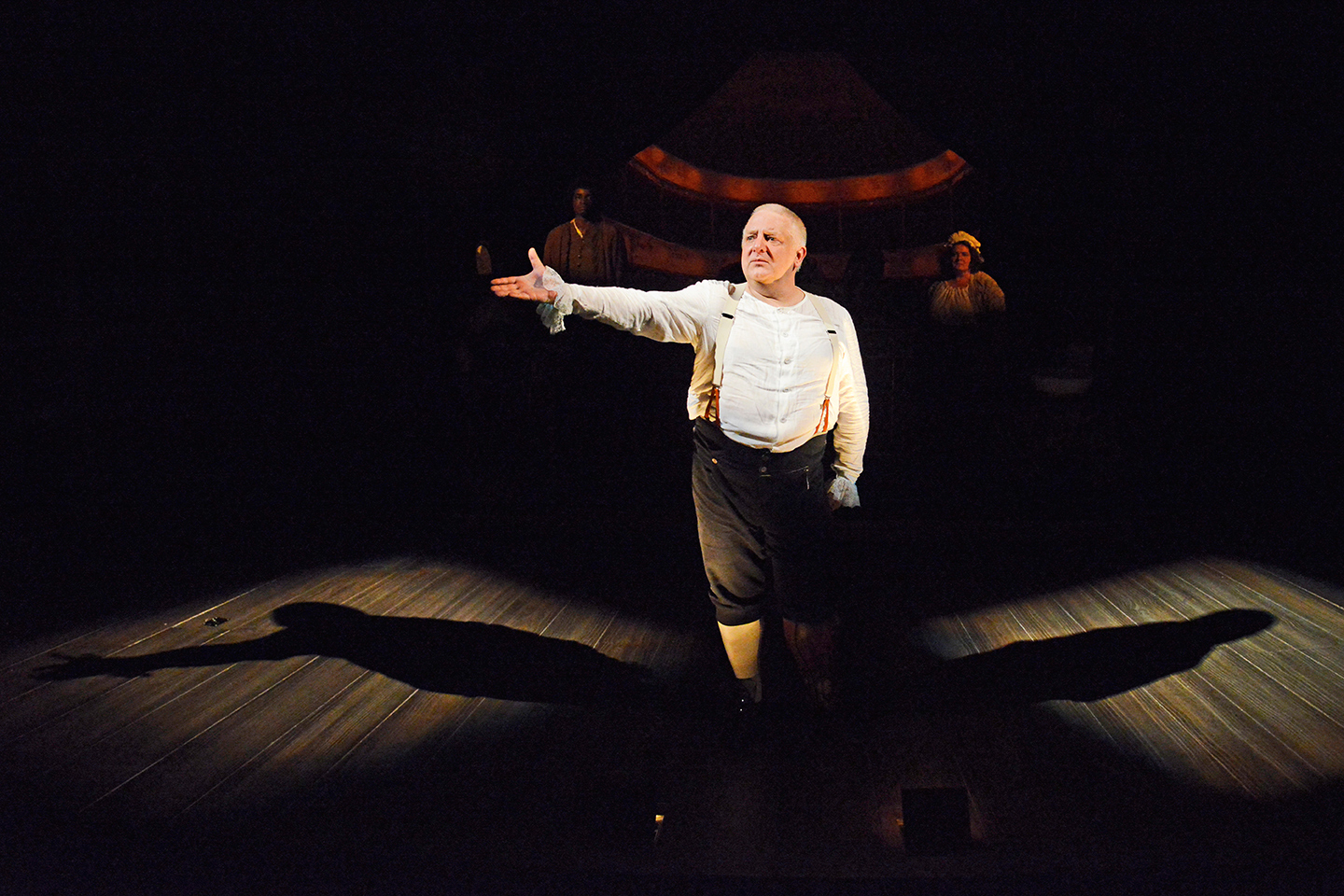
MR FOOTE'S OTHER LEG at Hampstead - Beale strides to glory!
There is no stopping Simon Russell Beale.
After delivering a sensitive, subtle performance earlier this year in the Donmar's TEMPLE, Beale is now firing on all cylinders and giving a larger-than-life performance at the Hampstead Theatre in actor/playwright Ian Kelly's MR. FOOTE'S OTHER LEG, based on his biography of the Georgian actor and comedian Samuel Foote.
Ian Kelly has resurrected Samuel Foote from the historical shadows and what a dazzling personality he was. As David Garrick was re-inventing the dramatic theatre to a more naturalistic style of performance and production, Samuel Foote was establishing himself as a gifted comedic actor who subversively flouted the censorship laws by staging his productions in the early evening and calling them "tea parties". His productions were filled with sly satires on public figures and in what must have been a glorious moment in theatre, he appeared as Othello in a production that played as a comedy - now THAT I would liked to have seen!
For such a savage satiric player as Foote, it was remarkable that he became a friend of both the future George III when he was Prince of Wales and his younger brother the Duke of York. Indeed it was the Duke of York who was instrumental in the first major crisis in Foote's life. Attending a royal house party, Foote accepted a wager to race the Duke's horse which ended in disaster when he was thrown from the horse resulting in his left leg being crushed and an immediate amputation.
Astonishingly Samuel Foote was back on stage within months of the accident and retained his popularity in roles which were written to feature his disability. However, what was undiagnosed at his accident was a head trauma which led to spells of troubling personality disorders. He parlayed the Royals' guilt in his accident by getting them to grant a Royal charter for his theatre, the Theatre Royal Haymarket. One wonders whether his brain injury may have led him to his second disaster? He wrote a play satirising the Duchess of Kingston who had been involved in a salacious divorce case and she retaliated by seeking out reports from former-employees of his that he had made homosexual advances to them.
The following year the Duchess was tried for bigamy and Foote could not resist staging his play again just as the press reported another allegation of sodomy against him. Foot's luck ran out and he was sent to trial, although he was released on a technicality, with the King's veiled assistance in asking Foote to stage a Command Performance. It says a lot for Foote's bravery that he still faced an audience at the Haymarket even while he was being traduced in the papers. The trial robbed him of his career and his health and he died the following year in Dover, waiting for a boat to take him to exile in France. He was 57 and had lived life to the brim.
Kelly's play could be accused of trying to cram too much in and the play sometimes wanders off to show Foote's connections with the electrical experiments of Benjamin Franklin who was a keen London theatregoer and his friend surgeon John Hunter who explored the subject of neuro-science. Where Kelly excels is in the backstage world of the 18th Century West End with actors bitching about each other, the helter-skelter staging of productions and the glowering indifference of the grumpy stage manager.
Ian Kelly has also written himself a tasty supporting part of the Prince of Wales and very funny he is too as the foppish twit destined to become George III who of course had his own flirtations with mental instability. There are also excellent supporting performances from the always-dependable Jenny Galloway as the dyspeptic stage manager, Micah Balfour as Foote's black servant Frank and Joseph Millson is very effective as David Garrick, changing from a thick-tongued northern theatrical newcomer to a pompous Shakespearean star actor who nevertheless can forgive Foote his excesses.
First seen as a heavily-brogued Irish ingenue, Dervla Kerwin gives a delightful performance as the 18th Century actress Peg Woffington, who worked often with both Foote and Garrick and was the latter's mistress for a while. She suggests the star quality that Woffington must have had which made her adept at both comedy and drama, and equally switches from being a brassy and hard-living actress to the reflective woman who learns she has cancer. It's the best performance I have seen Kerwin give.
Richard Eyre's direction elicits these fine performance and his delight in the theatrical material is palpable. He has found his perfect leading man in Simon Russell Beale who brings Samuel Foote to such vivid life. It's remarkable how each new portrayal one sees of his show an even deeper versatility from this actor who should be even more feted than he is. He truly is the successor to Ralph Richardson, an actor who can play a wide-ranging array of characters - both dramatic, tragic or comical - but always retain a real humanity.
He is given ample opportunity to show all these sides as Samuel Foote and creates such a warm, likable, 'human' personality that it is a relief that Kelly ends the play with Foote down - threatened with public humiliation - but not out - his bravery in going out onstage before his audience. Whether as the eager new actor, the bitchy star of his own comedies, writhing in agony as he is operated on, flying into frightening rages or begging for affection, Beale is never less than stunning.
Eyre has reunited his design team from GHOSTS and again they deliver: Peter Mumford's lighting is fluid and evocative while Tim Hatley's set and costumes are a constant delight. The Hampstead Theatre run sold out very quickly and the very exciting news is that MR FOOTE'S OTHER LEG will transfer to the Theatre Royal Haymarket from 28th October to 23rd January. Somewhere there will be a one-legged ghost very happy although the current Haymarket theatre building is to the right of where Foote's Haymarket stood. Either way, run - or hop - to see it!
After delivering a sensitive, subtle performance earlier this year in the Donmar's TEMPLE, Beale is now firing on all cylinders and giving a larger-than-life performance at the Hampstead Theatre in actor/playwright Ian Kelly's MR. FOOTE'S OTHER LEG, based on his biography of the Georgian actor and comedian Samuel Foote.
Ian Kelly has resurrected Samuel Foote from the historical shadows and what a dazzling personality he was. As David Garrick was re-inventing the dramatic theatre to a more naturalistic style of performance and production, Samuel Foote was establishing himself as a gifted comedic actor who subversively flouted the censorship laws by staging his productions in the early evening and calling them "tea parties". His productions were filled with sly satires on public figures and in what must have been a glorious moment in theatre, he appeared as Othello in a production that played as a comedy - now THAT I would liked to have seen!
For such a savage satiric player as Foote, it was remarkable that he became a friend of both the future George III when he was Prince of Wales and his younger brother the Duke of York. Indeed it was the Duke of York who was instrumental in the first major crisis in Foote's life. Attending a royal house party, Foote accepted a wager to race the Duke's horse which ended in disaster when he was thrown from the horse resulting in his left leg being crushed and an immediate amputation.
Astonishingly Samuel Foote was back on stage within months of the accident and retained his popularity in roles which were written to feature his disability. However, what was undiagnosed at his accident was a head trauma which led to spells of troubling personality disorders. He parlayed the Royals' guilt in his accident by getting them to grant a Royal charter for his theatre, the Theatre Royal Haymarket. One wonders whether his brain injury may have led him to his second disaster? He wrote a play satirising the Duchess of Kingston who had been involved in a salacious divorce case and she retaliated by seeking out reports from former-employees of his that he had made homosexual advances to them.
The following year the Duchess was tried for bigamy and Foote could not resist staging his play again just as the press reported another allegation of sodomy against him. Foot's luck ran out and he was sent to trial, although he was released on a technicality, with the King's veiled assistance in asking Foote to stage a Command Performance. It says a lot for Foote's bravery that he still faced an audience at the Haymarket even while he was being traduced in the papers. The trial robbed him of his career and his health and he died the following year in Dover, waiting for a boat to take him to exile in France. He was 57 and had lived life to the brim.
Kelly's play could be accused of trying to cram too much in and the play sometimes wanders off to show Foote's connections with the electrical experiments of Benjamin Franklin who was a keen London theatregoer and his friend surgeon John Hunter who explored the subject of neuro-science. Where Kelly excels is in the backstage world of the 18th Century West End with actors bitching about each other, the helter-skelter staging of productions and the glowering indifference of the grumpy stage manager.
Ian Kelly has also written himself a tasty supporting part of the Prince of Wales and very funny he is too as the foppish twit destined to become George III who of course had his own flirtations with mental instability. There are also excellent supporting performances from the always-dependable Jenny Galloway as the dyspeptic stage manager, Micah Balfour as Foote's black servant Frank and Joseph Millson is very effective as David Garrick, changing from a thick-tongued northern theatrical newcomer to a pompous Shakespearean star actor who nevertheless can forgive Foote his excesses.
First seen as a heavily-brogued Irish ingenue, Dervla Kerwin gives a delightful performance as the 18th Century actress Peg Woffington, who worked often with both Foote and Garrick and was the latter's mistress for a while. She suggests the star quality that Woffington must have had which made her adept at both comedy and drama, and equally switches from being a brassy and hard-living actress to the reflective woman who learns she has cancer. It's the best performance I have seen Kerwin give.
Richard Eyre's direction elicits these fine performance and his delight in the theatrical material is palpable. He has found his perfect leading man in Simon Russell Beale who brings Samuel Foote to such vivid life. It's remarkable how each new portrayal one sees of his show an even deeper versatility from this actor who should be even more feted than he is. He truly is the successor to Ralph Richardson, an actor who can play a wide-ranging array of characters - both dramatic, tragic or comical - but always retain a real humanity.
He is given ample opportunity to show all these sides as Samuel Foote and creates such a warm, likable, 'human' personality that it is a relief that Kelly ends the play with Foote down - threatened with public humiliation - but not out - his bravery in going out onstage before his audience. Whether as the eager new actor, the bitchy star of his own comedies, writhing in agony as he is operated on, flying into frightening rages or begging for affection, Beale is never less than stunning.
Eyre has reunited his design team from GHOSTS and again they deliver: Peter Mumford's lighting is fluid and evocative while Tim Hatley's set and costumes are a constant delight. The Hampstead Theatre run sold out very quickly and the very exciting news is that MR FOOTE'S OTHER LEG will transfer to the Theatre Royal Haymarket from 28th October to 23rd January. Somewhere there will be a one-legged ghost very happy although the current Haymarket theatre building is to the right of where Foote's Haymarket stood. Either way, run - or hop - to see it!
Saturday, June 20, 2015
THE ELEPHANT MAN at the Haymarket Theatre: Roll up, Roll up...
...see the West End's Main Acting Attraction!
That is very much how it felt when entering the Haymarket Theatre with more merchandise on sale than you might expect at a straight play: two different t-shirts, posters, mugs, etc. You don't get that for everyone, Simon Russell Beale would plotz to have such merch on sale!
No, the reason for such buying opportunities is because the titular hero is being played by Bradley Cooper, three-time Academy Award nominee for acting (plus one for producing) and, as I have been informed, a hunk. Personally, he doesn't do a lot for me - he looks like Barry Manilow's better-looking brother but how was he onstage?
Actually he gave a perfectly fine performance as did the imported American cast but as I left the theatre I found myself feeling oddly unmoved and slightly dissatisfied.
I think the fault is with Bernard Pomerance's play as well as Scott Ellis by-the-numbers production. At no time during this production did I feel engaged by Ellis' direction, it felt as if he just followed the stage directions.
Pomerance's play calls for the - usually handsome - actor playing the disfigured Joseph Merrick to perform the role without prosthetics, to suggest the disfigurement through his contorting face and body into the bizarre shape Merrick took. Cooper certainly succeeded in this admirably and he is probably grateful that Pomerance's sadly thin play only lasts two hours - with an interval to unbend in.
Despite sounding at times like David Walliams "I'm a lady" transvestite character from LITTLE BRITAIN, he also captured the humble and sweet nature of the unloved young man who yearned to be educated and liked but here's the rub. The only moment of real audience frisson was when, after a few hidden teases, Cooper was finally revealed in all his buff glory in a pair of grotty pants - I was sitting next to about six 30-something office-worker-women-types who all swooned at him and the one next to me even murmured "Oooo it's HIM". But a couple of seconds later, he morphed into his Merrick gait and the air of disappointment as they realised he was going to stay like that til the curtain call was palpable.
That is very much how it felt when entering the Haymarket Theatre with more merchandise on sale than you might expect at a straight play: two different t-shirts, posters, mugs, etc. You don't get that for everyone, Simon Russell Beale would plotz to have such merch on sale!
No, the reason for such buying opportunities is because the titular hero is being played by Bradley Cooper, three-time Academy Award nominee for acting (plus one for producing) and, as I have been informed, a hunk. Personally, he doesn't do a lot for me - he looks like Barry Manilow's better-looking brother but how was he onstage?
Actually he gave a perfectly fine performance as did the imported American cast but as I left the theatre I found myself feeling oddly unmoved and slightly dissatisfied.
I think the fault is with Bernard Pomerance's play as well as Scott Ellis by-the-numbers production. At no time during this production did I feel engaged by Ellis' direction, it felt as if he just followed the stage directions.
Pomerance's play calls for the - usually handsome - actor playing the disfigured Joseph Merrick to perform the role without prosthetics, to suggest the disfigurement through his contorting face and body into the bizarre shape Merrick took. Cooper certainly succeeded in this admirably and he is probably grateful that Pomerance's sadly thin play only lasts two hours - with an interval to unbend in.
Despite sounding at times like David Walliams "I'm a lady" transvestite character from LITTLE BRITAIN, he also captured the humble and sweet nature of the unloved young man who yearned to be educated and liked but here's the rub. The only moment of real audience frisson was when, after a few hidden teases, Cooper was finally revealed in all his buff glory in a pair of grotty pants - I was sitting next to about six 30-something office-worker-women-types who all swooned at him and the one next to me even murmured "Oooo it's HIM". But a couple of seconds later, he morphed into his Merrick gait and the air of disappointment as they realised he was going to stay like that til the curtain call was palpable.
It is certainly a showcase for an actor showing he is more than just a pretty face but that's about it for Pomerance's play. I was shocked at it's thinness, as Peggy Lee might sing "Is That All There Is?" The playwright strives to get us to register that Dr Frederick Treves' attempt to rehabilitate Merrick into his own room at the London Hospital in Whitechapel while having him receive visits from the rich and famous for donations to the Hospital was exploiting Merrick just as his fairground manager had, just to a higher income.
But after a while you want to shake Pomerance and say "Yes we get it, now give me something more!" but we just get more of the same. Scott Ellis's direction seemed to echo the surface appeal of the text and at best got the actors on and off the stage with a pleasing regularity. It mostly seemed to coast along with no real tempo to the later scenes and even the climactic scene of Merrick's decision to sleep lying down knowing this would kill him seemed to have the same uninterested feel.
For all Cooper's contorted perambulations, for me the performances most worth seeing were Alessandro Nivola's as Frederick Treves and Patricia Clarkson as Mrs Madge Kendall, the famous actress who befriends Merrick. Nivola gave a quietly intense performance as Treves, a good man troubled that he is morally wrong in exploiting Merrick and confronting his growing ambivalent feelings towards his charge.
By far the most engaging performance was Patricia Clarkson's as Mrs Kendall, one of the Victorian era's most popular actresses, as adept at Shakespeare as at comedies - indeed she often appeared on the very stage were she was being recreated. Pomerance gives her a couple of funny lines, usually sympathising with Merrick on the pressures of playing a role for a paying public but in a scene that had me quietly squirming in my seat, also had her taking off her blouse to show Merrick his first glimpse of a woman's body. It felt totally gratuitous, especially as they are interrupted by Treves who then acts like a wronged husband. Clarkson transcended the obvious writing to give a light, nuanced performance.
In the all-American company, it was good to see Anthony Heald in his contrasting roles of the censorious Bishop and as Ross, Merrick's fairground manager (even with a dodgy accent): he had a nice scene towards the end when Ross realised his hold over his former money-magnet had gone, and there was a steady performance from Henry Stram as Francis Carr Gomm, chairman of the London Hospital.
There was no chance for over-ovating as Cooper joined the company for ensemble curtain calls at the end which is oddly at variance with the merch onsale out front and I felt a definite air of frustration in the audience - yes, he wants to be just one of the company but it is him that most of the audience have come to see so at least spare them the chance to cheer and whoop him - especially standing up straight and smiling.
Sunday, February 08, 2015
TAKEN AT MIDNIGHT at Haymarket - remembering the forgotten
Last night we went to see something rare in the West End - a new play by a new author in one of the most prestigious of London theatres. Nope, not the Donmar or Almeida or some poky over-a-pub fringe venue but in the Haymarket, the sometime home of all-star revivals.
If I am honest I think that although this transfer from Chichester is to be applauded for introducing a new voice with a thoughtful and engrossing new play, I think it was an uneasy fit in the plush surroundings of the Haymarket, a more intimate auditorium would have served the play better and made it more powerful.
Mark Hayhurst is certainly no stranger to the tragic tale of Hans Litten as he has already written a tv drama and documentary about him so he is the right person to bring it to the stage but this time he shifts the focus to Litten's mother Irmgard.
Hans Litten was a young barrister in Berlin who specialised in defending the left-wing working-class in court. In 1931 he prosecuted three members of the SA for killing three and wounding twenty others in an attack by the paramilitaries on a left-wing dance hall. His bold coup-de-grace was to call Adolf Hitler to the stand where he was cross-examined on his claims that the Nazi Party did not propagate violence and were a credible political party.
Litten set out to show that Hitler was in fact the leader of a party that terrorised it's opponents. Hitler's obvious discomfort at being cross-examined was not forgotten. In 1932 the Nazi party rose to power and the following year, on the night of the Reichstag fire, Hitler exacted his revenge - Litten was arrested at midnight and spent almost five years being shuttled around various prisons and concentration camps, subjected to beatings and torture. This was done while he was being held without trial in "protective custody" - another fine example of the Nazi's corruption of language. Eventually moved to Dachau, Litten hanged himself on 5th February 1938.
All the time he was in prison, his mother Irmgard relentlessly pursued the Nazis for his release, haunting their offices with increasing desperation, happy for any information of his whereabouts from released prisoners as proof he was still alive.
There was one moment of real hope when Litten's case was picked up by British politician Lord Clifford Allen but although Allen had a meeting with Hitler, nothing came of it as Allen believed in appeasement with the Nazi party.
After their son's death, Irmgard moved to England while his father relocated to Northern Ireland. She lived to see her son's tormentors defeated and died in 1953 but her husband had predeceased her in 1940.
The play has them at odds over how to react to their son's fate and indeed, Hans had grown distant from his father, a Jew who converted to Lutheranism to further his legal career. Baptised a Christian, Hans embraced Judaism to get back at his father although this rebounded on him when he arrived at Dachau as he was classified Jewish and made to wear the yellow star. Which is also ironic in that the tragedy that overtook Hans Litten, his colleagues and other disaparate groups in the 1930s risks being lost in the wake of the overwhelming later Holocaust.
Some artistic licence has been taken in casting the tall and graceful Martin Hutson as Hans Litten as, in real life, he was more of a Billy Bunter lookalike, but he gave a heartfelt and affecting performance, nuanced enough to suggest that Litten realised that he had been the unwitting agent of his own fate.
The supporting roles have been cast well with solid, experienced actors: Pip Donaghy is very good as Erich Muhsam, the anarchist poet/playwright who shares Hans' cell and who remained unbowed in the face of his own death while Mike Grady plays Carl von Ossietzky, a left-wing journalist who also shares their cell. Ossietzky was awarded the Nobel Peace Prize in 1935 but remained in prison until he died in the following year from TB.
David Yelland was good as the affable Lord Allen, full of waffle about freedom but doing nothing to anger Hitler while John Light was suitably chilling as Dr Conrad, the Nazi who is Irmgard's one unpredictable link to her son's release. She has to demur to him in the hope that in doing so Hans will gain freedom but all the time you get the feeling of a sometimes-interested cat playing with a mouse.
There is a final confrontation scene between them when the avuncular mask drops and the real brutal face and mind of Nazism is revealed and it is to the credit of the lean, sinewy writing and committed playing of the actors that in this and similar scenes you could hear a pin drop - apart from the obligatory coughing.
Penelope Wilton was excellent as Irmgard, her unflinching quest for justice reflected in her tense, ramrod posture and her fists clenched. Lesser actresses would play the sentiment but Wilton remained believably stoic, aware that any sign of weakness would be seized on by her son's captors. She finally relents in her last meeting with Hans when she begs him to realise that "the time for bravery is over". Early on in the play it occurred to me that she almost seemed to be channeling her CHALK GARDEN co-star, the late Margaret Tyzack; both in her lower register and speech. Once I thought that I couldn't shift it from my mind. I hope she takes it as a compliment that I thought that.
Jonathan Church's direction has a relentless forward motion to it, moving inexorably towards the inevitable conclusion although after a while I wanted something more than the actors walking on, saying their lines and walking off. Robert Jones has designed a simple but very effective set which helps the action move seamlessly from scene to scene and is helped enormously by Tim Mitchell's marvellous lighting suggesting the looming shadows of German expressionism. In one memorable moment, Litten strides off after a reanactment of the 1931 trial with his shadow growing ever larger across the back wall only for it to suddenly change to the shadow of him hanged.
As I said, Mark Hayhurst's taut writing kept us subdued and attentive and with mothers across the world plaintively asking madmen for the return of their sons and daughters, the story of Irmgard and Hans Litten will tragically always be relevant but ultimately the play felt at times like a radio play transposed to the stage.
If I am honest I think that although this transfer from Chichester is to be applauded for introducing a new voice with a thoughtful and engrossing new play, I think it was an uneasy fit in the plush surroundings of the Haymarket, a more intimate auditorium would have served the play better and made it more powerful.
Mark Hayhurst is certainly no stranger to the tragic tale of Hans Litten as he has already written a tv drama and documentary about him so he is the right person to bring it to the stage but this time he shifts the focus to Litten's mother Irmgard.
Hans Litten was a young barrister in Berlin who specialised in defending the left-wing working-class in court. In 1931 he prosecuted three members of the SA for killing three and wounding twenty others in an attack by the paramilitaries on a left-wing dance hall. His bold coup-de-grace was to call Adolf Hitler to the stand where he was cross-examined on his claims that the Nazi Party did not propagate violence and were a credible political party.
Litten set out to show that Hitler was in fact the leader of a party that terrorised it's opponents. Hitler's obvious discomfort at being cross-examined was not forgotten. In 1932 the Nazi party rose to power and the following year, on the night of the Reichstag fire, Hitler exacted his revenge - Litten was arrested at midnight and spent almost five years being shuttled around various prisons and concentration camps, subjected to beatings and torture. This was done while he was being held without trial in "protective custody" - another fine example of the Nazi's corruption of language. Eventually moved to Dachau, Litten hanged himself on 5th February 1938.
All the time he was in prison, his mother Irmgard relentlessly pursued the Nazis for his release, haunting their offices with increasing desperation, happy for any information of his whereabouts from released prisoners as proof he was still alive.
There was one moment of real hope when Litten's case was picked up by British politician Lord Clifford Allen but although Allen had a meeting with Hitler, nothing came of it as Allen believed in appeasement with the Nazi party.
After their son's death, Irmgard moved to England while his father relocated to Northern Ireland. She lived to see her son's tormentors defeated and died in 1953 but her husband had predeceased her in 1940.
The play has them at odds over how to react to their son's fate and indeed, Hans had grown distant from his father, a Jew who converted to Lutheranism to further his legal career. Baptised a Christian, Hans embraced Judaism to get back at his father although this rebounded on him when he arrived at Dachau as he was classified Jewish and made to wear the yellow star. Which is also ironic in that the tragedy that overtook Hans Litten, his colleagues and other disaparate groups in the 1930s risks being lost in the wake of the overwhelming later Holocaust.
Some artistic licence has been taken in casting the tall and graceful Martin Hutson as Hans Litten as, in real life, he was more of a Billy Bunter lookalike, but he gave a heartfelt and affecting performance, nuanced enough to suggest that Litten realised that he had been the unwitting agent of his own fate.
The supporting roles have been cast well with solid, experienced actors: Pip Donaghy is very good as Erich Muhsam, the anarchist poet/playwright who shares Hans' cell and who remained unbowed in the face of his own death while Mike Grady plays Carl von Ossietzky, a left-wing journalist who also shares their cell. Ossietzky was awarded the Nobel Peace Prize in 1935 but remained in prison until he died in the following year from TB.
David Yelland was good as the affable Lord Allen, full of waffle about freedom but doing nothing to anger Hitler while John Light was suitably chilling as Dr Conrad, the Nazi who is Irmgard's one unpredictable link to her son's release. She has to demur to him in the hope that in doing so Hans will gain freedom but all the time you get the feeling of a sometimes-interested cat playing with a mouse.
There is a final confrontation scene between them when the avuncular mask drops and the real brutal face and mind of Nazism is revealed and it is to the credit of the lean, sinewy writing and committed playing of the actors that in this and similar scenes you could hear a pin drop - apart from the obligatory coughing.
Penelope Wilton was excellent as Irmgard, her unflinching quest for justice reflected in her tense, ramrod posture and her fists clenched. Lesser actresses would play the sentiment but Wilton remained believably stoic, aware that any sign of weakness would be seized on by her son's captors. She finally relents in her last meeting with Hans when she begs him to realise that "the time for bravery is over". Early on in the play it occurred to me that she almost seemed to be channeling her CHALK GARDEN co-star, the late Margaret Tyzack; both in her lower register and speech. Once I thought that I couldn't shift it from my mind. I hope she takes it as a compliment that I thought that.
Jonathan Church's direction has a relentless forward motion to it, moving inexorably towards the inevitable conclusion although after a while I wanted something more than the actors walking on, saying their lines and walking off. Robert Jones has designed a simple but very effective set which helps the action move seamlessly from scene to scene and is helped enormously by Tim Mitchell's marvellous lighting suggesting the looming shadows of German expressionism. In one memorable moment, Litten strides off after a reanactment of the 1931 trial with his shadow growing ever larger across the back wall only for it to suddenly change to the shadow of him hanged.
As I said, Mark Hayhurst's taut writing kept us subdued and attentive and with mothers across the world plaintively asking madmen for the return of their sons and daughters, the story of Irmgard and Hans Litten will tragically always be relevant but ultimately the play felt at times like a radio play transposed to the stage.
Tuesday, April 26, 2011
I suspect we shall know by the end of the year where we stand with Terence Rattigan. Much is being made that this year marks the centenary of his birth and a slew of productions are being staged to celebrate this as well as the release later in the year of Terence Davies' remake of THE DEEP BLUE SEA.It's all rather odd as 2011 is also the centenary of Tennessee Williams' birth and he is a writer whose work has received more attention in the past few years in London than Rattigan's but of Tennessee there appears to be nary a peep of celebrations this year.
Rattigan in truth has never been that far from our stages with fairly frequent revivals of THE DEEP BLUE SEA and, to a lesser extent, SEPARATE TABLES and THE WINSLOW BOY but I suspect the upswing in Rattigan's profile has been due to the phenomenal success last year of the National Theatre's AFTER THE DANCE. This seems to have led to him now being seen more as a playwright to be taken seriously as opposed to a writer whose plays make handy vehicles for starry revivals.
Trevor Nunn is launching his tenure as Artistic Director of the Theatre Royal Haymarket with a production of Rattigan's 1941 play FLARE PATH, written while he was serving with the RAF. It is what you expect from Rattigan, a solid well-made West End play with a beginning, a middle and an end - in that order. Not as haunting as AFTER THE DANCE but worthy of a revival I guess.The Falcon Hotel is a genteel Lincolnshire hotel which has as it's clientele the officers (and wives) of the neighbouring RAF airbase. We follow the events that take place over a single night when the airmen are recalled to the base for a night flight over Germany. One of the four planes in the squadron is fired upon by waiting enemy planes on take-off and one is reported Missing In Action and we watch as the news of a missing pilot refracts on his wife and his friends.
Rattigan rewrote the play for the 1945 film THE WAY TO THE STARS which packs a more emotional punch as he didn't hedge his dramatic bets as he does here. I suspect that because the film script was written towards the end of the war, it was easier to include lead characters being killed in action.The action here is given a melodramatic twist by having the hotel's occupants surprised by the appearance in their midst of Peter Kyle, an actor who has made a name for himself in Hollywood. It turns out that it isn't just a random visit as Kyle has been conducting a clandestine affair with Patricia, one of the pilot's wives. She is on the verge of telling her husband that she is leaving him when the call comes through for the night flight so the tension is stretched to breaking point between the lovers.
With not much sub-text to play, Trever Nunn ramps up the tension of the waiting women and this works very well. He also elicits sympathetic performances from his cast, the stand-out being the 'West End's Sweetheart' Sheridan Smith as Doris the down-to-earth and amiable ex-barmaid who now finds herself the Countess Skriczevinsky after her marriage to a Polish airman.Sheridan was the real heart of the play and as the realisation dawned that her husband had not returned with the others, she shone with a stoic sadness. In the scene where Doris asked Kyle to read her the letter that her husband left to be opened in the event of his death, her delicate reactions were heart-breaking.
Owing to the non-appearing James Purefoy, the lead role of Peter Kyle was played by Jim
Creighton and he was very good. Kyle secretly knows he is coming to the end of his Leading Man roles and is banking all on his relationship with Patricia and Creighton played this quiet desperation very well.The role of Patricia was played by media darling Sienna Miller. She was ok as the stage actress torn between her love for Kyle and her duty to her obviously disturbed pilot husband but watching her I was amazed that her name has such cachet. There are any number of actresses who could play the role as well if not better and her blandly attractive, blonde looks conjure up the model on a Timotei ad rather than a memorable actress. The media's constant infatuation with her is truly baffling.
The role of the golden boy pilot Teddy Graham who is becoming more and more frazzled with each sortie was played well by the impossibly posh-named Harry Hadden-Paton and there was fine support from Joe Armstrong as Sgt. 'Dusty' Miller, Emma Handy as his visiting wife Maudie, Mark Dexter as Johnny the Polish flyer and in particular from Clive Wood as Squadron Leader Swanson aka 'Gloria' who made a sympathetic older 'uncle' to the pilots.
It was an additional pleasure to see the play in a full theatre - although it was amusing to find that his personification of his core audience 'Aunt Edna' - "a nice, respectable, middle-class, middle-aged, maiden lady, with time on her hands and money to help her pass it, who resides in a West Kensington hotel" - is alive and well. She is going to need that money to catch up with all the upcoming productions of his work!
Subscribe to:
Posts (Atom)