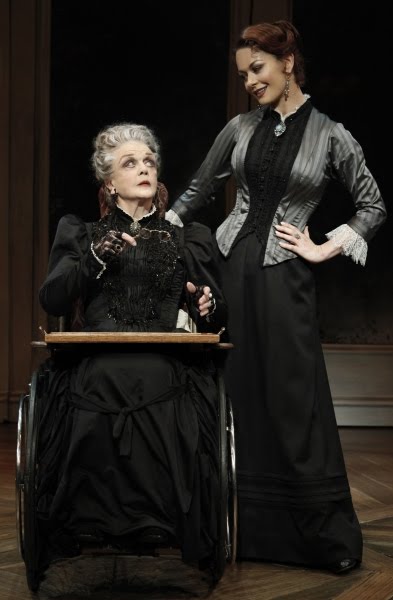
Twice this week I have come away from the National Theatre pondering how hard it must be for artistic directors as to how to fill their schedules.
The Donmar or the Menier for example are looked upon as having a certain caché but with runs allotted to a month or so that means these theatres at best can stage only 12 productions a year - and what plays get chosen? Monetary demands mean that a healthy sprinkling of popular titles and playwrights crop up again and again... but what gets left behind? What falls through the cracks?
The reason for these musings is down to seeing two excellent revivals of little-known early plays by Terence Rattigan and Tennessee Williams currently playing to packed houses at the NT.
Think of a Rattigan that gets revived and you will probably have THE WINSLOW BOY, THE DEEP BLUE SEA or SEPARATE TABLES on your list. At the Lyttleton however, Thea Sharrock has directed a revival of Rattigan's second play AFTER THE DANCE which I saw with Owen, Sharon and Eamonn.It opened in June 1939 to good reviews and enthusiastic audiences who no doubt responded to not only the high drama onstage but Rattigan's capturing of the zeitgeist of the country as it approached an unavoidable war. However this very atmosphere also was the production's downfall and as the situation worsened the play ended it's run after 2 months, less than a month before war was declared.
Rattigan appears to have had mixed feelings about it in hindsight, not including it in his Collected Plays when first published, probably because of it's failing to achieve as big a box office success as his later plays. There is also a theory that he was haunted by using the possible suicide of a young lover as a plot device in the play but then he is accused of using the same incident 13 years later in THE DEEP BLUE SEA so it appears to have been a handy haunting.The years in between might have lost out but it is this year's gain as what Sharrock's production showcases is a beautifully-crafted three-act play which nails a moment in time perfectly while also providing 5 cracking parts for actors to shine in.
Surprisingly only now making his NT debut, Benedict Cumberbatch (God, that name) is paired with the always-watchable Nancy Carroll as David and Joan, an archetypal Golden Couple who now find themselves at the wrong end of the 1930s after 12 years of marriage and secretly realise that their excessive round of drinks, parties, larks and more drinks will not stand scrutiny in the gray light of a possible war in Europe. Independently wealthy, David is drinking himself into an early grave while half-heartedly writing a biography of a little-known Balkan hero. Joan fills in her time by being the effortlessly chic hub of a circle of feckless, equally-sensation-craving group of drinking friends. She also chooses to ignore her husband's frequent but non-threatening flings with pretty young things for to mind would of course be a crashing bore.
They also share their large London flat with John (Adrian Scarborough) one of their drinking friends who has become an unofficial lodger and spends his time happily lying on the couch singing for his supper by keeping them amused with his cutting quips about all and sundry. Also sharing the flat is David's cash-strapped cousin who he 'employs' to type up the occasional page of his never-ending book and the couple are friendly with his fiancee Helen (Faye Castelow) who is a frequent visitor.
Of course what soon becomes apparent is that Helen is besotted with David, determined to lead him to the right road of Great Writing and Sobriety through her devotion. She manages to get her doctor brother to examine David and he is confronted with the fact that he is in the early stages of Cirrhosis. David's vanity cannot withstand Helen's passionate declarations and eventually confesses that he has fallen for her too and knows with her help he can lead a Life With Meaning.Helen then becomes that most dreaded creature, one who knows that everyone will be happier if they all know the plain truth. She confronts Joan on the afternoon of a huge party being held at the flat and tells her plainly that Joan's marriage is over as David now loves her.
Joan responds just as Helen and David expect, calm and excepting of the ways of the world, however the reality is witnessed by an appalled John who finds Joan, broken and in despair. The party goes ahead but events take a shattering turn from which their lives are changed just as the approaching war will change their world forever.
Thea Sharrock's direction is a model of empathy and clarity, her handling of characters who could easily be looked upon as irritating and distancing are instead presented to us with an immediacy and sympathy that is rare among today's directors. Both Scarborough and Castelow appeared last year on the same stage in Rupert Goold's take on J.B. Priestley's TIME AND THE CONWAYS in which the characters were treated as mere caricature. Here Sharrock is unafraid of allowing her characters to have an inner emotional life which resonates strongly.
She has elicited strong performances from her cast, namely from Cumberbatch, Carroll and Scarborough, all of whom know exactly how to balance the brittle, knowing banter of the opening scenes with the raw emotional hurt that all the stylish wit is a carapace for.
Nancy Carroll was quite breathtaking as Joan, her early scenes suggesting the unforced, confidant glamour of Kay Hammond but shattering that image with her lonely devastation at the news of her husband wanting to end their life together.
Cumberbatch fitted almost seamlessly into the role of David, he even resembled any number of tall, ramrod-backed, English leading men like Michael Rennie or David Farrar. However like Carroll he also found layers of emotion within David which while not making him sympathetic, did make his choices understandable.
My friend Sharon asked me afterwards if I thought Adrian Scarborough was a possible future Knight of the theatre and his performance here suggested it's possibly only a matter of his getting a tiny step up to some good lead parts. Again he gave a subtle and nuanced performance as John, scathingly funny with the timing of death but able to suggest the anger, fear and loneliness of a man all to aware of the superficiality of his place in life. Faye Castelow was fine as the frighteningly single-minded Helen although even Rattigan would have been alarmed by her Cut Glaws Eckcent which could have been slightly toned down. In a fine supporting cast special mention must be made for yet another exquisite performance by Jenny Galloway as Miss Potter, the no-nonsense, Widdecombe-esque copy typist that David finally employs.
A special word of praise for Hildegard Bechtler's deliciously sprawling set design for David and Joan's apartment and ravishing costumes, especially for Nancy Carroll. In particular, I really liked the subtle changes that turned the set from the casually elegant, lived-in home of the first two acts to the cold and empty haunted space of the third. Mark Henderson's lighting also was beautifully used to enhance the play.Next year is Rattigan's centenary and it is being marked with not only a retrospective at the National Film Theatre of films and tv plays based on his many works - PLEASE let them show the 1955 film of THE DEEP BLUE SEA starring Vivien Leigh - but a tribute at Chichester (where he has never gone out of fashion) and yet another screen remake of THE DEEP BLUE SEA but directed by Terence Davies which sounds quite exciting. So roll on next year!
In the meantime get yourself to the National Theatre to see AFTER THE DANCE.
Tuesday, June 22, 2010
On Saturday Owen and I went to Kingston via Wimbledon. Not too much of a struggle I hear you cry Constant Reader... 57 bus goes there from Streatham. But I mean Kingston, Jamaica.
Yes, man. This magical journey meant only one thing, Perry Henzell's musical adaptation of his film THE HARDER THEY COME was back in town! After it's criminally short tenure at the Playhouse in 2008, most of the company have returned from dates in Canada and the USA to finish off with a UK tour which had the good sense to play London again, this time at the cavernous Wimbledon theatre. Needless to say it wasn't the same show I saw five times back in 2008 but there were enough familiar faces to make it enjoyable and of course the sheer galvanizing effect of the show itself worked again with it's marvelous reggae score played by some fierce musicians.For the tour, the role of Ivanhoe Martin - the country bwoi coming to Kingston to seek his fortune in music but ending up a ghetto hero on the run from the police - was played by Matthew J. Henry who had played "The Photographer" at both the Barbican and Playhouse. Overall I missed the charismatic Rolan Bell in the part but Henry came into his own in the second half when he showed the hard side of Ivan's character.
The role of the hapless Elsa, Ivan's put-upon lover, was now played by Alanna Leslie and again I found myself missing the appealing performance of Joanna Leslie - she managed to give you a sense of the character's inner strength otherwise Elsa comes across as a bit of a drip.
For the main supporting performances it was great to see the original players - with a twist! Marlon King reprised his Playhouse role as Pedro who Ivan joins in the lucrative but treacherous world of ganja-trading and he was as powerful on stage as always, his rendition of MANY RIVERS TO CROSS is one of the highlights of the show. The twist this time out was seeing the great Chris Tummings taking over from the mighty Marcus Powell as Reggie Hilton, the power behind Kingston's music business. He again proved to be a magnetic performer but damn I missed him as Ray Pierre the corrupt policeman who sees to it that Ivan is hunted down so the corruption can keep flowing into his bank account. Although Reggie has his own moments of smiling menace, I missed Chris' LETHAL menace as Ray. His second act solo of PRESSURE DROP - which he interrupts to interact with the mouthy but predominantly petrified audience members - was handled ok by Craig Stein, but Tummings made this a scene a genuine showstopper. We also had the welcome return of Victor Romero Evans as the hypocritical fire & brimstone Preacher - he was also a fine Pedro in the Barbican production - as well as the joyous Joy Mack as Miss Daisy, Ivan's sometime-loving, most-time disparaging mama. It was also great to see Derek Elroy back and stealing every scene he was in as the radio dj Numero Uno and as the cowardly Longa. Nice too to see the delightful Jacqui Dubois again as Miss Brown, the shrewd seller of stylish ghetto headwear "International style, local price".
We had a new pair of performers as the two ghetto fabulous sistas Pinkie and Precious, Janine Johnson and Nataylia Roni (who originated the role at Stratford East). I liked Roni but missed the exuberant playing of Susan Lawson-Reynolds as Pinkie who certainly had more clarity in her 2nd act exposition scenes.The show is ultimately powered by the marvellous musicians who make up the onstage band, The Hilton All Stars: Perry Melius on drums, Wayne Nunes on bass, Darren Benjamin and Adrian McKenzie on keyboards and last but not least, Peter Lee and the mighty Alan Weekes on guitars. It's a-compulsory to not leave the auditorium until they have finished their last play-out jam.
The production next visits Salford, Oxford and Cardiff. You can get to see it if you really want - and you would be mad not to... it's a Boss production sar!
Monday, June 21, 2010
Last week it was time to immerse myself again into the deceptively placid water that is the music of Suzanne Vega as she was appearing at the Cadogan Hall, part of a small tour of the UK to promote her album CLOSE-UP VOL.1: LOVE SONGS.
As usual though, it was only when once immersed I remembered that all of Vega's songs, while placid on the surface, have a dangerous undertow.This was the 5th time Owen and I have seen her in concert and each time has seen a slight change in line-up and setlist so although I always get to hear her popular songs there are also the odd one or two thrown in which I am unaware of. Owen of course has all her studio albums so always claps a bit louder at those ones!
Speaking of studio albums, it was with some surprise that I realised that CLOSE-UP is only her eighth studio recording in a career that spans 25 years - a rare batting average, beaten of course by Kate Bush's eight in 32 years. Now I think about it, Kirsty MacColl managed five albums in 21 years and Laura Nyro recorded nine studio albums in 30 years. An obvious answer I suppose is that it is more the luck of the female singer/songwriter for life to be seen to intervene for long spells. A good subject for a blog eh Constant Reader?The CLOSE-UP series should bolster her total somewhat as she plans to release three more themed albums. After her well-received and Grammy-winning BEAUTY AND CRIME cd in 2007, Suzanne found herself dumped the next year after only 2 years into her contract with Blue Note Records. As a way to wrest some control over her legacy she has set about re-recording her songs and releasing them herself as the CLOSE-UP series. Another example of the fascinating ways that established artists are reacting to the through-the-looking-glass world of the current music business.
To be honest I can't hear that much difference between the originals and the re-records, the most obvious being Vega's voice which has of course gained in maturity while still retaining her idiosyncratic timbre. Actually the best way to hear her is in concert as that's when her intricate songs of love and loss come into their own - especially as Vega's personality is one that is still delightfully dry and acerbic - friendly but guarded, aloof yet with a devilish wit, a real new Yorker.She was accompanied with just two other musicians - her longtime bass player Mike Visceglia and electric guitarist Gerry Leonard who, alongside Vega's acoustic guitar, came up with wonderfully layered soundscapes for her songs. They were quite extraordinary at times, especially when Suzanne sang the great BLOOD MAKES NOISE against Visceglia's ominously rumbling bass and Leonard's fractured guitar squall. They were joined for a few songs by the Millenia String Quartet who gave those numbers a fuller sound but her songs are adaptable to any arrangement which always makes the concerts interesting.
My own favorites from the set were MARLENE ON THE WALL, LEFT OF CENTER, NEW YORK IS A WOMAN, SMALL BLUE THING, CARAMEL, GYPSY, SOME JOURNEY, IN LIVERPOOL, BLOOD MAKES NOISE and of course LUKA and TOM'S DINER (played a la the DNA remix).After two encores and two standing ovations we made our way out to the foyer to see - for the first time after one of our jaunts to see her - a table set up next to the merch stand. I had told Owen I suspected as the new album was on her own label she would probably do a signing to shift a few units and sure enough there she was. We pooled our resources to buy a cd each and got them signed - I thanked her for the show and told her I was away home to practice my projection so she might just hear me next time when I shout out a request for NO CHEAP THRILL as she has never sang the damn thing in all 5 times of seeing her!
It was delightful later to read that she posted online "Last night's audience in London was SO GREAT!! Mwah!! Kisses to everybody."
Mwah back!
Tuesday, June 15, 2010
As seen - and who could miss her - on the Tony Awards red carpet - The Queen of Soul Aretha Franklin: How ironic she once sang a song titled "A Whole Lot Of Me"....
Monday, June 14, 2010
Last night there were some noticeable British triumphs at the Tony Awards.
The two Best Director awards - for musicals and for plays - were both won by British directors: Terry Johnson for LA CAGE AUX FOLLES and Michael Grandage for RED.
The two lead performance awards for musicals were both won by British actors: Douglas Hodge for LA CAGE AUX FOLLES and Catherine Zeta-Jones for A LITTLE NIGHT MUSIC. Eddie Redmayne won the Best Supporting Actor award (drama) for RED.
The award for Best Musical Revival went LA CAGE AUX FOLLES which originated at the Menier Chocolate Factory.
In the technical awards Christopher Oram won Best Designer, Neil Austin won Best Lighting and Adam Cork won Best Sound, all for RED.
The Donmar Warehouse's production of RED won the award for Best Play and a special Lifetime Achievement award was given to Alan Ayckbourn.
Eleven awards and the best the BBC news could do to report this was a small segment on the early evening London news which was then dropped from the main evening broadcast.
It makes one despair, especially over the breathless squarking over "how we did" at the Academy Awards.
Sunday, June 13, 2010
For the second time within a month I have revisited one of the four classic early works of Arthur Miller, his Tony award-winning breakthrough play ALL MY SONS at the Apollo. Howard Davies has revived his National Theatre production from 2000, this time the Keller home and verdant garden transplanted from the Cottesloe's traverse stage to the proscenium stage of the Apollo.
The show again bears the hallmarks of Howard Davies' best work: an unhurried, clear-eyed production which frames the text perfectly, a harmony of performance, set, lighting & score and a unity of committed performance from the company.The original production featured a quartet of memorable performances - James Hazeldine, Julie Walters, Ben Daniels, Catherine McCormack - and while the present company are all fine, this new production is dominated by the devastating performances of the two leads, David Suchet and Zoe Wanamaker.
Davies has retained his invented prelude to the play where we see Kate's night-time witnessing of the tree planted in her missing son's memory snapped in two by a violent storm and, in this production in particular, it helps to put the audience on edge from the start as the play otherwise starts fairly uneventfully introducing us to the Keller family and their immediate neighbours.We follow the events of a summer Sunday in 1946 in small-town America. Joe Keller is a contented man, a local businessman doing well, admired by his younger neighbours and his son Chris who works with him. His and Chris' only concern is Joe's wife Kate who, while loving, has been distracted by the disappearance three years ago of her other son Larry who went missing in action in the far east. She is further on edge at Chris' secret invitation to Larry's girlfriend Ann Deever to visit them from NY.
Ann's presence has other implications for the Kellers as it is revealed that her father was Joe's business partner in a munitions factory and is in prison for causing the deaths of 21 pilots by knowingly shipping out faulty parts, an action for which Joe was exonerated in court by being off ill when it happened. Her admission to Kate that she is no longer waiting for Larry's return signals to both the parents that Chris' real intention inviting her there is to propose. However it's the appearance of Ann's brother George that brings down the house of cards that is Joe Keller's life.As I've said Davies elicits telling performances from the supporting cast, each imbuing their roles with an inner life. Tony Vaughan-Lawlor and Olivia Darnley are fine as the young neighbours, particularly Darnley in the scene where Daniel Lapaine's George meets her again and you get a sense of their earlier romance, lost by the intervention of the war.
Steven Elder and Claire Hackett also bring great heft to their roles as the Bayliss' who moved into the Deever house after Ann and George's father went to prison. They both stood out in each of their solo turns - Elder where he ruminates on the life he could have had and Hackett, looking not unlike Kathleen Turner, when she tells Ann exactly what she thinks of the idealistic Chris.While I liked Stephen Campbell Moore and Jemima Rooper as Chris and Ann, I felt they didn't quite eclipse the performances of Ben Daniels and Catherine McCormack in Davies' original production, particularly Rooper who couldn't quite get Ann's desperation - it didn't ring true when she begged Kate not to throw her out as she had nowhere to go. Still they did both give very touching performances.
Nothing however could match the performances of the leads.It doesn't hurt the Box Office of course that Suchet and Wanamaker are as well known to the general public for their television roles as much as their theatre work but here they transcend such concerns and both give performances of a rare intensity.
David Suchet is an actor that doesn't always engage me but as Joe Keller he gives what I think is his best stage performance. From the start his casual underplaying makes you believe Joe's idea of himself as a man trusted and a pillar of his community but as the action continues along the lines of classic Greek drama, this hubris is brought low when the Furies of his past actions catch up with him. Suchet's sheer physicality was astonishing - when first seen he is expansive and genial, safe literally in his own back yard, but when confronted by George Deevor he changes into a sharp business suit and appears more canny and alert but when his culpability is finally revealed, he seemed to collapse in on himself. In a masterful piece of physical acting, when Joe reads the damning final letter from his missing son, you could almost see his life ebbing away from him as the words sunk in. His delivery as well was faultless, in the opening scene his ability to project while still speaking in a conversational tone showed up Vaughan-Lawlor and Elder who were saying their lines In Their Best Theatrical Voices.
Suchet was matched stride-for-stride by Zoe Wanamaker as Kate. With no attempt to play for audience sympathy, she gave a multi-layered performance of a conflicted woman whose life is ultimately revealed to have been built on a lie.
Kate's wary humour, her desperate belief in her son's survival, her barely-disguised distrust of Ann and her lioness-like protection of Joe were woven together to give an outstanding performance.
Like Suchet, she seemed to live in the moment at all times, never dropping her concentration level which made her a hypnotic presence on the stage. None more so than when Kate unthinkingly blurts out an inconsequential remark which in an instant reveals the lie the Kellers have hidden. It was a mark of the audience's involvement in the action that when she said it there was an audible collective gasp of breath!
The production is again helped immeasurably by William Dudley's detailed set of the Keller's back porch and garden which seems to get more claustrophobic as the action progresses, and Mark Henderson's lighting especially in Act II when the characters are slowly bathed in a blood-red sunset as the truth behind the deaths of the 21 pilots is revealed. This production also made me realise how much of a companion piece ALL MY SONS is to Miller's DEATH OF A SALEMAN in the similar descents of Joe Keller and Willy Loman through their adherence to the work ethic which propels their own American Dreams. In a world where soldiers are killed due to faulty equipment and the ideals of capitalism are questioned, as with the best of Miller's work, ALL MY SONS is as relevant today as it was in 1946.
I am loving this....
for a while now Madonna fans have been getting increasingly vocal about how much Lady GaGa has been homaging/ripping off M's videos...
"She's Not Me / And she never will be"... indeed
Saturday, June 12, 2010
I think the National Theatre has developed a house style for Jacobean tragedy - spin them suckers silly! Thank God they don't go over the top on the fake blood otherwise the audience would be splattered like a Jackson Pollock.
Yes it was time to wrestle again with the deepest desires and the darkest deeds that populate Jacobean tragedy, this time it was WOMEN BEWARE WOMEN written in 1621 by Thomas Middleton.
Marianne Elliott has proven she can take problem plays and deliver productions that give them a narrative drive - PILLARS OF THE COMMUNITY, SAINT JOAN, ALL'S WELL THAT ENDS WELL - and she has succeeded again charting a course through the dense prose of Middleton and his twisting plot. It's the thoroughness of her vision that sweeps you along - the use of the puppet characters on WAR HORSE and the fairy-tale setting of ALL'S WELL - and here again, it's her consuming vision that carries you through.
With WOMEN BEWARE WOMEN she has whisked the action to a louche and glamorous 1950s Italy, all New Look and sharp suits. She is helped immeasurably by a typically showy design by Lez Brotherston who dominates the stage with a huge Imperial arch and balcony reached by two staircases, one side with a highly polished floor and sweeping staircase for the Palazzo scenes and a drab house front and rickety staircase for the street scenes.Middleton's title shows a healthy streak of misogyny but also points up an obvious truth, yes the villainous Livia is happy to ruin the lives of two women but all the women in the play have little real power - Livia is only able to hold her own in this society because she is wealthy from her two dead husbands.
The play opens with the arrival home of young Leantio (Samuel Barnett) who has a surprise for his mother, his new bride Bianca (Lauren O'Neil) who has eloped from her wealthy family to marry her lowly lover. Leantio must return to his work and is worried that his wife's beauty will prove too tempting so has his disapproving mother promise to keep Bianca hidden in the house.Meanwhile Fabritio (James Hayes) is trying to marry his daughter Isabella (Vanessa Kirby) to the irritating but wealthy nephew of courtier Guardiano (Andrew Woodall). Isabella is dismayed with her destiny and confesses to her widowed aunt Livia (Harriet Walter) that in a perfect world she could love her uncle Hippolito (Raymond Coulthard). Livia, knowing of her brother's attraction to his niece, tells her Hippolito isn't actually a blood relative so the coast is clear to marry the idiotic husband-to-be but be the mistress of Hippolito so the two start an incestuous relationship.Livia is then told by Guardiano that the Duke of Florence has seen Bianca watching a parade from her shuttered room and wants her. Now. So Livia and Guadriano invite Leantio's mother (Tilly Tremaine) to a banquet and persuade her to bring her daughter-in-law with her.
In the play's most famous scene, Livia implores the older woman into a game of chess while Guardiano offers to show the awed Bianca around the Palazzo. He lures her to a room where the Duke is hiding and locks her in. As Lydia teases the unknowing mother-in-law with a barbed commentary on what is really happening upstairs the Duke rapes Bianca. Bianca emerges from the room and determines that to survive in this world she has to use people as she has been used.
Leantio returns to find a cold and bored wife and realises that she is now the Duke's mistress. The Duke palms off Leantio with a highly-paid job at court and he too decides he will bide his time until the best time to revenge himself. A smitten Livia seduces Leantio and for a while it looks like everyone has what they wanted.
But the Duke's cardinal brother is appalled at the licentious nature of the court and demands the Duke leave the married Bianca. The angered Duke (Richard Lintern) instead decides to change Bianca from a married woman to a widow. This action sets in motion a chain of events that lead to a sumptuous wedding feast littered with corpses. Of course it does - a dead cast in Jacobean tragedy is as odds-on as an encore for a cabaret act. Two things struck me as I watched the play: the dramatists who wrote these revenge dramas always based them in Italy or Spain as if to prove that such actions could never happen in England and also after three hours of pure lip-smacking schadenfreude, they then grudgingly had to end the play with a survivor of the highest moral rectitude denouncing the nasty actions - like a tacked-on uplifting coda put on a slasher-porn film.
The production had me gripped from the get go - Elliott's direction was clear and fast-paced and most of the performances glittered like stiletto blades flashing in the light.
The production frustratingly only falters in the final bloodbath. The text has it taking place during a masque but here, as the revolve spun the set at a brisk pace, we watched the cast murdering each other without a world said - a massacre in pantomime. There was SO much going on that it left one simply confused who was doing what to who. This faltering spinning end also hampered Melly Still's REVENGER'S TRAGEDY last year at the Lyttleton.
The performances mostly hit home. Harriet Walter was on the top of her supercilious best as Livia, grasping the humour in the role as much as the dramatic possibilities. She is not the most sympathetic of performers but despite yourself, you find yourself rooting for Livia - Walters' playing of the chess scene was a model of timing and wicked sly delivery.Samuel Barnett was an odd choice for the cuckold Leantio playing the role almost like an Ayckbournish wheedling wimp but he still made an impression as did Tilly Tremaine as his overbearing mother. Lauren O'Neil made an assured stage debut as Bianca, moving effortlessly from the optimistic bride to the avaricious mistress of her rapist, her final appearance at her wedding banquet recalling Eva Peron. I suspect we will hear more of her.Vanessa Kirby was slightly under-charged as Isabella but then hers is the least exciting of roles. She was ably supported by the excellent James Hayes as her grasping father and Raymond Coulthard was suitably suave as her incestuous uncle but it was her misfortune to be paired with Harry Melling who gave a performance of profound punchability as the ninny Ward. His servant however was played by Nick Blood with an easy grace.
Andrew Woodall was excellent as the devilish Guardiano looking like he had escaped from a Pinter play. Richard Lintern as the Duke was oddly muted but did have a wonderful first appearance - slowly parading the stage in a solo spotlight, highlighting the golden glitter showering down on him.
As I said the production dazzled thanks to Lez Brotherston's set and costumes and the production was yet another triumph for the lighting design of Neil Austin.The production was also helped immensely by Olly Fox's jazz-influenced score which gave the production's transitions a filmic quality as did Wendy Nieper's seductive, smoky vocals.
Monday, June 07, 2010
Bloo-dy HELL!
Recently the producers of the New York production of A LITTLE NIGHT MUSIC announced that it's run at the Walter Kerr Theatre would end when the contracts were up for it's stars, Angela Lansbury and Catherine Zeta-Jones.
Whoa chile... it has now been announced that au contraire, after a closure of a month the production will reopen with the jaw-dropping killer-diller double-divadom of Bernadette Peters as Desiree and Elaine Stritch as her mother Mme. Armfelt.
Both are of course are well versed in Sondheim's work - apart from singing his songs in their solo shows Bernadette originated roles in SUNDAY IN THE PARK WITH GEORGE and INTO THE WOODS and in a revival of GYPSY while Stritch originated the role of Joanne in COMPANY and stopped the 1985 FOLLIES concert dead with her version of "Broadway Baby".
Here they are at Sondheim's birthday gala in March separated by David Hyde Pierce...
Looks like the couch is going to be burrowed into one more time for the odd penny...
Tuesday, June 01, 2010
The reason the David Laws story has intrigued me a little more than usual is probably down to seeing THE CRUCIBLE at the Regents Park Open Air Theatre last week - luckily when it was sunny - with it's underlying theme of "To thine own self be true".
The evening was a first for a couple of reasons as I had never seen a drama at Regents Park before, only Shakespeare comedies and musical revivals. I had also only ever seen the play in a 1980 BBC production - a memorable cast including Eric Porter, Daniel Massey, Denis Quilley and Peter Vaughn - and Nicholas Hytner's 1996 film with Daniel Day Lewis and a chilling Paul Scofield as Danforth.
It's a tricky play to pull off successfully with it's almost three hours of claustrophobic tension, the production needs to hold you in a vice grip which is equally difficult to do in a venue which has so many possible distractions. Arthur Miller never envisioned having to pitch his soberly savage work of the evil that men - and teenage girls - do against Mr. Whippy vans and speeding emergency vehicles. But while not a total success I think the production worked on most levels.The play of course is the thing. Arthur Miller wrote it in 1953 as a response to the anti-communist atmosphere that was cloaking America, first with the McCarthy trials in the early part of that decade and Miller was himself called to the later House Un-American Activities Commitee where he refused to name names. Mirroring this "scoundrel time" as Lilian Hellman called it, Miller found himself drawn to the 1692 Salem Witch-hunting case when twenty innocent people were executed on the evidence of some of the town's young schoolgirls.
What should be dated polemic, in the hands of Miller, becomes a play which feels as contemporary as the day it was written. Time and again we have seen a situation when what is unreal and unseen is more important that what is real and provable, as long as there is a small group of people whipping up hatred and blame based on a handy believe system, THE CRUCIBLE will be timely.Miller based his play around the real people in the case with a little dramatic seasoning to give the terrible occurrences a believable basis. In the hardline Puritanical community of Salem, as misogynistic as it is pious, the schoolgirls have to think fast when they are caught dancing in the woods at night so their ringleader Abigail Williams declares they were made to commune with the Devil through the spells of a black slave Tituba.
When brutally questioned by her owner and his fellow menfolk she agrees that she was made by the Devil to do his work - as were the people whose names she saw written in The Devil's Book. Soon the girls are caught up in the frenzy of the moment and scream out names of older women and men who they say send their spirits to torment them at night. Abigail seizes her moment for revenge by naming Elizabeth, the wife of farmer John Proctor with whom Abigail had an adulterous liaison when she worked as their servant but who was thrown out when Elizabeth found out about their affair. Slowly we watch a small community lose it's collective mind, where to question the madness means that you yourself are a suspect and every moment of possible salvation evaporates as their world spins even more off into a place where every denial is an obvious admission of guilt and recriminations can hide grudges and petty dislikes.
Jon Bausor's bare stage is shaped like a New England house so the horizontal doors and windows serve as trapdoors for the cast or props to pop out of is quite effective as it suggests the secrets the town hides and Paul Keogan's subtle lighting cues matched the fading light perfectly.Timothy Sheader's direction was steady and sure but I found the idea of having the girl accusers sitting around the stage who reacted as one to certain things said on the stage to be a bit of a misfire - also there is a bizarre idea to have them moved in a rigid choreographed movement during the scene changes and during the scenes where the girls have hysterical attacks of alleged possession, they came across as Puritan MTV dance routines rather than as violent eruptions of scary hysteria. It was during these scenes when the girls are gripped with this collective hysteria that the production's lack of claustrophobia was most noticeable.
The cast are uniformly fine apart from the central performance by Patrick O'Kane.
As usual he turned in a performance of unnecessary showy intensity - I once read a great slighting review of a Christopher Walken performance that said he acted with all the concentrated intensity of a drag queen who had his wig pulled off. Now I think of that every time I see O'Kane onstage - his final scene which should be Proctor's catharsis was so all over the place due to his over-emoting.
Luckily the rest of the cast were all fine and indeed was a cast worthy of any of the best stages at the NT or west end - Christopher Fulford was fine as Reverend Parris who uses the hysteria of the girls to gain a place in the important male power structure of Salem, Alexandra Mathie made Ann Putnam an all too-recognizable figure of provincial snobbery and venal prejudice, Philip Cumbus was equally effective as Reverand Hale the only authority figure who eventually realises what is really being perpetrated while the forces of good were well played by Susan Engel and Patrick Godfrey as the tragic real life figures of Rebecca Nurse and Giles Corey.
Emma Cunniffe was very fine as Elizabeth Proctor, a woman whose sense of duty leads her to not only inadvertently condemn her husband in the court's eyes but to make her realise that it had stifled their life together. It was just a shame her final scene was thrown off-balance by the showboating O'Kane.
Emily Taafe was fine as Abigail Williams, the catalyst for the madness but the performance of Bettrys Jones as Mary Warren was a marvel. She made Mary stand out from the other girls with a sly wit but also by suggesting not only the loneliness of an orphan in a society ruled by the family but also her defiance at facing her co-accusers in court and attempting to clear the name of her employers. Her terror was palpable when she in turn is accused by them and her final capitulation was heartbreaking. However the performance of the evening was from Oliver Ford Davies, in towering form as Deputy-Governer Danforth. He dominated the trial scene with his flinty determination that the letter of the law be adhered to - even as those letters were being twisted to suit the meaning he gave them. It was a truly frightening representation of power which ultimately is what the play is about - the perverting of justice and the truth by those who should be it's custodians.
Although the production had the flaws mentioned, it has stayed with me and has now made me keen to see the play again.
Sunday, May 30, 2010
So the ConDem coalition has been dealt it's first stumble thanks to David 'matinee idol' Laws being fingered. As twere.
He has claimed in excess of £40,000 over the past decade for rent, utilities etc. to pay his gay partner whose house he has lived in - although Laws re-mortgaged his Yeovil home to give the guy the money to buy the house in the first place. Now the problem arises because according to parliamentary rules you cannot claim expenses to pay a partner. Only Laws says that he did not believe his relationship to be a partnership in THAT respect.
Now I have many bafflement issues over this. Every politician interviewed are saying he is an honorable man and what a tragedy it is. He is not an honorable man, he has been defrauding the country knowingly for a long time - particularly in view of him dropping the amounts claimed by nearly 50% when he started to be asked for receipts. It's also particularly galling when one reads he has a personal wealth of over a million. His partner also is a director for a PR company so is worth a bob or three.So what's the tragedy? Laws says that he was only trying to protect his privacy as he didn't want his family to know he was gay. So here is an independently wealthy, 44 year old man who is happy to vote consistently for pro-gay policies but who cannot acknowledge his partner to his parents. But how would they have found out he was gay by what he claimed from the parliamentary cash office?
It sounds to me that he is using his gayness as a handy excuse for wrongdoing. Now that *is* a tragedy.
Oh to be a fly on the wall when Laws explains to his partner why he has been telling the world that he doesn't consider him really a partner.
Wednesday, May 26, 2010
On Sunday, after the bizarre experience of PARADISE FOUND at the Menier, it was time to escape the blazing heat of London for the cooler interior of the Albert Hall to see the Storyteller himself, Ray Davies.We had seats in the oval stalls section towards the back of the hall and as usual had to filter out what he was singing - and more worryingly, saying - through the ever-muddy RAH sound.
Ray was in good form and, as at Hammersmith last year, the first part of his set was acoustic and he was accompanied by fellow-guitarist Bill Shanley. He worked his way through a wide selection of Kinks hits and b-sides as well as his own material - and yes, when he played WATERLOO SUNSET, the song worked it's magic on me as usual and had an excess of moisture in the ol' tear ducts.
I must break off here and say that as good as he was, I preferred him at Hammersmith last year. The more I go to RAH there is always a reason not to have an enjoyable experience. This time my attention was constantly being drawn to the sadly noticeable areas of empty seating - and also to the people who seemed to get up after only about 15 minutes and leave! Like, why? Was it not the Ray Davies that you were expecting?? We had about 12 empty seats behind us and about 3 blocks of 5 empty seats in front of us. Now the reason that I was eyeing these seats a lot was because, again as usual, we had the Mad Sod magnet on again and two seats down the row from me was a fairly inebriated blonde woman who probably bought the first ever single by The Kinks if you know what I mean.
She was determined to have a good time so was the only one standing and swaying in an uncertain dance, clapping along like a one-person ice-skating audience and generally pulling the focus away from the stage as I had to look her way to see the stage.
Ray was joined by his band for the second section of the show and played, possibly to the show's detriment. mainly his solo material. He ended the show with a couple of fine encores including DAYS and LOLA - how glorious to have a song about a tranny so rousingly belted out by what I guess was a predominantly straight audience!I'm afraid that another reason why the show isn't sticking in my mind as well as it should is because I had a nightmare getting back home thanks to BR and London Transport not running any trains north of Wood Green up to Enfield. I left Owen at 10:55pm at South Kensington station - and walked through my door at 1:10am - and that was only due to Owen's quick thinking of calling me an Addison Lee cab when I was stranded in Alexandra Palace.
It is a universally-acknowledged fact that no matter how good the evening you have had, a bad journey home will be all you remember.
I would like to see Ray again... but please mate, a smaller venue?
 Twice this week I have come away from the National Theatre pondering how
  hard it must be for artistic directors as to how to fill their schedules.
  It opened in June 1939 to good reviews and enthusiastic audiences who no doubt responded to not only the high drama onstage but Rattigan's capturing of the zeitgeist of the country as it approached an unavoidable war. However this very atmosphere also was the production's downfall and as the situation worsened the play ended it's run after 2 months, less than a month before war was declared.
 The years in between might have lost out but it is this year's gain as what Sharrock's production showcases is a beautifully-crafted three-act play which nails a moment in time perfectly while also providing 5 cracking parts for actors to shine in.
 Helen then becomes that most dreaded creature, one who knows that everyone will be happier if they all know the plain truth. She confronts Joan on the afternoon of a huge party being held at the flat and tells her plainly that Joan's marriage is over as David now loves her.
 Joan responds just as Helen and David expect, calm and excepting of the ways of the world, however the reality is witnessed by an appalled John who finds Joan, broken and in despair. The party goes ahead but events take a shattering turn from which their lives are changed just as the approaching war will change their world forever.
 carapace for.
 Faye Castelow was fine as the frighteningly single-minded Helen although even Rattigan would have been alarmed by her Cut Glaws Eckcent which could have been slightly toned down. In a fine supporting cast special mention must be made for yet another exquisite performance by Jenny Galloway as Miss Potter, the no-nonsense, Widdecombe-esque copy typist that David finally employs.
 Next year is Rattigan's centenary and it is being marked with not only a retrospective at the National Film Theatre of films and tv plays based on his many works - PLEASE let them show the 1955 film of THE DEEP BLUE SEA starring Vivien Leigh - but a tribute at Chichester (where he has never gone out of fashion) and yet another screen remake of THE DEEP BLUE SEA but directed by Terence Davies which sounds quite exciting. So roll on next year!