Thursday, September 12, 2013

Flickers Flashback...

As I said last time, my film-going this year can be split into two new, two old...

The day after seeing the Pet Shop Boys at the O2, we went to the National Film Theatre (I still refuse to call it BFI Southbank) where Neil Tennant was introducing a screening of the great Russian classic BATTLESHIP POTEMKIN which was being shown with the 2004 Pet Shop Boys score for the first time in a cinema.  Up until now it had only been shown in open-air screenings - so a big thank you to Yoko Ono for including it as part of her Meltdown festival!
 

As always, Neil gave good interview and told us of how they got involved in writing a score for the film and the challenges they overcame in getting it right, he even revealed that the score was written with the aid of a dvd which they watched while fitting the music to it!  I simply *had* to give him a huge round of applause as he exited - I hope I didn't attract too much attention wearing the new bright orange tour t-shirt.


I had seen the film before on TV (and with a rinkydink score) but you really need to see this on the big screen to get the full overpowering effect of Eisenstein's vision and the combination of the Pet Shop Boys and the Dresden Symphonic Orchestra only added to a great experience.

Sergei Eisenstein based his film on an incident during the 1905 Russian uprising which was a response to the Bloody Sunday massacre in St. Petersburg.  The sailors on the Potemkin mutinied against their officers when provided with rotten meat as rations. The ringleaders were threatened with execution on deck but rioted when one of the mutiny's leaders Grigory Vakulinchuk was mortally wounded by the Chief Officer.  He was killed along with six other officers and the ship sailed to the town of Odessa where they were greeted as heroes by striking workers who were also rioting.

 
Eisenstein builds up the tension aboard the ship until the overthrow of the officers is seen as a great moment of liberation.  The excitement of this sequence is also ramped up by the Pet Shop Boys switching to a thumping beat with the repeated chances of "Da! Nyet!" The Revolution Will Have A Disco Beat!
 
Eisenstein wasn't interested in telling a linear story, he wanted to provoke his audience to revolutionary fervour, and with the next sequence he created cinema history.  Although there were instances of the army firing on the rioters in Odessa there was no massacre as Eisenstein portrays - but why let such details get in the way of good propaganda?  In a sequence which is still as thrilling as it is shocking, the inhabitants of Odessa are chased down the massive stairs to the port by a phalanx of Tsarist soldiers shooting rifles at their fleeing backs while a troop of Cossacks waits for them at the bottom with sabres slashing down on them.  For 88 years this ground-breaking sequence has been lampooned, ripped off and copied but still is one of the most exciting pieces of film ever.
 
 
Remarkable too are the faces he found to be the most iconic victims of the massacre: the woman walking toward the advancing soldiers holding her shot child, the old woman with the shattered pince-nez and the young mother whose dying fall launches her baby's pram to bounce down the stairs.  The time has come to give these women names - they were played by Prokopenko, N. Poltavtseva and Beatrice Vitoldi respectively.
 
Nothing can equal this sequence but it is not the end of the film as Eisenstein then shows us how the squadron sent to intercept the Potemkin capitulate at the very last second, lowering their guns and joining the mutiny.  After the ratcheted tension of the Odessa sequence, the squadron section is a bit dawdling - there is only so much tension to be gained from long shots of big ships going in opposite directions but once over, I almost staggered from the cinema, bedazzled by the imagery.
 
 
As propaganda it is unsurpassed - the film was banned in the UK for nearly 30 years - although as a film it's a trifle unsparing in it's severity but it still grips like a vice.
 
Otto Preminger's BONJOUR TRISTESSE from 1958 has just been re-released in a sparkling new print highlighting the lush cinematography of Georges Périnal.
 
 
It was also re-issued the same week as the 34th anniversary of the death of Jean Seberg.  TRISTESSE was the second film she made with Preminger who had chosen her from 18,000 submissions to be the unknown star of his 1957 film ST. JOAN.  The film was panned by critics who delighted in pointing out Jean's seemingly amateur-dramatic performance.  But determined to prove the critics wrong, Preminger cast his protégée in the role of 'Cecile' in his screen version of Francoise Sagan's debut novel.
 
The precocious Cecile lives with her playboy father Raymond enjoying a close relationship despite his constant relationships.  However Cecile's position is threatened when Raymond invites his late wife's friend Anne to their holiday villa in the south of France.  Unlike the flighty young women he usually has dalliances with, Anne is more mature with a career as a fashion designer and it's not long until Cecile finds her father becoming more sober and siding with Anne against her.  Cecile decides to try and ruin the growing relationship, using her own wiles and her knowledge of her father's weaknesses, with devastating consequences...
 
 
I have seen film before but this was my first time seeing it on a big screen and it looked great.  Preminger utilises black and white for the 'modern' setting in Paris and vibrant colour for Cecile's remembrances of 'last summer'.
 
Seeing it again made me fully appreciate the nuanced performances of David Niven as Raymond and Deborah Kerr as Anne as well as the vibrant supporting performances of Mylene Demongeot as Raymond's Bardotesque girlfriend, Martita Hunt as the gambling-mad mother of Cecile's boyfriend and Jean Kent as a bored English wife on the Riviera with a roving-eye and gossiping nature.
 

Again, Jean Seberg was heavily criticised when the film was released but her performance now looks fresh and constantly intriguing.  She draws your eye constantly and Cecile's conflicting emotions are fully understandable through her.  In the 'modern' Cecile, she is brittle, bored and closed-off and looking great in her Givenchy evening dress but in the devastating closing scene, the mask slips and as she smears her face with cold cream, she cries like the lost girl she still is inside. 
 
Seberg, who was bullied relentlessly by Preminger during the filming, finally had a box-office hit in 1959 with THE MOUSE THAT ROARED and in 1960 she starred in Jean-Luc Godard's A BOUT DE SOUFFLE (BREATHLESS) and her place in film history was set.  Ahead lay the disappointing film roles, disappointing love affairs and worst of all, the effect on her mental health when she was targeted by the FBI for her support of the Black Panthers which led to her miscarrying her daughter.  In August 1979, she was found dead in her car parked a few streets away from her Paris apartment, a seeming suicide although questions over what really happened will remain unanswered.


Monday, September 09, 2013

Flickers...

It's not been my finest year for cinemagoing... *flicks through diary* ...four times to be precise.  Two new films, two old.  I am nothing if not disciplined!

My first film of the year was Pedro Almodóvar's LOS AMANTES PASAJEROS (I'M SO EXCITED) and I was!  It has not been well-received with carping about it being too camp and too much like his early 'movida' films.  Which was probably why I enjoyed it as much as I did.  Pedro can't win, when his films went through a transition during the mid-nineties the general consensus was "Why isn't he doing more funny films like he used to make?"  The fact that he can move across styles and genres marks out his excellence.

Yes it was lightweight and ephemeral but it also had a wicked sense of humour - his characters here aren't given depth and deep emotions, they are brash, glossy and non-stop talking for longer than a full Madrid minute.


Taking his cue from the "Airport" film series, a plane on a routine flight is discovered to have damaged landing gear and only a limited amount of fuel and we watch as the passengers and crew react to the situation.  Only here the crew have access to copious amounts of drink and drugs - which they eventually share with the passengers!


As with any disaster film we have a motley bunch in first-class, a high-class bondage madame, a Mexican hit-man, a recently married couple, a psychic, a businessman etc. and of course we also get to find out what has brought them to be on that plane.  Mostly though we concentrate on the three gay cabin crew: the wonderful Javier Camara as Joserra who is having an affair with the pilot, Raul Arevalo as thin-as-a-whip Ulloa and chubby Fajas (Carlos Areces) who never flies without his portable shrine!


For us Pedro fans another treat was seeing Cecilia Roth (star of his first film PEPI, LUCI BOM as well as the magnificent TODO SOBRE MI MADRE) as the high-class dominatrix and Lola Dueñas (VOLVER, LOS ABRAZOS ROTOS) as the lovelorn psychic Bruna.  There are also two delightful cameos from long-time Pedro stars Antonio Banderas and Penelope Cruz as the airport workers who accidentally damage the plane.

 
It was fun, filthy and flew by, the only time the film seemed to pall was when we left the interior of the plane and returned to earth.  The highlight of the film being the trolly-dollys choreographed dance routine around the plane to The Pointer Sisters' I'M SO EXCITED (which is where the English language title comes from) - and on the subject of music, Alberto Iglesias' score is a major component in it's success.  If you want to view the film as a satire on Spain's current malaise you can, if you want to view it as a hymn to camp gay men - hey that's there as well!
 

As usual, I came out wondering where this remarkable film maker will take us next.

My second new film was Baz Luhrmann's much-vaunted version of F. Scott Fitzgerald's THE GREAT GATSBY.  This one was always going to be tricky for me, firstly because GATSBY is my favourite novel (I re-read it again last August) and secondly, because I have a problem with Luhrmann.  I loved WILLIAM SHAKESPEARE'S ROMEO + JULIET but his other films have always annoyed the hell out of me.

Luhrmann has stated that he made the film because he loves the book but I can't believe it's the same one that I do.

I have sat staring at this screen trying to find a way in to blogging about the film but I simply can't.  Let me try it this way:

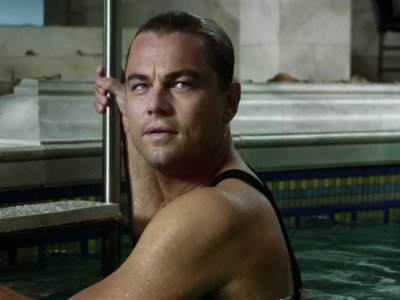
What did I like?  Leonardo DiCaprio gave a performance of pure star quality, suggesting the loneliness and quiet desperation behind Gatsby's studied pose.  He also conveyed the unquenchable hope that lay behind all his efforts to win Daisy back.  DiCaprio also had real chemistry with co-star Carey Mulligan.  The trouble with Mulligan though is she is such an intelligent actress that I felt she was simply too grounded to play Daisy.  Mia Farrow was the perfect Daisy in the 1974 version, highly-strung, maddening, gossamer.
 
 
Occasionally a screen image would appear which made me gasp with amazement and his vision of the desolate valley of ashes, that stretch of misery between the rich worlds of West Egg and New York was exactly how I had pictured it in my mind when reading the book.
 
While I disliked Luhrmann having Nick Carraway narrating the story to a doctor in an alcoholic sanatorium, I did like his occasional use of the actual text disappearing on and off the screen.  It felt to me like Luhrmann was showing up all his outlandish visuals - in the end, there are Fitzgerald's words.
 
 
What didn't I like?  Have you got a while?  The sheer dizzying absurdity of his vision was so relentless that when the visuals stopped, it was difficult to concentrate on the quieter scenes.  The worst excess was splurged on the impromptu party that Tom and Myrtle have at their apartment in New York.  Fitzgerald gives us a scene with Nick trapped in a small flat with bores and boozers, Luhrmann instead gives us a wild orgy with a hallucinating Nick.  It's all so crass.
 
My real problem lies in the fact that Luhrmann strips his characters of any saving graces apart from Gatsby, Daisy, Nick, possibly Jordan.  Tom Buchanan is a teeth-grinding, moustache-twirling villain straight out of a bad silent movie, Wilson is a snivelling loser and Myrtle is a low-rent slut.  Compare this with the way the characters are represented in Jack Clayton's superior 1974 film.  They all have key moments which at least give them a humanity: Tom and Wilson both have scenes mourning Myrtle and crucially, Myrtle is given the speech at the party where she explains how she first met Tom on a train.  Of course it also helps having actors of the calibre of Bruce Dern, Scott Wilson and the late Karen Black.  In this film Joel Edgerton gives a truly lousy performance as Tom while Isla Blair and Jason Clarke bring nothing to the table.  Luhrmann even changes the plot to have Nick tell Wilson that Gatsby is the man responsible for Myrtle's death.
 
 
Damning as well - especially from someone who says he loves the book - is that he changes the conclusion of the story.  In the book, an old man shows up at Gatsby's mansion in time for the funeral who turns out to be his father who explains to Tom his son's determination to 'better' himself and to marvel at what his son achieved.  Here Gatsby himself tells Nick in a few lines of his background which robs the story of any real context.
 
But right at the end, Luhrmann surprised me by including Fitzgerald's haunting last lines which Clayton left out of his film:
 
“So we beat on, boats against the current, borne back ceaselessly into the past.”
 
I know I will be borne back to the book again, I'm not sure about this film version.  Even if we did get a free Stella Artois pint glass after the screening!


Friday, September 06, 2013

Sweet Bird of Youth flies away...

Last week I finally saw the Old Vic's production of Tennessee Williams' 1959 play SWEET BIRD OF YOUTH in it's last week.  When we arrived there was a queue snaking around onto Waterloo Road just to collect tickets.  When I finally got to the counter they hadn't even printed my tickets off for collection.  Jesu Christi - what on earth had they been doing all day?

I had seen the play once before, in 1985 when Harold Pinter directed Lauren Bacall and Michael Beck (whatever happened to...) at the Haymarket in a production of which I retain the flimsiest of shadowy images.  I do remember Bacall being suitably domineering when her character flared into full diva status but unable to convince as the scared and frantic washed-up star. 

I had also seen Richard Brooks' 1962 film version in which Paul Newman (Chance), Geraldine Page (Alexandra), Madeleine Sherwood (Miss Lucy) and Rip Torn (Tom Jnr) recreated their original stage roles while Ed Begley won an Academy Award as the corrupt politician 'Boss' Finley.  Geraldine Page was memorable in only her fourth film role.

 
SWEET BIRD OF YOUTH was almost the last of Williams' run of 'classic' plays with just THE NIGHT OF THE IGUANA to come.  In 1963, written in the shadow of his partner's death, THE MILK TRAIN DOESN'T STOP HERE ANYMORE started the decline in both quality and his popularity.  His alcoholism and drug dependency made the quality of his later plays more erratic and harder to like so he was judged by producers and critics to be a busted flush.

Knowing this, it makes SWEET BIRD OF YOUTH an unsettling experience as the air of desperation at the passing of time hangs heavily on the main characters.  Another reason why I like the play less than his earlier works is I feel Williams' ambivalence towards his characters.  None of his characters here are written with the love you feel he invested in Laura Wingfield, Blanche du Bois, Lady Torrence or Maggie & Brick.  Although both Alexandra and Chance can easily be seen as having the traits of Williams' 'fugitive kind', they both lack Williams' soul.

Chance Wayne (Seth Numeric) returns to his home town on America's Gulf Coast, hiding out in the shabby elegance of the hotel where he once worked in the bar.  Chance left with hopes of becoming a film star but his dream foundered and he ended up as the plaything of rich, older women.

His latest meal-ticket is film star Alexandra Del Largo (Kim Cattrall) who is travelling with him under the name of Princess Kosmonopolis.  She too is a fugitive from her life as she believes her screen comeback has failed disastrously and is lost in drink, drugs and hysteria.

However Chance wants to use Alexandra for one more... er... chance: wanting her to use her alleged star power to launch him as her new 'discovery'.  But he also has an ulterior motive - to win back his first love, the groanworthy-named Heavenly (Louise Dylan) who is unfortunately the daughter of 'Boss' Finley (Owen Roe) the town's corrupt and white supremacist politician.

What Chance doesn't know is that after his last visit, he gave Heavenly an STD which has resulted in her father forcing her to have a hysterectomy and he is now out for revenge...


Director Marianne Elliott threw everything at the audience: in the big climactic scene, we have flashbulbs going off, thunder and lightning as a storm breaks, 'Boss' Finley haranguing the audience on large TV screens and amplified sound and Finley's thugs beating up a heckler while Finley's mistress screams her head off.  The odd thing was that none of it seemed out of place!  She also kept the pace going until the final scene which seemed oddly becalmed.

In a cast where the accents swung all over the place, the best performance came from Owen Roe as 'Boss' Finley who cast a loathsome shadow over the play as an all-too-believable "Family & State" politician who approves of castrating black men and denies the existence of his mistress.  I liked Kim Cattrall's exhausted and suspicious Alexandra, in particular how she slipped back into the manner of the screen diva as easily as donning her fur wrap.  She certainly humanised Alexandra - but does a humanised Alexandra serve the play?  I'm not really sure it does.


For the most part Seth Numrich was fine as Chance, his self-belief radiating from him but in the last scene I felt he simply drained away the closer Chance got to his destiny.  This production knitted together several versions of the play and Numrich's poetic last lines seemed oddly out of keeping with his performance up until then.  Also a special mention for Brid Brennan's Aunt Nonnie, a woman used to being ignored and browbeaten in the Finley household.

I also feel compelled to mention Lucy Robinson playing 'Boss' Finley's not-so-secret mistress Miss Lucy who gave a performance of quite jangling inadequacy.  It's a role that gives some spark of humanity as the forces of darkness move in but her shockingly poor attempt at a Southern accent had me wishing one of designer Rae Smith's peeling columns to fall on her just to stop the noise.

I am glad I saw it as it made me reassess this play in contrast with Tennessee Williams' earlier plays but I left the theatre with the feeling that the full power this play is capable of had not been fully explored.

Tuesday, August 27, 2013

TITANIC finally docks in London

A week or so ago I blogged about the pros and cons of seeing large-scale musicals revised to be staged in smaller venues.  Well you can't get bigger and/or smaller than the Maury Yeston musical TITANIC at the Southwark Playhouse.


I had never been to the Southwark Playhouse before.  It has a seating capacity of 240 and is designed so you enter through quite a large bar, get funnelled down a corridor then into the auditorium.  Sound ok?  Not on one of the hottest days of the year when the queue to get into the auditorium to nab one of the un-numbered seats joined the scrum in the bar and all the time the temperature went up or was that just my blood boiling at the sheer ineptness of fringe theatres to get a house in?  If you don't want to piss off your audience NUMBER YOUR BLOODY SEATS.  The Menier Chocolate Factory started off like that but has now entered civilization so come on!  Is there to be *no* progress?

Added to that tsouris we had the always fresh hell of the musical theatre drama students shrieking their heads off at each other allied to the seething hiss of the aged show queen.  I wouldn't put it past them to say they knew the band on the ill-fated ship.

 
Although this was the first time I had seen the show performed I have always been a huge fan of Maury Yeston's score thanks to the 1997 Broadway cast recording.  The derision that greeted the news of a Titanic musical lasted up to it's opening in April with mostly negative reviews but the show found an audience and lasted for nearly two years - indeed, although James Cameron's film opened in December 1997, it actually helped increase the show's attendance rather than the reverse as had been suggested.  At award time, the show's director and cast were all ignored but it won each of the five Tony Awards it was nominated for including Peter Stone's book, Yeston's score and the big one, Best Musical. 
 
By far the best component of the show is Yeston's score which takes in a wide range of contemporaneous musical styles of 1912: he gives us ragtime trots, Gilbert & Sullivan pastiches, stirring Elgar-esque themes, hymns, folk airs, all filtered through a traditional Broadway score of ballads and up-tempo numbers.  As much as I like Yeston's scores for GRAND HOTEL and NINE, his TITANIC score hits greatness with it's sweep of intimate and epic moments.
 
 
The design for the show was a simple bare floor stage, a moveable metal staircase and a single upper level/balcony which you entered under.  To get to the seats you walked past Greg Castiglioni as Thomas Andrews, the designer of the ill-fated ship, scribbling away at his desk.  Despite this, director Thom Sutherland took the opening song away from him, allocating it instead to Simon Green's J. Bruce Ismay, the owner of the White Star Line who famously not only pressurised the Captain to increase speed but who also survived by jumping into a lifeboat.  This production started with the cast shouting abuse at Ismay who turns to the audience and sings IN EVERY AGE.
 
 
The production boasts a cast of 20 which is remarkable for a production this size, Broadway boasted 37 cast members.  Of course this meant them rushing off as a 3rd class Irish immigrant to emerge minutes later as a 1st class millionaire but it's to the cast's credit that they all still managed to give strong, definable performances.  There were a couple of dodgy ones - Castiglioni's important second act solo MR. ANDREWS' VISION was horribly over-sung - even if he did had to contend with a platform tipping up underneath him (maybe I have explained him not singing the opening number?)  I was also praying for Jonathan David Dudley's Bellboy to drown, preferably five minutes after leaving Southampton.
 
 
But these were more than compensated by the very fine performances which were full of character, more than are given them in Stone's good but rather spare book: Green's Ismay was superbly hissable while James Austen-Murray stood out as the stoker Barrett.  His solo number, setting up the class divisions within the ship, was excellently sung, even if he had to contend with the distracting modern dance interpretations of shovelling coal around him!  His duet THE NIGHT WAS ALIVE with Matthew Crowe's radioman Harold Bride was also a stand-out, it was almost staged as a love song between the two men which certainly added a frisson to the number.
 
 
Celia Graham was very good as 2nd Class passenger Alice Beane, eager to mix with the upper echelons (vocally better than Victoria Clark on the cast recording) and as her disapproving husband Edgar, Oliver Hemsborough delivered a strong character above and beyond what the book provided for him.  James Hume was fine as Etches the 1st Class steward and Siôn Lloyd was in fine voice as Officer Murdoch, although Stone's book propagates the unsubstantiated story that he shot himself as the ship sank which goes against what several credible eyewitnesses said.
 
 
Victoria Serra made a spirited Kate McGowan travelling to America with a hope for the future of herself and her unborn child while Dudley Stevens and Judith Street made the most of their touching ballad STILL, sung as their characters Isador and Ida Strauss prepare for death on the sinking ship rather than be separated.
 
These were the cast members who stood out for me but the ensemble singing was wonderful too on such numbers as GODSPEED TITANIC (a number that always gets my tear ducts going), LADIES MAID, NO MOON, WE'LL MEET TOMORROW and the FINALE.
 
 
Thom Sutherland's direction was very good given the constraints on his production and David Woodhead's design made invention out of necessity.  Howard Hudson's lighting also contributed to the show's overall success.  Although I would have loved to have had Yeston's sweeping score played by a full orchestra - as it was meant to be heard - Mark Aspinall's band of only six did well.  It was also a nice touch for the show to end with the names of those who died in the tragedy scrolling up the stage.  Indeed all the characters in Stone's book are based on real people aboard the ship although he does play God and alter a couple of fates to suit his story.
 
Although the show was running late, we stayed behind as - totally unbeknownst at the time of booking - Maury Yeston was actually there to give a talk with the ever-gushing critic Mark Shenton.  Now answer me this... why have the cast all head-mic'd for the show but not provide even hand-mics for the interview?  Sadly most of what Yeston had to say about the genesis of the show, his other works and his thoughts on musicals in general was *just* audible from where we were sitting - and as I said it's not that big an auditorium.  Again the cluelessness of this theatre just seemed to end up standing on my one good nerve.
 
But I am very happy that I had the opportunity to finally see TITANIC - and in such an inventive production - so as to fully understand how this excellent score serves the show.


Thursday, August 22, 2013

Say Amen Somebody!

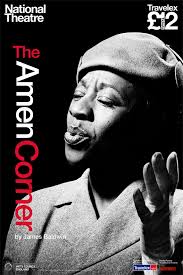
A few weeks ago Owen and I went to Church.  Oh,  and we went to New York.  The difficult part was that we also went back 60 years to 1953.  But the Olivier Theatre has always served me well as a time machine.  It was all so we could witness the goings on at a storefront church which is where James Baldwin's THE AMEN CORNER takes place. 

Baldwin had grown up in the abusive home of his preacher stepfather.  He became a preacher himself at the age of 14 until three years later when he became disenchanted with religious life, around the time he also discovered his gay sexuality.  At the age of 29, after living in Paris, he wrote GO TELL IT ON THE MOUNTAIN, a semi-autobiographical first novel set in the Pentecostal community but, still not exorcised, the following year he wrote his first play THE AMEN CORNER.

The play is a rarity in that it features four excellent larger-than-life female characters who power the play alongside three lesser male roles.  Rather shockingly, the play has only had one Broadway production, a two month run in 1965.  In London it had a notable premiere in 1987 at the Tricycle Theatre which transferred to the West End and now it is being presented in the largest auditorium at the National Theatre.

 
Margaret Alexander is a self-made woman, a woman who has raised her son David single-handed and become the preacher at a small storefront church while she, her son and her devoted sister Odessa all live in the small apartment on the premises.  Although she is deeply loved by her congregation they are also cowed by her God-fearing teaching and way of life which means that she is immovable in her fierce belief that God's is the only way.
 
For example, Brother Boxer comes to Margaret and says that he has been offered a job driving a beer truck which will earn him more money.  But no, Margaret rules from on high that to take the job would be Godless as it's propagating the sale of the demon drink.  The best the aggrieved parishioners can hope for is that the more easy-going Odessa will try to convince her hard-line sister.
 
 
But in true Greek Drama style, just as Margaret is achieving great things in hooking up with a bigger church in a different state, her life is rocked when her dissolute husband Luke appears from out of her past.  Luke is in a very bad physical state and cannot be moved so it allows David to finally get to know his musician father, just as he is feeling the pull away from the church to jazz clubs.
 
While this is taking place downstairs, Margaret is facing growing dissent in the church as questions are being asked, such as where the new fridge came from in her kitchen just after the parishioners had financed her trip to the affiliated church.  This Crimplene & big hat rebellion is led by sweet-talking, steel-eyed Sister Moore who is given extra fuel when Luke tells everyone that the truth is that Margaret left him, he never left her.
 
 
Baldwin certainly created interesting characters who hold your attention and are bold, decisive figures.  Sadly his dialogue doesn't match up to these characters and his scenes can sometimes go over the same ground too many times which can be a little wearying especially if it is between just two characters.  The pay-off is also rather obvious and the denouement, after all the plotting that has gone before, seems oddly rushed.
 
Rufus Norris has directed the play well with the action motoring along despite the treading-water quality to some of Baldwin's two-hander scenes.  I was surprised when it was announced that the production was going into the Olivier as the play would fit perfectly into the 'normality' of the Lyttleton but actually I applaud that choice as I suspect within the proscenium arch the whole enterprise would have felt stifled.  Ian MacNeil's set design angles the action so it is close to the audience and it certainly helps open the play out from what could be quite a claustrophobic piece.
 
What Norris has also done is elicited excellent performances from his cast of fine performers.  As I said earlier, Baldwin has written four stonking roles for women and here they are grabbed with huge gusto by four formidable performers.
 
 
Marianne Jean-Baptiste has lived and worked in Los Angeles since 2002 after finding little progression in the roles offered to her here after being the first black Briton nominated for an Academy Award in SECRETS AND LIES.  Her performance as the righteous Margaret shows us all how much we have been missing. 
 
It's a very hard role: although loving to her family, Margaret is a brick wall who will not be breached.  It is hard to feel sympathy for the character but at the end - when Margaret realises that love is the way to true spirituality - it is important that the actress can touch you and this is exactly what Jean-Baptiste achieved.  Throughout the second act you could almost see her carapace being chipped away piece by piece until, confronted by the collapse of all her dreams, she is left alone but more at peace.  It's a rare actress that can hold an audience's sympathy off until she needs to let it be released but Marianne Jean-Baptiste managed it with a consummate ease.  It's a crime that she was not given the opportunities before.
 
 
As Margaret's more forgiving but equally loyal sister Odessa, Sharon D. Clarke was a revelation too.  I am used to seeing her in musical roles but here she gave us a portrait of a woman who has put her on life on hold to support her more ambitious sister and her nephew.  Another actress who I have also only usually seen in featured musical roles is Jacqui Boatswain who here gave a delightfully slippery performance as Sister Boxer, smarting from Margaret's refusing her husband to take a well-paid job and biding her time until she could help bring her down. 
 
But despite these excellent performances, there was yet one more performer who not only stole every scene she was in but also went through all of our pockets and took the bulbs out of the lights too.  Cecilia Noble was just astonishing as Sister Moore, a baby-voiced Judas and an outsized Brutus, dissembling sweetly while she orchestrated Margaret's downfall only to let the mask fall at the end with a hollered "Victory!" as she moves to centre-stage.  It was an audaciously funny but truthful performance that lingered long in the memory.
 
 
I would also like to mention Naana Agyei-Ampadu as Ida, a nervous young woman who comes to Margaret for help over her sick child in the first act only to appear again in the second act - just as Margaret is starting to doubt her own rigid beliefs - in a state of suicidal distress now her child is dead.  It was a performance that had to go from 0 to 100 in as many minutes and she handled it with a raw power.
 
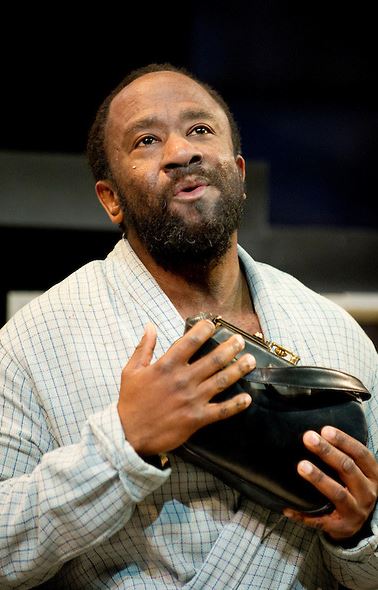
The three men's roles really are just supporting parts but I enjoyed Donovan F. Blackwood as the boisterous Brother Boxer, Eric Kofi Abrefa as the conflicted son David and Lucian Msamati was a shaky livewire as the dying ex-husband Luke.  Among the supporting cast, augmented with members of London Community Gospel Choir, who raised the Olivier roof with their Church singing were Delroy Atkinson (from Ray Davies' musical COME DANCING) and Miquel Brown (Hi-NRG Queen and Sinitta's mum!)


Wednesday, August 21, 2013

Bourne's Beauty

 
Quite a few months ago I went with Owen to have my senses well and truly shaken at the latest Matthew Bourne production SLEEPING BEAUTY.

Having missed it at Sadler's Wells we caught up with it on it's subsequent tour at Wimbledon.  How good that New Adventures, after playing in a major London venue for a month and a half, still include a London date on their tour.

Despite the best efforts of the shambolic Wimbledon Theatre staff - obviously conditioned to dealing with half-empty houses for the tribute act tat that is their usual fare but go into utter meltdown when faced with a sold out show - as well as the shockingly poor audience I was in the middle of, I have retained enough of a memory of the show to blog for you, Constant Reader.


My only experience of the SLEEPING BEAUTY ballet was being taken by my school to a English National Ballet production back in the day.  Indeed my only real memory of it was the teacher's long and laborious explanation of why we had to be vigilant for the 'Rose Adagio' danced by Princess Aurora in Act 1.  In the interval she then quizzed us on it but I guess I had nodded off or was looking at something else.

2012 saw the 25th anniversary of New Adventures and with SLEEPING BEAUTY Bourne completes his Tchaikovsky trilogy after his productions of NUTCRACKER! and SWAN LAKE which have both done so much to bring ballet to a wider audience.  His version of SLEEPING BEAUTY ditches Petipa's traditional tale and gives us a darkly romantic tale of Aurora, her love for the palace gardener Leo and the other-worldly creatures who alter their destiny.


Bourne retains the basic storyline but sets the start of the story in 1890, the year that SLEEPING BEAUTY premiered.  A childless King and Queen, having sought the help of the dark fairy Carabosse to have a baby, forget to invite her to their daughter's christening.  Carabosse appears and casts the famous spell that will see the Princess Aurora die at the age of 21 by pricking her finger. 

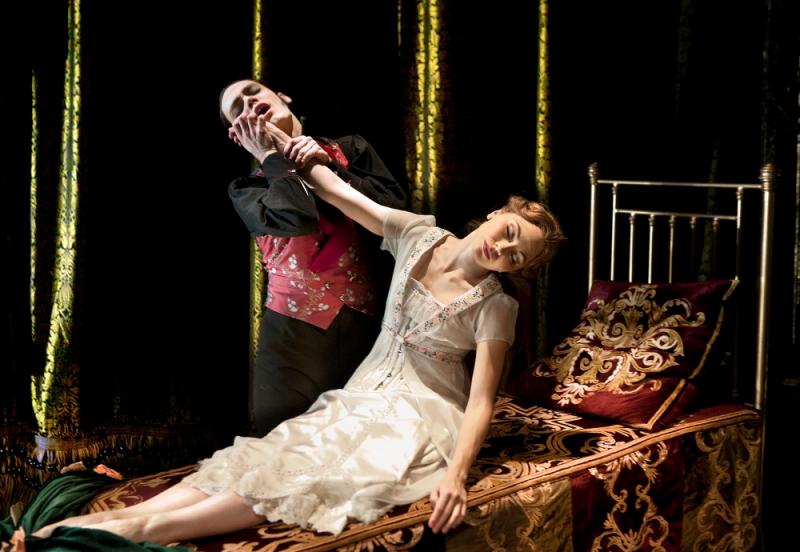
However The Lilac Fairy and his rag-tag retinue of fairies called Feral, Tantrum etc. arrive and mollify the spell so Aurora will not die but fall asleep for 100 years.  This scene introduced us not only to Liam Mower's wonderfully characterised Lilac Fairy but to Bourne's ingenious idea of having the baby Princess represented by a puppet who garnered laughs as she scampered around the stage and even up the curtains.

 
Flash forward to 1911 and Aurora's Edwardian 21st birthday party which she steals away from to spend time with Leo the gardener who loves her.  However a tall dark stranger appears who turns out to be Caradoc, the vengeful son of the now-dead Carabosse.  He implements his mother's plan and Aurora falls into a dead sleep as does the whole court.
 
But here Bourne encountered the problem of the story's insurmountable plot flaw - if Aurora has to sleep for 100 years, what then of Leo?  Here he has introduced a great zeitgeist idea of his own and the First Act ends with The Lilac Fairy biting Leo's neck turning him into an ageless vampire.  That's got the teenage girl audience sewn up!  This act introduced us to Hannah Vassallo's spirited and delightful Aurora, Bourne regulars Dominic North as Leo and Adam Maskell as the evil Caradoc (he had also played Carabosse).
 
 
The second act takes place in 2011 as Leo enters the palace's moonlit gardens to awaken Aurora with true love's kiss but he is foiled by the nasty Caradoc again who awakens Aurora instead to become his prisoner bride.  Leo and The Lilac Fairy then have to rescue Aurora from her fate worth than death and the climactic fight to the death between Leo and Caradoc takes place in the moody surroundings of a black and red nightclub which is the haunt of the evil retinue of Caradoc. 
 
Will Leo triumph?  Well, this IS a fairy tale... and there was also a delightful surprise at the end of the production which guaranteed it a massive round of applause.
 
I thoroughly enjoyed the sheer Gothic romanticism of Bourne's reimagining, his always entertaining choreography, the excellent performances of his lead dancers and tireless ensemble, and Les Brotherston's marvellous set design and costumes.  I particularly liked the punk elegance of The Lilac Fairy and his retinue with their frock coats and distressed layers of lace and silk.  He thoroughly deserved his Olivier award nomination.  Paule Constable's lighting design also contributed towards the success of the mis en scène.
 

If I did have a tiny complaint it's that not enough time is spent establishing Aurora and Leo's love story.  They had one lengthy pas de deux but that was all, it all felt a bit rushed and just assumed.  This is no reflection on the dancer's who were a delight to watch but on the sometimes thin quality of Bourne's scenarios.  Oddly enough it is usually felt most in establishing the love between his principal romantic couples.
 
This small quibble aside, I hope there will be another opportunity to see this wonderful addition to Bourne's canon of work again in the not too distant future.  I certainly wouldn't want to have to wait 100 years.