Showing posts with label Rufus Norris. Show all posts

Sunday, January 12, 2020

50 Favourite Musicals: 7: CABARET (1966) (John Kander / Fred Ebb)

The 50 shows that have stood out down the years and, as we get up among the paint cards, the shows that have become the cast recording of my life.


First performed: 1966, Broadhurst Theatre, NY
First seen by me: 1986, Strand Theatre, London
Productions seen: four

Score: John Kander / Fred Ebb
Book: Joe Masteroff

Plot: Writer Cliff Bradshaw arrives in 1930s Berlin seeking inspiration.  Renting a room at Fraulein Schneider's boarding house, Cliff then visits the seedy Kit Kat Klub - presided over by the mysterious MC - and meets extravagant English performer Sally Bowles.  Sally moves in with Cliff the next day and their love affair grows alongside Fraulein Schneider's tentative relationship with Jewish shopkeeper Herr Schultz.  But the darkening shadows of the Nazis are closing in...

Five memorable numbers: CABARET, TOMORROW BELONGS TO ME, WILKOMMEN, WHAT WOULD YOU DO, PERFECTLY MARVELLOUS

CABARET has infiltrated people's imaginations for 54 years, largely due to Bob Fosse's iconic 1972 screen version with the brilliant star wattage of Liza Minnelli as Sally Bowles.  It seems remarkable that the film was released only 6 years after the show's Broadway debut but it is a completely different entity to it's source.  Fosse dropped most of the score, any songs that were sung outside the Kit Kat Klub onstage were jettisoned to give his film a more realistic feel; a few sneaked through as background music and of course "Tomorrow Belongs To Me" provided a magnificent set-piece in a beer garden.  So a first-time viewer of the show who has a knowledge of the film - like me in 1986 - is thrown initially with the original storyline.   But CABARET has seen additions and deletions from it's score with almost every stage revival as tastes and directorial conceits change.


The first attempt to musicalize John Van Druten's play I AM A CAMERA based on Christopher Isherwood's GOODBYE TO BERLIN stories was by Sandy Wilson, writer of THE BOY FRIEND - just dwell on that for a minute - but the rights transferred to Harold Prince who decided his SHE LOVES ME writer Joe Masteroff could provide the book, with the score being written by John Kander and Fred Ebb, only their second musical.  The show opened at the Broadhurst Theatre, going on to win 8 Tony Awards including Best Musical.  This production included British actress Jill Haworth as Sally, Joel Grey as the MC, Lotte Lenya as Fraulein Schneider and Jack Gilford as Herr Schultz.  The production transferred to two other theatres before closing in 1969, and by then Prince had reproduced the show at London's Palace Theatre with Judi Dench as Sally (her musical debut), Lila Kedrova as Fraulein Schneider and Peter Sallis as Herr Schultz.  As I mentioned, I first saw CABARET when Gillian Lynne directed a revival at the Strand Theatre which felt off-kilter thanks to an over-emphasis on Wayne Sleep's MC to the detriment of Kelly Hunter's Sally, a real star turn.


Sam Mendes staged his acclaimed revival at the Donmar in 1993, starring Alan Cumming as the MC, Jane Horrocks as Sally and Sara Kestelman as Fraulein Schneider.  Setting it within the cabaret itself and ramping up the sleaze, songs were dropped while others were added.  In 1998 Mendes' production, now co-directed by Rob Marshall, made it to New York where it ran for four years, first at the site-specific Kit Kat Klub then, very appropriately, at Studio 54.  The cast was led again by Cumming with Natasha Richardson as Sally and both won Tony Awards as did the show for Best Musical Revival, losing other awards to THE LION KING juggernaut.  Mendes moving the MC to the centre of the production also meant he closed the show by stripping off an overcoat to reveal he was dressed as a concentration camp inmate.  Taking the sleaze and Nazis route, Rufus Norris directed a London revival in 2006 at the Lyric which starred Anna Maxwell Martin as Sally, James Dreyfus as the MC, Sheila Hancock as Fraulein Schneider and Geoffrey Hutchings as Herr Schultz.  No doubt feeling the need to top the Mendes final image, Norris had the MC joining the Cabaret dancers huddled upstage under a shower of Zyklon-B flakes and the sound of hissing echoing around the stage.  Hey Mr Director... we, the audience DO get the ending of the show.  One wonders how the next revival will end, it's almost like the directors are desperately covering up that they are actually directing a Broadway musical.

CABARET should be higher in the chart, it is at #7 only because it has suffered with misguided productions that the show struggles to overcome.

The obvious choice would be a clip of the Fosse film but I have gone with the original 1966 production at the Tony Awards - just look at the size of the cast - with Joel Grey's MC bidding us Wilkommen.... and who can ever refuse that invitation?


Sunday, March 11, 2018

MACBETH at the Olivier Theatre... Mad Macbeth

Going in to see Rufus Norris' new production of MACBETH at the Olivier Theatre it struck me that, having seen the play four times previously on stage, I had yet to see one that I found fully satisfactorily.  I still haven't...


During the opening I found myself thinking of RuPaul's command before the final lip-sync competition on RUPAUL'S DRAG RACE "DON'T fuck it up"... It was a waste of time, because the fucking up appeared to have occured some time before I arrived.  Once again - and it is happening with increasing regularity - I sat there thinking 'why couldn't anyone have spoken up during either the rehearsals or tech run and said "Is it me or is this shite not working"?

As with Nicholas Hytner's JULIUS CAESAR playing further down the Thames at The Bridge, any onstage cutting and stabbing has been matched offstage by the filleting of sections of Shakespeare's text.  Why this is done so often now is beyond me - a misguided attempt to just focus on the main characters?  An attempt to streamline the action to fit it into a certain concept or running time?  Both productions were attended by several school groups - what does the teacher say to the pupils when they study the text next: "You can skip the next page, Nicholas Hytner says it's surplus to requirements", or "Eye of newt, and toe of frog? Don't bother with that, Rufus Norris says it's expendable."


Rufus Norris certainly has a concept... and boy, is it driven home with relentless monotony.  Designer Rae Smith has conjured up a relentlessly ugly vision of a dystopian wasteland, a mostly bare stage is dominated by a large sloped walkway that wanders around the stage like rogue airport boarding stairs which also features a few tall blasted thin trees with ugly plastic fronds atop them.  The bin bag ethic is also featured in large oily-looking drapes that cover most of the stage at times - actually I quite liked them with their suggestion of all-encompassing demonic wings - and this look reaches it's apogee in the bizarre idea that Macbeth's castle has rooms that look like concrete pillboxes with black bin bags piled up in corners.  Go figure...

Costume designer Mauritz Junge has expended no imagination at all: the costumes are drab, ill-fitting fatigues or dirty jeans, vests and clumpy boots usually covered up by shapeless woolly coats.  King Duncan wears a particularly ugly red suit - which of course Macbeth turns up in after Duncan's death - and don't get me started on Lady Macbeth who is obviously allowed a bit of glamour when she becomes Queen and is fitted out with what looks like a handmade red sequined frock of shiteous quality.  It all suggests that Norris lent the creative team a dvd of MAD MAX and said "Something like this maybe...?"


Nothing lifts the murk of James Farncombe's lighting apart from the cold moonlight shafts that illuminate the grimy business or Orlando Gough's clanging music - never more ghastly than in a seriously misjudged 'party' scene where presumably well-brought-up Equity card-holding actors do a mentalist pogo-ing conga round the set, strenuously giving off "WE'RE OFF THE CHAIN, US".

One wonders how the performers will play the remaining shows?  Will they stick to Norris' depressing concept or will they actually try and give performances of character?  The much-vaunted casting of Rory Kinnear and Anne-Marie Duff fails to generate any heat: it's almost like neither of them wants to pull focus from the other.  In HAMLET, Rory Kinnear displayed a remarkable facility for making the most well-known speeches sound fresh but he is developing a worrying vocal shtick - which was actually effective in Norris' THE THREEPENNY OPERA - of falling into a distressingly fake Mockney accent which he drowns in here, hitting consonants with an exaggerated wallop such as "Is THis a DAgger I SEe BEfore Me" till you want to scream at the stage JUST SPEAK IN YOUR ORDINARY VOICE!  All the more annoying as he calms down for the 'murder of Duncan' sequence and the "Tomorrow and tomorrow and tomorrow" speech.


Anne-Marie Duff also disappointed in a performance that hardly made it to where we were sitting at the back of the stalls.  She started promisingly but her performance grew so colourless that I wanted to ask why she didn't assert herself and more importantly her character in the rehearsal room - there are certain Shakespeare female characters that you suspect the Bard simply threw out some scenes because they were too difficult for the boy actors who played them; a good actress will be able to 'fill in' the gaps of Gertrude or Lady Macbeth but Duff sadly lives up to her surname.

She can't even make Lady Macbeth's haunting mad scene anything other than just another drab scene - I could not help but think of when Maggie Smith asked Coral Brown for advice on playing the role as Coral had made a success of it in New York in the 1950s - her advice?  "It's a fucker darling, and remember to keep your eyes open during the sleepwalking scene, for some reason it rivets the fuckers!"  Oh Coral, that you should be alive at this hour.


Other performances fitfully come to life: the always hair-trigger Patrick O'Kane gave us an over-the-top Macduff but was momentarily effecting at his horror at the death of his family, Trevor Fox was a relentlessly Geordie Porter - oh no, Rufus Norris, you couldn't cut the Porter's speech could you? - and Kevin Hardy was an interesting Banquo (despite the scouse accent) until he was called upon to lurch around the stage as Banquo's ghost like a SHAUN OF THE DEAD blob-job performer.

Amaka Okafor was a dignified Lady Macduff and I liked the little that Nicholas Karimi did as Lennox but the three actresses playing the witches were saddled with modern-day "torture porn" horror film persona's and the two actors playing the assassins deserve to be shot for their over-the-top ONLY WAY IS ESSEX chav acting.


To say I was disappointed by this is to put it mildly and it does nothing to stop the creeping suspicion that after the dog shows of SALOMÉ, SAINT GEORGE AND THE DRAGON, COMMON and his own WONDER.LAND, Rufus Norris is clueless about how to use the Olivier stage to it's best advantage.

This is Rufus Norris' first Shakespeare production in 25 years.  It shows.

Tuesday, May 31, 2016

The THREEPENNY OPERA at the Olivier, National Theatre: Macheath's Back In Town...

Back in 1982 Richard Eyre's National Theatre company - when not owning the Olivier stage in GUYS AND DOLLS - also appeared in the Cottesloe in John Gay's THE BEGGAR'S OPERA and, again on the Olivier stage, they also appeared in Bertolt Brecht's SCHWEYK IN THE SECOND WORLD WAR.  Now add Bertolt Brecht to John Gay and you get THE THREEPENNY OPERA, now being revived on the Olivier stage - how cyclical is theatre life!


I last saw Brecht and Kurt Weill's savage musical in 1989 on Broadway in a Victorian-themed production directed by John Dexter with a lacklustre Sting as Macheath and it also marked the last time I saw Georgia Brown on stage as she played Mrs Peachum with her usual full-throated singing (Georgia had played Lucy Brown in a 1956 Royal Court production).  However I know the show best through the 1976 New York cast recording with Raul Julia as Macheath, Caroline Kava as Polly Peachum and Ellen Greene as Jenny Diver.

After the disaster that was WONDER.LAND I was worried what director Rufus Norris would do with another musical on the Olivier stage but we are on firmer ground here and I enjoyed his inventive and surprising production very much.  We saw it in preview and certain longueurs will hopefully tighten up.


The big surprise in the casting was that Rory Kinnear is playing Macheath. the murderous anti-hero at loose as London readies itself for a coronation parade.  I knew he would be able to play the part with ease but I was surprised how well he sang it too, although his way of hitting the consonants in the lyrics got a bit wearing.  However he was an excellent Macheath, a darkly evil focus for the show's action.

What Norris' production proved beyond all else is that the best roles go to the women in the cast - the poor men didn't stand a chance.  Like his namesake in THE BEGGAR'S OPERA, Brecht's Macheath may love the women but they constantly betray him or leave him confounded and here Kinnear has his hands full with four full-on performances from Haydn Gwynne as the vengeful Mrs Peachum, Rosalie Craig as her lovelorn but shrewd daughter Polly, Sharon Small as a very Scottish Jenny Diver and Debbie Kurup as Lucy Brown.


I blow hot and cold with Rosalie Craig as a performer - I found her a rather anonymous Rosalind in AS YOU LIKE IT on the same stage - but here she gave a sparky performance as Macheath's latest conquest Polly Peachum and was also in excellent voice with great renditions of "Pirate Jenny" and "Barbara Song".  She was also nicely bitchy in her "Jealousy Duet" with Debbie Kurup's Lucy Brown, her rival for Macheath.

Sharon Small was also very good as the prostitute Jenny Diver whose lust for Macheath doesn't stop her betraying him to the Peachums and Haydn Gwynne was almost unrecognizable as the tottering, unfaithful wife of the crime boss Peachum who runs all the beggars in London and who reveals that she too has been Macheath's mistress in the past.  Her whole look appears to be based on Otto Dix' famous portrait of the notorious Weimar German cabaret dancer Anita Berber.


Despite these heavy-hitting actresses, there was much to enjoy in Nick Holder's bulky but brutal Peachum - especially when he appears in a Louise Brooks bobbed wig - and there was excellent supporting performances from Matt Cross' wonky policeman Officer Smith and George Ikediashi - better known as the cabaret singer Le Gateau Chocolat - was in resonant voice as The Balladeer who ushers the show in with "The Ballad of Mack The Knife".

Simon Stephen's adaptation promised filthy language along with immoral behaviour but I was very disappointed in the swearing to be honest - I could have done with more!  Shepherd gives a particular gay spin to Macheath's relationship with the police chief Tiger Brown which actually worked within the dynamic of Brecht's original - Macheath will do *anything* to get away with his crimes - but Shepherd also changes the final moments of the play which sits less successfully.


Rufus Norris' production constantly surprised and used the bare Olivier stage well.  Vicki Mortimer's set mainly consisted of wooden frames and sheets of brown paper to be slashed or burst through - Norris said he wanted a set that looked cheap to stage - and the irony is it probably cost a fortune!  Paule Constable's lighting design is also hugely effective.

Kurt Weill's score might have been written in 1928 but it still sounds as cutting-edge as Macheath's machete, and is wonderfully vibrant under the musical direction of David Shrubsole and the seven other onstage musicians.


We are seeing it again in two weeks - what better recommendation can you have than that?  The production is currently booking up until October.

Monday, December 28, 2015

WONDER.LAND at the Olivier Theatre - Damon Albarn's musical is God.Awful...

Where to begin?  And more importantly, where to end?  I guess I should just dive in...


WONDER.LAND (the dot is so important) is a collaboration (or unholy alliance) between Damon Albarn, Moira Buffini and Rufus Norris based on ALICE IN WONDERLAND which launched at the Manchester International Festival - and that should set off the warning klaxons: the Manchester International Festival... words to chill the blood eh?

After not-terribly good reviews there, it has supposedly been "looked at again" for it's London debut.  I would suggest they all check in with their opticians very quickly as their is something very wrong with their collective sight.


It didn't take long before the sinking feeling started that we were watching a misfire of major proportions.  Again and again, with no attempts to cover them, the woeful Buffini script ticks off the important (to her) points: 'Bullied Schoolchild' = TICK, 'Gay Best Friend' = TICK, 'Single Mother' = TICK, 'Abuse of Social Media' = TICK, 'Gender Role' = TICK and on and on and on with the relentlessness of a Politically Correct Joyless Machine.

Aly is a teenager in a new school, suffering from the recent separation of her parents - her dad is a 'lovable' gambler - but she escapes her life of boredom and bullying through her mobile phone.  She starts a new game called Wonder.Land, picking as her avatar a cutesy Alice figure, but soon finds the gaming world swamping her real life - especially when her nasty headteacher confiscates Aly's phone and signs on as her into the Wonder.Land turning Alice into a nasty character instead...


They could have all been sitting on each other's faces for all I cared about them.  So to find something positive to say... the video designs were impressive I suppose, in particular the scary Cheshire cat slinking about, with a grinning mouth of fangs.  But the costume designs by Katrina Lindsey were ugly in the extreme - Carly Bawden as the Alice figure has the bad luck to wear the worst offender of all and Rae Smith's sets do little to inspire.

The performances also barely registered above the embarrassing.  Carly Bawden makes the most of her fictional Alice but she never registers above a blip of interest.  Lois Chimimba does at least make an impression as Aly but her character is so resoundingly chippy that again it's hard to get emotionally involved with her.  Anna Francolini, a stalwart of many a musical ensemble, plays the nasty head-mistress - MATILDA anyone? - but sings in such a harsh, grating tone that it's little wonder she rarely plays a lead.


I won't mention any of the other cast... oh ok then, Hal Fowler as the MC of the whole proceedings is profoundly annoying, none more so than bellowing out "Www.wonder.land" usually following it with "bubblewoobubblewoobubblewoo. bumberboo.bong" or some such shite.  I am sure Mrs Hal Fowler aka Kim Wilde was happy when he wasn't singing it around the house. 

Damon Albarn?  Don't get me started.  The man could not write a show tune if his preening life depended on it.  Hopefully WONDER.LAND will expose this musical charlatan of his much-vaunted prowess.  The broadsheets fall over themselves to praise his littlest fart as another ground-breaking sonic sound - write an opera Mr Albarn? Oh yes why not.  Write a musical Mr Albarn? Oh yes why not.  Only here his tunes are lightweight to say the least... halfhearted Lionel Bart rip-offs.  It truly is a ghastly score.


Afterwards I was sunk into the deepest depression.  It was the sheer ghastliness of the whole event, polluting the stage that once was home to Richard Eyre's production of GUYS AND DOLLS, that sent me into such a state.  That and the fact that it obviously cost the earth which could have been spent on a production that at least set out to provide genuine joy for the audience. 

As usual, I was left wondering when director Rufus Norris looked at this resounding load of cock and thought, "Yes this is ready to set before a paying audience".  I saw him walking through the Lyttelton bar afterwards where I had gone to have a strong drink.  If he wasn't moving so fast I would have thrown my empty glass at him.

At one point, as the air of confusion settled over the family audience, a child wailed loudly.  I genuinely thought of shouting out "You and me both bitch".

Sunday, August 02, 2015

EVERYMAN at the National Theatre: The hits keep on comin'...

I was very worried when I first heard the line-up for Rufus Norris' opening season at the National Theatre but the more I am seeing the more I am liking.  THE MOTHERFUCKER WITH THE HAT, THE BEAUX' STRATAGEM and THREE DAYS IN THE COUNTRY were all much more enjoyable than I was expecting and that feeling continues with EVERYMAN, directed by Norris in the Olivier.


The play, by an unknown author, was first performed as a Morality Play in English in the early 1500s to show the audience the error of it's ways and to fear the wrath of God.  Not exactly DREAMBOATS AND PETTICOATS then.  Mind you, anyone who sees that deserves eternal damnation.

It's a vibrant, full-on production with our hero descending from the flies on a wire, a huge wind machine that sprays money into the audience (I think someone must have been to see SLAVA'S SNOW SHOW), thumping music... oh and Donna Summer's I FEEL LOVE which, as Owen said, is an obvious musical shorthand for hedonistic, club culture. Not bad for a track nearly 40 years old!


Yes the medieval tale has been updated - to the streets of Hoxton it would appear - where Everyman, a sharp city wheeler-dealer has taken over a club for his 40th birthday.  Chitwetel Ejiofor makes a spectacular entrance, falling slowly from the flies, suited and booted while falling through space.  It looked very spectacular but what could it mean?

After a coke-fuelled rave which has the regulation fights, snogs and unspoken tensions Everyman ends up passed-out on a table.  We then meet a careworn cockney cleaner, resigned to her lot of cleaning up the mess of an ugly world only to begin again the next day.  But is she all she appears to be?


Actually she turns out to be none other than God and she decides to make Everyman an example of all that is wrong with human existence and she summons her colleague Death to deal with him.

But Everyman puts up a spirited fight to prove he has worth in the world and turns with increasing desperation to his neglected family, to his personal goods, to his good deeds, to anything that will prove he deserves more time.  But all he finds is a down-and-out called Knowledge.  Can Everyman make a justification to be allowed more time on a world whose sickness he has contributed?


The production is not a total success as it starts off with the extended, theatrical debauchery of Ev's birthday blow-out which seems never-ending, and there are other longuers that seem to tread water rather than move the action on.

But as the play reaches it's conclusion the theatrical trops fall away and Carol Ann Duffy's adaptation reaches a profound plateau that is as moving as it is simple.  Her script is wonderfully dense with ideas and certain lines leap out and strike a real chord.


Norris' production although sometimes overloaded with distractions does have a core energy that draws us nearer and nearer to the final confrontation between Everyman and his two judges.  As the latter Norris' production is blessed by two spiky, scene-stealing performances by Kate Duchene as the world-weary God and Dermot Crowley as a jokey and teasing Irish Death.

Norris also reunites with his AMEN CORNER actress Sharon D. Clarke who is great as Ev's loving but despairing mother and she also provides some soaring singing during other scenes.  She was well-partnered in the 'home' scene by Philip Martin Brown's confused father and Michelle Butterly's angry cousin, forced to stay at home and look after ailing relatives.


The heart of the play is Chiwetel Ejiofor's Everyman, onstage throughout, who goes on a journey of ever-decreasing circles from the boastful, morally corrupt city boy to the humble, scared but resigned man facing up to his fate with a learnt stoicism.  He is an actor of great power but he also has a subtle, quicksilver quality of thought and expression.  It's such a shame his stage performances are so rare.

Although they sometimes threaten to pull the attention from Duffy's script, the production team of Ian MacNeil (design), Javier De Frutos (movement), Paul Anderson (lighting) and Tal Rosner (video design) provide memorable stage moments and they are held together by the atmospheric music score of William Lyons.


I had not intended to see EVERYMAN thinking it sounded like a dour evening out but I am glad that Owen persuaded me to come along and experience it.

Sunday, January 04, 2015

Dvd/150: NATIONAL THEATRE 50 (2013)

A marvellous celebration of the National Theatre's 50th birthday, this 2-disc dvd includes the all-star gala which re-staged scenes and musical numbers from the NT's greatest shows plus the 2-part BBC Arena programme covering the National's tumultuous history, as dramatic as anything ever staged there.


Wonderful archive recordings and footage tell how Laurence Olivier launched the NT at the Old Vic and, in the second programme, how Peter Hall took over with it's move to the South Bank and how his successors Richard Eyre, Trevor Nunn and Nicholas Hytner have sustained it.  The programme interviews these directors along with the new Artistic Director Rufus Norris.


Also interviewed are Joan Plowright, Maggie Smith, Derek Jacobi, Michael Gambon, Tom Stoppard, Peter Brook, Ronald Pickup, Jonathan Miller, Ian McKellen, David Hare, Peter Shaffer, Judi Dench and Alan Bennett.


It's worth it for the footage of GUYS AND DOLLS alone!

Shelf or charity shop? It has a shelf all to itself.


Wednesday, November 19, 2014

BEHIND THE BEAUTIFUL FOREVERS

On reflection it hasn't been a year for memorable new plays but we saw a preview last week of David Hare's new play BEHIND THE BEAUTIFUL FOREVERS and it is as entertaining as the subject is fascinating.


Hare's play is based on the non-fiction bestseller of the same name by journalist Katherine Boo which she wrote after spending three years in the Indian slum of Annawadi which sprung up next to Mumbai airport.  Her kaleidoscopic view of the community that exists there is an unlikely choice for a play but it's wide-ranging cast of characters more than fill out the Olivier stage and Hare finds unlikely heroes and heroines within it's occupants.

Hare spotlights several occupants of Annawadi who struggle every day to survive the hardships of life within the slum, mainly by back-breaking work shifting through the piles of Mumbai's rubbish for any material that can be sold on especially plastics or metal.  Odd that the west is forever banging the drum for green economies and recycling when in Annawadi it's a way to make money, not to lead a more ethical life!


We follow the lives of several young inhabitants: Sunil Sharma, a bright and resourceful 'picker' who dreams of a better life beyond the billboards - put up in an attempt to hide the slum from the visitors to the airport and hotels - as well as Manju Waghekar, a young girl wrestling with the need to study MRS DALLOWAY at school but wanting to be the first Annawadi college graduate.

We also meet Manju's mother Asha, the hard-hearted woman who is the go-to woman for financial help for the dwellers but who is feared by them too.  Another powerful woman in the slum is Zehrunisa who has grown rich off the recycled goods found by the 'pickers', the most successful of whom is her son Abdul.


Zehrunisa and her Muslim family are particularly despised by their crippled neighbour Fatima.  When they argue fiercely over the shared wall between their shacks, Fatima sets her own house on fire and is badly burned but before she dies, she accuses Zehrunisa's sickly husband, studious daughter and Abdul of having beat her and driven her to do the deed.

Zehrunisa is suddenly faced with the bribe demands of both the corrupt police force and court system and finds the family's much-cherished fortune dwindling to nothing.  With all her resourcefulness even she is no match for the real forces that govern the lives of the slum dwellers.


There were certain longueurs in the play which hopefully will be ironed out when the company have established a rhythm to the scenes, but apart from these and a bit of confusion at the start while sorting out the many characters and their relationships to each other, I enjoyed the play very much.  The inhabitants of Annawadi are hardly Hare's usual characters but that it makes it all the more interesting and you can feel his sense of enjoyment in the tense scenes dealing with the police and courts.

It was only when the company took their bow that it occurred to me how many fine roles there are for actresses in the play.  David Hare has given us many fine female roles down the years and here it is definitely a case where the women have the upper hand.


Soon-to-be NT Artistic Director Rufus Norris shows his mettle by making the world of the slum a palpable environment and elicits fine performances from all his cast.  Very early on, there is a scene of savage violence that seemingly comes out of nowhere, the resultant uneasy atmosphere is well developed by Norris so the audience is never really allowed to relax, he gives us a world where danger and downfall can happen at any moment.

The design team of Katrina Lindsay and Paule Constable combine to suggest the fetid, dusty world of Annawadi very well - there is one coup-de-theatre early on which immediately places you within that world when an avalanche of rubbish is dumped onto the stage - seeing it from the front row of the circle was damn impressive!


The exemplary cast work as a real ensemble and many have a chance to shine in individual roles, none more so than Meera Syal as the slum-Mother Courage Zehrunisa although I suspect Hare has made her a touch more sympathetic in his version of her life.  From her imperious bossiness at the start to her later humble approach to life's vicissitudes, Syal made an indelible impression. 

Equally impressive performances came from Stephanie Street as the hard-hearted Asha, Anjana Vasan as her more caring daughter Manju, Nathalie Armin as the corrupt court official Poornima Paikrao and Thusitha Jayasundera, excelling as both the pathetic Fatima and the poised but icy Judge Chauhan.


There were also fine performances from Hiran Abeysekera as Sunil, always optimistic in the face of despair, Vincent Ebrahim as Zehrunisa's husband Karam and Shane Zaza as their ambitious son Abdul.

I recommend the play highly, it plays until April of next year in repertory and will also be shown live in cinemas in March as part of NT Live.

Thursday, August 22, 2013

Say Amen Somebody!

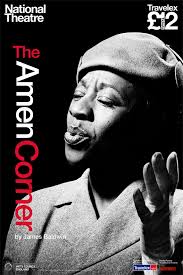
A few weeks ago Owen and I went to Church.  Oh,  and we went to New York.  The difficult part was that we also went back 60 years to 1953.  But the Olivier Theatre has always served me well as a time machine.  It was all so we could witness the goings on at a storefront church which is where James Baldwin's THE AMEN CORNER takes place. 

Baldwin had grown up in the abusive home of his preacher stepfather.  He became a preacher himself at the age of 14 until three years later when he became disenchanted with religious life, around the time he also discovered his gay sexuality.  At the age of 29, after living in Paris, he wrote GO TELL IT ON THE MOUNTAIN, a semi-autobiographical first novel set in the Pentecostal community but, still not exorcised, the following year he wrote his first play THE AMEN CORNER.

The play is a rarity in that it features four excellent larger-than-life female characters who power the play alongside three lesser male roles.  Rather shockingly, the play has only had one Broadway production, a two month run in 1965.  In London it had a notable premiere in 1987 at the Tricycle Theatre which transferred to the West End and now it is being presented in the largest auditorium at the National Theatre.

 
Margaret Alexander is a self-made woman, a woman who has raised her son David single-handed and become the preacher at a small storefront church while she, her son and her devoted sister Odessa all live in the small apartment on the premises.  Although she is deeply loved by her congregation they are also cowed by her God-fearing teaching and way of life which means that she is immovable in her fierce belief that God's is the only way.
 
For example, Brother Boxer comes to Margaret and says that he has been offered a job driving a beer truck which will earn him more money.  But no, Margaret rules from on high that to take the job would be Godless as it's propagating the sale of the demon drink.  The best the aggrieved parishioners can hope for is that the more easy-going Odessa will try to convince her hard-line sister.
 
 
But in true Greek Drama style, just as Margaret is achieving great things in hooking up with a bigger church in a different state, her life is rocked when her dissolute husband Luke appears from out of her past.  Luke is in a very bad physical state and cannot be moved so it allows David to finally get to know his musician father, just as he is feeling the pull away from the church to jazz clubs.
 
While this is taking place downstairs, Margaret is facing growing dissent in the church as questions are being asked, such as where the new fridge came from in her kitchen just after the parishioners had financed her trip to the affiliated church.  This Crimplene & big hat rebellion is led by sweet-talking, steel-eyed Sister Moore who is given extra fuel when Luke tells everyone that the truth is that Margaret left him, he never left her.
 
 
Baldwin certainly created interesting characters who hold your attention and are bold, decisive figures.  Sadly his dialogue doesn't match up to these characters and his scenes can sometimes go over the same ground too many times which can be a little wearying especially if it is between just two characters.  The pay-off is also rather obvious and the denouement, after all the plotting that has gone before, seems oddly rushed.
 
Rufus Norris has directed the play well with the action motoring along despite the treading-water quality to some of Baldwin's two-hander scenes.  I was surprised when it was announced that the production was going into the Olivier as the play would fit perfectly into the 'normality' of the Lyttleton but actually I applaud that choice as I suspect within the proscenium arch the whole enterprise would have felt stifled.  Ian MacNeil's set design angles the action so it is close to the audience and it certainly helps open the play out from what could be quite a claustrophobic piece.
 
What Norris has also done is elicited excellent performances from his cast of fine performers.  As I said earlier, Baldwin has written four stonking roles for women and here they are grabbed with huge gusto by four formidable performers.
 
 
Marianne Jean-Baptiste has lived and worked in Los Angeles since 2002 after finding little progression in the roles offered to her here after being the first black Briton nominated for an Academy Award in SECRETS AND LIES.  Her performance as the righteous Margaret shows us all how much we have been missing. 
 
It's a very hard role: although loving to her family, Margaret is a brick wall who will not be breached.  It is hard to feel sympathy for the character but at the end - when Margaret realises that love is the way to true spirituality - it is important that the actress can touch you and this is exactly what Jean-Baptiste achieved.  Throughout the second act you could almost see her carapace being chipped away piece by piece until, confronted by the collapse of all her dreams, she is left alone but more at peace.  It's a rare actress that can hold an audience's sympathy off until she needs to let it be released but Marianne Jean-Baptiste managed it with a consummate ease.  It's a crime that she was not given the opportunities before.
 
 
As Margaret's more forgiving but equally loyal sister Odessa, Sharon D. Clarke was a revelation too.  I am used to seeing her in musical roles but here she gave us a portrait of a woman who has put her on life on hold to support her more ambitious sister and her nephew.  Another actress who I have also only usually seen in featured musical roles is Jacqui Boatswain who here gave a delightfully slippery performance as Sister Boxer, smarting from Margaret's refusing her husband to take a well-paid job and biding her time until she could help bring her down. 
 
But despite these excellent performances, there was yet one more performer who not only stole every scene she was in but also went through all of our pockets and took the bulbs out of the lights too.  Cecilia Noble was just astonishing as Sister Moore, a baby-voiced Judas and an outsized Brutus, dissembling sweetly while she orchestrated Margaret's downfall only to let the mask fall at the end with a hollered "Victory!" as she moves to centre-stage.  It was an audaciously funny but truthful performance that lingered long in the memory.
 
 
I would also like to mention Naana Agyei-Ampadu as Ida, a nervous young woman who comes to Margaret for help over her sick child in the first act only to appear again in the second act - just as Margaret is starting to doubt her own rigid beliefs - in a state of suicidal distress now her child is dead.  It was a performance that had to go from 0 to 100 in as many minutes and she handled it with a raw power.
 
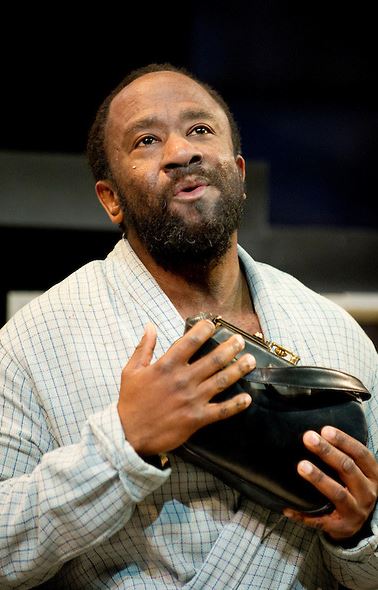
The three men's roles really are just supporting parts but I enjoyed Donovan F. Blackwood as the boisterous Brother Boxer, Eric Kofi Abrefa as the conflicted son David and Lucian Msamati was a shaky livewire as the dying ex-husband Luke.  Among the supporting cast, augmented with members of London Community Gospel Choir, who raised the Olivier roof with their Church singing were Delroy Atkinson (from Ray Davies' musical COME DANCING) and Miquel Brown (Hi-NRG Queen and Sinitta's mum!)