Showing posts with label Simon Green. Show all posts

Wednesday, February 19, 2014

Union Man...

Back in the 1990s and into the 2000s I used to frequent the Bridewell Theatre off Fleet Street.  It was a converted theatre space as it used to be a swimming pool and laundry yet!  To be honest no one ever went to the Bridewell to see great performances - I certainly saw some good ones but they were always a delightful surprise.  No, what one went to the Bridewell to see were productions of musicals that were too expensive and/or risky to ever appear in the West End.  The Bridewell closed to these productions in 2005.

I thought of the Bridewell last night on my way home from the Union Theatre as it seems to have taken it's place.  In almost as many weeks I have now seen two productions there and again both shows were ones that you would have to wait a long time to see in the West End.

 
The first show we saw there this year was the "Song By Song By Kander & Ebb" show THE WORLD GOES 'ROUND, the perfect show for a Sunday afternoon.
 
The show originated in 1991 when director Scott Ellis, choreographer Susan Stroman and librettist David Thompson (who would all later collaborate on the Kander & Ebb show STEEL PIER) put together the show to run off-Broadway where it won several awards but it never moved either to Broadway or London as by the next year the duo had their new show KISS OF THE SPIDER WOMAN staged.  The bizarre thing is that what we saw in 2014 was the 1991 show despite the fact they have since written STEEL PIER, THE VISIT, CURTAINS and THE SCOTTSBORO BOYS.  I think it would have been wiser to do a new show that could take in songs from these later productions.
 
So, once more into the CABARET and CHICAGO songbooks, dear friends, once more... The Union's set-up makes for a convoluted journey to your seat.  It is another 'reclaimed' space - once a paper warehouse - so after walking through it's narrow café (they call it a café, it's more like a passage with shelves on either side) you go into the bar at the back where you are given your numbered laminated tickets. They call numbers out in batches of ten so you can take your seats and give them back their laminated tickets!  I wonder - as I always do - why they can't just number their seats?  There was nearly a Queeny fight the afternoon we went to see the Kander & Ebb show over a disputed seat.  Oh and a handy tip... pee before you go otherwise you have to use the barnacled urinal.
 
 
But despite that Mrs. Lincoln, what did you think of the show?  Hey what's not to love?  They are lovely songs and they were sung by a good cast - Susan Fay, Simon Green, Gareth Snook, Lisa Stokke and Emma Francis.  There was also a supporting company of five dancers (aka possible understudies) who clumped around the concrete floor charmingly.  The leads all had their moments to shine and were clapped enthusiastically by us, the small but happy audience.
 
Kirk Jameson directed and designed the show (it couldn't have taken long as it was only 5 chairs and some mirrors) and Sam Spencer Lane was responsible for the moves.  Enjoyable but it wasn't a patch on HOW LUCKY CAN YOU GET! which was a Kander & Ebb compilation which played at the Donmar (before it became "The Donmar") in 1988 with the astonishing cast of Diane Langton, Josephine Blake, Angela Richards and the late Martin Smith.  The set list was roughly the same but damn it was one to remember.
 
 
Which brings me to the problem I have with most shows these days, where are the real musical comedy performers who can elevate a show from adequate to memorable?  Most shows these days usually feel like you are watching an understudy call - and yes, I'm talking West End too.
 
Show after show seems to be cast from an endless pool of tour choruses, understudies and cruise ship dancers.  Not a bad thing if these can then be built on but the level stays the same - acres of anonymous performers who can smile and nod but who are incapable of throwing shade on a characterisation.  So, on to FINIAN'S RAINBOW...
 
 
All though it's a well-known name I suspect that's due to the lame film version, it's certainly not down to production history, the Union Theatre's production is it's first in London since 1947 - and that one only lasted 22 performances!!
 
The original book has been rewritten by Charlotte Moore who is the artistic director of the USA's Irish Repertory Theatre who revived it ten years ago.  The whimsy-fuelled story centred on Finian, an Irish immigrant, and his daughter Sharon arriving in the imagined state of Missitucky - although a major part of the plot is about living near Kentucky's Fort Knox.  Finian wants to bury a crock of gold near Fort Knox so it will grow (I know, I know) but is unaware that Og, the leprechaun he stole it from, is on his trail.  Sharon falls in love with a local lad but the community is being threatened by a racist senator who wants to buy up their land.
 
 
Plenty there to rewrite I agree but what is the actual reason?  Because Sharon makes a wish that the senator would understand what it's like to be hated while accidently holding the magic crock which grants wishes and the Senator turns black.  The original - and well-meaning - book-writers meant for this to show the Senator exactly what it's like to be poor and black - but no, it is now taken to mean that to be black is to be 'wrong'. 
 
So political correctness decrees the character now disappears only to turn up as a poor white man!  So no, don't rewrite the Leprechaun character, don't rewrite the idea that burying gold will make it grow out of the ground - don't even rewrite the profoundly irritating character of the ingénue who can't speak but dances her answers!
 
 
So as has happened so often before, we have an under-par book supporting a delightful score.  In an odd turn of events, the three break-out numbers from the score - "How Are Things In Glocca Morra?", "Look To The Rainbow", "Old Devil Moon" - follow one another at the start of the show and are of such a high quality that it's hard for the score to keep up that standard but it constantly surprises and enchants.  It's no wonder that Sondheim is a fan of E.Y. 'Yip' Harburg, his lyrics are always on the money and genuinely inspired - the second act opener "When The Idle Poor Become The Idle Rich" is great fun.
 
There are nice performances from James Horne as 'Finian', Christina Bennington as 'Sharon', Raymond Walsh as 'Og' and Joseph Peters as 'Woody' but the playing area is too cramped to fully contain the cast of 23 so it gives an uneven feeling when they all cram in together and start bellowing at the three rows of humble punters.  Believe me, there is nowhere to hide - apropos my earlier point, although the chorus all gave energetic and 'up' performances there wasn't much variation to their playing and in such a confined space their "teeth, tits and tonsils" approach was quite claustrophobic.
 
 
I guess if it's the fault of director Phil Willmott it's because he's such a fan of the show. So, despite all my ruminations, the bottom line is you are not going to see FINIAN'S RAINBOW on any West End stage anytime soon and for the score alone - and the named performers above - I suggest you get along to the Union Theatre where it is playing until 15th March.
 
I guess - to paraphrase Og's second act number - when I'm not near the show I love, I love the show I'm near.

Tuesday, August 27, 2013

TITANIC finally docks in London

A week or so ago I blogged about the pros and cons of seeing large-scale musicals revised to be staged in smaller venues.  Well you can't get bigger and/or smaller than the Maury Yeston musical TITANIC at the Southwark Playhouse.


I had never been to the Southwark Playhouse before.  It has a seating capacity of 240 and is designed so you enter through quite a large bar, get funnelled down a corridor then into the auditorium.  Sound ok?  Not on one of the hottest days of the year when the queue to get into the auditorium to nab one of the un-numbered seats joined the scrum in the bar and all the time the temperature went up or was that just my blood boiling at the sheer ineptness of fringe theatres to get a house in?  If you don't want to piss off your audience NUMBER YOUR BLOODY SEATS.  The Menier Chocolate Factory started off like that but has now entered civilization so come on!  Is there to be *no* progress?

Added to that tsouris we had the always fresh hell of the musical theatre drama students shrieking their heads off at each other allied to the seething hiss of the aged show queen.  I wouldn't put it past them to say they knew the band on the ill-fated ship.

 
Although this was the first time I had seen the show performed I have always been a huge fan of Maury Yeston's score thanks to the 1997 Broadway cast recording.  The derision that greeted the news of a Titanic musical lasted up to it's opening in April with mostly negative reviews but the show found an audience and lasted for nearly two years - indeed, although James Cameron's film opened in December 1997, it actually helped increase the show's attendance rather than the reverse as had been suggested.  At award time, the show's director and cast were all ignored but it won each of the five Tony Awards it was nominated for including Peter Stone's book, Yeston's score and the big one, Best Musical. 
 
By far the best component of the show is Yeston's score which takes in a wide range of contemporaneous musical styles of 1912: he gives us ragtime trots, Gilbert & Sullivan pastiches, stirring Elgar-esque themes, hymns, folk airs, all filtered through a traditional Broadway score of ballads and up-tempo numbers.  As much as I like Yeston's scores for GRAND HOTEL and NINE, his TITANIC score hits greatness with it's sweep of intimate and epic moments.
 
 
The design for the show was a simple bare floor stage, a moveable metal staircase and a single upper level/balcony which you entered under.  To get to the seats you walked past Greg Castiglioni as Thomas Andrews, the designer of the ill-fated ship, scribbling away at his desk.  Despite this, director Thom Sutherland took the opening song away from him, allocating it instead to Simon Green's J. Bruce Ismay, the owner of the White Star Line who famously not only pressurised the Captain to increase speed but who also survived by jumping into a lifeboat.  This production started with the cast shouting abuse at Ismay who turns to the audience and sings IN EVERY AGE.
 
 
The production boasts a cast of 20 which is remarkable for a production this size, Broadway boasted 37 cast members.  Of course this meant them rushing off as a 3rd class Irish immigrant to emerge minutes later as a 1st class millionaire but it's to the cast's credit that they all still managed to give strong, definable performances.  There were a couple of dodgy ones - Castiglioni's important second act solo MR. ANDREWS' VISION was horribly over-sung - even if he did had to contend with a platform tipping up underneath him (maybe I have explained him not singing the opening number?)  I was also praying for Jonathan David Dudley's Bellboy to drown, preferably five minutes after leaving Southampton.
 
 
But these were more than compensated by the very fine performances which were full of character, more than are given them in Stone's good but rather spare book: Green's Ismay was superbly hissable while James Austen-Murray stood out as the stoker Barrett.  His solo number, setting up the class divisions within the ship, was excellently sung, even if he had to contend with the distracting modern dance interpretations of shovelling coal around him!  His duet THE NIGHT WAS ALIVE with Matthew Crowe's radioman Harold Bride was also a stand-out, it was almost staged as a love song between the two men which certainly added a frisson to the number.
 
 
Celia Graham was very good as 2nd Class passenger Alice Beane, eager to mix with the upper echelons (vocally better than Victoria Clark on the cast recording) and as her disapproving husband Edgar, Oliver Hemsborough delivered a strong character above and beyond what the book provided for him.  James Hume was fine as Etches the 1st Class steward and Siôn Lloyd was in fine voice as Officer Murdoch, although Stone's book propagates the unsubstantiated story that he shot himself as the ship sank which goes against what several credible eyewitnesses said.
 
 
Victoria Serra made a spirited Kate McGowan travelling to America with a hope for the future of herself and her unborn child while Dudley Stevens and Judith Street made the most of their touching ballad STILL, sung as their characters Isador and Ida Strauss prepare for death on the sinking ship rather than be separated.
 
These were the cast members who stood out for me but the ensemble singing was wonderful too on such numbers as GODSPEED TITANIC (a number that always gets my tear ducts going), LADIES MAID, NO MOON, WE'LL MEET TOMORROW and the FINALE.
 
 
Thom Sutherland's direction was very good given the constraints on his production and David Woodhead's design made invention out of necessity.  Howard Hudson's lighting also contributed to the show's overall success.  Although I would have loved to have had Yeston's sweeping score played by a full orchestra - as it was meant to be heard - Mark Aspinall's band of only six did well.  It was also a nice touch for the show to end with the names of those who died in the tragedy scrolling up the stage.  Indeed all the characters in Stone's book are based on real people aboard the ship although he does play God and alter a couple of fates to suit his story.
 
Although the show was running late, we stayed behind as - totally unbeknownst at the time of booking - Maury Yeston was actually there to give a talk with the ever-gushing critic Mark Shenton.  Now answer me this... why have the cast all head-mic'd for the show but not provide even hand-mics for the interview?  Sadly most of what Yeston had to say about the genesis of the show, his other works and his thoughts on musicals in general was *just* audible from where we were sitting - and as I said it's not that big an auditorium.  Again the cluelessness of this theatre just seemed to end up standing on my one good nerve.
 
But I am very happy that I had the opportunity to finally see TITANIC - and in such an inventive production - so as to fully understand how this excellent score serves the show.


Monday, December 19, 2005

Sublime SUNDAY....

On Saturday O and I went to see Stephen Sondheim's SUNDAY IN THE PARK WITH GEORGE at the small Menier Chocolate Factory fringe theatre in Southwark. This most personal of his musicals - dealing with the sacrifices an artist must make to pursue his vision - is a tricky one to pull off. It's hard to engage with the characters of Georges Seurat in the first act and his great-grandson also named George in the second while at the same time the score includes some of the loveliest music Sondheim has written. I remember being disappointed with the 1990 National Theatre's production possibly because I was so familiar with the Broadway recording with the powerhouse performances of Mandy Patinkin and Bernadette Peters. However this production by Sam Buntrock is an utter triumph again proving that the smaller you can do a Sondheim musical the more resonant the piece will be (mind you this isn't always the case, I disliked the cast-playing-instruments SWEENEY TODD earlier this year).

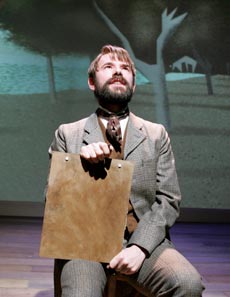
Daniel Evans, who seems to be getting better as he gets older, plays the two Georges very well while Anna Jane Casey is fine as Dot although her singing could do with a bit more heft. There is excellent support namely from Jan Soper as Seurat's mother, Simon Green as Jules, Seurat's more successful artist colleague and Liza Sadovy as Yvonne his wife and secret admirer of Georges. One of my favourite scenes is a small one between Yvonne and Dot in George's studio which is played very well by the two actresses. 


However what makes this production a winner is the excellent design team of David Farley's set and Timothy Bird's digital projection which floods the stage with colour and fluid movement. Used with economy and wit the digital animations are a total delight with nice telling touches such as the actor's one by one leaving the second act tableau of Seurat's "Sunday Afternoon on the Island of La Grande Jatte" as their characters digitally appear in the painting on the museum wall behind them.

I can never deceide which is my favourite Sondheim show - usually it's the one I have just come out of - but SUNDAY IN THE PARK WITH GEORGE lays claim to the one that effects me emotionally. The three songs that end the first act floor me: Dot's WE DO NOT BELONG TOGETHER usually starts me off, Georges and his mother's BEAUTIFUL keeps me sniffing on a low-light and then... the tears just flow during the song SUNDAY. 


One of the most beautiful melodies ever, it's sung softly by the characters in the Seurat's painting as he arranges them into the final tableau that will freeze into "Sunday Afternoon on the Island of La Grande Jatte". It gets me every time... I'm not talking "tear tricking down face" I'm talking shuddering sobs. I cannot explain it.. it just reduces me to an emotional blub at the end of each act.

I loved this production.